A public adjuster Fearrington Village NC homeowners hire works for you — not the insurance company — to document, value, and negotiate your property damage claim. For The Public Adjusters, Inc. is licensed and bonded, and we handle fire, smoke, water, tree, vandalism, and flood claims for homes and businesses throughout Chatham County. Our job is to build the claim your policy actually entitles you to, then push back when the carrier's number falls short.
What This Service Is
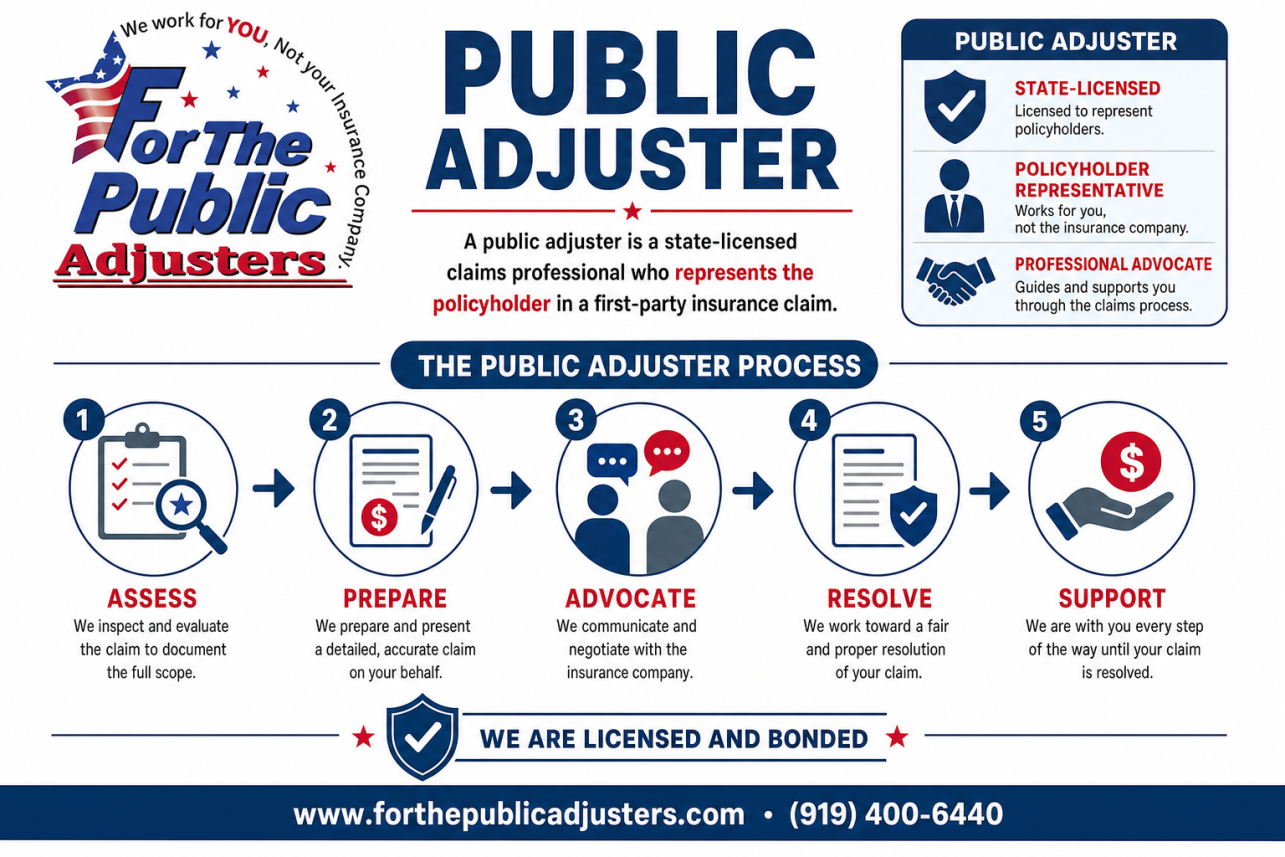
A public adjuster is a state-licensed claims professional who represents the policyholder in a first-party insurance claim. The adjuster the insurance company sends is paid by the carrier; we are the only category of adjuster legally permitted to work exclusively for you.
In practice, that means we read your policy line by line, inspect and photograph the damage, prepare a detailed scope and estimate, and handle the negotiation with the carrier's adjuster. The NCDOI Public Adjusters Guide explains that public adjusters in North Carolina must be licensed by the state, and it is worth confirming that license before you sign with anyone.
For a Fearrington Village homeowner, that typically means claims like a pine or hardwood through the roof, water intrusion after a storm, a kitchen fire with smoke damage spread through the HVAC system, or a burst pipe that soaked hardwoods and cabinetry. We also handle commercial claims for the shops and businesses that serve the village, plus NFIP flood claims, which follow their own federal rules and deadlines.
We work on a contingency basis, so our fee comes from the settlement rather than out of pocket up front. We cannot promise a specific outcome — no honest adjuster can — but we can promise the claim will be fully documented and professionally argued.
Common Problems
Is The Insurance Company's Estimate Really All My Claim Is Worth?
Often it isn't the whole picture. Carrier estimates frequently miss items a trained eye catches: smoke residue inside wall cavities, moisture wicking up drywall behind baseboards, code-required upgrades, matching issues where new materials won't blend with old, and contents losses that were never inventoried.
Courts have sided with policyholders on exactly these disputes. In Windridge of Naperville Condominium Association v. Philadelphia Indemnity Insurance Co., the insured won its argument that the carrier had to replace undamaged siding so the repaired building would match — not just patch the storm-hit sections. That principle matters in a community like Fearrington, where discontinued siding, trim, and roofing materials are common on homes built decades ago.
Our estimates are built from the policy language out, so nothing covered gets left on the table. Then the negotiation starts from your number, not theirs.
My Claim Keeps Stalling — What Do I Do When A Public Adjuster Fearrington Village NC Homeowners Call Gets Involved?
Stalled claims usually stall for a reason: the carrier is waiting on documentation, disputing scope, or hoping the homeowner accepts a low figure out of exhaustion. When we take over, we identify exactly what is holding the file up and answer it in writing.
We respond to document requests promptly, attend the carrier's reinspections, and put every disagreement about scope or pricing into a formal supplement rather than a phone call that goes nowhere. If the carrier's position doesn't hold up against the policy, we say so with photographs, moisture readings, and line-item detail attached.
Most delays break once the insurer sees the claim is professionally managed and documented. You stop chasing your adjuster, and the file stops sitting at the bottom of a stack.
Should I Just Handle The Claim Myself, Or Is Hiring An Adjuster Worth It?
For a small, simple loss, you may be fine on your own. Where policyholders get hurt is on larger or layered claims — a tree strike that also caused water intrusion, a fire with smoke damage three rooms away, or any loss where the first offer feels thin but you can't articulate why.
A good public adjuster earns the fee by finding covered damage you didn't know to claim, pricing repairs at real local rates, and handling deadlines and proof-of-loss requirements that can quietly sink a claim. Judging one is straightforward: verify the North Carolina license, confirm bonding, ask for the fee in writing, and be wary of anyone who guarantees a specific dollar result — that's a promise no ethical adjuster makes.
We're happy to review your situation first. If the claim genuinely doesn't warrant representation, we'll tell you that too.
Our Process
Free Claim Review And Policy Read
We start by reading your actual policy — dwelling limits, contents coverage, ordinance-or-law provisions, additional living expense, and any endorsements or exclusions. Then we walk the damage with you, whether it's a fallen oak on the roofline, water-stained ceilings, or a smoke-damaged kitchen. You'll get a straight assessment of whether the claim justifies our involvement.
Documentation And Independent Estimate
We photograph and measure everything, run moisture and residue testing where needed, inventory damaged contents room by room, and build a line-item repair estimate at current Chatham County pricing. For flood losses, we prepare the file to the National Flood Insurance Program's specific proof-of-loss standards, which are stricter and faster-moving than standard homeowner claims.
Negotiation And Settlement
We present the full claim package to your carrier, meet their adjuster on site, and negotiate each disputed line in writing. Supplements are filed as hidden damage emerges during repairs — common in older wood-framed homes. You approve every decision; we handle the argument. Our fee is a percentage of the recovery, agreed in writing before we start.
| What Happens | Filing on Your Own | With For The Public Adjusters, Inc. |
|---|---|---|
| Damage documentation | You rely on the carrier's adjuster, who works for the insurance company | Independent inspection with moisture mapping, photos, and engineer referrals when needed |
| Estimate accuracy | Carrier estimates often omit matching, code upgrades, and hidden damage | Line-item estimates built to current Chatham County pricing and NC building code |
| Negotiation | You argue with trained claims professionals on your own | A licensed NC adjuster negotiates every supplement and disputed line item for you |
| Underpaid or denied claims | Your options are unclear and deadlines quietly pass | We invoke appraisal, file supplements, and track every policy deadline |
| Your time | Dozens of hours of calls, paperwork, and contractor coordination | We manage the claim so you manage your life |
| Cost | Free, but underpayments routinely exceed thousands of dollars | A percentage of the recovery — no recovery, no fee |
Commonly Overlooked In The Public Adjusting Industry
- Matching requirements for continuous flooring and siding — Carrier adjusters often scope only the damaged boards or panels, ignoring that a patch in a continuous run creates an obvious mismatch the policy may obligate them to fix.
- Ordinance and law (code upgrade) coverage — Older Fearrington-area homes often need current-code electrical, insulation, or framing updates during repairs, and this separate coverage sits unused because nobody claims it.
- The HOA master policy versus HO-6 boundary in townhome claims — Neither insurer volunteers to read the association's governing documents, so unit owners get bounced between two carriers while damage sits unrepaired.
- Moisture migration beyond the visibly wet area — Water travels along subfloors and inside wall cavities, and adjusters who don't take meter readings scope only what their eyes can see.
- Additional living expenses during the repair period — Homeowners assume they must stay in a torn-up house, not realizing the policy typically pays for comparable lodging while the kitchen or bedrooms are unusable.
- Recoverable depreciation left unclaimed — Many policyholders never submit final invoices after repairs, permanently forfeiting the depreciation the carrier withheld from the first check.
- Proof-of-loss and supplement deadlines in the policy — These deadlines run quietly in the background of a stressful claim, and missing one can bar recovery even when the damage is legitimate.
- Fresh versus weathered damage evidence after storms — Waiting weeks to document a tree strike or hail hit lets fracture faces and impact marks weather over, handing the carrier its 'pre-existing damage' argument.
Case Studies
Case Study #1
Situation: A retired couple in a Camden Park townhome came home from a weekend in Asheville to find their water heater had failed, flooding the hardwood floors, lower cabinets, and the shared wall with a neighboring unit.
Problem: Their carrier's initial estimate came in at $9,400 — enough to dry the structure and patch drywall, but nothing for the continuous hardwood flooring that ran through the living area, and no allowance for matching the discontinued cabinet line.
Investigation: We brought in a moisture-mapping specialist and documented saturation readings under the flooring the carrier's adjuster never lifted. We also pulled the townhome association's governing documents to clarify exactly where the HOA's master policy ended and the owners' HO-6 coverage began.
Findings: Moisture had wicked well beyond the visibly damaged boards, and North Carolina's matching considerations meant the continuous flooring couldn't reasonably be patched in one room. The cabinet line had been discontinued in 2019, making a partial repair impossible without a visible mismatch.
Solution: We prepared a line-item estimate covering full flooring replacement across the continuous run, complete lower-cabinet replacement, proper containment and drying protocols, and additional living expenses for the two weeks the kitchen was unusable.
Outcome: The claim settled at $41,700 — more than four times the original offer — and the couple's contractor was able to restore the home without piecemeal patching.
Lesson: In condo and townhome communities like those around Fearrington, the line between master policy and unit-owner coverage decides who pays for what. Reading the governing documents before accepting an estimate is not optional.
Case Study #2
Situation: A homeowner off Millcroft had a mature oak come through the roof during a summer thunderstorm, punching into the attic and cracking rafters over the primary bedroom.
Problem: The insurer paid promptly for the visible roof hole and tarp, but classified the rafter damage as 'pre-existing deflection' and denied the structural portion, leaving the owner facing a five-figure framing bill.
Investigation: We hired an independent structural engineer to inspect the attic framing, photographed fresh fracture faces in the split rafters, and compared the roofline against the homeowner's pre-storm photos and a 2021 home inspection report showing no deflection.
Findings: The fracture surfaces were clean and unweathered — consistent with a single impact event, not gradual sagging. The engineer's report tied every damaged member directly to the point of tree impact.
Solution: We submitted the engineering report with a supplemental claim covering rafter sistering, ridge repair, full slope replacement where shingles could not be matched, and interior ceiling and insulation replacement in the bedroom below.
Outcome: The carrier reversed the structural denial and paid an additional $28,300 on top of the initial roof payment.
Lesson: 'Pre-existing' is one of the most common denial phrases in tree and wind claims. Independent engineering evidence, gathered quickly, is what turns that argument around.
| Your Situation | Handle It Yourself? | What It Depends On |
|---|---|---|
| Small claim under your deductible or just above it | Usually yes | If repair quotes barely exceed your deductible, a fee-based advocate may not add value |
| Water damage with any hidden or spreading moisture | Rarely | Carriers frequently miss saturation under floors and behind walls; underpayments here are routine |
| Roof damage the carrier calls 'cosmetic' or 'wear' | No | That language usually signals a denial in progress — independent documentation changes the outcome |
| Townhome or condo claim involving the HOA master policy | No | Coverage boundaries in governing documents are complex and both insurers may deflect responsibility |
| Claim already denied or paid far below contractor quotes | No | Supplements, engineering reports, and NC appraisal rights can reopen and correct the claim |
| Fire or smoke loss with contents damage | No | Contents inventories, smoke remediation scope, and additional living expenses are consistently underscoped |
| Fallen tree with only fence or landscaping damage | Often yes | Policy limits on trees and fences are usually clear-cut and low, leaving little to negotiate |
| Carrier requesting a recorded statement or examination under oath | No | Anything you say shapes the claim outcome — get representation before you respond |


Reviews
After our pipe burst in the crawl space, State Farm offered us barely enough to replace the subfloor in one room. For The Public Adjusters found moisture damage in three rooms their adjuster never checked and handled every phone call with the carrier. Our final settlement was almost triple the first offer. My husband and I are in our seventies and there is no way we could have fought that battle ourselves.
Margaret H., Fearrington Village
Hail damage to our roof was denied twice as 'cosmetic.' These folks documented every slope, brought their own inspection photos, and invoked appraisal when the carrier wouldn't budge. We ended up with a full roof replacement approved. Worth every penny of the fee — I only wish I'd called them before the first denial instead of after.
Tom R., Chatham County
Our townhome's water claim was a mess because the HOA's insurance and our own policy both pointed fingers at each other. This team sorted out exactly which policy owed what, which nobody at either insurance company would explain to us. Communication was steady throughout — the only reason for four stars instead of five is that the whole process still took about three months, though I understand most of that was the carrier dragging its feet.
Diane K., Fearrington Village
Frequently Asked Questions
What Does A Public Adjuster Fearrington Village NC Homeowners Hire Actually Do For Me?
A public adjuster works exclusively for you, the policyholder — never for the insurance company. When your Fearrington Village home suffers damage from a fallen pine, a burst pipe, hail, or fire, your insurer sends its own adjuster to evaluate the loss. That person's job is to protect the carrier's bottom line. Our job is the opposite.
At For The Public Adjusters, Inc., we start by reviewing your full policy, including endorsements and exclusions most homeowners never read. Then we document the damage ourselves: moisture readings, roof inspections, structural photos, and line-item repair estimates built on real Chatham County contractor pricing, not the insurer's software defaults.
From there, we prepare and file the claim, handle every phone call and email with the carrier, attend all inspections, and negotiate the settlement on your behalf. Many homes in Fearrington Village have custom finishes, mature landscaping, and construction details from the community's original development that generic estimates routinely undervalue. We make sure those specifics are captured in writing.
You stay informed at every step, but you don't have to argue with an insurance company while also managing repairs and daily life. In most cases we handle, the documented and negotiated settlement is meaningfully higher than the carrier's first offer — often enough to change whether a proper repair is even possible. Our fee is a percentage of what we recover, so we only succeed when you do.
When Should I Call A Public Adjuster In Fearrington Village — Before Or After Filing My Claim?
The best time to call is before you file, or as early in the process as possible. What you say in that first call to your insurer, and how the damage is initially documented, shapes the entire claim. We regularly see claims in Chatham County get underpaid or denied because of an offhand phrase in the first notice of loss or a missed deadline buried in the policy.
If you call us first, we inspect the damage, review your coverage, and file the claim correctly from day one. That means proper cause-of-loss language, complete documentation, and a repair scope that reflects what it actually costs to rebuild in the Fearrington Village and Pittsboro area — where skilled trades are in demand and pricing runs higher than statewide software averages suggest.
That said, it is never too late to bring us in. If you've already filed and received a lowball offer, we can reopen negotiations, supplement the claim with new documentation, and pursue amounts the carrier's estimate missed. Even claims that were partially paid or outright denied can often be revisited; North Carolina generally allows time to supplement or dispute a claim, though deadlines vary by policy.
A good rule of thumb: if the damage looks like it will exceed a few thousand dollars, or if anything about the insurer's response feels rushed or dismissive, get a second opinion. Our initial consultation is free, and we'll tell you honestly whether your claim warrants professional representation.
How Much Does It Cost To Hire For The Public Adjusters, Inc., And How Are Fees Structured?
We work on contingency, which means there are no upfront costs, no hourly billing, and no retainer. Our fee is a percentage of the insurance settlement we recover for you, agreed to in writing before we begin. If we don't recover money, you don't owe us a fee.
North Carolina regulates public adjusting, and licensed adjusters must operate under written contracts with disclosed fees. When we meet with you at your home in Fearrington Village, we walk through the agreement line by line so there are no surprises. You'll know exactly what the percentage is and what services it covers before you sign anything.
Homeowners naturally ask whether the fee is worth it. In our experience, the answer usually comes down to documentation. Insurance carriers pay based on what is proven, itemized, and supported. A homeowner negotiating alone rarely has the estimating software, code knowledge, and policy expertise to build that proof. We do, and the difference frequently exceeds our fee many times over — particularly on larger losses involving roof replacement, water mitigation, or structural repair.
There's also the value of your time. A contested claim can involve dozens of calls, multiple inspections, and months of back-and-forth. We absorb all of that. For retirees and busy professionals throughout the Fearrington Village community, handing that burden to a licensed advocate is often reason enough on its own. Ask us for a free claim review and we'll give you a straightforward assessment of whether hiring us makes financial sense for your situation.
What Types Of Property Damage Claims Do You Handle In The Fearrington Village Area?
We handle the full range of residential and commercial property claims common to this part of Chatham County. The most frequent calls we get involve wind and storm damage — the tall loblolly pines that give the area its character are also a leading cause of roof punctures, fence damage, and tree-on-structure losses during summer thunderstorms and the remnants of tropical systems.
Water damage is a close second. Burst supply lines, failed water heaters, HVAC condensate leaks, and slow plumbing failures cause significant hidden damage inside walls and under floors. These claims are frequently underpaid because the visible damage is only a fraction of the real loss. We use moisture mapping and thorough documentation to capture everything, including mold remediation when coverage applies.
We also represent policyholders on fire and smoke claims, lightning strikes, hail damage to roofing and siding, and theft or vandalism losses. For business owners in and around the Fearrington area, we handle commercial property claims and business interruption coverage as well.
As a public adjuster Fearrington Village NC property owners can call for any covered loss, we also review previously settled or denied claims. If you received a payment in the past year or two that didn't come close to covering repairs, bring us the paperwork. Supplemental claims are a significant part of our work, and reopening an underpaid claim is often more successful than homeowners expect. Whatever the damage, the first step is the same: a free inspection and an honest opinion about what your claim is really worth.
My Insurance Company Already Made An Offer — Can A Public Adjuster Fearrington Village NC Residents Trust Still Help Me?
Yes, and this is actually one of the most common situations we handle. Receiving an initial offer does not close your claim, and in North Carolina you generally have the right to dispute a settlement you believe is too low, even after a check has been issued.
When a Fearrington Village homeowner brings us an existing offer, we start with a line-by-line review of the carrier's estimate. We frequently find missing trades, lowballed unit pricing, overlooked code-upgrade costs, and damage the field adjuster never inspected — attic decking after a tree strike, hidden moisture behind plaster, or matching issues with discontinued siding and roofing common on homes built here in the 1980s and 1990s.
From there, we document the full scope with photos, moisture readings, and a detailed independent estimate, then present a supplement or dispute directly to the insurer. Many of our largest recoveries in Chatham County came from claims the homeowner assumed were finished.
One important caveat: do not cash a check marked "full and final settlement" without understanding the language, and do not sign a release before we review it. Most claim payments in North Carolina are not final releases, but it costs nothing to have us confirm that first. Our review of your existing offer is free, and if we don't believe we can recover meaningfully more than the carrier has already paid, we'll tell you honestly rather than take the file.
How Long Does The Claims Process Take When I Hire Your Team In Fearrington Village?
Most residential claims we manage in the Fearrington Village area resolve within 30 to 90 days from the date we take over, though the timeline depends on the size of the loss and how the insurance company responds.
Here's a realistic breakdown. Our initial inspection and documentation typically takes one to two weeks — longer for major losses like a fire or a large tree-through-roof claim, where we may bring in engineers or contractors for scope verification. Once our estimate and demand package go to the carrier, North Carolina regulations require insurers to acknowledge and respond to claims within reasonable timeframes, and we hold them to it.
Straightforward wind, hail, or water claims often settle in a month or two. Larger or disputed losses — significant fire damage, long-term water intrusion, or claims where the carrier initially denied coverage — can run three to six months, occasionally longer if appraisal is invoked.
One thing many Chatham County homeowners don't realize: hiring us usually shortens the timeline, not lengthens it. Delays typically come from incomplete documentation, back-and-forth over scope, and homeowners not knowing what the adjuster needs next. Because we hand the carrier a complete, professionally documented file up front, there's far less reason for the claim to stall.
We also keep you updated at every stage, so you're never wondering where things stand. If a deadline passes without carrier action, we escalate immediately — in writing — rather than waiting politely for a callback that never comes.
Are You Licensed To Handle Claims In Chatham County, And How Do I Verify That?
Yes. For The Public Adjusters, Inc. is licensed by the North Carolina Department of Insurance, which is required by law for anyone negotiating an insurance claim on a policyholder's behalf in this state. Our license covers all of North Carolina, including Chatham County, Fearrington Village, Pittsboro, and the surrounding communities.
Verifying a license takes about two minutes and we encourage every homeowner to do it before signing with anyone. Visit the NC Department of Insurance website and use the agent and adjuster license lookup tool, or call the Department directly. You can search by the individual adjuster's name or the company name and confirm the license is active and in good standing.
Be cautious of anyone who resists this question. After major storms roll through the Triangle area, out-of-state operators and unlicensed "claim consultants" sometimes canvass neighborhoods like Fearrington Village door to door. In North Carolina, contractors are also prohibited from negotiating your claim with the insurer — that crosses into adjusting, which requires a license. A roofer can repair your roof, but only a licensed adjuster or attorney can legally advocate on the claim itself.
Beyond the license, we carry errors and omissions insurance and work under a written contract that spells out our fee, both of which North Carolina law requires. When we meet with you, we'll show you our credentials before we ever ask for a signature, and we'll walk you through the contract line by line so there are no surprises.
Will Hiring A Public Adjuster In Fearrington Village Make My Insurance Company Treat Me Differently Or Cancel My Policy?
No. Hiring representation is your legal right as a policyholder in North Carolina, and insurers deal with public adjusters every day. Your carrier cannot cancel or non-renew your policy simply because you chose professional help with a claim — that would violate state insurance regulations, and it's a complaint the Department of Insurance takes seriously.
What actually changes is the tone of the process. Once a licensed public adjuster Fearrington Village NC homeowners have retained enters the claim, the carrier knows the file will be professionally documented and every estimate will be scrutinized. In our experience, that tends to make adjusters more careful and more responsive, not adversarial. Lowball tactics that work on unrepresented homeowners simply don't hold up against a detailed, code-compliant estimate.
Some homeowners worry that pushing back on a settlement will label them a "problem customer." Claims are evaluated on documentation and policy language, not personality. Recovering the full amount your policy owes for a legitimate loss is not fraud, inflation, or bad faith on your part — it's the entire reason you've paid premiums.
The one thing that genuinely affects future premiums is the claim itself, which exists whether or not you hire us. Filing a claim and then settling for less than you're owed gives you the worst of both worlds: the claim on your record and a repair bill you're covering out of pocket. If you're going to have a claim in your history, it should at least pay for the full repair.
What's The Difference Between A Public Adjuster Fearrington Village NC Policyholders Hire And The Adjuster My Insurance Company Sends?
The adjuster your insurance company sends works for the carrier. Their job is to evaluate your claim within the company's guidelines, and their loyalty is to their employer — not to you. That doesn't make them dishonest, but it does mean nobody in that process is advocating for your full recovery.
A public adjuster works exclusively for you, the policyholder. When For The Public Adjusters, Inc. takes on a claim in Fearrington Village, we conduct our own independent inspection, prepare our own detailed estimate, and negotiate directly with the carrier on your behalf. We answer to you and no one else.
The practical difference shows up in the details. Carrier adjusters often handle dozens of files at once and may spend twenty minutes at your property. We document everything — hidden moisture behind walls, code-upgrade requirements Chatham County enforces, matching issues with discontinued siding or roofing — items that routinely get missed or minimized in a quick walkthrough.
It's also worth noting we're not contractors. A roofer or restoration company can estimate repairs, but they cannot legally negotiate your insurance claim in North Carolina. Only a licensed public adjuster can represent you in that negotiation. Many Fearrington Village homeowners use both: a trusted contractor for the repairs, and our team to make sure the settlement actually covers what those repairs cost.
My Claim Was Denied Outright — Is It Too Late To Bring In Your Team?
No, a denial is not the end of the road, and in many cases it's exactly when a Fearrington Village public adjuster earns their keep. Insurance denials are frequently based on incomplete inspections, misapplied policy language, or causation arguments that don't hold up under scrutiny.
The first thing we do is review your denial letter alongside your full policy — including endorsements most homeowners have never read. Carriers sometimes deny water or storm claims by citing exclusions like "wear and tear" or "long-term seepage" when the actual cause was a sudden, covered event. Proving that distinction requires documentation, and that's our specialty.
Next, we conduct our own inspection of your property. Around Fearrington Village, we often find evidence the original adjuster missed: wind-lifted shingles that aren't visible from the ground, moisture readings inside wall cavities, or hail bruising on roofing that only shows up on close examination. We photograph, measure, and document everything.
From there, we prepare a formal supplement or dispute package and push the carrier to reopen and re-evaluate the claim. North Carolina policies also generally allow the appraisal process as a dispute-resolution tool, and we can guide you through invoking it when negotiation stalls.
One caution: don't wait too long. Policies have deadlines for disputing decisions and filing suit, so the sooner you get us involved after a denial, the more options we have to work with.
Fearrington Village Has A Lot Of Homes Built In The 1980s And 1990s — Does The Age Of My House Affect My Claim?
It absolutely can, and it's one of the reasons local knowledge matters. Much of Fearrington Village was built out in the 1980s and 1990s, and homes from that era present specific claim issues that carriers often use to reduce settlements.
The biggest one is matching. If a storm damages part of your roof or siding, the original materials may be discontinued. Your carrier might offer to patch a slope or replace a few boards, leaving you with a visibly mismatched exterior. North Carolina claims practice and many policy provisions support arguments for broader replacement to achieve a reasonably uniform appearance — but you have to know how to make that argument, and we do.
Code upgrades are another factor. When repairs trigger current Chatham County building-code requirements — updated electrical, decking, ventilation, or fastening standards that didn't exist when your home was built — those costs should be covered if your policy includes ordinance-or-law coverage. Carriers frequently omit these items unless someone pushes back with specifics.
Depreciation is the third issue. Adjusters sometimes apply aggressive depreciation to older components, shrinking your initial payment. We scrutinize those calculations and fight for accurate valuations, and we help you recover withheld depreciation once repairs are complete.
An older home isn't a weaker claim. It's a claim with more moving parts, and our job is to make sure every one of them is accounted for in your settlement.
What Should I Do To Protect My Claim Before Your First Visit To My Home?
A few simple steps in the first days after damage can meaningfully strengthen your position, whether the loss is from a storm coming through Chatham County, a burst pipe, or a fire.
First, document everything before touching anything. Take wide photos of each affected room or roof area, then close-ups of specific damage. Video walkthroughs are excellent too. If water is involved, photograph the source before any cleanup begins.
Second, prevent further damage — your policy actually requires it. Tarp a damaged roof, shut off water to a leaking line, or board a broken window. Keep every receipt for tarps, fans, or emergency services, because those mitigation costs are typically reimbursable.
Third, hold onto damaged items. Don't throw out ruined furniture, flooring, or personal belongings until they've been documented and, ideally, until we or the carrier's adjuster have seen them. Discarded evidence is one of the most common reasons contents claims get shortchanged.
Fourth, be careful with recorded statements. You're required to report the loss, but you're not required to speculate about causes or timelines on a recorded call. Stick to facts and keep it brief.
Finally, gather your policy documents, any prior inspection or repair records, and notes on when you first noticed the damage. When For The Public Adjusters, Inc. arrives, we'll build on that foundation with our own detailed inspection — but as any experienced public adjuster Fearrington Village NC homeowners have worked with will tell you, early documentation is the raw material of a strong settlement.
Fearrington Village Has Covenants And Architectural Guidelines — How Does A Public Adjuster Fearrington Village NC Homeowners Hire Account For Those In A Claim?
This is one of the most overlooked issues in local claims, and it can cost you real money if it's ignored. Fearrington Village homes are subject to community covenants and architectural standards that govern things like siding materials, roofing color and style, fencing, and exterior finishes. When your home is damaged, you can't simply repair it with the cheapest available materials — repairs generally need to match community requirements.
Insurance carriers often write estimates using generic, lowest-cost materials that would never pass architectural review here. That gap between what the carrier offers and what the community actually requires is money you'd otherwise pay out of pocket.
Our team documents those requirements as part of the claim itself. Most homeowner policies include ordinance or law coverage and require the carrier to pay for like-kind-and-quality repairs, which means matching what existed before the loss. We build the estimate around materials and specifications that satisfy both your policy and the community's standards, then support that estimate with documentation the carrier has to respond to.
We also coordinate timing. If a repair needs approval before work begins, we make sure the claim settlement isn't finalized around an estimate that the review process would later force you to change. For Fearrington homeowners, that attention to community-specific detail is often the difference between a settlement that fully restores the home and one that leaves a shortfall.
What Is Recoverable Depreciation, And How Do You Make Sure I Actually Collect It?
Recoverable depreciation is one of the most commonly forfeited pieces of a homeowner's settlement, and it deserves a clear explanation. Most policies in Chatham County are replacement cost policies. When the carrier settles your claim, it first pays the actual cash value — the replacement cost minus depreciation for age and wear. The depreciation withheld is 'recoverable,' meaning you're entitled to it once repairs are completed and documented.
Here's where homeowners lose money. Carriers set deadlines for completing repairs and submitting proof, often 180 days to a year. Miss the deadline, submit incomplete invoices, or complete repairs that don't match the approved scope, and the carrier may refuse to release those funds. On a significant roof or water loss in a Fearrington-area home, withheld depreciation can run into five figures.
When we handle your claim, we track every dollar of depreciation the carrier withholds and map it against the repair scope. As work is completed, we compile contractor invoices, photos, and certificates of completion, then submit the recoverable depreciation demand in the format the carrier requires. If the carrier under-releases — which happens more than you'd expect — we reconcile the numbers line by line and pursue the difference.
We also watch for improperly depreciated items. Carriers sometimes depreciate labor or apply depreciation percentages that don't reflect the actual condition of your materials. Correcting those errors before settlement raises both the upfront payment and the amount you recover at the end.
I Found More Damage After My Claim Was Settled — Can You Reopen It With A Supplemental Claim?
Yes, in most cases we can, and this situation comes up regularly. A settled claim is not necessarily a closed door. In North Carolina, if additional damage related to the original loss is discovered — hidden water damage behind drywall, decking rot found when a roof is opened up, or a scope the first estimate simply missed — a supplemental claim can be filed with the same carrier under the same loss.
Timing matters, though. Policies and state law impose deadlines, typically measured from the date of loss, so the sooner you call after discovering the additional damage, the stronger your position. Don't let a contractor cover up newly discovered damage before it's documented.
When a public adjuster Fearrington Village NC property owners bring in for a supplemental claim gets involved, the first step is a fresh inspection. We compare what the carrier originally paid against what the repairs actually revealed, photograph and measure everything, and prepare a supplemental estimate that ties the new damage back to the original covered event. That connection is critical — the carrier will look for any reason to call it a separate, unrelated, or excluded loss.
We then handle the resubmission, the carrier's reinspection, and the negotiation. Homes in this community often have layered construction details — crawl spaces, wood siding, mature landscaping close to the structure — where hidden damage is easy to miss on a first pass. If your repairs uncovered more than the settlement covered, it's worth a call before you pay the difference yourself.

Fearrington Village Is Surrounded By Mature Hardwoods And Pines — How Do You Handle Tree And Storm Damage Claims Here?
Tree-related losses are among the most frequent claims we see in this part of Chatham County. The mature oaks, poplars, and loblolly pines that make the village so attractive also make wind and ice storms genuinely dangerous for roofs, gutters, screened porches, and fences.
These claims involve more moving parts than most homeowners expect. There's the structural damage itself, tree removal costs, debris hauling, and often hidden impact damage — cracked rafters, punctured decking, or shifted framing that isn't visible from the ground. Carriers frequently pay for the obvious hole in the roof while missing the structural damage radiating out from the impact point.
Our inspections go beyond the visible strike zone. We check attic framing, look for stress cracks in interior drywall, and evaluate whether the roof system as a whole was compromised. We also document policy sublimits correctly — many policies cap tree removal per tree and per occurrence, and carriers sometimes apply those caps incorrectly or fail to pay removal when the tree damaged a covered structure.
One local wrinkle worth knowing: when a neighbor's tree falls on your home, your own policy typically responds first, and questions of negligence come later. We sort out that documentation so you're not stuck in a standoff between two carriers.
After a major wind or ice event, we recommend photographing everything before cleanup begins, keeping every tree-service invoice, and calling us before accepting the carrier's first roof estimate. Storm-surge pricing on materials and labor in the Triangle area often outpaces what initial estimates allow.
Local Relevance
Fearrington Village sits among mature pines and hardwoods on former farmland in Chatham County, and that tree canopy is both the community's charm and its most common claim source. Summer thunderstorms, remnants of tropical systems moving inland, and the occasional winter ice storm bring trees and heavy limbs down onto roofs, porches, and garages — often with water intrusion following close behind.
Much of the village's housing dates to the 1980s and 1990s, so claims here regularly involve discontinued roofing, siding, and interior finishes. That raises matching and code-upgrade questions that carriers frequently underpay unless someone presses the policy language.
Because the area is inland, wind claims we see here typically stem from tornadoes or the leftover force of hurricanes tracking up from the coast rather than routine gusts. For low-lying lots near creeks and ponds, flood coverage is a separate policy entirely — the Federal Emergency Management Agency oversees that program, and its claims follow federal deadlines that catch many homeowners off guard.
We serve the village and the surrounding Pittsboro and Chapel Hill corridor, so inspections happen quickly and our repair pricing reflects what local contractors actually charge.
Many Fearrington-area homes were built in the 1980s and 1990s beneath what are now fully mature trees, so a single storm strike often produces two intertwined claims — structural tree damage plus the water intrusion that follows — and carriers tend to underpay the second unless it's documented within days of the loss.
Tree Through The Roof? Water Where It Shouldn't Be? Talk To Us First.
Before you accept the carrier's number, let For The Public Adjusters, Inc. review your policy and your damage at no cost. We're licensed and bonded, we work only for policyholders, and we know how Chatham County claims get underpaid — and how to answer it.
Call us: (919) 400-6440
Helpful Resources
- NCDOI Public Adjusters Guide
- Federal Emergency Management Agency (FEMA)
- NCDOI Public Adjusters Guide — North Carolina's consumer guidance on public adjusters and insurance claims
- FEMA flood insurance information — Official federal resource on flood coverage and NFIP claims
Our services in this city
Service pages for this city are coming soon.
Last updated: August 3, 2026