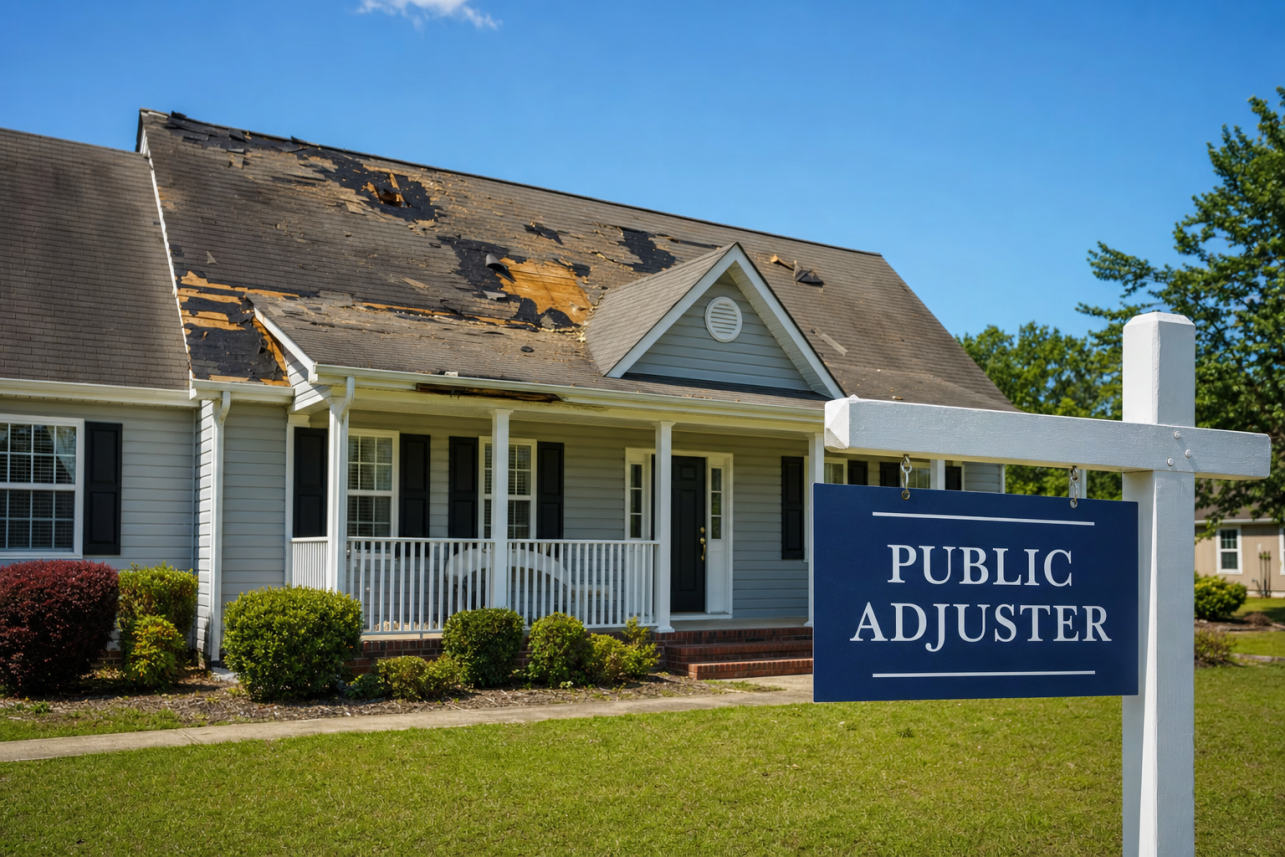
A public adjuster Rougemont NC homeowners can call after a fire, burst pipe, fallen tree, or flood works only for the policyholder — never the insurance company. For The Public Adjusters, Inc. is licensed and bonded, and we handle the documentation, valuation, and negotiation of your property claim from start to finish. Instead of accepting the insurance carrier's first number, you get an independent professional building the case for what your loss is actually worth.
What This Service Is
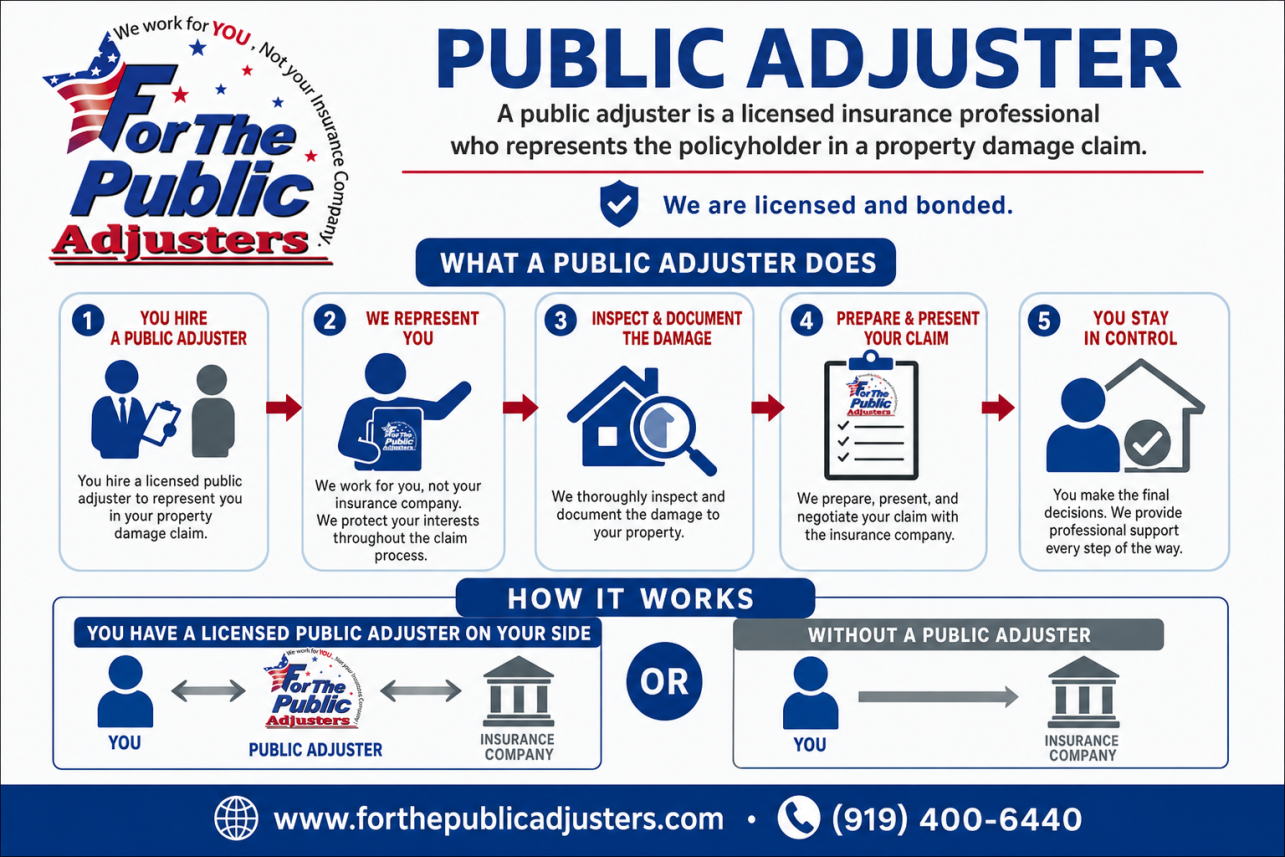
A public adjuster is a licensed insurance professional who represents the policyholder in a property damage claim. Your insurance company sends its own adjuster to evaluate your loss, and that person answers to the carrier. We do the opposite job: we inventory your damaged structure and contents, read your policy line by line, prepare a detailed estimate, and negotiate directly with the insurer on your behalf.
In Rougemont and the surrounding parts of Durham County, we handle fire and smoke damage claims, water damage from plumbing and roof failures, tree damage claims, vandalism and arson losses, car-hits-home incidents, and flood claims including those filed through the National Flood Insurance Program. We work residential homeowners claims and commercial business claims alike.
The North Carolina Department of Insurance regulates this profession, and its NCDOI Public Adjusters Guide explains exactly what a licensed adjuster may and may not do for policyholders — worth reading before you hire anyone. We do not handle claims involving cell phones, motor vehicles, health, or life insurance; our work is buildings, structures, and the contents inside them.
Common Problems
What Does A Public Adjuster Rougemont NC Homeowners Hire Actually Cost?
We work on a contingency fee — a percentage of the claim settlement, agreed to in writing before we start. There is no hourly billing and no upfront charge, so our compensation only comes from what the claim actually pays.
The reason policyholders hire us anyway is simple: carrier estimates frequently miss items like code-required upgrades, smoke residue inside wall cavities, matching materials, or the full contents inventory. We cannot guarantee any particular outcome, but a professionally documented claim is a fundamentally different negotiation than a homeowner's photo album and a hope.
My Claim Was Underpaid, Delayed, Or Denied — What Now?
This is the most common call we get from northern Durham County. A tree crushes a roof, the carrier pays for a patch instead of a proper repair, and the homeowner is stuck. Or a kitchen fire claim drags for months while the family lives in limbo.
Courts have repeatedly sided with policyholders in these disputes. In Cedar Bluff Townhome Condominium Association v. American Family Mutual Insurance Co., the Minnesota Supreme Court ruled in 2014 that the insurer had to replace all of the buildings' siding — not just the storm-damaged panels — so the repair would reasonably match. A denial or lowball offer is a position, not a verdict, and it can be challenged with better documentation and policy knowledge.
Should I Just Handle The Claim Myself, Or Is Hiring Someone Worth It?
For a small, straightforward loss, you may not need us — and we will tell you that honestly. For a significant fire, water, smoke, or flood loss, the gap between what a policyholder can document and what a trained adjuster can document tends to be substantial.
When you evaluate any adjuster, verify three things: an active North Carolina license, a bond, and a written contract that spells out the fee. For The Public Adjusters, Inc. is licensed and bonded, and we put everything in writing. Be wary of anyone who shows up uninvited after a disaster promising a specific dollar figure — no ethical adjuster guarantees results.
Our Process
Free Claim Review And Policy Analysis
We start by inspecting the damage and reading your actual policy — declarations, endorsements, and exclusions. Many Rougemont homeowners are surprised by what their coverage includes once someone reads the full document, from debris removal to additional living expenses while repairs happen.
Documentation And Valuation
We photograph and measure the loss, inventory damaged contents room by room, and build a line-item estimate using professional valuation tools. For fire and smoke losses this includes hidden damage like odor absorption and soot migration; for water losses, moisture mapping and secondary damage to framing and finishes.
Negotiation And Settlement
We present the claim to your insurance carrier, meet its adjuster on site, and respond to every pushback with documentation. You approve any settlement before it is final. Our goal is a payment that reflects the true scope of the loss under your policy — nothing invented, nothing left off.
| What Happens During the Claim | Handling It Yourself | With For The Public Adjusters |
|---|---|---|
| Damage documentation | Phone photos of what you can see; hidden moisture and smoke residue usually missed | Thermal imaging, moisture mapping, hygienist testing, and full photo logs before anything gets torn out |
| Estimate of repairs | You rely on the carrier's numbers or a contractor's rough bid | Line-by-line estimate written in the same software carriers use, including code upgrades and matching |
| Policy interpretation | Exclusions and sub-limits often accepted at face value | Every coverage, endorsement, and NC-specific provision applied in your favor |
| Negotiation | One homeowner against a trained claims department | A licensed advocate who negotiates carrier tactics daily and can invoke appraisal when needed |
| Time cost | Dozens of hours of calls, paperwork, and re-inspections | We manage the file; you approve decisions and get back to your life |
| Typical result | First offers frequently cover only visible damage | Documented claims routinely settle for multiples of the initial offer |
Commonly Overlooked In The Public Adjusting Industry
- Recoverable depreciation left unclaimed — Homeowners cash the actual-cash-value check and never realize the policy owes them the depreciation back once repairs are completed.
- Ordinance and law coverage for code upgrades — Carrier estimates price rebuilding to the old code, even though older Durham County homes almost always need electrical, structural, or egress updates the policy covers.
- Matching of undamaged materials — Adjusters pay to patch one roof slope or one wall of siding, ignoring that discontinued products can entitle you to replacement of the whole visible section.
- Moisture trapped in wall cavities and insulation — A quick visual inspection can't detect saturation behind drywall, so the scope gets written before anyone knows how far the water traveled.
- HVAC and duct contamination after smoke or water losses — Ductwork is out of sight, so soot residue and microbial growth inside the system rarely make it into the carrier's estimate.
- Additional living expenses beyond the hotel bill — Policyholders don't know ALE also covers increased mileage, pet boarding, laundry, and meal cost differences while displaced from a rural property.
- Contents priced at replacement cost, not garage-sale value — Carriers depreciate belongings aggressively, and without a detailed inventory with current pricing, the contents payout shrinks by thousands.
- Proof-of-loss deadlines and appraisal rights in the policy — The dispute tools and time limits are buried in the policy conditions, and missing them can quietly forfeit leverage — or the claim itself.
Case Studies
Case Study #1
Situation: A family on Red Mountain Road came home after a July thunderstorm to find water pouring through their kitchen ceiling. Wind had lifted a section of architectural shingles and rain followed the decking straight into the living space below.
Problem: Their carrier's field adjuster inspected for twenty minutes and offered $4,800 — enough to patch one roof slope and repaint the kitchen ceiling. The estimate ignored saturated insulation, wet drywall behind the cabinets, and the fact that the discontinued shingle line meant a partial repair would never match.
Investigation: We performed a full moisture survey with thermal imaging and pin meters, documented elevated readings inside two wall cavities, and pulled the manufacturer records confirming the shingle profile was no longer produced. We also photographed wind creasing on three slopes the carrier's adjuster never walked.
Findings: The damage extended well beyond the visible leak: wet blown-in insulation across roughly 400 square feet of attic, compromised drywall in two rooms, and storm damage on slopes the original inspection skipped. North Carolina's matching considerations and the policy's replacement-cost language supported a full roof replacement rather than a patch.
Solution: We rewrote the scope line by line in the same estimating software carriers use, submitted the moisture documentation and discontinued-shingle evidence, and requested a joint re-inspection where we walked the adjuster across every slope.
Outcome: The claim settled at $41,300 — a full roof replacement, interior repairs to code, insulation removal and replacement, and additional living expenses for the four days the family relocated during interior demolition.
Lesson: A fast first offer usually reflects what the adjuster saw in twenty minutes, not what the storm actually did. Moisture doesn't announce itself, and in rural Durham County homes with older roofs, hidden saturation is the rule, not the exception.
Case Study #2
Situation: A small horse-property owner off Moores Mill Road had a kitchen fire that the local volunteer department knocked down quickly. The flames stayed contained to one wall, but smoke traveled through the ductwork into every room of the 1990s farmhouse.
Problem: The insurance company's estimate covered the burned wall and a light cleaning, totaling about $18,000. It treated smoke as a surface-cleaning issue and made no allowance for the HVAC system, soot-permeated soft goods, or the odor sealed into wall cavities and attic framing.
Investigation: We brought in an independent industrial hygienist to test for chloride and soot residue in rooms the carrier called 'unaffected.' Wipe samples showed corrosive residue on electronics and inside the air handler. We inventoried contents room by room and documented staining inside the return ducts.
Findings: Soot testing confirmed contamination throughout the home, including areas with no visible damage. The ductwork could not be reliably cleaned to pre-loss condition, textiles required specialized restoration or replacement, and the kitchen rebuild triggered code upgrades the original estimate omitted entirely.
Solution: We submitted the hygienist's report, a complete contents inventory with replacement pricing, and a revised structural scope including duct replacement and code-required electrical work. When the carrier pushed back on odor remediation, we invoked the policy's appraisal option to keep pressure on the timeline.
Outcome: The claim resolved at $96,500 before appraisal concluded — more than five times the original offer — covering full smoke remediation, HVAC replacement, contents restoration, and temporary housing for the owners and boarding costs consistent with their policy's coverage.
Lesson: Smoke damage is a chemistry problem, not a cleaning problem. If nobody tests the residue, the carrier prices the claim as a wipe-down job, and the homeowner inherits the odor and corrosion for years.
| Your Situation | Handle It Yourself? | Call a Public Adjuster? | What It Depends On |
|---|---|---|---|
| Small claim under ~$5,000 with obvious, visible damage | Usually yes | Rarely worth the fee | Whether hidden damage (moisture, smoke) could be lurking behind the visible loss |
| Roof storm damage with a low first offer | Risky | Yes — before you accept anything | Whether all slopes were inspected and whether matching shingles are still made |
| Water loss the carrier calls 'wear and tear' or 'seepage' | No | Yes, immediately | Proving the loss was sudden requires moisture documentation before repairs begin |
| Fire with smoke throughout the home | No | Yes | Soot and odor spread far beyond the burn area; only testing establishes the true scope |
| Claim denied outright | No | Yes — a denial is a starting point, not a verdict | Policy language, documentation quality, and NC deadlines for disputing the decision |
| Carrier delaying past reasonable timelines | Frustrating and slow | Yes | Whether the delay violates NC fair claims handling standards worth escalating |
| You already accepted payment but found more damage | Possible | Often yes | Most policies allow supplemental claims; the clock and documentation matter |
| Large loss over $50,000 of any kind | Not advisable | Strongly yes | Contents inventory, ALE, code upgrades, and depreciation recovery get complex fast |
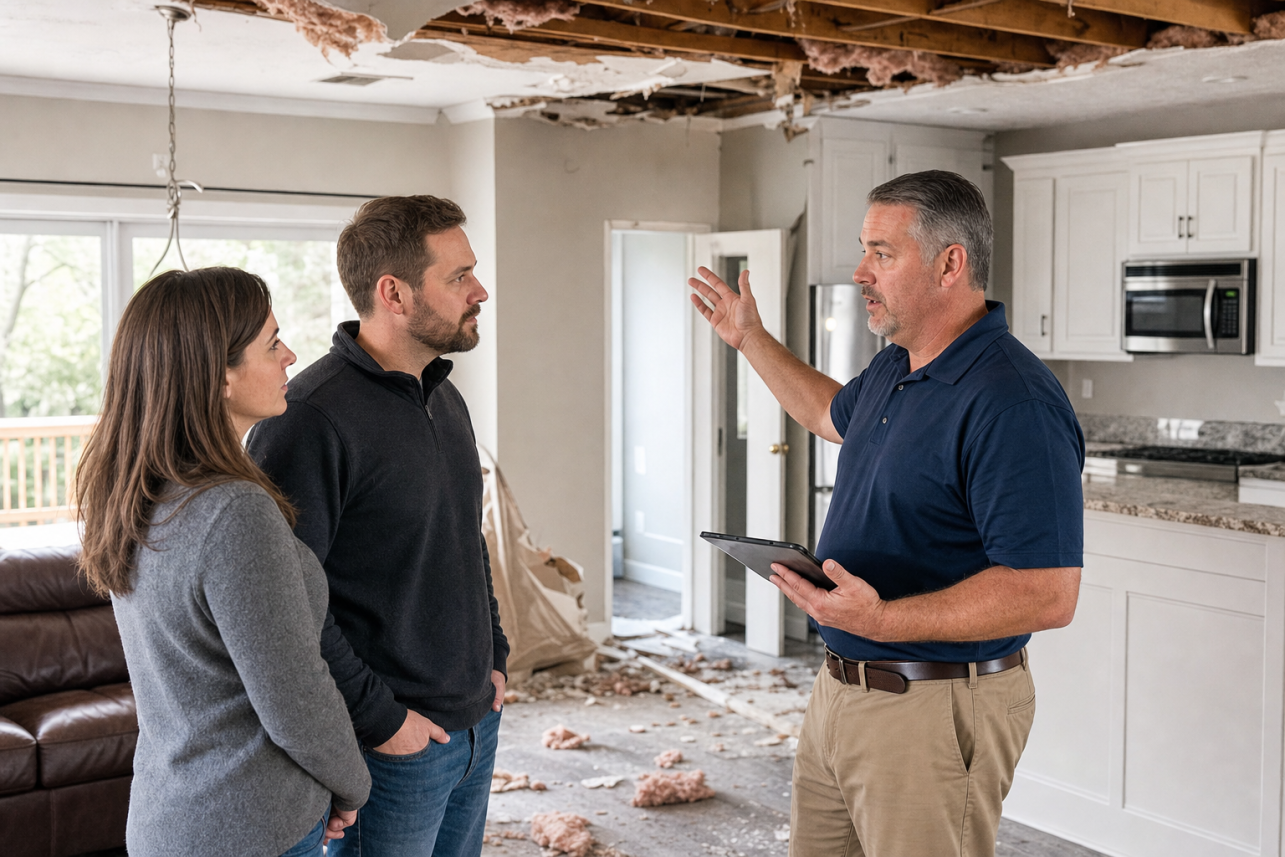
Reviews
Straight-line winds took half the shingles off our house near Lake Michie and the insurance company offered us barely enough to tarp it. For The Public Adjusters found wind damage on slopes their adjuster never even looked at and got the whole roof replaced plus interior repairs. Settlement ended up almost four times the first offer.
Danielle W., Rougemont
After a pipe burst under our crawl space, the carrier kept insisting the damage was 'long-term seepage' and tried to deny it. These folks documented everything with moisture readings and photos, pushed back with the actual policy language, and turned a denial into a $38,000 settlement. I would never handle a water claim alone again.
Marcus T., Bahama
Our detached garage burned with all my husband's woodworking equipment inside. I had no idea how to inventory contents or prove what tools were worth. They built the entire contents list, priced every item at replacement cost, and handled every call with the adjuster. The only reason it isn't a perfect experience is that claims just take time — but they kept us informed the whole way.
Rebecca H., Rougemont
Frequently Asked Questions
What Does A Public Adjuster Rougemont NC Homeowners Hire Actually Do For My Insurance Claim?
A public adjuster works exclusively for you, the policyholder — never the insurance company. When you hire For The Public Adjusters, Inc., we take over the entire claim process from documentation to final settlement negotiation.
That starts with a thorough inspection of your property. Rougemont sits in northern Durham County, where older farmhouses, brick ranches, and newer builds off Red Mountain Road and Moores Mill Road all have different construction details. We document damage the way an estimator would — measuring, photographing, and pricing every line item, including hidden damage like moisture behind siding or compromised roof decking that a quick carrier inspection often misses.
From there, we review your policy language line by line to identify every coverage that applies, including ones adjusters rarely volunteer, such as code upgrade coverage, additional living expenses, and debris removal. We then prepare a detailed, defensible estimate and negotiate directly with the insurance company's adjuster on your behalf.
You stay informed, but you're no longer stuck fielding calls, chasing paperwork, or arguing over scope. Our job is to make sure the settlement reflects what it actually costs to restore your home in today's market — not what the carrier's software says it should cost. For most Rougemont homeowners, that difference is substantial, especially on roof, storm, water, and fire claims where scope disputes are common.
How Much Does It Cost To Hire A Rougemont Public Adjuster, And Is It Worth It?
We work on a contingency fee, which means you pay nothing upfront and nothing out of pocket. Our fee is a percentage of the settlement we recover for you, agreed to in writing before we begin. If we don't recover money for you, you don't owe us a fee.
North Carolina law regulates how licensed adjusters representing policyholders operate, including fee disclosures and contract requirements, so everything is transparent from day one. You'll see exactly what the percentage is before you sign anything.
Is it worth it? Consider the math. Industry studies and our own case files in Durham County consistently show that professionally represented claims settle significantly higher than claims homeowners handle alone — often enough that the net amount in your pocket, even after our fee, exceeds what the carrier originally offered. On larger losses like fire or major water damage, the gap can be tens of thousands of dollars.
The reason is simple: insurance carriers write estimates using pricing databases and scopes that favor their bottom line. Most Rougemont homeowners don't know what a proper roof replacement, smoke remediation, or structural drying should actually cost, and the carrier isn't going to volunteer that information.
We do know, we document it, and we negotiate from a position of expertise. Beyond the money, you also get your time back — no more spending evenings on hold or deciphering reservation-of-rights letters. For most people, that alone justifies the call.
When Should I Call A Claims Adjuster Who Works For Me Instead Of Handling The Insurance Company Myself?
The best time to call is before you file the claim, or as soon as possible afterward. Early involvement lets us document the loss properly, set the scope correctly from the start, and avoid the recorded statements and quick lowball offers that cause problems later.
That said, it's rarely too late. We regularly step in when a claim has already been underpaid, delayed, or denied. If the carrier's check won't come close to covering repairs, or your claim has stalled for weeks with no explanation, those are clear signals to get representation.
Specific situations where Rougemont and northern Durham County homeowners benefit most: hail and wind damage after the spring and summer storms that roll through this part of the Piedmont, tree strikes on roofs — common given how wooded the properties are out toward Lake Michie and along Highway 501 — water damage from burst pipes in winter cold snaps, and fire or smoke losses of any size.
You should also call if the insurance company sends its own engineer or requests an Examination Under Oath. Those steps usually mean the carrier is building a case to limit payment, and you shouldn't face that alone.
A good rule of thumb: if the damage is more than cosmetic, if the numbers don't add up, or if you feel outmatched by the process, a consultation costs you nothing. We'll review your claim honestly and tell you whether representation makes financial sense for your situation.
Is For The Public Adjusters, Inc. Licensed To Handle Claims In Rougemont And The Rest Of Durham County?
Yes. For The Public Adjusters, Inc. is licensed by the North Carolina Department of Insurance, which is a legal requirement for anyone representing policyholders in claim negotiations in this state. Always verify a license before signing with any firm — you can check credentials directly through the Department of Insurance, and we're happy to provide our license information upfront.
We serve Rougemont and the surrounding communities throughout Durham County, as well as neighboring areas of Person, Orange, and Granville counties. That local footprint matters. A public adjuster Rougemont NC property owners can actually meet on site — someone who knows local repair costs, area contractors, and how regional carriers' adjusters typically scope claims here — has a real advantage over an out-of-state firm working from photos.
Local knowledge shows up in the details. We know what wind-driven rain does to homes on open acreage north of town. We understand the pricing realities of getting quality trades out to rural addresses, which carrier estimates often ignore. We know Durham County permitting and building code requirements that can trigger ordinance-and-law coverage on older Rougemont homes.
Every claim we handle stays with a licensed adjuster from first inspection through final settlement — no handoffs to call centers or subcontracted negotiators. If you'd like to confirm our credentials or ask how we've handled claims similar to yours nearby, call us and ask. We believe you should vet us as carefully as we'll vet your insurance company's offer.
What Types Of Insurance Claims Can A Public Adjuster Rougemont NC Property Owners Rely On Actually Handle?
We handle nearly every kind of first-party property claim that comes up in northern Durham County. The most common ones in the Rougemont area are wind and hail damage from spring and summer storms, water damage from burst pipes or failed water heaters, fire and smoke losses, fallen trees from ice storms, and lightning strikes that damage roofs, wiring, or wells.
Rural and semi-rural properties around Rougemont bring some unique claim situations too. We regularly work on losses involving detached garages, barns, workshops, fencing, and other outbuildings that homeowners often don't realize are covered under their policy's other-structures provision. Well pumps, septic components damaged by covered perils, and long private driveways affected by debris removal can also factor into a settlement.
Commercial claims are within our scope as well, including losses at small businesses, churches, and farm operations along the US-501 corridor. Business interruption coverage is frequently overlooked, and documenting lost income correctly can make a significant difference in the final payout.
The one thing we don't handle is third-party liability claims, meaning situations where you're pursuing someone else's insurance company for an injury or damage they caused. Our role is representing you on claims filed under your own policy. If you're not sure whether your situation qualifies, call us and we'll review your policy and the facts of the loss at no charge before you commit to anything.
My Claim Was Already Denied Or Underpaid. Can You Still Help, Or Is It Too Late?
In most cases it is absolutely not too late. North Carolina policies typically allow a substantial window to pursue a claim, and many carriers will reopen or supplement a claim when new documentation is presented. Some of our strongest results come from files where the homeowner accepted a low first offer and later realized it wouldn't come close to covering the repairs.
The first thing we do is request the complete claim file and the carrier's estimate, then compare it line by line against the actual damage at your property. Underpayments in this area often trace back to a few predictable gaps: missed hail damage on roof slopes the adjuster didn't walk, hidden water intrusion behind walls, code-upgrade costs that weren't included, or depreciation calculated too aggressively.
Once we've built our own estimate, we present the discrepancy to the insurance company with photos, measurements, contractor pricing, and policy language supporting each item. If the carrier won't move, we can invoke the appraisal clause in your policy, which forces a structured dispute-resolution process without the cost of litigation.
One important caution: deadlines do exist. Most policies require suit to be filed within a set period after the loss, and waiting too long can close your options. If your claim from a Rougemont-area storm was denied or the check felt short, bring us the paperwork sooner rather than later. Reviewing a closed or disputed claim costs you nothing, and you'll know quickly whether there's money left on the table.
How Long Does The Claims Process Take When I Work With A Public Adjuster In Rougemont?
Timelines vary with the size and complexity of the loss, but here's a realistic picture. Straightforward claims, like a single-room water loss or moderate roof damage, often resolve in four to eight weeks once we submit our documentation. Larger losses involving structural repairs, extensive smoke damage, or disputes over scope can run three to six months.
A few things influence the pace. North Carolina requires carriers to acknowledge claims and respond to communications within set timeframes, and we hold them to those obligations. Delays most often happen when the insurance company requests repeated inspections, sends multiple field adjusters, or drags its feet on supplements. Part of our job is keeping steady, documented pressure on the file so it doesn't sit in a queue.
Weather events matter too. After a major hailstorm rolls through northern Durham or neighboring Person County, carriers get flooded with claims and response times stretch. Getting a complete, well-documented claim package in early puts you ahead of that backlog.
Here's what most clients find surprising: even though hiring representation adds a step, claims we handle often close faster than ones homeowners fight alone, because the carrier receives a professional estimate it can't easily dispute. There's less back-and-forth, fewer lowball counteroffers, and fewer reinspections.
We'll give you an honest timeline estimate after our initial inspection, and you'll get regular updates as the file moves. You won't be left wondering what's happening with your claim.
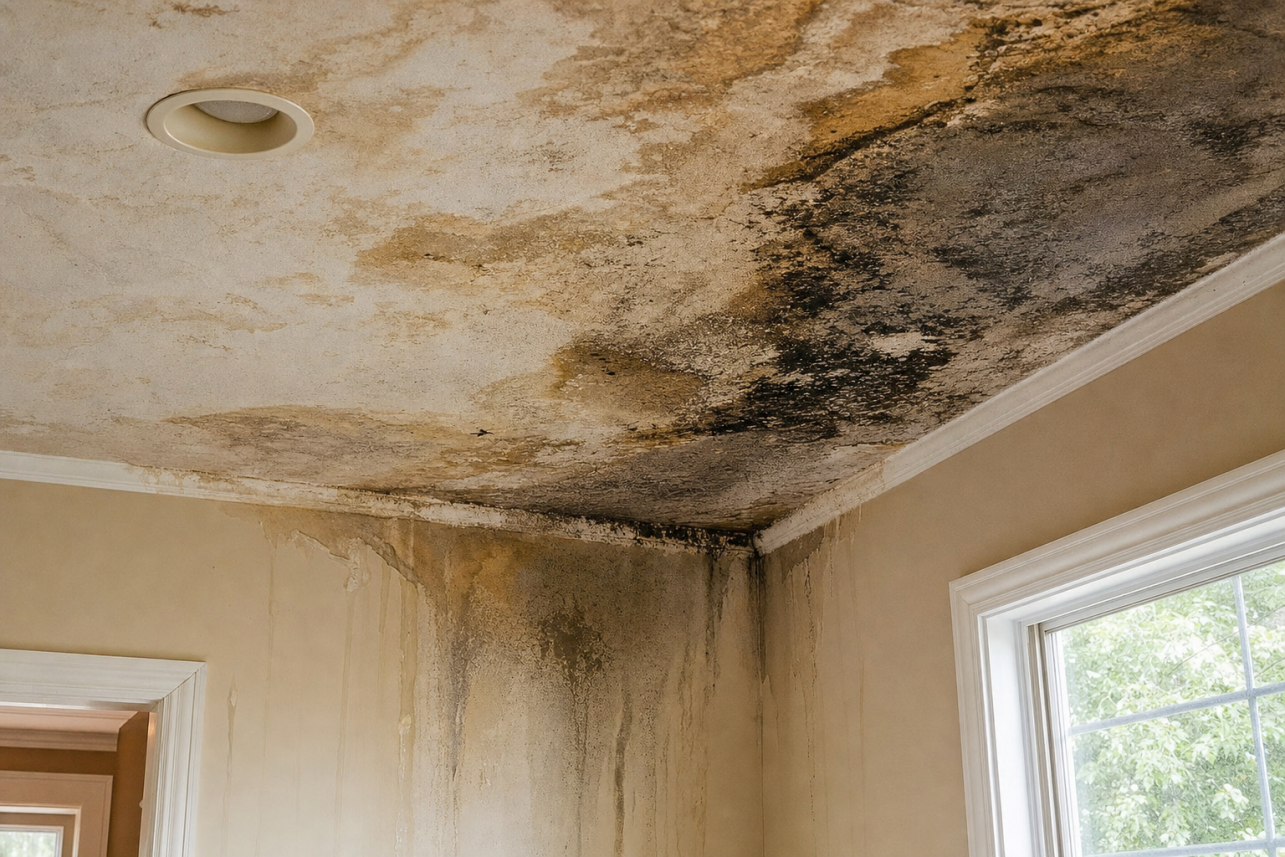
What Should I Do Right After Storm Or Water Damage In Rougemont, Before Anyone Inspects My Property?
The first hours after a loss matter more than most homeowners realize. Start with safety: if there's standing water near electrical outlets, a compromised roof structure, or lingering smoke, keep your family out of the affected area.
Next, document everything before you touch anything. Take wide photos of each damaged room or roof section, then close-ups of individual items. Video walkthroughs with narration are even better. Around Rougemont, where properties often include outbuildings, fencing, and equipment, walk the entire parcel — damage to a barn or well house counts too.
Your policy requires you to prevent further damage, so it's fine to tarp a roof opening or shut off water to a burst pipe. Keep receipts for tarps, fans, or emergency services, because those mitigation costs are typically reimbursable. What you should not do is start permanent repairs or throw away damaged materials before the loss is fully documented. Discarded shingles, flooring, or drywall are evidence, and carriers use their absence to question the claim.
Be careful with recorded statements early on. You're required to cooperate with your insurer, but you're not required to speculate about causes or accept an adjuster's characterization of the damage on the spot.
Ideally, call a public adjuster Rougemont NC residents can reach quickly before the carrier's inspector arrives. When For The Public Adjusters, Inc. gets involved at the start, we attend that inspection with you, make sure nothing gets missed, and set the claim up correctly from day one instead of fixing problems later.
Will Hiring A Public Adjuster In Rougemont Cause My Insurance Company To Raise My Rates Or Drop My Policy?
No. Your premiums are tied to the claim itself — the type of loss, your claims history, and regional risk factors — not to who represents you during the process. Filing a legitimate claim for storm, fire, or water damage is exactly what your policy exists for, and North Carolina law protects your right to hire licensed representation.
In fact, having professional representation often makes the process smoother for everyone. We document the loss thoroughly, present it in the format carriers expect, and handle communication so there are fewer disputes and delays. Insurance companies deal with licensed adjusters every day; it is a normal part of the industry, not a red flag on your account.
What homeowners in Rougemont and northern Durham County should actually worry about is the opposite scenario: accepting a low settlement, paying out of pocket for the shortfall, and then discovering more damage later. Underpaid claims can leave hidden problems like moisture behind walls or compromised roof decking unaddressed, which leads to bigger claims down the road.
It is also illegal in North Carolina for an insurer to retaliate against you for exercising your policy rights. If a carrier ever suggested your coverage was at risk because you hired representation, that would be a serious regulatory issue for them, not for you. Our job is simply to make sure the settlement reflects what your policy actually promises — nothing about that puts your coverage in jeopardy.
What Documents Should I Gather Before Meeting With A Public Adjuster Rougemont NC Homeowners Can Call For A Free Review?
Start with your full insurance policy, including the declarations page and any endorsements or riders. Many Rougemont homeowners only have the declarations summary, so if you cannot find the complete policy, we can request a certified copy from your carrier on your behalf.
Next, gather anything related to the loss itself: photos and videos of the damage, the date it occurred, and any correspondence with your insurance company — emails, letters, claim numbers, and the name of the adjuster they assigned. If the carrier already sent an estimate or a denial letter, bring that too. Those documents tell us exactly where the claim stands and where it fell short.
Receipts and records help enormously. Contractor estimates, repair invoices, hotel bills if you had to relocate, and receipts for emergency work like tarping or water extraction all support your claim. For contents losses, even old photos of your rooms can help us rebuild an inventory of damaged belongings.
Do not worry if you are missing pieces. A public adjuster Rougemont NC property owners hire is trained to reconstruct documentation — we photograph and measure everything ourselves, write our own line-item estimates, and pull weather data for the date of loss when a carrier questions whether a storm actually hit your area. The initial consultation costs nothing, so bring what you have and we will build the rest of the file together.
What Is The Difference Between The Adjuster My Insurance Company Sends And One Who Works For Me?
The adjuster your insurance company sends — whether a staff adjuster or an independent adjuster the carrier hires — works for the insurance company. Their estimate is written on the carrier's behalf, using the carrier's guidelines. They may be perfectly professional, but their loyalty is to the company paying them, and their scope of damage often reflects that.
A licensed public adjuster is the only type of adjuster legally allowed to represent you, the policyholder. When For The Public Adjusters, Inc. takes on a claim in Rougemont, we conduct our own independent inspection, write our own detailed estimate, interpret the policy language in your favor where the law allows, and negotiate directly with the carrier until the settlement matches the actual cost of putting your property back the way it was.
The practical difference shows up in the details. A carrier's adjuster might allow patching a section of roof; we document why matching shingles are unavailable and push for full replacement. They might miss code-upgrade costs required in Durham County; we include them when your policy provides ordinance and law coverage.
Think of it like a legal dispute: you would not rely on the other side's attorney to protect your interests. Insurance claims work the same way. The carrier has trained professionals on its side of the table from day one — a policyholder adjuster simply levels that playing field, and in our experience the resulting settlements reflect it.
Do You Handle Claims For Rural Properties Around Rougemont, Like Homes On Acreage, Barns, And Outbuildings?
Yes, and it is one of the areas where local experience matters most. Much of the Rougemont area is rural — homes on several acres along Red Mountain Road, Moores Mill Road, and the roads running toward the Person and Orange County lines, often with detached garages, barns, sheds, workshops, and fencing. Those structures are frequently covered under the 'other structures' portion of a homeowners policy, and they are just as frequently overlooked or underpaid when a claim is filed.
Storm damage rarely stops at the house. Straight-line winds and falling trees, both common in this part of northern Durham County, can damage a metal barn roof, take out fence runs, and destroy equipment stored in outbuildings all in the same event. We inspect the entire property, not just the residence, and document every covered structure and item.
Well houses, pump equipment, propane systems, and long private driveways add complications that carriers unfamiliar with rural properties tend to undervalue. Debris removal alone on a wooded lot can run into thousands of dollars, and many policies include specific coverage for it that never gets claimed.
We also review whether you have replacement-cost or actual-cash-value coverage on outbuildings, because that distinction dramatically changes what you are owed. If you own acreage anywhere around Rougemont, Bahama, or Timberlake and suffered storm, fire, or water damage, we will walk the whole property with you and make sure nothing covered gets left out of the claim.
What Happens During The Initial Claim Review With A Public Adjuster Rougemont NC Property Owners Can Schedule?
The first step is a no-obligation review of your loss and your policy. We come out to your property, walk the damage with you, and take our own photos, measurements, and moisture readings rather than relying on what the insurance company documented.
We also read your policy in full, including endorsements and exclusions, because coverage details often change the strategy for a claim. Many homeowners around Rougemont have never had anyone explain what their deductible structure, ordinance-and-law coverage, or additional living expense limits actually mean in dollars.
From there, we give you an honest assessment. If the insurance company's offer is fair and the claim is straightforward, we will tell you that and you owe us nothing. If we see damage that was missed, pricing that is below real local repair costs, or coverage that was not applied, we explain exactly where the gaps are and what a properly documented claim should look like.
If you decide to move forward, we handle the paperwork, the correspondence, and the negotiation from that point on. You are never pressured to sign anything on the spot. Most reviews take about an hour on-site, though larger fire or water losses can take longer because there is simply more to inspect. Bring your policy declarations page if you have it; if not, we can help you request a certified copy from your carrier.
What Is Recoverable Depreciation, And How Do I Make Sure I Actually Get It Back?
If you have a replacement cost policy, your insurer typically pays your claim in two stages. The first check is the actual cash value, which is the replacement cost minus depreciation for age and wear. The depreciation that was held back is called recoverable depreciation, and you are entitled to it once the repairs are completed.
This is one of the most common places Rougemont homeowners leave money behind. Carriers often depreciate items aggressively, apply depreciation to labor when they should not, or make the recovery process so paperwork-heavy that people give up. On a roof claim alone, the withheld depreciation can be thousands of dollars.
To recover it, you generally must complete the repairs, then submit invoices or a signed contract showing the actual cost, along with photos and sometimes a completion certificate. There are deadlines in most policies, often 180 days to two years, so waiting too long can forfeit that money entirely.
When we manage a claim, we track every depreciated line item, challenge depreciation percentages that do not match the real condition of the property, and handle the release paperwork so the second check actually arrives. We also verify that the replacement cost figures reflect what contractors in northern Durham County actually charge, not a software default. If your contractor's bid comes in higher than the insurer's estimate, we document and negotiate that difference before you are stuck covering it out of pocket.
My Insurance Company And I Still Disagree After Negotiation. What Options Does A Rougemont Public Adjuster Have At That Point?
Most claims settle through documentation and negotiation, but when a carrier refuses to move, you are not out of options. Nearly every North Carolina property policy contains an appraisal clause, which is a formal dispute-resolution process built into your contract.
Under appraisal, you select an appraiser, the insurance company selects one, and the two appraisers agree on a neutral umpire. If the appraisers cannot agree on the amount of the loss, the umpire decides, and agreement by any two of the three is binding on the dollar amount. It is faster and far less expensive than a lawsuit, and it frequently produces a much better result than the carrier's final offer.
We prepare appraisal cases the same way we prepare claims: detailed estimates, photographs, material pricing that reflects real costs in the Rougemont and Durham County market, and a clear record of every inspection and communication. That documentation is often what wins the day in front of an umpire.
Appraisal resolves disputes over the amount of the loss, not coverage denials. If the carrier is denying that the loss is covered at all, that becomes a legal question, and we can refer you to attorneys who handle insurance litigation and work alongside them with our file already built. Either way, you do not have to simply accept a number you know is wrong. The policy gives you leverage, and our job is to use it.
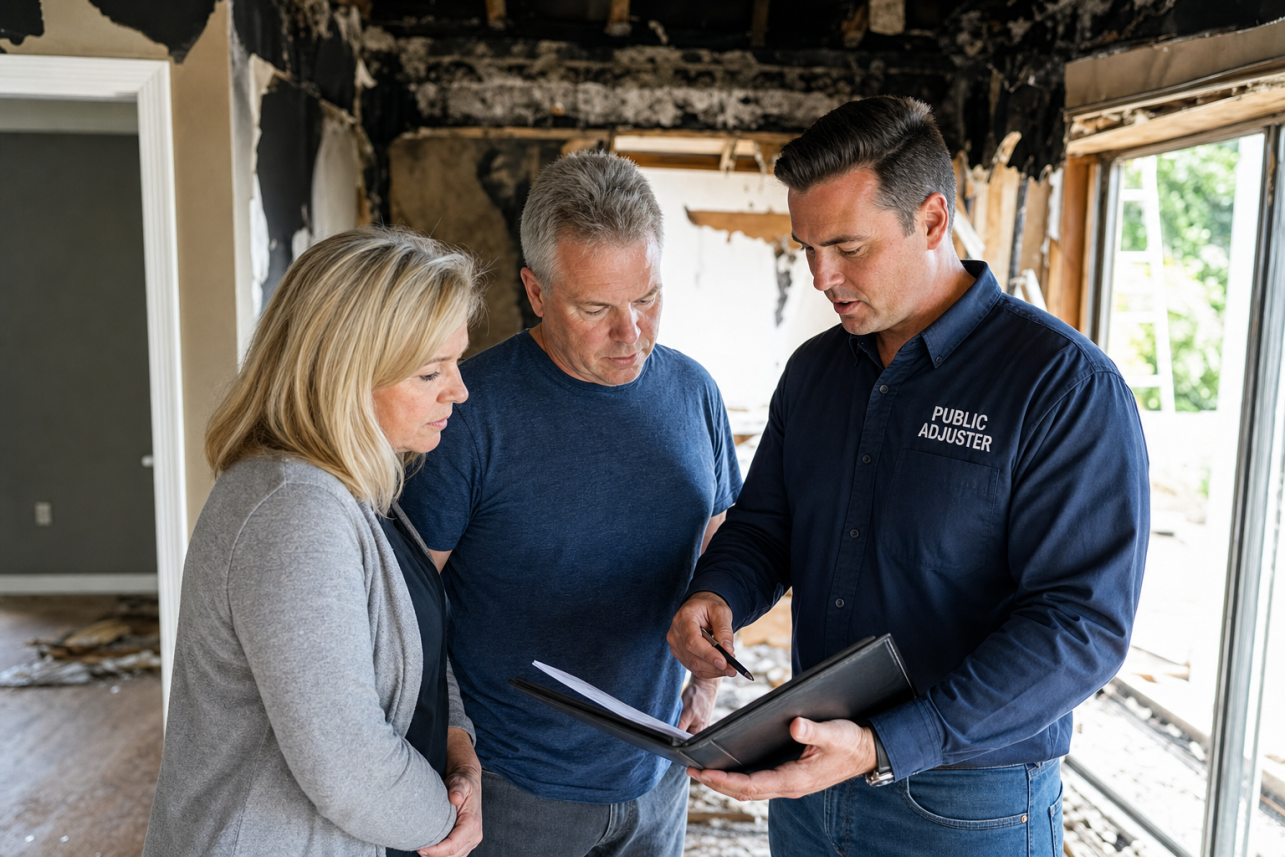
My Mortgage Company Is Named On The Settlement Check. How Does That Work With A Public Adjuster Rougemont NC Homeowners Hire?
This surprises a lot of people. If you have a mortgage, your lender is listed on your homeowners policy as a loss payee, so insurance checks for structural damage are made out to both you and the mortgage company. You cannot cash the check without their endorsement.
Each lender has its own loss-draft process. Smaller checks, often under a threshold like $10,000 to $40,000 depending on the servicer, may be endorsed and released quickly. Larger settlements are usually held in escrow and paid out in stages as repairs progress, with the lender requiring inspections, contractor documentation, W-9 forms, and lien waivers along the way.
When we handle a claim, we help you navigate that process too. We provide the detailed repair estimates and documentation lenders ask for, help you understand each servicer's forms, and push back when a mortgage company sits on funds longer than it should. Delays in fund releases are one of the biggest frustrations for homeowners after a major fire or storm loss, and knowing the process ahead of time prevents most of them.
One important note for the Rougemont area: checks for personal property contents and additional living expenses are typically made out to you alone, not the lender, so those funds are available sooner. Detached structures like barns and workshops on rural properties may be treated differently depending on your loan documents. We walk through all of this with you so the money moves as fast as the rules allow.
Local Relevance
Rougemont sits in the rural northern reach of Durham County, where properties often mean acreage, mature hardwoods and pines, older farmhouses, and outbuildings alongside newer construction. That mix creates specific claim patterns: falling trees during summer thunderstorms and winter ice, chimney and heating-related fires in older homes, and water damage from aging plumbing and roofs.
The Piedmont's humid subtropical climate also delivers the remnants of tropical systems and heavy downpours that can push creeks and low-lying lots past their limits. Homeowners here sometimes discover after the fact that standard homeowners policies exclude flood — which is why NFIP flood claims are their own specialty, with their own deadlines and proof-of-loss requirements that the Federal Emergency Management Agency oversees.
Because Rougemont is unincorporated and spread out, carrier adjusters covering the Triangle may spend limited time on a rural property inspection. Having a local advocate who will walk the whole loss — house, barn, fencing, contents — changes what ends up in the estimate.
Many Rougemont properties combine large wooded lots with older wood-frame homes and detached outbuildings, so a single severe thunderstorm or ice event often produces layered losses — roof, structure, trees, and contents — that a quick carrier inspection can undervalue if each element isn't documented separately.
Talk To A Rougemont Claim Advocate Before You Accept The Carrier's Number
Whether it's fire damage on an older farmhouse, a tree through the roof, or an NFIP flood claim with a deadline approaching, For The Public Adjusters, Inc. will review your situation at no cost. We're licensed, bonded, and we only get paid when your claim does.
Call us: (919) 400-6440
Helpful Resources
- NCDOI Public Adjusters Guide
- National Flood Insurance Program (NFIP)
- Federal Emergency Management Agency (FEMA)
- NC Department of Insurance consumer resources — State regulator guidance for policyholders
Our services in this city
Service pages for this city are coming soon.
Last updated: August 15, 2026