
The Finger-Pointing Trap: Why Hurricane Victims Face Wind vs Flood Damage Denials
Wind vs flood damage disputes happen when your homeowners insurer blames flooding (which it doesn’t cover) while your flood insurer blames wind (which it doesn’t cover), leaving you with two denials instead of two checks. Courts have repeatedly rejected this tactic, and homeowners who document their damage and push back often recover from both policies.
Key takeaways
- In Corban v. United Services Automobile Association (Miss. 2009), the Mississippi Supreme Court ruled an anti-concurrent causation clause cannot wipe out coverage for wind damage that occurred before storm surge arrived — a major win for policyholders.
- Wind damage is covered by your homeowners policy while flood damage falls under a separate flood policy, so one hurricane often means two claims with two different carriers.
- Never accept both insurers denying your claim by pointing at each other — damage caused by wind before floodwater arrived is generally the homeowners carrier’s responsibility.
- The burden is on each insurer to properly investigate and allocate damage, so document everything with photos, timelines, and weather data before repairs begin.
- Eastern North Carolina homeowners should file both the wind and flood claims promptly and in writing, because missing either deadline can forfeit coverage you actually paid for.
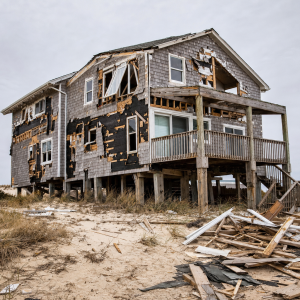
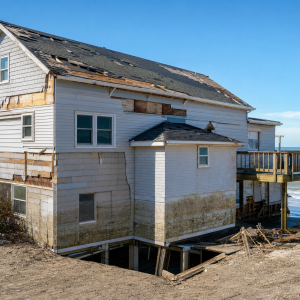
If you own a home in eastern North Carolina, you already know how a single hurricane delivers both hazards at once. Wind tears off shingles and drives rain through broken windows hours before storm surge or a swollen creek ever reaches your door. The problem is that those two perils are covered by two different policies — your homeowners policy covers hurricane wind damage, while a separate flood policy (usually through the National Flood Insurance Program) covers rising water. When both carriers look at the same destroyed house, each has a financial incentive to say the other peril caused the loss.
How the Trap Plays Out
- The homeowners carrier says: “This was flood damage. Your flood policy should pay.”
- The flood carrier says: “This was wind damage. Your homeowners policy should pay.”
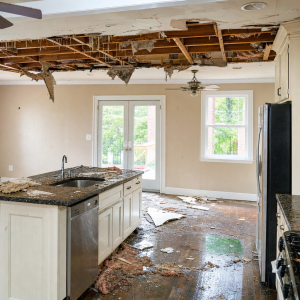
- The result: Two lowball offers or outright denials for one storm — and a homeowner stuck in the middle with a gutted house.
The good news is that policyholders have fought back and won. In Corban v. United Services Automobile Association, the Mississippi Supreme Court sided with Hurricane Katrina homeowners, holding that an insurer cannot use flood damage as an excuse to escape paying for damage that wind caused first or independently. In other words, if wind destroyed part of your home before the water arrived, the wind insurer still owes you for that damage — the carriers don’t get to cancel each other out. Courts and claim professionals handling flood insurance claim help in Garner and across North Carolina lean on that same principle: each insurer must pay for the damage its own policy covers.
Why This Matters Right Now
As fall storms close out hurricane season along the North Carolina coast and inland counties, thousands of homeowners are filing wind and flood claims for the same event. The claims filed in the next few weeks will determine whether families rebuild quickly or spend months fighting dueling denials. Knowing that the finger-pointing tactic has been rejected in court — and that detailed documentation of when and how each type of damage occurred is your strongest weapon — changes the entire negotiation. Homeowners who get professional water damage claim help in Bynum and surrounding communities learn early that the burden of sorting wind from water shouldn’t fall on them alone.
The rest of this guide walks through exactly who pays for what, the policy language insurers use to dodge wind claims, and the concrete steps to take when both of your carriers point at each other.

Who Pays for Wind vs Flood Damage After a Hurricane?
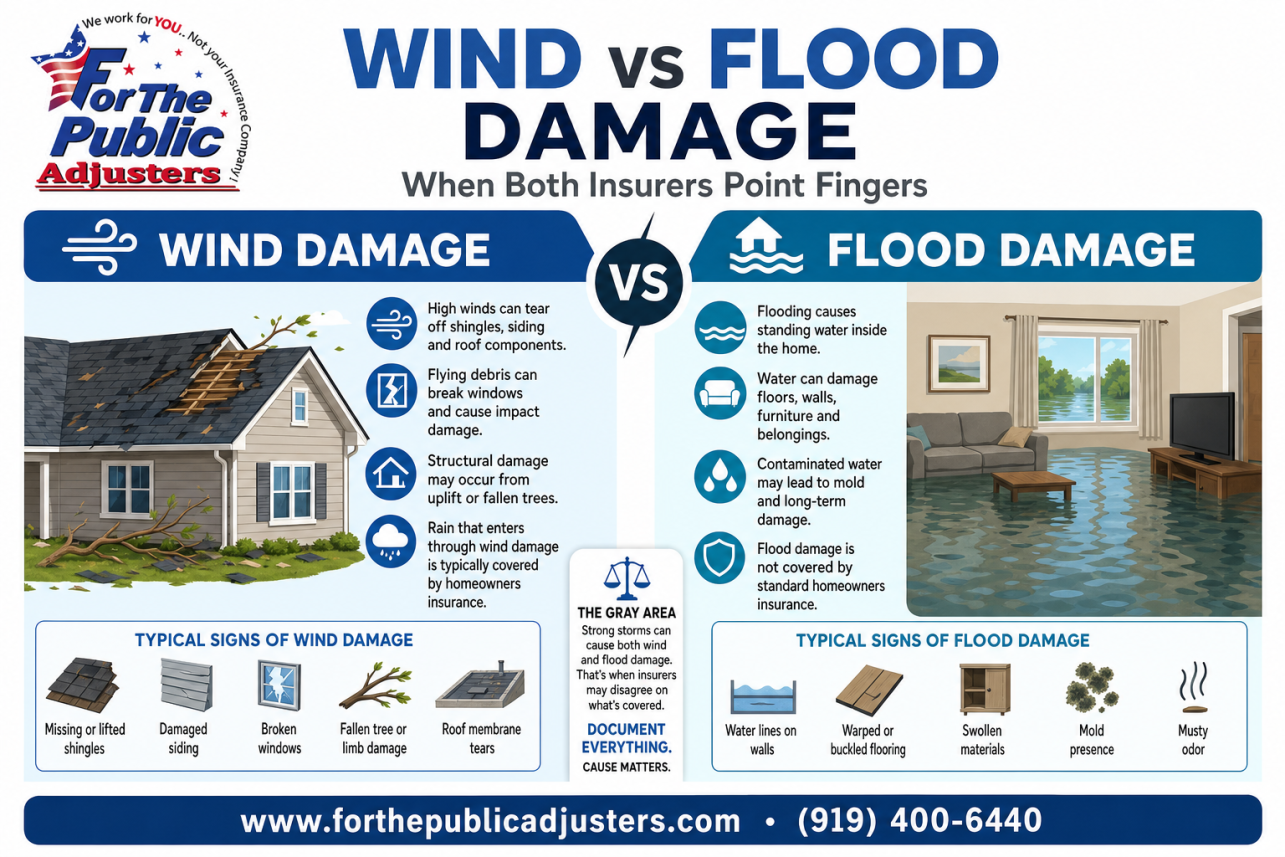
Your homeowners insurance pays for hurricane wind damage — torn shingles, broken windows, rain entering through a wind-created opening. Your flood policy, usually through the National Flood Insurance Program (NFIP) or a private flood carrier, pays for storm surge and rising water. Wind vs flood damage disputes happen because these are two separate policies with separate adjusters and rules.
That split sounds simple on paper. In practice, a single hurricane often causes both types of damage to the same house within hours — and sometimes to the same wall, floor, or room. Each insurer is only responsible for the peril it covers, which creates a built-in incentive for each one to attribute the damage to the other policy.
What Each Policy Typically Covers
- Homeowners policy (wind): Roof damage, siding torn off, trees pushed onto the structure, windows and doors breached by wind, and rain that enters through a storm-created opening.
- NFIP or private flood policy (water): Storm surge, tidal flooding, overflowing creeks and rivers, and rising groundwater — generally defined as water that touches the ground before entering your home.
- Neither, unless specifically added: Some losses fall into gaps, which is why reading both policies carefully matters.
Why Two Different Adjusters Show Up
Your wind claim is handled under state insurance law and your homeowners contract. An NFIP flood claim is governed by federal rules, with its own proof-of-loss deadlines and documentation standards. The two adjusters do not coordinate, do not share files, and each one documents only the damage relevant to their own policy. Homeowners dealing with complicated water losses often seek water damage claim help in Bynum and surrounding communities precisely because the paperwork and rules differ so much between the two claims.
Where the Line Falls on a Coastal NC Home
Adjusters often use a rough physical marker: the waterline. Damage below the high-water mark — soaked flooring, lower drywall, cabinets — is usually assigned to the flood policy. Damage above it — the roof, upper walls, ceilings stained by wind-driven rain — points to the homeowners policy. The gray zone is everything in between, especially when wind breached the home before the surge arrived. Courts have recognized this distinction matters: in Corban v. United Services Automobile Association, the Mississippi Supreme Court sided with the homeowner, holding that wind damage occurring before flood waters arrived remained covered under the homeowners policy.
Getting that sequence of damage documented correctly is the whole game. An experienced public adjuster in Siler City NC can help establish which peril caused which damage, so each carrier pays its fair share instead of pointing at the other.
What Is an Anti-Concurrent Causation Clause and Can It Erase My Wind vs Flood Damage Coverage?
An anti-concurrent causation (ACC) clause is policy language that lets a homeowners insurer deny a loss entirely when a covered cause (wind) and an excluded cause (flood) combine to damage your property. It cannot erase damage that wind caused on its own — which is why proving the sequence and timing of your damage matters so much.
The ACC Clause in Plain English
Buried in most homeowners policies is wording that says, in effect: if an excluded peril like flood contributes to a loss “concurrently or in any sequence” with a covered peril, the whole loss is excluded. Insurers lean on this language after hurricanes to argue that because storm surge or rising water touched your home, the wind damage is somehow swallowed up too. For homeowners, it can feel like the fine print is being used to make real, visible wind destruction disappear on paper.
Why Sequence and Timing Are Everything
Courts have pushed back on the broadest readings of these clauses. In Corban v. United Services Automobile Association, decided by the Mississippi Supreme Court in 2009 after Hurricane Katrina, the court sided with the homeowners and held that an ACC clause does not exclude damage caused by wind before flooding ever arrived. If wind tore off your roof at 2 p.m. and water rose at 6 p.m., the wind loss happened first, stands on its own, and remains covered. The two perils were not truly “concurrent” — they were sequential, separate losses.
That distinction is why documentation of timing can make or break your claim. Evidence that helps establish the order of events includes:
- Time-stamped photos and videos taken during or right after the storm
- Weather data showing when peak winds hit versus when water rose in your area
- Neighbor and eyewitness accounts of roof, siding, or window damage before flooding
- Physical evidence, such as wind-driven rain stains above the waterline
- Interior water paths that start at the ceiling, not the floor — a pattern often seen in disputes like a contested flood insurance claim in Hillsborough
The Bottom Line for Homeowners
An ACC clause is a real obstacle, but it is not a magic eraser. It applies only where wind and water genuinely combined to cause a single, indivisible loss. Damage that wind caused independently — before the water arrived — generally remains covered, and the insurer typically bears the burden of proving its exclusion applies. Experienced claim professionals, like a licensed and bonded public adjuster in Siler City NC, spend much of their time in hurricane disputes building exactly this kind of timeline evidence so covered wind damage is not quietly folded into a flood exclusion.
Has a Homeowner Ever Beaten the ‘Blame the Other Carrier’ Tactic in Court?
Yes. In Corban v. United Services Automobile Association, the Mississippi Supreme Court ruled in 2009 that an anti-concurrent causation clause cannot erase coverage for wind damage that happened before storm surge arrived. Wind losses that occur first remain covered losses, and the insurer cannot retroactively exclude them just because flooding followed.
The Story Behind the Corban Case
After Hurricane Katrina devastated the Mississippi Gulf Coast in 2005, the Corban family’s home suffered damage from both hurricane winds and the storm surge that came later. Their homeowners insurer, USAA, pointed to the anti-concurrent causation clause in the policy and argued that because flood waters contributed to the overall destruction, the wind damage was swept into the flood exclusion too.
The Mississippi Supreme Court rejected that argument. The court reasoned that once wind causes damage, the policyholder’s right to recover for that damage vests at the moment the loss occurs. Storm surge arriving hours later cannot reach back in time and un-cover a loss that was already covered. The anti-concurrent causation language, the court held, only applies when two perils act together at the same time to cause a single, indivisible loss — not when they strike in sequence.
Why Corban Matters for North Carolina Hurricane Claims
While Corban is a Mississippi decision and not binding on North Carolina courts, its logic is a powerful tool in any wind vs flood damage dispute after a hurricane. The key takeaways for homeowners include:
- Sequence matters. If wind tore off shingles or breached your roof before flood waters ever arrived, that wind damage is a separate, covered loss under most homeowners policies.
- The burden of proof shifts. The court made clear the insurer carries the burden of proving that damage falls within the flood exclusion — the homeowner does not have to disprove it.
- Exclusions are read narrowly. Courts generally interpret ambiguous exclusion language in favor of the policyholder, not the carrier.
For coastal and inland North Carolina homeowners alike, documenting when each type of damage occurred — through weather data, witness accounts, and physical evidence — is what makes a Corban-style argument possible. If rising water played a role in your loss, getting experienced flood insurance claim help in Hillsborough early can preserve exactly that kind of evidence before it disappears.
The lesson from Corban is simple: policyholders can and do win when insurers try to stretch exclusions beyond what the policy actually says. Working with a licensed and bonded public adjuster in Mebane NC gives you an advocate who understands how to separate wind losses from flood losses and present the proof your claim deserves.
What Should I Do If My Homeowners and Flood Claims Are Both Pending After the Same Hurricane?
File both claims promptly, photograph everything before cleanup — including fallen debris and interior waterlines — and keep the two carriers’ findings consistent. Never accept a verbal “the other policy covers that” without written proof, and preserve evidence showing what the wind did before the water ever rose.
When the same storm triggers two policies, your documentation becomes the referee. In the landmark case Corban v. United Services Automobile Association, the Mississippi Supreme Court sided with homeowners after Hurricane Katrina, holding that an insurer could not escape paying for wind damage that occurred before flooding arrived. The lesson for eastern North Carolina homeowners is simple: proof of the sequence of damage is what wins wind vs flood damage disputes.
Document Before You Clean Up
The urge to start cleanup immediately is understandable, but evidence disappears fast. Before you move a single branch or rip out wet drywall:
- Photograph and video every room, the roof, siding, and yard from multiple angles.
- Capture interior and exterior waterlines on walls, furniture, and foundations — they show how high floodwater rose.
- Document fallen trees, limbs, and wind-driven debris exactly where they landed. If a tree punched through your roof before the water rose, that timeline matters enormously, much like the tree damage insurance claim help in Carrboro situations we see after major storms.
- Note timestamps. Phone photos with metadata, neighbor videos, and weather reports help establish when wind struck versus when flooding began.
File Both Claims Right Away
Do not wait for one carrier to decide before notifying the other. Flood policies in particular have strict deadlines, including the proof of loss requirement. Filing late gives either insurer an easy reason to deny. If you need guidance navigating the flood side specifically, resources like our flood insurance claim help in Hillsborough page explain what flood carriers expect from policyholders.
Keep the Carriers Honest — and Consistent
- Get everything in writing. If an adjuster says “that’s a flood item,” ask for that determination in a written report.
- Compare the two reports side by side. If the wind carrier attributes your roof damage to flooding and the flood carrier attributes it to wind, you now have documented proof of contradictory positions — powerful leverage.
- Request each carrier’s engineering and adjuster reports. You are entitled to understand the basis for any denial.
- Keep your own statements consistent. Describe the damage the same way to both carriers, sticking to what you actually observed.
Handled this way, two claims become two paths to recovery rather than two opportunities for denial. The homeowners who fare best are the ones who treat documentation as seriously as the insurers do.
How Can a Public Adjuster Help With a Wind vs Flood Damage Dispute in NC?
A licensed, bonded public adjuster works only for you, not the insurance company. In a wind vs flood damage dispute, they document each type of damage separately, build a timeline showing what happened first, submit properly supported claims to both carriers at once, and negotiate on your behalf — though no outcome can ever be guaranteed.
When two insurers each insist the other is responsible, the policyholder who wins is usually the one with the best evidence. That is exactly where a public adjuster earns their keep.
Separating Wind Damage From Flood Damage
A public adjuster inspects your property with causation in mind, not just cost. They look for the physical signatures that distinguish the two perils:
- Waterlines, silt, and sediment that mark how high floodwater rose
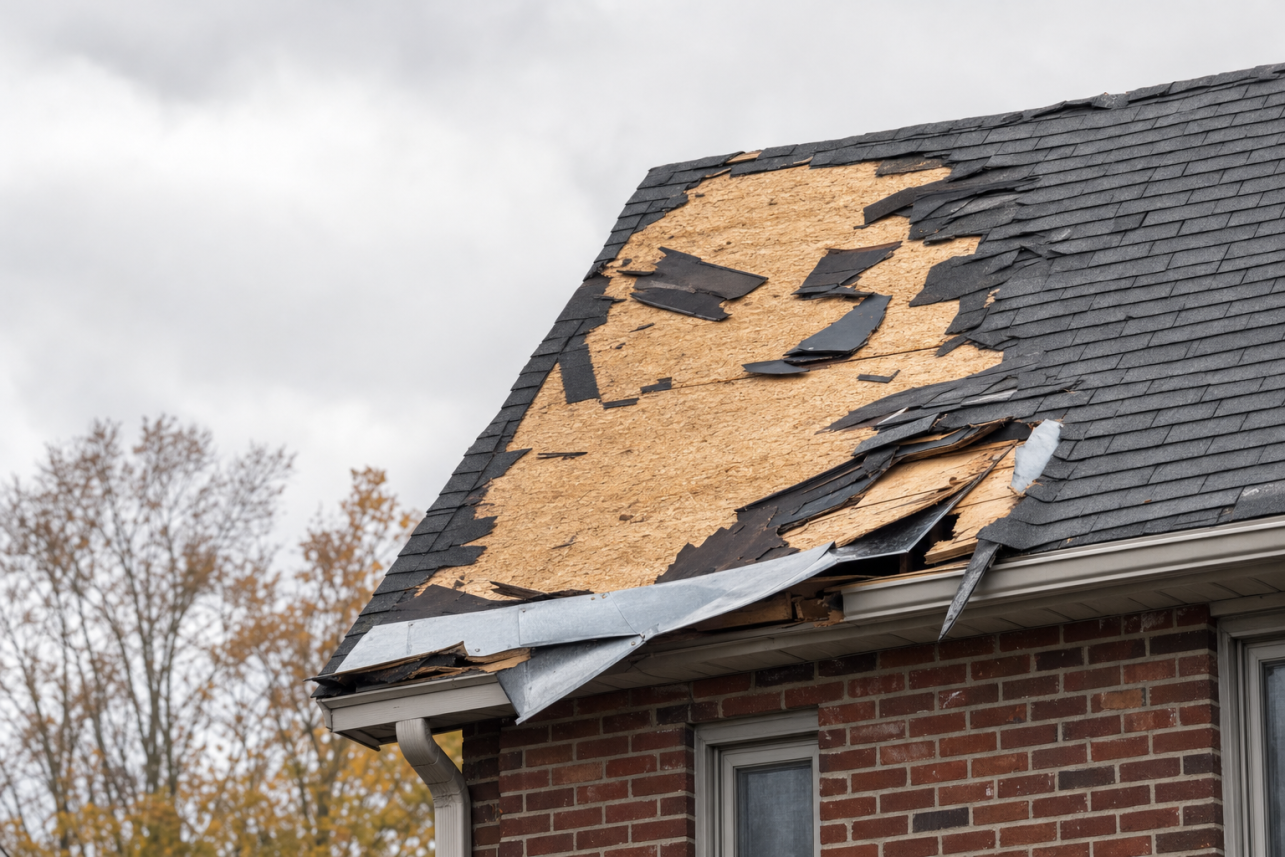
- Roof, siding, and window damage above the waterline that only wind could have caused
- Interior water staining that tracks from the roof down, rather than from the floor up
- Debris patterns, missing shingles, and damage on neighboring structures that corroborate wind force
Each finding is photographed, measured, and tied to a specific line item, so neither carrier can wave away covered damage as “the other peril.”
Building the Timeline That Mattered in Corban
In Corban v. USAA, the Mississippi Supreme Court sided with the homeowner largely because the sequence of damage mattered: wind damage that occurs before floodwater arrives is a separate, covered loss. A public adjuster reconstructs that sequence for your property using weather data, storm surge records, witness statements, and the physical evidence itself. Official storm reports from the National Weather Service and flood mapping from FEMA often become key pieces of that timeline.
Negotiating With Both Carriers in Parallel
Rather than letting your homeowners insurer and your NFIP flood carrier take turns pointing at each other, a public adjuster presents both claims simultaneously, with the damage clearly allocated between them. If the flood side of your claim stalls, experienced flood insurance claim help in Garner and across the Triangle can keep the NFIP paperwork, proof-of-loss deadlines, and documentation requirements on track while the wind claim moves forward.
Homeowners farther west face the same finger-pointing after hurricanes push inland. If you need a Public Adjuster in Pittsboro NC, the same approach applies: document, allocate, and press both carriers for a fair settlement on what each policy actually covers.
Honest Expectations
No public adjuster can promise a specific result, and you should be wary of anyone who does. What a licensed, bonded professional can do is make sure your claim is complete, well-documented, and hard to deny on causation grounds. You can verify any adjuster’s license through the North Carolina Department of Insurance before you hire them — a simple step that protects you from the start.
Wind vs Flood Damage: Which Policy Responds After a Hurricane
| Question | Wind Damage (Homeowners Policy) | Flood Damage (Flood Policy / NFIP) |
|---|---|---|
| What typically causes it? | Hurricane winds, wind-driven rain through openings, tornadoes spawned by the storm | Storm surge, overflowing rivers, rising surface water |
| Who pays the claim? | Your homeowners insurance carrier | Your separate flood insurer, often through the National Flood Insurance Program |
| Common dispute tactic | Carrier claims the damage was really flood, not wind | Carrier claims the damage was really wind, not rising water |
| Key legal precedent for policyholders | Corban v. USAA (Miss. 2009): wind damage occurring before flood arrives stays covered, despite anti-concurrent causation language | Flood policy still owes for damage rising water actually caused, up to policy limits |
| Your best move | Document wind damage with photos, dates, and weather reports before repairs | Document water lines, surge timing, and flooded contents separately |
Illustrative Example: One Hurricane, Two Carriers, Zero Finger-Pointing Allowed
Illustrative example
Consider a hypothetical, composite example of a coastal North Carolina family whose home lost shingles and part of its roof deck to hurricane winds hours before storm surge flooded the first floor. The homeowners carrier initially blamed everything on flooding, while the flood insurer argued most of the damage was wind-related — leaving the family stuck in the middle. By building a careful timeline with photos, weather service records, and a detailed damage inventory separating roof and upper-wall harm from water-line damage below, they were able to show each carrier exactly which policy owed for which loss. The same reasoning that prevailed for the policyholders in Corban v. USAA — that wind damage occurring before the water arrived remains covered — gave the family a firm, documented basis to press both claims rather than accept two denials. Every claim is different and outcomes vary, but organized documentation and persistence can keep both insurers accountable.
Frequently asked questions
How do insurance companies tell the difference between wind vs flood damage after a hurricane?
Adjusters look at physical evidence: water lines on walls mark how high flooding rose, while missing shingles, broken windows, and water stains coming from the ceiling point to wind. Debris patterns, neighbor comparisons, and weather data showing when wind peaked versus when surge arrived all matter. In Corban v. United Services Automobile Association, the Mississippi Supreme Court confirmed that wind damage occurring before floodwater arrived stays covered under the homeowners policy, so the timing of each type of damage is critical.
What happens if my homeowners insurer says flood caused the damage and my flood insurer says wind did?
This finger-pointing is common after hurricanes, but it does not mean you are out of options. File claims with both carriers, demand each one’s position in writing, and document every piece of damage with photos before cleanup. The Corban v. USAA ruling showed courts will not let an insurer use flood exclusions to erase legitimate wind damage. A licensed public adjuster or attorney can help allocate the loss properly so neither carrier escapes its share.
What is an anti-concurrent causation clause and can it wipe out my whole claim?
It is policy language insurers use to deny coverage when an excluded cause, like flood, combines with a covered cause, like wind. In Corban v. USAA, the Mississippi Supreme Court held the clause cannot erase coverage for wind damage that happened before storm surge arrived, because that loss was already complete. So no, it should not automatically wipe out your claim, but you will likely need evidence showing which damage the wind caused first.
How long does it take to settle a hurricane claim when both wind and flood are involved?
Expect dual-cause claims to take longer than a single-peril loss. Straightforward claims may resolve in a few months, but when carriers dispute which peril caused what, claims can stretch out considerably, especially if engineering reports or appraisal are needed. You can shorten the timeline by documenting damage immediately, responding quickly to requests, and keeping written records of every conversation. Persistent, organized policyholders generally see faster and fairer outcomes.
What proof do I need to show the wind damaged my house before the flood arrived?
Gather time-stamped photos and videos, eyewitness accounts from neighbors who stayed, and official weather records showing when hurricane-force winds hit your area versus when surge or river flooding arrived. Interior ceiling stains, roof damage, and broken windows above the waterline strongly suggest wind. This sequencing evidence was central in Corban v. USAA, where the court recognized that damage caused by wind before floodwater arrived remains the homeowners insurer’s responsibility.
Should I file with my homeowners insurer or my flood insurer first after a hurricane?
File both claims promptly rather than choosing one. Flood policies carry strict proof-of-loss deadlines, and homeowners policies require timely notice too, so waiting on one while the other decides can cost you coverage. Filing both also prevents either carrier from later claiming you sat on your rights. Keep the two claims organized separately, but make sure each adjuster documents all the damage, not just the portion they believe falls on their policy.
What are the biggest mistakes homeowners make with dual wind and flood claims?
The most costly mistakes: accepting the first denial without question, throwing out damaged materials before both adjusters document them, missing the flood policy’s proof-of-loss deadline, and letting each carrier blame the other until the claim stalls. Another trap is signing a release or accepting a quick lowball settlement. Cases like Corban v. USAA prove policyholders can prevail when insurers wrongly deny wind coverage, so keep records and push back in writing.
Can both my homeowners policy and flood policy pay on the same hurricane claim?
Yes. They cover different perils, so each can pay for the damage its policy covers — homeowners for wind, flood insurance for rising water. You cannot collect twice for the identical damage, but a house hit by both perils often has legitimate claims under both policies. The key is a clear allocation showing which damage belongs to which cause, supported by photos, weather data, and inspection reports, so each carrier pays its proper share.
Is it worth hiring a public adjuster for a disputed wind vs flood claim?
For complex dual-cause claims, professional help often makes sense. A licensed public adjuster works for you, not the insurance company, documenting damage, building the causation evidence, and negotiating with both carriers. While no one can guarantee a specific outcome, having an experienced advocate levels the playing field when insurers point fingers at each other. Verify any adjuster is licensed and bonded in your state, and ask how their fee works before signing anything.
Flood Insurance Claim help near you
Related local pages
Caught between your homeowners carrier and your flood carrier after a hurricane? Our licensed and bonded NC public adjusters document wind and flood damage separately so neither insurer can shift the blame. Contact us for a free claim review today. Get in touch.
Last updated: November 24, 2026