
If you're searching for a public adjuster Pittsboro NC policyholders can actually rely on, For The Public Adjusters, Inc. represents you — not the insurance company — on fire, water, smoke, flood, and storm damage claims. We are licensed and bonded, and we handle the documentation, estimating, and negotiation so your claim reflects the true scope of your loss. Whether it's a kitchen fire in an older home near downtown or a pine that came through the roof during a hurricane remnant, we work the claim from your side of the table.
What This Service Is
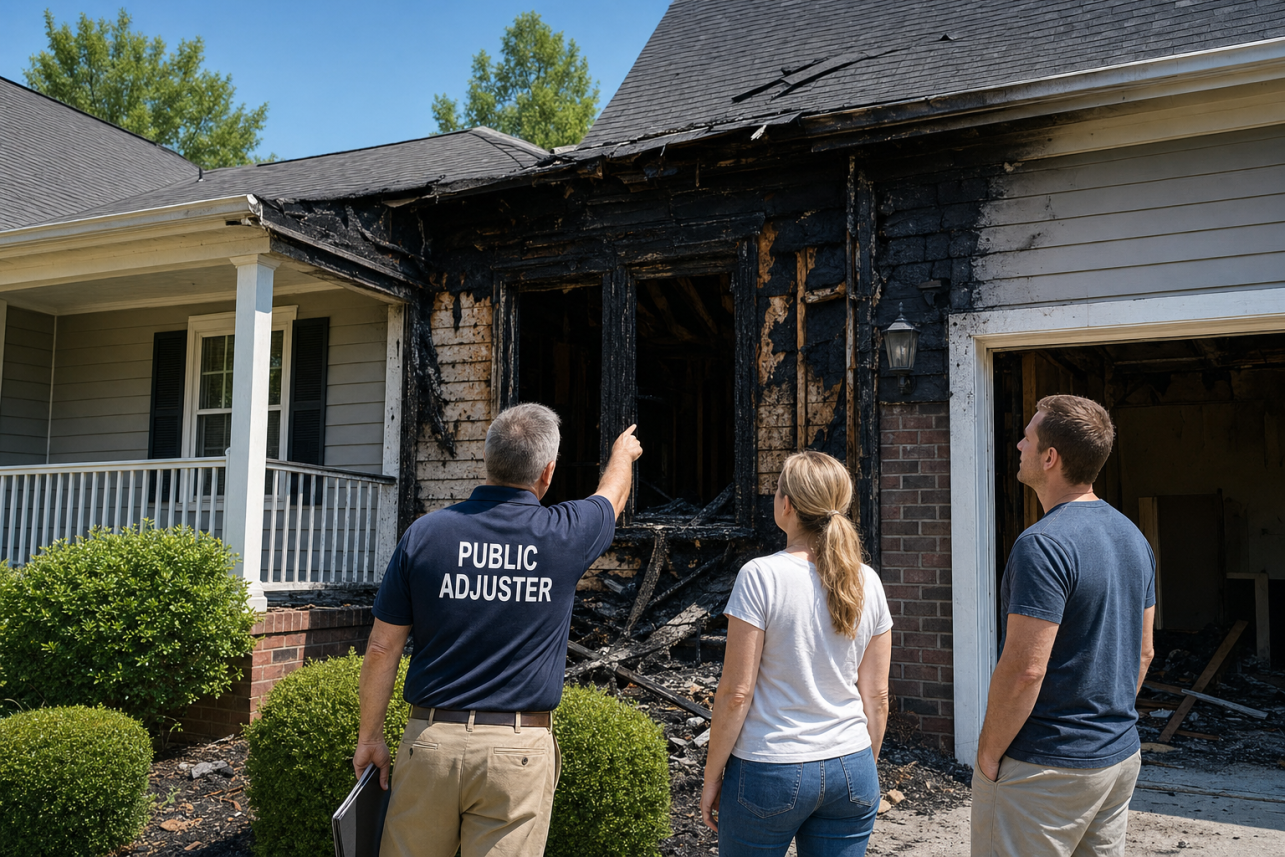
A public adjuster is a licensed insurance professional who works exclusively for the policyholder. The adjuster your insurance company sends works for the insurer. We read your policy the way it's written, inspect and document the damage independently, prepare a detailed estimate, and negotiate with the carrier on your behalf.
The North Carolina Department of Insurance regulates our profession, and the NCDOI Public Adjusters Guide explains exactly what a licensed adjuster may and may not do — including the requirement to be licensed and bonded, which we are. That oversight exists because the difference between a carrier's first offer and a properly documented claim can be substantial.
Courts have long backed policyholders who push back on narrow readings of their coverage. In Farmers Insurance Co. of Oregon v. Trutanich, the court sided with the property owner, holding that persistent odor contamination was real physical damage the insurer had to pay for — a ruling that still matters today for smoke damage claims where carriers try to dismiss what they can't see. We handle residential homeowners claims, commercial business claims, fire, smoke, water, tree damage, vandalism, arson-related homeowners claims, car-hits-home losses, and both standard flood damage claims and NFIP flood claims. We do not handle cell phone, motor vehicle, health, or life insurance matters.
Common Problems
What Does Hiring A Pittsboro Public Adjuster Cost — And Is It Worth It On My Claim?
We work on a contingency percentage of the claim settlement, so there's no upfront fee and no hourly billing. If the claim doesn't pay, we don't get paid.
The real question is value. Carrier estimates often miss hidden damage — moisture inside wall cavities after a pipe burst, smoke residue in HVAC systems, structural issues where a tree struck the roofline. A thorough, independent estimate frequently uncovers covered damage the first inspection skipped.
We can't promise a specific dollar outcome — no honest adjuster can — but we can promise the claim will be fully documented and every applicable coverage in your policy will be pursued.
My Insurance Company Is Delaying, Lowballing, Or Disputing My Claim. What Now?
This is the most common reason Chatham County homeowners call us. The carrier's estimate comes in far below contractor bids, or weeks pass with requests for the same paperwork, or coverage is denied based on a policy exclusion you've never heard of.
You have options. Every dispute point — scope of damage, cause of loss, pricing, depreciation — can be challenged with proper documentation. We build the file the way an insurer's own adjusters are trained to read it: line-item estimates, photographs, moisture readings, contents inventories.
Even if you've already received an offer or a denial, most claims can be reopened or supplemented. It's rarely too late to bring in representation.
How Do I Choose A Public Adjuster Pittsboro NC Property Owners Can Trust?
Start with licensing. North Carolina requires public adjusters to be licensed and bonded, and you can verify any license directly with the state. Never sign with anyone who shows up unsolicited after a fire and pressures you on the spot.
Ask what types of losses they actually handle. Fire, smoke, water, flood, and tree damage claims each require different documentation, and NFIP flood claims follow their own federal rules and deadlines that differ sharply from a standard homeowners policy.
A good adjuster explains your policy in plain English, gives you a written fee agreement, and communicates throughout. If you're comparing doing it yourself versus hiring help, remember the carrier negotiates claims every day — most homeowners do it once or twice in a lifetime.

Our Process
Free Policy Review And Damage Assessment
We start by reading your actual policy — dwelling coverage, contents, additional living expenses, ordinance and law provisions — then inspect the damage in person. This tells us what the claim is genuinely worth pursuing and whether hidden damage was missed. There's no cost or obligation for this review.
Documentation And Independent Estimate
We photograph and measure everything, inventory damaged contents, and prepare a detailed line-item estimate using the same estimating standards insurers use. For flood losses, we build the file to National Flood Insurance Program (NFIP) requirements, including the proof-of-loss deadlines that catch so many policyholders off guard.
Negotiation And Settlement
We present the claim to your carrier, meet their adjuster on site, and negotiate every disputed line item. You approve any settlement before it's accepted — the decision is always yours. We keep you informed at every step until the claim is resolved.
| What Happens | Handling It Yourself | With Our Team |
|---|---|---|
| Damage documentation | Whatever the carrier's adjuster photographs in one visit | Independent inspection, moisture mapping, engineering reports when structural questions arise |
| Estimate accuracy | You rely on the carrier's numbers with no way to verify them | A line-by-line estimate built in the same software carriers use, priced to local Chatham County contractor rates |
| Policy interpretation | Coverage like matching, code upgrades, and business income often goes unclaimed | The full policy is read and every applicable coverage is pursued in writing |
| Negotiation | One homeowner against a trained claims department | A licensed advocate who negotiates carrier-to-adjuster with documentation, not opinions |
| Your time | Weeks of calls, emails, and reinspections on your schedule | We manage communication and meetings; you review and approve decisions |
| Cost | Free, but underpayments on similar claims often reach five figures | A percentage of the recovery — you pay nothing unless the settlement improves |
Commonly Overlooked In The Public Adjusting Industry
- Ordinance and law coverage for code upgrades — Chatham County permitting can require updated electrical, framing, or egress work during repairs, and carrier estimates almost never include it unless someone specifically invokes that coverage.
- Matching of continuous flooring and siding — Carriers price a patch in the middle of a room or wall, and homeowners don't know North Carolina claim practices often support replacing the entire continuous surface when a match doesn't exist.
- Moisture trapped in wall cavities after 'completed' drying — Surface readings look fine while insulation and framing stay wet, and by the time mold appears the carrier argues the damage is new and unrelated.
- Contractor overhead and profit on multi-trade repairs — When a loss needs three or more trades, general contractor overhead and profit is owed on the estimate, but carriers quietly omit it unless it's demanded in writing.
- Depreciation recovery deadlines on replacement cost policies — The withheld depreciation is only paid after repairs are completed and documented within the policy's time limit, and thousands of dollars expire because no one told the policyholder the clock was running.
- Business income and extra expense coverage on commercial policies — Owners focus on the physical damage and never realize their policy pays for lost revenue and temporary relocation during repairs.
- Soft-metal evidence in hail claims — Inspectors who only look at shingles miss dented gutters, vents, and flashing — the collateral proof that turns a 'no hail damage' denial into an approved roof.
- Documenting mitigation efforts in real time — Policyholders tarp, dry, and clean without saving call logs, receipts, or photos, then face a 'failure to mitigate' argument they can't rebut months later.
Case Studies
Case Study #1
Situation: A retired couple in Fearrington Village came home from a weekend trip to find their supply line to the second-floor washing machine had burst, sending water through the ceiling into the kitchen and hardwood-floored dining room below.
Problem: Their carrier's initial estimate came in at $18,400 — enough to dry the structure and patch drywall, but nothing for matching the discontinued hardwood flooring, the custom kitchen cabinetry that had wicked water at the toe kicks, or code-required electrical work behind the wet walls.
Investigation: We brought in moisture mapping equipment and documented elevated readings in wall cavities the carrier's adjuster never opened. We pulled the flooring specification, confirmed the plank profile was no longer manufactured, and obtained written confirmation from two suppliers that a matching product did not exist.
Findings: The saturation extended roughly eleven feet beyond the carrier's drying perimeter. Under North Carolina's matching considerations and the policy's replacement cost language, the continuous hardwood flooring through the kitchen, dining room, and hallway had to be replaced as one surface — not patched in the middle of the room.
Solution: We rewrote the estimate line by line in the same estimating software the carrier used, submitted the moisture logs and supplier letters as supporting documentation, and requested a joint reinspection with the desk adjuster's field representative.
Outcome: The claim settled at $61,700 — more than three times the original offer — covering continuous flooring replacement, cabinet box replacement rather than refinishing, and the electrical upgrades required to close permits in Chatham County.
Lesson: The first estimate is a starting point built on what the carrier's adjuster could see in one visit. Hidden moisture and matching rules are where most water claims are underpaid, and both require documentation the homeowner rarely knows to collect.
Case Study #2
Situation: A small business owner operating a shop just off Hillsboro Street took a direct hit when a summer thunderstorm sent a mature loblolly pine through the rear of the building's roof, crushing trusses and exposing inventory to two days of rain before tarping was complete.
Problem: The carrier treated it as a simple roof repair, offering about $27,000, and denied most of the business personal property claim on the grounds that the owner 'failed to mitigate' — even though no tarping crew in the area was available for 48 hours after the storm.
Investigation: We documented the owner's mitigation timeline with call logs and texts to three tarping contractors, photographed the truss damage with a structural engineer's report, and inventoried the damaged stock item by item with purchase invoices and replacement quotes.
Findings: The engineer confirmed three trusses were compromised beyond repair, requiring engineered replacement rather than sistering. The mitigation record showed the owner acted as fast as any reasonable person could during a storm event that had crews booked across the county. The policy also carried business income coverage no one had mentioned.
Solution: We submitted a rebuttal to the mitigation denial with the documented timeline, presented the engineering report to support structural replacement, and filed a business income claim covering the six weeks the rear of the shop was unusable.
Outcome: The final settlement reached $112,000: full structural roof replacement, the complete inventory loss paid, and business income for the closure period. The mitigation denial was withdrawn in writing.
Lesson: Carriers sometimes deny based on assumptions rather than evidence. A documented timeline and a professional inventory can reverse a denial — and many policyholders never realize they carry business income coverage until someone reads the full policy.
| Your Situation | Should You Get Help? | What It Depends On |
|---|---|---|
| Carrier's offer feels low but you're not sure | Yes — get a free review before signing anything | Whether the estimate includes matching, code upgrades, and hidden damage; most first offers don't |
| Claim denied outright | Yes, and quickly | The stated denial reason and your policy deadlines — denials for 'wear and tear' or 'failure to mitigate' are frequently reversible with evidence |
| Small, clean claim under your deductible margin | Probably not worth a fee | If the offer already covers documented repairs and there's no hidden damage, self-handling is fine |
| Tree or wind damage with possible structural issues | Yes — before repairs begin | Whether trusses, rafters, or framing are compromised; carriers routinely price structural work as cosmetic patching |
| Water damage that was dried but walls were never opened | Yes — get moisture readings first | Whether saturation reached wall cavities and insulation; mold and rot claims are harder to make after the fact |
| Business property damaged and revenue interrupted | Yes | Whether your policy includes business income and extra expense coverage — coverages carriers rarely volunteer |
| Carrier has gone silent for weeks | Yes | North Carolina claim-handling timelines; a licensed advocate can force written responses and escalate delays |
| Already accepted and cashed a settlement check | Maybe — call before assuming it's over | Whether the claim can be supplemented or reopened, which depends on the policy language and what was released |
Reviews
After the pipe burst in our laundry room, our insurance company offered barely enough to dry things out. For The Public Adjusters found moisture in walls their adjuster never checked and fought for our hardwood floors to be replaced across the whole downstairs instead of patched. The final settlement was more than triple the first offer. We could never have done this ourselves.
Marianne T., Fearrington Village
A pine came down on our garage during that April storm and the carrier's estimate didn't even cover the framing. These folks brought out an engineer, redid the whole estimate, and handled every call with the insurance company so I didn't have to. Worth every penny of the fee — the increase covered it many times over.
Doug R., Pittsboro
I hired them after my hail claim was denied outright. They reinspected the roof, documented soft-metal damage the first inspector ignored, and got the denial overturned into a full roof replacement. The only frustration was how long the carrier dragged its feet, but they kept me updated the entire time.
Sheila K., Chatham County
Frequently Asked Questions
What Does A Public Adjuster Pittsboro NC Homeowners Hire Actually Do For Me?
A public adjuster works exclusively for you, the policyholder — never for the insurance company. When your home off Hillsboro Street or your farm property outside town suffers damage, the insurance carrier sends its own adjuster to evaluate the claim. That adjuster's job is to protect the insurer's bottom line. Our job is to protect yours.
For The Public Adjusters, Inc. handles the entire claim from start to finish. We document the damage in detail, review your policy language line by line, prepare a professional estimate using the same software carriers use, and negotiate directly with the insurance company on your behalf. You don't have to sit through inspections alone or argue over lowball figures.
In Chatham County, we regularly see claims involving wind and hail damage to roofs, fallen trees from summer storms, water intrusion, pipe bursts in older homes, and fire and smoke losses. Rural properties around Pittsboro often include outbuildings, barns, wells, and fencing that carrier adjusters overlook or undervalue — we make sure every covered item is included.
We also handle the paperwork deadlines that trip up so many homeowners. North Carolina policies contain strict proof-of-loss requirements and time limits, and missing one can jeopardize your recovery. Hiring a licensed advocate early in the process typically means a better-documented claim, a stronger negotiating position, and in most cases a significantly higher settlement than you would receive on your own.
How Much Does It Cost To Hire A Claims Advocate In Pittsboro, And How Are Fees Structured?
We work on a contingency fee basis, which means you pay nothing up front and nothing out of pocket. Our fee is a percentage of the settlement we recover for you, agreed to in writing before any work begins. If we don't recover money on your claim, you don't owe us a fee.
North Carolina regulates how licensed adjusters may charge policyholders, and our contracts comply fully with state requirements. You'll see the exact percentage spelled out clearly — no hidden costs, no hourly billing, no surprise invoices after the claim closes.
Many Pittsboro homeowners worry that a fee will leave them with less money than handling the claim themselves. In our experience, the opposite is almost always true. Carrier estimates on Chatham County properties frequently miss code-upgrade costs, matching requirements for roofing and siding, detached structures, and hidden water or smoke damage. When those items are properly documented and negotiated, the increase in the settlement typically far exceeds the fee.
There's also real value in what you don't have to do. You won't spend weeks on hold with the carrier, chasing contractors for estimates, or deciphering policy exclusions. We handle inspections, correspondence, supplements, and negotiations while you focus on getting your home or business back to normal.
If you're unsure whether your claim is worth pursuing, we offer a free, no-obligation review. We'll look at your policy, your damage, and any offer the carrier has made, and give you an honest assessment before you sign anything.
My Insurance Company Already Made An Offer On My Chatham County Claim. Is It Too Late To Get Help?
No — in most cases it is not too late. Receiving an offer, or even cashing a partial payment, does not automatically close your claim in North Carolina. As long as you're within the policy's time limits, a claim can usually be reopened or supplemented when new documentation shows the original settlement was inadequate.
This situation is one of the most common reasons Pittsboro and Chatham County homeowners call us. The carrier's first estimate often covers only the obvious surface damage. What it tends to miss: full roof replacement when repairs can't match existing shingles, water damage inside wall cavities, HVAC and electrical issues after lightning or fire, and damage to fences, sheds, and barns common on rural properties around Highway 64 and 15-501.
When we take on an underpaid claim, we start with a fresh, independent inspection and a complete review of your policy. We then prepare a detailed supplemental estimate and present it to the carrier with photographs, measurements, and supporting documentation. Insurers respond very differently to a professionally prepared demand than to a homeowner's phone call.
One important caution: don't sign a full release or accept language stating the payment is a 'final settlement' without having it reviewed first. And be aware that policy deadlines for disputing a claim do run, so the sooner you act, the more options you have. Bring us the carrier's estimate and your policy, and we'll tell you plainly whether there's additional money on the table.
How Long Does The Claims Process Take With A Public Adjuster Pittsboro NC Residents Can Trust, And What Should I Expect?
Timelines vary with the size and complexity of the loss, but working with an experienced public adjuster Pittsboro NC property owners rely on generally makes the process faster and far less stressful — even when it takes similar calendar time, because we're doing the work instead of you.
Here's the typical flow. First, we meet at your property for a free evaluation and review your policy. Straightforward claims — a hail-damaged roof, a single-room water loss — often resolve in four to eight weeks once we submit our documentation. Larger losses, like a house fire or extensive storm damage, can run several months, particularly if the carrier disputes scope or pricing.
After you retain For The Public Adjusters, Inc., we notify your insurer that we represent you, and from that point forward the carrier communicates with us. We complete a thorough inspection, prepare a line-item estimate, and schedule a joint walkthrough with the company adjuster so disagreements get resolved at the property, not through months of letters.
North Carolina requires insurers to acknowledge and respond to claims within reasonable timeframes, and we hold them to it. When a carrier drags its feet, we escalate — through supplements, appraisal demands when the policy allows, or complaints to the NC Department of Insurance if warranted.
Throughout the process you'll get regular updates in plain English. You'll always know where your claim stands, what the carrier has offered, and what we're pursuing next. Our goal in every Chatham County claim is the same: full policy benefits, recovered as quickly as the facts allow.
What Types Of Property Damage Claims Does A Public Adjuster Pittsboro NC Property Owners Rely On Typically Handle?
For The Public Adjusters, Inc. handles the full range of property claims that hit Chatham County homes and businesses. That includes wind and hail damage from the severe thunderstorms that roll through the Piedmont each spring, water damage from burst pipes and appliance failures, fire and smoke losses, tree impact damage, and lightning strikes.
We also take on hurricane-related claims. Pittsboro sits far enough inland that many carriers downplay tropical storm damage, but remnants of coastal systems regularly bring damaging wind and flooding rain up the Highway 64 and 15-501 corridors. We know how to document that damage properly and connect it to the covered event.
Commercial claims are a significant part of our work as well. Businesses along the courthouse circle, in Chatham Park, and out toward Moncure face business interruption losses on top of physical damage, and those calculations are where carriers most often underpay. We prepare the income documentation and extra-expense figures the policy actually entitles you to.
One category worth mentioning: older homes. Pittsboro has a large stock of historic and mid-century houses, and repairing them to pre-loss condition often costs far more than a standard carrier estimate assumes. Matching original materials, meeting current Chatham County code requirements, and handling plaster, true-dimension lumber, or older roofing systems all change the numbers. We build estimates that reflect what restoration in this town actually costs, not a software default.
How Is Your Role Different From The Adjuster My Insurance Company Sends Out?
The adjuster your carrier sends works for the insurance company. That person may be professional and courteous, but their job is to settle your claim within the carrier's guidelines, and their estimate is written with the company's interests in mind. Many are also catastrophe adjusters from out of state who have never priced a roof replacement or interior rebuild in Chatham County.
We work exclusively for you. North Carolina licenses public adjusters specifically to represent policyholders, and we owe no duty to the insurer. Our job is to read your entire policy, identify every coverage that applies, document the full scope of damage, and negotiate until the settlement reflects what it genuinely costs to restore your property here in Pittsboro.
The practical differences show up quickly. A carrier adjuster might spend forty-five minutes on site and photograph the obvious damage. We spend the time needed to find what's not obvious: moisture behind walls, compromised roof decking, smoke residue in ductwork, code-upgrade costs the policy covers. Those items routinely add tens of thousands of dollars to a settlement.
We also handle the paperwork burden. Proof of loss forms, contents inventories, recorded statements, and supplement requests all have deadlines and traps for the unwary. When we're involved, the carrier communicates with us, and you stay focused on your family or your business rather than fighting for a fair number.
My Claim Was Denied. Can Anything Still Be Done, Or Is A Denial Final?
A denial is rarely the end of the road. Insurance companies deny claims for many reasons, and a significant number of those denials don't hold up when someone who knows the policy pushes back with evidence.
The first thing a public adjuster Pittsboro NC policyholders bring in will do is get the denial letter and your full policy, then compare the carrier's stated reason against the actual policy language. Denials often rest on shaky ground: the carrier claims damage is wear and tear when it's actually storm-related, invokes an exclusion that doesn't apply to your specific facts, or relies on a brief inspection that missed the real cause of loss.
From there, we build the case to reopen the claim. That can mean bringing in engineers or specialized contractors, documenting weather data for the date of loss, photographing damage the original inspection skipped, and submitting a formal, evidence-backed demand that the carrier reconsider. North Carolina policies also give you appraisal rights in many disputes, which is a powerful tool when the disagreement is about the amount of damage.
Timing matters, though. Policies impose deadlines for disputing decisions and filing suit, and evidence degrades as repairs happen or weather continues. If you've received a denial on a Pittsboro or greater Chatham County property, get the file reviewed promptly. For The Public Adjusters, Inc. evaluates denied claims at no charge, and we'll tell you honestly whether the denial is worth challenging before you commit to anything.
What Should I Do In The First 48 Hours After Damage To My Pittsboro Home Or Business?
The first two days shape the entire outcome of your claim, so a few disciplined steps matter enormously.
First, make the property safe and prevent further damage. Your policy requires reasonable steps to mitigate, so tarp an open roof, shut off water to a burst pipe, and board broken windows. Keep every receipt for tarps, fans, temporary repairs, and hotel stays; those costs are typically reimbursable.
Second, document everything before anything gets moved or thrown away. Take wide shots of each room, then close-ups of individual damage. Video walkthroughs with narration work well. If contents are ruined, photograph them before disposal and note brands and approximate purchase dates. In Chatham County, storm debris cleanup often starts fast, and evidence disappears with it.
Third, report the claim to your carrier, but keep the initial report factual and brief: what happened, when, and where. Don't speculate about causes, and don't agree to a recorded statement on the spot. You have the right to prepare first.
Fourth, be cautious with the first contractors and restoration companies who show up, especially after a widespread storm event. Some assignment-of-benefits agreements sign away your control of the claim. Read anything before signing it.
Finally, call us early. Our team serves Pittsboro and the surrounding communities, and involving an advocate from day one means the claim gets documented correctly from the start rather than repaired retroactively. The earlier we're in, the stronger your position with the carrier.
Is A Public Adjuster Pittsboro NC Homeowners Hire Required To Be Licensed, And How Can I Verify Credentials?
Yes. North Carolina requires anyone negotiating insurance claims on behalf of a policyholder for a fee to hold a public adjuster license issued by the North Carolina Department of Insurance. That licensing process includes an examination, a background check, and a surety bond requirement, and licensees must complete continuing education to stay current.
Verifying a license takes about two minutes. Visit the NC Department of Insurance website and use the licensee lookup tool, or call the Department directly and ask whether the individual is licensed and in good standing. Any reputable adjuster will hand over their license number without hesitation — if someone dodges the question, walk away.
At For The Public Adjusters, Inc., we encourage every Pittsboro and Chatham County property owner to check us out before signing anything. We will provide our license information up front, along with references from local claims we have handled.
Be cautious of a common problem after major storms: out-of-state operators and contractors who show up offering to "handle your claim." In North Carolina, a contractor cannot legally negotiate your insurance claim unless they hold a public adjusting license, and mixing repair contracts with claim negotiation creates a conflict of interest. Working with a licensed, independent advocate keeps the person fighting for your settlement separate from the person profiting from the repair work — which is exactly how it should be.
Is My Claim Big Enough To Justify Hiring A Claims Professional In Pittsboro, Or Is It Only Worth It For Major Losses?
There is no strict dollar minimum, but there is a practical one. Because fees are typically a percentage of the recovery, representation makes the most sense when the damage is significant, complex, or when you suspect the insurer's estimate is well below the real cost of repairs.
As a rough guide, claims involving structural damage, water intrusion into walls or flooring, fire and smoke, roof replacement, or business interruption almost always benefit from professional handling. These losses involve hidden damage, code-upgrade costs, and pricing disputes that carriers routinely undervalue. In Chatham County, we frequently find that repair costs on older homes around Pittsboro's historic core run well above what a carrier's software estimate allows, because materials and craftsmanship on those properties are not standard-grade.
For a very small claim — a few hundred dollars over your deductible — hiring anyone probably does not make financial sense, and we will tell you that honestly during a free consultation.
The smarter question is often not the size of the claim but the size of the gap. If your insurer offered $12,000 and your contractor says the work costs $30,000, that gap is worth pursuing regardless of the total claim value. We review your estimate, inspect the damage ourselves, and give you a straight answer about whether representation will put meaningfully more money in your pocket. If it will not, you will hear that from us before any contract is signed.
Once I Hire Your Firm, Do I Still Have To Deal With My Insurance Company Myself?
For the most part, no — and that is one of the biggest reliefs our clients describe. Once you sign a representation agreement and we send the insurer a letter of representation, the carrier is required to direct claim communications through our office. The phone calls, emails, document requests, and estimate disputes land on our desk instead of yours.
There are a few things only you can do as the policyholder. You may need to sign certain documents, such as a sworn proof of loss, and if the carrier requests an examination under oath, you would attend — though we prepare you thoroughly beforehand. You also make every final decision: we negotiate and advise, but no settlement is accepted without your approval.
We handle the technical heavy lifting. That means documenting the loss with photos, moisture readings, and measurements; preparing a detailed line-item estimate; meeting the insurance company's adjuster at your Pittsboro property so damage is not overlooked; and pushing back in writing when the carrier's numbers fall short.
You stay informed the entire way. We provide regular updates and are a phone call away when questions come up — and because we work throughout Chatham County, we are on-site quickly when an inspection or re-inspection is scheduled. Most clients tell us the reduced stress alone was worth it, separate from the larger settlement. You get your time and peace of mind back while the claim is fought properly.
My Settlement Mentions 'recoverable Depreciation.' Can A Public Adjuster Pittsboro NC Property Owners Work With Help Me Get That Money Back?
Absolutely — and this is an area where a public adjuster Pittsboro NC families rely on earns their fee many times over. Most homeowner policies pay claims in two stages. First, the insurer issues payment for actual cash value (ACV), which is the replacement cost minus depreciation for age and wear. The withheld portion, called recoverable depreciation, is paid only after you complete the repairs and submit proof.
Problems show up in both stages. Carriers sometimes apply aggressive depreciation percentages — depreciating a fifteen-year roof as if it were thirty years old, for example — which shrinks your initial check unfairly. Then, at the second stage, homeowners lose recoverable depreciation entirely because they miss deadlines, fail to submit the right invoices, or never realized more money was owed. In North Carolina, policies typically set time limits for completing repairs and claiming those funds, so the clock matters.
We address both ends of the problem. During the claim, we challenge inflated depreciation with documentation of your property's actual age and condition. After repairs, we compile the contractor invoices, completion certificates, and correspondence needed to release every withheld dollar.
We also review whether your policy pays replacement cost at all, and whether ordinance-and-law coverage applies — a real issue in Chatham County, where repairs on older Pittsboro homes often trigger current building-code requirements that add thousands to the job. If you are holding an ACV check and are not sure what you are still owed, bring us the paperwork and we will map it out for you.
Can A Public Adjuster Pittsboro NC Storm Victims Call Help With Wind And Hail Damage After A Chatham County Storm?
Yes, and wind and hail claims are among the most commonly underpaid losses we see in Chatham County. The storms that roll through Pittsboro off the Piedmont often leave damage that isn't obvious from the ground — bruised shingles, lifted flashing, dented soft metals, and compromised seals that lead to leaks months later.
Insurance company inspections after a major storm are frequently rushed. When hundreds of homes between Pittsboro, Siler City, and Moncure get hit in the same weather event, carrier adjusters may spend fifteen minutes on a roof that deserves an hour. Damage gets missed, or it gets labeled 'wear and tear' and excluded.
Our team documents storm damage the right way: full roof inspections, moisture readings inside attics and wall cavities, weather data verification tying the damage to the specific storm date, and photographs of every affected slope, elevation, and interior room. That documentation matters, because a claim built on evidence is much harder to underpay.
We also know the local roofing landscape. Replacement costs in Chatham County have climbed significantly in recent years, and carrier pricing software doesn't always keep pace with what Pittsboro-area contractors actually charge. We build estimates using real local pricing, not a database average.
If your roof or siding took a hit and the settlement offer doesn't come close to a contractor's quote — or the claim was denied outright as 'cosmetic' — get a second opinion before you accept anything. The inspection costs you nothing, and it may reveal damage the first adjuster never climbed up to see.
What Is The Appraisal Clause In My Policy, And When Would You Recommend Using It For My Pittsboro Claim?
The appraisal clause is a dispute-resolution tool built into most North Carolina property policies. When you and your insurance company agree that a loss is covered but disagree on how much it's worth, either side can invoke appraisal instead of heading to court.
Here's how it works: you select an appraiser, the carrier selects an appraiser, and those two agree on a neutral umpire. The appraisers each present their valuation of the loss. If they agree, that amount is binding. If they don't, the umpire reviews both positions and a decision signed by any two of the three sets the award.
For Pittsboro homeowners, appraisal can be a powerful option when negotiations stall — especially on larger losses like fire damage or major water events where the gap between the carrier's number and the real repair cost runs into tens of thousands of dollars. It's typically faster and far less expensive than litigation.
That said, appraisal isn't always the first move. It resolves the amount of the loss, not coverage disputes, so if the carrier is denying that damage is covered at all, appraisal won't fix that. It also involves costs, since you pay your appraiser and split the umpire fee.
When we handle a Chatham County claim, we exhaust negotiation first, backed by thorough documentation. Most claims settle without appraisal because the evidence speaks for itself. But when a carrier refuses to move despite clear proof, we'll walk you through whether invoking appraisal makes financial sense for your specific loss — and prepare the file so your position is as strong as possible if you do.
I Own A Business In Downtown Pittsboro. Do You Handle Commercial Claims And Lost Income, Or Only Residential Losses?
We handle both, and commercial claims are often where professional representation makes the biggest difference. If you run a shop near the Chatham County courthouse circle, a restaurant on Hillsboro Street, or a warehouse operation out toward the industrial corridor, a property loss hits you twice — once in physical damage and again in interrupted revenue.
Commercial policies are more complex than homeowner policies. They typically include separate coverages for the building, business personal property, tenant improvements, business income, and extra expense. Each coverage has its own limits, deductibles, and documentation requirements, and carriers scrutinize business interruption claims heavily.
Proving lost income requires financial records: profit-and-loss statements, tax returns, sales data from comparable periods, and payroll documentation. Many business owners undervalue this portion of their claim simply because assembling the proof is overwhelming while they're also trying to reopen. That's exactly where a public adjuster Pittsboro NC business owners bring in earns their fee — building the financial case alongside the property damage case.
We also account for realities specific to smaller markets like ours. Repair timelines in Chatham County can stretch because contractor availability is tighter than in Raleigh or Durham, which extends your period of restoration and increases your legitimate business income claim. Carriers don't always factor that in voluntarily.
Whether your loss involves fire, water, storm damage, or a collapsed roof over your inventory, we document the physical loss, quantify the income interruption, and negotiate both. You focus on your customers and employees; we handle the insurance company.
My Insurer Wants To Replace Only Part Of My Roof, But The New Shingles Won't Match. What Are My Rights In North Carolina?
This is one of the most frequent disputes we handle for homeowners in Pittsboro and the surrounding countryside, and the answer depends on your specific policy language and how the argument is presented.
Here's the typical scenario: a storm damages one or two slopes of your roof, and the carrier offers to replace only those slopes. The problem is that shingle colors and profiles are discontinued constantly, and even the same product weathers over time. A five-year-old roof patched with brand-new shingles can look like a checkerboard — which affects your home's appearance and resale value.
North Carolina does not have a statute mandating matching the way some states do, so the outcome usually turns on your policy wording and negotiation. Some policies contain matching provisions or 'line of sight' language; others are silent, which leaves room to argue. Carriers frequently offer a small 'matching allowance' and hope you accept it.
Our approach is to build the technical case: documentation from shingle manufacturers confirming discontinuation, contractor letters stating a reasonable match cannot be achieved, ITEL or comparable lab reports analyzing the existing material, and photographs demonstrating the visible mismatch. We also look for repair-related damage — brittle shingles that crack during a repair attempt can justify full slope or full roof replacement on their own.
The same fight comes up with siding, especially on homes in Pittsboro's newer subdivisions where builders used products that vanished from the market within a few years. Before you accept a patchwork settlement, have someone review the policy and the materials. A well-documented matching argument often turns a partial repair into a full replacement.
Local Relevance
Pittsboro sits at the crossroads of old and new Chatham County. The historic core of town includes homes that are decades — sometimes a century — old, with aging plumbing, original framing, and roofs that have weathered a lot of North Carolina storms. Meanwhile, rapid growth around town is adding newer construction with its own claim issues, from builder-grade materials to complex modern policies.
The climate here drives most of the claims we see. Humid summers bring severe thunderstorms and lightning-sparked fires. Remnants of Atlantic hurricanes push inland across central North Carolina with heavy rain and gusts strong enough to drop the tall loblolly pines that surround so many local properties. Winter ice storms bring down limbs and power lines, and burst pipes follow hard freezes in older, less-insulated homes.
Water is a constant theme. Heavy rain events can overwhelm drainage near the Haw River corridor and low-lying areas around Jordan Lake, and many homeowners discover too late that their standard policy excludes flood — that's a separate NFIP or private flood policy. When any of these losses hit, having a local advocate who knows both the policies and the region makes a measurable difference in how the claim gets built.
Many Pittsboro-area properties combine older housing stock with mature pine canopy, so a single hurricane remnant or ice storm often produces layered damage — roof puncture, water intrusion, and contents loss — that carriers tend to estimate as three small problems rather than one connected claim. Documenting the loss as a whole, from attic decking to finished ceilings below, is usually where these claims are won or lost.
Talk To A Pittsboro Claims Advocate Before You Settle
Whether your loss just happened or your claim has stalled, a free policy and damage review costs you nothing and tells you exactly where you stand. For The Public Adjusters, Inc. is licensed and bonded, and we only get paid when your claim does. Serving Pittsboro and all of Chatham County.
Call us: (919) 400-6440
Helpful Resources
- NCDOI Public Adjusters Guide
- National Flood Insurance Program (NFIP)
- Federal Emergency Management Agency (FEMA)
- North Carolina Department of Insurance — State regulator overseeing insurance and public adjuster licensing
Our services in this city
- Arson Insurance Claim Pittsboro: When The Insurance Company Points The Finger At You
- Fire Insurance Claim Dispute Pittsboro: When The Insurance Company Won't Pay What The Fire Actually Cost You
- Tree Damage To House Pittsboro NC: Public Adjusters For Severe Structural Damage Claims
- Water Damage Coverage Insurance Pittsboro: When The Insurer's First Check Doesn't Come Close To Your Repair Bill
Last updated: August 5, 2026