Water Damage Claim Denied in NC? Here’s the Quick Answer
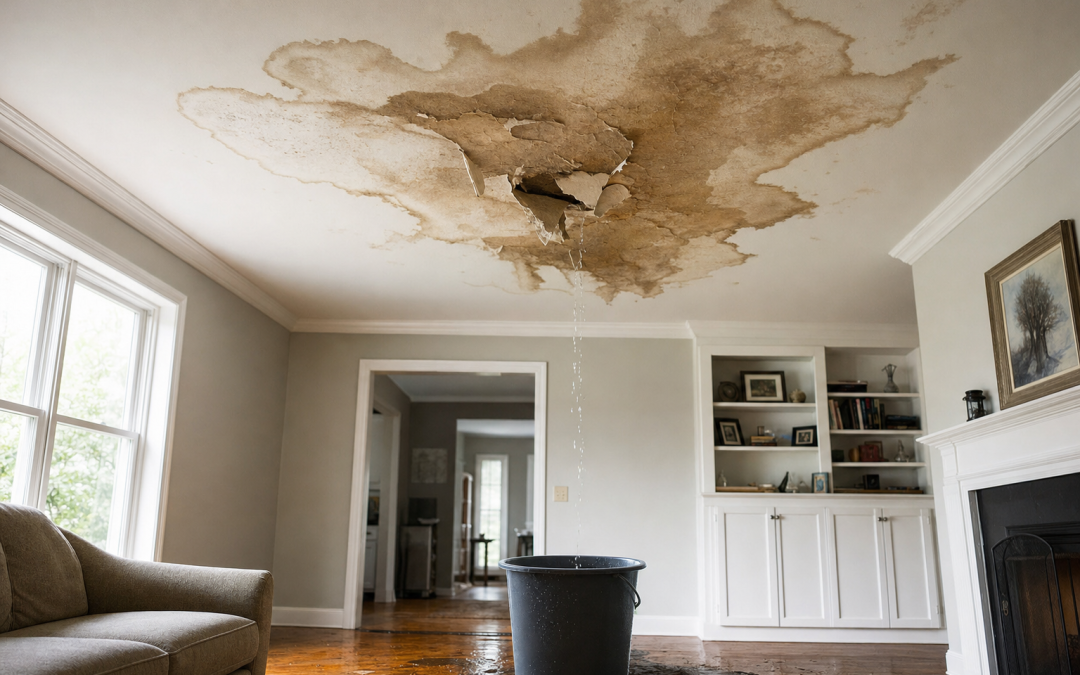
If your water damage claim denied letter just arrived in North Carolina, take a breath: a denial is not the final word. You have the right to request the insurer’s reasons in writing, gather new evidence, demand a re-inspection, and bring in a licensed public adjuster or attorney to challenge the decision.
Key takeaways
- A water damage claim denied in NC is not final — you have the right to request the denial in writing, appeal, and dispute the insurer’s decision.
- Most denials hinge on how the loss is categorized: sudden pipe bursts are typically covered, while gradual leaks and flood (surface water) often are not.
- North Carolina policyholders generally have up to three years to bring a breach-of-contract suit, but some policies shorten that window, so act quickly.
- In Gaston County Dyeing Machine Co. v. Northfield Insurance Co. (N.C. 2000), the North Carolina Supreme Court sided with the insured, finding resulting damage covered even where an excluded cause started the chain of events — proof that denials can be successfully challenged.
- A licensed public adjuster can reinspect the damage, document the true scope of loss, and negotiate on your behalf — at no cost unless the claim is resolved in your favor.
Insurance companies deny water damage claims for all kinds of reasons — some legitimate, many debatable. Adjusters working for the carrier may label your loss as “long-term seepage,” blame a maintenance issue, or lean on policy exclusions that don’t actually fit the facts of your loss. North Carolina courts have long held that ambiguous policy language must be read in favor of the policyholder, which means a confusing or borderline denial is often worth a second look by someone who works for you, not the insurance company.
Why Denials Get Overturned
Many denials fall apart once the claim is properly documented and the policy is read carefully. Common weak points in a denial include:
- Misclassified cause of loss — a sudden pipe burst wrongly labeled as gradual seepage
- Incomplete inspections — the company adjuster never opened walls or checked hidden moisture
- Misapplied exclusions — flood or maintenance exclusions stretched to cover damage they shouldn’t
- Documentation gaps — missing photos, plumber reports, or moisture readings that can still be collected
A licensed, bonded public adjuster can review the denial letter, re-document the damage, and negotiate directly with the carrier on your behalf. While no one can promise a specific outcome, homeowners who push back with solid evidence are frequently in a far stronger position than those who simply accept the first answer. If you’re in Chatham County, for example, our team provides water damage insurance claim help in Bennett for exactly these situations.
Why Fall Is Prime Time for Water Claims in North Carolina
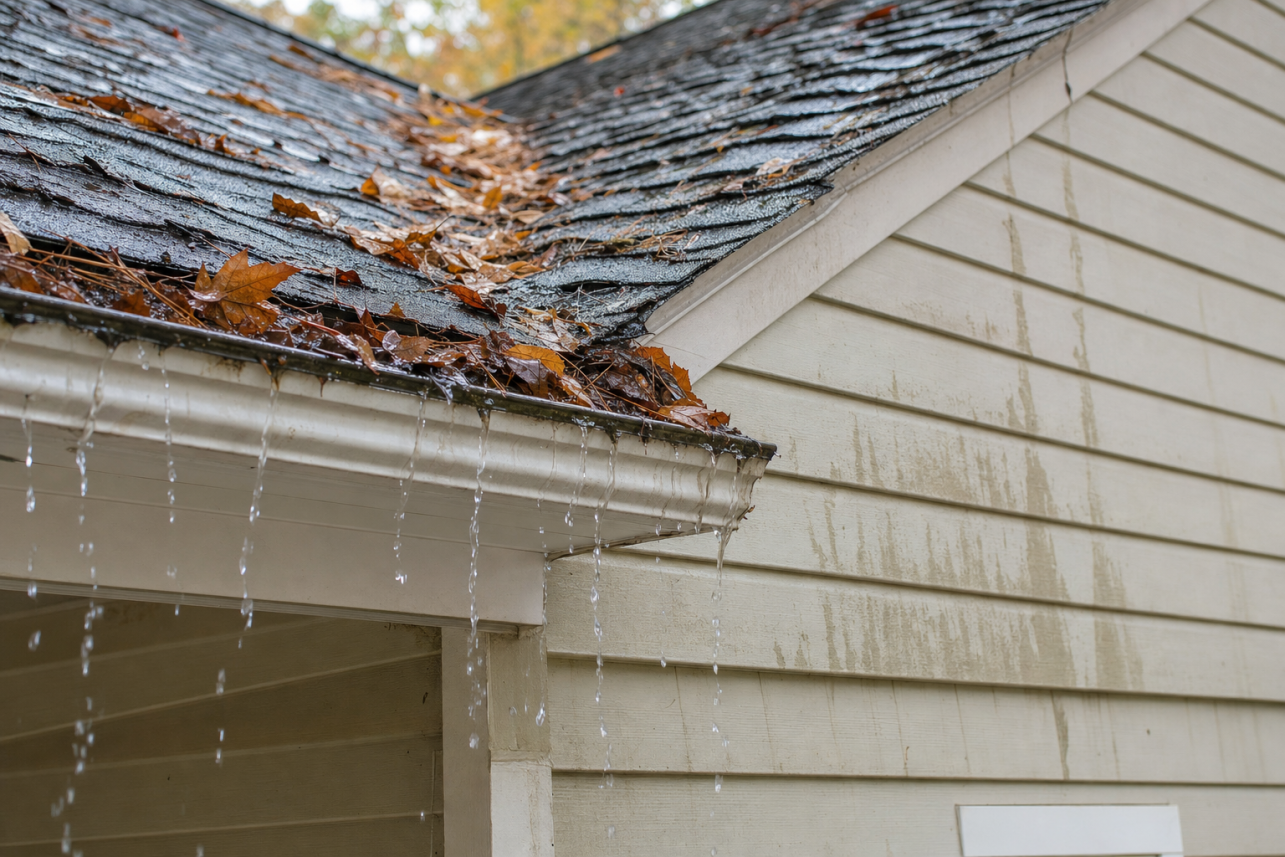
Right now, the timing matters. Early cold snaps across the Piedmont and foothills can freeze and burst pipes in crawl spaces, attics, and exterior walls before homeowners have winterized. At the same time, leaf-clogged gutters send rainwater over the edge and down into fascia, soffits, siding, and foundations. Insurers see a wave of water claims every fall — and with that wave comes a wave of denials, often issued quickly and without a thorough inspection.
If a cold-weather pipe burst or gutter overflow has already soaked your home, don’t let a fast denial decide the outcome. A public adjuster for water damage in Bear Creek and the surrounding area can evaluate whether your denial deserves a fight. In the sections below, we’ll walk through why denials happen, the exact steps to take next, and how to protect your home — and your future claims — this fall.
Why Do Insurance Companies Deny Water Damage Claims?
Insurance companies most often deny water damage claims by labeling the loss as gradual damage, a maintenance issue, a pre-existing leak, or excluded groundwater or flooding. Late reporting is another frequent reason. Many of these denials rest on how the adjuster interprets your policy — and that interpretation is not always correct or final.
Understanding the exact reason behind your denial is the first step toward challenging it. Here are the most common denial categories homeowners in North Carolina encounter, in plain language.
“Gradual Damage” and Maintenance Exclusions
Most homeowners policies cover sudden and accidental water damage — a burst pipe, a failed supply line — but exclude damage that happens slowly over weeks or months. Insurers sometimes stretch this exclusion, arguing that a sudden pipe failure must have been leaking gradually, which shifts the blame to you as a maintenance failure. The distinction between “sudden” and “gradual” is often debatable, and homeowners pursuing a water insurance claim in Siler City and across Chatham County frequently find that a second, independent review tells a different story than the insurer’s first inspection.
Late Reporting and Alleged Pre-Existing Leaks
- Late reporting: Policies require “prompt” notice. If you discovered damage behind a wall months after the leak started, the insurer may argue you reported too late — even though you reported as soon as you reasonably could have known.
- Pre-existing damage: Insurers may claim staining, warping, or mold existed before your policy period, often based on limited visual evidence rather than proof.
Groundwater and Flood Exclusions
Standard homeowners policies exclude flooding, surface water, and water that seeps up through foundations. But not all water on the ground is “flood” water under the policy’s definition. If a plumbing failure or roof breach caused the water, the flood exclusion may not apply — yet denials sometimes lump everything together. Courts have pushed back on overly broad readings of exclusions; in Hughes v. Potomac Insurance Co., a California appellate court sided with homeowners whose dwelling claim was denied on a narrow interpretation of policy language, holding that coverage terms must be read reasonably in the policyholder’s favor when ambiguous.
How Fall Conditions Get Mislabeled as Neglect
Autumn in North Carolina brings two common triggers: clogged gutters that push water under roofing or against fascia, and early cold snaps that freeze pipes in crawl spaces. Insurers sometimes characterize the resulting damage as “failure to maintain” — even when gutters were cleaned recently or the freeze was unexpected. If your denial letter uses words like “neglect” or “wear and tear,” don’t assume the insurer’s conclusion is accurate. Licensed professionals who provide water damage claim help in Bynum and nearby communities regularly document the true cause of loss and find that seasonal events were sudden, covered occurrences — not neglect.
Knowing which of these reasons appears in your denial letter shapes everything you do next, which we cover in the following section.
What Should I Do Right After My Water Damage Claim Is Denied?
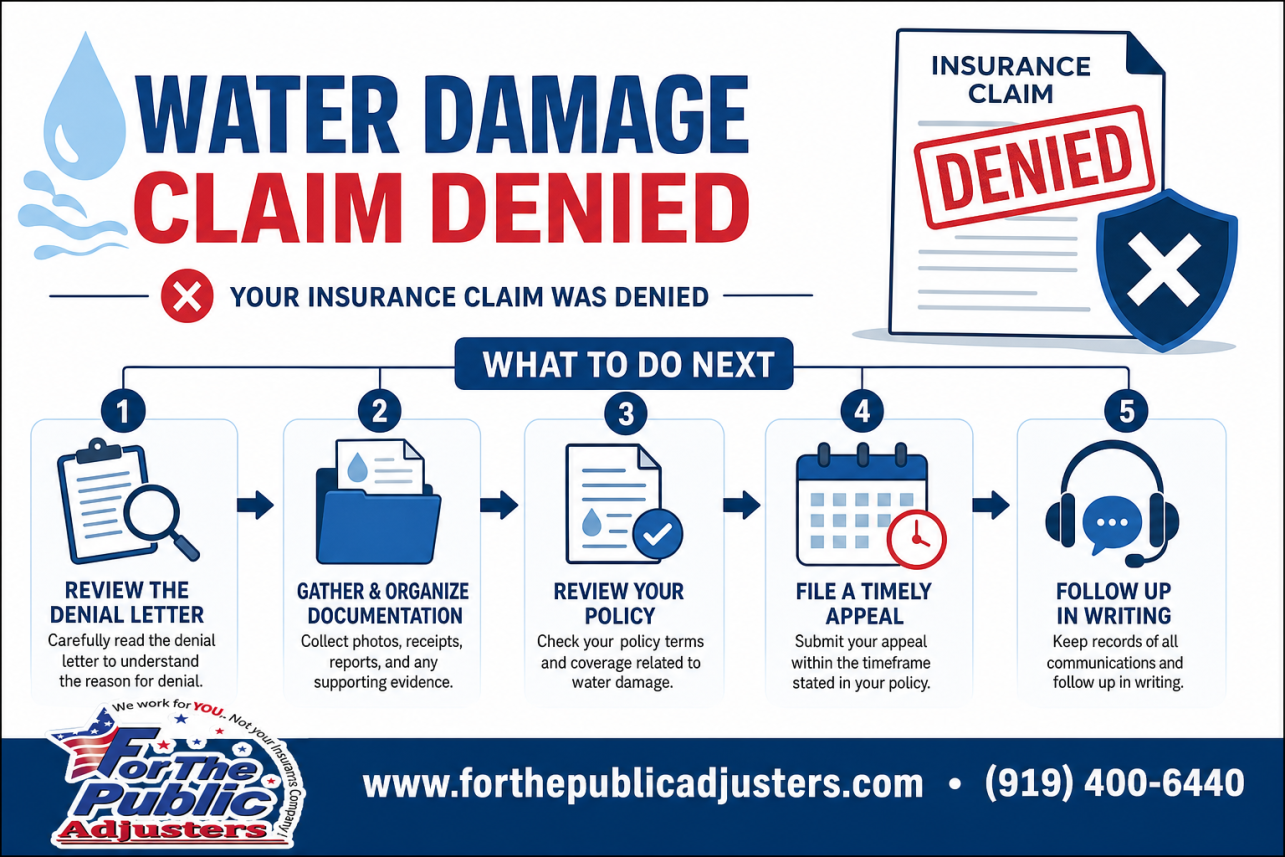
Act quickly and methodically: request the denial in writing, re-read your policy’s water damage provisions, photograph and preserve all evidence of the loss, take reasonable steps to stop further damage, and ask the insurer for copies of its inspection reports. Deadlines to dispute a water damage claim denial run from the denial date, so start now.
A denial letter is not the end of the conversation — it is the starting point for your response. The steps you take in the first days and weeks often determine whether a dispute succeeds. Here is a clear action plan.
Step 1: Get the Denial in Writing
If you were told over the phone that your claim was denied, politely insist on a written denial letter that cites the specific policy language the insurer is relying on. In North Carolina, you are entitled to know the reason for the denial. Vague explanations like “wear and tear” or “maintenance issue” are much harder to challenge until they are pinned down in writing.
Step 2: Review the Exact Policy Language
Request a complete certified copy of your policy, including all endorsements, and compare the cited exclusion to the actual facts of your loss. North Carolina courts have long held that ambiguous policy language must be construed in favor of the policyholder, so an exclusion that seems airtight to the insurer may not hold up under scrutiny. Many homeowners pursuing a water insurance claim in Siler City have found that the denial rested on an exclusion that didn’t actually apply to their situation.
Step 3: Document and Preserve Everything
- Take dated photos and videos of all damaged areas, materials, and contents — even items already set aside for disposal.
- Keep damaged pipes, fittings, or appliance parts; they are physical evidence of the cause of loss.
- Save plumber invoices, moisture readings, drying logs, and any repair estimates.
- Keep a written log of every call, email, and letter with the insurer, including names and dates.
Step 4: Stop Further Damage — Safely
Your policy still requires you to mitigate, even after a denial. Dry the area, shut off the water source, and make reasonable temporary repairs — but keep receipts and photograph conditions before and after. Do not begin permanent repairs until the dispute is resolved, since that can destroy evidence you will need.
Step 5: Request the Insurer’s Inspection Reports
Ask in writing for copies of the adjuster’s report, any engineer or leak-detection findings, and photos the insurer relied on. These documents often reveal gaps or assumptions you can challenge. If reviewing them feels overwhelming, professionals who provide water damage claim help in Bynum and surrounding North Carolina communities regularly analyze these reports for policyholders.
Finally, calendar every deadline in your denial letter and policy. Appeal windows and suit-limitation periods pass quickly, and missing one can close the door on an otherwise strong claim.
Can I Fight a Denied Water Damage Claim and Win?
Yes. North Carolina law protects policyholders from unfair claim handling, and homeowners have successfully challenged insurers in court. A water damage claim denied by your carrier is not the final word — it is the insurer’s opening position, and with the right evidence and advocacy, denials are often reversed or renegotiated.
North Carolina’s Unfair Claims Settlement Practices Law
Under North Carolina’s unfair and deceptive trade practices framework, insurance companies are prohibited from engaging in unfair claims settlement practices. Among other things, insurers generally may not:
- Misrepresent what your policy covers or the facts of your claim
- Fail to conduct a reasonable investigation before denying a claim
- Refuse to pay a claim without a reasonable basis
- Fail to promptly explain, in writing, the specific policy language supporting a denial
- Force you to file a lawsuit by offering substantially less than your claim is reasonably worth
When an insurer crosses these lines, North Carolina courts can hold them accountable — sometimes for far more than the original claim amount.
A Real Case: Guessford v. Pennsylvania National Mutual Casualty Insurance Co.
One of the clearest examples of policyholder leverage in North Carolina is Guessford v. Pennsylvania National Mutual Casualty Insurance Co., a federal case out of the Middle District of North Carolina. The homeowner suffered significant property damage to his house, and the insurer’s handling of the claim — including lowball valuations and drawn-out, inadequate responses — left him far short of what the loss was actually worth. Rather than accepting the insurer’s numbers, the homeowner pushed back and pursued claims that the carrier had engaged in unfair and deceptive claim practices under North Carolina law. He prevailed against the insurance company, and the case stands as a reminder that insurers who mishandle or undervalue property claims can face real consequences in court.
The lesson for homeowners is simple: a denial or a lowball offer backed by a flawed investigation is challengeable. Documentation, persistence, and knowledgeable representation — like the water damage claim help in Bynum and surrounding communities that licensed professionals provide — can shift the balance back toward the policyholder.
What Winning Actually Looks Like
Fighting back doesn’t always mean a courtroom. Most successful challenges are resolved through:
- Re-inspection and re-evaluation once new evidence is presented
- Appraisal, a policy-based process for resolving disputes over the amount of loss
- Negotiated settlements after the insurer’s position is professionally contested
- Litigation, as a last resort, where cases like Guessford show courts will side with wronged policyholders
No one can guarantee a specific outcome in any claim, but the law gives you genuine standing. Working with a licensed, bonded public adjuster in Selma NC or anywhere across the Triangle puts someone on your side who documents the loss properly and holds the insurer to its legal obligations.
How Can a Public Adjuster Help With a Denied Water Damage Claim?
A licensed, bonded North Carolina public adjuster works solely for you, not the insurance company. On a denied claim, they conduct an independent damage inspection, map moisture to show how water actually traveled, analyze your full policy, challenge weak denial reasons like “gradual damage,” and prepare a documented, re-opened claim for the insurer to review.
When your water damage claim denied letter arrives, it can feel like the final word. It usually isn’t. A public adjuster’s job is to rebuild the claim from the ground up with evidence the insurance company’s own adjuster may never have gathered.
What a Public Adjuster Actually Does on a Denied Claim
- Independent damage inspection. A fresh, top-to-bottom walkthrough of the loss — walls, flooring, subfloor, insulation, cabinetry, and contents — documented with photos and detailed notes rather than a quick visual scan.
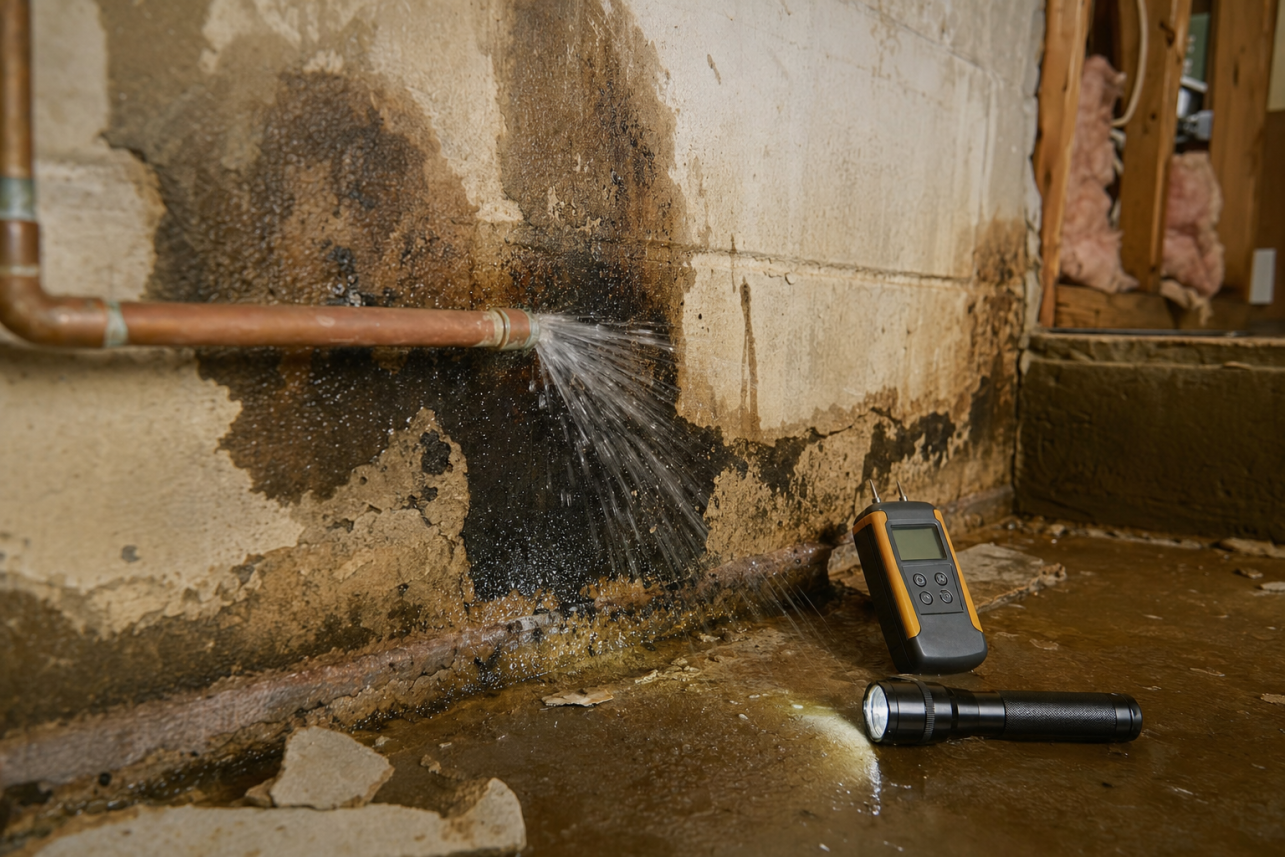
- Moisture mapping. Using moisture meters and readings taken room by room, the adjuster traces where water traveled and how far it penetrated. This technical record often reveals hidden damage the carrier’s estimate ignored.
- Line-by-line policy analysis. Denials frequently lean on exclusions that don’t actually fit the facts. Your adjuster reads the full policy — including endorsements — to identify coverage the denial letter overlooked. North Carolina courts have long held that ambiguous policy language is construed in favor of the policyholder, which matters when an exclusion is being stretched to fit your loss.
- Rebutting the “gradual damage” label. Carriers often call a loss “long-term seepage” to trigger an exclusion. A public adjuster builds the counter-case with evidence of a sudden event — a burst supply line, a failed fitting, an appliance rupture — supported by plumber reports, drying logs, and the physical condition of the materials.
- Preparing a documented re-opened claim. Everything is assembled into a complete, professionally formatted claim package with an independent estimate, then presented to the insurer with a formal request to reconsider.
Honest Expectations Matter
A reputable public adjuster will never promise a specific result — no one can guarantee an insurer will reverse a denial or pay a particular amount. What they can do is make sure your claim is presented accurately, completely, and with the documentation it deserved the first time. Many denials collapse simply because the original file was thin, and homeowners who work with a Public Adjuster in Selma NC often discover their policy covered far more than the denial letter suggested.
Why Local Licensing and Bonding Matter in North Carolina
In North Carolina, public adjusters must be licensed and bonded, which gives you real accountability. A local adjuster also understands how water losses behave in our region — crawlspace moisture, pipe failures during cold snaps, and humidity-driven secondary damage. If you’re searching for experienced help, a Public Adjuster in Rougemont NC can evaluate your denial at no obligation and tell you honestly whether the claim is worth re-opening.
In short, a public adjuster levels the playing field — replacing a one-sided denial with a professionally documented case for the coverage you paid for.
How Do I Protect My Home and Future Claims This Fall?
Protect your home and future claims this fall by clearing leaves from gutters, insulating exposed pipes before the first hard freeze, photographing your home’s current condition, and saving every maintenance receipt. This simple routine prevents the most common cold-weather water losses and gives you documented proof that defeats “neglect” denials later.
North Carolina autumns are deceptive. Mild October afternoons give way to sudden November freezes, and falling leaves quietly clog the drainage systems your home depends on. A little preparation now can save you from both a burst pipe and an uphill battle with your insurer in January.
Your NC Fall Maintenance Checklist
- Clear gutters and downspouts once most leaves have fallen. Clogged gutters push water under shingles and against fascia boards, creating slow leaks insurers love to label as long-term neglect.
- Insulate exposed pipes in crawl spaces, attics, and exterior walls, and disconnect garden hoses before the first hard freeze. Frozen-pipe bursts are among the most frequent winter claims in the state.
- Check your water heater and washing machine hoses for corrosion or bulging, and know where your main shutoff valve is.
- Seal gaps around foundation vents, windows, and doors where wind-driven rain can enter.
Document Everything — Your Photos Are Your Defense
Walk through and around your home this fall with your phone. Photograph ceilings, walls, flooring, the roof, gutters, and the crawl space. Date-stamped images proving your home was dry and well-maintained before a loss are powerful evidence if an adjuster later argues the damage was pre-existing. Keep receipts for gutter cleaning, plumbing work, and HVAC service in one folder — digital or paper. When a carrier claims “wear and tear” or “lack of maintenance,” organized records tell a very different story. Homeowners who’ve worked with a Public Adjuster in Rougemont NC often learn that documentation gathered before a loss is just as valuable as evidence gathered after one.
Know Your Flood Risk, Too
Remember that standard homeowners policies do not cover flooding from rising water. Fall storm systems and lingering tropical moisture can flood areas well outside mapped flood zones, so review your risk and coverage options through the National Flood Insurance Program at FloodSmart.gov. You can also review your homeowners policy rights through the North Carolina Department of Insurance.
Finally, if you’ve already had a water damage claim denied, don’t let that experience make you hesitant to report future losses promptly. Prompt reporting, paired with the documentation habits above, puts you in the strongest possible position. And if a dispute does arise, a licensed and bonded Public Adjuster in Fearrington Village NC can review your policy and evidence before you accept the insurer’s final word.
Water Damage Claim Denied: Your Options Compared in North Carolina
| Option | Best For | Typical Cost to You | What to Expect |
|---|---|---|---|
| Request internal appeal with insurer | Clear documentation errors or missing information | Free | A written re-review; keep everything in writing and set deadlines |
| File a complaint with the NC Department of Insurance | Delays, poor communication, or unfair handling | Free | The DOI contacts the insurer and requires a response, but cannot force payment |
| Hire a licensed public adjuster | Underpaid or wrongly categorized water losses | Percentage of recovery (no upfront fee) | Independent damage documentation and direct negotiation with the carrier |
| Invoke the appraisal clause | Disputes over the amount of loss, not coverage itself | Your appraiser’s fee (shared umpire cost) | A binding process to settle valuation disagreements |
| Consult an attorney / litigation | Bad-faith conduct or outright wrongful denial | Varies; many offer contingency arrangements | Courts have ruled for NC policyholders, as in Gaston County Dyeing Machine v. Northfield Ins. Co. |
Illustrative Example: A Denied Pipe-Burst Claim Turned Around
Illustrative example
Consider a hypothetical Raleigh homeowner whose claim was denied after a supply line failed behind a kitchen wall, with the insurer labeling the damage “long-term seepage.” A licensed public adjuster reinspected the home, brought in a plumber’s report showing the failure was sudden, and documented damage to flooring, cabinetry, and contents the original inspection had missed. Armed with that evidence — and the principle from Gaston County Dyeing Machine Co. v. Northfield Insurance Co. that resulting damage can remain covered — the adjuster presented a revised claim package to the carrier. The insurer reopened the file and ultimately agreed to cover the loss. This composite example is for illustration only; every claim is different and outcomes are never guaranteed.
Frequently asked questions
Why was my water damage claim denied in NC?
The most common reasons are exclusions for gradual leaks or long-term seepage, claims the damage came from poor maintenance, late reporting, missing documentation, or confusion between water damage and flood damage, which standard homeowners policies don’t cover. The good news is a denial letter must state the reason, and that reason can often be challenged with better evidence, a correct reading of the policy, or a professional review of the adjuster’s findings.
What should I do first after getting a water damage claim denied letter?
Read the denial letter carefully and note the exact policy language the insurer cited. Request a complete certified copy of your policy, gather your photos, repair estimates, and plumber or contractor reports, and keep all damaged materials if it’s safe to do so. Then put your disagreement in writing. Don’t repair everything or discard evidence before documenting it, because you may need to show the damage again during a reinspection.
Is it worth appealing a denied water damage claim?
Often, yes. Many denials rest on a single adjuster’s interpretation, an incomplete inspection, or a cause-of-loss finding that an independent expert can dispute. If the damage is significant and you believe the cause falls within your coverage, challenging the denial costs little compared to what’s at stake. No one can promise a specific outcome, but denials are reversed or renegotiated regularly when policyholders present stronger documentation and a correct reading of the policy.
How long do I have to fight a denied water damage claim in North Carolina?
In North Carolina, lawsuits over insurance contract disputes are generally subject to a three-year limitations period, but your policy itself may set a shorter deadline for filing suit, so read it carefully. Internal appeals and supplemental claims should be started much sooner, while evidence is fresh. The safest move is to act within weeks of the denial, not months, and confirm the exact deadline that applies to your specific policy.
How much does it cost to hire a public adjuster after a denial?
Licensed public adjusters in North Carolina typically work on a contingency basis, meaning the fee is a percentage of whatever recovery they help you obtain, with no upfront cost in most cases. If nothing is recovered, you generally owe nothing under that arrangement. Fee percentages are regulated and must be disclosed in your contract before you sign, so ask for the agreement in writing and make sure the adjuster is licensed and bonded.
Does my homeowners policy cover flood damage or just water damage?
They’re treated as two different things. Standard homeowners policies generally cover sudden, accidental water damage from inside the home, like a burst pipe or appliance failure. Rising water from outside, including storm surge, overflowing creeks, or heavy rain runoff, is flood damage and is excluded unless you carry a separate flood policy. Many denials hinge on this distinction, so the actual cause of the water matters enormously and is worth verifying independently.
Should I hire a public adjuster or a lawyer for a denied water damage claim?
A public adjuster handles documentation, damage valuation, policy interpretation, and negotiation with the insurer, which resolves many disputes without litigation. An attorney becomes the better fit when the insurer refuses to move, the policy deadline to sue is approaching, or you believe the insurer acted in bad faith. Many homeowners start with a public adjuster, then bring in counsel only if negotiation stalls. The two often work together on larger disputes.
How long does it take to overturn a denied water damage claim?
It varies with the complexity of the dispute. A denial based on a documentation gap might be resolved in a few weeks once you submit the missing proof. Disputes over the cause of loss, which may require an engineer or plumber’s report and a reinspection, commonly take a few months. Litigation takes longer still. Responding promptly, in writing, and with organized evidence is the single biggest thing you control in the timeline.
What mistakes do people make after a water damage claim is denied?
The big ones: throwing away damaged materials before they’re documented, making full repairs before a reinspection, missing policy deadlines, accepting the denial letter’s reasoning without reading the actual policy language, giving additional recorded statements without preparation, and signing releases without understanding them. Another common mistake is assuming the first answer is final. A denial is the insurer’s position, not a verdict, and it can be challenged through several formal channels.
Can I file a complaint with the North Carolina Department of Insurance?
Yes. The NC Department of Insurance accepts consumer complaints against insurers at no cost, and the insurer must respond to the Department’s inquiry. This can prompt a second look at your file and creates an official record of the dispute. It’s a useful step, but the Department generally can’t decide factual disagreements about what caused your damage, so pair a complaint with strong independent documentation of the loss and the cause.
Water Damage Claim help near you
Related local pages
Get a free claim review from a licensed, bonded NC public adjuster today. Get in touch.
Last updated: October 19, 2026