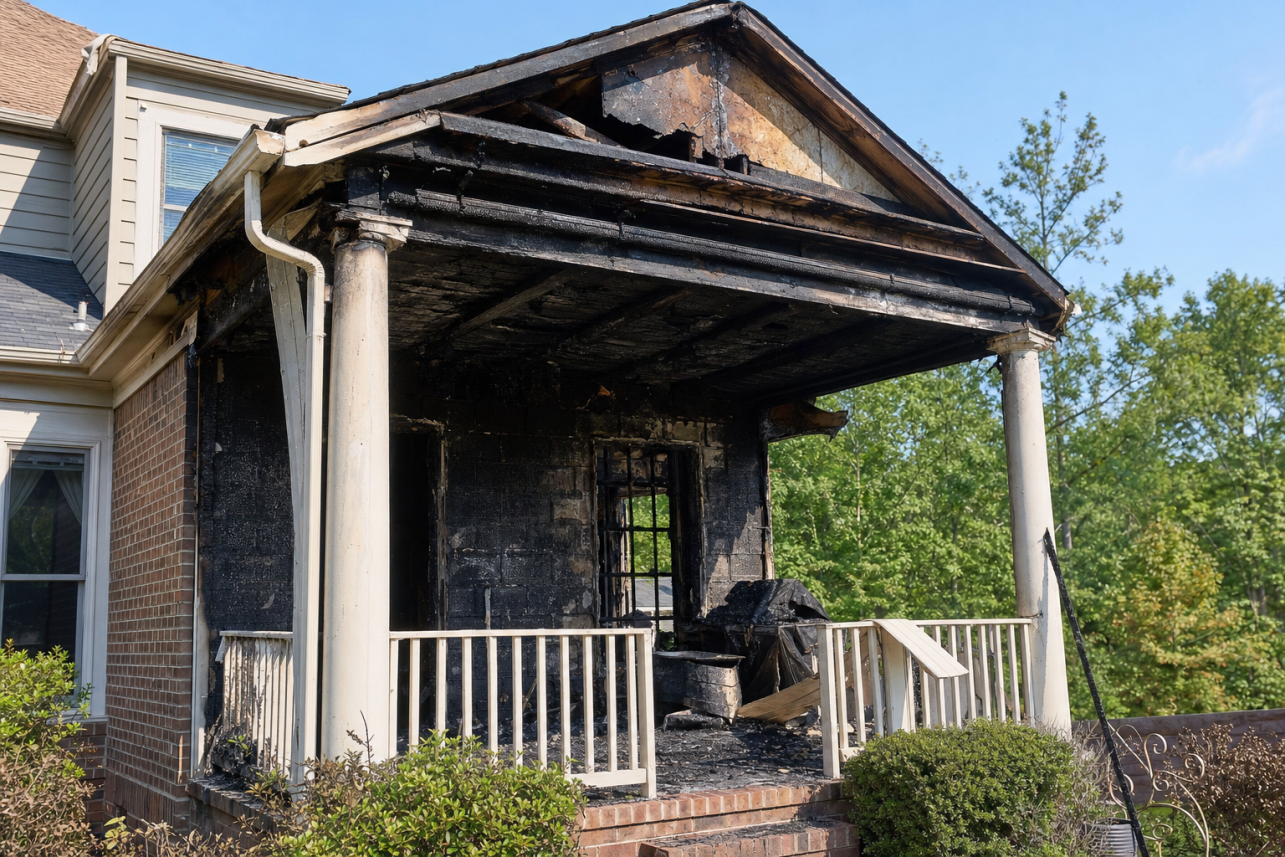
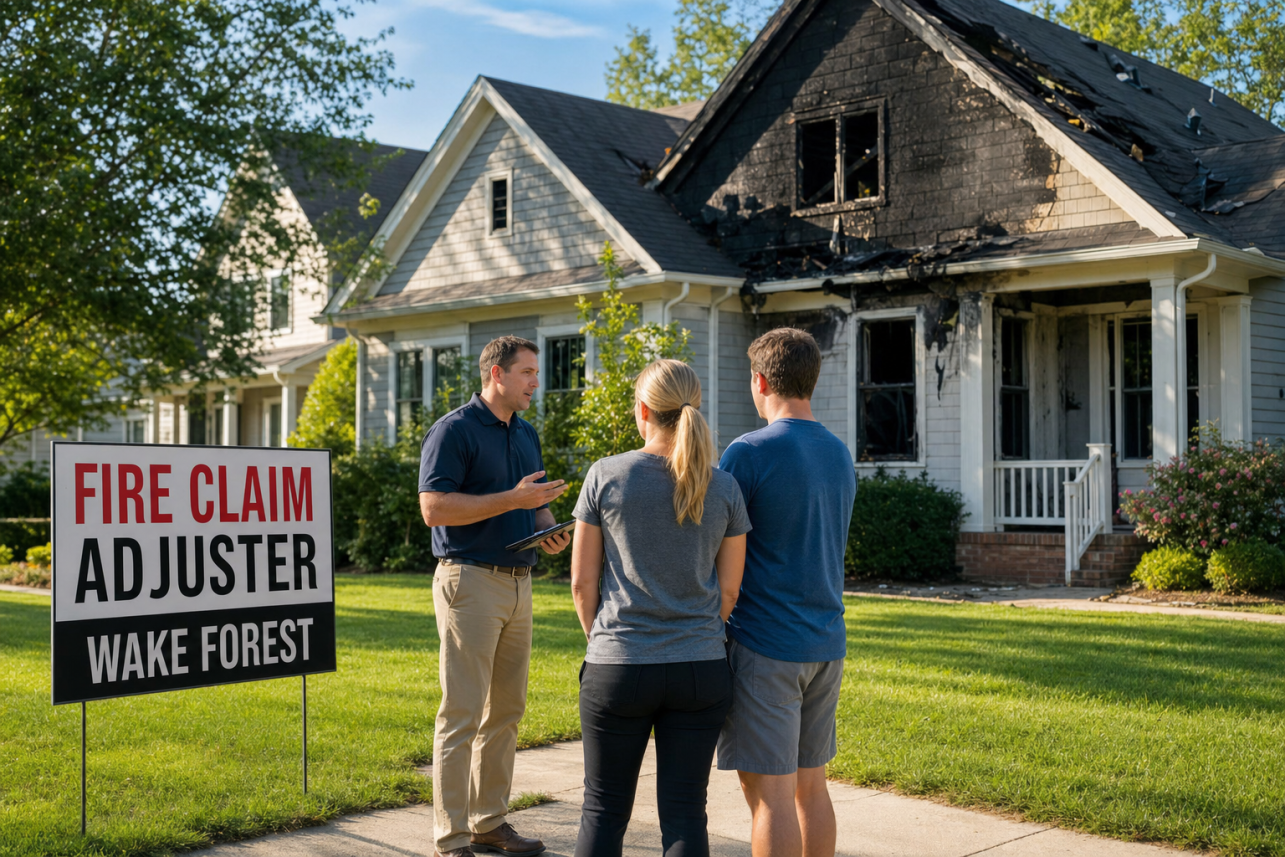
A Fire Claim Adjuster Wake Forest homeowners hire from For The Public Adjusters, Inc. works for you — not your insurance company — after a house fire. We are licensed and bonded, and we handle the entire claim: documenting structural damage, smoke and soot contamination, water damage from firefighting, and your personal property losses. Then we negotiate directly with your insurer so the settlement reflects what it actually costs to rebuild your life, not what the carrier prefers to pay.
What This Service Is
After a fire, your insurance company sends its own adjuster. That person is paid by the insurer, and their estimate protects the insurer’s interests. A public adjuster does the opposite — we represent the policyholder only.
For a Wake Forest fire loss, that means a full property loss assessment. We measure the structural damage, trace smoke and soot into rooms the flames never touched, and account for the water and chemical damage left behind by firefighting efforts. Water soaked into subfloors and wall cavities is one of the most commonly missed items on carrier estimates.
We also build your contents inventory — the room-by-room list of furniture, clothing, electronics, and keepsakes — and prepare the proof of loss paperwork your policy requires. If your home is unlivable, we push your insurer to honor the additional living expenses portion of your policy so temporary housing doesn’t come out of your pocket.
We do this work across the Triangle. Whether it’s a kitchen fire here in town or a claim we’re handling as a Fire Damage Claim Adjuster in Cary NC, the goal is the same: a settlement that actually covers the loss. Beyond fire, we also handle water damage, smoke damage, vandalism, and tree damage claims for both homes and commercial buildings.
Common Problems
Why Is The Insurance Company’s Offer So Much Lower Than My Contractor’s Rebuild Estimate?
This gap is the most common reason Wake Forest homeowners call us. Carrier estimates frequently price repairs at depreciated values — actual cash value — while your policy may entitle you to replacement cost once repairs are complete. That difference can be enormous on a fire loss.
Low offers also tend to skip things: smoke odor treatment in rooms far from the fire, hidden structural damage behind drywall, and building code upgrades that North Carolina requires when you rebuild older construction. If the estimate doesn’t include those items, you pay for them.
We rebuild the estimate line by line, apply your policy’s coverage limits correctly, and challenge depreciation deductions that don’t hold up. When Raleigh-area carriers dig in, our experience with a Fire Insurance Claim Dispute in Raleigh shows how much a properly documented counter-estimate can change the conversation.
My Claim Is Stalled, Underpaid, Or The Insurer Is Questioning How The Fire Started. Now What?
Delayed claim processing is not something you simply have to accept. Insurers must handle claims in good faith, and the North Carolina Department of Insurance oversees how carriers treat policyholders in this state. When a claim drags for months without a clear reason, that’s a red flag worth acting on.
Some homeowners face worse: an accusation, spoken or implied, that the fire was intentional. Courts have sided with policyholders in exactly this situation. In State Farm Fire & Casualty Co. v. Simmons, a family whose home burned was wrongly suspected of arson; the insured ultimately prevailed, and the court upheld a finding that the insurer had acted in bad faith by conducting an outcome-driven investigation.
You don’t need to fight that battle alone. We document the loss properly, respond to the carrier’s demands, and when a claim crosses into bad faith territory, we work alongside insurance dispute lawyers to protect your position.
Do I Really Need A Fire Claim Adjuster Wake Forest — Or Can I Handle The Claim Myself?
You can file a claim yourself, and for very small losses that may be fine. But a serious fire claim is a technical negotiation involving policy language, repair pricing, contents valuation, and deadlines — and the insurer’s adjuster does this every day. Most homeowners do it once in a lifetime.
A good public adjuster is licensed by the state, works on your behalf under a written agreement, and gets paid from the settlement — not upfront. The NCDOI Public Adjusters Guide explains how these arrangements work in North Carolina, and we encourage every homeowner to read it before hiring anyone, including us.
What should you look for? Local claim experience, references from real fire losses, and honest expectations — no one can guarantee a specific outcome, and anyone who does is telling you something about themselves. Our track record on losses like a Fire Damage Claim Help Garner case speaks to how we work.
Our Process
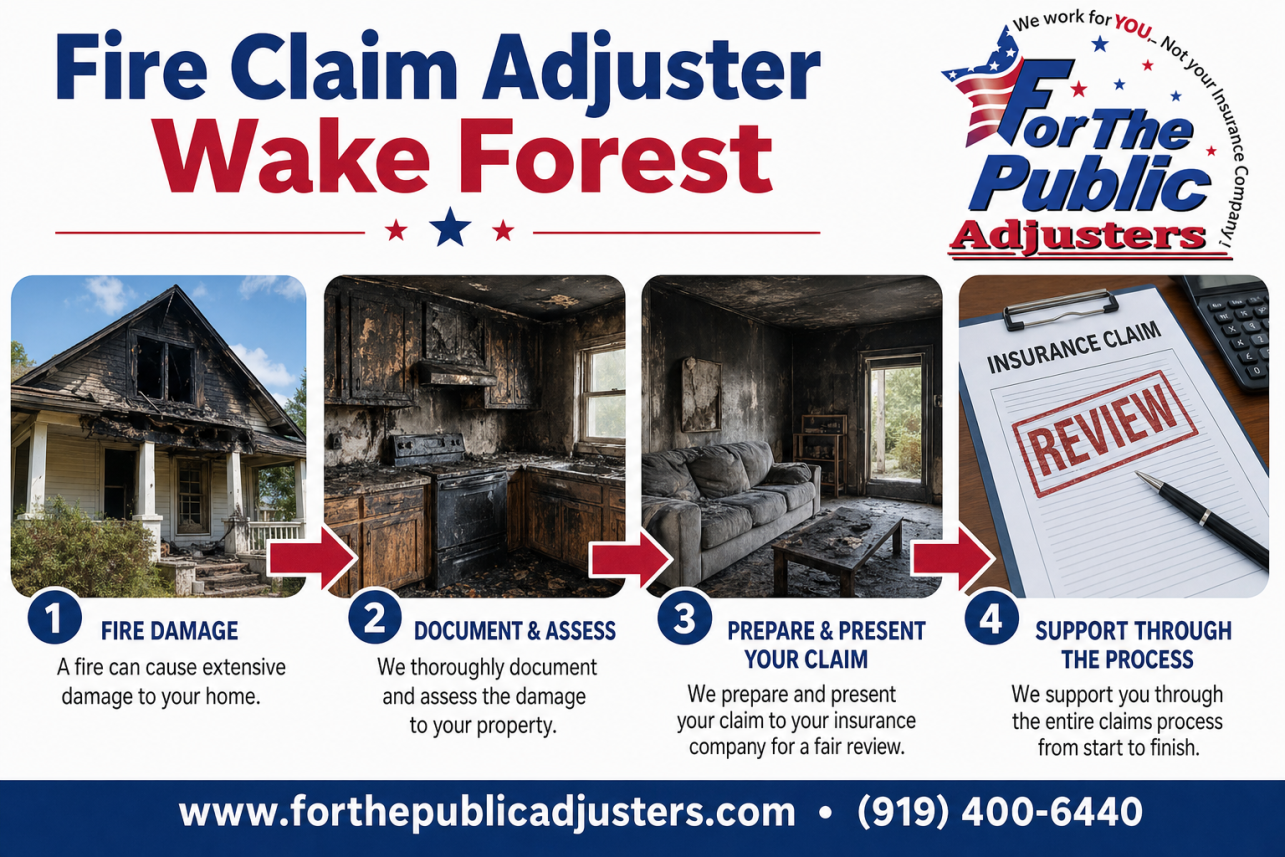
Free Inspection And Policy Review
We walk the property with you, at no cost, and read your actual policy — coverage limits, deductible amount, additional living expenses provisions, and code upgrade coverage. You’ll know what your policy really provides before any negotiation starts. If the loss is small enough to handle yourself, we’ll tell you that too.
Full Documentation Of The Loss
We photograph and measure everything: burn damage, smoke and soot migration, water intrusion from hose lines, and damage hidden inside walls and under floors. We build your complete contents inventory and prepare the sworn proof of loss your insurer requires. Thorough documentation now prevents disputes later — it’s the same discipline we bring as a Fire Damage Public Adjuster in Durham and throughout the Triangle.
Negotiation And Settlement
We present the documented claim to your insurer, meet their adjuster on site, and negotiate every category — structure, contents, temporary housing, and code-required upgrades. We push back on unjustified depreciation and keep you informed at each step. Our fee comes from the settlement, so our interests stay aligned with yours from start to finish.
| Claim Stage | Handling It Alone | With For The Public Adjusters |
|---|---|---|
| Damage documentation | Carrier’s adjuster scopes the loss on their timeline, often limited to the visible burn area | Independent room-by-room inspection with soot testing, moisture mapping, and photo documentation before evidence is disturbed |
| Policy review | You rely on the carrier to tell you what’s covered | Full policy analysis to identify ordinance-and-law, ALE, contents, and debris removal coverage you may not know you have |
| Contents inventory | You reconstruct your belongings from memory under stress | Professionally cataloged, photographed, and priced inventory with replacement-cost support |
| Estimate negotiation | You accept or dispute the carrier’s numbers without leverage | Line-item rebuttal built on contractor pricing and documented damage, negotiated by a licensed adjuster |
| Additional living expenses | Often unclaimed or cut off early | Tracked, documented, and extended for the realistic rebuild timeline |
| Typical result | Settlements frequently based on the carrier’s first, narrowest scope | Settlements that reflect the full documented loss — often multiples of the initial offer |
Commonly Overlooked In The Public Adjusting Industry
- Smoke contamination in HVAC ductwork — Ducts pull soot through the entire house during a fire, but nobody opens a register during a quick walk-through inspection.
- Recoverable depreciation holdback — Carriers pay actual cash value up front and quietly wait for homeowners to forget they can claim the withheld replacement-cost balance after repairs.
- Ordinance-and-law (code upgrade) coverage — Rebuilding to current Wake County code costs more than replacing what burned, and this coverage is buried in policy language most people never read.
- Attic insulation soot absorption — Insulation acts like a sponge for smoke, but it sits out of sight and rarely gets tested unless someone climbs up and samples it.
- Additional living expense cutoffs — Carriers approve a few weeks of housing based on an optimistic timeline, and families end up paying rent themselves when the rebuild runs long.
- Contents in unburned rooms — Clothing, upholstery, and electronics absorb smoke odor and corrosive residue even in closed rooms, but only the burn area gets inventoried.
- Structural charring behind finished surfaces — Fire can weaken framing inside walls and above ceilings that look fine, and no one finds it without opening up the assembly or hiring an engineer.
- Sprinkler and fire-hose water damage — Everyone focuses on the fire, while the thousands of gallons used to extinguish it soak subfloors and wall cavities that mold if they’re not scoped and dried.
Case Studies
Case Study #1
Situation: A family on Ligon Mill Road came home to a kitchen fire that started in a countertop appliance. The flames were contained to the kitchen, but smoke had traveled through the HVAC system into every room of the two-story home.
Problem: The insurance carrier’s adjuster scoped the loss as a single-room event, offering roughly $28,000 to repair the kitchen and clean ‘affected surfaces.’ The estimate ignored smoke residue in the ductwork, soot embedded in attic insulation, and pervasive odor in soft goods and framing cavities.
Investigation: Our team performed a room-by-room inspection with chemical sponge testing to document soot migration, pulled HVAC register samples, and inspected the attic insulation directly above the kitchen. We also inventoried personal property in every room, not just the kitchen.
Findings: Lab-confirmed protein and synthetic soot residue was present in all thirteen rooms, the duct system, and the attic. Insulation contamination alone required full removal and replacement. Contents in closed closets two rooms away tested positive for smoke residue.
Solution: We rebuilt the claim with a documented scope covering duct cleaning and partial replacement, attic insulation removal, sealing and repainting throughout, full contents inventory with cleaning-versus-replacement analysis, and additional living expenses while the odor remediation was completed.
Outcome: The claim settled at just over $164,000 — nearly six times the original offer — and the family stayed in temporary housing at the carrier’s expense for the eleven weeks the work required.
Lesson: Smoke damage almost never stops where the flames did. A scope built around the visible burn area will miss the majority of a real fire loss, and once you sign off on that scope, reopening it is far harder than getting it right the first time.
Case Study #2
Situation: The owner of a small retail building near downtown Wake Forest suffered an electrical fire that started in a wall behind a service panel overnight. Fire crews opened walls and the ceiling to chase hot spots, and the sprinkler activation added significant water damage.
Problem: The carrier treated the water damage as secondary and undervalued it, applied heavy depreciation to a 1980s-era building, and made no allowance for code upgrades required by Wake County when the electrical system was rebuilt. Their offer also excluded business interruption beyond two weeks.
Investigation: We reviewed the policy for ordinance-and-law coverage, brought in a licensed electrician to document the code upgrades the rebuild would trigger, and used moisture mapping to establish the true footprint of the sprinkler and fire-hose water intrusion into flooring and lower wall assemblies.
Findings: The policy carried ordinance-and-law coverage the carrier never mentioned, worth up to 10% of the building limit. The water damage extended under the slab-adjacent flooring throughout the sales floor, and realistic contractor timelines put the business closure at four months, not two weeks.
Solution: We submitted a revised claim with a code-compliant electrical rebuild scope, full flooring replacement supported by moisture readings, a business interruption calculation built from actual sales records, and a formal demand invoking the ordinance-and-law provision.
Outcome: The settlement increased from an initial $91,000 offer to $312,000 across building, code upgrades, and business income. The owner reopened in month five with the electrical system fully modernized at the insurer’s expense.
Lesson: Commercial fire claims live or die on policy provisions most owners never read. Ordinance-and-law coverage, business interruption periods, and depreciation methodology are all negotiable points — but only if someone on your side knows to raise them.
| Decision Point | Best Timing | What It Depends On | Cost of Getting It Wrong |
|---|---|---|---|
| Call a public adjuster | Within the first 72 hours, before the carrier’s inspection | Size of loss — most valuable on claims over $10,000 or any structural fire | Early statements and a signed narrow scope are hard to undo later |
| Sign a contractor’s work authorization | Only after the scope of loss is fully documented | Whether the contractor’s estimate matches the actual damage, not the carrier’s estimate | You may owe for work the settlement doesn’t cover |
| Accept the carrier’s first offer | Almost never immediately | Whether smoke, water, HVAC, and contents damage are all in the scope | First offers on fire losses are routinely a fraction of documented value |
| Start smoke and odor remediation | After documentation, but quickly — soot etches surfaces within days | Whether all damage is photographed and tested first | Cleaning before documenting can erase proof of your claim |
| Move out and claim living expenses | Immediately if the home is uninhabitable | Your policy’s ALE limit and the realistic rebuild timeline | Paying out of pocket for housing the policy should have covered |
| Dispute depreciation on the settlement | Before signing any release | Whether your policy pays replacement cost and whether holdback is recoverable | Leaving recoverable depreciation — often tens of thousands — on the table |
| File supplemental claims for hidden damage | As soon as damage is discovered during rebuild | Whether the claim was closed with a full release or left open | A signed full release can bar recovery for damage found in the walls |
Reviews
After our garage fire, the insurance company offered us $19,000 and called it done. For The Public Adjusters found smoke damage in our attic and ductwork the first adjuster never even looked at. Final settlement was over $70,000. They handled every call with the carrier so I didn’t have to.
Melissa T., Heritage neighborhood
Our chimney fire spread into the roof structure two days before Thanksgiving. These folks met us at the house the next morning, documented everything before the carrier’s adjuster arrived, and got our additional living expenses approved fast so we weren’t paying for a hotel out of pocket. Worth every penny of their fee.
Darnell W., Wake Forest
The hardest part of our house fire was the contents inventory — the carrier wanted us to list everything we owned from memory. Their team photographed, cataloged, and priced our entire contents claim room by room. It took the settlement from lowball to fair. Only wish we’d called them on day one instead of week three.
Priya K., Traditions
Frequently Asked Questions
When Should I Hire A Fire Claim Adjuster Wake Forest Homeowners Can Trust After A House Fire?
The best time to bring us in is before you sign anything from your insurance company — ideally within the first few days after the fire. Early decisions matter. The initial scope of loss, the mitigation contractor you choose, and even your first recorded statement can shape the entire outcome of your claim.
That said, it is never too late. For The Public Adjusters, Inc. regularly takes over claims that are already underway, including cases where the carrier has issued a lowball estimate or denied portions of the loss. We review the policy, re-inspect the property, and build a documented counter-scope covering structure, smoke and soot damage, contents, and additional living expenses.
Many Wake Forest homeowners don’t realize that smoke migration through HVAC systems, attic insulation contamination, and heat damage to roofing and framing are routinely missed in a carrier’s first estimate. Homes in neighborhoods like Heritage, Traditions, and the older downtown blocks off South Main each present different construction types, and each burns and holds smoke differently. We document all of it.
If your fire happened weeks or even months ago and the settlement feels wrong, call us for a free claim review. In North Carolina, you generally have three years to pursue a property claim dispute, so there is usually time to reopen or supplement. The sooner we see the file, though, the more evidence we can preserve — charred materials, soot patterns, and moisture readings disappear quickly once demolition and cleanup begin.
How Is A Public Adjuster Different From The Adjuster My Insurance Company Sends Out?
The adjuster your insurance carrier sends works for the insurance company. Their job is to evaluate the loss on behalf of the insurer, and their estimate reflects the carrier’s interests, guidelines, and pricing software settings. They may be perfectly polite and professional, but they do not represent you.
A public adjuster works exclusively for the policyholder. When you hire For The Public Adjusters, Inc., we are licensed by the North Carolina Department of Insurance to advocate for you — the homeowner or business owner — and only you. We prepare our own independent estimate, inventory your damaged contents item by item, calculate your additional living expenses, and negotiate directly with the carrier’s representatives so you don’t have to.
The difference shows up in the details. A carrier adjuster might spend an hour at your Wake Forest property and write a scope from photos. We spend as long as it takes, often returning multiple times as demolition reveals hidden damage. After a fire, that hidden damage is common: soot inside wall cavities, heat-compromised electrical wiring, warped structural members, and odor absorbed into porous materials that appear clean.
We also read your policy the way it deserves to be read. Coverage for code upgrades, debris removal, landscaping, and ordinance compliance is frequently left on the table when homeowners handle claims alone. Our fee is a percentage of the recovery, so we only succeed when your settlement improves — and industry studies consistently show represented policyholders recover significantly more than those who negotiate alone.
What Does It Cost To Hire A Fire Claim Adjuster In Wake Forest, And Is It Worth It?
For The Public Adjusters, Inc. works on a contingency fee, meaning we charge a percentage of the insurance settlement we recover for you. There are no upfront costs, no hourly billing, and no fee at all if we don’t recover money. The exact percentage is agreed upon in writing before we begin, as required by North Carolina law, and it is capped by state regulation.
Is it worth it? Consider what a fire claim actually involves. A typical residential fire loss in Wake County includes a structural repair estimate, a room-by-room contents inventory that can run to hundreds of line items, smoke and odor remediation scoping, additional living expense tracking while you’re displaced, and often code-upgrade coverage for older homes near downtown Wake Forest that must be rebuilt to current standards.
Every one of those categories is a place where an underdocumented claim loses money. Carriers pay what is proven, not what is fair in the abstract. Our job is to prove the full value of your loss with photographs, moisture and soot testing, contractor-grade estimates, and detailed inventories — then negotiate until the numbers reflect reality.
In most cases, the increase we secure over the carrier’s initial offer substantially exceeds our fee, which is why the contingency model works for policyholders. During your free initial consultation, we’ll review your policy and the carrier’s estimate honestly. If we don’t believe we can meaningfully improve your outcome, we’ll tell you that before you sign anything.
How Long Does A Fire Insurance Claim Take In Wake Forest, And What Does The Process Look Like?
Most fire claims we handle in the Wake Forest area resolve within two to six months, though smaller kitchen fires can settle faster and total losses or disputed claims can take longer. Working with a Fire Claim Adjuster Wake Forest property owners rely on typically shortens the timeline, because complete documentation submitted correctly the first time prevents the back-and-forth that stalls most claims.
Here’s how the process works with our team. First, we conduct a free review of your policy and the damage. If we take the claim, we notify your carrier that we represent you, which means all communication and negotiation runs through us.
Next comes documentation. We inspect the structure thoroughly — including areas carriers often skim, like attics, crawlspaces, and HVAC systems where smoke travels. We photograph everything, inventory damaged contents, and prepare an independent repair estimate. If you’re displaced, we help you track and claim additional living expenses such as temporary housing, meals, and mileage.
Then we submit the full claim package and negotiate. North Carolina insurers must acknowledge claims promptly and pay undisputed amounts within 30 days of agreement, and we hold them to those obligations. If the carrier’s position stays unreasonable, we can invoke the appraisal clause in most policies to move the dispute to a formal valuation process.
Throughout, you get regular updates and a single point of contact. Fires in Wake County homes are stressful enough — chasing your own insurance company shouldn’t be part of the recovery.
What Should I Do In The First 48 Hours After A House Fire In Wake Forest?
First, make sure the property is safe and that the fire department has cleared it for entry. Then notify your insurance company promptly — most policies require timely reporting — but keep that first call short and factual. Give the date, cause if known, and a general description. Avoid guessing at dollar amounts or agreeing to a settlement figure this early.
Next, protect the property from further damage. That means boarding windows, tarping the roof, and securing openings. Your policy actually requires reasonable steps to prevent additional loss, and those emergency costs are typically reimbursable, so keep every receipt.
Document everything before anything is moved or cleaned. Photograph each room, including smoke-stained ceilings, melted fixtures, and water-damaged flooring from firefighting efforts. Do not throw anything away yet — even badly burned items help prove the contents portion of your claim.
Finally, be cautious about signing anything. Restoration contractors and the carrier’s adjuster often show up within days, and paperwork signed under stress can limit your options. This is the ideal window to bring in a Wake Forest public adjuster, because decisions made in the first week — what gets cleaned versus replaced, how the loss is scoped, what temporary housing you accept — shape the entire settlement. Getting the documentation and strategy right from day one is far easier than trying to fix a shortchanged claim months later.
Will Hiring A Fire Claim Adjuster Wake Forest Homeowners Rely On Hurt My Relationship With My Insurance Company?
No, and this is one of the most common worries we hear from Wake County homeowners. Retaining your own adjuster is a right protected under North Carolina law, and licensed public adjusters are regulated by the North Carolina Department of Insurance. Carriers deal with policyholder representatives on fire losses every week — it is a normal, professional part of the claims process.
Your insurer cannot cancel your policy, deny your claim, or raise your premium simply because you hired representation. Rates are driven by the loss itself and broader underwriting factors, not by who negotiates on your behalf.
In practice, professional representation often makes the process smoother, not more adversarial. When a Fire Claim Adjuster Wake Forest families trust prepares the claim, the carrier receives a complete, well-organized estimate with photographs, a line-item scope of repairs, and a properly documented contents inventory. That reduces back-and-forth, cuts down on disputed line items, and gives the insurance company’s adjuster something concrete to review instead of vague verbal descriptions.
What changes is the balance of the conversation. Instead of a homeowner trying to interpret policy language about replacement cost, ordinance and law coverage, or additional living expenses, you have someone who reads those provisions daily and knows how smoke and soot damage should be scoped in homes throughout Wake Forest — from older properties near downtown to newer construction in Heritage and Traditions. The carrier still handles your claim; you simply stop handling it alone.
My Fire Claim Was Already Underpaid Or Denied — Can A Public Adjuster In Wake Forest Still Help?
Yes, in most cases. A low settlement offer or even a denial is rarely the end of a fire claim. Policyholders in North Carolina generally have the right to dispute the carrier’s position, submit supplemental claims when additional damage is found, and invoke the appraisal clause found in most homeowners policies when the disagreement is about the amount of the loss.
Underpayment on fire losses usually comes from an incomplete scope. Common gaps we find in Wake Forest claims include smoke and soot contamination in rooms far from the fire, damage inside HVAC ductwork, water damage in wall cavities from firefighting, and code-upgrade costs required when Wake County permits the rebuild. Carriers also frequently apply heavy depreciation or price repairs below what local contractors actually charge in this market.
The process starts with a full review of your policy and the carrier’s estimate, followed by an independent inspection of the property. From there, we build a corrected scope with documentation the insurer has to respond to — photographs, moisture and soot testing where appropriate, and line-item pricing.
Timing matters. North Carolina policies contain deadlines for disputing decisions and filing suit, typically spelled out in the conditions section, so it is important not to sit on a bad offer. Even if you have already cashed a check, that usually does not close the claim; supplemental payments are common when new evidence is presented. The sooner the file is reviewed, the more options remain open.
Does A Fire Claim Only Cover Burned Areas, Or Does It Include Smoke, Soot, And Water Damage Too?
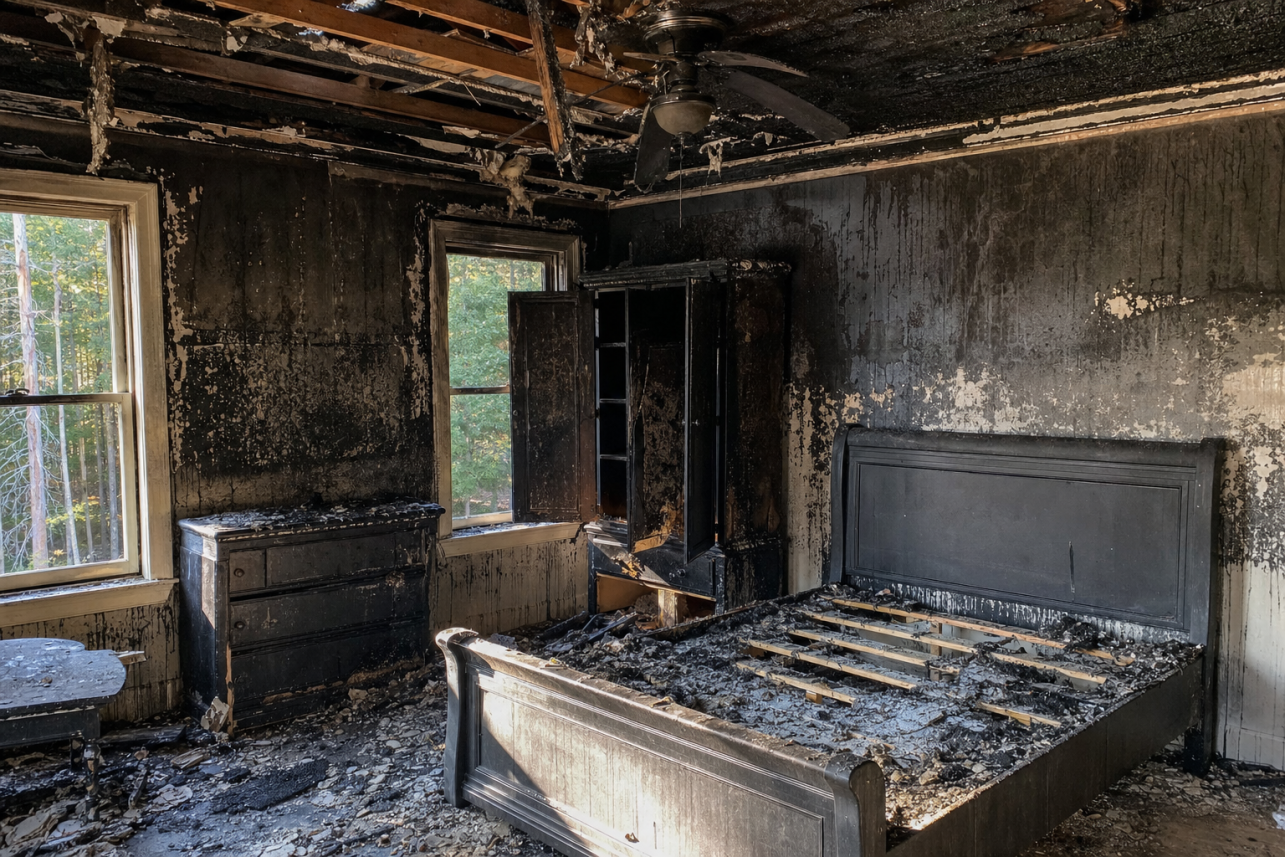
A properly handled fire claim covers far more than the charred rooms. In fact, on many Wake Forest house fires, the majority of the payout comes from secondary damage — smoke, soot, heat, and the water used to put the fire out.
Smoke travels through a home in minutes and penetrates drywall, insulation, ductwork, cabinetry, and soft goods like clothing and furniture. Soot is acidic and continues damaging metals, electronics, and finishes for weeks if not properly remediated. A fire contained to a kitchen can legitimately require cleaning or replacement of materials throughout the entire house, and your policy covers that when it is documented correctly.
Water damage from fire suppression is also part of the same claim. Fire hoses can push hundreds of gallons into a structure, saturating subfloors, wall cavities, and insulation. Left unaddressed, that moisture leads to mold and structural issues, which is why moisture mapping early in the claim is so important.
Your claim should also account for additional living expenses if the home is uninhabitable — hotel or rental costs, increased food expenses, even pet boarding — plus debris removal, landscaping damaged by fire crews, and code upgrades required during reconstruction under current Wake County building requirements.
As the Fire Claim Adjuster Wake Forest property owners call after a loss, our job at For The Public Adjusters, Inc. is to make sure every one of these categories is inspected, measured, and included in the settlement — not just the rooms with visible burn damage.
How Does A Fire Claim Adjuster Wake Forest Homeowners Hire Actually Document My Losses?
Thorough documentation is where most self-managed fire claims fall apart, and it is where a professional adjuster earns their fee. We start with a room-by-room inspection of your Wake Forest home, photographing and cataloging structural damage, smoke penetration, soot residue, and water damage from firefighting efforts.
For your personal property, we build a detailed contents inventory. That means listing every damaged item with its description, age, condition, and replacement cost — from furniture and electronics down to clothing, pantry goods, and items in closets and the attic. Homeowners working alone typically recover only a fraction of their contents coverage because they simply cannot remember or price everything they owned.
We also document hidden damage that insurance company adjusters often miss on a quick walkthrough. Smoke and soot travel through HVAC ductwork, wall cavities, and insulation. Heat can compromise roof decking, wiring, and structural framing even in rooms that never saw flames. We bring in specialists when needed to test and verify these conditions in writing.
Finally, we translate all of that evidence into a professionally prepared claim package with line-item estimates using the same software insurance carriers use. That puts your claim in a format the carrier cannot easily dismiss or lowball. Every dollar we request is backed by photographs, measurements, and documentation, which is exactly what it takes to get a fire claim in Wake Forest paid fully and fairly.
Where Will My Family Live While Our Fire-Damaged Home Is Repaired, And Who Pays For It?
If your Wake Forest home is unlivable after a fire, your homeowners policy almost certainly includes Additional Living Expenses coverage, sometimes called Loss of Use. This pays the reasonable extra costs of maintaining your normal standard of living while your home is repaired — hotel stays, a rental house, restaurant meals above your normal grocery budget, extra mileage, pet boarding, even laundry costs.
The problem is that many families never claim everything they are owed under this coverage, or they accept a temporary housing arrangement that does not fit their needs. If you live in a four-bedroom home near downtown Wake Forest or in a neighborhood like Heritage or Traditions, you should not be expected to squeeze into a single hotel room for eight months. The policy standard is comparable living conditions, and we hold carriers to it.
As your public adjuster, we document your pre-fire standard of living, calculate a realistic monthly ALE budget, and push for housing that keeps your kids in their same Wake County schools and your commute manageable. We also track every receipt so nothing is left unclaimed.
Just as important, we watch the timeline. ALE coverage typically runs until repairs are reasonably complete or a policy time limit is reached. When the carrier drags its feet on approving the structural claim, your temporary housing clock keeps ticking. We press for prompt decisions precisely so your family is not left paying out of pocket while the repair estimate sits on someone’s desk.
The Insurance Company Already Sent A Check After Our House Fire — Should I Cash It?
Be careful, but do not panic. In most cases, cashing an initial check does not close your claim or waive your rights, because it is usually an advance or a payment on the undisputed portion of the loss. However, you should read the check and any accompanying letter closely before depositing it, and never sign a release or a document labeled full and final settlement without having it reviewed.
First checks after a fire are almost always low. They are based on the carrier adjuster’s initial walkthrough, before hidden smoke damage, HVAC contamination, structural issues, and a complete contents inventory have been evaluated. We routinely see initial payments in Wake Forest that cover only a fraction of what the policy actually owes.
Also understand how depreciation works. If you have replacement cost coverage, the carrier typically pays actual cash value first, then releases the recoverable depreciation after you complete repairs or replace items. Many homeowners never collect that second payment because no one explains the process or the deadlines for claiming it.
A Wake Forest fire claim adjuster from our team can review the carrier’s estimate line by line, identify what was missed or underpriced, and file a supplemental claim for the difference. There are deadlines under North Carolina policy provisions for disputing valuations and submitting proof of loss, so the sooner we review the paperwork, the more leverage you keep. Deposit the check if it is clearly an advance, keep every document, and get a professional second opinion before agreeing that the claim is settled.
How Do I Choose A Qualified Fire Claim Adjuster In Wake Forest, And What Credentials Should I Check?
Start with licensing. In North Carolina, public adjusters must be licensed by the Department of Insurance, and you can verify any license online in minutes. Never work with anyone who cannot produce a current North Carolina public adjuster license — after major fires, unlicensed operators sometimes canvas damaged neighborhoods, and homeowners in Wake County are not immune to that.
Next, ask about fire-specific experience. Fire losses are among the most complex residential claims because they combine structural damage, smoke and soot contamination, water damage from suppression, contents losses, and additional living expenses. An adjuster who mostly handles roof hail claims may not know how to document smoke migration through ductwork or fight for proper contents valuation. Ask how many fire claims they have handled and what results they achieved.
Read the contract carefully before signing. North Carolina regulates public adjuster fees and contracts, and a reputable firm will explain its percentage clearly, put it in writing, and never ask for money upfront. You should also get a clear point of contact — one person who knows your file, not a call center.
Finally, look for local knowledge. At For The Public Adjusters, Inc., we know Wake Forest construction styles, local rebuilding costs, Wake County permitting requirements, and the carrier adjusters who work this market. That familiarity matters when negotiating line-item pricing on a rebuild. When you interview any Fire Claim Adjuster Wake Forest firms offer, ask direct questions about license status, fire experience, fees, and references — a legitimate professional will welcome every one of them.
How Do I Handle The Contents Inventory After A House Fire, And Can Your Team Do It For Me?
The contents inventory is one of the most tedious and most underpaid parts of any fire loss, and yes — we handle it for you. Insurance companies typically hand homeowners a blank spreadsheet and ask them to list every item they owned, room by room, with age, brand, and purchase price. Most families, still in shock, list a fraction of what they actually lost.
Our Wake Forest fire adjusters approach it differently. We walk the property with you, photograph and catalog damaged items before anything is discarded, and use pricing databases to establish accurate replacement values rather than guesses. For items destroyed beyond recognition, we reconstruct the inventory using photos, receipts, bank statements, and even social media images of your rooms.
This matters more than most people realize. A typical Wake Forest home in a neighborhood like Heritage or Traditions holds tens of thousands of dollars in personal property — clothing, electronics, kitchenware, tools, kids’ belongings. Smoke and soot contamination often makes items unusable even when they look intact, and we document that contamination so the carrier can’t dismiss it.
We also track which items are cleanable versus non-salvageable, because carriers frequently push cleaning on items that restoration companies would never certify. Getting the inventory right, and getting it right the first time, is often the difference between a settlement that replaces your life and one that leaves you buying everything back out of pocket.
Is It Worth Hiring A Fire Claim Adjuster Wake Forest Homeowners Recommend For A Smaller Kitchen Or Electrical Fire?
Often, yes — and smaller fires are where homeowners get shortchanged most. A kitchen or electrical fire that looks contained to one room rarely is. Smoke travels through HVAC ductwork, soot settles inside wall cavities and attic insulation, and protein residue from a grease fire bonds to surfaces throughout the house. Insurance carriers frequently scope these losses as a quick paint-and-clean job when the real remediation cost is several times higher.
We’ve represented Wake Forest families whose “small” stovetop fire required full duct cleaning, cabinet replacement, and odor sealing throughout the first floor — items the carrier’s initial estimate never mentioned. In older homes near downtown Wake Forest, electrical fires inside walls also raise code-upgrade questions that most homeowners don’t know their policy may cover.
Our review costs you nothing upfront. We inspect the loss, compare the damage against the carrier’s estimate, and tell you honestly whether professional representation makes financial sense. If the insurer’s number is fair, we’ll say so. If the claim is worth pursuing, we work on a contingency fee, so our interest is aligned with maximizing your recovery.
As a rule of thumb: if the damage touches more than one room, involves smoke odor you can still detect days later, or requires you to relocate even temporarily, the claim is complex enough that a professional review will likely pay for itself many times over.
What Is Recoverable Depreciation On A Fire Claim, And How Do I Make Sure I Actually Collect It?
Recoverable depreciation is money your insurance company holds back until you complete repairs — and it’s one of the most commonly forfeited pieces of a fire settlement in Wake County.
Here’s how it works. Most homeowner policies pay claims in two stages. First, the carrier issues the actual cash value (ACV), which is the replacement cost minus depreciation for age and wear. Then, once you repair or replace the damaged property and submit proof, the carrier releases the withheld depreciation. On a significant fire loss, that holdback can be tens of thousands of dollars.
The problem is the fine print. Policies impose deadlines — often 180 days or one year — to complete work and claim those funds. After a fire, with contractor schedules in the Triangle stretched thin and permitting through Wake County taking time, homeowners frequently miss the window or never realize the money exists.
When we represent a fire loss in Wake Forest, we track every depreciated line item, calendar the policy deadlines, request extensions in writing when construction timelines demand it, and submit the documentation the carrier requires to release the funds. We also challenge excessive depreciation up front; carriers sometimes depreciate items like roofing or flooring far beyond their actual condition, which shrinks your initial check unfairly.
If you’ve already received an ACV payment and aren’t sure what’s still owed, bring us the estimate. Recovering held-back depreciation on an existing claim is something we do regularly.

Do You Handle Fire Claims For Rental Properties, Landlords, And Businesses In The Wake Forest Area?
Yes. For The Public Adjusters, Inc. represents landlords, real estate investors, and commercial property owners throughout Wake Forest, Rolesville, Youngsville, and greater Wake County — not just owner-occupied homes. These claims carry complications a standard homeowner never faces, and each Fire Claim Adjuster Wake Forest property owners work with on our team knows how to handle them.
For rental properties, the biggest issue is usually lost rental income. Landlord policies typically include fair rental value coverage, which reimburses rent you lose while the unit is uninhabitable. Carriers often lowball the monthly figure or cut off payments before repairs are realistically finished. We document local market rents and realistic reconstruction timelines to keep that income stream flowing for the full period you’re entitled to.
For commercial losses — a restaurant fire on South Main Street, a warehouse or office loss along Capital Boulevard — business interruption coverage becomes the largest and most contested part of the claim. Calculating lost profits, continuing expenses, and extra expenses requires financial documentation most owners have never assembled under pressure. We build that claim with your financial records and present it in the format carriers require.
We also coordinate tenant-versus-landlord coverage questions, betterments and improvements, and code-upgrade costs that apply when older commercial buildings must be rebuilt to current standards. Whether it’s a single rental house or a multi-unit commercial property, the process starts the same way: a no-cost review of your policy and the carrier’s position on your loss.
Local Relevance
Wake Forest has grown fast, and its housing stock shows it: charming older wood-frame homes around the historic downtown sit alongside large newer subdivisions built over the last two decades. Fires behave differently in each. Older homes may have aging wiring and original framing that burns and smolders unpredictably, while newer builds use engineered lumber and open floor plans that let smoke and heat travel quickly through the whole house.
The National Fire Protection Association has long identified cooking as the leading cause of home fires nationally, and Wake County households are no exception — kitchen fires, dryer vent fires, and lightning strikes during summer thunderstorms make up much of what we see here. Even a contained kitchen fire can push soot through HVAC ductwork into every room.
Because Wake Forest rebuilds must meet current building codes, older homes often need electrical, plumbing, or structural upgrades the carrier’s first estimate ignores. We make sure those costs are claimed under your policy’s code upgrade coverage rather than landing on you. We serve all of Wake County and the surrounding Triangle, including work as a Public Adjuster in Apex NC and neighboring communities.
Many Wake Forest fire claims involve two very different problems on the same loss: older homes near the historic core often trigger costly code-required electrical and structural upgrades when rebuilt, while newer open-plan subdivisions tend to suffer widespread smoke and soot contamination far from the fire itself — and carrier estimates routinely undervalue both. A thorough independent assessment catches what the first walkthrough misses.
Had A Fire In Wake Forest? Get A Free Claim Review First
Before you accept your insurer’s number, let For The Public Adjusters, Inc. review your policy and inspect the damage — at no cost and no obligation. We’re licensed and bonded, we work only for policyholders, and we don’t get paid unless your claim does. One conversation can tell you whether your settlement is fair.
Call us: (919) 400-6440
Helpful Resources
- National Fire Protection Association (NFPA)
- NCDOI Public Adjusters Guide
- North Carolina Department of Insurance — State regulator overseeing insurers and public adjuster licensing in NC
Serving Wake Forest · Wake
Last updated: September 5, 2026