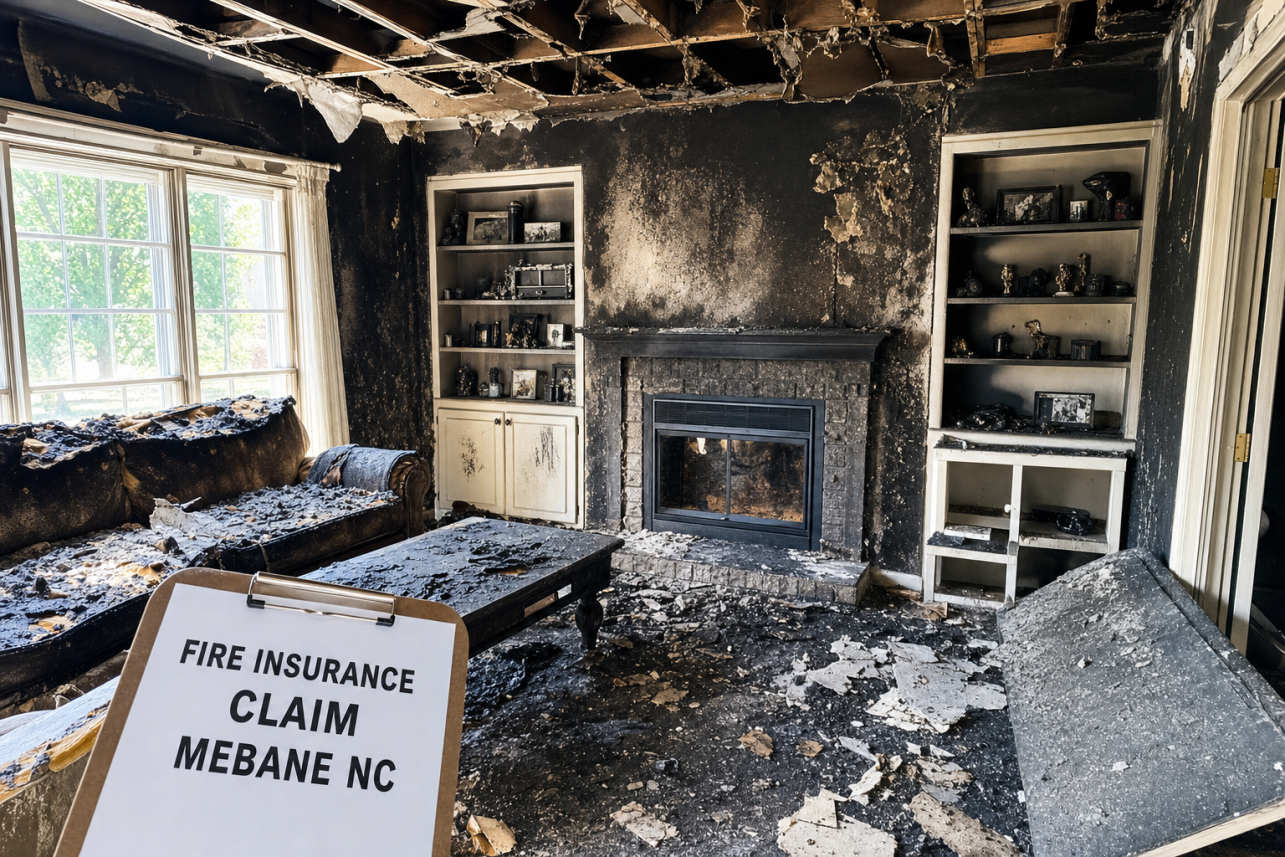
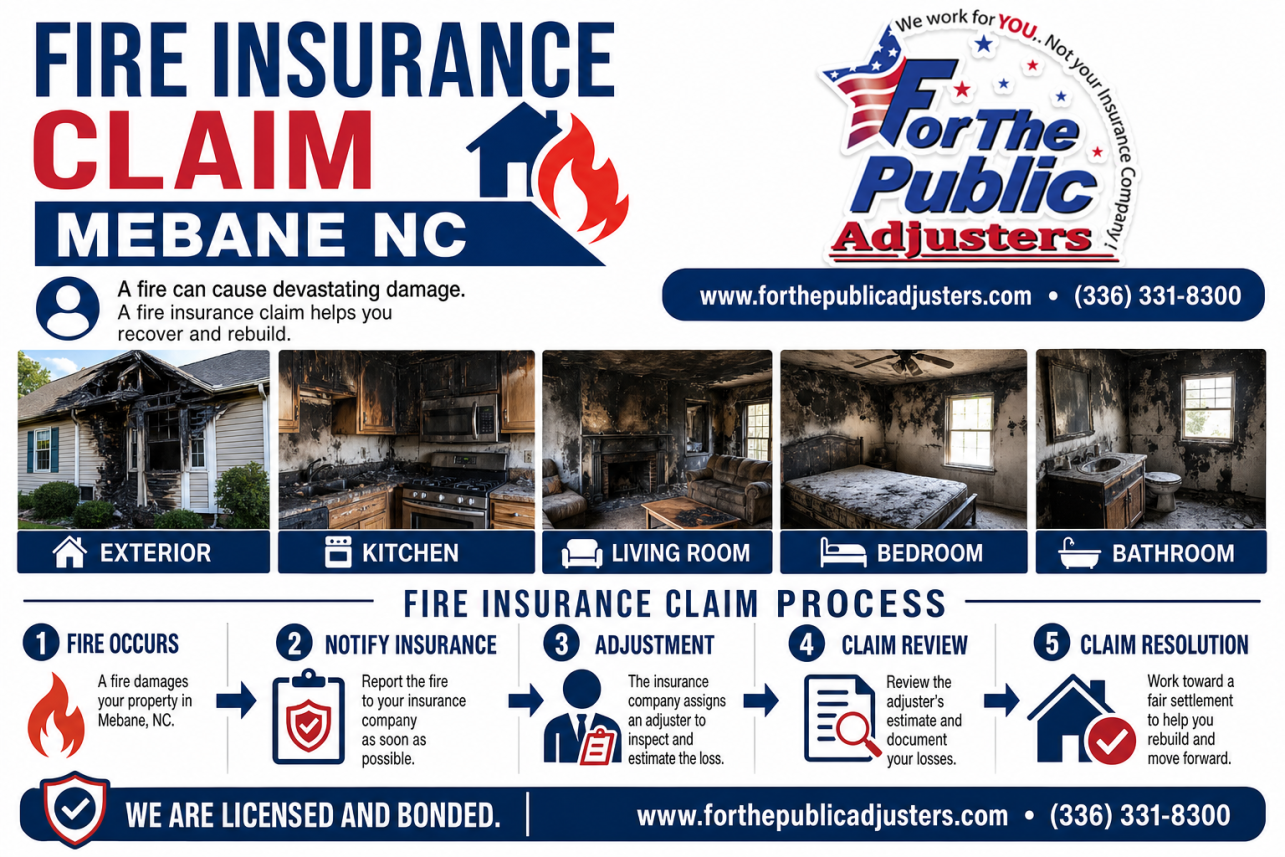
If you need help with a fire insurance claim Mebane NC homeowners can hire a licensed public adjuster to represent them instead of relying on the insurance company's own adjuster. For The Public Adjusters, Inc. works only for the policyholder — we assess the full damage, prepare the documentation, and negotiate the settlement on your behalf. That includes the smoke, soot, and firefighting water damage that insurance company estimates frequently leave out. We are licensed and bonded, and we never charge a fee based on money the insurer already offered you before we were hired.
What This Service Is
A public adjuster is the policyholder's own claim professional. After a fire, your insurance company sends its adjuster to estimate the loss — but that person works for the insurer, not for you. Our job is to level the field.
We start by reading your actual policy, because coverage limits, your deductible, and whether you're paid replacement cost or depreciated actual cash value all shape what your claim is worth. Then we perform a complete property loss assessment: the burned structure, smoke and soot that traveled far beyond the fire room, water damage from the hoses that put the fire out, and hidden structural damage inside walls and framing.
We also build the contents inventory — every piece of personal property lost, room by room — and document your additional living expenses if your family can't live in the home while it's repaired. Hotel bills, temporary rentals, and extra meal costs are often covered, but only if they're claimed and documented properly.
Finally, we prepare the proof of loss and negotiate directly with the insurance company. If the first offer is low, we push back with evidence, not opinions. The North Carolina Department of Insurance publishes the NCDOI Public Adjusters Guide explaining exactly how this profession works in our state, including licensing requirements and the fee limits that protect you as a consumer.
Common Problems
Why Is The Insurance Company's Offer So Much Lower Than My Contractor's Estimate?
This is the most common call we get from Mebane homeowners. The insurer's estimate often prices repairs at depreciated actual cash value rather than the replacement cost your policy may actually provide, and depreciation deductions can quietly strip thousands from the check.
Carrier estimates also tend to miss things: smoke odor sealed into insulation and ductwork, soot etched into finishes, water soaked into subfloors from firefighting, and code upgrade costs when Alamance County requires rebuilt portions to meet current building codes.
A proper structural damage repair estimate accounts for all of it. When we rebuild the claim line by line, the gap between the first offer and the real cost of repair is usually where your recovery lies. We can never guarantee a specific outcome, but we can make sure nothing covered is left off the table.
What Happens When A Fire Insurance Claim Mebane NC Homeowners File Gets Delayed Or Denied?
Delays and underpayments are not something you simply have to accept. If your insurer keeps requesting the same documents, goes quiet for weeks, or denies parts of the loss without a clear policy reason, you have real options — starting with a formal, documented dispute backed by evidence.
North Carolina courts have sided with homeowners in these fights. In Gray v. North Carolina Insurance Underwriting Association, the North Carolina Supreme Court upheld a verdict — including punitive damages — for homeowners whose insurer grossly undervalued the storm damage to their house. Insurers know that unfair claim handling carries consequences in this state.
Our role is to make bad faith tactics harder to use in the first place: complete proof of loss documentation, photographs, itemized estimates, and a written record of every communication. Most disputes settle once the file is too well-documented to lowball.
Should I Handle The Claim Myself Or Hire A Public Adjuster?
Some homeowners do manage small, simple claims on their own. Fire claims are rarely small or simple. Between the structure, the contents inventory, temporary housing costs, and negotiating with a trained company adjuster, most people are working a full-time claim while also holding a job and relocating their family.
When you evaluate any public adjuster, verify a current North Carolina license, ask whether they are bonded, and ask how they charge. Legitimate adjusters work on a regulated percentage of the recovery — you should never pay large fees upfront.
Be careful with contractors or 'claim consultants' who show up unsolicited after a fire. Estimating repairs and adjusting an insurance claim are different skills, and only a licensed adjuster may legally negotiate your claim in North Carolina.
Our Process
Free Policy Review And Damage Inspection
We start by reading your homeowners policy so you know your coverage limits, deductible amount, and whether you hold replacement cost or actual cash value coverage. Then we inspect the property in person — including areas the carrier's adjuster may skip, like attic framing, wall cavities, and HVAC systems where smoke and hidden structural damage often lurk.
Full Documentation Of The Loss
We build the complete claim file: a detailed structural repair estimate, a room-by-room contents inventory of your personal property, water damage from the firefighting effort, and a running log of your additional living expenses while you're out of the home. This becomes your formal proof of loss — the document that anchors the entire settlement.
Negotiation And Settlement
We present the claim to your insurance company, meet their adjuster at the property, and answer every dispute with documentation. If they undervalue an item or deny a portion of the loss, we challenge it in writing with policy language and evidence. You stay informed at every step, and no settlement is accepted without your approval.
| What's Involved | Filing Alone | With For The Public Adjusters |
|---|---|---|
| Damage scope | Based on the carrier adjuster's walkthrough, which often misses hidden smoke, soot, and heat damage | Independent inspection with hygienist testing and engineering reports when the structure was exposed to heat |
| Contents inventory | Homeowner lists items from memory under stress; missed items are never paid | Room-by-room photographed inventory with documented replacement values and depreciation pushback |
| Additional living expenses | Often cut off early or paid at rates below actual Alamance County rental costs | Comparable-rent documentation and ALE extended through the full realistic rebuild timeline |
| Policy provisions | Ordinance/law coverage and recoverable depreciation frequently go unclaimed | Every applicable coverage identified and claimed, including code upgrades on older Mebane homes |
| Negotiation | Homeowner accepts or argues alone against a trained carrier adjuster | Licensed NC adjusters negotiate with documentation, supplements, and appraisal if needed |
| Typical result | Settlement anchored to the carrier's first estimate | Documented settlements frequently two to three times the initial offer on significant fire losses |
Commonly Overlooked In The Public Adjusting Industry
- Soot contamination in HVAC ductwork and rooms far from the fire — Carrier adjusters scope what they can see, and corrosive soot that traveled through the duct system is invisible without particulate testing.
- Heat-compromised framing and trusses that look intact — Wood loses structural capacity below the point of visible charring, so only an engineer's evaluation catches it — a quick walkthrough never does.
- Ordinance and law (code upgrade) coverage on older homes — Rebuilding a pre-code Mebane home to current NC standards costs significantly more, and this coverage is rarely paid unless someone specifically claims it.
- Recoverable depreciation after repairs are complete — Replacement-cost policies hold back depreciation until work is finished, and many homeowners never file the paperwork to get that money back.
- Additional living expenses beyond the carrier's initial cutoff — Insurers set ALE timelines around their own estimate, not the actual permitting and rebuild schedule, so displaced families quietly absorb months of housing costs.
- Corrosion damage to electronics, appliances, and wiring from acidic smoke residue — These items often power on fine right after the fire and then fail weeks later, long after a hasty settlement has closed the claim.
- Matching requirements for siding, flooring, and roofing — Carriers pay to patch the damaged section, but discontinued materials mean a proper repair requires replacing the full run — a difference worth thousands.
- Water and chemical damage from firefighting efforts — Attention goes to the burn area while thousands of gallons of suppression water soak subfloors and wall cavities that later grow mold if not scoped.
Case Studies
Case Study #1
Situation: A family on the west side of Mebane, near the Cameron Park area, suffered a kitchen fire that spread into the attic before the fire department contained it. The carrier's first field adjuster inspected within a week and issued an estimate under $60,000.
Problem: The insurer's estimate covered visible char and drywall but ignored smoke and soot migration through the HVAC system, heat damage to roof trusses above the kitchen, and the family's four months of additional living expenses. The homeowners were being pushed to sign off and start repairs quickly.
Investigation: We brought in an independent industrial hygienist to test for soot particulate in rooms the carrier called 'unaffected,' documented protein residue and corrosive soot on electronics and ductwork, and had a structural engineer evaluate the charred truss chords in the attic.
Findings: Soot testing came back positive in every bedroom, meaning contents cleaning and duct replacement were owed throughout the house. The engineer confirmed three trusses had lost structural capacity and required sistering or replacement, which triggered code-upgrade coverage under the policy's ordinance and law provision.
Solution: We rebuilt the scope of loss line by line, submitted the hygienist and engineering reports with a revised estimate, and invoked the policy's appraisal-ready documentation standards. We also compiled receipts and a comparable-rent analysis for the family's temporary housing in Alamance County.
Outcome: The claim settled at just over $214,000 — more than three and a half times the original offer — including full ALE for the extended rebuild timeline. The family moved back into a properly remediated home instead of one that still smelled like smoke.
Lesson: The first estimate after a house fire almost never captures hidden smoke migration or structural heat damage. Independent testing, not the carrier's walkthrough, is what proves the true scope.
Case Study #2
Situation: A small commercial property owner on the South Fifth Street corridor in Mebane had an electrical fire in a tenant-occupied retail unit. The fire itself was contained to one wall, but smoke filled the entire suite and the adjoining unit.
Problem: The carrier accepted the fire but disputed business income losses, arguing the tenant could have reopened within 30 days. It also depreciated the building repairs heavily and questioned whether the neighboring unit's smoke damage was part of the same occurrence.
Investigation: We pulled the tenant's sales records for the prior 24 months, obtained restoration contractor timelines showing why deodorization and electrical rewiring genuinely required 11 weeks, and documented smoke transfer paths through the shared plenum above both suites.
Findings: The realistic period of restoration was 11 weeks, not 30 days, and the shared-plenum documentation established that both units were damaged in a single occurrence. We also identified recoverable depreciation the owner didn't realize the policy allowed once repairs were completed.
Solution: We presented a business income calculation built on actual seasonal revenue, a contractor-verified restoration schedule, and a supplemental claim for the adjoining unit. When the desk adjuster stalled, we requested a joint re-inspection with the carrier's building consultant on site.
Outcome: The insurer extended the business income period to the full 11 weeks, paid both units under one occurrence, and released recoverable depreciation after repairs — roughly $87,000 more than the initial position.
Lesson: Commercial fire losses are won on documentation: real revenue records and contractor timelines beat a carrier's assumptions about how fast a business 'should' reopen.
| Situation | What You Should Do | Why It Matters to Your Claim |
|---|---|---|
| First 48 hours after the fire | Secure the property (board-up, tarping) and keep every receipt | Policies require you to prevent further damage; unsecured properties give carriers grounds to deny secondary losses |
| Carrier asks for a recorded statement | You can pause and get representation first | Innocent guesses about the fire's cause or your belongings can be used to limit or dispute the claim later |
| Insurer's adjuster offers a quick check | Don't treat it as final — it's usually an advance, not the settlement | Early payments are based on visible damage only; hidden smoke and structural damage come later |
| Restoration company shows up unsolicited | Get the scope in writing and don't sign an assignment of benefits blindly | Some contractors bill the carrier directly and leave you responsible for anything the insurer refuses |
| Smoke smell lingers in 'undamaged' rooms | Request independent soot and particulate testing | Corrosive soot travels through HVAC ducts; without testing, those rooms get excluded from the payout |
| Home was built before modern NC codes | Check your policy for ordinance and law coverage | Rebuilding to current code costs more, and many older Mebane homes qualify for this extra coverage |
| You're displaced from the home | Document actual comparable rents in Alamance County, not just what the carrier offers | ALE should reflect real local housing costs for the full rebuild period, not an arbitrary cutoff |
| Settlement offer feels low | Get a second opinion before signing a release | Once you accept a final release, reopening the claim for missed damage is extremely difficult |

Reviews
Our house fire off Mattress Factory Road left us completely lost. The insurance company's adjuster spent maybe 45 minutes here and offered less than half of what the rebuild actually cost. For The Public Adjusters found smoke damage in rooms we thought were fine, got soot testing done, and handled every call with the carrier. Our final settlement was nearly triple the first offer, and they kept our temporary housing paid the whole time.
Darlene W., Mebane
After a garage fire spread into our roofline, the insurer kept saying the trusses just needed 'cleaning.' This team brought in an engineer who proved the wood had lost strength from the heat. That one report changed everything — the carrier approved a full roof section replacement plus code upgrades. Worth every penny of the fee.
Marcus T., Alamance County
The hardest part after our kitchen fire was the contents inventory — the carrier wanted every single item listed with age and price. I was overwhelmed until these adjusters took it over, photographed and cataloged everything, and pushed back on the ridiculous depreciation the insurer applied. Only reason for four stars is the claim still took several months, though I know that was mostly the insurance company dragging its feet.
Renee P., Mebane
Frequently Asked Questions
How Do I Start A Fire Insurance Claim Mebane NC Homeowners Can Actually Win?
Start by making the property safe, then notify your insurance carrier that a loss occurred — but be careful how much detail you volunteer before you understand your policy. What you say in that first call can shape the entire claim, and adjusters for the insurance company are trained to lock in your statements early.
Before any inspection, document everything. Photograph and video every room, including smoke-stained walls, melted wiring, and water damage from firefighting efforts. In Mebane homes, we frequently find hidden damage inside wall cavities and attic spaces that a quick carrier inspection misses entirely.
Do not throw anything away until it has been documented, and do not sign any release or accept a quick settlement check without a complete scope of damage. Smoke and soot travel far beyond the burn area, and HVAC systems often distribute contamination through the whole house.
When you bring in For The Public Adjusters, Inc. early, we handle the notice of loss, prepare the inventory of damaged contents, and build a detailed estimate using the same software carriers use. That puts you on equal footing from day one. Alamance County homeowners who involve a licensed public adjuster at the beginning of a fire loss typically avoid the lowball first offers that come from letting the insurance company control the narrative. The earlier we're involved, the fewer mistakes there are to undo later.
What Does A Public Adjuster In Mebane Charge, And Is It Worth It After A House Fire?
Public adjusters in North Carolina work on a contingency fee — a percentage of the amount recovered from your insurance company. There are no upfront costs, no hourly bills, and if we don't recover money for you, you don't owe a fee. The percentage is agreed to in writing before any work begins, as required by the North Carolina Department of Insurance.
Is it worth it? Fire losses are the most complex claims in property insurance. They involve structural damage, smoke and soot contamination, water damage from suppression, contents inventories that can run hundreds of line items, and additional living expenses while you're displaced. Carriers routinely underscope these claims — missing code-upgrade costs, undervaluing contents, or applying depreciation too aggressively.
In our experience with Alamance County fire losses, the documented settlement increase after professional representation typically exceeds the fee many times over. On a significant fire, a missed code-compliance item alone — like required electrical or egress upgrades on an older Mebane home near downtown — can be worth more than the entire fee.
There's also the time factor. Managing a fire claim properly is a part-time job for months. We handle the inspections, correspondence, estimates, and negotiations so you can focus on your family and getting back into your home. For most homeowners facing a serious fire loss, representation isn't a luxury — it's the difference between a rebuilt home and a compromised settlement.
The Insurance Company Already Sent Its Own Adjuster. Why Would I Need Separate Help With My Fire Claim?
The adjuster your carrier sends works for the insurance company, not for you. That person's job is to evaluate the loss within the company's guidelines — and those guidelines are built to control costs. A public adjuster is the only type of adjuster licensed by North Carolina to represent the policyholder's interests exclusively.
The difference shows up in the details. A carrier adjuster might spend an hour or two at your Mebane property. We spend as long as it takes, opening up wall cavities where appropriate, testing for soot and char behind finishes, and cataloging contents room by room. Smoke residue is acidic and keeps damaging metals, electronics, and finishes for weeks after the fire — damage a quick walkthrough won't capture.
We also read your policy the way it deserves to be read. Coverage for ordinance and law upgrades, debris removal, landscaping, additional living expenses, and matching of undamaged materials often goes unmentioned unless someone on your side raises it. Older homes in Alamance County frequently trigger code-upgrade coverage that carriers rarely volunteer.
Finally, there's negotiation. When the carrier's estimate comes in low — and first offers usually do — we respond with a line-item rebuttal backed by photos, moisture readings, contractor pricing, and policy language. Homeowners negotiating alone are often told 'that's just what the policy pays.' With licensed representation, that answer gets tested, documented, and very often changed.
How Long Does A Fire Insurance Claim Mebane NC Take To Settle, And What Slows It Down?
A straightforward fire insurance claim Mebane NC residents file might settle in two to four months. A significant structural fire with a full contents inventory and displacement costs commonly takes six to twelve months to resolve properly. Rushing that timeline is usually how homeowners leave money on the table.
Several things slow claims down. Cause-and-origin investigations come first — carriers investigate nearly every fire, and until that's complete, payments stall. Incomplete contents inventories are another major delay; the carrier won't pay for personal property it can't verify. Disputes over scope, like whether smoke-contaminated drywall needs replacement or just cleaning, can add months of back-and-forth.
North Carolina does give you leverage. Once you and the carrier agree on an amount, insurers are expected to pay promptly, and unreasonable delays can expose them to bad-faith claims. Documented, organized submissions move faster — which is a big part of what we do at For The Public Adjusters, Inc.
We front-load the work: a complete estimate, a photographed and priced contents list, and additional living expense documentation submitted as a package rather than in dribbles. That removes the carrier's most common excuse for delay — 'we're waiting on documentation from the insured.'
One more timing note for Alamance County homeowners: don't let your mortgage company's check-endorsement process catch you off guard. Settlement checks on fire losses typically name your lender, and their draw process adds weeks. We help clients navigate that too, so repairs start as soon as funds are approved.
My Fire Insurance Claim Mebane NC Was Denied Or Underpaid. Can For The Public Adjusters, Inc. Still Help?
Yes, and this is one of the most common situations we handle. A denial or lowball offer is rarely the end of the road. In North Carolina, you generally have three years from the date of loss to pursue a property claim, though your specific policy may set shorter deadlines for certain steps, so acting quickly matters.
When a Mebane homeowner brings us an underpaid fire loss, we start by re-inspecting the property ourselves. Carriers frequently miss smoke penetration inside wall cavities, heat damage to roof decking, and contamination in HVAC ductwork. We document everything the first estimate skipped, price it against current Alamance County construction costs, and file a supplemental claim with the evidence attached.
If the claim was denied outright, we review the denial letter against your actual policy language. Denials often lean on vague reasoning that does not hold up when challenged with proper documentation. We prepare a formal rebuttal, and if the carrier still refuses to move, North Carolina policies include an appraisal clause that lets us force a neutral valuation process without going to court.
Even if you already cashed a check, you have usually not waived your right to additional payment unless you signed a full release. Bring us the estimate, the correspondence, and any payments received, and we will tell you honestly whether there is more money on the table. In our experience with fire losses around Mebane, there almost always is.
Does My Policy Cover Smoke, Soot, And Water Damage From Putting Out The Fire, Or Just What Actually Burned?
Your policy covers far more than the charred areas, and this is exactly where Mebane homeowners get shortchanged. A standard HO-3 policy covers fire as a named peril, and that includes all resulting damage: smoke, soot, heat, and the water or chemical residue left behind by the Mebane Fire Department's suppression efforts.
Smoke is the sneaky one. Soot particles are acidic and travel through your entire home via the HVAC system, settling inside ducts, behind cabinets, and into insulation, fabrics, and electronics. A kitchen fire that burned one wall can contaminate every room in the house. Carriers often propose a light cleaning when full duct remediation, sealing, and repainting are actually required to eliminate odor and corrosion.
Water damage from firefighting is equally significant. Hundreds of gallons soaked into subfloors, drywall, and framing create secondary problems, and in our humid Piedmont climate, mold can take hold within 48 to 72 hours. Your fire claim should include drying, antimicrobial treatment, and replacement of saturated materials, not just the burn zone.
Heat damage matters too. Vinyl siding, window seals, wiring insulation, and roof shingles can be compromised by heat without ever catching flame. When we work a fire loss in Alamance County, we test and document all of these categories separately so each one is itemized in the claim. If your carrier's estimate only addresses what visibly burned, it is almost certainly incomplete.
What Should I Do In The First 48 Hours After A House Fire In Mebane, Before Anyone Inspects The Damage?
The first two days shape the entire outcome of a fire insurance claim Mebane NC property owners file, so a few careful moves protect you enormously.
First, do not throw anything away. Burned furniture, melted electronics, ruined clothing, all of it is evidence of your loss. Carriers can dispute items they never saw. Photograph and video every room, every closet, the attic, and the exterior before anything is moved or cleaned.
Second, secure the property. Your policy requires you to prevent further damage, so board up broken windows and tarp roof openings, and keep every receipt because those emergency costs are reimbursable. If the home is unsafe, get a copy of any report from the Mebane Fire Department and note the incident number.
Third, be careful what you sign. Restoration companies and contractors often show up within hours of a fire, and some ask you to sign work authorizations or assignments of benefits on the spot. Read carefully or wait, because a bad contract signed at your worst moment can complicate your recovery for months.
Fourth, track your living expenses immediately. Hotel stays, meals beyond your normal grocery costs, even pet boarding fall under your Additional Living Expenses coverage, but only if you document them from day one.
Finally, notify your carrier promptly but keep the initial report factual and brief: date, time, and general nature of the loss. You are not required to guess at causes or dollar amounts. If you call us early, we handle the carrier communication for you from that point forward.

How Do I Prove What I Lost Inside The House When Everything Burned, Including My Receipts?
This worry stops a lot of fire victims cold, but you do not need original receipts to get paid for your contents. Insurance carriers accept many forms of proof, and part of our job as your Mebane public adjuster is rebuilding that record with you.
We start with what survived digitally. Credit card and bank statements can be pulled going back years, and they establish purchases even without itemized receipts. Amazon, Walmart, Lowe's, and most major retailers keep order histories in your online account. Photos on your phone or in cloud backups, holiday pictures, videos of the living room, even a real estate listing from when you bought the house, all document what you owned.
From there, we walk the loss room by room. Most people can only recall a fraction of their belongings from memory, so we use a structured inventory process that prompts you drawer by drawer and shelf by shelf. A typical Alamance County home holds thousands of individual items, and homeowners who inventory alone routinely leave 30 to 50 percent of their contents unclaimed.
Each item then gets priced at current replacement cost, not what you paid a decade ago. If your policy includes replacement cost coverage, you are owed the price of buying it new today, though the carrier may hold back depreciation until you actually replace items, and we track that recoverable depreciation so it gets paid.
Sworn statements also carry legal weight. A properly prepared proof of loss, signed under oath, is itself evidence. Between records, photos, and testimony, we build contents claims that stand up, even when the fire took the paperwork with it.
Will My Policy Pay For A Hotel Or Rental While My Mebane Home Is Being Repaired After A Fire?
Almost certainly, yes. Nearly every homeowner policy sold in North Carolina includes Additional Living Expense (ALE) coverage, sometimes called Loss of Use. It pays the extra costs you incur because your home is unlivable — hotel nights, a short-term rental, restaurant meals beyond your normal grocery bill, extra mileage, even pet boarding.
The key word is 'extra.' The insurer owes the difference between your normal cost of living and what you're spending now. If your mortgage is $1,400 and a comparable rental in Mebane or nearby Burlington runs $1,900, that $500 gap is theirs to cover, along with deposits and utility setup fees in many cases.
Where families get hurt is when the carrier pushes them into housing that isn't comparable — a single hotel room for a family of five, or a rental thirty minutes from their kids' school in the Alamance-Burlington district. You're entitled to housing of similar size, quality, and location, and rental inventory close to downtown Mebane is tight, which strengthens the argument for adequate reimbursement.
Keep every receipt from day one, including meals and laundry. ALE also has a time limit, typically 12 to 24 months, so if the carrier drags out the rebuild, we document that the delay was theirs — not yours — to protect an extension. We track ALE as its own claim category so it doesn't get lost inside the larger structure settlement, because carriers frequently underpay this coverage simply because homeowners never itemize it.
What's The Difference Between Actual Cash Value And Replacement Cost On A Fire Insurance Claim Mebane NC Policyholders Should Understand?
This distinction often determines whether you can actually rebuild. Actual cash value (ACV) is the cost to replace your damaged property minus depreciation for age and wear. Replacement cost value (RCV) is what it costs to replace with new, comparable materials at today's prices in the Alamance County market.
Here's how it works in practice on a fire insurance claim Mebane NC carriers typically pay in two stages. First, the insurer issues the ACV amount. Then, once you complete repairs or replace items, they release the withheld depreciation — called recoverable depreciation. If your roof is 15 years old, the carrier might hold back 40% or more until the work is done.
Two problems come up constantly. First, insurers over-depreciate. There's no fixed schedule in North Carolina, so a carrier may depreciate cabinets or flooring far more aggressively than their real condition justifies. Second, homeowners never claim the recoverable depreciation because nobody told them they had to submit final invoices within the policy deadline, often 180 days to a year. That money is simply forfeited.
We audit the depreciation applied to every line item — structure and contents — and challenge figures that don't match the age and condition of what burned. On a significant house fire, aggressive depreciation can shave tens of thousands off your initial check. We also calendar the recoverable depreciation deadlines so nothing you're owed gets left on the table after the rebuild is finished.
The Insurance Company Wants A Recorded Statement And A Sworn Proof Of Loss. Should I Be Worried?
Not worried, but careful. Both requests are standard after a significant fire, and your policy likely obligates you to cooperate. The problem is that they're one-sided tools: the carrier's representatives handle these every week, while you're doing it once, under stress, possibly days after losing your home.
A recorded statement locks in your account of what happened — where the fire started, who was home, what condition the house was in, what you owned. Innocent guesses ('I think the roof was maybe 20 years old') get treated as fact later and used to depreciate your payout or question coverage. You're allowed to prepare, to have representation present, and to say 'I don't know' instead of guessing. All three matter.
The sworn proof of loss is more serious. It's a notarized legal document stating the amount of your loss, and in North Carolina you typically must submit it within a strict window — often 60 days of the carrier's request. Undervalue it and you've anchored your claim low. Miss the deadline and the carrier may argue you breached the policy.
For Mebane homeowners we prepare both. We build the documented valuation before the proof of loss is signed, so the sworn figure reflects the real cost to rebuild in Alamance County, not a rushed estimate. And we sit in on recorded statements so questions stay within fair bounds. Cooperation is required; walking in unprepared is not.
My Fire Was Small — Mostly A Kitchen And Smoke Through The House. Is It Even Worth Filing A Fire Insurance Claim Mebane NC Insurers Won't Just Lowball?
Small fires are exactly where underpayment happens most, because the visible damage looks minor while the real damage hides in walls, ductwork, and attic insulation. A kitchen fire in a Mebane home can easily be a $60,000 to $100,000+ claim once it's properly scoped, even when the flames never left one room.
Here's why. Smoke and soot are acidic and travel through your HVAC system into every room. Protein smoke from a grease fire penetrates drywall, cabinets, and fabrics and cannot simply be wiped down. Heat can compromise wiring and plumbing inside the wall cavity behind the stove. Insulation that absorbed smoke odor usually must be replaced, not deodorized. Carriers routinely write these losses as 'clean and paint' when the correct scope is selective demolition and rebuild.
There's also the matching issue. If your kitchen cabinets burn but they run continuously into a butler's pantry, North Carolina's line-of-sight and matching arguments often support replacing the full run so your home isn't left with mismatched finishes. Insurers rarely volunteer that.
So yes — a properly documented fire insurance claim Mebane NC homeowners file for even a contained kitchen fire is usually well worth pursuing. Before you accept a quick settlement, get the hidden damage inspected: ducts, attic, wall cavities, and contents. We regularly reopen 'small' fire claims across Alamance County where the first payment covered a fraction of the actual repair cost, and the gap between the initial offer and the corrected scope is often five figures.
My Mortgage Company Is Listed On The Insurance Check. How Do I Actually Get The Money To Rebuild My Mebane Home?
This surprises almost every homeowner. Because your lender has a financial interest in the property, the insurer will make the dwelling portion of the check payable to both you and your mortgage company. You can't just deposit it — the bank has to endorse it first, and most lenders place the funds in a restricted escrow account.
From there, the lender releases money in draws as repairs progress, usually after their own inspector confirms each stage of the work. Larger servicers have loss-draft departments with their own paperwork: contractor W-9s, lien waivers, signed repair contracts, and inspection reports. Miss a form and your draw stalls, which means your contractor stalls too.
We help Mebane homeowners manage this alongside the claim itself. That means getting the lender's loss-draft packet started early, making sure the settlement is documented in a way the bank will accept, and coordinating draw inspections so money moves when your contractor needs it. If your home was a total loss and the payout exceeds your mortgage balance, we also help you understand what happens to the remainder, because that varies by policy and loan terms.
One practical tip: contents and additional living expense payments are typically made to you alone, not the lender. Keep those funds separate from structure money so you always know what's available for temporary housing and replacing belongings. Getting the lender process right early can shave weeks or months off your rebuild timeline in Alamance County.
My House Is Older. Will A Fire Insurance Claim Mebane NC Policyholders File Cover Bringing It Up To Current Building Code?
It depends on whether your policy includes ordinance or law coverage, and this is one of the most commonly missed dollars in a fire insurance claim Mebane NC homeowners settle on their own. Many houses around Mebane — especially in the older neighborhoods near downtown and out along the rural stretches of Alamance County — were built decades before today's codes existed.
When you rebuild after a fire, the county and city won't let you rebuild to 1970s standards. Current North Carolina building code may require upgraded electrical panels and wiring, hardwired smoke detectors, updated framing and insulation values, egress windows, and modern plumbing. None of that existed in your home before the fire, so the insurer's base estimate won't include it.
Ordinance or law coverage is the part of your policy that pays for these mandated upgrades, often up to 10 percent or more of your dwelling limit. The catch: insurance company estimates frequently leave it out entirely, and adjusters rarely volunteer that it exists.
We review your policy for this coverage, then build the code-upgrade costs into the estimate with citations to the actual code requirements Alamance County inspectors will enforce. If a portion of the undamaged structure must be demolished or modified to comply with code, that can be covered too. On an older Mebane home, this coverage can add tens of thousands of dollars to a settlement — money you're contractually entitled to but will almost never receive unless someone documents and demands it.
The Insurance Company Says The Fire Cause Is 'under Investigation.' What Does That Mean For My Claim?
A cause-and-origin investigation isn't automatically bad news, but it does mean your claim is being handled more carefully — and you should be too. Insurers routinely investigate fires with unclear origins, fires that started when no one was home, and losses involving recent policy changes or financial stress. In Mebane, that often includes electrical fires in older homes where the origin point burned away.
During the investigation, the insurer may send a fire investigator, request documents like bank statements and phone records, and ask for an examination under oath. You're generally required to cooperate under the policy, but you also have rights: you're entitled to reasonable notice, you can have representation present, and you shouldn't guess at answers or speculate about how the fire started.
Here's what matters most: do not let the scene be cleared or debris hauled away until the investigation is complete. Destroying evidence, even innocently, can jeopardize coverage. The fire marshal's report from the Mebane Fire Department or Alamance County officials is also a key document, and an accidental finding there carries real weight.
As licensed public adjusters, we can't act as your attorney, and if fraud is formally alleged we'll tell you plainly that you need one. But in the vast majority of investigations, the finding is accidental, and our job is to keep the claim documented and moving while the insurer does its due diligence — so that a routine investigation doesn't quietly become a six-month delay in paying what you're owed.

I Own A Rental Property Or Small Business In Mebane That Had A Fire. Is The Claim Handled Differently Than A Home?
Yes, in several important ways, and the stakes are often higher. Commercial and landlord policies work differently than homeowners policies, and the losses go beyond the building itself.
If you're a landlord, your policy likely includes loss of rents — the income you would have collected while the unit is uninhabitable. Insurers frequently underpay this by using unrealistic repair timelines. If your Mebane tenant's lease was $1,400 a month and repairs realistically take nine months, that number belongs in the settlement, not the insurer's optimistic four-month estimate.
For a business — a shop off Fifth Street, a restaurant, a warehouse near the industrial corridor — business interruption coverage is usually the biggest and most contested piece. Proving lost income requires profit-and-loss statements, tax returns, sales records, and a defensible projection of what you would have earned. Business personal property, tenant improvements, equipment, and spoiled inventory each need separate documentation under separate policy limits.
Coinsurance clauses are another trap unique to commercial policies. If your building was insured for less than the required percentage of its value, the insurer can penalize the payout — and they will calculate that penalty in their favor unless someone checks the math.
We handle a fire insurance claim Mebane NC property investors and business owners bring us with the same approach as a home claim, but with the added financial documentation these policies demand. Our fee is contingent on your recovery, so a landlord or owner with thin margins after a fire isn't paying anything out of pocket to get properly represented.
Local Relevance
Mebane sits at the seam of Alamance and Orange counties, and its housing stock reflects the town's history — early-1900s mill-era homes near the historic downtown alongside the newer subdivisions that have grown fast along the I-40/I-85 corridor. Both types carry fire risk, just different kinds.
Older Mebane homes often have aging wiring, original wood framing, and construction methods that let fire and smoke spread inside walls. Newer homes burn differently: modern furnishings and open floor plans mean fast, hot fires with heavy smoke damage throughout the house even when flames stay in one room. The National Fire Protection Association has long noted that cooking and heating equipment are leading causes of home fires — and our cold Piedmont snaps each winter bring out the space heaters that start many of them.
After the fire trucks leave, Mebane families face the same battle everywhere: an insurance estimate that covers the charred room but shortchanges the smoke, the soot, the soaked flooring, and the months of displacement. We handle fire, smoke, and water damage claims across Alamance County — as well as arson and vandalism losses, tree damage, and commercial business claims — so local policyholders don't have to face a national carrier alone.
Many of the older homes around Mebane's historic core were built in the mill-town era with framing that lets fire and smoke travel unseen through wall cavities, so real damage often extends well past the rooms that look burned — which is why a full assessment before accepting any settlement matters more here than homeowners expect.
Talk To A Mebane Public Adjuster Before You Accept An Offer
The first settlement offer is a starting point, not a final answer. Before you sign anything, let For The Public Adjusters, Inc. review your policy and your damage at no cost. We're licensed and bonded, we work only for policyholders, and we know how fire, smoke, and firefighting water losses play out in Alamance County homes.
Call us: (336) 331-8300
Helpful Resources
- NCDOI Public Adjusters Guide
- National Fire Protection Association (NFPA)
- North Carolina Department of Insurance — State regulator with consumer guidance on public adjusters and insurance claims
- U.S. Fire Administration — Federal fire safety and post-fire recovery resources for homeowners
Last updated: August 5, 2026