
The Real Danger After a Fire Isn’t the Flames — It’s the Clock: Why a Fire Claim Delay Can Cost You Everything! A fire claim delay can destroy a business or household budget as surely as the fire itself — and courts have punished insurers for it. Your single best defense is bringing in a licensed public adjuster the week of the loss, not months into a stalled claim, so your file is documented and pushed forward from day one.
Quick Answer: What Should You Do if Your Fire Insurance Claim Is Delayed in North Carolina?
If your fire insurance claim is delayed, underpaid, or repeatedly stalled, document all damage, keep written records of communications, and request a written explanation from your insurance company. North Carolina law prohibits certain unfair claim settlement practices, including unreasonable delays and failing to attempt good-faith settlements when liability is reasonably clear. A licensed public adjuster can help document structural damage, smoke and soot damage, damaged contents, and additional living expenses or business interruption losses, then negotiate with the insurer on your behalf. Getting professional help early can protect important evidence and help prevent avoidable claim delays. Consider speaking with a NC Public Insurance Adjuster for assistance on how to move your claim forward.
Key takeaways
- In Bi-Economy Market v. Harleysville Insurance (2008), New York’s highest court held that an insurer who unreasonably delays and underpays a fire claim can owe consequential damages beyond the policy limits.
- The court reasoned that business interruption coverage exists to keep a business alive, so a fire claim delay that destroys the business defeats the very purpose of the policy.
- Consequential damages are not punitive damages — they compensate the policyholder for foreseeable losses the insurer’s delay actually caused, like the collapse of the business itself.
- Policyholders who bring in a licensed public adjuster the week of the fire, rather than months into a stalled claim, document the loss early and make a slow-walk strategy much harder to sustain.
- Bi-Economy waited months for an adequate business interruption payment and never reopened — the lesson is that time, not just money, is what a fire claim delay takes from you.
When the fire trucks leave, most property owners assume the hard part is over. In reality, a second threat begins immediately: time. Every week your claim sits unpaid, the damage compounds. Mortgage and rent payments don’t pause. Smoke-damaged contents deteriorate. A closed business loses customers who may never come back. This is exactly what happened in Bi-Economy Market v. Harleysville Insurance, where New York’s highest court held that an insurer’s unreasonable delay in paying a fire-destroyed market’s claim could make the insurer liable for consequential damages — including the loss of the business itself — beyond what the policy promised. The court recognized a simple truth: policyholders buy insurance to survive a disaster, and a slow-walked payout defeats the entire purpose of the coverage.
Why Fall Is Peak Season for Fire Claims in North Carolina
This time of year, fire losses spike across North Carolina as heating season begins. Common fall and winter fire causes include:
- Space heaters placed too close to bedding, curtains, or furniture
- Chimney fires from creosote buildup in fireplaces that sat unused all summer
- Overloaded circuits powering heaters, holiday lighting, and kitchen appliances
- Furnace and heating system malfunctions after months of sitting idle
More fires mean more claims hitting insurance company desks at once — and more opportunity for your file to sit at the bottom of a pile. Business owners feel this acutely: if a restaurant, shop, or office is forced to close while a claim stalls, the lost income can exceed the fire damage itself. That’s precisely the kind of loss our team handles with a commercial business claim in Raleigh and throughout the state.
The Takeaway: Don’t Wait to Get Help
The policyholders who recover fully — and fastest — are the ones who treat the claim itself as seriously as the fire. That means documenting everything early, meeting the insurer’s deadlines, and having a licensed, bonded professional advocating on your side from the start. Homeowners who bring in a public adjuster in High Point NC or elsewhere in North Carolina during the first week after a loss give themselves the strongest possible position if the insurer drags its feet. In the sections below, we’ll look at what the courts have said about fire claim delays, what your rights are in North Carolina, and exactly what a public adjuster does to keep your claim moving.
What Happened in Bi-Economy Market v. Harleysville Insurance?
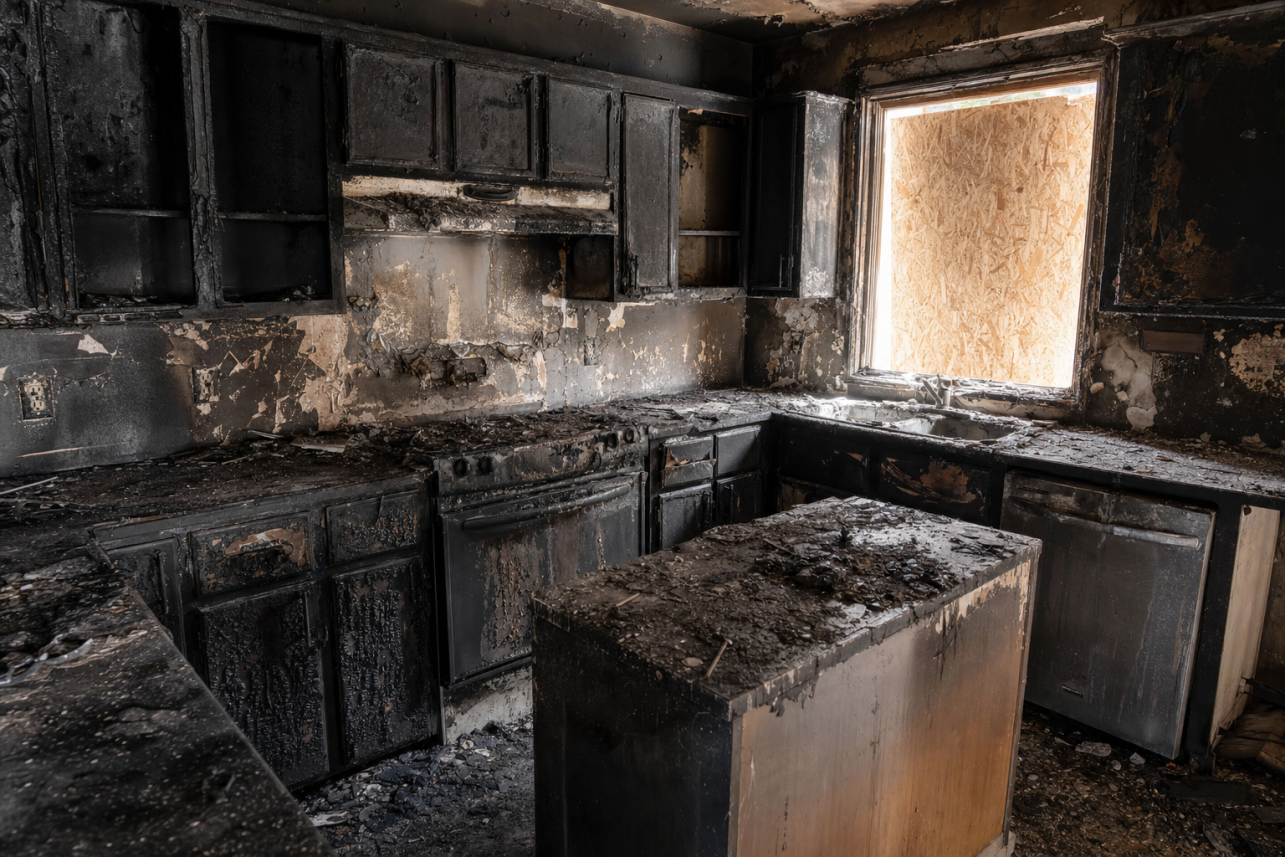
In Bi-Economy Market v. Harleysville Insurance, a family-owned meat market was destroyed by fire, and the insurer lowballed the damage payment, dragged out the building claim for more than a year, and cut the promised business-interruption coverage short. The business collapsed — but New York’s highest court ultimately ruled for the policyholder, not the insurance company.
A Fire, Then a Second Disaster: The Claim Itself
Bi-Economy Market was a family-run wholesale and retail meat market in upstate New York. A fire tore through the business, destroying the building, the equipment, and the inventory. The owners did exactly what policyholders are told to do: they had insurance in place — including business-interruption coverage designed to keep income flowing while they rebuilt — and they filed their claim promptly.
What happened next is a textbook example of a fire claim delay doing more damage than the fire:
- A lowball payment on the actual damage. The insurer’s initial offer on the direct fire loss fell far short of what the destruction actually cost, and the full building loss was not resolved until more than a year after the fire.
- Business-interruption coverage cut short. The policy promised up to twelve months of lost business income. The insurer paid only about seven months’ worth — then stopped.
- No business left to save. A meat market cannot survive a year with no building, no inventory, and no steady income. While the claim sat unresolved, the business never reopened. It was gone.
The Fight to New York’s Highest Court
Bi-Economy’s owners refused to accept that outcome. They sued, arguing the insurer had not just underpaid a claim — it had breached its duty of good faith, and that breach destroyed the very business the policy existed to protect. The case went all the way to the New York Court of Appeals, the state’s highest court, which sided with the insured. The court recognized that the whole point of business-interruption insurance is to keep a business alive after a disaster, so an insurer that stalls and shortchanges a claim can be held responsible for the foreseeable harm its delay causes. Delays like these are exactly why documentation and persistence matter so much in a commercial business claim in Elon or anywhere else.
Why This Case Still Matters to Property Owners
Bi-Economy is a powerful reminder that an insurance policy is a promise of timely performance, not just a dollar figure. When an insurer slow-walks payment, the harm can spread far beyond the original fire damage — lost tenants, lost customers, a business that never comes back. Whether you’re a homeowner or handling a commercial business claim in Raleigh, the lesson is the same: the clock on your claim deserves as much attention as the numbers.
Can an Insurer Owe More Than Policy Limits for a Fire Claim Delay?
Yes. In Bi-Economy Market v. Harleysville Insurance, New York’s highest court ruled that when an insurer unreasonably delays and underpays a fire claim, it can be held liable for consequential damages beyond the policy limits — including the destruction of the policyholder’s business — because that harm was a foreseeable result of the insurer’s stalling.
That ruling matters because it cuts through the argument insurers have leaned on for decades: that the worst-case outcome of denying or dragging out a claim is simply having to pay the policy limits later. The court said no. The entire reason a business owner buys property and business-interruption coverage is to stay afloat after a disaster. An insurer knows that when it signs the policy. So when the carrier slow-walks payment and the business collapses while waiting, the insurer can be on the hook for that collapse — not just the building and contents it should have paid for in the first place.
What “Consequential Damages” Means in Plain English
Consequential damages are the losses that flow from the insurer’s broken promise, beyond the covered property itself. In a fire claim delay, those can include:
- The lost value of a business that failed because repair money never arrived on time
- Income the business would have earned beyond the business-interruption coverage period
- Costs the owner incurred trying to keep operations alive while the claim sat unpaid
These are the kinds of stakes that come up in a serious commercial business claim in Raleigh or anywhere else — the longer the carrier delays, the more the real-world damage compounds.
What “Bad Faith” Actually Means for a Policyholder
Bad faith doesn’t mean the insurer made an honest mistake or disagreed with you about a repair estimate. It generally means the carrier acted unreasonably and knew it — lowballing without a legitimate basis, sitting on a claim without explanation, or ignoring evidence that supported payment. Every insurance policy carries an implied duty of good faith and fair dealing. When a carrier breaches that duty, courts in many states, including North Carolina, allow the policyholder to pursue remedies that go beyond the face value of the policy.
Why This Matters Even if You Never Sue
Most fire claims never see a courtroom, and that’s usually a good thing. But rulings like Bi-Economy shift the leverage. An insurer that knows delay can cost it more than the policy limits has a strong incentive to pay fairly and promptly. Documenting the delay, the damage, and the financial fallout as it happens — the kind of groundwork involved in fire damage claim help in Garner — is what makes that leverage real for a policyholder, whether the claim settles at the negotiating table or ends up in front of a judge.
What Are My Rights if My NC Fire Claim Is Being Slow-Walked?
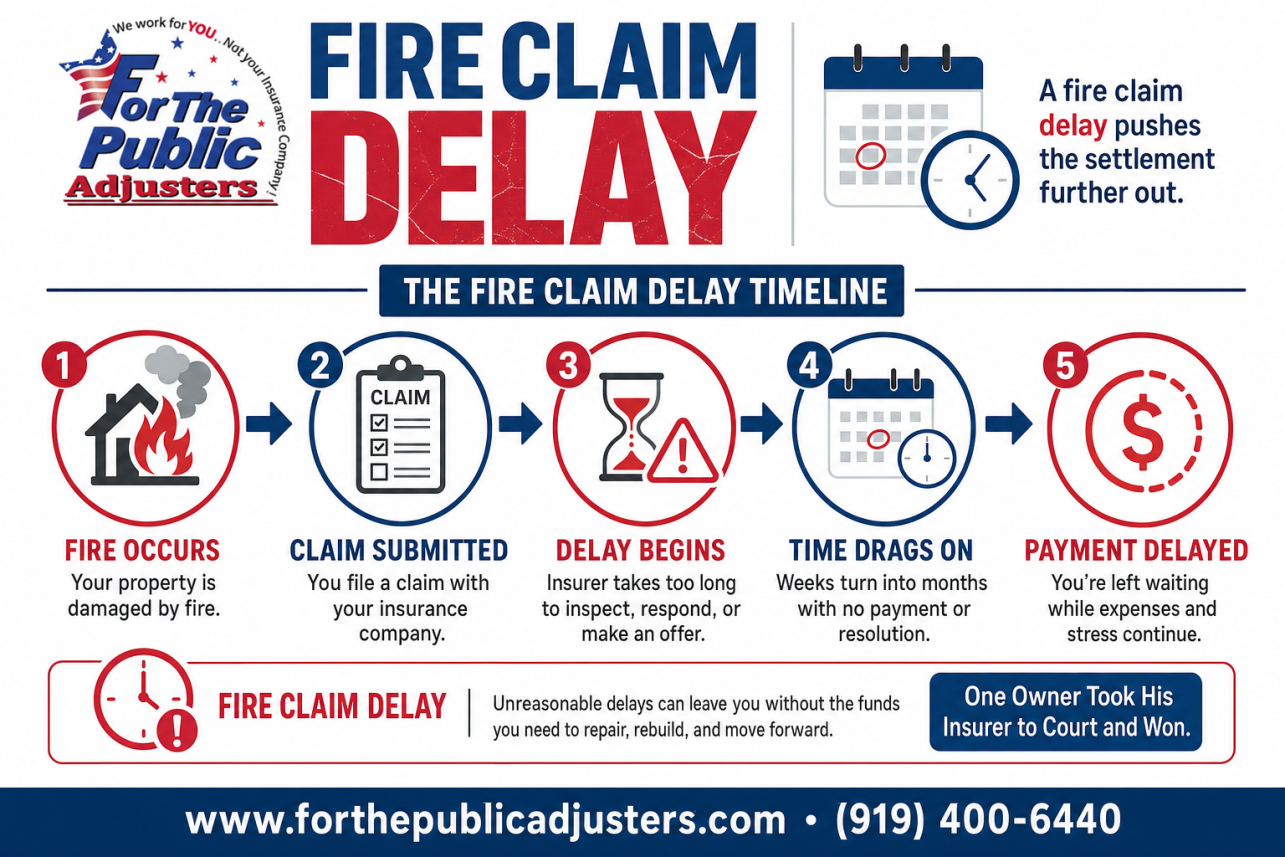
North Carolina law requires insurers to investigate fire claims promptly, communicate in a timely way, and attempt good-faith settlements once liability is reasonably clear. If an insurer violates these duties, policyholders can pursue bad-faith and unfair-trade-practice claims that may multiply their damages well beyond the original claim amount.
North Carolina’s Unfair Claim Settlement Practices Rules
Under N.C. Gen. Stat. § 58-63-15(11), insurers handling home, building, and contents claims in North Carolina are prohibited from, among other things:
- Failing to acknowledge and act reasonably promptly on claim communications
- Failing to adopt reasonable standards for prompt investigation of claims
- Refusing to pay without conducting a reasonable investigation
- Not attempting in good faith to settle a claim once liability has become reasonably clear
- Forcing policyholders to sue in order to recover amounts actually owed
The Case North Carolina Insurers Know Well
In Gray v. North Carolina Insurance Underwriting Association (2000), homeowners whose coastal property was damaged sued their insurer over how their claim was handled. The North Carolina Supreme Court sided with the insureds, holding that conduct violating the Unfair Claim Settlement Practices statute can support a claim under the state’s Unfair and Deceptive Trade Practices Act — which allows treble (tripled) damages. That decision gives North Carolina property owners real leverage: a fire claim delay isn’t just frustrating, it can expose the insurer to liability far beyond the policy itself.
Warning Signs Your Fire Claim Is Being Delayed or Underpaid
Delay rarely announces itself. Watch for these patterns on a home, building, or contents claim:
- Repeated document requests — asking again for paperwork you already submitted, or demanding records in small batches that reset the clock
- Long stretches of silence — unreturned calls, a rotating cast of adjusters, or vague “still under review” responses
- Partial payments with no explanation — small advances that stall while the bulk of the claim sits unresolved
- Lowball repair estimates — scopes of work that ignore smoke, soot, and odor damage or price repairs below what local contractors will actually charge
- Disputed contents values — aggressive depreciation or demands for receipts you couldn’t possibly have saved before the fire
If you’re seeing these signs, document everything in writing and get your own independent damage assessment. Many Wake County policyholders facing this situation seek fire damage claim help in Garner so the insurer’s estimate isn’t the only number on the table.
The same rights apply across the state, whether your loss is urban or rural. Working with a licensed fire damage claims adjuster near Apex or Selma puts someone on your side who knows these statutes and can push back when a claim is being slow-walked — before you’re forced to consider litigation.
When Should I Search for a Public Adjuster After a Fire?
The week of the loss — not months into a stalled claim. Bringing a licensed public adjuster on board within days of a fire means the damage gets documented before cleanup, your proof of loss is complete from the start, and a fire claim delay never has room to take hold.
Most homeowners wait until frustration sets in. By then, debris has been hauled away, smoke-damaged contents have been tossed, and the insurer’s file already tells a one-sided story. A slow-walk gains momentum in the gaps — missing photos, incomplete inventories, unanswered letters — and early professional involvement closes those gaps before they open.
Why the First Week Matters So Much
- Documentation before cleanup. Once charred materials and soot-covered belongings are removed, proving their condition becomes far harder. Early photographs, moisture readings, and room-by-room notes preserve the evidence your claim rests on.
- Accurate contents inventories. Building a thorough list of damaged personal property is slow, detailed work. Starting early means fewer forgotten items and fewer disputes later.
- A complete proof of loss. An incomplete or late proof of loss is one of the most common reasons insurers pause a file. A professional prepares it correctly the first time.
- Deadline tracking. Your policy contains time limits for notice, documentation, and sworn statements. Missing one hands the carrier a reason to delay or deny.
- A professional on record from day one. When the insurer knows a licensed, bonded advocate is reviewing every letter and every offer, files tend to move with more urgency.
Courts have recognized how damaging delay can be. In Bi-Economy Market, Inc. v. Harleysville Insurance Co., New York’s highest court sided with a small business owner whose fire claim was dragged out, holding that the insurer could be responsible for consequential damages flowing from its delay — a reminder that prompt, fair handling is part of what policyholders pay for. The best strategy, though, is never needing that fight. Early help with fire damage claim help in Garner and surrounding communities is designed to keep claims moving before they ever stall.
Fall Fires Mean a Crowded Claims Pipeline
This matters even more right now. Fall brings space heaters out of closets, fireplaces back into rotation, and lint-clogged dryer vents working overtime — and heating-related fires push a wave of new claims into insurers’ queues. More files per adjuster generally means slower responses for homeowners who wait to get organized. If a heating fire has damaged your home or contents, talking with a fire damage claims adjuster near Apex or elsewhere in the Triangle that first week puts your claim ahead of the seasonal backlog instead of behind it.
You don’t need to know yet whether your insurer will treat you fairly. You simply need your claim built right from day one — because a well-documented file is the hardest kind to slow-walk.

What Does a Licensed NC Public Adjuster Actually Do for a Fire Claim?
A licensed public adjuster works only for you, the policyholder — never the insurance company. On a fire claim, they scope the structural and smoke damage, inventory and value your contents, prepare and file the claim, negotiate with the insurer’s adjuster, and document every delay so your file is protected if bad-faith remedies ever become necessary.
That last point matters more than most homeowners realize. If your insurer is slow-walking payment, a well-built paper trail — dated correspondence, documented requests, itemized estimates — is exactly the kind of evidence that supports a complaint to the North Carolina Department of Insurance or, in serious cases, a bad-faith claim. A public adjuster builds that record as a matter of routine, not as an afterthought.
The Work Behind a Properly Prepared Fire Claim
- Scoping structural damage: Fire rarely stops at the char line. Heat can compromise framing, wiring, and roofing systems, and water from firefighting efforts causes its own damage. A public adjuster inspects and documents all of it.
- Addressing smoke and soot: Smoke residue migrates into HVAC systems, wall cavities, insulation, and belongings far from the fire itself. The U.S. Fire Administration notes that recovering after a fire involves far more than visible burn damage — and an undervalued claim often starts with an incomplete smoke assessment.
- Valuing contents: Creating a room-by-room inventory with replacement values is tedious, emotional work for a family. A public adjuster handles it systematically so items aren’t missed or lowballed.
- Preparing and negotiating the claim: They assemble estimates, respond to the carrier’s requests, and push back when the insurer’s numbers don’t match the real cost to rebuild and replace.
- Countering delay tactics: Repeated document requests, re-inspections, and unexplained silence are logged and answered promptly, removing the excuses that fuel a fire claim delay.
Honest Representation — Not Empty Promises
No public adjuster can guarantee a specific outcome or dollar amount, and you should be wary of anyone who does. What a licensed and bonded professional can promise is this: you won’t be negotiating alone against a trained company adjuster. Homeowners who search for a Public Adjuster in Cary NC after a fire are usually looking for exactly that — someone in their corner who knows the policy, the process, and the pressure points.
The same professional representation applies whether you own a home or a commercial building. If you’re weighing your options, talking with a private claims adjuster in Apex NC costs you nothing but a conversation, and it may change the entire trajectory of your claim.
If your fire claim is stalled, underpaid, or simply overwhelming, don’t wait for the insurer to set the pace. Contact a licensed, bonded North Carolina public adjuster today for a free review of your claim — and put someone on your side of the table.
Fire Claim Delay: Acting Early vs. Waiting It Out
| Factor | Hire a Public Adjuster Week One | Wait Months Into a Stalled Claim |
|---|---|---|
| Evidence of the loss | Damage, contents, and business records documented while fresh | Evidence degrades, memories fade, and the site may be cleared |
| Business interruption clock | Lost income tracked and claimed from day one | Gaps and disputes over what the fire actually cost the business |
| Insurer momentum | Deadlines, demands, and documentation keep the claim moving | Delay becomes the insurer’s negotiating leverage |
| Leverage if delay continues | A well-documented file supports a Bi-Economy-style consequential damages argument | A thin file makes proving delay-related losses much harder |
Illustrative Example: A Restaurant Fire and the Week-One Difference
Illustrative example
Consider a hypothetical North Carolina restaurant owner whose kitchen fire shuts down operations overnight. Rather than waiting for the insurer’s pace to dictate the claim, she brings in a licensed, bonded public adjuster within days, who inventories contents, documents the structural damage, and begins building the business interruption record immediately. When the insurer requests round after round of paperwork, the adjuster responds promptly with an organized file and firm timelines, leaving little room for the claim to drift. This is a composite scenario and no outcome can ever be guaranteed, but it illustrates the core lesson of Bi-Economy: early documentation and steady pressure are what keep a fire claim delay from becoming the loss that closes your doors.
Frequently asked questions
What should I do if my insurance company keeps stalling my fire claim delay after fire damage?
Document everything in writing. Send a dated letter or email asking for a written explanation of the delay and a decision deadline, and keep copies of every call log and request. In Bi-Economy Market v. Harleysville, New York’s highest court held an insurer that unreasonably delayed a fire claim could owe consequential damages beyond the policy limits. Bringing in a licensed public adjuster early puts a professional on your side who tracks deadlines and pushes the claim forward.
How long should a fire insurance claim take to pay out?
Most straightforward fire claims resolve within a few months, while large or complex losses can take longer. State regulations generally require insurers to acknowledge your claim promptly, investigate within a reasonable time, and pay promptly once liability is clear. If weeks pass with no inspection, no written explanation, or repeated requests for documents you already sent, that pattern is a warning sign the claim is being slow-walked and deserves immediate attention.
How much does a public adjuster cost for a fire claim?
Public adjusters typically work on a contingency fee — a percentage of the claim payment — so there is usually no upfront cost. Fees vary by state and by the size and complexity of the loss, and in North Carolina they are set out in a written contract you review before signing. Because the adjuster documents the full scope of damage, many policyholders find the professional handling pays for itself, though no specific result can ever be guaranteed.
Should I hire a public adjuster right after a fire or wait to see how the claim goes?
The week of the loss is the best time. Evidence is freshest, temporary repairs and inventory can be documented correctly from day one, and the insurer’s first inspection happens with a professional representing you. Waiting until a claim stalls means playing catch-up on months of missed documentation. The lesson of Bi-Economy v. Harleysville is that delay itself destroys businesses — early professional involvement keeps a slow-walk from ever gaining momentum.
What are consequential damages in an insurance claim?
Consequential damages are losses caused by the insurer’s own unreasonable conduct — not just the fire itself. In Bi-Economy Market v. Harleysville, the New York Court of Appeals ruled a meat market owner could pursue damages for the collapse of his business caused by the insurer’s delay and underpayment, even beyond the policy limits. The reasoning: the whole point of buying coverage is prompt payment, so an insurer that defeats that purpose can be held accountable.
Does the Bi-Economy ruling apply to homeowners in North Carolina?
Bi-Economy is a New York decision, so it doesn’t automatically bind North Carolina courts. But North Carolina has its own protections, including unfair claims settlement practices laws, that address unreasonable delay and underpayment. The case matters here as a widely cited example of courts holding insurers accountable when delay destroys what the policy was supposed to protect. For case-specific legal questions, consult a North Carolina attorney; a public adjuster handles the claim documentation side.
What are the biggest mistakes people make after a house or business fire?
Common missteps include accepting the insurer’s first offer without an independent damage estimate, throwing away damaged contents before they’re documented, giving recorded statements without preparation, missing proof-of-loss deadlines, and assuming silence from the insurer means the claim is progressing. Another big one: not reading the policy for coverage like additional living expenses or business interruption. Careful documentation from day one prevents most of these problems.
What happens step by step after I file a fire claim?
Expect this sequence: you report the loss and secure the property; the insurer acknowledges the claim and assigns an adjuster; an inspection follows; you submit a contents inventory and proof of loss; the insurer issues a coverage decision and payment, often in stages for structure, contents, and living expenses or lost income. At each step, deadlines apply to both sides — tracking them in writing is how you spot a stall before it costs you.
Can my insurer pay less than it costs to actually rebuild after a fire?
Insurers sometimes issue initial payments based on incomplete scopes — missing smoke damage, code-upgrade costs, or hidden structural harm. You’re entitled to the full benefit of your coverage, and Bi-Economy v. Harleysville shows courts take underpayment seriously when it causes real harm. Get an independent, line-item estimate of the damage before accepting any settlement, and remember that a payment can often be supplemented if additional covered damage is properly documented.
When do I need a lawyer instead of a public adjuster for a delayed fire claim?
A public adjuster documents, values, and negotiates the claim itself — the scope of damage and what the policy owes. An attorney becomes appropriate when the insurer denies the claim outright, alleges fraud, or when bad-faith litigation like the Bi-Economy case is the right path. Many policyholders start with a public adjuster, since thorough documentation early often resolves the claim; if litigation is later needed, that same record strengthens the legal case.
Commercial Business Claim help near you
Related local pages
If your fire claim is stalling, don’t wait for the slow-walk to gain momentum. Call our licensed and bonded NC public adjusters today for a free claim review. Get in touch.
Last updated: October 22, 2026