
What Is Recoverable Depreciation on an Insurance Claim?
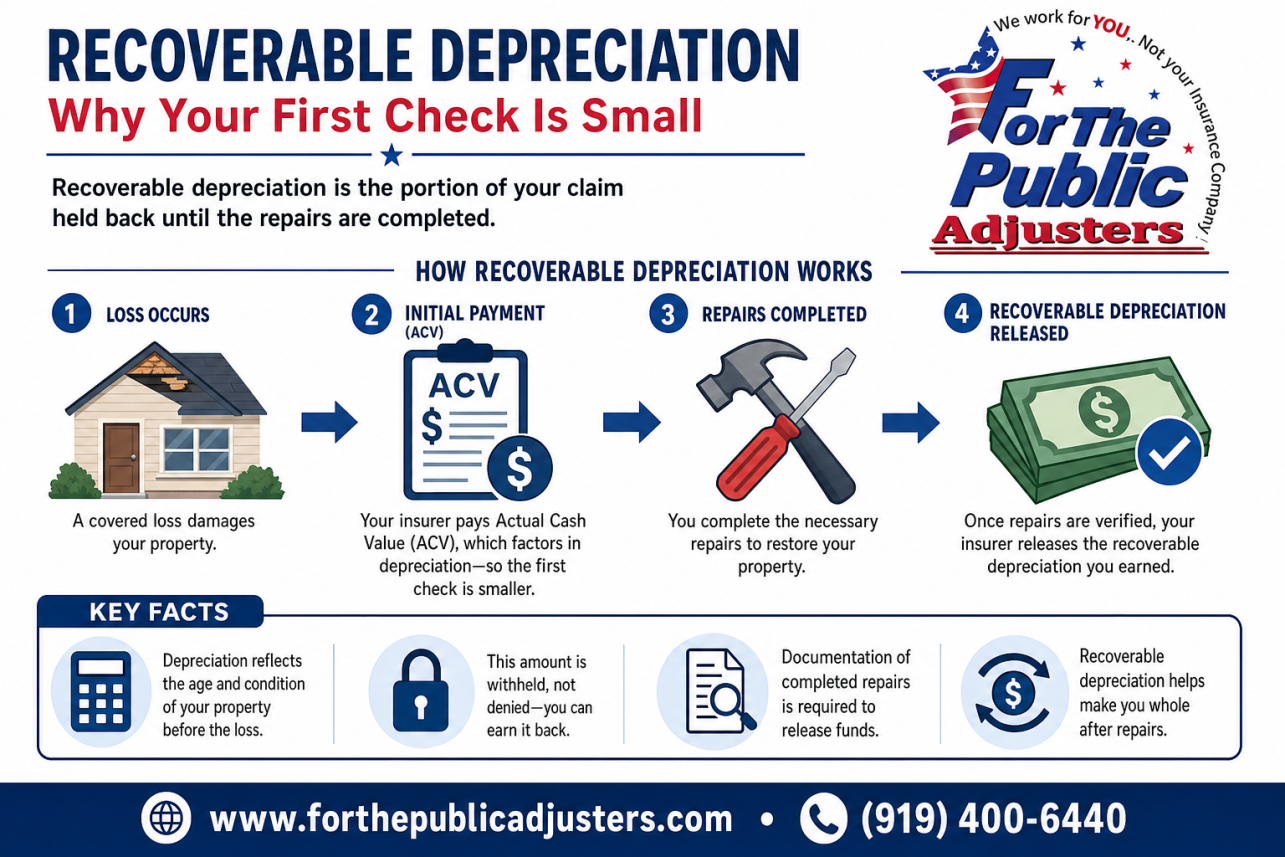
Recoverable depreciation is the portion of your insurance claim that the insurer withholds until you actually complete repairs or replace the damaged property. It represents the difference between an item’s depreciated value and its full replacement cost, and you can get it back — but only after showing proof the work was done.
Key takeaways
- Your first insurance check is typically the actual cash value (ACV), which is the replacement cost minus depreciation.
- Recoverable depreciation is the withheld portion you can claim back after completing repairs and submitting proof.
- You must usually finish the work and provide receipts or invoices before the insurer releases the depreciation payment.
- Most policies impose a deadline—often 6 months to a year after the loss—to complete repairs and claim recoverable depreciation.
- If you never complete the repairs or miss the deadline, the withheld depreciation may be forfeited entirely.
If you have a replacement cost policy and your first check seemed far smaller than the estimate, recoverable depreciation is almost always the reason. To understand why, you need to know the two ways insurers value your property.
ACV vs. RCV: The Two Numbers That Shape Your Payout
Most homeowners policies calculate losses using one of two methods:
- Actual Cash Value (ACV): The cost to replace the damaged item minus depreciation for age, wear, and condition. A ten-year-old roof is worth less than a new one, so its ACV reflects that lost value.
- Replacement Cost Value (RCV): The full cost to repair or replace the damaged property with new materials of similar kind and quality, with no deduction for age or wear.
If your policy pays replacement cost, the gap between those two numbers is your depreciation — and under most RCV policies, that depreciation is recoverable. In other words, the insurer will eventually pay it, but not up front.
Why Insurers Hold Back Part of the Payment
Insurance companies typically pay replacement cost claims in two stages:
- First payment: The ACV amount, minus your deductible. This is the smaller initial check that surprises many homeowners.
- Second payment: The recoverable depreciation, released after you complete the repairs or replacement and submit documentation, such as contractor invoices or receipts.
The holdback exists because replacement cost coverage is meant to fund actual repairs — not to provide a cash windfall. By withholding depreciation until the work is done, insurers make sure the money goes toward restoring the property. If you never complete the repairs, you generally keep only the ACV payment.
Recoverable vs. Non-Recoverable Depreciation
Not all depreciation comes back to you. The distinction matters:
- Recoverable depreciation: Withheld temporarily and paid once repairs are completed and documented, under an RCV policy.
- Non-recoverable depreciation: Permanently deducted. This applies if you have an ACV-only policy, or if your policy specifically limits certain items — older roofs are a common example — to actual cash value.
Reading your policy’s loss settlement provisions is the only way to know for certain which category applies to your claim. If the language is unclear or the depreciation deducted seems excessive, that’s a sign it’s worth reviewing your claim documentation carefully before accepting the settlement as final. The sections below walk through how the two-check process works and how to make sure you collect every dollar you’re owed.

Why Is My First Insurance Check Smaller Than the Estimate?
Your first check is smaller because the insurance company subtracts two things from its estimate: depreciation and your deductible. The initial payment reflects only the actual cash value (ACV) of the damage — the depreciated worth of your property — not the full cost to repair or replace it. The withheld depreciation comes later, after repairs are complete.
This catches thousands of homeowners off guard every year. You receive an estimate that looks reasonable, then a check arrives that’s thousands of dollars short. Nothing has gone wrong — this is how replacement cost value (RCV) policies are designed to pay out. Understanding the math behind that first check makes the whole process far less stressful.
The Formula Behind Your First Check
When your adjuster writes an estimate, the initial payment is calculated like this:
- Start with the RCV: the full estimated cost to repair or replace the damage with materials of like kind and quality at today’s prices.
- Subtract depreciation: a deduction based on the age, condition, and expected lifespan of the damaged materials. Older materials mean more depreciation withheld.
- Subtract your deductible: your out-of-pocket share of the loss under the policy.
What’s left is the ACV payment — your first check.
A Realistic Roof-Replacement Example
Say a hailstorm destroys your roof, and the insurance company estimates the replacement at $30,000 RCV. Your shingles are 15 years old on a roof rated for roughly 30 years, so the adjuster applies depreciation of about $10,000. Your policy carries a $3,000 deductible. The math looks like this:
- $30,000 replacement cost estimate
- − $10,000 depreciation withheld
- − $3,000 deductible
- = $17,000 first check
That $10,000 in withheld depreciation isn’t gone — if your policy pays on a replacement cost basis, it’s recoverable depreciation, held back until you actually complete the roof replacement and document the cost. The deductible, on the other hand, is never reimbursed; that portion is always yours to cover.
Why Insurers Structure Payments This Way
Carriers withhold depreciation to ensure the money is actually used to repair the property. If they paid the full replacement cost up front, some claimants might pocket the difference and never fix the damage. By releasing recoverable depreciation only after repairs are finished, insurers confirm the work was done before paying full value.
The key takeaway: a small first check is not the insurance company’s final answer. Before assuming you’ve been underpaid, check the estimate paperwork for line items labeled “depreciation” or “recoverable depreciation” — that’s money you can still claim once the work is done.
How Do I Claim My Recoverable Depreciation After Repairs?
To claim recoverable depreciation, complete the repairs listed on your insurance estimate, then send your insurer proof of the finished work — typically contractor invoices, receipts, and photos — before your policy’s deadline. Once the adjuster verifies the repairs match the approved scope, the company releases the withheld depreciation in a second check.
The process is straightforward on paper, but claims stall when homeowners skip a step or miss a deadline. Here is how to move through it cleanly.
Step 1: Review Your Loss Statement Carefully
Start with the itemized estimate or loss statement your insurer provided. It shows the replacement cost, the depreciation withheld, and your deductible. Confirm the scope of work matches your contractor’s plan. If your contractor finds damage the adjuster missed, request a supplement before repairs are finished — it is much harder to add items afterward.
Step 2: Complete the Repairs
Recoverable depreciation is only released for work that is actually done. You generally must repair or replace the damaged items described in the estimate. Keep the scope consistent: if the estimate covers a full roof replacement, a patch job may not qualify for the full holdback.
Step 3: Document Everything
Insurers want proof, not promises. Gather:
- Final invoices or receipts showing the completed work and total cost, ideally itemized to mirror the insurance estimate
- A signed contract or work order from your contractor
- Before-and-after photos of the repaired areas
- A certificate of completion if your contractor or insurer uses one
- Proof of payment, such as canceled checks or credit card statements, if requested
If you did the work yourself, keep material receipts and photos. Note that some policies limit what you can claim for your own labor, so ask your adjuster how DIY repairs are handled before you start.
Step 4: Submit Your Proof Before the Deadline
Most policies set a time limit for completing repairs and requesting the withheld funds — often stated in the policy or your claim paperwork. Read your policy’s loss settlement section, and if a deadline is approaching and repairs are delayed by contractor availability or weather, ask your insurer in writing for an extension. Submit your documentation by email or your insurer’s claim portal so you have a timestamped record.
Step 5: Follow Up Until the Check Arrives
Do not assume submission equals payment. After sending your documents:
- Confirm the adjuster received everything and ask what, if anything, is missing
- Ask for a target date for releasing the recoverable depreciation
- Follow up in writing every week or two until the check is issued
- Keep notes of every call, including names and dates
If a mortgage company is listed on the check, contact your lender early — they often have their own inspection and endorsement process that can add weeks if you wait.
What If the Insurance Company Refuses to Release the Money?
If your insurer refuses to release recoverable depreciation after you complete repairs, you can push back. Start by requesting a written explanation of the denial, submit complete documentation of the finished work, and escalate to a supervisor, your state’s Department of Insurance, a public adjuster, or an attorney if the carrier still won’t pay.
Insurers don’t always make it easy to collect the money withheld from your first check. Knowing the tactics they use — and the counter-moves available to you — can make the difference between recovering the full amount and leaving money on the table.
Common Tactics Insurers Use to Delay or Deny Payment
- Disputing your invoices. The carrier may claim your contractor’s invoice lacks detail, doesn’t match the original scope of work, or includes items that weren’t part of the approved estimate. Line-item invoices that mirror the insurer’s own estimate are much harder to reject.
- Arguing the work wasn’t completed properly. Some adjusters demand photos, inspections, or a certificate of completion before releasing funds — then move slowly on scheduling those steps.
- Claiming you missed a deadline. Many policies set a time limit for completing repairs and requesting the withheld funds. Insurers may enforce these strictly, even when delays were outside your control.
- Improperly depreciating labor. Some carriers depreciate not just materials, but the labor to install them. Critics argue this is improper because labor doesn’t wear out or age the way shingles or siding do — and courts have increasingly agreed.
The Lammert Decision: Labor Costs and Depreciation
A significant ruling on this issue came in Lammert v. Auto-Owners Insurance, decided by the Tennessee Supreme Court in 2019. Homeowners with property damage challenged the insurer’s practice of depreciating labor costs when calculating actual cash value (ACV) payments. The court sided with the homeowners, ruling that labor costs cannot be depreciated under the ACV policies at issue.
While the decision applies directly to Tennessee, it reflects a broader trend: courts in several states have scrutinized labor depreciation, and the outcome often turns on the exact policy language. If your insurer depreciated labor in your claim, it’s worth reviewing your policy and asking the carrier to justify that deduction in writing — you may be owed more than the stated recoverable depreciation amount.
Steps to Take When Payment Is Withheld
- Request the insurer’s refusal and its reasons in writing — vague verbal denials are harder to challenge.
- Gather proof of completed work: final invoices, receipts, before-and-after photos, and any permits or inspection sign-offs.
- Send a formal written demand referencing your policy’s loss settlement provisions.
- File a complaint with your state’s Department of Insurance if the carrier remains unresponsive.
- Consult a public adjuster or an attorney experienced in property claims if the amount in dispute is significant.
Persistence and paperwork are your best tools. Insurers are far more likely to release withheld funds when a homeowner responds with organized documentation and a clear understanding of their rights.
Can a Public Adjuster Help Me Recover More of My Claim?
Yes. A public adjuster works for you, not the insurance company. They re-inspect the damage, challenge inflated depreciation and low actual cash value (ACV) figures, and handle the recoverable depreciation paperwork so nothing is left on the table. While results vary by claim, professional review often uncovers underpaid items.
Insurance company adjusters are trained, experienced, and often handle dozens of claims at once. Most homeowners, on the other hand, will only file a major property claim once or twice in a lifetime. That knowledge gap is exactly where a public adjuster adds value — especially when depreciation is where much of your money is being held back.
What a Public Adjuster Actually Does for Your Claim
- Re-inspects the damage independently. They document everything the first inspection may have missed — hidden water damage, code-required upgrades, or damaged items that were never scoped.
- Challenges the depreciation itself. Depreciation is not an exact science. If the insurer assumed your roof was older than it is, or applied depreciation to labor when it shouldn’t have, a public adjuster can push back with documentation.
- Disputes low-ball ACV figures. If the replacement cost estimate is too low to begin with, your recoverable depreciation will be undervalued too. Adjusters compare the carrier’s pricing against real local contractor costs.
- Manages the recoverable depreciation paperwork. They track invoices, completion certificates, and proof-of-repair documentation, and submit everything in the format and timeframe the policy requires — so the final check isn’t delayed or denied on a technicality.
A Real-World Style Example
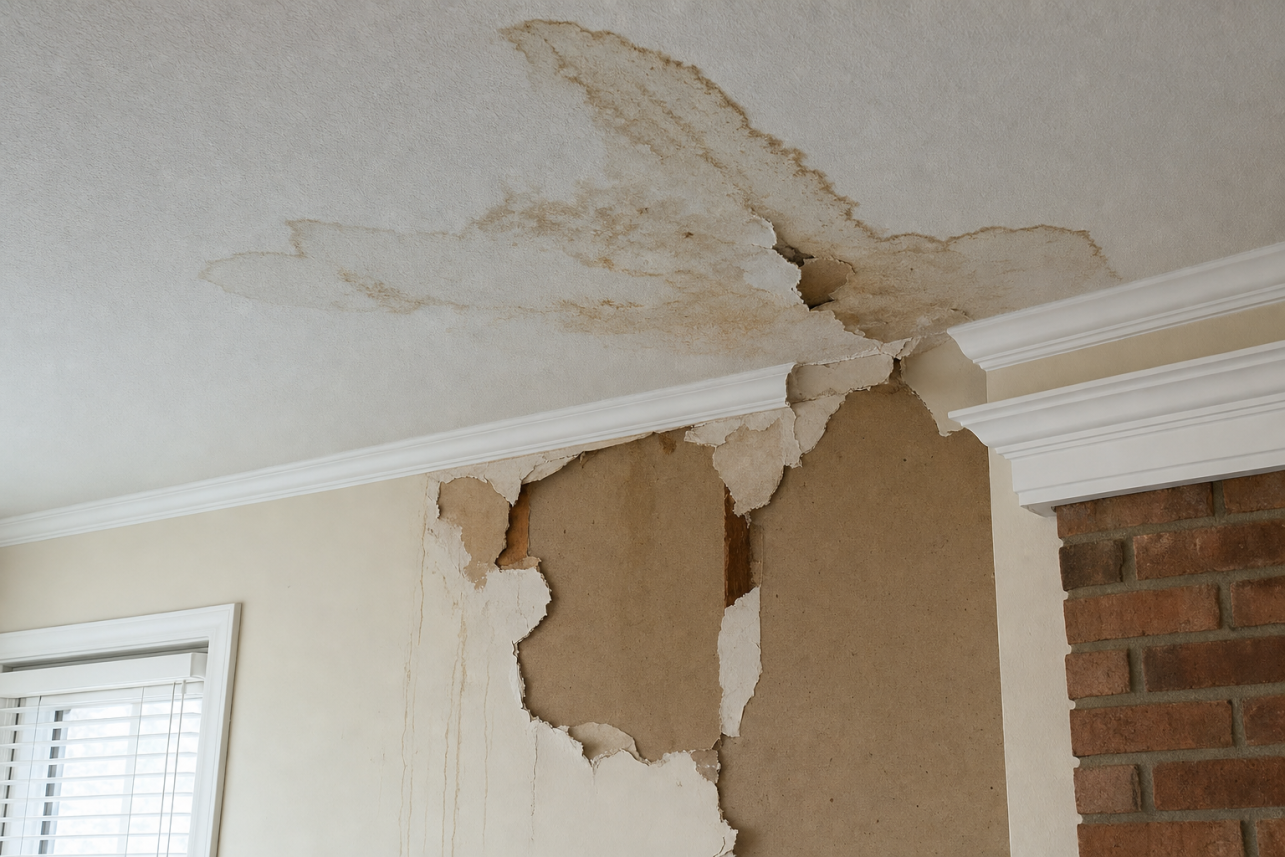
Consider a common scenario: a homeowner files a claim for storm damage to their roof and interior ceilings. The insurer’s estimate covers a partial roof repair, applies heavy depreciation based on the roof’s assumed age, and misses the water-stained drywall entirely. The first ACV check feels shockingly small — and it is.
After a public adjuster gets involved, the picture changes. A fresh inspection documents damage across the full roof slope, corrects the roof’s actual age with permit records, adds the interior damage to the scope, and revises the replacement cost using current local pricing. The result is a substantially higher settlement — both in the upfront ACV payment and in the recoverable depreciation released after repairs. Outcomes like this are common, though no professional can guarantee a specific result on any individual claim.
When Hiring a Public Adjuster Makes the Most Sense
- Your first check is dramatically lower than contractor estimates.
- The carrier applied depreciation that seems excessive for the age or condition of your property.
- The claim involves large or complex damage — roofs, water intrusion, fire, or multiple trades.
- You’re overwhelmed by the documentation required to release your recoverable depreciation.
Public adjusters typically work on a percentage of the recovered amount, so ask about fees upfront and verify the adjuster is licensed in your state before signing anything.
What Deadlines and Rules Apply in North Carolina and Virginia?
Most homeowners policies in North Carolina and Virginia require you to complete repairs and request your recoverable depreciation within a set window — commonly 180 days to two years from the date of loss or the date of the actual cash value payment. Your specific policy language controls, so read it carefully and act early.
Neither state sets a single, universal deadline for claiming recoverable depreciation. Instead, the time limit lives in your policy’s loss settlement provisions, and it can vary significantly from one insurer to the next. That’s why two neighbors with the same storm damage can face very different clocks.
Where to Find Your Deadline
Look in the section of your policy typically titled “Loss Settlement” or “How We Pay for a Loss.” Key details to check include:
- The trigger date: Some policies count from the date of loss; others count from the date the insurer issued the actual cash value payment.
- The repair completion requirement: Most policies require repairs to be finished — not just started — before depreciation is released.
- Notice requirements: Some policies require you to notify the insurer of your intent to make a replacement cost claim within a stated period.
- Extension provisions: Many insurers will grant written extensions for delays caused by contractor availability or material backorders, but you generally must request them before the deadline passes.
State-Specific Considerations
Both states regulate insurer claim-handling conduct, and both have consumer services divisions that accept complaints if you believe a deadline is being applied unfairly or your depreciation is being wrongfully withheld. In North Carolina, the North Carolina Department of Insurance handles consumer complaints and can answer questions about your rights under a homeowners policy. In Virginia, the Virginia Bureau of Insurance at the State Corporation Commission serves the same role.
Keep in mind that separate legal deadlines — such as contractual limitation periods for filing suit over a claim dispute — also exist and may be shorter than you expect. If a dispute is heading toward litigation, consult an attorney promptly rather than assuming you have years to act.
Why Acting Early Protects Your Full Payout
Waiting until the last minute is one of the most common ways homeowners forfeit recoverable depreciation. Contractors book out weeks or months in advance, permits take time, and material delays are unpredictable. If your repairs aren’t complete and documented before the policy deadline, the insurer may have no obligation to pay the withheld amount — even if the work eventually gets done.
Practical steps: schedule repairs as soon as the ACV check arrives, request any needed extensions in writing before the deadline, and keep dated invoices and photos throughout the project. Early action keeps the full replacement cost of your loss within reach.
Recoverable Depreciation: ACV vs. RCV Payouts Compared
| Feature | Actual Cash Value (ACV) Payment | Recoverable Depreciation Payment |
|---|---|---|
| When it’s paid | First check, shortly after claim approval | Second check, after repairs are completed and documented |
| How it’s calculated | Replacement cost minus depreciation | The depreciation amount that was withheld from the first check |
| What you must do | Accept the claim settlement | Complete repairs and submit receipts or invoices |
| Risk of losing it | Generally paid automatically | Can be forfeited if repairs aren’t done or deadlines are missed |
| Typical policy type | Available on all property policies | Only on replacement cost value (RCV) policies |
Illustrative Example: A Roof Claim in Two Payments
Illustrative example
Consider a hypothetical homeowner whose roof is damaged in a hailstorm and who carries a replacement cost policy. The insurer approves the claim but issues a first check for only the roof’s depreciated value, leaving the homeowner confused about how they’ll afford the full repair. After hiring a contractor, completing the work, and submitting the final invoice, the homeowner receives a second check covering the withheld recoverable depreciation. Because they acted within the policy’s deadline and kept thorough documentation, they ultimately recovered close to the full replacement cost, minus their deductible. This composite scenario reflects how the two-check process typically works, though timelines and requirements vary by policy and state.
Frequently asked questions
What is recoverable depreciation in an insurance claim?
Recoverable depreciation is the difference between an item’s replacement cost and its actual cash value (its depreciated value). If you have replacement cost coverage, your insurer typically pays the actual cash value first, then reimburses the depreciation amount after you complete repairs or replace the item and submit proof, such as receipts or invoices.
Why is my first insurance check smaller than my estimate?
Most insurers initially pay the actual cash value of your loss, which is the replacement cost minus depreciation for age and wear, and often minus your deductible as well. The remaining amount, the recoverable depreciation, is held back until you show the work was actually completed. This structure prevents policyholders from being paid full replacement cost without replacing anything.
How do I get my recoverable depreciation paid out?
You generally need to complete the repairs or replace the damaged items, then submit documentation to your insurer, such as receipts, invoices, or a contractor’s final bill. Once the insurer verifies the work, they release the withheld depreciation. Check your policy or ask your adjuster about any deadlines, since many policies limit how long you have to make the claim.
Is recoverable depreciation the same as non-recoverable depreciation?
No. Recoverable depreciation can be claimed back once you complete repairs, and it applies when you have replacement cost coverage. Non-recoverable depreciation cannot be reimbursed, which is typical with actual cash value policies. Reviewing your policy language or asking your agent is the best way to confirm which type of coverage you have.
Related local pages
- Public Adjuster Burlington NC: Fire, Water & Storm Damage Claims Handled On The Policyholder’s Side
- Public Adjuster Cary NC — Licensed Help For Fire, Storm, Water & Tree Damage Claims In Wake County
- Public Adjuster Garner NC — Fight for the Full Settlement You Deserve
Confused by a smaller-than-expected claim check? Our licensed and bonded public adjusters serve homeowners and business owners across North Carolina and Virginia. Contact us for a free claim review and let us help you pursue every dollar your policy allows. Get in touch.
Last updated: September 28, 2026