
What Is the NC Matching Rule for Siding and Shingles?
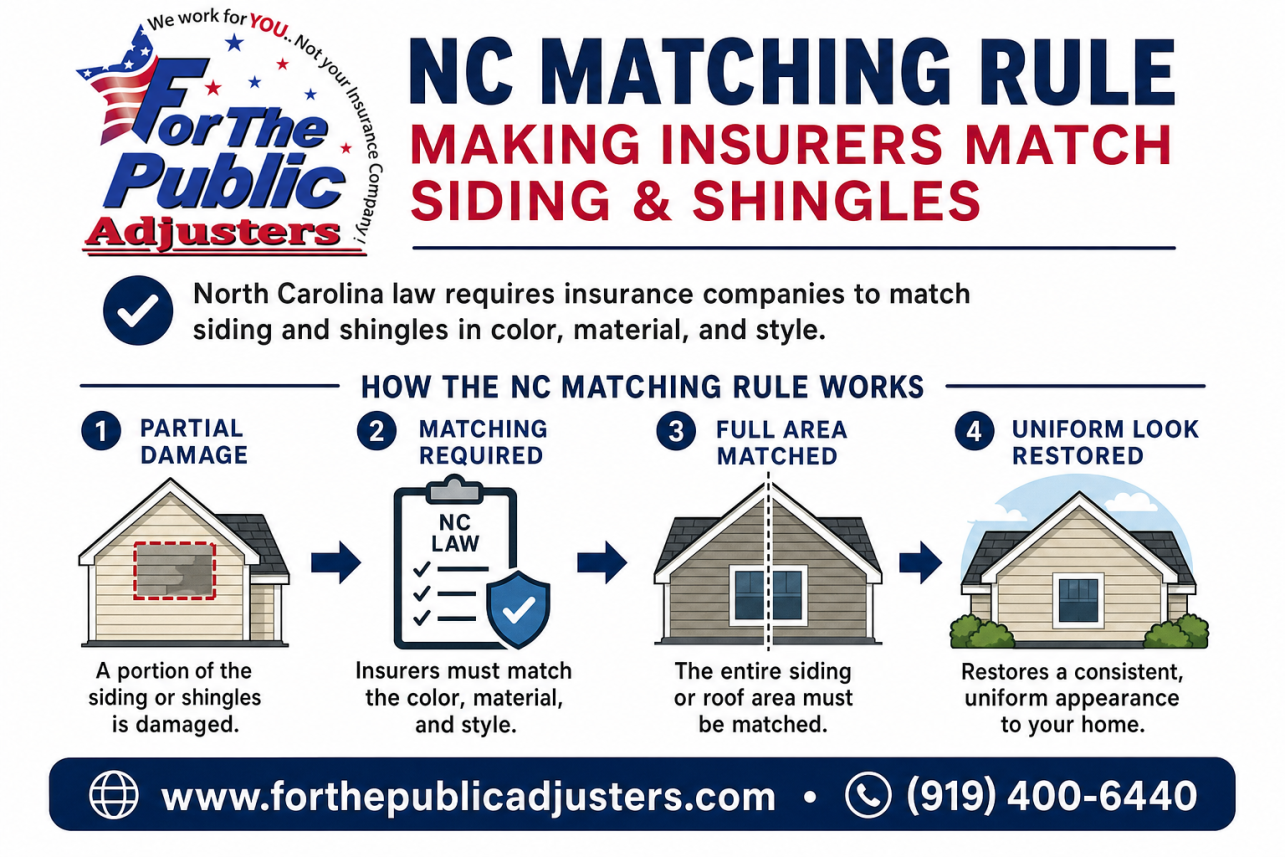
The NC matching rule is a North Carolina insurance regulation — 11 NCAC 4 .0421 — that requires insurers, when replacing damaged siding or shingles that no longer match in quality, color, or size, to replace items in the surrounding area so the property has a “reasonably uniform appearance.” In practice, this can force replacement of undamaged materials.
Key takeaways
- North Carolina’s matching regulation (11 NCAC 4 .0428) generally requires insurers to replace undamaged siding or shingles when repaired sections cannot reasonably match the rest of the home.
- The rule typically applies to items within the same ‘line of sight’ or contiguous area, such as one full wall of siding or a continuous roof slope.
- If your siding or shingle style is discontinued, that fact strengthens your argument that a reasonable match is impossible and broader replacement is owed.
- Document the mismatch with photos, manufacturer discontinuation letters, and contractor statements before accepting a partial-repair settlement.
- If your insurer refuses to apply the matching rule, you can file a complaint with the NC Department of Insurance or consult a policyholder attorney or public adjuster.
North Carolina is one of a minority of states with an explicit regulatory matching requirement written into its administrative code. The rule sits within the state’s unfair claims settlement practices regulations, which means an insurer that ignores it isn’t just being difficult — it may be engaging in a claims practice the North Carolina Department of Insurance can scrutinize.
What the Regulation Actually Says
The core of 11 NCAC 4 .0421 addresses what happens when a covered loss requires replacement of items and the replacement items do not match the existing ones. In that situation, the insurer is expected to replace items in the affected area so that the finished result conforms to a reasonably uniform appearance. For homeowners, the most common applications are:
- Vinyl or fiber-cement siding — where the original color or profile has been discontinued, or existing siding has faded so new panels visibly stand out
- Roof shingles — where a hail- or wind-damaged slope can’t be patched with shingles that blend with the weathered ones around them
- Other exterior materials — trim, gutters, and similar components where a partial repair would leave an obvious mismatch
What “Reasonably Uniform Appearance” Means
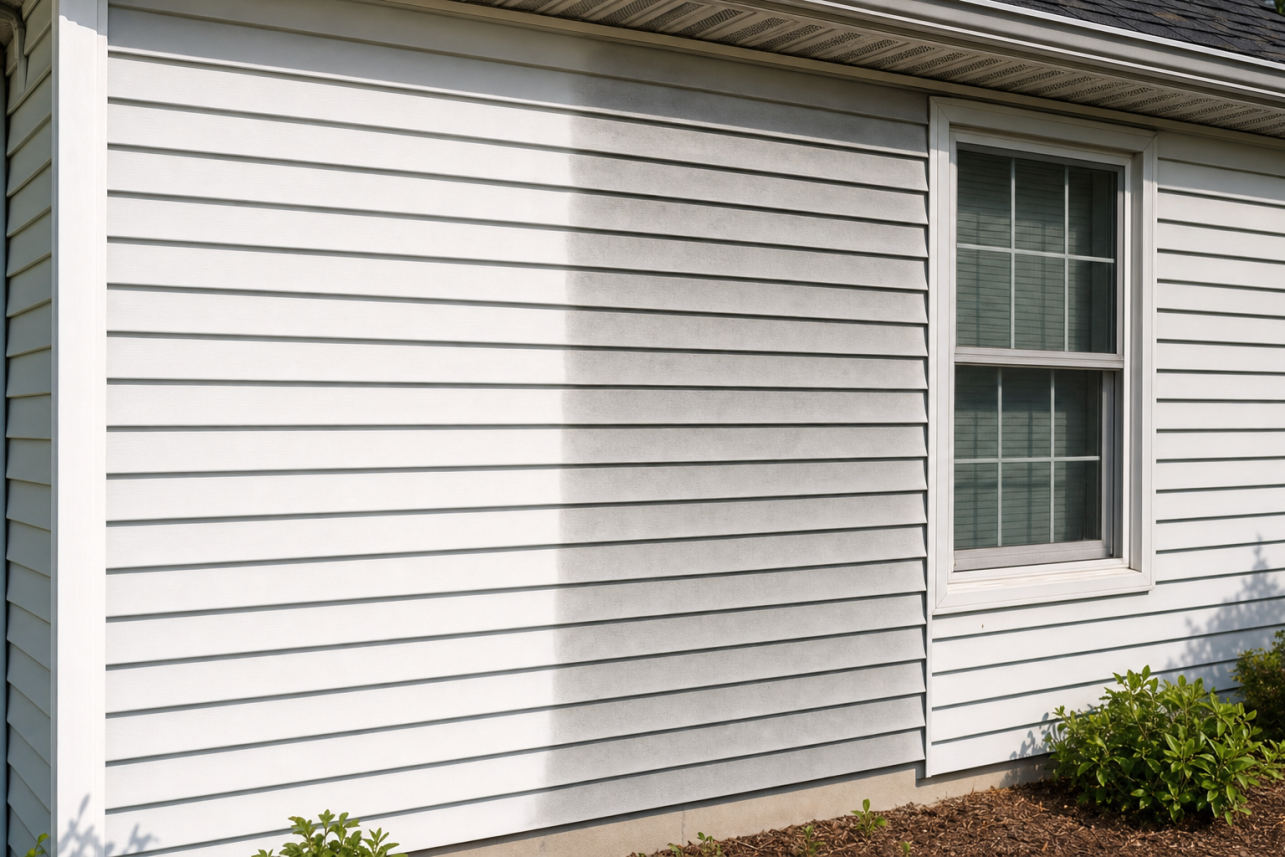
The regulation doesn’t demand a perfect, invisible match — the standard is reasonable uniformity. But it also doesn’t allow an insurer to bolt bright new panels onto a wall of sun-faded siding and call the job done. Key points homeowners should understand:
- The rule applies to the area affected, which is often interpreted as a full wall elevation or roof slope rather than the entire structure — though the right scope depends on the facts of each loss.
- If the original material is discontinued and nothing on the market reasonably matches, replacing only the damaged pieces usually can’t produce a uniform appearance, which strengthens the argument for broader replacement.
- Fading and weathering matter. Even if the same product line still exists, a decade of UV exposure can make a technically identical shingle or panel look obviously different.
Why This Rule Matters to Your Claim
Without a matching requirement, an insurer could pay to swap out a handful of hail-dented siding panels and leave you with a patchwork exterior that hurts your home’s appearance and resale value. The NC matching rule shifts that outcome: when a true match isn’t achievable, the cost of replacing undamaged material to restore uniformity becomes part of the covered loss. The sections below cover how insurers push back, how North Carolina compares to Virginia, and what to do when your carrier refuses to honor the rule.

Can My Insurer Refuse to Match My Siding or Shingles?
An insurer can try to refuse a match, but in North Carolina that refusal often conflicts with the state’s matching regulation and the insurer’s own policy language. When replacement materials don’t reasonably match the existing siding or shingles in color, quality, or size, the NC matching rule generally requires the insurer to replace surrounding material to achieve a reasonably uniform appearance.
In practice, adjusters rarely say “no” outright. Instead, they use a handful of familiar tactics to shrink the scope of the repair. Knowing what those tactics look like — and why they often don’t hold up — puts you in a much stronger position.
Tactic 1: Patching With Off-Color Shingles
The most common move is paying to patch only the damaged slope or section of roof, even when the new shingles will visibly clash with weathered ones around them. Shingles fade in the sun, so even the exact same product installed years apart can look mismatched. If the patch leaves your roof with an obvious checkerboard appearance, that’s precisely the situation the NC matching rule was written to address — a repair that doesn’t restore your home to a reasonably uniform look.
Tactic 2: The Discontinued-Siding “Close Match”
Vinyl siding profiles and colors are discontinued constantly. When your siding is no longer manufactured, some insurers offer a “comparable” product that differs in texture, panel width, or shade. A few things to keep in mind:
- A “close match” that a neighbor can spot from the street usually isn’t a reasonable match.
- Independent suppliers (such as itel-style siding match reports) can document whether a true match exists — insurers use these reports, and so can you.
- If no reasonable match exists, the question becomes how much surrounding siding must be replaced, not whether you’re stuck with a mismatch.
Tactic 3: Line-of-Sight Limitations
Some carriers agree to match — but only within a single “line of sight,” such as one wall or one roof slope. They’ll replace the damaged elevation and leave the rest, arguing you can’t see both sides of the house at once. This is a negotiating position, not a rule carved into most policies. Whether it’s reasonable depends on your home’s layout: on many houses, mismatched elevations are plainly visible from the street or yard, and a wall-by-wall patchwork does not produce a reasonably uniform appearance.
Check the Policy Before Accepting Any of These Positions
Some policies contain explicit matching exclusions or “cosmetic” limitations; many do not. If your policy is silent on matching, the insurer is generally in a weaker position to impose these limits, especially given North Carolina’s regulatory guidance. Read the estimate line by line, get the insurer’s position in writing, and don’t assume the first scope of repair is the final word.
How Does the NC Matching Rule Differ From Virginia’s Approach?
North Carolina has an explicit administrative rule requiring insurers to address mismatched siding and shingles, giving policyholders a regulation they can cite directly. Virginia has no equivalent rule, so matching disputes there turn on how the policy language is interpreted, with ambiguities resolved in the insured’s favor and appraisal often used to settle the fight.
North Carolina: A Written Rule You Can Point To
In North Carolina, the matching requirement is spelled out in the state’s insurance regulations. When replacement items don’t reasonably match the surrounding undamaged materials in quality, color, or size, the insurer is expected to resolve the mismatch — which often means replacing adjacent undamaged siding or shingles to achieve a uniform appearance. The practical advantage for homeowners is leverage:
- You cite a regulation, not just an argument. An adjuster who denies matching outright is contradicting a rule enforced by the NC Department of Insurance.
- Complaints have teeth. A complaint to the Department of Insurance references a specific standard the carrier is expected to follow.
- Negotiations start from a stronger position. The burden shifts toward the insurer to explain why a reasonable match exists, rather than you proving why one doesn’t.
Virginia: A Policy-Interpretation Battle
Virginia does not have a comparable administrative matching rule. That doesn’t mean Virginia homeowners are out of luck — it means the dispute plays out differently:
- The policy language controls. Most policies promise to repair or replace damaged property with material of “like kind and quality.” Homeowners argue that a patch of visibly different shingles or discontinued siding is not “like kind and quality” and diminishes the home’s value and appearance.
- Ambiguity favors the insured. Under standard contract-interpretation principles, if policy language is reasonably susceptible to more than one meaning, courts construe it against the insurer that drafted it. Since most policies don’t expressly exclude matching, that silence can work in the homeowner’s favor.
- Appraisal is a common battleground. Many matching disputes in Virginia are resolved through the policy’s appraisal clause, where each side selects an appraiser and disagreements go to an umpire. Whether matching is a question of “amount of loss” (appraisable) or “coverage” (not appraisable) is often the pivotal fight.
What This Means for Your Leverage
If your property is in North Carolina, lead with the NC matching rule itself — it’s your strongest card, and carriers operating in the state know it. If you’re in Virginia, build your case around the policy wording, document the mismatch thoroughly with photos and contractor statements about discontinued products, and be prepared to invoke appraisal if negotiations stall. In both states, insurers frequently settle matching claims once they see the homeowner understands the applicable framework, because the cost of fighting often exceeds the cost of doing the job right.
Have Policyholders Actually Won Matching Cases in Court?
Yes. Courts have sided with policyholders in significant matching disputes. In Windridge of Naperville Condominium Ass’n v. Philadelphia Indemnity Ins. Co. (7th Cir. 2019), the court ordered replacement of undamaged siding so all building sides matched, and in Cedar Bluff Townhome Condominium Ass’n v. American Family (Minn. 2014), “matching” required full color-matched replacement.
These decisions matter to homeowners because insurers often argue they only owe for the panels or shingles that were physically damaged. Courts examining what “direct physical loss” and “replacement cost” really mean have repeatedly found that a patchwork, mismatched repair does not put the policyholder back where they started. While these cases arose outside North Carolina, they are frequently cited in matching disputes nationwide, including negotiations involving the NC matching rule.
Windridge of Naperville v. Philadelphia Indemnity (7th Cir. 2019)
A hailstorm damaged the siding on the south and west elevations of a condominium association’s buildings. The insurer wanted to replace only those two sides, even though matching replacement siding was no longer available. The Seventh Circuit held that the buildings should be viewed as a whole, and that replacing only two sides would leave the association with a mismatched result that did not restore its pre-loss condition. Key takeaways for property owners:
- The court treated each building’s siding as a single, integrated unit rather than a collection of independent panels.
- When matching materials are discontinued or unavailable, replacing only the damaged sections may be an inadequate remedy.
- The insurer was required to pay to replace siding on all sides so the buildings matched.
Cedar Bluff Townhome Condominium Ass’n v. American Family (Minn. 2014)
In this Minnesota Supreme Court case, hail damaged siding on every building in a townhome complex, but only some panels on each. The original siding color had been discontinued, so any replacement panels would visibly differ. The court held that a “reasonable match” was part of restoring the property, and because no reasonable color match existed, the insurer owed for full replacement of the siding. The lesson: a technically functional repair that leaves an obvious color mismatch may not satisfy the insurer’s replacement-cost obligation.
What These Wins Mean for You
Neither case guarantees a particular outcome in North Carolina, since results always depend on your specific policy language and the facts of your loss. But these decisions give policyholders real leverage:
- They show that courts take mismatch seriously, especially when original materials are discontinued.
- They support the argument that “repair” means restoring uniform appearance, not just structural function.
- They are persuasive authority you or your representative can cite when an adjuster offers a patch-only settlement.
If your insurer insists on spot repairs that will leave your home visibly mismatched, these precedents demonstrate that pushing back is not just wishful thinking — insureds have won on exactly this issue.
What Should I Do If My Insurer Won’t Replace Undamaged Siding?
If your insurer refuses to replace undamaged siding to achieve a reasonable match, start building a paper trail: photograph the mismatch, get a contractor’s written opinion, request the insurer’s matching analysis in writing, obtain a product-availability report such as ITEL, and be prepared to invoke appraisal or file a complaint with the NC Department of Insurance.
1. Document the Mismatch Thoroughly
Evidence wins matching disputes. Take clear photos of the damaged area next to the surrounding siding or shingles in good daylight, from multiple angles and distances. A mismatch that looks minor up close often looks glaring from the street, so capture curb-view shots too. Ask your contractor to provide a written statement explaining why a patch repair will not result in a reasonably uniform appearance — this is the standard the NC matching rule is built around.
2. Get the Insurer’s Position in Writing
Verbal denials are hard to challenge. Send a written request asking the adjuster to explain, in writing, how they determined a match exists or why matching is not owed. Ask specifically:
- What product did they identify as a match, including manufacturer, profile, and color?
- Where is that product currently available for purchase?
- What portion of your policy language supports their position?
If they can’t answer these questions, that weakness becomes leverage.
3. Obtain an ITEL or Product-Availability Report
An ITEL report analyzes a sample of your siding or shingles and identifies whether the product is still manufactured and where comparable matches can be sourced. Insurers routinely rely on ITEL themselves, so a report showing your material is discontinued or has no reasonable match is difficult for them to dismiss. Your contractor can typically send in a sample, and the cost is modest relative to what’s at stake.
4. Invoke Appraisal If the Dispute Is About Amount
Most homeowner policies include an appraisal clause for disagreements over the amount of loss. If the insurer agrees the damage is covered but won’t pay to replace undamaged sections for uniformity, appraisal can resolve the scope and cost dispute without litigation. Each side selects an appraiser, and those appraisers choose an umpire. Review your policy’s appraisal provision carefully before invoking it, and consider getting professional advice first, since the outcome is generally binding on the amount.
5. File a Complaint With the NC Department of Insurance
The NC Department of Insurance accepts consumer complaints online and by mail, and it will require the insurer to respond in writing. While the DOI can’t order payment on your specific claim, a complaint creates regulatory pressure and an official record — and insurers know the NC matching rule is a regulatory position the Department takes seriously. Include your photos, contractor statements, ITEL report, and the insurer’s written denial when you file.
Work these steps in order where possible: strong documentation early makes every later step — appraisal, a DOI complaint, or professional representation — far more effective.
How Can a Public Adjuster Help With a Matching Dispute?
A licensed, bonded public adjuster represents you — not the insurance company — in a matching dispute. They document that your siding or shingles are discontinued or unmatchable, build a detailed estimate based on full replacement of the affected elevation or slope, and negotiate directly with the carrier to close the gap between a low initial offer and a fair settlement.
Matching disputes often come down to proof. Carriers rarely reverse a denial because a homeowner insists the new siding looks wrong; they respond to documentation, product research, and a professionally prepared estimate. That is exactly where a public adjuster earns their keep.
Documenting That Your Materials Can’t Be Matched
Before any negotiation happens, a public adjuster builds the evidentiary file the NC matching rule analysis depends on:
- Product identification — determining the exact manufacturer, profile, and color of your existing siding or shingles, often from labels, samples, or manufacturer records.
- Discontinuation research — obtaining written confirmation from manufacturers or distributors that the product or color is no longer produced.
- Sample and photo evidence — side-by-side comparisons showing that proposed “comparable” materials create a visible mismatch in color, texture, or dimension.
- Weathering documentation — showing why even the same product line won’t blend with faded, aged material already on the home.
Building a Matching-Based Estimate and Negotiating It
With the file assembled, the adjuster prepares a line-item estimate that reflects replacing continuous sections — a full elevation of siding or a full roof slope, for example — rather than patching a handful of squares. They then handle re-inspections, respond to the carrier’s engineer or field adjuster, and press the claim through supplements rather than accepting the first number.
This matters because hail and wind claims are frequently underpaid at first inspection. It is common for an initial estimate to cover only spot repairs, then increase substantially after a public adjuster requests re-inspection, presents discontinuation evidence, and documents the mismatch. Every claim is different, though, and no adjuster can guarantee a specific outcome — anyone who promises a particular payout should be treated with caution.
How to Vet a Public Adjuster
- Confirm they are licensed and bonded in North Carolina through the North Carolina Department of Insurance.
- Ask about their specific experience with siding and shingle matching disputes, not just general storm claims.
- Review the fee agreement carefully — public adjusters typically work on a percentage of the recovery, and the contract terms should be in writing.
- Understand the difference between the adjusters involved in your claim; the National Association of Insurance Commissioners explains that company and independent adjusters work for the insurer, while only a public adjuster works for the policyholder.
If your matching claim has stalled, bringing in a public adjuster early — before you accept a settlement check — generally gives them the most room to strengthen the file and negotiate effectively on your behalf.
NC Matching Rule: Partial Repair vs. Full Replacement Scenarios
| Scenario | Typical Insurer Position | How the NC Matching Rule Helps |
|---|---|---|
| Shingles still manufactured, color match available | Repair only the damaged slope or section | Limited leverage — a reasonable match may satisfy the rule |
| Shingle line discontinued or badly faded | Patch with ‘closest available’ product | Mismatch may trigger replacement of the full slope or roof area in the line of sight |
| Vinyl siding damaged on one wall, profile discontinued | Replace only broken panels | Rule can support replacing the entire affected wall or elevation |
| Insurer offers cash allowance for color difference | Pay a small mismatch allowance instead of matching | You can push back if the result is not a reasonably uniform appearance |
Illustrative Example: The Discontinued Siding Dilemma
Illustrative example
Consider a hypothetical Raleigh homeowner whose vinyl siding on one wall is cracked by hail, only to learn the manufacturer discontinued that color years ago. The insurer initially offers to replace just the broken panels with a visibly different shade. Citing North Carolina’s matching regulation and armed with a supplier letter confirming the discontinuation, the homeowner requests replacement of the entire affected elevation so the home has a uniform appearance. In this composite scenario, the insurer revises the estimate to cover the full wall rather than a mismatched patch — a common outcome when policyholders document the impossibility of a reasonable match.
Frequently asked questions
What is the NC matching rule for siding and shingles?
North Carolina has an insurance regulation that addresses situations where replacement materials don’t reasonably match the surrounding, undamaged materials. In general, when a covered loss requires replacing items like siding or shingles and the new materials can’t be made to reasonably match the existing ones in quality, color, or size, the insurer may be required to replace enough of the surrounding material to achieve a reasonably uniform appearance. The exact outcome depends on your policy language and the specific facts of your claim.
Does my insurer have to replace my whole roof if only part of it is damaged?
Not automatically. The insurer’s obligation is triggered when replacement shingles can’t reasonably match the existing ones — for example, if your shingle style or color has been discontinued. If a reasonable match is available, the insurer typically only owes for the damaged section. Disputes often come down to what counts as a ‘reasonable’ match, which is why documentation like photos, contractor statements, and manufacturer discontinuation notices can be important.
What should I do if my insurer refuses to pay for matching siding?
Start by getting the denial in writing and asking the insurer to cite the specific policy language it’s relying on. Gather evidence that a reasonable match isn’t available, such as a contractor’s written opinion or confirmation that the product is discontinued. If the dispute continues, you can file a complaint with the North Carolina Department of Insurance or consult a licensed public adjuster or an attorney who handles property insurance claims.
Does the NC matching rule apply to every type of insurance policy?
No. Matching requirements generally apply to property insurance claims for covered losses, and how they apply can vary based on your policy’s terms, such as whether you have replacement cost or actual cash value coverage, and any endorsements that limit matching. Review your policy carefully and ask your insurer or an insurance professional how the rule applies to your specific coverage.
Related local pages
- Public Adjuster Burlington NC: Fire, Water & Storm Damage Claims Handled On The Policyholder’s Side
- Public Adjuster Cary NC — Licensed Help For Fire, Storm, Water & Tree Damage Claims In Wake County
- Public Adjuster Garner NC — Fight for the Full Settlement You Deserve
Fighting a mismatched siding or shingle settlement? Our licensed and bonded public adjusters serve North Carolina and Virginia. Contact us for a free claim review today. Get in touch.
Last updated: October 1, 2026