
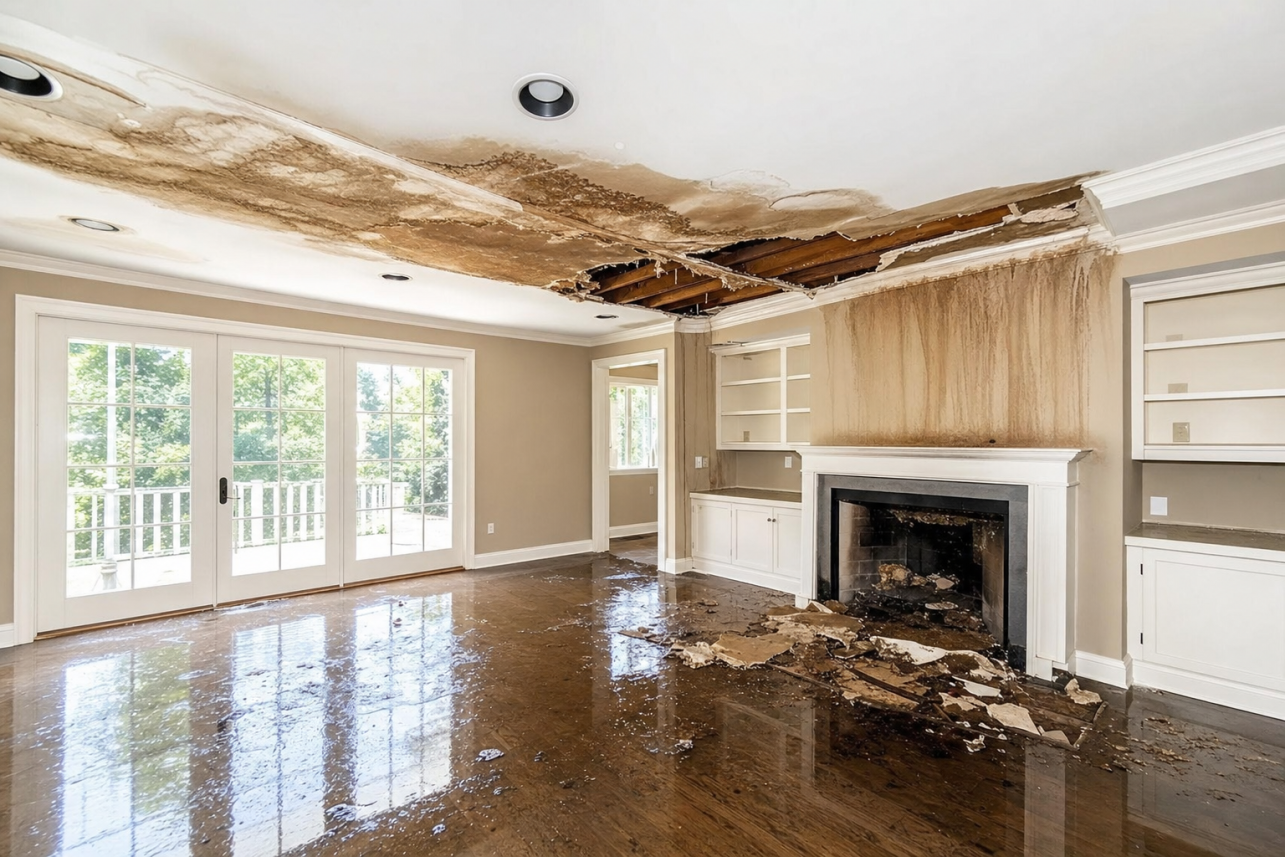
A water damage claims adjuster Wake Forest NC policyholders can call is a licensed professional who works only for you — never the insurance company — to document your water loss, build the repair estimate, and negotiate the settlement. For The Public Adjusters, Inc. is licensed and bonded in North Carolina and handles everything from burst pipes and roof leaks to slow, hidden leaks that turn into mold. If your claim was denied, delayed, or the offer will not cover the actual repairs, we step in and take over the negotiation.
What This Service Is
When water gets into your home, your insurance company sends its own adjuster to inspect the damage. That person is paid by the insurer, and the estimate they write tends to reflect that. A public adjuster is the counterweight — a state-licensed advocate who represents only the policyholder. The public adjuster in Wake Forest NC team at For The Public Adjusters, Inc. inspects the loss ourselves, including the damage you cannot see.
Water rarely stays where it starts. It wicks up drywall, soaks insulation, runs along framing, and pools under flooring. We use moisture readings and a room-by-room inspection to map the full extent of the damage, then prepare a detailed repair estimate and the proof of loss documentation your policy requires. That paperwork is where most claims are won or lost.
We handle every type of water loss on the residential and commercial side: burst and frozen pipes, water heater failures, roof leaks, appliance and supply-line failures, and sewer or drain backups where coverage applies. One important distinction: rising water from outside is flood, not water damage, and it falls under a separate flood policy. We handle flood insurance claims too, and we will tell you honestly which policy your loss belongs under. This is the same work our team does on an insurance water damage claim in Raleigh and across Wake County.
Courts have long recognized that insurers owe policyholders fair treatment. In Gruenberg v. Aetna Insurance Co., the California Supreme Court sided with a policyholder whose insurer refused to pay after a fire damaged his business property, holding that an insurance company’s unreasonable refusal to pay a valid claim can make it liable beyond the policy itself. You do not have to accept an unfair outcome — but the fight is far easier with a professional building your case from day one.
Common Problems
The Insurance Company’s Offer Won’t Come Close To Covering The Repairs
This is the most common call we get. The insurer’s estimate covers drying the carpet and patching one wall — but not the buckled hardwoods, the soaked subfloor, or the cabinets that have to come out to reach wet drywall behind them.
Lowball offers usually come from two places. First, a rushed inspection that misses hidden damage. Second, aggressive depreciation — paying you the ‘actual cash value’ of ten-year-old flooring instead of what it actually costs to replace it. If you have replacement cost coverage, much of that depreciation is recoverable, but insurers rarely volunteer that.
We rebuild the estimate line by line at real local contractor pricing, document what the first inspection missed, and negotiate from evidence. Homeowners are often shocked at the gap between the first offer and what the policy actually owes.
My Claim Was Denied — Or It’s Been Weeks And Nothing Is Happening
Denials on water claims usually lean on policy exclusions: the insurer calls it ‘long-term seepage’ instead of a sudden leak, or ‘flood’ instead of covered water damage, or claims you failed to maintain the home. Sometimes those arguments hold up. Very often they don’t survive real documentation.
Delays are their own problem. While the file sits, mold grows, materials degrade, and you may be paying out of pocket for emergency drying and a place to stay. Those emergency mitigation costs and additional living expenses are frequently covered — if someone documents and claims them properly.
We review the denial letter against your actual policy language, gather the evidence the insurer ignored, and push the claim forward on a defined timeline. When a dispute truly cannot be resolved, we work alongside insurance dispute lawyers so you are never stuck at a dead end. The North Carolina Department of Insurance publishes an NCDOI Public Adjusters Guide explaining exactly how licensed adjusters like us are permitted to represent you in this process.
Do I Really Need A Water Damage Claims Adjuster Wake Forest NC Insurers Will Take Seriously?
You can handle a claim yourself, and for a very small, simple loss that may be fine. But water claims are rarely simple. Coverage turns on the source of the water, the speed of the leak, your deductible, your coverage limits, and how well the damage is documented before repairs erase the evidence.
A good public adjuster does three things you cannot easily do yourself: finds damage the insurer’s inspection missed, writes an estimate in the same format and pricing language insurers use, and negotiates as a licensed equal rather than a frustrated homeowner. Before hiring anyone, verify their North Carolina license and confirm they are bonded — we are both.
We work on a percentage of the recovery, so we only get paid when you do, and our interests are aligned with yours. We cannot promise a specific dollar outcome — no honest adjuster can — but we can promise your claim will be fully documented and professionally argued. We do this same work for neighbors filing a water damage insurance claim in Rolesville, so we know exactly how carriers handle losses in this part of Wake County.

Our Process
Free Claim Review And Full Damage Inspection
We start by reading your policy and reviewing anything the insurer has already sent — estimates, denial letters, correspondence. Then we inspect the property ourselves, using moisture meters to trace water beyond the visible stains into walls, subfloors, and crawl spaces. Your contents matter too, so we inventory damaged furniture, electronics, and personal belongings for reimbursement.
Build The Estimate And File The Documentation
We prepare a complete, line-item repair estimate at current local pricing, photograph and log every damaged item, and assemble the proof of loss and supporting records your policy requires. If mold has started or structural elements are compromised, that goes in the file with proper support. Thorough documentation now prevents the ‘we have no record of that’ argument later.
Negotiate The Settlement And See It Through
We present the claim to your insurer, attend the carrier’s re-inspections, and answer their pushback point by point. If they dispute scope or pricing, we respond with evidence, not emotion. We stay on the file through supplemental payments — including recoverable depreciation after repairs — so money owed under the policy does not get left behind.
| What Happens | Filing Alone | With For The Public Adjusters |
|---|---|---|
| Damage documentation | Photos of visible damage only; hidden moisture usually missed | Moisture mapping, thermal imaging, and room-by-room documentation before demolition |
| Estimate scope | Based on the carrier adjuster’s brief walkthrough | Independent line-item estimate including hidden and secondary damage |
| Policy interpretation | You rely on the insurer’s reading of exclusions | We identify coverage the carrier didn’t mention, including matching and code upgrades |
| Negotiation | You accept, argue alone, or give up | Documented supplements and direct negotiation until the scope is complete |
| Typical result | First offers on water losses are frequently a fraction of true cost | Settlements aligned with the actual cost to restore your home |
| Your time invested | Hours of calls, paperwork, and follow-ups | We manage the claim start to finish while you get updates |
Commonly Overlooked In The Public Adjusting Industry
- Moisture trapped behind cabinets and vanities — Carrier adjusters rarely pull cabinets to take readings, so swollen boxes and hidden mold get left out of the scope until it’s too late to claim them.
- Continuous flooring and the matching rule — Insurers will pay to patch one room, but when the same hardwood or tile runs through connected spaces, North Carolina matching arguments can require replacing all of it.
- Saturated insulation inside wall and ceiling cavities — Wet insulation loses its R-value permanently and breeds mold, but it doesn’t show on a visual inspection so it’s routinely omitted from estimates.
- Additional living expenses beyond the hotel bill — Extra mileage, pet boarding, meal cost differences, and laundry are all reimbursable during displacement, and almost nobody tracks or claims them.
- Code upgrade (ordinance or law) coverage — Wake County code may require updated plumbing, electrical, or drywall assemblies during repairs, and carriers won’t volunteer that most policies include money for it.
- The failed part as evidence — Homeowners throw away the split pipe or burst supply line during cleanup, discarding the single best proof that the loss was sudden rather than long-term wear.
- Recorded statements given too early — An offhand guess like ‘it may have been leaking a while’ can hand the carrier a seepage denial before any expert has actually dated the failure.
- Depreciation holdback that’s recoverable — Many settlements pay actual cash value first, and homeowners never file for the recoverable depreciation they’re owed after repairs are completed.
Case Studies
Case Study #1
Situation: A family in the Heritage neighborhood of Wake Forest came home from a weekend trip to find their kitchen ceiling sagging and water pooled across hardwood floors. A supply line to the upstairs bathroom had failed, running for roughly two days.
Problem: The carrier’s field adjuster spent twenty minutes on site and offered $11,400 — enough to dry the structure and patch the ceiling, but nothing for the hardwood that ran continuously into the dining room and hallway, and nothing for cabinet toe-kicks that had wicked water.
Investigation: We brought in moisture mapping across every affected level, documented elevated readings behind the kitchen cabinets and under the flooring transition zones, and pulled the manufacturer specs on the discontinued hardwood to establish that a partial repair could not match.
Findings: Moisture had migrated well beyond the visible stain lines. The cabinet boxes were swollen at the base, the subfloor showed readings above dry standard in three rooms, and the flooring could not be feathered in without an obvious mismatch — triggering continuous-flooring replacement under the policy.
Solution: We rewrote the scope line by line, submitted a supplemental estimate with photo documentation and moisture logs, and negotiated directly with the carrier’s desk adjuster through two rounds of revisions.
Outcome: The claim settled at $67,800 — nearly six times the original offer — covering full flooring replacement across connected rooms, lower cabinet replacement, drywall, paint, and additional living expenses during the rebuild.
Lesson: The first offer on a water loss is usually built on what the adjuster can see, not what the water actually did. Moisture readings and continuous-material arguments change the entire scope.
Case Study #2
Situation: A retired couple near downtown Wake Forest discovered water stains spreading across their finished basement ceiling after a February cold snap. A pipe in the exterior wall had frozen and split, saturating insulation, drywall, and carpet below.
Problem: The insurer initially denied the claim, arguing the homeowners had failed to maintain heat in the home — a common exclusion argument for freeze losses — even though the couple had been living in the house the entire time.
Investigation: We collected the couple’s utility records showing continuous heating use, photographed the pipe’s location inside an under-insulated exterior wall cavity, and obtained a plumber’s written assessment that the split was caused by an original construction defect in insulation placement, not neglect.
Findings: The denial rested on an assumption, not evidence. The policy’s freeze exclusion only applies when the insured fails to use reasonable care to maintain heat — and the documentation proved they had. The loss was a covered sudden and accidental discharge.
Solution: We filed a formal rebuttal to the denial with the supporting records, demanded a re-inspection, and walked the carrier’s second adjuster through the wall cavity and moisture readings ourselves.
Outcome: The denial was reversed. The claim paid $42,300 for demolition, drying, insulation, drywall, carpet, built-in shelving, and the couple’s damaged personal property inventory, which we itemized room by room.
Lesson: A denial letter is a position, not a verdict. Freeze exclusions are among the most commonly misapplied denials in North Carolina, and documented facts routinely overturn them.
| Your Situation | Is a Claim Likely Worth Filing? | Smart Next Step |
|---|---|---|
| Burst pipe or supply line failure, active water | Yes — sudden and accidental discharge is core coverage | Stop the water, photograph everything, then call an adjuster before the carrier inspects |
| Slow leak discovered behind a wall or under flooring | Maybe — carriers often argue long-term seepage | Get expert documentation of the failure date before giving a recorded statement |
| Frozen pipe during a cold snap | Yes, if heat was maintained — denials here are often wrong | Save utility records and get the pipe location documented before repairs |
| Appliance overflow (water heater, dishwasher, washing machine) | Yes — resulting damage is typically covered even if the appliance isn’t | Keep the failed part; it’s evidence of a sudden failure |
| Sewer or drain backup | Depends — usually requires a specific endorsement | Check your declarations page for backup coverage before assuming denial |
| Groundwater or outside flooding entering the home | Usually not under homeowners — flood is a separate policy | Verify the water source; interior plumbing losses are often misclassified as flood |
| Carrier already made an offer that seems low | Yes — offers can be reopened and supplemented | Don’t cash anything marked final; get an independent review of the scope |
| Claim already denied | Often still recoverable | Request the denial in writing and have the policy language reviewed against the facts |

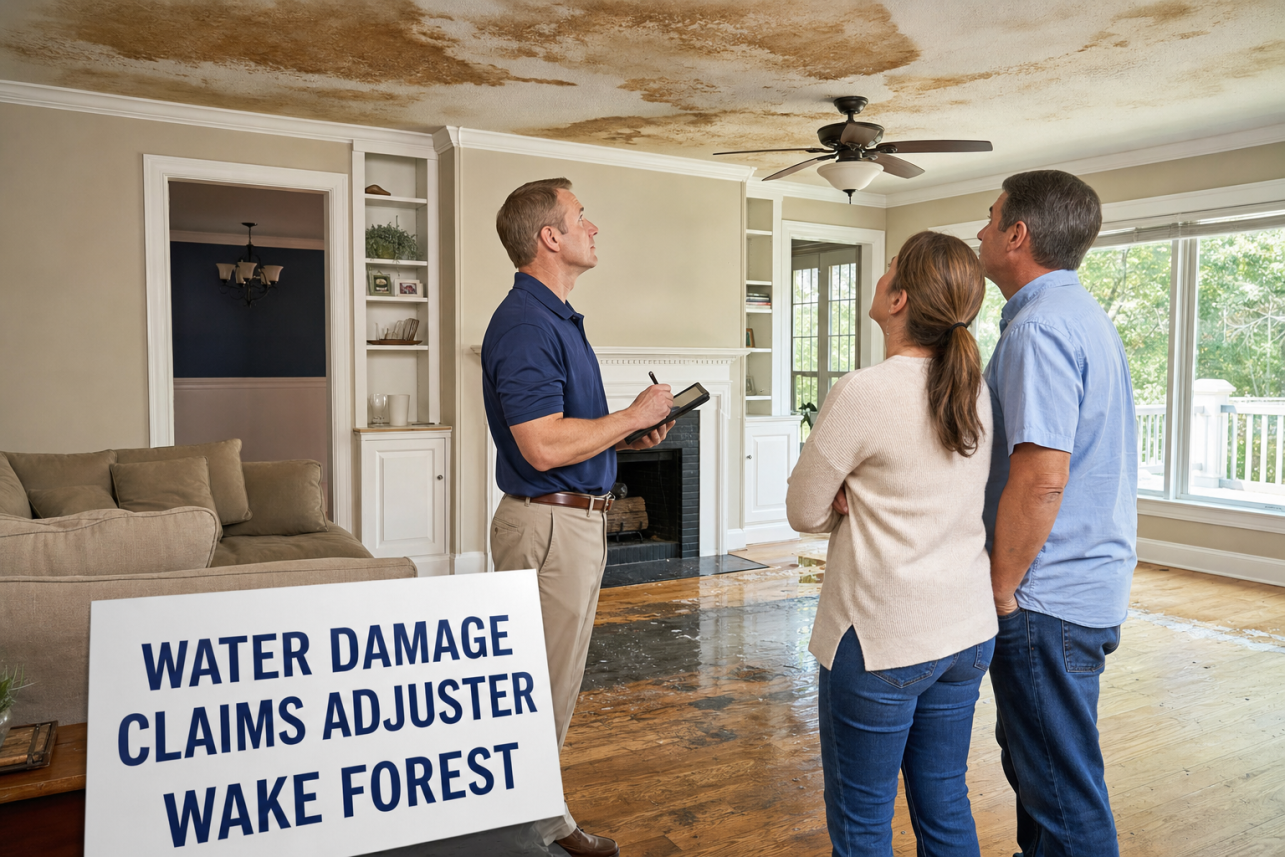
Reviews
Our water heater let go on a Friday night and flooded half the first floor. The insurance company’s first number wouldn’t have covered the flooring alone. For The Public Adjusters found moisture in walls the carrier’s adjuster never even checked and got our settlement more than tripled. Worth every penny of their fee.
Melissa T., Wake Forest
After a slow leak behind our shower turned into rotted subfloor and mold, our claim got denied as ‘long-term seepage.’ These folks pulled the plumber’s report apart, proved the actual failure date, and got the denial reversed. They handled every call with the insurance company so I didn’t have to.
Daryl K., Heritage, Wake Forest
Burst pipe upstairs, water through the kitchen ceiling. I honestly thought the carrier’s estimate was fine until a friend suggested a second opinion. The team’s moisture mapping found saturated insulation and cabinet damage that added over $20k to the claim. Communication was excellent from day one to final check.
Priya R., Wake Forest NC
Frequently Asked Questions
When Should I Hire A Water Damage Claims Adjuster Wake Forest NC Homeowners Can Trust?
The best time to bring in a water damage claims adjuster wake forest NC property owners rely on is before you file the claim, or as soon as possible after the loss. Early involvement means we document the damage properly from day one, before repairs or cleanup make it harder to prove what happened.
That said, it is never too late. Many Wake Forest homeowners call us after the insurance company has already made a lowball offer or denied the claim outright. We can reopen negotiations, submit supplemental documentation, and often recover significantly more than the original settlement.
Water losses are especially time-sensitive because moisture spreads. A burst supply line in a Heritage or Traditions home can wick into subfloors, wall cavities, and insulation within hours. If the carrier’s adjuster inspects a week later and only notes surface staining, the hidden damage gets left out of the estimate entirely.
We use moisture meters and thermal imaging to map the full extent of the loss, then build a detailed scope of repairs that reflects what it actually costs to restore your home in the Wake Forest market, not a generic estimate. If you are staring at a soaked ceiling or a flooded crawl space right now, call us before you sign anything from your insurer. The consultation costs nothing, and we only get paid when you do.
What Types Of Water Losses Does Your Wake Forest Team Handle?
We handle virtually every category of water loss that affects homes and businesses in Wake Forest and the surrounding Wake County area. The most common claims we see involve burst or frozen pipes, water heater failures, washing machine and dishwasher supply line breaks, and slow leaks behind walls that go undetected for months.
We also work storm-related losses regularly. Wake Forest sits in the path of tropical systems moving up from the coast, and wind-driven rain through damaged roofs or siding creates complicated claims where carriers often try to split coverage between wind and water. We know how to document these losses so the covered portions are fully paid.
Other situations we handle include HVAC condensation line failures, sewer and drain backups where you carry that endorsement, roof leaks after hail events, and crawl space flooding, which is a frequent problem in older homes near Smith Creek and in low-lying lots around town.
One important note: standard homeowners policies exclude rising floodwater, which requires separate flood insurance. During your free consultation, we review your specific policy language to confirm what applies to your loss. Coverage often hinges on whether the damage was sudden and accidental versus gradual, and carriers frequently deny legitimate sudden losses by labeling them long-term seepage. Our job is to gather the plumber reports, moisture readings, and photographic evidence that prove your claim qualifies under the actual terms of your policy.
How Much More Money Can A Public Adjuster In Wake Forest Recover On A Water Claim?
Results vary by claim, but industry studies and our own case files show that professionally represented policyholders routinely recover substantially more than those who accept the carrier’s first offer. On water losses specifically, the gap is often dramatic because so much of the damage is hidden.
Here is why. The insurance company’s adjuster typically spends a limited amount of time on site and writes an estimate based on visible damage. But water travels. It saturates drywall from behind, warps hardwood flooring beyond the wet area you can see, and breeds mold inside wall cavities within days. If the estimate only covers drying out one room and repainting, you are being shortchanged.
Our team performs a complete inspection using moisture mapping and thermal imaging, then writes a line-item scope that includes demolition, structural drying, matching materials, code upgrades where your policy covers them, and additional living expenses if you had to leave your home. We also pursue contents coverage for damaged furniture, rugs, and personal property that carriers frequently overlook.
We work on contingency, meaning our fee is a percentage of what we recover for you. There are no upfront costs and no hourly bills. If we do not increase your settlement, you owe us nothing. For most Wake Forest homeowners, the net recovery after our fee still far exceeds what they would have received negotiating alone against a trained insurance company adjuster.
What Should I Do Right After Discovering Water Damage, Before The Water Damage Claims Adjuster Wake Forest NC Residents Call Gets Involved?
First, stop the water source if you safely can. Shut off the main water valve, which in most Wake Forest homes is located near the water heater, in the crawl space, or at the meter box near the street. If water is contacting electrical outlets or fixtures, shut off power to that area at the breaker panel.
Second, document everything before you touch anything. Take wide photos of each affected room, then close-ups of damaged flooring, walls, ceilings, and belongings. Video is even better. This evidence becomes critical later, because carriers often argue the damage was less severe than reported.
Third, take reasonable steps to prevent further damage. Your policy requires this. Move furniture off wet carpet, place aluminum foil under furniture legs, and mop up standing water. Keep receipts for anything you buy, including fans, tarps, or emergency plumbing repairs, because these costs are typically reimbursable.
What you should not do is throw anything away, sign contracts with restoration companies pushed on you by the insurer, or give a recorded statement before understanding your coverage. Do not agree to a quick settlement either. Once you deposit that check, reopening the claim becomes much harder.
Then call For The Public Adjusters, Inc. As the water damage claims adjuster wake forest NC policyholders turn to for these exact situations, we step in, handle every conversation with your carrier, and manage the claim from documentation through final payment so you can focus on your family and your home.
How Does The Fee Structure Work When I Hire A Water Damage Claims Adjuster Wake Forest NC Policyholders Recommend?
For The Public Adjusters, Inc. works on a contingency basis, which means you pay nothing upfront and nothing out of pocket. Our fee is a percentage of the settlement we recover for you, so we only get paid when you get paid.
This structure matters for a practical reason: it aligns our interests completely with yours. The harder we work to document every affected material in your home — from saturated subflooring to damaged cabinetry — the better the outcome for both of us.
Many Wake Forest homeowners worry that a fee will eat into their settlement. In our experience, the opposite is true. Insurance carriers routinely undervalue water losses by missing hidden moisture, undercounting drywall square footage, or applying depreciation too aggressively. A properly documented and negotiated claim typically results in a net recovery that far exceeds what the homeowner would have received alone, even after our fee.
Before you sign anything, we review your policy at no charge and give you an honest assessment. If your claim is small enough that our involvement wouldn’t add meaningful value, we’ll tell you that directly. North Carolina requires public adjusters to be licensed by the Department of Insurance, and our contract spells out every term in plain language — no surprises, no hidden charges, and a clear percentage you agree to before we lift a finger on your file.
My Water Damage Claim Was Already Denied Or Underpaid. Can You Still Help?
Yes, and this is one of the most common situations that brings Wake Forest homeowners to our door. A denial or a lowball payment is rarely the end of the road — it’s often just the carrier’s opening position.
When we take on a previously denied claim, we start by pulling apart the denial letter and comparing it against your actual policy language. Carriers frequently deny water losses by citing exclusions for “long-term seepage” or “maintenance issues” when the evidence actually supports a sudden and accidental loss, which is covered. We gather plumber reports, moisture readings, photographs, and material samples to build a factual record that challenges the carrier’s conclusion.
For underpaid claims, the process is similar. We prepare a detailed, line-item estimate using the same software the insurance industry uses, then document everything their adjuster missed — moisture wicking up wall cavities, damaged insulation, flooring that must be replaced wall-to-wall rather than patched, and code-required upgrades common in older Wake Forest homes near the downtown historic area.
Timing matters. North Carolina policies contain deadlines for disputing decisions and filing suit, so don’t sit on a denial letter for months. Bring it to us as soon as possible, along with your policy and any estimates you’ve received. We’ll review everything at no cost and tell you honestly whether reopening or supplementing the claim is worth pursuing.
How Long Does A Water Damage Claim Take To Settle In Wake Forest?
Most straightforward residential water claims we handle in Wake Forest and the surrounding Wake County area resolve within 30 to 90 days from the date we’re retained. More complex losses — extensive Category 3 water, disputes over mold remediation, or claims involving structural drying of crawl spaces common in local homes — can take three to six months.
Several factors drive the timeline. North Carolina law requires carriers to acknowledge claims promptly and to pay undisputed amounts within a reasonable period, but “reasonable” gets stretched when documentation is thin. That’s exactly where a public adjuster changes the pace. When we submit a claim package, it arrives complete: itemized estimates, moisture maps, photo logs, and policy citations. Carriers have far less room to stall with requests for more information.
We also push for advance payments early in the process. If your kitchen is torn out or your family is displaced to a hotel off Capital Boulevard, you shouldn’t wait months for the first dollar. We routinely secure partial payments for emergency mitigation and additional living expenses while the larger settlement is still being negotiated.
One honest caveat: if a carrier digs in and forces the claim toward appraisal — a formal dispute-resolution process built into most policies — that can add 60 to 120 days. Even then, our clients generally come out well ahead, because appraisal awards on properly documented water losses tend to land much closer to our estimate than the carrier’s.
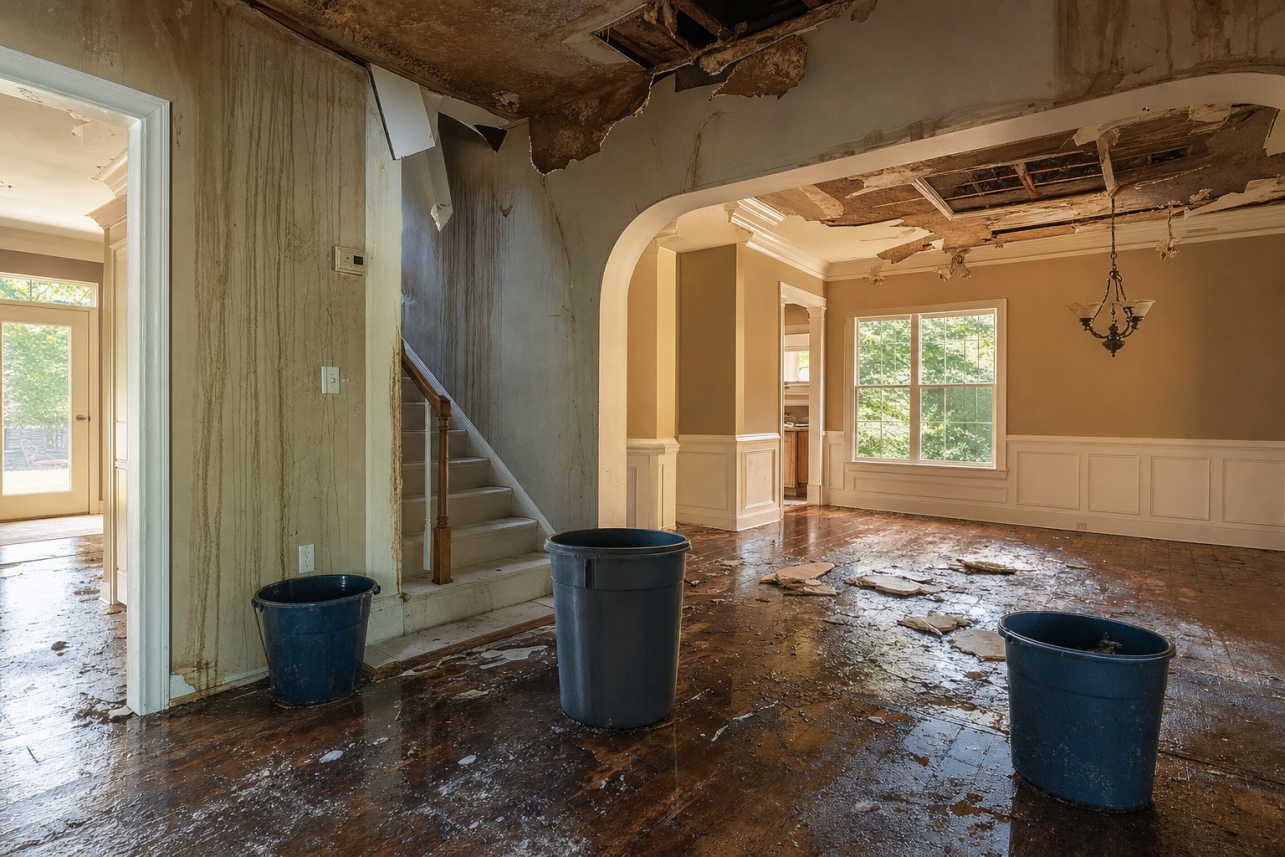
What’s The Difference Between The Insurance Company’s Adjuster And A Water Damage Claims Adjuster Wake Forest NC Homeowners Hire Themselves?
The difference comes down to one word: loyalty. The adjuster your insurance company sends works for the carrier. They may be professional and pleasant, but their job is to evaluate the loss within the carrier’s guidelines, and those guidelines are built to control payout costs. A public adjuster works exclusively for you, the policyholder, and is licensed by the North Carolina Department of Insurance to represent your interests.
In practice, that distinction shows up everywhere in a water loss. A carrier’s adjuster might spend forty-five minutes in your home, take a handful of photos, and write an estimate that patches drywall and dries the carpet. Our team spends hours with moisture meters and thermal imaging, tracing water into wall cavities, under hardwood flooring, and into the crawl spaces and slab-adjacent framing typical of Wake Forest construction. We document what a quick walkthrough misses.
We also read your policy the way it’s meant to be read — for coverage, not for exclusions. Additional living expenses, code upgrade coverage, matching provisions for flooring and cabinetry, and mold remediation sublimits are all areas where homeowners leave money on the table simply because nobody explained what they were entitled to.
You’re never required to accept the carrier adjuster’s estimate as final. Bringing in your own licensed advocate levels the playing field, and For The Public Adjusters, Inc. has been doing exactly that for families throughout Wake County. The consultation costs nothing, and you’ll know within one conversation whether your claim is being handled fairly.
Does Homeowners Insurance Cover Mold After A Water Loss, And Can A Water Damage Claims Adjuster Wake Forest NC Provider Include It In My Claim?
Mold coverage is one of the most misunderstood parts of a North Carolina homeowners policy. Most policies exclude mold as a standalone peril, but many will cover mold remediation when it results directly from a covered water loss — a burst supply line, a failed water heater, or an appliance leak. The distinction matters enormously, and insurers often deny mold-related costs by blurring that line.
Wake Forest’s humidity makes this a real concern. In our climate, mold can begin colonizing wet drywall, subfloors, and insulation within 24 to 48 hours. If your carrier delayed the inspection or the initial dry-out was incomplete, resulting mold growth is frequently a consequence of the covered loss, not a maintenance issue.
As your water damage claims adjuster wake forest NC policyholders rely on, we document the moisture timeline carefully. We use moisture mapping, photographs, and remediation protocols to tie the mold directly to the original covered event. We also review your policy’s mold sublimit — many policies cap mold coverage at $5,000 or $10,000 — and structure the claim so that legitimate water damage repairs aren’t wrongly lumped under that cap.
If your insurer has already told you mold isn’t covered, don’t take that at face value. The answer depends on causation, policy language, and documentation, and we’ve recovered mold remediation costs in situations where homeowners were initially told there was nothing to be done.
Is Flood Damage The Same As Water Damage Under My Policy In Wake Forest?
No, and the difference determines whether your claim gets paid. A standard homeowners policy covers sudden, accidental water discharge from inside your home — plumbing failures, water heater ruptures, HVAC condensation leaks, and washing machine hose breaks. Flood damage, meaning water rising from outside — overflowing creeks, storm surge, or surface water pooling and entering the home — is excluded and requires separate flood insurance through the NFIP or a private carrier.
Here’s where Wake Forest homeowners get burned: during heavy storms, water can enter a home multiple ways at once. Wind-driven rain through a damaged roof is typically covered. Water backing up through drains may require a sewer backup endorsement. Groundwater seeping through a foundation is usually excluded. Carriers frequently classify a covered loss as an excluded one to reduce or deny payment.
Our job is to establish the actual cause and path of the water. We inspect the property, review weather data, and document entry points so the loss is categorized correctly under your specific policy language. If your carrier claimed “groundwater” when the real culprit was a wind-damaged roof or a failed sump pump you had an endorsement for, that denial deserves a second look.
Every policy reads differently, so we start by reviewing yours line by line — including endorsements you may not realize you’re paying for. That review costs you nothing, and it often changes the entire trajectory of the claim.
Will My Insurance Pay For A Hotel Or Rental If My Wake Forest Home Is Unlivable During Water Damage Repairs?
In most cases, yes. Nearly every homeowners policy includes Additional Living Expenses (ALE) coverage, sometimes called Loss of Use. If a covered water loss makes your home uninhabitable — no working kitchen, no functional bathroom, unsafe air quality during demolition — ALE pays the reasonable increase in your living costs while repairs are underway.
That can include hotel stays, a short-term rental comparable to your home, restaurant meals above your normal grocery spending, pet boarding, laundry, and even added mileage if your temporary housing puts you farther from work or your kids’ schools. Around Wake Forest, comparable rentals can run $2,000 to $3,500 a month or more, so this coverage adds up fast.
The catch is that carriers rarely volunteer ALE, and homeowners often don’t realize they qualify. “Uninhabitable” doesn’t require total destruction — if drying equipment is running for a week, the flooring is torn out, or your only bathroom is gutted, you likely have a valid ALE claim.
We calculate ALE from day one, keep a running documentation file of receipts and comparable housing costs, and push back when the insurer tries to end your housing benefits before repairs are actually finished. We also make sure the repair timeline the carrier uses is realistic — contractors in Wake County are busy, and you shouldn’t be forced back into an unfinished home because an adjuster in another state assumed a two-week rebuild.
What Documentation Should I Keep To Strengthen My Water Damage Claim?
Documentation is where most water claims are won or lost, and it’s the first thing a water damage claims adjuster wake forest NC homeowners hire will build for you. If you’re gathering evidence yourself before we get involved, focus on these areas.
First, photograph and video everything before anything is moved, dried, or thrown away — the source of the water, standing water levels, wet flooring, baseboards, cabinetry, and every affected room from multiple angles. Include the failed component itself, like a burst pipe or cracked supply line, and keep the part if a plumber removes it. That physical evidence proves causation.
Second, save every receipt: emergency plumbers, water extraction, fans and dehumidifiers, tarps, hotel nights, meals out, and any temporary repairs. These are typically reimbursable and homeowners routinely leave thousands on the table by not tracking them.
Third, keep a written log of every contact with your insurer — dates, names, claim numbers, and what was said. If the carrier delays or changes its position later, that timeline becomes powerful leverage.
Finally, inventory damaged contents room by room with photos, approximate purchase dates, and replacement costs. Don’t discard items until they’ve been documented and the carrier has had a fair chance to inspect, unless they pose a health hazard.
When we take over your claim, we layer professional evidence on top of this — moisture readings, thermal imaging, detailed repair estimates written to local Wake County pricing — but your early photos and receipts give us a stronger foundation to fight from.
Will Hiring A Water Damage Claims Adjuster Wake Forest NC Insurers Respect Cause My Premiums To Go Up Or My Policy To Be Canceled?
No. Your premium is affected by the claim itself, not by who represents you during it. Whether you handle the claim alone or bring in For The Public Adjusters, Inc., the loss is already on record with your carrier the moment you report it. Hiring professional representation does not change your risk profile, and North Carolina law prohibits insurers from retaliating against policyholders for exercising their contractual rights.
What we often see in Wake Forest is the opposite concern playing out: homeowners who under-document a burst pipe or slab leak, accept a low payment, and then file a second claim later when hidden damage surfaces. Two claims on your record can affect future rates far more than one properly settled claim ever will.
A licensed public adjuster helps you capture the full scope of the loss the first time, which protects both your recovery and your claims history. Carriers also tend to handle represented claims more carefully, because they know the documentation will be scrutinized and every policy provision will be enforced.
If you are worried about non-renewal, keep in mind that insurers in Wake County make those decisions based on loss frequency and severity, not representation. Our job is to make sure the one claim you do file is complete, accurate, and paid at full value, so you never have to reopen it or file again for the same event.
How Do You Find Hidden Water Damage Behind Walls And Under Floors In Wake Forest Homes?
We use moisture meters, thermal imaging cameras, and hygrometers to trace water migration that is invisible to the naked eye. Water rarely stays where it entered. A supply line failure in a second-floor bathroom can travel through wall cavities, saturate subfloor sheathing, and pool on top of the crawl space vapor barrier below, all while the drywall surface looks dry.
Wake Forest housing stock makes this especially important. Many homes in Heritage, Traditions, and the older in-town neighborhoods have hardwood over plywood subfloor, and trapped moisture between those layers causes cupping and delamination weeks after the visible cleanup is done. Crawl space construction, common throughout Wake County, gives water a hidden place to collect and feed mold growth.
Insurance company adjusters frequently scope only what they can see in a thirty-minute walkthrough. We map moisture readings room by room, photograph and log every elevated reading, and compare them against dry-standard baselines so nothing gets dismissed as pre-existing.
That documented moisture map becomes the backbone of the claim. It justifies drywall removal, flooring replacement, cabinet detachment, and proper structural drying rather than surface-level fixes. When the carrier’s estimate says paint and patch, our readings prove why the correct repair is tear-out and rebuild, and the settlement follows the evidence.
What Happens Step By Step After I Contact Your Team About A Water Loss?
The first step is a free consultation and policy review. We read your actual policy language, confirm coverage for the type of water loss you experienced, and give you an honest assessment of whether professional representation makes financial sense. If the claim is small or straightforward, we will tell you so.
If you hire us, we notify your carrier in writing that For The Public Adjusters, Inc. now represents you. From that point forward, adjuster calls, inspection scheduling, and document requests come to us, not to you.
Next comes the inspection and scoping phase. We visit your Wake Forest property, take moisture readings, photograph every affected area, inventory damaged contents, and build a line-item repair estimate using the same professional estimating software carriers use. This is where most of the recovered value comes from, because we scope damage the insurance company’s adjuster overlooked or minimized.
We then submit the full claim package, attend the carrier’s re-inspection alongside their adjuster, and negotiate each disputed line item with documentation rather than opinion. You receive updates at every stage and approve any settlement before it is accepted.
Once the claim pays, we walk you through the release of funds, including how mortgage company endorsements work if your lender is named on the check. From first call to final payment, you make the decisions and we do the work.
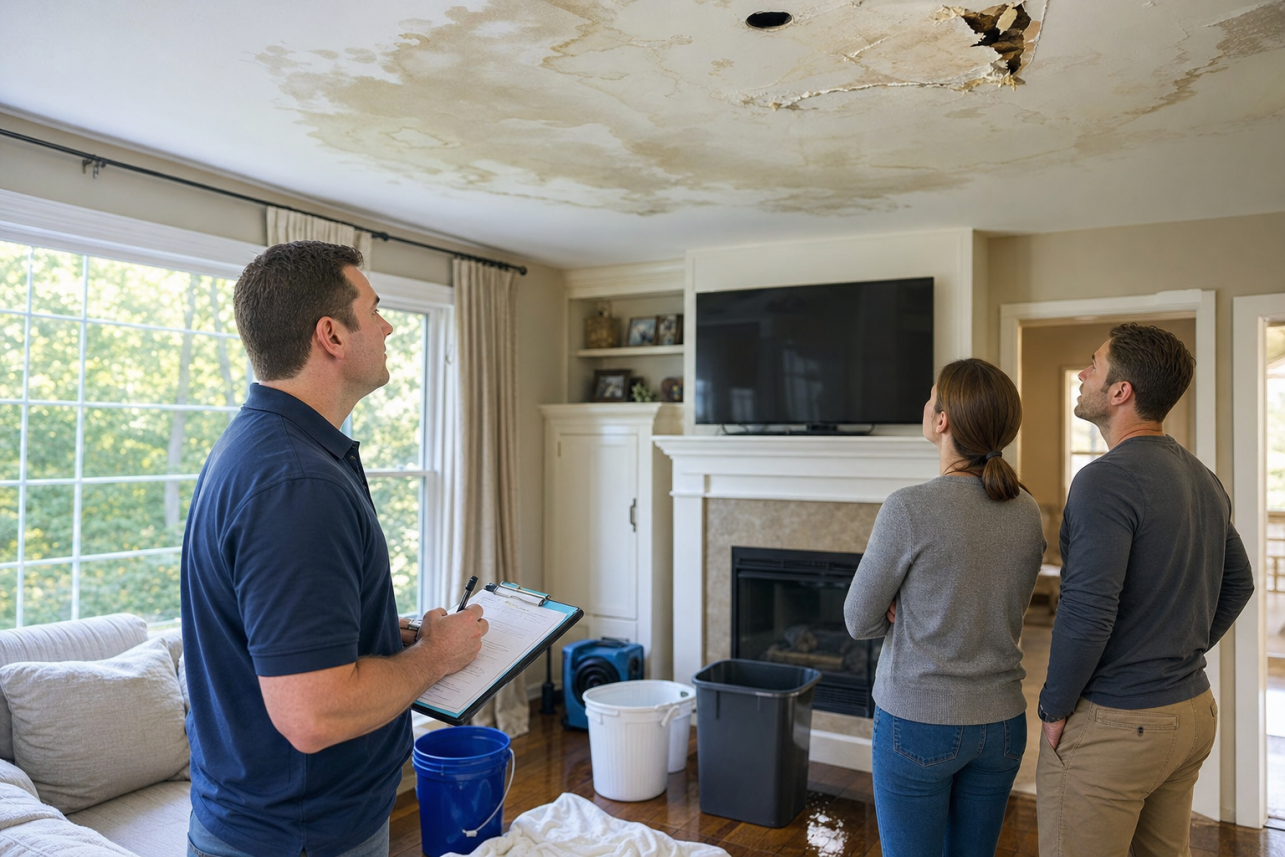
I Already Started Repairs Or Tore Out Wet Materials. Can A Water Damage Claims Adjuster Wake Forest NC Homeowners Hire Still Document My Claim?
Yes, and this situation is more common than you might think. North Carolina policies actually require you to mitigate further damage, so removing soaked drywall, extracting standing water, or pulling up buckled flooring was the right move. The key now is reconstructing the evidence of what existed before the tear-out.
Start by gathering everything you have: phone photos and videos taken during the loss, receipts from the mitigation company or equipment rentals, invoices from any plumber who repaired the failed line, and the dry-out company’s moisture logs if a restoration crew was involved. Even casual pictures texted to family members can establish the extent of the damage.
Our team then supplements that record. Water leaves forensic evidence long after cleanup, including staining on framing, mineral lines on foundation walls, corrosion patterns, and residual moisture in materials that were never fully dried. We document all of it and interview you in detail about pre-loss conditions so the estimate reflects the true scope.
What you should not do is finish repairs completely before the carrier has had a fair chance to inspect, because that can complicate the claim. If contractors are mid-project at your Wake Forest home, pause where you reasonably can, save every removed material sample if possible, and call us. We have settled plenty of claims where demolition happened first, and thorough documentation almost always overcomes the gap.
Local Relevance
Wake Forest sits in a humid part of the North Carolina Piedmont, and that humidity is the quiet enemy in every water loss here. A leak that might dry out harmlessly in a drier climate can feed mold inside a wall cavity within days, especially in the crawl-space homes common around the older parts of town.
The town’s housing stock cuts both ways. Historic homes near downtown carry aging plumbing, original framing, and materials that are expensive to match — all of which insurers love to depreciate. Meanwhile, the newer subdivisions built during Wake Forest’s rapid growth have their own pattern: supply-line failures, water heater leaks in second-floor closets, and slab leaks that go unnoticed until flooring cups.
Our summer thunderstorms and the remnants of tropical systems drive roof leaks and, in low-lying spots, true flooding — which is a separate flood insurance claim, not a standard water claim. The Federal Emergency Management Agency (FEMA) administers the National Flood Insurance Program, and knowing which policy your loss falls under is one of the first things we sort out. We serve all of Wake County, including as a water damage claims adjuster in Knightdale and handling public adjuster water damage work in Apex, so we know how carriers price and dispute claims in this market.
Many Wake Forest homes — older crawl-space houses near downtown and newer slab-built subdivisions alike — tend to hide slow leaks until humidity-driven mold or cupped flooring finally reveals them, which is exactly when insurers start arguing the damage was ‘long-term’ and excluded. Getting the loss professionally documented the moment you find it is often the difference between a covered claim and a denial letter.
Get A Free Review Of Your Wake Forest Water Damage Claim
Whether the pipe burst yesterday or the denial letter arrived last month, it costs nothing to have For The Public Adjusters, Inc. look at your claim. We are licensed and bonded in North Carolina, we work only for policyholders, and we do not get paid unless you recover. Let us tell you honestly whether your settlement offer holds up — and what we can do about it if it doesn’t.
Call us: (919) 400-6440
Helpful Resources
- NCDOI Public Adjusters Guide
- Federal Emergency Management Agency (FEMA)
- National Flood Insurance Program (NFIP)
- North Carolina Department of Insurance consumer resources — State regulator overseeing insurance and adjuster licensing in NC
- FEMA flood insurance information — Federal resource explaining flood coverage under the NFIP
Serving Wake Forest · Wake
Last updated: August 22, 2026