
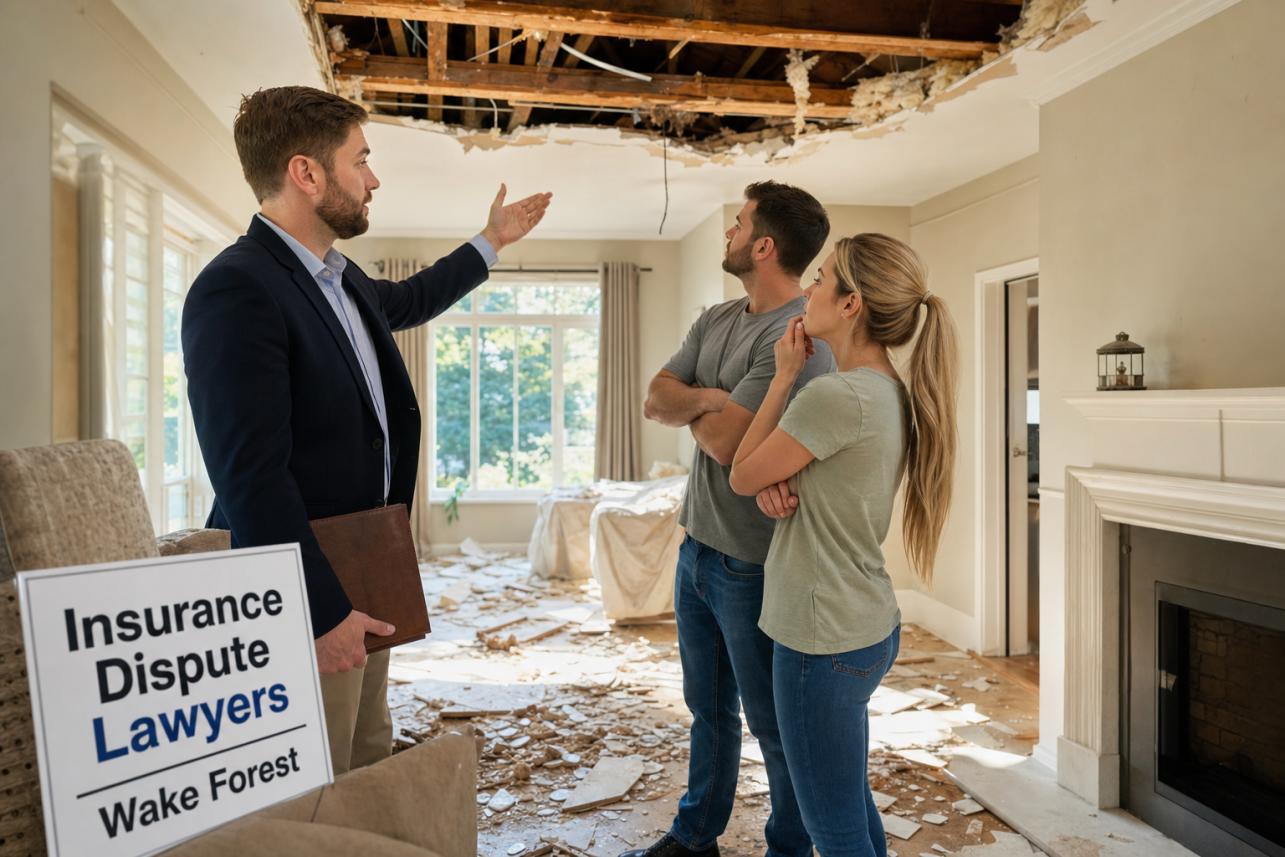
Before searching for Insurance Dispute Lawyers Wake Forest homeowners should know that most denied or underpaid property claims can be resolved without litigation. For The Public Adjusters, Inc. is a licensed and bonded public adjusting firm that represents policyholders — not insurers — in disputes over fire, water, smoke, tree, and hurricane damage claims. We document the loss, challenge the carrier’s numbers, and negotiate on your behalf; if a claim truly requires an attorney, we know when that line is crossed and can work alongside legal counsel.
What This Service Is
When an insurance company denies a claim, delays it for months, or offers a fraction of what repairs actually cost, homeowners often assume a lawsuit is the only option. In reality, litigation is usually the last resort, not the first. A public adjuster is a state-licensed professional who handles the entire dispute for the policyholder: re-inspecting the damage, preparing a detailed independent estimate, identifying coverage the carrier overlooked, and negotiating directly with the insurer’s adjusters.
The NCDOI Public Adjusters Guide explains that public adjusters are the only category of adjuster licensed to represent the insured rather than the insurance company. That distinction matters. The adjuster your carrier sends works for the carrier. We work for you.
Courts have repeatedly sided with policyholders who pushed back on lowball valuations. In Sproull v. State Farm Fire & Casualty Co., the Illinois Supreme Court ruled in favor of a homeowner who challenged the insurer’s practice of depreciating labor costs when calculating the actual cash value of storm damage to his home — a ruling that put real money back in policyholders’ pockets. Disputes like that are exactly why independent representation exists.
Our dispute work covers fire claims adjuster in Apex, water and flood claims, smoke and vandalism damage, tree strikes, and commercial building claims. If a matter genuinely requires litigation, we can support your attorney with the documentation and damage valuation the case will rest on.
Common Problems
The Insurance Company’s Offer Won’t Come Close To Covering Repairs — Is That Worth Fighting?
Almost always, yes. Carriers frequently price repairs using outdated software rates, omit code-required upgrades, or depreciate items more aggressively than the policy allows. On a fire or major water loss in Wake Forest, those gaps can add up to tens of thousands of dollars.
Our fee is a percentage of what we recover, so you’re not paying hourly legal rates to find out whether the claim was underpaid. We never guarantee a specific outcome — no honest professional can — but we can tell you quickly whether the carrier’s estimate holds up against a line-by-line independent scope.
Insurance Dispute Lawyers Wake Forest Homeowners Call After A Denial — What Should You Actually Do First?
Don’t accept a denial letter as the final word, and don’t rush to court either. Denials are often built on a narrow reading of the policy or an incomplete inspection. The right first move is a documented rebuttal: independent moisture readings, engineering observations, photographs, and a corrected estimate submitted through the claim’s formal channels.
We recently see the same pattern in a water damage claim dispute in Clayton as we do here — carriers calling long-term seepage what was actually a sudden pipe failure. Reframing the facts correctly, with evidence, resolves many disputes without a single court filing.
Do I Need A Lawyer, A Public Adjuster, Or Can I Handle The Dispute Myself?
It depends on where the dispute stands. If the disagreement is about the amount of the loss — what the damage is worth and what the policy covers — a public adjuster is usually the faster, more economical path. If the carrier has acted in bad faith or the claim is headed to litigation, an attorney belongs on the team, and a strong adjuster’s file makes that attorney’s case.
Handling it yourself is possible but risky: policyholders rarely know the estimating software, policy language, and appraisal provisions carriers rely on. We handle these disputes across Wake County, including for insurance dispute lawyers in Morrisville searches that end up needing adjusting work, not litigation.

Our Process
Free Claim And Policy Review
We start by reading your full policy and the carrier’s denial or settlement letter side by side. Many disputes trace back to a misapplied exclusion or an estimate that simply missed damage. You’ll get a straight answer on whether the claim is worth reopening before you commit to anything.
Independent Documentation And Re-Inspection
Our team inspects the property, photographs and measures every affected area, and builds a complete independent estimate — structure, contents, and additional living expenses. For water losses, that includes moisture mapping that the carrier’s quick walkthrough often skipped. Our water damage claims adjuster Wake Forest work follows this same evidence-first approach.
Negotiation, Appraisal, Or Escalation
We present the corrected claim to the carrier and negotiate directly with its adjusters. If the insurer won’t move, most policies contain an appraisal clause that resolves valuation disputes without court. And if the facts point to bad faith, we hand your attorney a fully documented file — the foundation any successful case is built on.
| Factor | Public Adjuster (For The Public Adjusters) | Insurance Dispute Attorney |
|---|---|---|
| Typical fee | Percentage of the additional recovery, often lower overall | 33–40% contingency plus litigation costs |
| Timeline to resolution | Weeks to a few months via negotiation or appraisal | Often 12–24+ months in court |
| Best suited for | Underpaid, delayed, or wrongly scoped claims | Bad-faith conduct, coverage denials after appeals fail |
| Who does the damage documentation | We inspect, photograph, estimate, and build the proof of loss | Usually hires outside experts, billed to you or the case |
| Relationship with the carrier | Negotiation within the policy’s own dispute mechanisms | Adversarial litigation posture from day one |
| When to start | Immediately after loss or at the first sign of underpayment | After policy remedies like appraisal are exhausted |
Commonly Overlooked In The Public Adjusting Industry
- The appraisal clause buried in the policy’s conditions section — Most policyholders and even some attorneys jump to litigation without realizing the policy already contains a binding, faster mechanism for resolving valuation disputes.
- Recoverable depreciation left unclaimed after repairs — Carriers withhold depreciation until work is completed, and homeowners who never submit final invoices forfeit thousands they were already owed.
- Ordinance and law coverage for code upgrades — Wake County’s current building code often requires upgrades during repairs, and adjusters rarely volunteer that a separate coverage exists to pay for them.
- Hail bruising on shingle mats that isn’t visible from the ground — Carrier inspectors doing quick single-slope walkthroughs miss fractured shingle mats that only show up under hands-on testing of every roof plane.
- The one-time re-inspection request most carriers must honor — Policyholders accept the first inspection as final, not knowing they can compel a second look with new documentation before any formal dispute begins.
- Additional living expense (ALE) reimbursement during displacement — Families paying out of pocket for hotels and meals often never file for ALE because the carrier’s estimate paperwork doesn’t prompt them to.
- Contents depreciation calculated with generic tables instead of item-specific values — Desk adjusters apply blanket depreciation percentages that dramatically undervalue commercial equipment, electronics, and quality furnishings.
- Deadlines for sworn proof of loss submissions — Missing the policy’s proof-of-loss window can void an otherwise valid claim, and carriers are under no obligation to remind you it’s coming due.
Case Studies
Case Study #1
Situation: A homeowner off Heritage Lake Road in Wake Forest suffered significant roof and interior water damage after a spring hailstorm swept through northern Wake County. The carrier’s initial inspection took less than twenty minutes.
Problem: The insurer offered $6,400, claiming most of the roof damage was pre-existing wear and denying the interior ceiling stains as unrelated. The homeowner had gotten contractor bids topping $38,000 and was preparing to hire an attorney and sue.
Investigation: Before litigation, our licensed public adjuster performed a full forensic inspection: drone imagery of the entire roof plane, hail spatter mapping on soft metals, moisture meter readings inside, and a review of NOAA storm data confirming 1.25-inch hail on the date of loss.
Findings: The carrier’s adjuster had only inspected one roof slope and never entered the attic. We documented consistent hail bruising on all four slopes, fractured mat on shingles, and a moisture trail from the roof deck to the stained ceilings — directly tying the interior damage to the storm.
Solution: We compiled a line-item estimate in the same software the carrier uses, submitted our documentation package, and invoked the appraisal clause in the policy when the desk adjuster wouldn’t move. That contractual mechanism resolved the valuation dispute without a lawsuit.
Outcome: The claim settled at $41,200 — more than six times the original offer — covering full roof replacement, interior repairs, and code-required upgrades. The homeowner avoided attorney contingency fees, which would have consumed 33-40% of any recovery.
Lesson: Most Wake Forest insurance disputes are valuation and documentation problems, not legal problems. Exhausting the appraisal and negotiation process with a public adjuster first often recovers more, faster, and at lower cost than heading straight to court.
Case Study #2
Situation: A small restaurant owner near downtown Wake Forest had a kitchen fire that shut the business down. The commercial policy included building coverage, contents, and business interruption.
Problem: The carrier paid the structure claim quickly but lowballed contents at depreciated garage-sale values and stalled on business interruption for months, demanding endless documentation. The owner was weeks from losing the lease and had already consulted lawyers about a bad-faith suit.
Investigation: We reconstructed the contents inventory from purchase records, vendor invoices, and photographs — over 400 line items priced at actual replacement cost. For the interruption claim, we worked with the owner’s bookkeeper to build a twelve-month revenue model with seasonal adjustments.
Findings: The carrier’s contents figure was based on generic depreciation tables, not commercial kitchen equipment values, understating the loss by roughly $60,000. Their business interruption calculation had ignored the restaurant’s growth trend and used the slowest quarter as the baseline.
Solution: We submitted a corrected sworn proof of loss, challenged the depreciation methodology line by line, and presented the financial model directly to the carrier’s large-loss examiner in a documented negotiation.
Outcome: Total recovery increased from the carrier’s $118,000 position to $296,000, including recoverable depreciation and eleven months of lost income. The restaurant reopened without ever filing suit.
Lesson: When a commercial claim stalls, the missing ingredient is usually a professionally built financial case. Litigation should be the last resort in a Wake County insurance dispute — a public adjuster can often force fair payment through the policy’s own terms.
| Your situation | Best first move | What it depends on |
|---|---|---|
| Carrier’s offer is far below contractor bids | Get an independent public adjuster estimate and demand re-inspection | Whether the gap is scope (missed damage) or pricing (depreciation rates) |
| Claim partially denied as ‘wear and tear’ or ‘pre-existing’ | Gather cause-of-loss evidence: expert reports, storm data, dated photos | How clearly the damage can be tied to the covered event date |
| Claim delayed with no decision for 30+ days | Send a written status demand citing NC’s prompt-handling standards | Whether the delay is documentation-related or a stall tactic |
| Dispute is purely about the dollar amount | Invoke the appraisal clause in your policy | Whether your policy includes appraisal and coverage isn’t contested |
| Full denial with coverage exclusion cited | Have the policy language professionally reviewed before accepting it | Whether the exclusion actually applies to your specific facts |
| Evidence of bad faith — misrepresented policy terms, ignored proof | Document everything, then consult a Wake Forest insurance dispute attorney | Strength of your paper trail and whether policy remedies were exhausted |
| Business interruption claim stalled | Build a documented income model with financial records | Quality of your pre-loss bookkeeping and seasonal revenue history |
Reviews
State Farm denied half my hail claim and I was about to call one of those Insurance Dispute Lawyers wake forest firms advertising on billboards. A friend told me to try For The Public Adjusters first. They re-inspected my roof, found damage the carrier’s adjuster never even looked at, and got the offer from $7k to $34k through appraisal. No lawsuit, no attorney fees eating a third of it.
Marcus T., Wake Forest
Our water damage claim sat in dispute for four months. The insurer kept saying the pipe failure was ‘wear and tear.’ The team documented everything — plumber’s report, moisture mapping, photos — and rebutted the exclusion in writing. Claim was paid in full six weeks after they got involved. They know the policy language better than the desk adjusters do.
Denise W., Heritage neighborhood
My commercial fire claim was headed to litigation until these folks took over. They rebuilt my contents inventory and business interruption numbers from scratch and negotiated directly with the carrier’s examiner. Nearly tripled the payout. Only wish I’d called them the week of the fire instead of month four.
Ravi P., Wake Forest business owner
Frequently Asked Questions
Do I Need Insurance Dispute Lawyers Wake Forest Homeowners Typically Hire, Or Can A Public Adjuster Resolve My Claim?
In most cases, you do not need to hire an attorney first. The majority of underpaid or denied property claims in Wake Forest are resolved through skilled negotiation, thorough documentation, and a correct reading of your policy — which is exactly what a licensed public adjuster does.
At For The Public Adjusters, Inc., we work exclusively for policyholders, never for insurance companies. We re-inspect the damage, prepare a detailed line-item estimate, and present the evidence your carrier’s adjuster may have missed or minimized. That process alone often turns a lowball offer into a fair settlement without any litigation.
Where attorneys become necessary is when a carrier acts in bad faith, refuses to negotiate after clear evidence is presented, or a claim requires a lawsuit to move forward. When that happens, we can coordinate with local insurance dispute attorneys and hand over a fully documented file — photos, moisture readings, estimates, and correspondence — which makes their job faster and your case stronger.
A practical way to think about it: a public adjuster is usually the first and most cost-effective step. Legal action is the last resort, reserved for the small percentage of claims where the insurer simply will not act in good faith. Starting with us means you may never need to pay attorney fees at all, and if you do, you enter that fight with a professionally built case behind you.
What Types Of Insurance Claims Do You Handle For Wake Forest Property Owners?
We handle residential and commercial property claims throughout Wake Forest and the surrounding Wake County area. The most common disputes we see locally involve wind and hail damage to roofs, water damage from burst pipes or appliance failures, fire and smoke losses, storm damage from summer thunderstorms and hurricane remnants, and tree impact claims — a frequent issue in the older, heavily wooded neighborhoods near downtown and along the Falls Lake side of town.
We also take on claims that were already filed and went wrong: denials, underpayments, delayed responses, and settlements that don’t come close to covering actual repair costs. If your carrier paid for a roof patch when the entire roof system was compromised, or approved drying but not the drywall and flooring replacement that follows a serious water loss, those are exactly the situations we correct.
For commercial policyholders, we handle building damage, business personal property, and business interruption claims, which are frequently undervalued because carriers calculate lost income conservatively.
Every claim starts with a free review of your policy and the insurer’s position. We’ll tell you honestly whether we can add value or whether the offer on the table is actually fair. If we take the claim, we manage the entire process — inspections, estimates, negotiations, and paperwork — so you’re not fighting a billion-dollar company alone.
How Much Does It Cost To Hire Your Team Compared To Insurance Dispute Lawyers Wake Forest Residents Might Otherwise Call?
Our fee structure is contingency-based, meaning we only get paid when you do. We charge a percentage of the settlement we recover, agreed to in writing before any work begins. There are no upfront costs, no hourly billing, and no fee at all if we don’t improve your outcome.
This is typically far more economical than litigation. Attorneys handling insurance disputes generally charge either hourly rates or contingency fees of 33% to 40%, and lawsuits add court costs, expert witness fees, and months — sometimes years — of delay. Public adjuster fees in North Carolina are meaningfully lower, and most claims we handle settle in weeks or a few months rather than years.
There’s also a return-on-investment factor worth understanding. Industry studies and state insurance department data consistently show that professionally represented policyholders recover substantially more than those who negotiate alone. In many cases, the increase in settlement value covers our fee several times over, so the net amount in your pocket is higher even after we’re paid.
During your free initial consultation, we’ll review the carrier’s offer or denial and give you a straightforward assessment. If your claim is already being handled fairly, we’ll tell you so — and if legal action truly is the right path, we’ll say that too and can point you toward experienced Wake Forest insurance dispute lawyers we’ve worked alongside on prior cases.
My Claim Was Already Denied. Is It Too Late To Dispute It In Wake County?
No — a denial is rarely the end of the road. In North Carolina, most property policies allow claims and disputes to be pursued within three years of the date of loss, though your specific policy may set shorter internal deadlines for things like proof of loss or appraisal demands. The sooner you act, the more options remain open.
Denials get overturned more often than most policyholders realize. Common reasons include the carrier’s adjuster misidentifying the cause of damage (calling hail damage “wear and tear,” for example), incomplete inspections, misapplied exclusions, or missing documentation the homeowner never knew was required. Each of those is fixable with the right evidence.
Our process starts with a full review of your denial letter, your policy, and the insurer’s inspection report. We then perform our own detailed inspection of your Wake Forest property, document everything the carrier overlooked, and submit a formal, evidence-backed rebuttal. If the carrier still won’t move, North Carolina policies include an appraisal provision — a binding dispute-resolution process that resolves valuation disagreements without going to court, and one we regularly use to policyholders’ advantage.
Bring us whatever you have: the denial letter, photos, repair estimates, and any emails or letters from the adjuster. Even claims denied months ago can often be reopened and paid. The free review costs you nothing, and it will tell you exactly where your claim stands and what it’s realistically worth.
How Long Does An Insurance Claim Dispute Usually Take In Wake Forest?
Most disputes we handle for Wake Forest property owners resolve within 30 to 90 days, though the timeline depends heavily on the carrier and the complexity of the damage. A straightforward underpayment on a roof claim after a hailstorm may settle in a few weeks. A large fire loss with structural, contents, and additional living expense components can take several months.
North Carolina law requires insurers to acknowledge claims promptly and to pay undisputed amounts within 30 days of reaching an agreement, which gives us leverage to keep adjusters moving. When a carrier drags its feet, we document every delay and cite those obligations directly in our correspondence.
One advantage of working with a public adjuster rather than heading straight to litigation is speed. Court cases in Wake County can stretch on for a year or more before you see a dime. Negotiated settlements, supplemental claims, and the appraisal process typically move much faster because the carrier has a financial incentive to close the file.
We give every client a realistic timeline after our initial inspection. Once we see the policy language, the damage, and the carrier involved, we can usually tell you within a few days what kind of fight you are facing and how long it is likely to last.
My Insurance Company Paid Something, But Nowhere Near Enough To Repair My Home. Can That Be Disputed?
Yes, and underpaid claims are actually the most common situation we see in Wake Forest. Accepting a payment does not close your claim or waive your rights. In North Carolina, you can pursue a supplemental claim for the difference between what the carrier paid and what the repairs genuinely cost.
Underpayments happen for predictable reasons. The carrier’s adjuster may have missed damage entirely, used outdated pricing software, applied excessive depreciation, or ignored code-upgrade requirements that Wake County inspectors will enforce during permitting. Local labor and material costs in the Triangle have risen sharply, and carrier estimates frequently lag behind what contractors here actually charge.
Our process starts with a line-by-line comparison of the carrier’s estimate against a detailed scope we build ourselves. We inspect the property, photograph and measure everything, and price the work using current local rates. That gap between their number and the real number becomes the basis of the dispute.
From there, we submit the supplemental demand with full documentation and negotiate directly with the insurer. If they refuse to move, your policy almost certainly contains an appraisal clause, which lets an impartial umpire decide the amount of loss without going to court. Bring us the carrier’s estimate and your payment letter, and we will tell you honestly whether the numbers hold up.
When Should Wake Forest Homeowners Escalate To Insurance Dispute Lawyers Wake Forest Attorneys Instead Of Staying With A Public Adjuster?
There is an honest answer here, and we give it to every client: most disputes are about the amount of money owed, and those are resolved through documentation, negotiation, and appraisal, which is exactly what a public adjuster does. But some situations genuinely call for an attorney, and we will tell you when yours is one of them.
Escalation makes sense when the carrier denies coverage entirely based on a policy interpretation, accuses you of fraud or misrepresentation, or acts in bad faith by ignoring deadlines and evidence. Those are legal questions, and Insurance Dispute Lawyers wake forest residents rely on are the right professionals to argue them before a judge.
The good news is that these paths work together. We frequently prepare the entire damage file, including the estimate, photos, moisture readings, and correspondence log, before an attorney ever gets involved. That documentation becomes the backbone of any lawsuit and often makes legal representation faster and less expensive, because the attorney is not starting from zero.
Our recommendation for most Wake Forest claims is to exhaust the adjusting and appraisal route first. It costs less, moves faster, and resolves the majority of underpayments and wrongful denials. If your carrier still refuses to act in good faith after that, we will refer you to a litigator we trust and hand over a case file that is ready to fight with.

What Should I Do Right After Storm Or Water Damage In Wake Forest To Protect My Claim?
The first 48 hours matter more than most homeowners realize. Start by making the property safe and preventing further damage, because your policy requires reasonable mitigation. Tarp the roof, shut off the water, and move undamaged belongings out of harm’s way. Keep every receipt for tarps, fans, and emergency services, since those costs are typically reimbursable.
Before anything gets cleaned up or thrown away, document everything. Take wide photos of each room, then close-ups of individual damage. Video walkthroughs are even better. If wet drywall or flooring must be removed quickly to prevent mold, photograph it first and keep sample pieces if possible.
Be careful with your first call to the insurance company. Report the loss promptly, but stick to facts: the date, the cause, and the areas affected. Avoid guessing at causes or downplaying damage, because recorded statements are used to shape coverage decisions later.
Finally, be cautious about signing anything from contractors who show up after a storm rolls through Wake County. Assignment-of-benefits agreements and vague repair contracts can complicate or even compromise your claim.
Calling our office early is the single most protective step you can take. When For The Public Adjusters, Inc. is involved from day one, we control the documentation, manage carrier communications, and build the claim correctly instead of repairing a damaged one months later.
What Documentation Do Insurance Dispute Lawyers Wake Forest Firms And Public Adjusters Need To Build A Strong Dispute?
The stronger your paper trail, the stronger your position. Before we or any Insurance Dispute Lawyers wake forest property owners might consult can push back effectively, we need a copy of your full policy, including the declarations page and all endorsements. Many homeowners only have the summary page, so we often request the complete policy directly from the carrier on your behalf.
Next comes damage evidence. Dated photos and video of every affected area, receipts for emergency repairs or tarping, and any communication with the insurance company all matter. Keep every letter, email, and estimate the carrier sends you, including the adjuster’s report if you can obtain it.
We also gather independent proof of loss. That means our own detailed inspection, moisture readings for water claims, roof measurements for hail and wind claims, and line-item repair estimates using the same pricing software carriers use. When our estimate and theirs sit side by side, gaps in their scope become impossible to ignore.
Finally, records of the property’s condition before the loss help enormously. Prior inspection reports, real estate listing photos, or even old family photos showing the roof or interior can defeat the common carrier argument that damage was pre-existing.
Don’t worry if you’re missing pieces. Homeowners across Wake Forest come to us with incomplete files all the time, and part of our job is reconstructing the record. Bring what you have, and we’ll build the rest through inspection and documented requests to the carrier.
What Is The Appraisal Clause, And Can It Resolve My Wake Forest Claim Without Going To Court?
Most North Carolina property policies contain an appraisal clause, and it’s one of the most underused tools for settling disputed claims. When you and the carrier agree damage is covered but disagree on the amount, either side can invoke appraisal. You select an appraiser, the insurance company selects one, and the two choose a neutral umpire. Any award signed by two of the three parties becomes binding on the dollar amount.
For homeowners in Wake Forest, appraisal is often faster and far less expensive than litigation. There are no court filings, no depositions, and no waiting on the Wake County docket. Many appraisals resolve in a few months, and the process focuses purely on what the repairs actually cost, which is where carriers most often lowball.
We frequently serve as the policyholder’s appraiser or prepare the detailed estimate and documentation your appraiser presents. Because we’ve inspected the property, measured the damage, and priced repairs at real local contractor rates, our clients enter appraisal with evidence rather than opinions.
One caution: appraisal only settles the amount of loss, not coverage disputes. If the carrier claims the damage isn’t covered at all, appraisal generally won’t help, and that’s when an attorney referral makes sense. Part of our value is telling you honestly which path fits your situation. For the majority of underpaid storm, water, and fire claims we see in this area, appraisal or direct negotiation resolves the dispute without anyone stepping into a courtroom.
Will Disputing My Claim Cause My Insurer To Raise My Rates Or Cancel My Policy?
This fear stops a lot of Wake Forest homeowners from pursuing money they’re legitimately owed, so let’s address it directly. In North Carolina, filing a claim itself can affect your renewal, but disputing the amount of an existing claim generally does not create additional rating impact beyond the claim already on your record. The claim exists either way; fighting for a fair payout doesn’t add a second strike.
Carriers also cannot legally retaliate against you for exercising rights written into your own policy. Requesting a re-inspection, submitting a supplemental estimate, or invoking appraisal are all contractual rights, not hostile acts. North Carolina’s unfair claims settlement practices statutes exist precisely to prevent carriers from punishing policyholders who push back.
Non-renewal decisions are typically driven by claim frequency, total payout history, and underwriting factors like roof age, not by whether you negotiated. Ironically, we’ve seen homeowners accept lowball settlements to “stay off the radar,” then get non-renewed anyway because the claim was on their record regardless.
Our advice to Wake County homeowners is simple: the financial difference between an underpaid claim and a fair one is often tens of thousands of dollars. That money belongs to you under a contract you’ve paid premiums on for years. If a carrier’s conduct crosses into bad faith, that’s when Insurance Dispute Lawyers wake forest residents can turn to become relevant, and we’ll tell you when a referral is warranted. In our experience, though, firm, well-documented negotiation resolves most disputes without any retaliation.
Do You Handle Insurance Disputes For Wake Forest Businesses And Commercial Properties, Or Only Homes?
We handle both. Commercial claims along Capital Boulevard, in downtown Wake Forest, and throughout the surrounding business corridors involve the same carrier tactics as residential claims, but with higher stakes and more complicated policies.
Commercial property policies often include business interruption coverage, extra expense coverage, and co-insurance clauses that carriers use to reduce payouts. A restaurant with kitchen fire damage, a retail shop with a roof leak over inventory, or an office building with storm damage all face two losses: the physical damage and the income lost while repairs drag on. Carriers frequently pay the building damage while dramatically undervaluing the interruption claim.
Our team documents both sides of the loss. We prepare detailed building estimates, inventory the damaged business personal property, and work with your financial records to substantiate lost income during the restoration period. That level of documentation is exactly what carriers cannot easily dismiss.
We also handle claims for landlords and property investors in Wake County, including multi-unit buildings and rental homes, where loss of rents coverage adds another disputed layer. Condo and HOA claims involving shared roofs and building envelopes are another common source of underpayment we see locally.
If your commercial dispute involves an outright coverage denial or clear bad faith conduct, we’ll be candid about when a local insurance dispute attorney should take over. For the majority of underpaid commercial claims, though, thorough documentation and persistent negotiation recover what the business is owed, and our fee comes only from what we recover, never from your operating budget upfront.
I Already Cashed The Settlement Check From My Insurer. Can Insurance Dispute Lawyers Wake Forest Homeowners Work With, Or Your Team, Still Reopen My Claim?
In most cases, yes. Cashing a claim check in North Carolina does not automatically waive your right to pursue additional money, unless you signed a full release along with it. Many Wake Forest homeowners assume the first check is final, when it is often just the insurer’s opening position.
The key is what you signed. If the check memo or accompanying paperwork says “full and final settlement,” bring it to us before doing anything else. Even then, releases can sometimes be challenged if the damage was hidden or the scope was misrepresented. If there was no release, we can typically file a supplemental claim documenting the shortfall.
Our process starts with a fresh, independent inspection of your property. We frequently find damage the original adjuster missed entirely, such as wind-lifted shingles on the back slope of a roof, moisture trapped behind drywall, or code-upgrade costs the estimate ignored. We then submit a revised scope with photographs, measurements, and line-item pricing that reflects actual Wake County contractor rates rather than the insurer’s software defaults.
Where homeowners might otherwise call Insurance Dispute Lawyers wake forest firms after cashing a check, a public adjuster can often resolve the shortfall directly with the carrier, without the delay of litigation. Timing matters, though. Policy deadlines for supplemental claims and North Carolina’s statute of limitations both keep running, so the sooner we review your file, the more options you keep on the table.
My Insurer Says The Damage Is From Wear And Tear Or A Pre-Existing Condition. How Do You Fight That In Wake Forest?
This is one of the most common denial tactics we see across Wake County, and it is very often beatable. Carriers know that older roofs and homes in established Wake Forest neighborhoods like Heritage, Holding Village, and the historic downtown blocks give them an easy excuse to blame age instead of the storm.
Our job is to separate the two with evidence. Wind damage, hail strikes, and sudden water intrusion leave distinct physical signatures that differ from gradual deterioration. We document creased shingles, fractured mats, spatter marks, and directional damage patterns that align with recorded weather events. Then we pull National Weather Service and hail-tracking data for your exact address and date of loss, which ties the damage to a specific covered event rather than slow decline.
North Carolina law also matters here. Under most policies, the insurer bears a real burden when it invokes a wear-and-tear exclusion, and if a covered peril made pre-existing conditions worse, the resulting damage is often still compensable. We build the file with that framework in mind.
In practice, a well-documented rebuttal package, including photos, weather records, moisture readings, and a professional scope of repairs, frequently turns a “wear and tear” denial into a paid claim without anyone filing suit. If the carrier still refuses to budge, we prepare the evidence so it is litigation-ready and can hand a fully developed file to an attorney, which strengthens your position from day one.
Do You Handle Insurance Disputes Only Inside Wake Forest, Or Do You Cover Nearby Areas Like Rolesville, Youngsville, And Raleigh Too?
We serve all of Wake Forest and the surrounding communities. That includes Rolesville, Youngsville, Wakefield, Falls Lake area properties, and north Raleigh, along with the rest of Wake County and neighboring Franklin and Granville counties. Storm systems that hit Wake Forest rarely stop at the town line, so neither do we.
Working locally matters more than most homeowners realize. Repair pricing in insurer estimating software often defaults to regional averages that undercut what Triangle-area contractors actually charge. Because we work these disputes throughout the northern Wake County market, we know current local labor and material costs and can document when a carrier’s estimate falls short of what it truly takes to rebuild here.
Local knowledge also helps with building codes. Wake Forest, Rolesville, and Wake County each enforce code requirements that can add real cost to a repair, such as full roof replacement standards, electrical upgrades, and drainage requirements. If your policy includes ordinance-or-law coverage, those costs belong in your settlement, and we make sure they are itemized rather than ignored.
Every engagement starts the same way regardless of your address: an on-site inspection of the damage, a review of your policy and the insurer’s correspondence, and an honest assessment of whether the dispute is worth pursuing. If your property sits outside our service area, we will tell you upfront and point you toward someone reputable rather than take a claim we cannot handle well.
How Does The Dispute Process Actually Work Once I Hire You, Step By Step?
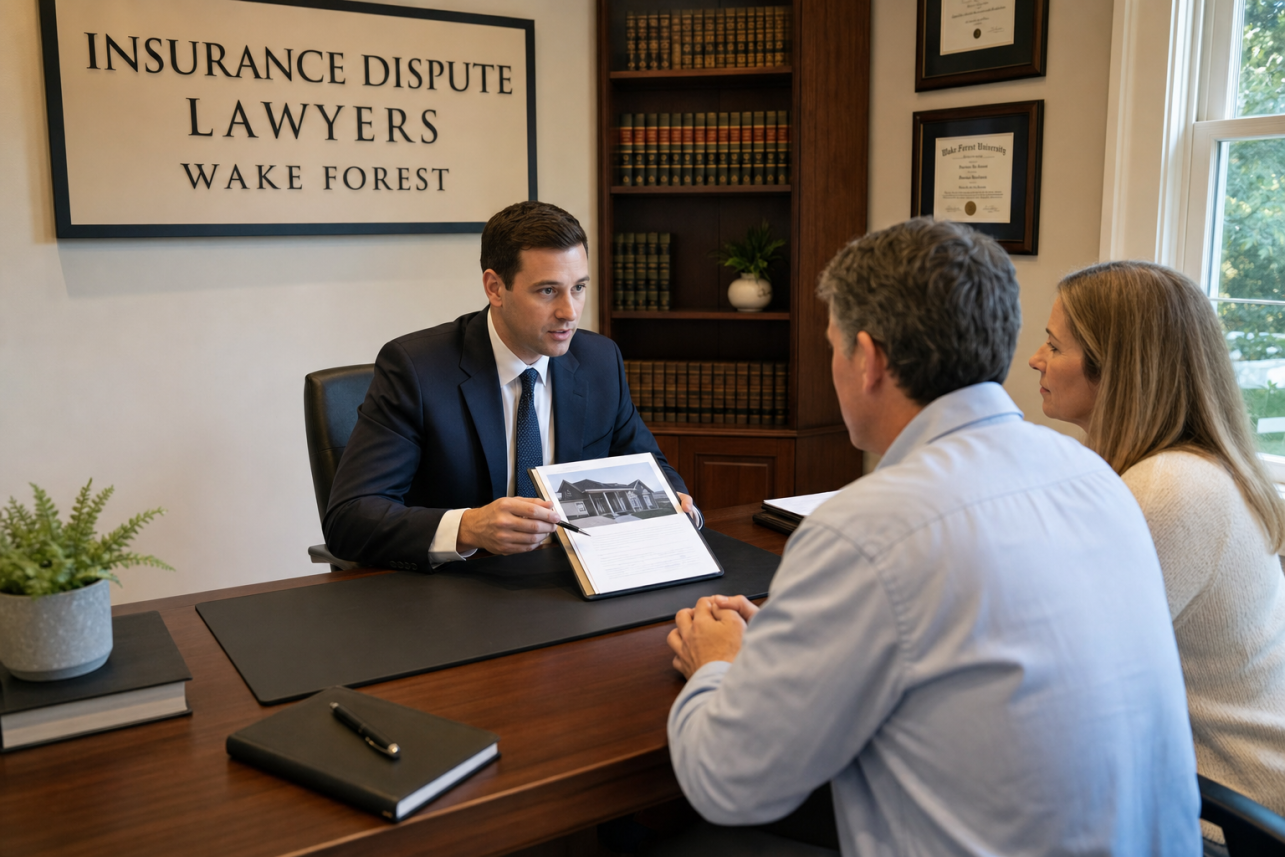
It starts with a free review of your claim file. Bring us your policy, the insurer’s estimate or denial letter, and any photos you have. We inspect the property ourselves, at no charge, and give you a straight answer about whether the carrier’s position can realistically be challenged.
If you hire us, we formally notify your insurer that we represent you. From that point forward, adjuster calls, inspection scheduling, and paperwork run through our office, which immediately takes the pressure off you and stops the carrier from using confusing questions to weaken your claim.
Next comes documentation. We produce a complete, line-item scope of damage using detailed photographs, moisture mapping where water is involved, measurements, and pricing that reflects real Wake County repair costs. We compare that scope against your policy language, including often-overlooked coverages like code upgrades, debris removal, and additional living expenses.
Then we negotiate. Most disputes resolve through documented back-and-forth with the carrier’s adjuster or a re-inspection where we walk the property together. If the insurer will not move, we can invoke the appraisal clause or, where bad faith is involved, coordinate a handoff to counsel. Homeowners searching for a Wake Forest insurance dispute lawyer often find that this structured process resolves the claim before an attorney is ever needed.
Throughout, you approve every submission before it goes out, and you receive updates at each stage. Our fee is a percentage of what we recover, so our incentive is identical to yours: the strongest legitimate settlement, as quickly as the facts allow.
Local Relevance
Wake Forest has grown fast, which means claims here span two very different kinds of housing: older homes near the historic downtown with aging plumbing, original wiring, and mature hardwoods overhead, and newer subdivisions where builder-grade materials and fast construction schedules create their own failure points. Carriers treat these losses very differently, and disputes over pre-existing damage versus covered damage are common in both.
The weather adds pressure. Hurricane remnants tracking inland regularly bring tree strikes and wind-driven rain to northern Wake County, summer thunderstorms overwhelm gutters and flat roof sections, and occasional winter ice events snap limbs onto rooflines. When a large oak comes through a roof, the difference between the carrier’s tarp-and-patch estimate and a proper structural repair scope is frequently the entire dispute.
We handle these fights throughout the Triangle, from a smoke damage claim help Fuquay file in southern Wake County to fire and water disputes here in town. The Insurance Information Institute notes that policyholders have the right to dispute a claim decision — locally, we make sure that right actually gets exercised with evidence behind it.
Because so much of Wake Forest was built during rapid growth spurts, many homes of the same era share the same vulnerabilities — polybutylene-era plumbing in some older houses, fast-framed roof systems in newer ones — and carriers often deny these losses as ‘wear and tear’ rather than sudden covered damage. An independent inspection that pins down the actual cause of loss is frequently what turns a denial into a paid claim here.
Denied Or Underpaid In Wake Forest? Get A Second Opinion Before You Litigate
For The Public Adjusters, Inc. is licensed and bonded, and we only get paid when your claim does. Send us the carrier’s letter and your policy — we’ll tell you honestly whether the dispute is worth pursuing and exactly how we’d fight it.
Call us: (919) 400-6440
Helpful Resources
- NCDOI Public Adjusters Guide
- Insurance Information Institute (III)
- North Carolina Department of Insurance — State regulator overseeing insurers and licensed adjusters in NC
- Insurance Information Institute — Consumer education on property insurance claims and disputes
Serving Wake Forest · Wake
Last updated: August 31, 2026