
If you're stuck in a fire insurance claim dispute Pittsboro insurance adjusters keep stalling or lowballing, a licensed public adjuster can step in, re-document the loss, and negotiate directly with the insurance company on your behalf. For The Public Adjusters, Inc. represents you — the policyholder — not the insurer. We handle denied, delayed, and underpaid fire and smoke damage claims throughout Chatham County so you don't have to argue with a claims department alone.
What This Service Is
After a house fire, most homeowners assume the insurance company's adjuster will figure out what's owed and pay it. In reality, that adjuster works for the insurer, and the first offer often reflects what's cheapest for them — not what it actually costs to rebuild your home and replace what you lost.
A public adjuster is the licensed professional who works only for you. We read your policy line by line, build a complete estimate of the structural damage, inventory every item of personal property lost to fire, smoke, and soot, and document the water damage left behind by firefighting efforts — a category insurers frequently undervalue.
We also make sure the parts of your policy people forget about get used: money for temporary housing and extra living costs while you're displaced, coverage for bringing repairs up to current building codes, and the difference between the depreciated payout and full replacement cost once repairs are done. The North Carolina Department of Insurance's NCDOI Public Adjusters Guide explains exactly what licensed public adjusters can do for policyholders in this state — and that's the role we fill. For The Public Adjusters, Inc. is licensed and bonded, and our fee comes from the settlement we help recover, not from your pocket up front.
Common Problems
The Offer Won't Come Close To Covering The Rebuild — What Is My Claim Really Worth?
This is the most common call we get after a Pittsboro house fire. The insurer's estimate uses depreciated values, misses smoke and soot damage in rooms the fire never touched, and skips the cost of meeting current building codes during repairs.
Many policies pay replacement cost, but insurers often start by paying only actual cash value — the depreciated amount — and homeowners never claim the rest. Add an incomplete contents inventory and forgotten living-expense coverage, and the gap between the first offer and the true loss can be enormous.
Our job is a full property loss assessment: structure, contents, code upgrades, hidden damage behind walls, and the water damage firefighters left behind. Then we compare that number to your policy limits and negotiate from there. We never promise a specific dollar outcome — no honest adjuster can — but we make sure nothing you're entitled to gets left off the table.
Fire Insurance Claim Dispute Pittsboro: What To Do When Your Claim Is Denied, Delayed, Or Stuck
Weeks of unreturned calls. Requests for the same documents three times. A denial letter citing policy language you can't decode. If that sounds familiar, you're not being paranoid — delay and underpayment are how disputed claims quietly die.
North Carolina courts have sided with homeowners in these fights. In Gray v. North Carolina Insurance Underwriting Association, the North Carolina Supreme Court allowed homeowners to pursue claims against their insurer for unfair handling of a property damage claim — a reminder that insurers in this state can be held accountable for how they treat policyholders, not just whether they eventually pay.
We take over the paperwork war: preparing a proper proof of loss, meeting policy deadlines, answering the insurer's document demands, and pushing stalled claims forward. When a carrier's conduct crosses into bad faith territory, we document it thoroughly so you have options.
Should I Fight The Insurance Company Myself, Or Is Hiring A Public Adjuster Worth It?
You can handle your own claim — the question is whether you should while you're living in temporary housing, paying out of pocket for essentials, and trying to reconstruct a room-by-room inventory of everything you owned from memory.
The insurer has professional adjusters, estimating software, and engineers on their side. Going in alone means negotiating against people who do this every day. A good public adjuster levels that field: we know how fire, smoke, and firefighting water damage actually price out, and we know the arguments carriers use to shrink claims.
When you're choosing someone, verify they're licensed with the state, bonded, and paid only as a percentage of what's recovered — never a big upfront fee. Be wary of anyone who guarantees a specific settlement; that's a red flag, and it's why we never do it.

Our Process
Free Review Of Your Policy And The Insurer's Position
We start by reading your actual policy — coverage limits, deductible, living-expense provisions, code-upgrade coverage — and reviewing every letter and estimate the insurance company has sent. Within that first conversation you'll know whether the offer is reasonable or whether there's a real dispute worth pursuing.
Full Re-Documentation Of The Loss
We inspect the property ourselves, looking for what the carrier's adjuster missed: smoke residue in HVAC systems, soot in adjacent rooms, hidden structural damage, and moisture damage from the water used to put the fire out. We build a detailed repair estimate and a complete contents inventory, then prepare the formal proof of loss the policy requires.
Negotiation Until The Claim Is Resolved
Armed with documentation the insurer can't wave away, we negotiate directly with their adjusters. If they dig in, we know the escalation paths available to North Carolina policyholders, including the state's appraisal and complaint processes. You get updates in plain English at every stage — no jargon, no surprises.
| What Happens | Handling It Yourself | With For The Public Adjusters |
|---|---|---|
| Damage scope | You rely on the carrier's adjuster, who works for the insurance company | Independent inspection including hidden smoke, soot, and structural damage |
| The estimate | You react to the carrier's number without a basis to challenge it | A competing line-item estimate built to full restoration cost |
| Contents inventory | Lump-sum allowance or a blank spreadsheet you fill out alone | Room-by-room documented inventory with replacement values |
| Carrier delays | Unreturned calls and rotating adjusters with no leverage | Written demands citing NC claims-handling deadlines and statutes |
| Deadlock | Accept the offer or hire a lawyer | Appraisal clause invoked and managed on your behalf |
| Your time | Months of paperwork, calls, and negotiation while rebuilding your life | We handle the claim; you handle recovery |
Commonly Overlooked In The Public Adjusting Industry
- Smoke migration through HVAC ductwork — Carrier adjusters rarely scope ducts, so soot spread into rooms far from the burn area goes unpriced until odors return months after repairs.
- Charred framing behind intact drywall — If the wall surface looks fine, most estimates skip demolition — but heat-damaged studs lose structural capacity and only show up when cavities are opened.
- The appraisal clause in the policy — Most Pittsboro homeowners don't know their policy contains a built-in dispute mechanism, so they accept a low offer thinking a lawsuit is the only alternative.
- Code-upgrade (ordinance or law) coverage — Chatham County's current building code often requires upgrades the original structure didn't have, and carriers won't pay for them unless the coverage is specifically invoked.
- Depreciation holdback recovery — Insurers pay actual cash value first and owe the withheld depreciation after repairs, but many policyholders never file the paperwork to claim it back.
- Additional living expenses beyond rent — Extra mileage, pet boarding, laundry, and increased food costs are all recoverable, but families only submit the hotel bill because nobody tells them otherwise.
- Non-salvageable 'cleanable' contents — Carriers push cleaning over replacement to save money, even though porous items like mattresses, upholstery, and children's toys can't be safely restored after heavy smoke exposure.
- The proof-of-loss deadline — Policies impose a sworn proof-of-loss filing window, and missing it while waiting on the carrier to respond can hand the insurer a technical reason to underpay or deny.
Case Studies
Case Study #1
Situation: A family on a rural road off US-64 outside Pittsboro lost their kitchen and most of the main floor to an electrical fire that started behind the range. The insurer accepted coverage quickly and sent an adjuster within a week, which initially felt like good news.
Problem: The carrier's estimate came in at $87,000 — enough to patch and repaint, but nowhere near enough to address smoke penetration throughout the HVAC system, charred framing behind intact drywall, or the family's smoke-saturated contents. When the homeowners questioned the number, the desk adjuster stopped returning calls for three weeks.
Investigation: We performed our own room-by-room inspection with moisture and combustion residue testing, opened wall cavities adjacent to the burn area, and had a licensed HVAC contractor scope the ductwork. We also built a full contents inventory the carrier had never asked the family to complete.
Findings: Soot and protein residue had traveled through the ducts into all three upstairs bedrooms. Two structural studs behind 'undamaged' drywall were charred past the point of repair. The contents loss alone — documented item by item — exceeded $40,000, and the carrier's estimate had allowed $6,500 as a lump sum.
Solution: We prepared a competing line-item estimate, submitted the engineering and HVAC documentation, and invoked the policy's appraisal clause when the carrier refused to move meaningfully. Our appraiser and the carrier's appraiser agreed on an umpire, and the file was resolved without litigation.
Outcome: The final award was $241,000 — nearly three times the original offer — including full duct replacement, structural repairs, and a properly documented contents payout. The family also recovered fourteen months of additional living expenses the carrier had initially capped at four.
Lesson: A fast acceptance of coverage means nothing if the scope is wrong. The most common tactic in Chatham County fire losses isn't denial — it's a lowball estimate delivered quickly, before the homeowner knows what full restoration actually costs.
Case Study #2
Situation: The owner of a small commercial building near downtown Pittsboro suffered a fire that started in a tenant's storage area. Smoke damage spread to two other tenant suites, and the building sat unusable while the claim dragged on.
Problem: The insurer raised a 'concurrent causation' argument, suggesting pre-existing wiring issues contributed to the loss, and demanded an examination under oath before paying anything. Six months in, the owner had received a single $25,000 advance and was losing tenants.
Investigation: We pulled the fire marshal's report, retained an independent origin-and-cause investigator, and gathered the building's electrical inspection records from Chatham County permitting. We also documented the business income loss with lease agreements and rent rolls, which the carrier had never requested.
Findings: The fire marshal and our investigator both placed the origin in the tenant's stored materials, not the building wiring. The carrier's own field notes — obtained during the dispute — contained no evidence supporting the wiring theory. Meanwhile, the loss-of-rents claim had simply never been calculated by anyone on the carrier's side.
Solution: We prepared the owner for the examination under oath, submitted a sworn proof of loss with full supporting documentation, and put the carrier on written notice of North Carolina's unfair claims practices statute. Faced with its own contradictory file, the carrier withdrew the causation defense.
Outcome: The claim settled for $478,000 covering structure, code upgrades, and eleven months of lost rental income. The owner retained two of three tenants and reopened the following spring.
Lesson: Delay is a strategy, not an accident. When a carrier stalls a fire claim with investigation demands, the answer is documentation the carrier can't argue with — and knowing exactly which deadlines North Carolina law puts on their side of the table.
| Your Situation | Best First Move | What It Depends On | Typical Timeline |
|---|---|---|---|
| Offer feels low but claim was accepted | Request the carrier's full estimate, then get an independent scope | Gap between their number and real repair costs; hidden smoke damage | 30–90 days to renegotiate |
| Carrier has gone silent for weeks | Send written status demand referencing NC claims-handling rules | Whether delays are documented in writing; how long since last contact | Response usually within 2–4 weeks of formal notice |
| Insurer disputes cause or suspects arson | Get the fire marshal's report and independent origin-and-cause expert before your examination under oath | Official fire report findings; quality of your documentation | 3–9 months |
| Contents payout is a lump sum, not itemized | Build a full inventory with photos, receipts, and replacement pricing | Records you can reconstruct; policy's replacement-cost terms | 4–8 weeks to document and resubmit |
| Negotiation is fully deadlocked | Invoke the policy's appraisal clause | Whether the dispute is about amount (appraisal) or coverage (attorney) | 60–120 days through appraisal |
| Coverage itself is denied | Consult a policyholder attorney alongside a public adjuster | Policy language and denial grounds; statute of limitations clock | Varies; litigation can run 1–2 years |
| ALE (additional living expense) checks stopped | Submit repair-timeline evidence showing rebuild isn't complete | Contractor delays vs. carrier-caused delays; policy ALE limits | 2–6 weeks to reinstate |

Reviews
After our house fire off Hanks Chapel Road, the insurance company offered us less than half of what our contractor said repairs would cost, then stopped answering the phone. For The Public Adjusters found smoke damage in rooms the company adjuster never even walked into. Our final settlement was almost triple the first offer. I wish we'd called them the week of the fire instead of month four.
Denise R., Pittsboro
The carrier accepted our fire claim but nickeled-and-dimed every line item — they wanted to clean charred cabinets instead of replacing them. These folks knew exactly how to document why cleaning wasn't feasible and pushed the dispute to appraisal. We got a fair number without ever going to court. Worth every penny of their fee.
Marcus T., Chatham County
Our fire claim sat in limbo for five months with a new adjuster assigned every few weeks, each one asking for the same documents. One call to this team and things started moving. They handled the sworn proof of loss, rebuilt our contents list from photos and receipts, and kept me updated the whole way. Only reason for four stars is the process still took time — but that was the insurer's doing, not theirs.
Angela P., Pittsboro
Frequently Asked Questions
Why Is My Insurance Company Making My Fire Insurance Claim Dispute Pittsboro So Difficult?
Insurance carriers are businesses, and every dollar they pay on a fire claim comes off their bottom line. When you push back on a lowball offer or a partial denial, many adjusters respond with delay tactics: repeated requests for the same documents, slow callbacks, reassigned adjusters, and vague explanations for why smoke damage, structural repairs, or contents losses were undervalued.
Here in Chatham County, we also see carriers lean on out-of-town repair estimates that do not reflect what local contractors actually charge to rebuild in Pittsboro. Fire losses are complicated, involving structure, contents, smoke and soot remediation, code upgrades, and additional living expenses, and each category gives the carrier another opportunity to underpay.
The uncomfortable truth is that the insurance company's adjuster works for the insurance company, not for you. Their job is to close your file as quickly and cheaply as possible. Homeowners who accept the first offer on a fire loss frequently leave tens of thousands of dollars on the table.
That is exactly why a fire insurance claim dispute Pittsboro homeowners bring to For The Public Adjusters, Inc. gets handled differently. As licensed public adjusters, we work only for the policyholder. We re-inspect the damage, document every covered item the carrier missed, prepare a detailed estimate based on real local repair costs, and negotiate directly with the insurance company so you are not stuck arguing with a professional negotiator on your own.
What Can A Public Adjuster Do That I Can't Do Myself When Disputing A Fire Claim?
You have every legal right to dispute your fire claim on your own, but you are up against trained claims professionals who handle disputes every day. A licensed public adjuster levels that playing field.
First, we know how to read your policy. Fire policies contain provisions most homeowners never notice, including code upgrade coverage, debris removal allowances, additional living expense limits, and recoverable depreciation. Carriers rarely volunteer money you did not specifically claim.
Second, we document the loss properly. After a fire in Pittsboro, damage often extends far beyond the burn area. Smoke residue penetrates HVAC systems, insulation, and wall cavities. Heat damages wiring and plumbing behind surfaces that look fine. We inspect, photograph, and estimate all of it using the same professional estimating software the carriers use, so our numbers are hard to dismiss.
Third, we handle the negotiation. We know the deadlines your carrier must meet under North Carolina regulations, and we know when a delay or denial crosses the line into bad faith. That knowledge changes the tone of the conversation quickly.
Finally, we take the burden off your shoulders. After a house fire, you are dealing with temporary housing, family stress, and contractors. Letting For The Public Adjusters, Inc. manage the paperwork, meetings, and phone calls means you can focus on your family while a professional fights for the settlement your policy actually promises.
How Much Does It Cost To Hire For The Public Adjusters, Inc. For A Fire Claim Dispute In Pittsboro?
We work on a contingency fee basis, which means there is no upfront cost and no hourly billing. Our fee is a percentage of the amount we recover for you, agreed to in writing before we begin. If we do not recover money on your claim, you do not owe us a fee.
This structure matters for Chatham County homeowners recovering from a fire, because money is usually tight while you are paying for temporary housing and replacing essentials. It also means our interests are aligned with yours: we only do well when your settlement improves.
Homeowners sometimes worry that a percentage fee will eat into their recovery. In practice, the opposite is almost always true. Industry studies and our own case files consistently show that professionally represented fire claims settle for significantly more than claims homeowners handle alone, often several times the carrier's initial offer. The increase in the settlement typically exceeds our fee many times over.
When you call us about a disputed fire loss in Pittsboro, the first step is a free review. We look at your policy, the carrier's estimate or denial letter, and the damage itself. Then we give you an honest assessment of whether we can add value. If the carrier's offer is actually fair, we will tell you so. If it is not, and after a fire it usually is not, we will explain exactly where the money was left out and how we plan to recover it.
The Insurance Company Already Made An Offer On My Fire Loss. Is It Too Late To Dispute It?
In most cases, no. Receiving an offer, or even receiving a check, does not automatically end your claim. Unless you have signed a full and final release, you generally still have the right to dispute the amount, submit supplemental documentation, and demand payment for damage the carrier overlooked or undervalued.
North Carolina policies typically give you a set window, often stated in your policy, to pursue additional amounts, so timing matters. The sooner we review your file, the more options you have. We regularly reopen underpaid fire claims for homeowners around Pittsboro and throughout Chatham County, including claims where the homeowner already cashed an initial payment.
Common items we recover after the first offer include recoverable depreciation the carrier held back, smoke and soot contamination in areas the field adjuster never inspected, code-required upgrades to electrical and framing, contents that were never fully inventoried, and additional living expenses that continued longer than the carrier assumed.
Before you sign anything, get a second opinion. A fire insurance claim dispute Pittsboro residents assume is a lost cause is often very winnable once the loss is properly documented and the policy is applied correctly. Bring us the carrier's estimate and your policy, and For The Public Adjusters, Inc. will compare them line by line at no charge. If we find money on the table, and on fire losses we usually do, we will show you exactly how much and lay out a clear plan to recover it.
How Long Does A Fire Insurance Claim Dispute Pittsboro Homeowners File Typically Take To Resolve?
Most disputes we handle in Pittsboro resolve within 60 to 120 days, though the timeline depends heavily on how far apart the two estimates are and how the carrier responds. Simple disagreements over repair pricing often settle within a few weeks once we present a properly documented counter-estimate. Disputes involving denied smoke damage, structural issues, or contents inventories can take longer.
North Carolina law gives insurers specific deadlines. Once a proof of loss is submitted, the carrier must acknowledge, investigate, and respond within reasonable timeframes, and we hold them to those obligations in writing. If an adjuster goes quiet, we document every missed deadline, which becomes leverage later.
One factor that speeds things up considerably is presenting the dispute correctly the first time. Carriers stall when they receive vague complaints like "the offer is too low." They respond faster when they receive a line-item estimate built on local Chatham County repair costs, photographs, moisture and soot readings, and policy language citations. That is exactly what we prepare.
If negotiation stalls completely, most fire policies include an appraisal clause, which is a formal process for resolving valuation disagreements without a lawsuit. Appraisal typically adds 30 to 90 days but often produces significantly better outcomes than continued back-and-forth. We will tell you honestly at the start whether your situation looks like a quick correction or a longer fight, so you can plan your family's housing and finances accordingly.
What Documentation Do I Need To Challenge A Low Fire Damage Offer In Pittsboro?
The strongest disputes are built on evidence the insurance company cannot easily dismiss. At minimum, you need a detailed independent repair estimate, room-by-room photographs taken before any cleanup, a complete contents inventory with replacement values, and copies of every letter, email, and estimate the carrier has sent you.
The independent estimate matters most. Insurance company estimates frequently use regional pricing averages that do not reflect what contractors actually charge in Chatham County, and they routinely omit items like smoke sealing, HVAC duct cleaning, code-required upgrades, and matching of undamaged materials. A local, line-item estimate exposes those gaps.
For contents, do not rely on memory alone. Bank statements, credit card records, photos from past holidays, and even Amazon order histories help establish what you owned. For older Pittsboro homes, permits and prior renovation records can prove the quality of finishes the carrier is trying to price as builder-grade.
You also need your complete policy, including all endorsements, not just the declarations page. Coverage for additional living expenses, debris removal, and ordinance-and-law upgrades often goes unclaimed simply because homeowners never see those provisions.
When For The Public Adjusters, Inc. takes on a case, we assemble all of this for you. We inspect the property ourselves, take our own soot and odor readings, build the estimate, and reconstruct the contents inventory. Homeowners who try to gather this alone while displaced from their home almost always leave money undocumented, and undocumented losses are the easiest ones for a carrier to deny.
The Adjuster Keeps Saying My Smoke And Soot Damage Is 'cleanable.' Is That A Common Tactic In A Fire Insurance Claim Dispute Pittsboro Property Owners Should Push Back On?
Yes, and it is one of the most frequent disagreements we see. Carriers save enormous amounts of money by classifying smoke-damaged materials as cleanable rather than replaceable, and their adjusters are often instructed to try surface cleaning first regardless of what testing would actually show.
The problem is that smoke and soot are not surface issues. Soot is acidic and continues corroding metals, electronics, and finishes for weeks after the fire. Odor compounds penetrate drywall, insulation, subflooring, and HVAC systems. A home that smells fine in October can reek again the first humid Piedmont summer afternoon, when heat reactivates embedded odor. By then, the claim is closed.
In a fire insurance claim dispute Pittsboro homeowners bring to us over this exact issue, we respond with evidence rather than argument. We arrange third-party testing that measures soot penetration and char residue inside wall cavities and duct systems. When lab results show contamination behind surfaces the carrier called cleanable, the conversation changes quickly.
We also push back on partial approaches, like cleaning walls but leaving contaminated attic insulation, or replacing flooring but not the smoke-saturated subfloor beneath it. Your policy entitles you to be restored to pre-loss condition, not to a home that looks acceptable but harbors odor and corrosive residue.
If you have already accepted cleaning and the odor has returned, do not assume you are out of options. Supplemental claims for damage that was underestimated the first time are common, and we handle them regularly for Chatham County property owners.

Does For The Public Adjusters, Inc. Handle Fire Claim Disputes For Businesses And Rental Properties In The Pittsboro Area, Or Only Homes?
We represent both. Commercial and rental property fire claims around Pittsboro, from shops near the historic courthouse circle to farms and rental houses throughout Chatham County, involve everything a homeowner claim does plus several layers that carriers frequently underpay.
For business owners, the biggest fight is usually business interruption coverage. Insurers often calculate lost income using the slowest months on your books or cut off the recovery period before your customer base has actually returned. We reconstruct your true earnings history, project realistic recovery timelines, and document ongoing expenses like payroll and lease obligations that continue while your doors are closed.
For landlords, the disputes tend to center on lost rental income, code-upgrade requirements when repairing older buildings, and disagreements over whether damaged units must be brought up to current standards. Chatham County's building requirements have changed significantly over the years, and ordinance-and-law coverage is routinely overlooked in initial settlements.
Mixed-use properties, which are common in downtown Pittsboro, add another wrinkle: carriers sometimes apply the wrong valuation method to the residential portion versus the commercial portion, and sorting that out correctly can change the payout substantially.
When a carrier disputes any of this, whether by delaying, underpaying, or denying portions of the loss outright, we manage the entire disagreement on your behalf. We inspect the property, build the financial documentation, negotiate directly with the insurance company, and invoke appraisal when negotiation fails. You keep running what is left of your business while we handle the fight.
My Insurance Company Has Stopped Returning My Calls About My Fire Loss. Is That Normal, And What Can I Do About It?
Unfortunately, it's common. Once a claim becomes contested, some carriers slow their communication to a crawl. Weeks pass between responses, your assigned adjuster gets 'reassigned,' and you're left repeating your story to a new person who claims the file is incomplete. Homeowners in Chatham County tell us this stalling is often more exhausting than the fire itself.
North Carolina law does give you leverage. Insurers operating here are required to acknowledge communications and act on claims within reasonable timeframes under the state's unfair claims settlement practices regulations. Documented silence can become evidence of bad faith, which changes the negotiation entirely.
When For The Public Adjusters, Inc. takes over a stalled fire claim, we put every request in writing, set deadlines tied to the policy language, and escalate past the desk adjuster when necessary. Carriers respond differently when a licensed adjuster is tracking their response times and citing the specific provisions they're violating.
Start by keeping a simple log: every call, every email, every promised callback that never came. Save it all. That record becomes powerful when we push a Pittsboro fire dispute toward resolution — or, if it comes to it, when it lands in front of the Department of Insurance. You don't have to keep chasing them alone.
The Insurer Denied My Fire Claim Entirely, Blaming The Cause Of The Fire. Can A Fire Insurance Claim Dispute Pittsboro Public Adjuster Still Help?
Yes, and full denials based on cause and origin are exactly the situations where professional help matters most. Carriers sometimes deny fire losses by alleging the fire was intentionally set, resulted from an excluded cause, or started in an area the policy doesn't cover. These denials often rest on a single fire investigator's report — one hired and paid by the insurance company.
A denial is an opinion backed by the carrier's evidence. It is not the final word. In a fire insurance claim dispute Pittsboro property owners bring to us, we review the denial letter line by line against your actual policy language, then examine whether the carrier's investigation was thorough or rushed. We can bring in independent cause-and-origin experts, engineers, and fire scientists whose findings frequently contradict the insurer's conclusions.
We also look at how the investigation was conducted. Did they preserve the scene properly? Did they interview the fire department personnel who responded in Pittsboro? Did they rule out electrical faults, appliance failures, or other accidental causes before pointing the finger at you? Gaps in their process become grounds to reopen the claim.
For The Public Adjusters, Inc. has seen denied fire losses reversed once the carrier faced credible opposing evidence. If your denial letter arrived recently, act quickly — policies contain deadlines for contesting decisions, and physical evidence at the fire scene degrades every week it sits exposed to Chatham County weather.
The Insurance Company Cut Off My Additional Living Expenses While Our Dispute Drags On. Do We Have To Move Back Into A Fire-Damaged House?
No — and this pressure tactic deserves a firm response. Additional living expenses (ALE) coverage exists to house your family while your home is uninhabitable. Some carriers terminate ALE mid-dispute, declaring the home 'livable' even when smoke odor lingers, the electrical system hasn't been cleared, or repairs haven't started because the payout is still being contested.
The question isn't whether the carrier says the house is livable. It's whether the home is actually fit for occupancy under your policy's terms and basic habitability standards. A house with unresolved soot contamination, compromised wiring, or open structural damage generally isn't, and moving children back into that environment shouldn't be the price of standing up for a fair settlement.
When we handle a fire dispute in Pittsboro, we document habitability with photos, air-quality considerations, contractor statements, and inspection findings. We then challenge the ALE cutoff in writing, tying it directly to the policy language. In many cases the carrier reinstates benefits rather than defend a cutoff it can't support.
Also important: keep every receipt. Hotel stays, short-term rentals around Chatham County, extra mileage, meals beyond your normal grocery spending — all of it is potentially recoverable, even retroactively, if the cutoff was improper. For The Public Adjusters, Inc. builds ALE recovery into the overall claim, so your temporary housing costs become part of what we fight for, not a separate battle you wage alone.
Do I Need A Lawyer For A Fire Insurance Claim Dispute Pittsboro Homeowners Are Facing, Or Is A Public Adjuster Enough?
In most cases, a licensed public adjuster resolves the dispute without litigation — and at a fraction of the cost. The majority of fire claim disagreements come down to scope and value: what was damaged, what it costs to properly repair or replace, and what the policy actually owes. Those are adjusting questions, not legal questions, and they're settled through documentation, estimating expertise, and persistent negotiation.
For The Public Adjusters, Inc. handles that work directly. We prepare independent damage estimates, inventory your personal property losses, invoke policy provisions like appraisal when the carrier won't budge, and negotiate with the insurer's representatives on equal footing. Appraisal in particular resolves many valuation disputes without anyone filing suit.
That said, some situations genuinely call for an attorney: outright bad-faith conduct, a denial the carrier refuses to reconsider despite strong evidence, or coverage questions that turn on legal interpretation. When a fire insurance claim dispute Pittsboro families bring to us reaches that point, we'll tell you honestly and can work alongside counsel — our documentation and damage analysis strengthen a legal case rather than duplicate it.
A practical note on cost: public adjusters in North Carolina work on a regulated contingency percentage of the recovery, typically lower than attorney contingency fees. Starting with an adjuster preserves the legal option while often making it unnecessary. Most of our Chatham County fire claims settle at the adjusting level, with the homeowner keeping more of the final payout.
The Insurance Company Is Demanding A Recorded Statement And An Examination Under Oath For My Fire Insurance Claim Dispute Pittsboro. Should I Be Worried?
You should be careful, not panicked. Recorded statements and examinations under oath (EUOs) are tools insurers use when they want to lock in your version of events — and sometimes to find inconsistencies they can later use to reduce or deny your fire claim.
An innocent misstatement matters. If you guess at the value of your contents, misremember when you last updated the wiring, or estimate a timeline incorrectly, those answers become part of the official record. Carriers in Chatham County disputes lean on these transcripts heavily during negotiations.
Most NC policies do require you to cooperate, so refusing outright can jeopardize coverage. The smarter move is preparation. Before you sit for anything, your documentation should be organized, your inventory complete, and your understanding of the loss accurate — not approximate.
For The Public Adjusters, Inc. prepares Pittsboro homeowners for exactly these situations. We review your policy obligations, help you assemble the records the insurer will ask about, and make sure your statements match the documented facts of the loss. A public adjuster cannot answer legal questions for you at an EUO, and if the carrier's posture suggests a fraud accusation, we'll tell you plainly that an attorney should be involved.
But in the majority of cases, the EUO request is pressure, not proof of a problem. Homeowners who show up organized and consistent usually see the dispute move toward resolution afterward, because the carrier realizes the stall tactic didn't work.
The Insurer's Contractor Gave A Repair Estimate That's Half Of What Local Pittsboro Contractors Quoted Me. Whose Numbers Count?
Yours can — if they're documented correctly. This gap is one of the most common flashpoints we see in fire claim disputes around Pittsboro, and it usually isn't an accident.
Insurance company estimates are typically written in Xactimate using regional pricing databases and, frequently, scopes of work that leave items out entirely. They may price a repaint where a Chatham County contractor sees warped framing, or allow generic cleaning where fire restoration specialists would require full tear-out of smoke-saturated insulation and drywall.
Local contractor quotes matter because they reflect what repairs actually cost here — including the reality that fire restoration in a smaller market like ours often means bringing in specialized trades from the Triangle at real-world rates. A carrier's software number doesn't rebuild your house; a licensed contractor's signed bid does.
The key is translating those contractor quotes into a format the insurer must respond to. We prepare a line-by-line competing estimate, document every disputed item with photos, moisture and soot testing where relevant, and code requirements from Chatham County inspections. When the discrepancy is laid out item by item, the carrier can no longer wave off your contractor's price as inflated.
If the two sides still can't agree on the amount of loss, most policies include an appraisal provision — a formal process where each side names an appraiser and a neutral umpire resolves the difference. Homeowners with well-supported local estimates tend to do very well in appraisal.
My Insurer Paid 'actual Cash Value' And Is Holding Back Thousands In Depreciation On My Fire Loss. How Do I Get That Money?
Recoverable depreciation is one of the most misunderstood — and most frequently forfeited — parts of a fire settlement in this area. Here's how it works.
If you have replacement cost coverage, the carrier first pays actual cash value: the replacement cost minus depreciation. The withheld depreciation becomes payable only after you actually complete the repairs or replace the items, and only if you submit proof within your policy's deadline. In North Carolina, that window is often 180 days from the date of loss or from the ACV payment, though it varies by policy.
Two problems trip up Pittsboro homeowners. First, disputes over the initial estimate eat up the clock — if you're still fighting over scope six months in, your deadline to recover depreciation may pass while negotiations drag on. A written request to extend the deadline should go in early, and it should be in writing.
Second, carriers sometimes apply aggressive depreciation percentages — depreciating a three-year-old roof as if it were fifteen, or depreciating labor when the policy or state guidance doesn't clearly support it. Every one of those percentages can be challenged.
For The Public Adjusters, Inc. tracks depreciation on every line item, disputes excessive age and condition assumptions, and manages the paperwork proving repairs were completed so the holdback is actually released. On a significant fire loss in Chatham County, recoverable depreciation can amount to tens of thousands of dollars. It's your money — but only if the deadlines and documentation are handled.
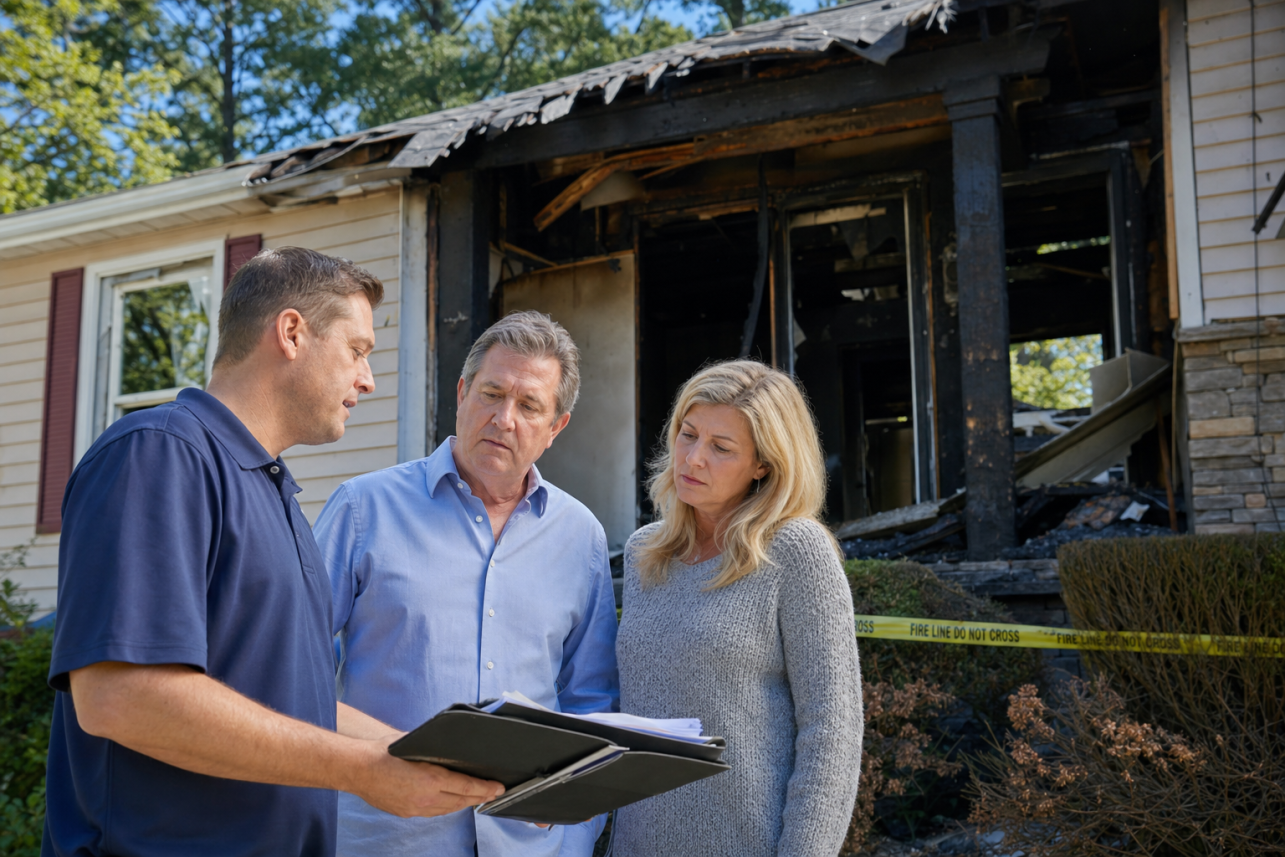
We Had A Kitchen Fire And The Insurer Only Wants To Pay For The Kitchen, But Smoke Traveled Through The Whole House. Is That Worth Fighting?
Absolutely — and it's a fight worth having early, because this is one of the most common ways carriers underpay fire losses. Smoke, soot, and corrosive combustion byproducts do not respect room boundaries.
A kitchen fire pushes soot through open doorways, HVAC ductwork, wall cavities, and attic spaces. Weeks later, homeowners notice yellowing paint upstairs, persistent odor in closets, and soot film inside electronics. Protein smoke from cooking fires is especially insidious — it's nearly invisible but bonds to surfaces and produces a lingering odor that surface cleaning won't remove.
Insurers often scope only the visibly burned room because that's what their adjuster photographed on a single walkthrough. Proving whole-house contamination takes testing: soot wipe samples from remote rooms, inspection of duct interiors, and documentation from a certified fire restoration contractor. Chatham County homes with older ductwork or open floor plans are particularly prone to widespread migration.
This is exactly the kind of scope disagreement that turns into a full fire insurance claim dispute Pittsboro families end up needing professional help with. We bring in the right testing, document contamination room by room, and present the carrier with evidence it cannot dismiss as homeowner speculation.
HVAC systems deserve special attention — running a contaminated system redistributes soot through every register in the house. If the carrier's estimate doesn't include duct cleaning or replacement after a significant kitchen fire, that alone is a red flag that the scope is too narrow. Don't accept a one-room settlement for a whole-house problem.
Local Relevance
Pittsboro sits at the heart of Chatham County, and its housing stock tells the story — historic homes near the old downtown, mid-century farmhouses on rural acreage outside town, and newer construction spreading with the area's growth. That mix matters in a fire claim. Older homes often have plaster walls, hardwood details, and craftsmanship that costs far more to restore than a standard insurance estimate assumes, and rural properties can suffer more extensive damage simply because fire response takes longer to arrive.
When a fire happens here, homeowners are often displaced to Chapel Hill, Sanford, or Apex while repairs drag on — which makes the additional living expenses portion of the policy critical, and it's one of the coverages insurers most often underpay or quietly stop reimbursing.
The National Fire Protection Association has long noted that cooking and heating equipment are leading causes of home fires, and in a region where older houses may have aging wiring and wood-burning heat, those risks are real. For The Public Adjusters, Inc. handles fire, smoke, and related water damage claims for homeowners and business owners throughout Pittsboro and Chatham County — as well as flood claims through the NFIP, tree damage, vandalism, and other residential and commercial losses.
Many homes around Pittsboro — especially the older farmhouses and pre-war houses common in Chatham County — feature plaster walls, original hardwoods, and period millwork that standard insurer pricing software tends to treat like modern drywall and trim, which is one of the most frequent reasons local fire claims come in underpaid on the first estimate.
Don't Let The Insurance Company Have The Last Word On Your Fire Claim
If your fire claim in Pittsboro has been denied, delayed, or paid at a number that won't rebuild your home, get a second opinion from a licensed, bonded public adjuster who works only for you. The policy review costs nothing, and you'll know exactly where your claim stands before you decide anything.
Call us: (919) 400-6440
Helpful Resources
- NCDOI Public Adjusters Guide
- National Fire Protection Association (NFPA)
- North Carolina Department of Insurance consumer resources — State regulator overseeing insurers and public adjusters in NC
- U.S. Fire Administration home fire safety information — Federal resource on home fire causes and prevention
Last updated: August 8, 2026