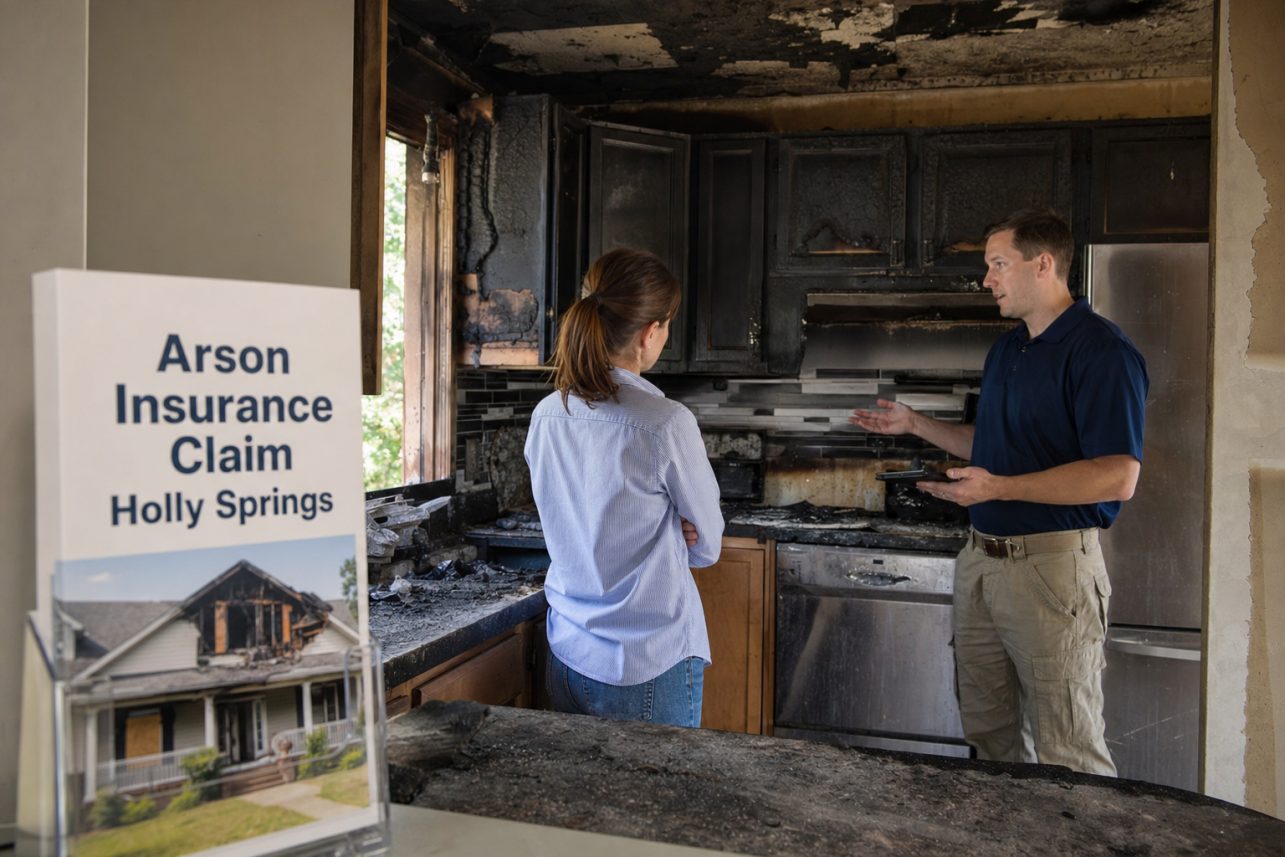
If your Arson insurance Claim Holly Springs fire investigation has turned against you, you have the right to independent representation before you give another statement to the insurance company. An accusation of arson is not proof, and insurers must still meet a real burden of evidence before denying a fire loss. For The Public Adjusters, Inc. is licensed and bonded, and we work only for the policyholder — never the carrier — to document the fire, challenge flawed origin-and-cause conclusions, and press the claim forward.
What This Service Is
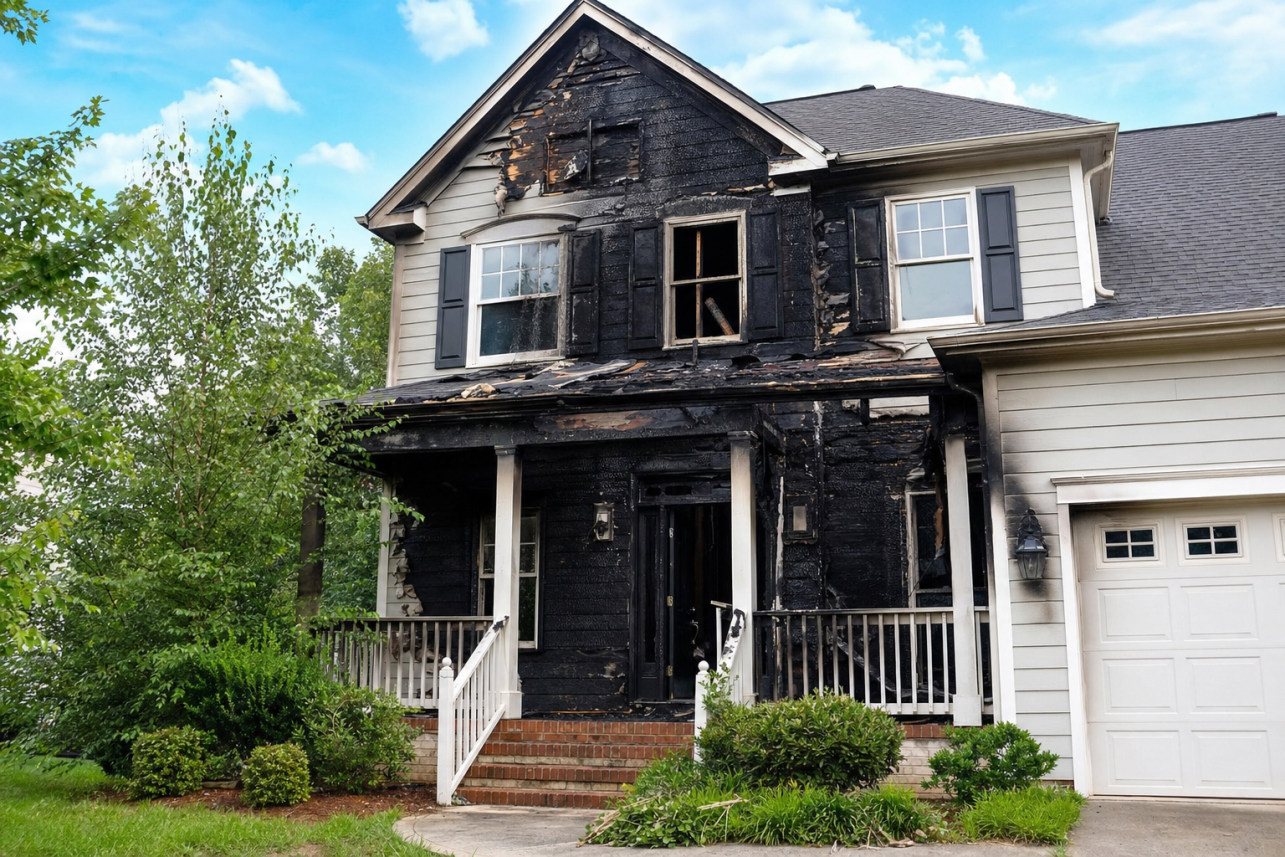
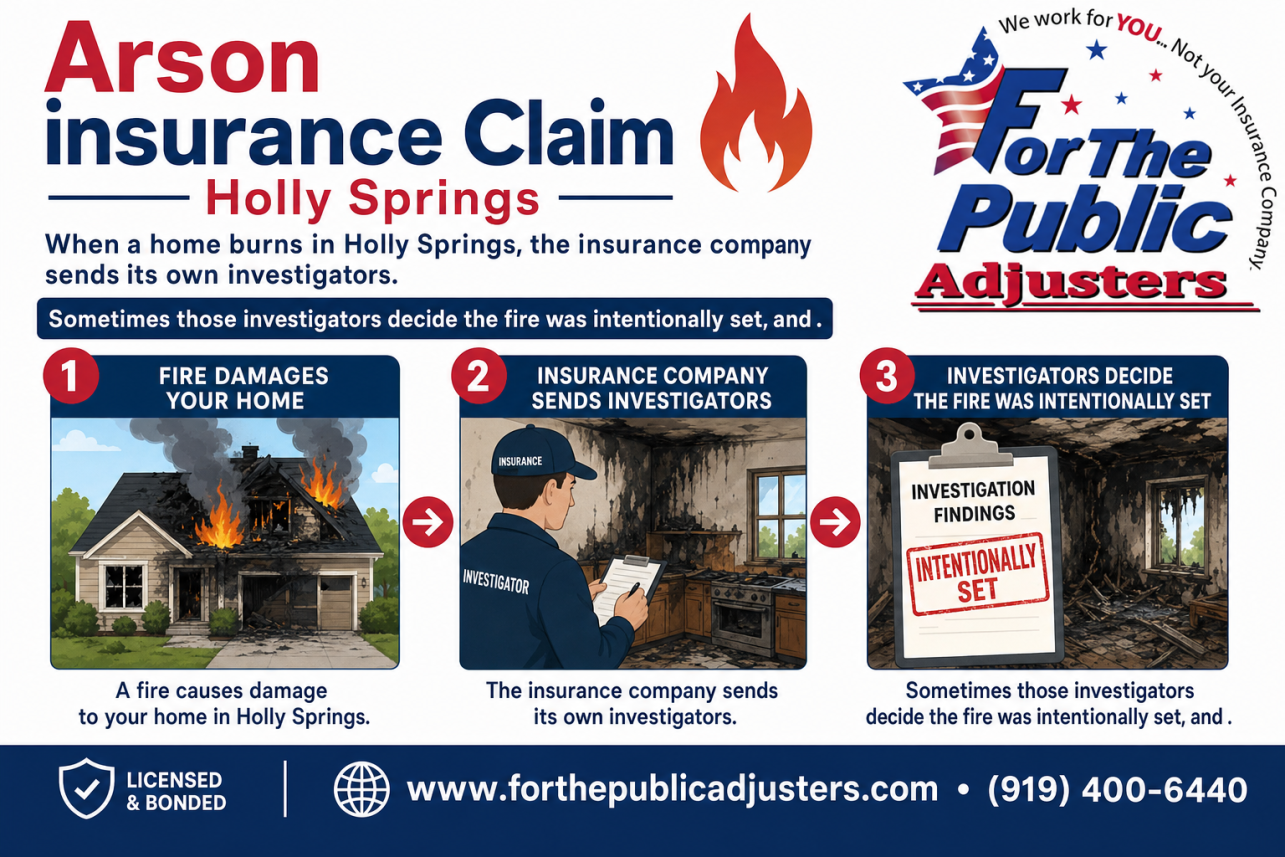
When a home burns in Holly Springs, the insurance company sends its own investigators. Sometimes those investigators decide the fire was intentionally set, and too often the homeowner becomes the suspect simply because they held the policy. That is where a public adjuster changes the equation.We represent you, not the insurer. We review the carrier’s origin-and-cause report against recognized fire investigation methodology — the kind published by the National Fire Protection Association (NFPA), whose guidance is the professional benchmark for how fire scenes should be examined. When an investigator skips steps, ignores accidental causes, or leans on assumptions instead of evidence, we document it.
We also handle the parts of the claim the accusation tends to bury: the full structural loss, smoke damage claim items throughout the house, destroyed contents, and additional living expenses while you are displaced. Homeowners nearby lean on us the same way — from arson homeowners claim help in Apex to fire losses across southern Wake County — because a wrongful arson defense follows the same playbook everywhere, and it can be answered everywhere.
Courts have backed policyholders in exactly this situation. In DeWitt v. American Family Mutual Insurance Co., a Missouri homeowner whose fire claim was denied on an arson theory took the insurer to trial — and the jury found for the insured, awarding the fire loss and punitive damages after concluding the carrier’s accusation did not hold up. The lesson is simple: an insurer’s suspicion is not a verdict, and policyholders who push back with evidence can prevail.
Common Problems
Will An Arson Accusation Wipe Out My Entire Payout?
Not automatically — but the carrier may act as if it does. While the investigation is open, insurers often withhold everything: the dwelling payment, contents, even the living-expense money you need for temporary housing. That pressure is real, and it is often the point.A denial for arson requires the insurer to establish that the fire was incendiary, that you had motive, and that you had opportunity. Missing any leg of that stool should collapse the defense. Meanwhile, the actual value of your loss — rebuild costs, smoke-contaminated contents, code upgrades — still has to be measured correctly, and it rarely is when the carrier assumes it will never pay. We build the full damage estimate anyway, so the moment the accusation fails, the number on the table is the right one, not a lowball placeholder.
My Arson Insurance Claim Holly Springs Investigation Feels Aimed At Me — What Now?
First, stop giving unrepresented statements. You generally must cooperate with your policy’s conditions, including an examination under oath if demanded, but you are entitled to preparation and representation before you sit for one. Innocent homeowners hurt themselves every day by guessing at answers about wiring, appliances, or their whereabouts.Second, preserve everything: photos of the scene, receipts, the fire department’s incident report, and the names of everyone who has walked the property. Third, get an independent review of the carrier’s origin-and-cause findings — negative corpus reasoning, where an investigator calls a fire arson merely because they could not find an accidental cause, is a known weakness we look for immediately. We have unwound the same tactics in a nearby arson homeowners claim in Fuquay-Varina, and the pattern repeats: rushed scene work, ignored electrical evidence, and pressure on the homeowner to fill the gaps.
Should I Fight This Myself, Or Does Hiring Help Actually Change The Outcome?
You can respond to an arson defense alone, but understand what you are up against: the insurer’s investigator, its special investigations unit, and its counsel, all coordinating before you see a single report. Going in without your own expert reading of the file is how honest claims die quietly.A good public adjuster does three things a homeowner cannot easily do alone: audits the fire investigation against accepted methodology, values the entire loss line by line, and manages every communication so nothing you say is taken out of context. Look for a firm that is licensed and bonded, works on the policyholder’s side exclusively, and can point to fire and arson-defense work specifically — not just routine claims. The NCDOI Public Adjusters Guide explains what licensed adjusters in North Carolina may and may not do, and it is worth reading before you sign with anyone, including us. When a claim needs litigation, we also coordinate with insurance dispute lawyers so the file is trial-ready rather than starting over.
Our Process
Independent Review Of The Fire Scene And The Carrier’s File
We inspect the property, photograph and document the burn patterns and damage, and obtain the fire department report. Then we scrutinize the insurer’s origin-and-cause conclusions for shortcuts — untested accidental causes, missing lab work, or conclusions that outrun the evidence. This is the foundation for challenging a wrongful arson theory.
Full Valuation Of The Loss — Structure, Contents, And Displacement
While the accusation is contested, we build the complete claim: room-by-room structural estimates, a detailed contents inventory, smoke and soot remediation, and additional living expenses. We handled a contested arson insurance claim in Durham the same way — value the loss fully first, so the carrier cannot use delay to shrink the number later.
Negotiation, Examination-Under-Oath Preparation, And Resolution
We prepare you for any examination under oath, respond to document demands, and negotiate directly with the carrier’s adjusters and counsel. If the insurer will not move off a baseless denial, we make sure the documented file supports the next step, whether that is appraisal or litigation. We never guarantee a specific outcome — no honest adjuster can — but we make sure your side of the file is complete and credible.
| Stage of the Claim | Homeowner Alone | With For The Public Adjusters, Inc. |
|---|---|---|
| Carrier’s origin-and-cause report | Rarely requested; accepted at face value | Obtained, reviewed line by line, and challenged against NFPA 921 methodology |
| Independent fire investigation | Almost never hired; too costly and unfamiliar | Certified independent investigator retained to test alternative ignition sources |
| Examination under oath | Attends unprepared; statements later used against them | Prepared in advance, with counsel referral when the accusation is serious |
| Burden of proof | Assumes they must prove innocence | Holds the insurer to its legal burden: incendiary origin, motive, and opportunity |
| Case law leverage | Unknown to most policyholders | North Carolina decisions like Bryant v. Nationwide (1985), where the insured recovered despite an intentional-act defense, put on the table |
| Contents and ALE documentation | Incomplete inventories, missed living expenses | Full room-by-room inventory and additional living expense tracking from day one |
Commonly Overlooked In The Public Adjusting Industry
- Demanding the carrier’s full origin-and-cause file, not just the denial letter — Most policyholders never learn they can challenge the investigator’s methodology, so a report that skipped NFPA 921 steps goes unquestioned.
- Sending a spoliation letter before the fire scene is cleared — Once debris is hauled away, the physical evidence that could prove an accidental electrical or appliance origin is gone forever.
- The insurer’s three-part burden: incendiary origin, motive, AND opportunity — Homeowners assume an accusation equals proof, when North Carolina law actually requires the carrier to establish all three elements.
- The innocent co-insured doctrine — Families don’t know that under Bryant v. Nationwide, 313 N.C. 362 (1985), an insured who had nothing to do with the fire may still recover even if another named insured is accused.
- Additional living expenses accruing during the arson investigation — Displaced families pay for months of rentals and meals out of pocket without documenting them, then can’t recover costs the policy owed all along.
- Preparation for the examination under oath — Policyholders treat it like a casual interview, not sworn testimony the SIU is specifically designed to use against the claim.
- Smoke, soot, and heat damage in rooms far from the fire’s origin — Adjusters scope the burned room and miss HVAC-distributed soot contamination that ruins contents throughout the home.
- Statutory deadlines and proof-of-loss timing during a stalled investigation — Carriers let the clock run while ‘investigating,’ and homeowners unknowingly miss filing windows that can weaken or bar the claim.
Case Studies
Case Study #1
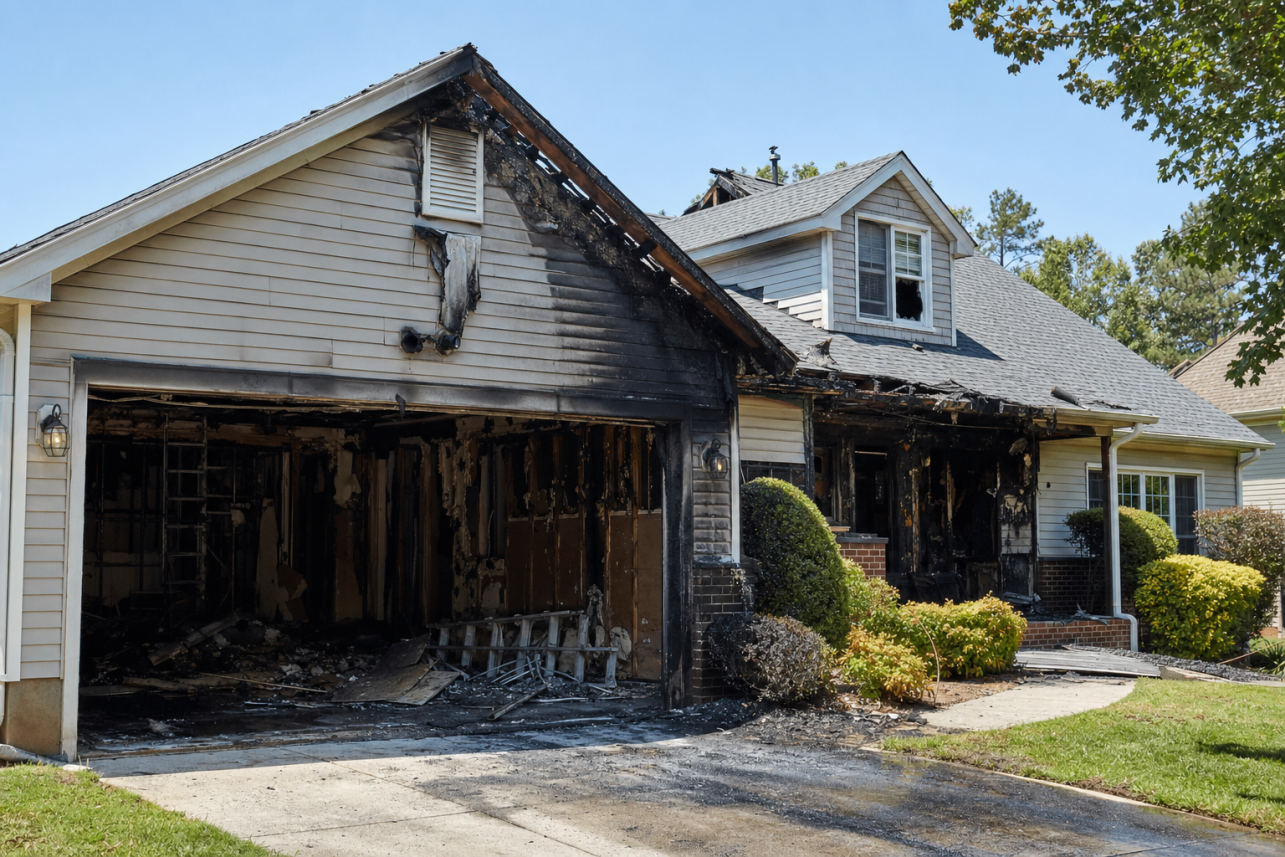
Situation: A homeowner near Bass Lake Road in Holly Springs suffered a kitchen and attic fire that started overnight. The family escaped safely, but the home was uninhabitable and most contents in the main living area were destroyed by smoke and heat.
Problem: The insurer’s origin-and-cause investigator flagged ‘irregular burn patterns’ on the kitchen floor and noted the homeowner had recently increased personal property coverage. Within weeks, the carrier sent a reservation of rights letter suggesting the fire was intentionally set and demanded an examination under oath.
Investigation: We were retained before the examination under oath. We hired an independent, NFPA 921-certified fire investigator, pulled the fire department’s incident report from Wake County records, and obtained the appliance service history for the range. We also documented that the coverage increase came from a routine agent review, not the homeowner’s request.
Findings: The independent investigation traced the origin to a failed connection behind the range — an electrical ignition source the carrier’s investigator never disassembled or lab-tested. The ‘irregular patterns’ were consistent with melted vinyl flooring and flashover, a phenomenon NFPA 921 specifically warns can mimic accelerant pours.
Solution: We presented the independent report, the lab findings on the failed component, and the agent’s own notes on the coverage change. We reminded the carrier that under North Carolina law an arson defense requires proof of motive, opportunity, and incendiary origin — and cited Bryant v. Nationwide Mutual Fire Insurance Co., 313 N.C. 362 (1985), where the North Carolina Supreme Court allowed an innocent insured to recover under a fire policy despite the carrier’s intentional-act defense.
Outcome: The carrier withdrew the arson theory and paid the dwelling, contents, and additional living expense claims. The family’s ALE coverage kept them in a rental in Holly Springs through the entire rebuild.
Lesson: A burn pattern is not proof of arson. Carriers must meet a legal burden, and an independent origin-and-cause investigation often dismantles a rushed accusation before it hardens into a denial.
Case Study #2
Situation: The owner of a small commercial building off Main Street in Holly Springs had a fire in a rear storage room. The business was struggling financially, which the insurer discovered quickly during its investigation.
Problem: The carrier’s special investigations unit built its case almost entirely on motive — tax liens and a slow sales quarter — and issued a denial alleging the owner set or procured the fire. The origin analysis was thin: no lab samples were taken, and two alternative ignition sources were never ruled out.
Investigation: We reconstructed the timeline hour by hour, proving the owner was 40 miles away with cell records and receipts. Our independent investigator identified an overloaded power strip feeding a compressor in the storage room and documented that the carrier’s investigator never eliminated it as required by NFPA 921’s systematic methodology.
Findings: The denial rested on financial motive alone, with no reliable proof of incendiary origin and no evidence of opportunity. North Carolina courts have repeatedly held that motive by itself cannot carry an arson defense — the same failure of proof that doomed the insurer’s position in Marshburn v. Associated Indemnity Corp., 84 N.C. App. 365 (1987), where the insured prevailed on a fire loss the carrier had blamed on arson.
Solution: We submitted a detailed rebuttal package — alibi evidence, the independent origin report, and the case law — and invoked appraisal on the disputed valuation while the coverage position was reconsidered.
Outcome: The carrier reversed the denial and settled the building and business personal property claim. The owner reopened rather than losing the business to a wrongful accusation.
Lesson: Financial trouble is not a crime, and it is not proof of arson. When a denial leans on motive instead of physical evidence, the insurer’s case is usually weaker than its letters sound.
| Warning Sign From the Insurer | What It Usually Means | Smart Next Step |
|---|---|---|
| Reservation of rights letter after a fire | The carrier is preserving the option to deny; the investigation has turned toward you | Stop giving recorded statements alone; get professional representation before responding |
| Request for an examination under oath | The SIU is building a formal record it can use to deny the claim | Never attend unprepared; this testimony is under oath and legally binding |
| Demand for tax returns, bank records, and credit history | The insurer is hunting for financial motive | Comply through a representative who frames the records — motive alone cannot prove arson in North Carolina |
| ‘Suspicious burn patterns’ cited with no lab results | The origin conclusion may not survive NFPA 921 scrutiny | Commission an independent origin-and-cause investigation before evidence is demolished or discarded |
| Claim silent for 60+ days with no coverage decision | The carrier may be delaying while the accusation develops | Send written demands for status and preserve every communication for a potential bad-faith record |
| Fire scene about to be released or cleared | Physical evidence proving an accidental cause could be lost forever | Send a spoliation letter and photograph, sample, and document everything first |
| Denial letter citing the intentional-acts exclusion | The insurer believes its file is strong enough to refuse payment | Challenge it — insureds have won these fights, as in Marshburn v. Associated Indemnity Corp. (N.C. App. 1987) |
| You had no involvement but a co-insured is suspected | Coverage may still exist for you personally | Raise the innocent co-insured doctrine recognized in Bryant v. Nationwide, 313 N.C. 362 (1985) |
Reviews
After our house fire in the Sunset Ridge area, the insurance company’s investigator started asking questions like we were suspects instead of victims. For The Public Adjusters brought in their own certified fire investigator who proved the fire started at a bathroom exhaust fan. The arson accusation disappeared and our claim finally got paid. I can’t imagine going through an examination under oath without them preparing us first.
Darren M., Holly Springs
The carrier held our fire claim hostage for months hinting at ‘suspicious origin’ without ever putting it in writing. This team forced the issue — they demanded the carrier’s origin-and-cause report, picked it apart line by line, and showed the investigator skipped basic NFPA 921 steps. Our dwelling and contents claim settled shortly after. Professional, licensed, and they knew North Carolina fire claim law cold.
Renee T., Wake County
I was wrongly blamed for a garage fire because I had filed a claim years earlier and money was tight. Humiliating experience. For The Public Adjusters documented my whereabouts, got the electrical panel independently tested, and cited actual North Carolina court cases where homeowners beat these accusations. The denial was reversed. Four stars only because the process still took several months — but that was the insurer’s doing, not theirs.
Carlos J., Holly Springs
Frequently Asked Questions
What Should I Do If My Arson Insurance Claim Holly Springs Was Denied Because The Insurer Suspects I Set The Fire?
First, do not panic and do not accept the denial as final. Insurers carry the burden of proving arson by the insured, and suspicion alone is not proof. When a fire investigation is wrongfully pointed at a homeowner, the denial can and should be challenged with evidence.
Request the full denial letter in writing, along with the cause-and-origin report the carrier relied on. These reports are sometimes rushed, and independent fire experts frequently reach different conclusions about ignition sources, burn patterns, and accelerant testing.
Courts have sided with wrongly accused policyholders before. In Merrick v. Farmers Insurance Group, 892 F.2d 1434 (9th Cir. 1990), the insurer denied a homeowner’s fire loss claim on an arson theory. The insured fought back, a jury found in the homeowner’s favor, and the verdict against the carrier was upheld on appeal. That case is a reminder that an accusation is not the end of the road.
As licensed and bonded public adjusters serving Holly Springs and the rest of Wake County, we review the carrier’s file, bring in independent experts when warranted, document the structure and contents losses, and present a properly supported claim. We can never guarantee a specific outcome, but we can make sure your side of the story is documented and professionally argued rather than ignored.
How Long Does An Arson Investigation Delay A Fire Claim In Holly Springs, And Can The Insurer Keep Stalling?
In North Carolina, a carrier is expected to investigate and resolve a claim within a reasonable time. A legitimate cause-and-origin investigation on a suspicious fire can take 30 to 90 days, sometimes longer if the Holly Springs Fire Department or the SBI is involved. What insurers cannot do is use an open-ended “investigation” as an excuse to avoid paying indefinitely.
During the delay, you still have rights. Most homeowner policies include Additional Living Expenses coverage, which should pay for temporary housing while your home is uninhabitable, even while the investigation is pending. If the carrier refuses ALE without a documented basis, that refusal should be challenged in writing.
Watch for warning signs of a stall: repeated requests for documents you already provided, multiple Examinations Under Oath on the same topics, or months of silence between updates. These patterns often precede a wrongful denial.
Our team tracks every request, deadline, and response, and pushes the adjuster to either pay the claim or state, in writing, exactly what evidence supports withholding payment. That paper trail matters enormously if the dispute ends up before the North Carolina Department of Insurance or in court. We handle homes, commercial buildings, and contents losses throughout Wake County, and we keep the pressure on so a slow investigation does not quietly become a denial by attrition.
The Fire Investigator Says The Fire Was Intentionally Set, But I Had Nothing To Do With It. Can A Holly Springs Public Adjuster Still Help?
Yes, and this situation is exactly where professional representation matters most. An “incendiary” finding on the cause-and-origin report does not automatically mean you set the fire. To deny the claim, the insurer generally must show the fire was intentional, that you were connected to setting it, and often that you had motive. Missing any of those elements weakens the denial.
Many wrongful accusations start with sloppy science. Burn-pattern interpretation has changed significantly under NFPA 921 standards, and conclusions that would have passed twenty years ago are now considered unreliable. An independent fire investigator can re-examine the scene evidence, lab results, and electrical components, and quite often the “arson” turns out to be an appliance failure, wiring fault, or unknown third party.
We coordinate that independent review, document the full scope of damage to the dwelling and your personal property, and prepare a detailed, defensible estimate. We also prepare you for the Examination Under Oath process so you understand your policy duties without being ambushed.
If intentional conduct by someone outside your household caused the fire, your policy typically still covers the loss, because vandalism and arson by a third party are covered perils. As a licensed and bonded firm, we present the facts honestly and thoroughly. No one can promise a specific dollar result, but a properly built file gives a wrongly accused homeowner in Holly Springs the strongest possible footing.
What Does For The Public Adjusters, Inc. Charge To Handle An Arson Insurance Claim Holly Springs Homeowners Are Fighting?
For an Arson insurance Claim Holly Springs policyholders bring to us, we work on a contingency-fee basis. Our fee is a percentage of what the insurance company actually pays, and the percentage is stated plainly in a written contract before any work begins. If the carrier pays nothing, we receive nothing on that recovery, which keeps our interests aligned with yours.
There is no upfront cost for the initial claim review. We read your policy, examine the denial or reservation-of-rights letter, and give you an honest assessment of whether the accusation against you can be effectively challenged. Not every claim is one we can take, and we will tell you that directly.
Keep in mind what a wrongful arson denial actually costs a family: the dwelling repair or rebuild, every item of contents inside the home, and months of additional living expenses. On losses of this size, disputes between carrier estimates and independent estimates in Wake County routinely involve substantial sums, which is why professional claim preparation frequently pays for itself.
One important note: we handle claims for homes, commercial buildings, and their contents only. We do not handle motor vehicle, health, life, or cell phone claims of any kind. If your fire loss also involved flooding from firefighting or storm water, resources from FEMA at fema.gov and the National Flood Insurance Program at floodsmart.gov can help you understand what falls under flood coverage. We are licensed and bonded, and every engagement starts with a clear, written agreement.
What Evidence Does An Insurer Need To Deny An Arson Insurance Claim Holly Springs Homeowners File, And Who Carries The Burden Of Proof?
The burden falls on the insurance company, not on you. To deny a fire claim on arson grounds, the insurer generally must prove three things: the fire was intentionally set, you had a motive, and you had the opportunity to set it or arrange it. Suspicion alone is not proof, and courts have repeatedly rejected denials built on speculation.
That matters because many wrongful accusations in Wake County start with a thin origin-and-cause report and a note that the homeowner had recent financial stress. Neither of those, alone or together, meets the legal standard.
Courts have punished insurers who cut corners here. In McGory v. Allstate Insurance Co., 527 So. 2d 632 (Miss. 1988), the insurer denied a homeowner’s fire claim by alleging arson without adequate proof. The court sided with the policyholder, finding the carrier lacked a legitimate, arguable basis for the denial, and the insured recovered damages beyond the policy amount.
When we take on a wrongfully accused homeowner in Holly Springs, we scrutinize whether the carrier can actually satisfy each element. We review the investigator’s methodology against NFPA 921, the recognized standard for fire investigation, and document alibi evidence, alarm records, and witness accounts. We are licensed and bonded, and while no one can promise a specific outcome, holding the insurer to its actual burden of proof often changes the conversation entirely.
Can I Dispute The Fire Investigator’s Origin-And-Cause Report If It Wrongly Points The Finger At Me?
Yes, and in many cases you should. Origin-and-cause reports are opinions, not verdicts. They can be challenged when the investigator failed to follow NFPA 921, the national standard that requires fire conclusions to rest on the scientific method rather than hunches.
Common flaws we find in reports used against Holly Springs homeowners include misreading normal burn patterns as evidence of accelerants, ignoring electrical or appliance failure points, failing to test debris samples in a lab, and ruling the fire ‘incendiary’ simply because no accidental cause was immediately obvious. That last move, called negative corpus, has been discredited in the fire-science community.
Disputing a flawed report usually means bringing in an independent certified fire investigator to re-examine the scene, the photographs, and the physical evidence before it is lost. Timing matters, so preserving the scene and demanding the carrier’s full file early is critical.
As your public adjuster in Holly Springs, our role is to coordinate that independent review, document your home and contents losses in parallel, and push back in writing on every unsupported conclusion. Courts have shown they will side with policyholders when the science does not hold up, as in McGory v. Allstate, where a homeowner defeated an arson-based denial that rested on inadequate proof. We cannot guarantee any particular result, but a wrongly accused homeowner should never accept a defective report as the final word.
Have Homeowners Actually Won In Court After Being Falsely Accused Of Arson By Their Insurance Company?
Yes. One of the clearest examples is McGory v. Allstate Insurance Co., 527 So. 2d 632 (Miss. 1988). A homeowner’s house burned, and the insurer refused to pay, claiming the fire was arson. The court found the carrier had no legitimate, arguable basis for that accusation and ruled for the policyholder, who recovered damages for the home and its contents along with additional damages for the bad-faith denial.
Cases like that one send an important message to Wake County homeowners: an accusation is not evidence, and insurers who deny fire claims without meeting their burden of proof expose themselves to serious liability.
That said, homeowners rarely win these fights by waiting quietly. The policyholders who prevail are the ones who preserve the fire scene, obtain independent origin-and-cause analysis, document every item of damaged contents, and respond carefully to the carrier’s requests without volunteering statements that get twisted later.
Our team handles that groundwork for fire loss claims involving homes, buildings, and personal property throughout Holly Springs and the surrounding area. We build the documented record that either persuades the carrier to pay or gives your attorney a strong foundation if litigation becomes necessary. We are licensed and bonded, and while no one can promise a court outcome or a specific payment, the case law makes clear that wrongly accused homeowners have real rights and real remedies.
Should I Give A Recorded Statement Or Examination Under Oath While The Insurer Investigates My Fire As Suspicious?
Cooperate, but do it carefully and never blind. Most homeowner policies require you to participate in an examination under oath (EUO) if requested, and refusing outright can give the carrier grounds to deny coverage. The danger is that in a suspected-arson file, the EUO is often used to build a case against you rather than to evaluate your loss.
Before any recorded statement or EUO connected to an Arson insurance Claim Holly Springs policyholders should get their documents in order first. That means gathering your mortgage records, bank statements, receipts, photos of contents, and a timeline of your whereabouts, because financial questions and opportunity questions are exactly where wrongful accusations take root.
Answer truthfully and precisely. Do not guess at values, dates, or details you are unsure of; an innocent inconsistency can be portrayed later as deception. If a question feels like an accusation, you have the right to have an attorney present at an EUO, and for accused homeowners we typically recommend it.
While we do not act as your lawyer, our job as your adjuster is to prepare the documented proof of your dwelling and contents loss so the facts are on paper before you ever sit down. That preparation limits the insurer’s room to distort your answers. We are licensed and bonded, and although no one can guarantee how a carrier will respond, walking into an EUO organized and represented is one of the strongest protections a wrongly suspected homeowner has.
Will Hiring A Public Adjuster Make Me Look Guilty During A Suspicious-Fire Investigation In Holly Springs?
No. Hiring your own licensed representative is a normal, lawful step, and insurers deal with public adjusters every day. What actually raises red flags with carriers is silence, missed deadlines, and inconsistent statements — not professional representation.
For The Public Adjusters, Inc. is licensed and bonded, and our role is to document your loss, organize your proof of ownership and occupancy, and hold the carrier to the policy language and North Carolina’s claim-handling rules. That structure protects you, because everything submitted is accurate, consistent, and on the record.
Courts have made clear that policyholders are entitled to fair treatment even when a fire looks suspicious. In Rawlings v. Apodaca, the insureds’ home was destroyed by fire and the carrier withheld its own fire investigation findings while dragging out the process. The homeowners sued and won, and the court held that an insurer owes its policyholder equal consideration and cannot put its own interests first.
That decision is a useful reminder for Wake County homeowners: the burden of proving arson sits with the insurer, and your job is to present a clean, well-documented claim. Having an advocate who knows fire losses generally strengthens your position rather than weakening it. We cannot promise a specific outcome — no one honestly can — but we can make sure your side of the file is complete and professionally presented.
How Does For The Public Adjusters, Inc. Document A Holly Springs Fire Loss While An Arson Accusation Is Still Pending?
We start fast, because fire scenes degrade quickly in North Carolina humidity and evidence can be lost once cleanup begins. Our first step is preserving the scene through photographs, video, and a room-by-room walkthrough before anything is moved.
Next comes the contents inventory. We build a detailed list of damaged personal property — furniture, clothing, electronics, tools, heirlooms — with descriptions, ages, and replacement costs. When an insurer suspects arson, sloppy or inflated inventories get used against homeowners, so precision matters enormously here.
On the structure side, we scope smoke, soot, heat, and water damage separately, since suppression water often causes losses adjusters undercount. We also gather the paperwork that undercuts a wrongful accusation: utility records showing normal occupancy, mortgage statements, receipts, and timelines that account for your whereabouts.
Where the carrier’s origin-and-cause investigator has reached a conclusion we believe is wrong, we help you engage an independent fire expert to review burn patterns, electrical evidence, and accelerant testing. In Rawlings v. Apodaca — a home destroyed by fire — the policyholders prevailed against their insurer partly because the carrier concealed its investigation while the insureds diligently pursued their claim. Thorough, honest documentation is exactly what puts a Wake County homeowner in that stronger position.
We are licensed and bonded, and we handle the measuring, pricing, and paperwork so you can focus on your family and temporary housing.
What Happens To My Mortgage And Living Expenses While My Arson Insurance Claim Holly Springs Investigators Flagged As Suspicious Is Under Review?
Your mortgage does not pause because the fire is under investigation, and that pressure is real for Holly Springs families. Contact your lender immediately, explain the loss, and ask about forbearance or hardship options in writing. Most servicers have programs for borrowers displaced by fire.
Your homeowner policy almost certainly includes Additional Living Expense (ALE) coverage, which pays the extra cost of temporary housing, meals, and similar expenses while your home is uninhabitable. Insurers sometimes slow-walk ALE during a suspicious-fire review, but a pending investigation is not, by itself, a lawful reason to refuse legitimate interim payments. We push for ALE to be advanced while the broader investigation continues, and we document every hotel night and receipt.
Keep every expense record, no matter how small. Rental deposits, laundry, pet boarding, added commuting mileage from a temporary rental in Fuquay-Varina or Apex — these add up and are frequently recoverable.
The courts back diligent policyholders here. In Rawlings v. Apodaca, homeowners whose house burned won against their insurer after it delayed and withheld information, with the court emphasizing that a carrier must give its insured’s interests equal weight. We cannot guarantee any particular payment or timeline, but an Arson insurance Claim Holly Springs homeowners pursue with organized proof of expenses and firm, written demands tends to move very differently than one the family handles alone.
What Common Mistakes Lead Fire Investigators To Wrongly Suspect Holly Springs Homeowners Of Arson?
Most wrongful suspicion starts with circumstances, not evidence. Financial strain is the biggest one — a recent job loss, listing the home for sale, or being behind on payments gets treated as motive even when the fire had an accidental cause. Wake County homeowners are often shocked that ordinary money troubles put them under a microscope.
Investigation science itself is a second problem. Burn patterns once treated as proof of accelerants — pour patterns, deep charring, crazed glass — have been discredited or shown to occur in accidental fires, especially after flashover. An origin-and-cause report built on outdated indicators can be challenged by a qualified independent expert, and we help homeowners arrange that review.
Third, homeowners hurt themselves with honest mistakes: guessing at answers instead of saying “I don’t recall,” giving unprepared recorded statements, discarding fire debris before the carrier’s inspection, or submitting a rushed contents list with errors the insurer later calls misrepresentation.
Remember the legal framework. The insurer carries the burden of proving arson, and courts have punished carriers that overreach. In Rawlings v. Apodaca, a family whose home burned prevailed against their insurance company after it concealed its fire investigation and delayed the claim, with the court affirming the insurer’s duty of good faith.
If your carrier is treating you like a suspect instead of a policyholder, get representation early. We’re a Holly Springs-area resource for exactly this situation, and careful handling from day one is the best protection against a wrongful accusation hardening into a denial.
Does It Matter For My Arson Insurance Claim Holly Springs Whether I Was Ever Criminally Charged With Setting The Fire?
It matters a great deal — and usually in your favor. If the Holly Springs Fire Department, the Wake County Fire Marshal, or the SBI investigated your fire and no criminal charges were ever filed, that fact undercuts the insurer’s story. Prosecutors need proof beyond a reasonable doubt, but even the lower civil standard requires the carrier to prove you actually set or procured the fire, not just that the fire looks suspicious.
Insurers sometimes deny anyway, betting the homeowner won’t push back. North Carolina courts have punished that tactic. In McLeod v. Nationwide Mutual Insurance Co., 115 N.C. App. 283 (1994), Nationwide denied a fire loss on an arson theory, the homeowner sued, and the jury sided with the insured — awarding damages that included punitive damages for the carrier’s bad-faith handling. The Court of Appeals upheld that result.
So the absence of charges is a fact we use, not a footnote. We gather the fire department run report, the investigator’s file where obtainable, and any correspondence showing law enforcement closed the matter, then put that record squarely in front of the adjuster. We can never promise a specific outcome, but a documented file changes the conversation. As a licensed and bonded firm, we build that record properly from day one.
Can The Insurer Refuse To Pay If Someone Else — Like An Estranged Spouse Or Ex-Partner — Intentionally Set Fire To My Holly Springs Home?
Not automatically. When one person named on the policy sets a fire, carriers often try to deny everyone, including the co-owner who had nothing to do with it. Courts across the country have pushed back on that under the innocent co-insured doctrine.
A leading example is Watson v. United Services Automobile Association, 566 N.W.2d 683 (Minn. 1997), where a spouse intentionally burned the family home. The Minnesota Supreme Court held the innocent wife could still recover under the fire policy for her interest in the house and its contents, because the statutory fire policy protects an insured who didn’t participate in the wrongdoing. The insurer could not use one person’s act to erase the other’s coverage.
How this plays out depends on your specific policy language and how the named insureds are listed, so the wording matters. Some policies say ‘an insured’ and others say ‘the insured,’ and courts have treated that difference as significant.
If you’re the innocent owner of a Wake County home damaged by someone else’s act, don’t accept a blanket denial as the final word. We read the exact policy form, separate your interest from the wrongdoer’s, and present your portion of the loss — dwelling, contents, and additional coverages — as its own documented claim. No firm can guarantee a result, but an innocent co-insured has real legal footing worth asserting.
How Long Do I Have To Fight Back After A Suspicious-Fire Denial In Wake County Before I Lose My Rights?
Less time than most homeowners assume, which is why waiting is the most expensive mistake you can make. North Carolina’s general statute of limitations for breach of an insurance contract is three years, but many fire policies contain their own suit-limitation clause that can shorten the window to sue after a loss. That clause is buried in the conditions section, and it keeps running even while the carrier is ‘still investigating.’
There are also shorter internal deadlines. Fire policies typically require a signed, sworn proof of loss within a set number of days after the insurer demands it — often 60 — and missing it can give the carrier a separate excuse to deny. When an arson accusation is on the table, adjusters watch those deadlines closely.
Practically, that means a homeowner near Holly Springs Road or out toward Sunset Lake shouldn’t spend six months writing polite letters. Pull your full policy, note every date in the denial or reservation-of-rights letter, and get the sworn proof of loss done correctly and on time.
For The Public Adjusters, Inc. tracks each of these deadlines the day we’re retained, prepares the proof of loss with a line-item valuation behind it, and keeps the file litigation-ready in case an attorney is ultimately needed. We’re licensed and bonded, and while we never promise a particular recovery, we make sure a deadline is never the reason you lose.

Are My Smoke, Soot, And Contents Losses Still Covered While Investigators Label The Fire Suspicious?
Yes — a suspicion label doesn’t shrink your coverage. An Arson insurance Claim Holly Springs homeowners are wrongly accused of causing still includes everything a normal fire claim includes: structural damage, smoke and soot contamination throughout the home, heat damage to rooms the flames never reached, and every item of personal property that was destroyed or contaminated.
The problem is that carriers under an arson theory often go quiet on the whole file, and homeowners stop documenting. That’s backwards. Soot is acidic and keeps corroding electronics, HVAC components, and finishes the longer it sits. Textiles and upholstered furniture absorb protein and synthetic smoke residues that become harder to prove — and harder to clean — over time.
Our approach in Wake County fire losses is to inventory contents room by room while evidence is fresh: photographs, model and serial numbers where legible, purchase records, and replacement-cost pricing for each item. We separate cleanable items from total losses so the carrier can’t lump everything into a lowball ‘cleaning allowance.’ We also document hidden smoke migration in attics, duct systems, and wall cavities that quick carrier inspections routinely miss.
None of that documentation admits anything or weakens your position on the arson dispute — it simply preserves the value of the claim so that when the accusation collapses, the payout reflects the true loss. We can’t guarantee what the insurer will pay, but an itemized, defensible inventory is consistently what closes the gap between their first number and the real one.
Local Relevance
Holly Springs has grown fast, and its housing stock shows it: large tracts of homes built in the last two or three decades, heavy with modern electrical systems, gas appliances, and open floor plans that let fire and smoke travel quickly. Fast-moving fires burn hot and destroy the very evidence that would prove an accidental cause — which is precisely when investigators are most tempted to fill the gap with suspicion of the homeowner.Wake County fire scenes also draw multiple parties quickly: the local fire marshal, the carrier’s investigator, and sometimes a special investigations unit, all before the homeowner has recovered from the shock. Having your own representative on scene early keeps the record honest. We serve policyholders throughout southern Wake County, and our public adjuster Apex NC office is minutes from Holly Springs, so we can be at your property fast.
Fire is not the only loss we see here. Humid summers and heavy storm seasons mean many families also come to us for a water damage claim or tree damage claim, and neighboring towns rely on our fire damage insurance claim help in Knightdale when a loss turns adversarial. Wherever you are in the Triangle, the principle is the same: the burden of proving arson sits with the insurer, not with you.
Because so much of Holly Springs was built during the region’s rapid growth, fires here often involve newer construction with engineered lumber and open layouts that burn fast and leave less physical evidence behind — a gap insurers’ investigators sometimes fill with suspicion rather than science. Getting an independent expert into the scene early, before debris is cleared, is often the difference between a documented accidental cause and an unanswered accusation.
Accused Of Setting Your Own Fire? Get Someone On Your Side Today
Do not give another statement or sign another form until you know where the investigation stands. For The Public Adjusters, Inc. is licensed and bonded, and we represent Holly Springs policyholders — never insurance companies. The consultation costs you nothing, and the sooner we see the file, the more we can do with it.
Call us: (919) 400-6440
Helpful Resources
- National Fire Protection Association (NFPA)
- NCDOI Public Adjusters Guide
- U.S. Fire Administration home fire resources — Federal fire safety and post-fire guidance for homeowners
Serving Holly Springs · Wake
Last updated: September 30, 2026