
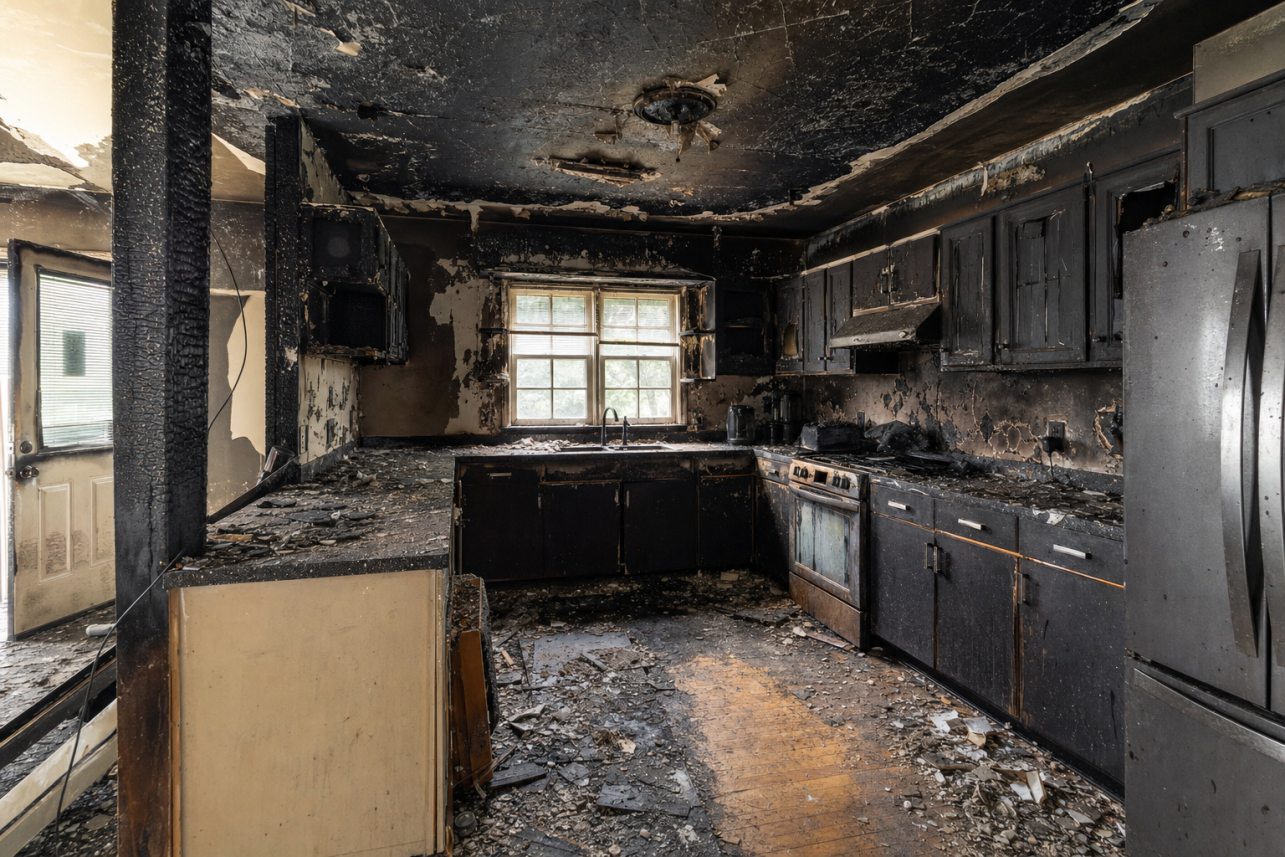
A fire damage insurance claim adjuster Elon property owners can call on works for you, not the insurance company, to document your fire loss and negotiate your settlement. For The Public Adjusters, Inc. is licensed and bonded in North Carolina, and we handle everything from the smoke and soot assessment to the final proof of loss. If your home or business in Alamance County has burned, we step in so you are not left interpreting your policy alone while the insurer's adjuster writes the estimate.
What This Service Is
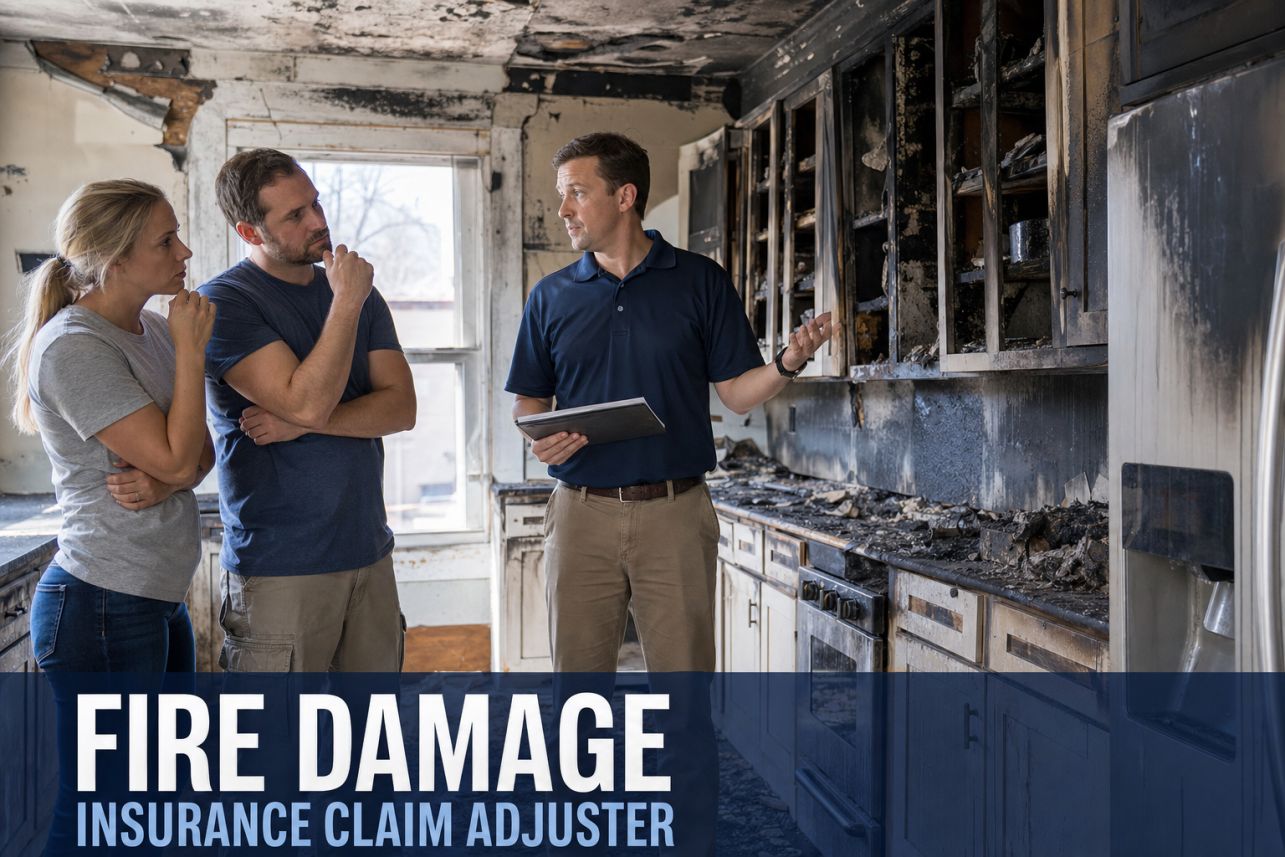
After a fire, your insurance company sends its own adjuster to inspect the damage and put a number on it. That number is the insurer's opinion of your loss — not necessarily what your policy actually owes you. A public adjuster is the licensed professional who represents the policyholder's side of that conversation.
Our job starts with a complete property loss assessment: the structure, the contents, the smoke and soot that traveled far beyond the burn area, and the water damage left behind by firefighting. Fire hoses can put hundreds of gallons of water into walls and floors, and that damage is often bigger than the fire itself.
We then build the claim the way your policy requires — a room-by-room contents inventory, repair estimates that account for hidden structural damage, documentation of your temporary housing costs under your additional living expenses coverage, and a properly prepared proof of loss. Then we negotiate directly with your insurer's adjuster until the settlement reflects what the policy promises.
The NCDOI Public Adjusters Guide explains that public adjusters in North Carolina must be licensed by the state, and it is worth confirming that license before you hire anyone. We are licensed and bonded, and we work on residential homeowners claims and commercial business claims alike.
Common Problems
The Insurance Company's Offer Feels Low — How Do I Know What My Fire Claim Is Really Worth?
Low first offers are common after fires, and there are usually two reasons. First, the insurer's estimate often stops at what the eye can see — charred framing, blackened drywall — and misses smoke residue in the HVAC system, soot etched into finishes rooms away, and moisture trapped in walls from the hoses.
Second, depreciation. Many policies pay actual cash value first — replacement cost minus depreciation — and only release the rest after repairs. If nobody pushes back on how aggressively items were depreciated, or claims the recoverable amount later, that money simply stays with the insurer.
We re-measure the loss from scratch, including building code upgrade costs your policy may cover when an older home has to be rebuilt to current code. We never guarantee a specific outcome, but we make sure the number on the table is built from your actual damage, not a drive-by estimate.
What If My Fire Damage Insurance Claim Adjuster Elon Settlement Gets Delayed, Underpaid, Or Denied?
Delays and disputes usually trace back to documentation. If the proof of loss is incomplete, the contents inventory is thin, or the cause-and-origin file raises questions, the insurer has cover to stall or underpay. Arson accusations, in particular, can freeze a legitimate claim for months.
Policyholders have real leverage here, and courts have backed them. In Grace v. Lititz Mutual Insurance Co., a Mississippi homeowner whose house was destroyed sued after the insurer refused to pay the full policy amount, arguing an excluded cause — and the courts sided with the insured, upholding recovery under the policy. Insurers do not get the last word just because they wrote the first estimate.
Our role is to close the documentation gaps that give insurers room to delay, respond to their requests in writing, and escalate when a file sits too long. If an insurer's conduct crosses into bad faith, thorough records become your strongest asset.
Should I Handle The Claim Myself, Or Is Hiring An Elon Public Adjuster Worth It?
You can absolutely file yourself, and for a small kitchen fire with light smoke damage, you may not need help. But a serious fire claim is really three or four claims in one — structure, contents, smoke, and the water damage from putting the fire out — each with its own documentation rules and coverage limits.
Most homeowners have never inventoried every item they own, assigned it a value, and defended that value to a trained company adjuster. They also do not know which questions on the proof of loss can quietly narrow their recovery.
A good public adjuster does this daily. When you interview one, ask to see their North Carolina license, ask whether they are bonded, and ask how their fee works — reputable adjusters charge a percentage of the recovery, so you owe nothing up front. We handle fire, smoke, and firefighting water damage claims across Alamance County, and we welcome those questions.

Our Process
Free Policy And Damage Review
We start by reading your actual policy — coverage limits, deductible amount, whether contents are covered at replacement cost or actual cash value, and what your additional living expenses coverage will pay while you are out of the house. Then we walk the property and give you an honest picture of where the claim stands. No cost, no obligation.
Full Documentation Of The Loss
We inspect beyond the burn zone: soot in ductwork, smoke odor absorbed into insulation, moisture readings in walls and subfloors from firefighting water. We build the room-by-room contents inventory with you, photograph everything, obtain repair estimates that include hidden structural damage, and prepare the proof of loss correctly the first time so the insurer cannot use paperwork as a reason to stall.
Negotiation And Settlement
We present the documented claim to your insurer, meet their adjuster on site, and negotiate line by line — structure, contents, code upgrades, living expenses. If the fire results in a total loss determination, we make sure that decision is supported and that policy limits are applied correctly. We keep you informed at every step, and you make the final call on any settlement.
| What Happens After the Fire | Handling It Yourself | With For The Public Adjusters |
|---|---|---|
| Damage scope | Carrier's estimate defines the loss; hidden smoke and heat damage often excluded | Independent inspection, soot testing, and moisture mapping document the full loss |
| Contents inventory | You list what you remember; undervalued and incomplete | Room-by-room inventory with photos, receipts research, and replacement-cost pricing |
| Policy interpretation | You take the adjuster's word on coverage, exclusions, and deadlines | Every coverage, endorsement, and deadline reviewed and enforced on your behalf |
| Negotiation | One offer, take it or fight alone | Documented supplements, re-inspections, and appraisal invoked when needed |
| Additional living expenses | Often unclaimed or cut off early | ALE tracked and claimed for the full displacement period |
| Typical result | First offers frequently a fraction of actual repair cost | Settlements built on evidence, not the carrier's initial scope |
Commonly Overlooked In The Public Adjusting Industry
- Soot contamination inside HVAC ductwork — Nobody sees inside the ducts during a walkthrough, so carriers routinely scope smoke damage only in rooms with visible staining.
- Char depth in structural framing behind 'clean and seal' recommendations — Sealant hides charring instead of measuring it, and only probing or engineering review reveals whether joists and studs lost load capacity.
- Smoke-contaminated attic insulation — Blown-in insulation absorbs soot and odor permanently, but adjusters rarely climb into the attic to check it.
- Water damage from firefighting efforts — Everyone focuses on the burn, while thousands of gallons of suppression water soak wall cavities and subfloors that dry out on the surface and hide the rest.
- Corrosive chloride residue on electronics and metal fixtures — Burned plastics release chlorides that corrode circuit boards and hardware weeks later, long after the item 'looked fine' at inspection.
- Code-upgrade coverage during rebuild — Homes in Alamance County built decades ago must be rebuilt to current code, and the ordinance-or-law coverage that pays for it goes unclaimed because no one asks.
- Full additional living expense entitlement — Policyholders accept a few weeks of hotel money without realizing ALE typically covers comparable housing, meals, and mileage for the entire displacement.
- Depreciation holdback recovery after repairs — Carriers pay actual cash value up front, and thousands in recoverable depreciation are forfeited when nobody submits the final documentation to claim it.
Case Studies
Case Study #1
Situation: A family on Westbrook Avenue in Elon came home from a weekend trip to find their kitchen and adjoining den destroyed by an electrical fire that started behind the range. Smoke had traveled through the HVAC ductwork into every room of the 2,400-square-foot home.
Problem: The carrier's staff adjuster inspected for forty minutes, scoped the loss as a 'kitchen fire with light smoke migration,' and issued an initial estimate of $38,000. The homeowners could smell smoke in bedroom closets two floors away, but the estimate included no duct cleaning, no attic insulation replacement, and no content inventory beyond the kitchen.
Investigation: Our team spent two full days in the home. We pulled supply registers and swabbed the ductwork, tested soot residue in the attic insulation with wipe sampling, and photographed protein and synthetic smoke residue on surfaces in every room. We also built a room-by-room contents inventory that ran to 61 pages.
Findings: Chloride-bearing soot from burned wiring and plastics had contaminated the entire duct system and settled into blown-in attic insulation, which cannot be cleaned. Smoke odor had penetrated soft goods, mattresses, and upholstered furniture throughout the house. The kitchen structural repairs were also under-scoped — charred joists needed sistering, not just cleaning and sealing.
Solution: We prepared a complete Xactimate estimate supported by the sampling results and photo documentation, presented it to the carrier, and requested a joint re-inspection. We walked the desk adjuster's field representative through every finding on site, room by room.
Outcome: The claim settled at $214,600 — more than five times the original offer. That covered full duct replacement, attic insulation removal and replacement, structural repairs done correctly, professional contents cleaning and replacement, and fourteen weeks of additional living expenses in a rental near campus.
Lesson: Smoke doesn't stay in the room where the fire started. If the estimate only covers the burn area, the estimate is wrong — and the time to prove it is before you sign anything.
Case Study #2
Situation: The owner of a small commercial building near downtown Elon suffered a fire that started in a tenant's storage room. The fire itself was contained quickly, but firefighters opened the roof for ventilation and thousands of gallons of water ran through two floors.
Problem: The insurance company treated the loss as primarily a fire claim and largely ignored the water and ventilation damage. Their estimate excluded the compromised roof decking, offered nothing meaningful for business income loss, and applied co-insurance penalties the owner didn't understand.
Investigation: We reviewed the full policy — including the business income worksheet and co-insurance clause — before touching the estimate. We brought in a moisture-mapping specialist to document saturation in wall cavities and subfloors, and had a structural engineer evaluate the fire-cut roof decking and heat-exposed trusses.
Findings: Moisture readings showed hidden saturation in twelve wall cavities the carrier never opened, creating a documented mold risk. The engineer's report confirmed three trusses had lost structural capacity from heat exposure. We also found the co-insurance penalty had been miscalculated using the wrong valuation basis under the policy's replacement cost provision.
Solution: We submitted a revised proof of loss with the engineering report, moisture mapping, a corrected co-insurance calculation, and a business income claim built from the tenant's actual rent rolls and the owner's tax returns. When the carrier disputed the truss replacement, we invoked the policy's appraisal clause.
Outcome: The appraisal panel awarded $487,000 against the carrier's original $126,000 position. The business income recovery alone — which the first estimate valued at zero — came to $61,000 for the period the building couldn't be leased.
Lesson: Commercial fire losses are really three claims in one: building, contents, and lost income. Most underpayments happen because only the first one gets documented.
| Decision Point | Best Move | What It Depends On | Claim Impact If You Get It Wrong |
|---|---|---|---|
| Signing the carrier's first offer | Wait until the full loss is documented | Whether smoke, odor, and structural damage have actually been scoped | Accepting early can waive supplements worth tens of thousands |
| Throwing out burned belongings | Photograph and keep everything until inventoried | Health hazards vs. proof requirements | Discarded items are nearly impossible to get paid for |
| Hiring a restoration contractor immediately | Get emergency mitigation only; hold full repairs | Whether the scope of loss has been agreed with the carrier | Repairs done before documentation destroy your evidence |
| Recorded statement request from the insurer | Review your policy obligations first, then prepare | What the policy actually requires vs. what's being asked | Casual answers get used to narrow coverage later |
| Staying in the damaged home | Claim additional living expenses if it's not safely habitable | Smoke contamination, utilities, and structural safety | Living in a contaminated home undercuts both health and ALE claims |
| Cleaning smoke residue yourself | Leave it for testing and professional remediation | Type of soot — wet, dry, or protein residue | Wrong cleaning method sets stains and destroys sampling evidence |
| Accepting 'clean and seal' for charred framing | Demand engineering evaluation of char depth | How deep the char goes and load-bearing status | Sealed-over structural damage surfaces years later, uncovered |
| Disputing a low settlement | Invoke appraisal or hire representation before deadlines run | Policy appraisal clause and NC statute of limitations | Missed deadlines can forfeit the right to contest entirely |
Reviews
Our house fire in March gutted the garage and the smoke ruined half the house. State Farm's first number wouldn't have covered the framing, let alone everything else. For The Public Adjusters found smoke damage in rooms we thought were fine, documented every bit of it, and the final settlement was almost four times the original offer. Worth every penny of their fee.
Marcus T., Elon, NC
After a chimney fire, the carrier's adjuster said the attic just needed 'cleaning and sealing.' These folks brought in testing that proved the insulation was contaminated and the rafters were charred deeper than anyone admitted. They handled every phone call and every letter so I didn't have to argue with the insurance company while displaced from my own home.
Diane W., Alamance County
I run a small shop off Haggard Avenue and the fire next door smoked out my whole inventory. My insurer wanted receipts for everything, which was impossible. Their team rebuilt my inventory from photos, supplier invoices, and bank records, and got the business income claim paid too. Only knock is the process still took months, but that was the carrier dragging, not them.
James R., Elon, NC
Frequently Asked Questions
What Does A Fire Damage Insurance Claim Adjuster Elon Homeowners Hire Actually Do For Them?
A fire damage insurance claim adjuster Elon property owners bring in works exclusively for the policyholder, never the insurance company. At For The Public Adjusters, Inc., our job is to document, value, and negotiate your fire loss so you recover everything your policy owes you, not just what the carrier's first offer suggests.
After a fire, the insurance company sends its own adjuster to assess the damage. That person is paid by the insurer, and their scope of loss often misses smoke penetration in wall cavities, soot damage to HVAC systems, structural charring behind finishes, and personal property losses that homeowners forget to list while under stress.
We start with a complete inspection of your Elon home, including areas the carrier's adjuster may have walked past. We build a detailed inventory of damaged contents, obtain contractor-level repair estimates using local Alamance County pricing, review your policy for coverage you may not know you have, such as additional living expenses and code upgrade coverage, and handle every conversation and document exchange with the insurer.
The result is a claim built on evidence rather than a quick walkthrough. Policyholders who work with a licensed public adjuster routinely see settlements substantially higher than the carrier's initial figure, and they avoid the exhausting back-and-forth that comes with fighting an insurance company alone while also trying to rebuild their lives.
How Much Does It Cost To Hire A Public Adjuster After A House Fire In Elon?
For The Public Adjusters, Inc. works on a contingency fee, which means you pay nothing out of pocket. Our fee is a percentage of the settlement we recover for you, and if we don't recover anything, you owe us nothing. That structure matters after a fire, when families in Elon are already juggling temporary housing, replacing essentials, and coordinating cleanup.
North Carolina regulates public adjuster fees, and we put our percentage in writing before any work begins, so there are no surprises. You'll know exactly what the arrangement is before you sign.
Here's why the fee typically pays for itself many times over. Fire claims are among the most complex losses an insurer handles. They involve structural repairs, smoke and soot remediation, water damage from firefighting efforts, contents inventories that can run hundreds of line items, and additional living expense coverage while your home is uninhabitable. Each of those categories is a place where an undervalued estimate costs you real money.
When we build the claim properly, using detailed documentation and repair pricing that reflects what Alamance County contractors actually charge, the increase in your settlement almost always exceeds our fee by a wide margin. Many of our clients tell us the bigger benefit was not having to negotiate with the insurance company themselves during one of the most stressful periods of their lives. We handle the paperwork, the deadlines, the inspections, and the pushback so you can focus on your family.
My Insurance Company Already Sent Their Adjuster. Is It Too Late To Get My Own Representation?
No, it's not too late, and this is one of the most common situations we see in Elon and across Alamance County. The insurance company's adjuster has already inspected the property, and you may have even received an initial estimate or a partial payment. You can still hire your own advocate at any point before the claim is fully settled and closed.
In fact, this is often exactly when a fire damage insurance claim adjuster Elon residents can trust becomes most valuable. If the carrier's estimate feels low, if entire categories of damage were left out, or if the claim has stalled with unanswered calls and repeated document requests, an independent review can change the outcome significantly.
When For The Public Adjusters, Inc. takes over an active claim, we re-inspect the property from scratch. Fires create damage that hides: smoke odor absorbed into insulation and framing, soot in ductwork, heat damage to roofing and electrical systems, and water damage from suppression efforts that leads to mold weeks later. We compare what we find against the carrier's scope and file a supplemental claim for everything that was missed or undervalued.
Even claims that have received payment can often be reopened for supplements in North Carolina, provided policy deadlines haven't passed. The sooner you call, the more options you have, so don't wait until you've cashed a check or signed a release. Bring us the carrier's estimate and we'll tell you honestly whether we can improve your position.
How Long Does A Fire Claim Take To Settle In Elon, And What Can Slow It Down?
Most residential fire claims in the Elon area settle within two to six months when they're documented properly from the start, though severe losses involving major reconstruction can take longer. Small kitchen fires with limited smoke spread may resolve faster; total losses with disputes over dwelling value or contents can stretch toward a year if handled poorly.
Several things commonly slow claims down. Incomplete contents inventories force repeated rounds of documentation requests. Disagreements between the carrier's repair estimate and actual contractor pricing in Alamance County lead to stalled negotiations. Cause-and-origin investigations, especially if the fire's source is unclear, can pause payments while the insurer investigates. And missed deadlines for submitting proof of loss forms can jeopardize the entire claim under North Carolina policy terms.
Our role at For The Public Adjusters, Inc. is to remove those bottlenecks. We prepare a complete, itemized claim package up front, including a full structural scope, a room-by-room contents inventory with replacement values, and documentation of your additional living expenses. When the insurer receives a professionally organized claim, there are fewer excuses for delay and fewer requests for more information.
We also track every deadline the policy imposes and follow up persistently when the carrier goes quiet. If the insurer disputes our valuation, we know the appraisal and negotiation tools available under North Carolina law to keep things moving. You'll get realistic timelines from us at every stage, because knowing what to expect is half the battle when you're waiting to rebuild your home.
What Should I Do In The First 48 Hours After A Fire In Elon, Before Calling A Fire Damage Insurance Claim Adjuster Elon Families Trust?
First, make sure the fire department has cleared the property for re-entry. Never go back inside until they say it is safe, because structural damage and smoldering hot spots are common even in fires that look contained.
Once you can safely access the home, document everything before touching it. Take wide photos of every room, then close-ups of damaged items, and video walkthroughs if possible. Do not throw anything away yet, even items that seem obviously ruined. Your policy pays based on proof, and discarded contents are contested contents.
Notify your insurance carrier promptly to open the claim, but keep your statements factual and brief. Avoid guessing at causes or estimating dollar amounts on that first call, since early statements get quoted back later. You should also take reasonable steps to prevent further damage, like tarping a compromised roof or boarding broken windows. Keep every receipt, because emergency mitigation costs are typically reimbursable.
If you were displaced, ask about your Additional Living Expenses coverage right away. Hotel stays, meals above your normal costs, and even pet boarding around Alamance County can qualify, but only if you track them from day one.
Bringing in For The Public Adjusters, Inc. early makes all of this easier. We help Elon homeowners document the loss correctly from the start, coordinate with mitigation contractors, and make sure nothing said or signed in those chaotic first days undermines the settlement you are owed.
Does My Policy Cover Smoke And Soot Damage In Rooms The Fire Never Reached?
In most cases, yes. Standard homeowners policies in North Carolina cover fire as a named peril, and that coverage extends to smoke, soot, and heat damage throughout the structure, not just the rooms where flames burned. This is one of the most underpaid categories we see on Elon fire claims.
Smoke behaves differently than people expect. Soot particles travel through HVAC ductwork, settle inside wall cavities, and bond to painted surfaces, fabrics, and electronics far from the point of origin. Protein smoke from kitchen fires is nearly invisible but leaves a persistent odor that ordinary cleaning cannot remove. Acidic soot can corrode wiring and appliance circuit boards weeks after the fire.
Carrier estimates frequently allow for a light wipe-down and a coat of paint in adjacent rooms. Proper restoration often requires sealing or replacing drywall, cleaning or replacing ductwork, thermal fogging or ozone treatment for odor, and specialized cleaning of contents. The gap between those two scopes can be tens of thousands of dollars on a typical Alamance County home.
Our job as your public adjuster is to prove the full extent of smoke migration with testing, detailed inspection, and line-item documentation the carrier cannot dismiss. If your settlement offer treats smoke damage as an afterthought, that is a strong sign the claim was underscoped, and it is worth having For The Public Adjusters, Inc. review it before you accept.
How Is A Public Adjuster Different From The Contractor Or Restoration Company That Showed Up After My Fire?
They serve completely different roles, and confusing the two costs Elon homeowners real money. A restoration contractor repairs the damage. A public adjuster represents you in the insurance claim itself, negotiating what the carrier actually pays for.
Contractors who chase fire trucks often ask you to sign work authorizations or assignment-of-benefits paperwork on the spot. Some are excellent at mitigation, but their incentive is to get the repair job, not to maximize your settlement. Many will only bid the scope the insurance company approves, which means an underscoped carrier estimate becomes an underscoped repair.
A licensed North Carolina public adjuster works the other side of that equation. We prepare our own independent estimate of the structural damage, inventory and value your contents, calculate your additional living expenses, and negotiate directly with the carrier's adjuster until the settlement reflects the true cost of putting your home back the way it was. We are licensed and regulated by the North Carolina Department of Insurance and owe our duty to you, not to any contractor or carrier.
The two can work together well. Once we establish the proper scope and dollar amount, you can hire any reputable contractor you choose in the Elon or Burlington area to do the work. What you should avoid is letting a contractor act as your claim negotiator, because in North Carolina it is illegal for anyone but a licensed public adjuster or attorney to negotiate a claim on your behalf.
My Fire Claim Was Underpaid Or Denied. Can A Fire Damage Insurance Claim Adjuster Elon Residents Hire Still Help After The Fact?
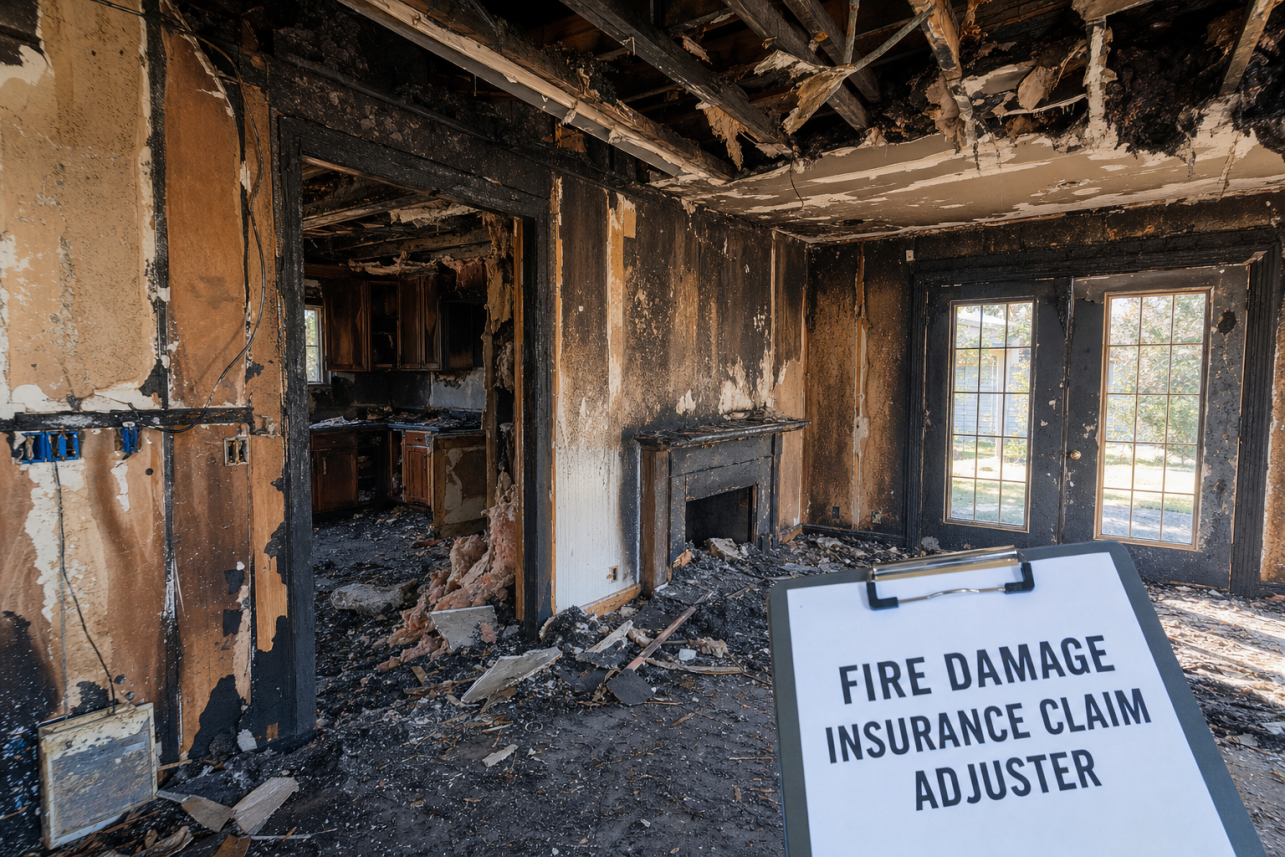
Yes, and this is a significant part of our work. A denial or a low settlement offer is not the end of your claim. It is the carrier's opening position, and it can be challenged with better documentation and negotiation.
For underpaid claims, we start with a full review of the carrier's estimate against the actual damage. On fire losses we routinely find missing line items: smoke remediation in untouched rooms, code-upgrade costs required by current Alamance County building standards, matching allowances for flooring and siding, and contents that were never properly inventoried. We then submit a supplemental claim with our own detailed estimate and negotiate the difference. Even claims that were already paid and closed can often be reopened if new damage or missed scope is documented within your policy's time limits.
For denied claims, the reason for denial matters. Denials based on alleged non-cooperation, late reporting, or disputed cause of loss can frequently be overturned when the facts are presented properly. If the dispute comes down to the dollar amount rather than coverage, most North Carolina policies include an appraisal clause, a formal process where each side names an appraiser and an umpire resolves the difference. We guide Elon homeowners through that process regularly.
Timing matters, though. North Carolina policies impose deadlines for supplements, appraisal demands, and legal action. If you are sitting on an offer that feels wrong, have For The Public Adjusters, Inc. review it now rather than after a deadline quietly passes. The review costs you nothing.
Will A Fire Damage Insurance Claim Adjuster Elon Property Owners Hire Also Handle My Additional Living Expenses While I'm Displaced?
Yes, and this is one of the most overlooked parts of a fire claim. If your home on the edge of Elon's downtown or out toward the Alamance County line is unlivable, your policy's Additional Living Expenses (ALE) coverage should pay the difference between your normal costs and what you're spending now — hotel stays, a short-term rental, extra mileage, restaurant meals, even pet boarding.
The problem is that insurers rarely volunteer what ALE covers, and displaced families often absorb costs they were entitled to recover. Rental inventory around Elon and Burlington is tight, so temporary housing frequently costs more than your old mortgage payment. That gap is exactly what ALE exists to close.
When For The Public Adjusters, Inc. manages your claim, we build the ALE portion alongside the structure and contents claims. We track receipts, document your pre-loss living costs, and push back when the carrier tries to cap your housing allowance at an unrealistic local rate.
We also watch the calendar. ALE benefits have time limits, and if the carrier drags out repairs, we document those delays so you aren't penalized for a timeline you didn't control. Families juggling work in the Triad and kids in Alamance-Burlington schools shouldn't have to fight for grocery reimbursements on top of everything else. Turning that burden over to a professional advocate is a big part of why people hire us in the first place.
How Do I Document My Personal Belongings After A Fire When So Much Was Destroyed?
Contents documentation is where most fire claims lose the most money, because insurers expect a detailed, room-by-room inventory — brand, age, condition, and replacement cost for every item — and most families can't reconstruct that from memory after a traumatic loss.
Start with what survives: photos on your phone, cloud backups, social media posts showing your rooms in the background, credit card statements, and order histories from Amazon or other retailers. Even a video walkthrough from a past holiday can prove what was in your Elon home.
From there, our team does the heavy lifting. We conduct a structured inventory interview, walking you through each room the way it existed before the fire. Homeowners are consistently surprised at how much they recall when guided properly — kitchen drawers alone often hold hundreds of dollars in overlooked items.
We then price everything at true replacement cost, not the depreciated figures carriers prefer, and we document smoke-damaged items that may look intact but hold odor and soot contamination that can't be cleaned. Clothing, upholstered furniture, mattresses, and electronics frequently fall into this category.
One warning: don't throw anything away until it's documented, even badly burned items. Debris is evidence. If the restoration company is pushing to haul everything off quickly, slow that down until a proper inventory exists. A thorough contents claim routinely adds tens of thousands of dollars to a settlement, and it can't be rebuilt after the dumpster leaves.
My Kitchen Fire Was Small And Contained. Is It Still Worth Hiring A Fire Damage Insurance Claim Adjuster Elon Has Available For A Partial Loss?
Often, yes — partial losses are where carriers underpay most aggressively, precisely because homeowners assume a small fire means a small, simple claim.
A contained kitchen fire in an Elon home rarely stays contained in its effects. Smoke travels through HVAC ductwork into every room. Soot bonds to painted walls, cabinet interiors, and attic insulation. Protein residue from a grease fire leaves an odor that surface cleaning won't remove. Heat can compromise wiring behind walls that look fine. The carrier's estimate frequently covers repainting one room while ignoring all of this.
There's also the matching problem. If your cabinets were a continuous run and three are destroyed, North Carolina claims practice and most policies support replacing the run so finishes match — not bolting three mismatched boxes next to fifteen-year-old ones. Insurers resist this constantly, and it can be the difference between a $12,000 payment and a $45,000 one.
As a fire damage insurance claim adjuster Elon homeowners can call before accepting any offer, For The Public Adjusters, Inc. will review your situation honestly. If the carrier's number is genuinely fair, we'll tell you, and you've lost nothing. But in our experience, partial fire losses are underpaid more often than total losses, because total losses hit policy limits while partial losses live and die on the quality of the estimate. A free review costs you a phone call; accepting a bad estimate can cost you the proper repair of your home.
The Insurance Company Made A Settlement Offer. How Do I Know If It's Fair Before I Sign Anything?
Never judge an offer by the dollar figure alone — judge it against a complete, line-item scope of what it actually takes to restore your home. That's the only honest comparison, and it's exactly what the carrier is hoping you won't make.
Ask for the full estimate behind the offer, not just the summary page. Then look for what's missing. Common gaps we find on Alamance County fire claims include code-upgrade costs required by current Elon and county building requirements, HVAC duct cleaning and smoke sealing, structural drying from firefighting water, contents cleaning versus replacement, debris removal, and general contractor overhead and profit on multi-trade jobs.
Also check the depreciation. If you carry replacement cost coverage, much of the depreciation withheld from your first check is recoverable after repairs — but only if you follow the policy's procedures and deadlines. Many homeowners never collect it because nobody explained the process.
Before you deposit anything, understand whether the payment is a partial or a full-and-final settlement, and be cautious about signing releases. In North Carolina you generally retain the right to pursue supplemental amounts, but a signed release can close that door.
Our team reviews carrier offers for Elon-area homeowners at no cost. We prepare our own independent estimate, compare it line by line against theirs, and show you the gap in plain numbers. On fire losses, that gap is routinely 30 to 60 percent. Once you see the two documents side by side, you won't need anyone to tell you whether the offer was fair — it will be obvious.
Can A Fire Damage Insurance Claim Adjuster Elon Landlords And Business Owners Hire Handle Commercial And Rental Property Fires?
Yes. Commercial and rental fire claims are often more complicated than homeowner claims, and they're a core part of what we do at For The Public Adjusters, Inc. A fire at a rental house near Elon University or a business along the Highway 100 corridor triggers coverage questions a standard homeowner never faces.
For landlords, the biggest overlooked item is usually loss of rental income. Your policy likely pays the rent you would have collected while the unit is uninhabitable, but insurers rarely volunteer that money. We document lease terms, market rents in Alamance County, and realistic repair timelines to support that portion of the claim.
For business owners, business interruption coverage is where claims are most frequently underpaid. Calculating lost revenue, continuing expenses, payroll, and extra expenses to keep operating requires financial documentation the carrier's adjuster won't assemble for you. We work through profit-and-loss statements, tax records, and sales history to build that number properly.
Commercial policies also carry coinsurance clauses, tenant improvement provisions, and ordinance-and-law coverage that interact in ways that can quietly reduce your payout if the claim isn't presented correctly. Elon's older commercial buildings often need code upgrades during fire repairs, and that coverage has to be claimed deliberately.
Whether it's a duplex on the edge of town or a storefront downtown, the process is the same: we inspect, document, value the full loss, and negotiate directly with the insurer so you can focus on your tenants or your business.
What Is Recoverable Depreciation On A Fire Claim, And How Do I Make Sure I Actually Collect It?
Recoverable depreciation is money your insurer holds back from your initial payment — and it's one of the most commonly forfeited amounts on fire claims in Alamance County.
Here's how it works. If you have replacement cost coverage, the insurer first pays the actual cash value of your damaged property: replacement cost minus depreciation for age and wear. A fire-damaged roof that would cost $18,000 to replace might generate an initial check of only $11,000, with $7,000 held back as depreciation.
That $7,000 is recoverable, but only after you complete the repairs or replace the items and submit proof — invoices, receipts, and sometimes photos — usually within a strict deadline written into your policy, often 180 days to two years. Miss the deadline or the paperwork, and the insurer keeps the difference.
The problem after a house fire in Elon is scale. You're not tracking one roof; you're tracking depreciation across hundreds of line items — flooring, cabinets, drywall, clothing, electronics, furniture. Homeowners routinely leave thousands of dollars unclaimed simply because nobody tracked what was replaced and when.
As your public adjuster, we track every held-back dollar from the initial estimate forward, make sure the depreciation applied is reasonable in the first place, and submit the documentation to release those funds as work is completed. We also flag items the carrier wrongly classified as non-recoverable. It's tedious, detail-heavy work, and it's exactly the kind of money that disappears when no one is watching the claim on your side.
How Do I Verify That A Public Adjuster Working In Elon Is Properly Licensed In North Carolina?
North Carolina requires every public adjuster to hold a license issued by the North Carolina Department of Insurance, and verifying it takes about two minutes. Go to the Department of Insurance website, use the licensee lookup tool, and search by the adjuster's name or license number. The listing will show whether the license is active and current.
Ask for the license number directly — any legitimate adjuster will provide it without hesitation. For The Public Adjusters, Inc. shares ours up front, and we encourage every homeowner in Elon to check before signing anything with any firm, including us.
Why does this matter so much after a fire? Because fires attract unlicensed operators. After a visible house fire in a neighborhood like Mackintosh on the Lake or near downtown Elon, it's common for out-of-state solicitors, storm chasers, and contractors informally 'negotiating' with insurers to knock on your door. In North Carolina, negotiating an insurance claim on your behalf for a fee without a public adjuster license is illegal — and if that person mishandles your claim, you have little recourse.
A few other things to look for: a written contract that states the fee percentage clearly, a North Carolina-compliant right to cancel, and no demands for money up front. Licensed public adjusters in this state work on contingency and are bound by regulations on fees and conduct.
If someone pressures you to sign on the spot, that's your cue to slow down. Your claim will still be there tomorrow; a legitimate adjuster will respect that.

Will Hiring My Own Adjuster Make The Insurance Company Treat My Fire Claim As Adversarial Or Slow Things Down?
This is one of the most common worries we hear, and the honest answer is no — hiring a fire damage insurance claim adjuster Elon homeowners can rely on doesn't make your claim adversarial. It makes it professional.
Insurance carriers deal with public adjusters constantly. When we notify your insurer that For The Public Adjusters, Inc. represents you, nothing punitive happens. Your policy rights don't change, your coverage doesn't shrink, and the carrier is still legally obligated to handle your claim in good faith under North Carolina law. What changes is that communication now runs through someone who speaks the carrier's language.
In practice, professional representation often speeds claims up rather than slowing them down. Delays on fire claims usually come from incomplete documentation, back-and-forth requests for information, and disputes over scope. We front-load the claim with a thorough estimate, complete inventories, and organized proof of loss, which removes the carrier's most common reasons to stall.
Will the negotiation sometimes get firm? Yes — that's the point. If the carrier's estimate misses smoke contamination in your HVAC system or undervalues rebuilding costs in the current Alamance County construction market, we push back with documentation, not hostility. Carriers respond to well-supported numbers.
What you avoid is the exhausting cycle of calling your assigned adjuster, waiting on hold, and wondering whether you said the wrong thing on a recorded line. Your insurer keeps working the claim; you just stop being the one who has to fight for every line item alone.
Local Relevance
Elon is a town of contrasts when it comes to housing. Around the university and older neighborhoods, you find homes dating back generations — many with original framing, plaster walls, and electrical systems that predate modern code. West and north of town, newer subdivisions have gone up as the Burlington–Elon area has grown.
That mix matters after a fire. When an older Alamance County home burns, rebuilding to today's building code can add significant cost — updated wiring, egress, and structural requirements — and whether your policy pays for those upgrades depends on specific coverage that insurers rarely volunteer to explain. Newer homes bring different issues, like lightweight construction that lets smoke and heat travel fast through open floor plans.
The National Fire Protection Association has long identified cooking and heating as leading causes of home fires, and our cold snaps bring out the space heaters and fireplaces that drive winter fire losses here. Whether the fire started in a kitchen near campus or a furnace room in a farmhouse outside town, the claim challenges are the same: smoke that traveled everywhere, water damage from the fire department's response, and an insurer's estimate that often covers only part of it.
We serve Elon, Burlington, Gibsonville, Graham, and the rest of Alamance County, and we know how local insurers' adjusters tend to write these files.
Many of Elon's older homes were built with balloon framing and plaster over wood lath, which lets smoke and heat travel inside wall cavities far from the fire itself — so a fire that looks contained to one room often leaves hidden soot and charring that a quick insurance estimate misses. Insisting on wall-cavity inspection before accepting a settlement tends to change the number considerably in these houses.
Had A Fire In Elon? Talk To Us Before You Accept The Insurer's Number
For The Public Adjusters, Inc. is licensed and bonded in North Carolina, and we only get paid when you do. Whether the damage is fire, smoke, or the water left behind by the fire department, we will review your policy and your loss for free and tell you honestly where you stand. One conversation now can save you from accepting a settlement that leaves you paying out of pocket to rebuild.
Call us: (336) 331-8300
Helpful Resources
- NCDOI Public Adjusters Guide
- National Fire Protection Association (NFPA)
- U.S. Fire Administration home fire prevention resources — Federal fire safety and prevention guidance
- North Carolina Department of Insurance — State regulator that licenses public adjusters
Last updated: August 4, 2026