
When the Vandal Is Your Own Tenant: What NC Landlords Need to Know
A tenant vandalism insurance claim is often denied on the grounds that damage caused by a tenant “doesn’t count” as vandalism — but that blanket denial is frequently wrong. In North Carolina, intentional, malicious destruction by a departing tenant can still qualify as vandalism under many landlord policies, and a denial letter is the start of the process, not the end of it.
Key takeaways
- An insurance denial letter is an opinion, not a final ruling — North Carolina policyholders have the right to challenge it.
- When a policy never defines ‘vandalism and malicious mischief,’ North Carolina law requires ambiguous terms to be read in the policyholder’s favor.
- Courts have held that a tenant’s deliberate destruction — punched walls, ripped-out cabinets, poured paint — can qualify as covered vandalism when the policy leaves the term undefined.
- In Cresthill Industries v. Providence Washington Insurance Co., a New York appellate court sided with the property owner, finding deliberate stripping and destruction of a building was covered ‘vandalism’ despite the insurer’s denial.
- Before accepting a flat denial that tenant damage ‘doesn’t count,’ NC landlords should get the denial in writing, review the exact policy language, and consider a professional claim review.
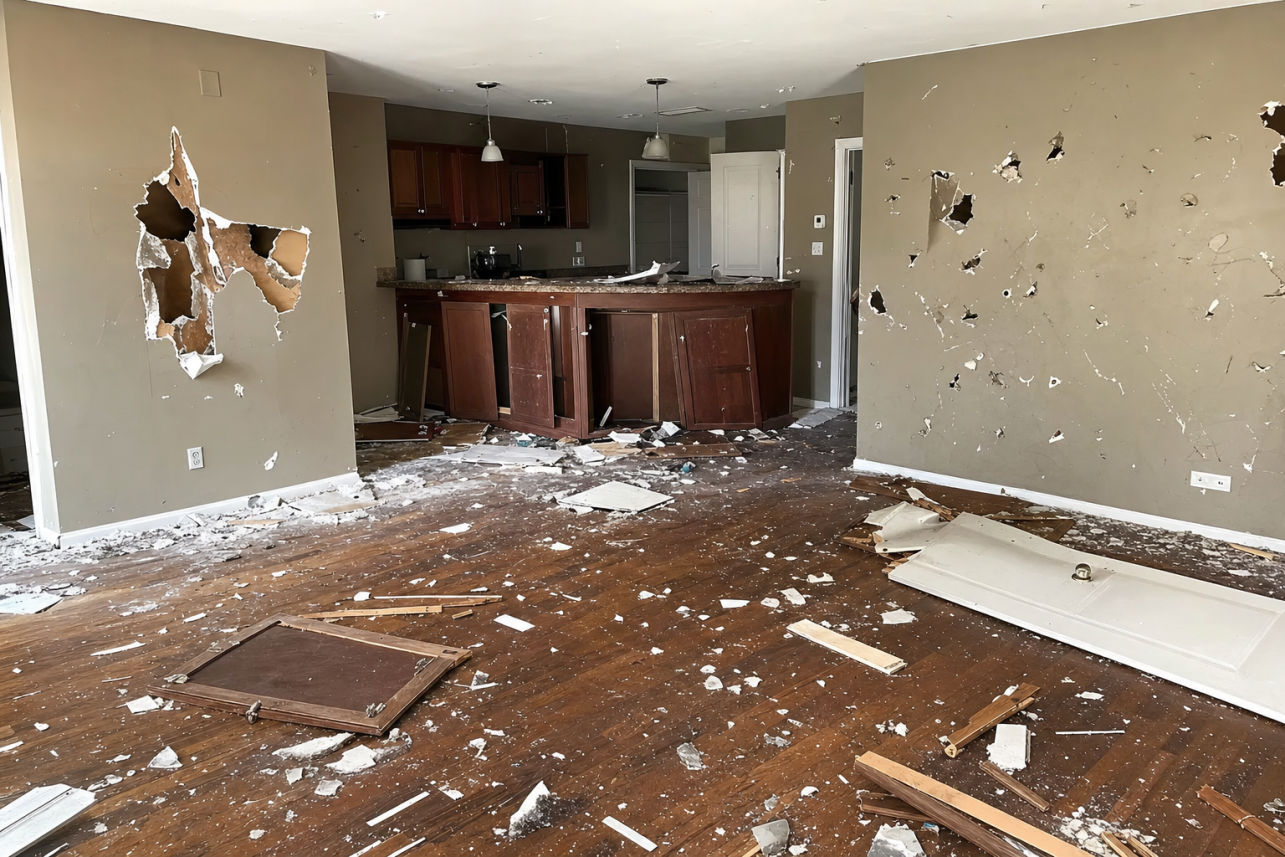
Fall and early winter are peak move-out season across the Triangle and Piedmont, and that’s when many rental-home owners walk into a property and find the kind of damage no security deposit will ever cover: punched-out drywall, cabinet doors ripped off their hinges, paint deliberately poured across hardwood floors, fixtures torn from the walls. This is not “wear and tear.” It is intentional destruction of your property — and that distinction matters enormously when you file a claim.
Why Insurers Say Tenant Damage Isn’t Vandalism
When landlords report this kind of destruction, some carriers respond with a quick denial, arguing that a tenant had lawful possession of the home, so their actions can’t be “vandalism” by a third party. Others point to exclusions for damage caused by “occupants” or claim the destruction was gradual neglect rather than a covered event. These arguments sound official, but they often don’t hold up when the policy language and the facts are examined carefully. Property owners who push back — sometimes with help pursuing a homeowners vandalism insurance claim in Durham or elsewhere in NC — frequently find the denial was far from final.
What Typically Separates a Covered Claim From a Denied One
- Intent: Deliberate, malicious destruction (holes kicked in walls, poured paint, smashed fixtures) is fundamentally different from ordinary wear or poor housekeeping.
- Policy wording: Whether your policy defines vandalism narrowly, and whether any “tenant” or “occupant” exclusion actually applies to your situation, depends on the exact language.
- Documentation: Photos, move-in/move-out inspection reports, police reports, and contractor estimates can make or break how the loss is characterized.
- Timing: Damage discovered after the tenant vacated is often treated differently than damage occurring during the tenancy.
The Quick Takeaway for NC Landlords
If your carrier denied your claim by labeling deliberate tenant destruction as excluded, you have options: request the denial in writing with the specific policy provisions cited, preserve all evidence, and get an independent review of the policy language. Many landlords bring in a licensed professional — for example, a public adjuster in Cary NC — to reassess the loss and advocate on their behalf. While no one can guarantee a specific outcome, a careful, well-documented challenge is often the difference between eating the repair bill yourself and having your policy respond the way you paid for it to.
Does Landlord Insurance Cover a Tenant Vandalism Insurance Claim?
In most cases, yes. Standard dwelling and landlord policies in North Carolina list “vandalism and malicious mischief” as a covered peril, and the policy language rarely excludes damage simply because a tenant caused it. The catch is that most policies never define “vandalism” at all — and that undefined term is where nearly every dispute begins.
What the Typical Policy Language Actually Says
Rental properties are usually insured under a dwelling fire policy (often a DP-1, DP-2, or DP-3 form) or a dedicated landlord package policy. These forms generally handle vandalism in one of two ways:
- Named-peril forms (DP-1, DP-2): The policy lists the specific perils it covers, and “vandalism and malicious mischief” typically appears on that list — sometimes as an add-on you had to purchase.
- Open-peril forms (DP-3 and most landlord packages): The dwelling is covered against all risks of direct physical loss unless a peril is specifically excluded. Vandalism is covered unless an exclusion clearly takes it away.
Read your declarations page and the perils section carefully. If “vandalism and malicious mischief” is listed — or not excluded — you have a strong starting position, whether the vandal was a stranger or the person named on your lease. Policyholders pursuing a vandalism homeowners claim in Cary and across Wake County face this same policy-reading exercise, and the wording matters more than the adjuster’s first opinion.
The Undefined Term That Decides Everything
Here is the heart of the fight: insurance policies almost never define “vandalism” or “malicious mischief.” When a term is undefined, North Carolina courts generally give it its ordinary, everyday meaning — and when the language is genuinely ambiguous, ambiguities are construed in favor of the policyholder, not the insurance company. That principle is a real advantage for landlords.
Insurers often argue that a tenant cannot commit “vandalism” because the tenant had lawful possession of the property, or they try to reframe intentional destruction as ordinary “wear and tear” or a maintenance issue. Neither argument appears in the plain text of most policies. Punched-in doors, destroyed fixtures, paint poured on floors, and deliberately smashed cabinets fit the common-sense meaning of vandalism regardless of who held the keys.
Watch for These Policy Traps
- Vacancy clauses: Many policies restrict or void vandalism coverage if the dwelling was vacant for a set period (often 30 or 60 days) before the loss.
- Intentional-acts exclusions: These typically apply to acts by the insured — you — not by your tenant. Insurers sometimes stretch this exclusion beyond its actual wording.
- Theft carve-outs: Stolen appliances or fixtures may be treated differently from destroyed ones, so document each type of damage separately.
Because these disputes turn on precise policy interpretation, having an experienced advocate review your specific form language early can change the outcome. Property owners handling a vandalism homeowners claim in Burlington often discover that the coverage they were told didn’t exist was sitting in the policy all along.
How Have Courts Ruled on a Tenant Vandalism Insurance Claim?
Courts have often sided with property owners on a tenant vandalism insurance claim when the policy leaves the word “vandalism” undefined. Under the long-standing rule that ambiguous policy language must be read in the policyholder’s favor, judges have held that deliberate destruction by a tenant fits the ordinary meaning of vandalism — meaning the insurer must pay.
The Ambiguity Rule Works for You, Not the Insurer
Insurance companies write the policies, so courts hold them responsible for any vague wording. North Carolina follows this widely accepted principle: when a term like “vandalism” or “malicious mischief” is not clearly defined, it must be given the meaning an ordinary policyholder would reasonably expect. If a reasonable landlord would read “vandalism” to include a tenant deliberately smashing walls, ripping out fixtures, or gutting the property, that reading generally controls — even if the insurer intended something narrower.
Bowers v. Farmers Insurance Exchange: A Win for the Landlord
A frequently cited example is Bowers v. Farmers Insurance Exchange, decided by the Washington Court of Appeals. In that case, tenants caused extensive intentional damage to a rental home, and the insurer denied the landlord’s claim, arguing tenant-caused destruction was not “vandalism” under the policy. The court disagreed. Because the policy did not define vandalism, the court applied the word’s ordinary meaning — the willful and malicious destruction of property — and found the tenants’ deliberate damage fit squarely within it. The landlord’s claim was covered, and the denial did not stand.
While that decision came from another state, the reasoning reflects principles North Carolina courts also apply, and it is the kind of authority policyholders can point to when an adjuster insists tenant damage “doesn’t count.” Owners facing a similar dispute over a vandalism homeowners claim in Burlington or elsewhere in the state should not assume a denial letter is the last word on what the policy language means.
What These Rulings Mean for NC Landlords
- Undefined terms favor you. If “vandalism” isn’t defined, its everyday meaning applies — and that meaning can include tenants.
- Intent matters. Courts distinguish deliberate destruction from ordinary wear and tear; documented willful damage strengthens your position.
- Denials can be challenged. A denial reflects the insurer’s interpretation, not a court’s ruling on your policy.
Reading your own policy through this lens takes a trained eye, which is where a licensed professional such as a public adjuster in Garner can review the exact wording, compare it to how courts have treated similar language, and help you present the strongest possible case. While no one can guarantee a specific outcome, the case law makes one thing clear: insurers do not get the final say on what an ambiguous policy means.
Why Do Insurers Deny Tenant Damage Claims — and Is That Final?
Insurers most often deny tenant damage claims by arguing a tenant cannot “vandalize” a home they lawfully occupy, that the destruction is excluded wear and tear, or that a vacancy clause voids coverage. None of these arguments is automatically final — North Carolina’s policyholder-friendly interpretation rules give landlords real grounds to challenge each one.
A denial letter is written to sound like the last word. It rarely is. In North Carolina, courts have long held that ambiguous policy language must be construed in favor of the insured. In Wachovia Bank & Trust Co. v. Westchester Fire Insurance Co., the North Carolina Supreme Court reinforced that when a property policy can reasonably be read more than one way, the reading that favors the policyholder controls — and the insured prevailed. That principle sits behind every denial argument below.
“A Tenant Can’t Vandalize Their Own Home”
This is the most common carrier position: vandalism requires a stranger, so a tenant’s intentional destruction doesn’t count. But most landlord policies define vandalism simply as willful and malicious damage to property — without saying who must cause it. When the policy doesn’t clearly exclude tenants, that silence is an ambiguity, and under NC law ambiguities cut toward coverage. A landlord who works with an experienced public adjuster in Garner or elsewhere in the Triangle can have the actual policy language reviewed line by line rather than taking the adjuster’s summary at face value.
The Wear-and-Tear Exclusion
Carriers sometimes reframe deliberate destruction as gradual deterioration. The distinction matters:
- Wear and tear is slow, expected decline — worn carpet, faded paint, loose hinges.
- Malicious damage is sudden and intentional — holes punched in drywall, ripped-out fixtures, poured concrete in drains, smashed cabinets.
Photographs, move-in inspection reports, and contractor statements can draw a clear line between the two. If your documentation shows deliberate destruction, the wear-and-tear exclusion is being misapplied.
The Vacancy Clause
Many policies suspend vandalism coverage if a building has been vacant for a set period, often 60 days. Insurers sometimes stretch this clause to cover situations it doesn’t fit — for example, damage done while the tenant still lived there that was only discovered after move-out. Timing is everything: if the destruction occurred during occupancy, the property wasn’t vacant when the loss happened. “Vacant” and “unoccupied” also carry different legal meanings, and the insurer bears the burden of proving the exclusion applies.
The takeaway for rental-home owners is simple: a tenant vandalism insurance claim denial is a starting position, not a verdict. Landlords from Wake County out to Johnston County — including those who consult a public adjuster in Kenly, NC — regularly find that denials rest on interpretations the policy language doesn’t actually support.
What Should I Do If My Tenant Vandalism Insurance Claim Is Denied in NC?
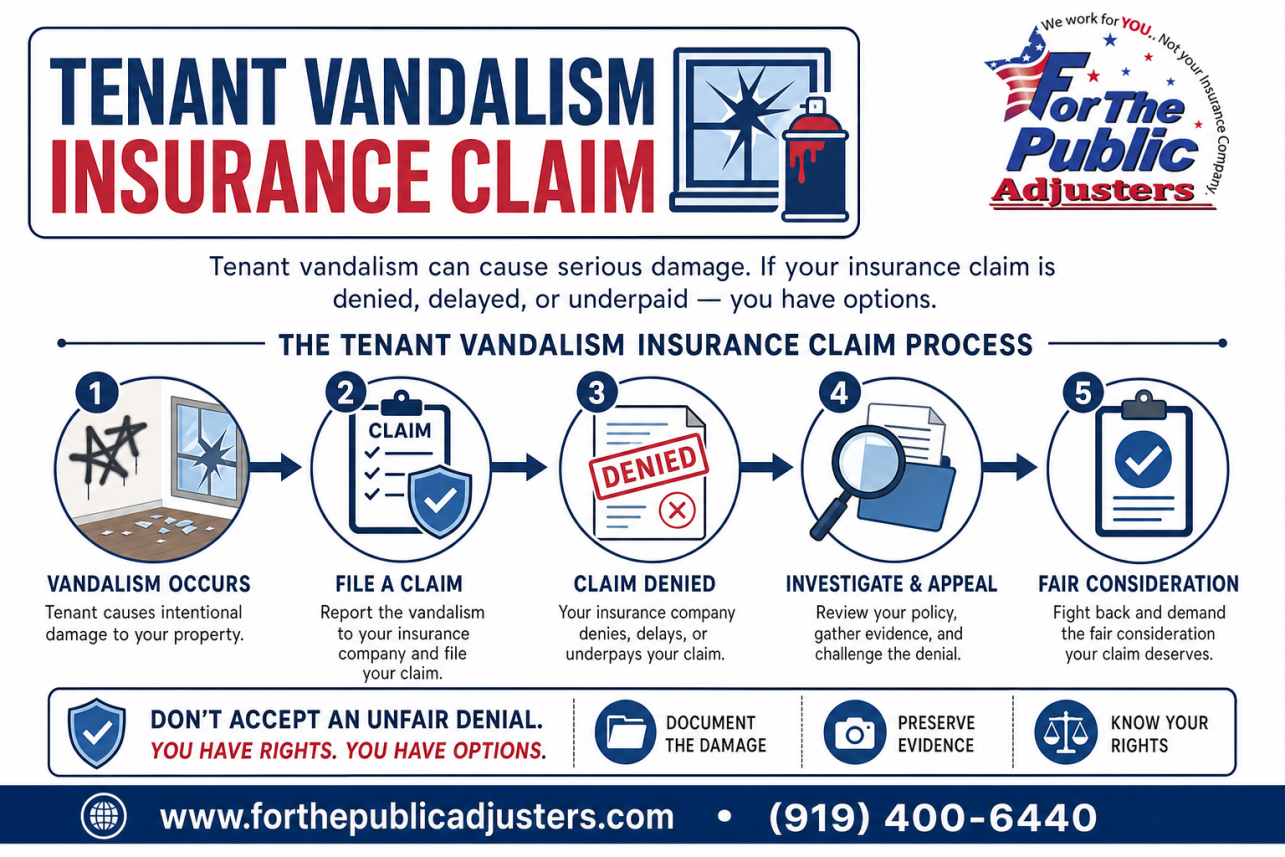
If your tenant vandalism insurance claim is denied, don’t repair anything yet. Preserve and photograph the damage, gather your lease and move-in inspection records, request a complete copy of your policy and a written denial letter, and have the denial professionally reviewed. Many denials rest on shaky policy interpretations and can be successfully challenged.
Preserve the Scene and Photograph Everything
Your damaged property is your evidence. Before any cleanup or repairs, document the condition of every room, fixture, and surface. Once contractors start work, you lose the ability to prove what the tenant actually did.
- Take wide shots of each room plus close-ups of every damaged item
- Capture video walkthroughs with timestamps
- Keep damaged materials (broken fixtures, punched drywall sections) where practical
- Get written repair estimates before work begins, not after
Gather Your Paper Trail
Pull together the signed lease, the move-in inspection or condition report, dated photos from when the tenant took possession, and any texts, emails, or eviction filings that show when the tenancy ended and what state the property was in. This record helps establish that the damage was malicious destruction rather than gradual wear — a distinction insurers lean on heavily. Landlords near Johnston County often bring these records to a Public Adjuster in Kenly NC for an organized, policy-based presentation.
Demand the Full Policy and a Written Denial
You are entitled to a complete certified copy of your policy — not just the declarations page — and a denial letter that states the specific policy language the insurer is relying on. Vague verbal denials are not final. Courts have sided with property owners in these disputes: in Bowers v. Farmers Insurance Exchange, a Washington appellate court ruled in favor of a landlord whose rental home was damaged by a tenant’s illegal grow operation, finding the tenant’s destructive conduct qualified as vandalism under the policy despite the insurer’s denial.
Get a Professional Review — and Mind the Calendar
An independent, licensed professional can compare the denial letter against the actual policy wording and identify misapplied exclusions or undervalued damage. Timing matters in North Carolina: if your unit sits open through a fall lease turnover, exposed drywall, broken windows, and damaged plumbing only worsen once cold weather arrives — and insurers may then argue the additional deterioration is your fault for failing to mitigate. Owners in the Smithfield and Clayton corridor can get a denial reviewed by a Public Adjuster in Wilsons Mills NC before winter compounds the loss.
Board up openings, shut off water if pipes are exposed, and keep receipts for every protective measure — reasonable steps to prevent further damage are typically reimbursable and strengthen your position when you fight the denial.

How Can a Public Adjuster Help NC Landlords and Rental-Home Owners With a Tenant Vandalism Insurance Claim?
A licensed, bonded public adjuster works for you — not the insurance company. On a tenant vandalism insurance claim, they analyze your policy language, document and photograph every item of damage, prepare a detailed repair estimate, and negotiate directly with the insurer to pursue the full amount your policy actually owes.
When a tenant trashes your rental, you are already juggling lost rent, contractor calls, and possibly an eviction file. Handling a disputed insurance claim on top of that is a full-time job — and it is exactly the job a public adjuster is trained and licensed to do. In North Carolina, public adjusters are licensed and regulated by the North Carolina Department of Insurance, and reputable firms are bonded as that licensing requires.
What a Public Adjuster Actually Does on a Tenant Damage Claim
- Policy analysis: Reading your landlord or dwelling-fire policy line by line to identify vandalism and malicious mischief coverage, applicable exclusions, and the arguments that support coverage rather than denial.
- Damage documentation: Building a photographic and written record of every damaged room, system, and fixture — the kind of evidence insurers find hard to dismiss.
- Professional estimating: Preparing a line-item repair estimate using the same estimating platforms insurers use, so the conversation is about scope and pricing, not guesswork.
- Negotiation and follow-through: Managing communications, responding to the insurer’s engineers or field adjusters, and pressing the claim through supplements or appraisal where appropriate.
Vandalism claims are document-heavy and detail-driven. The same skills apply whether the property is a rental house or your own residence — for example, a homeowners vandalism insurance claim in Durham follows much of the same documentation and negotiation process a landlord’s claim does.
What Honest Advocacy Can — and Cannot — Promise
Be wary of anyone who guarantees a specific payout. No public adjuster can promise a particular result, and North Carolina rules do not allow that kind of guarantee. What a qualified adjuster can commit to is thorough preparation, accurate estimating, and persistent, professional negotiation. According to the Insurance Information Institute, public adjusters are typically paid a percentage of the settled claim, which means their interests are aligned with yours: they only do well when your claim does.
Geography matters less than experience with the claim type. Whether your rental sits in a city or a small town, the process is similar — property owners pursuing a vandalism homeowners claim in Elon face the same coverage questions and documentation demands as landlords across the Triangle and beyond.
If your claim has been denied or underpaid, a policy review by a licensed public adjuster costs you nothing but a phone call — and it may reveal that your denial is far from the final word.
Tenant Vandalism Insurance Claim: How Denial Arguments Stack Up Against Policyholder Responses
| Insurer’s Denial Argument | Policyholder’s Counter-Argument | Why It Matters in NC |
|---|---|---|
| ‘Vandalism doesn’t apply to tenants — they had permission to be there’ | The policy never limits vandalism to strangers or intruders | Undefined terms are construed in the insured’s favor under NC contract principles |
| ‘This is just wear and tear or neglect’ | Punched drywall, ripped-out cabinets, and poured paint are deliberate destruction, not gradual deterioration | Intentional, malicious damage fits the ordinary meaning of vandalism and malicious mischief |
| ‘The damage is excluded because the property was rented’ | Landlord/dwelling-fire policies are sold specifically to cover rental homes | An exclusion must be clearly stated; courts will not read one in for the insurer |
| ‘Our decision is final’ | Denials can be appealed, re-opened, or litigated within the legal deadline | In NC, breach-of-contract claims generally carry a three-year filing window |
Illustrative Example: A Wake County Rental Left in Ruins
Illustrative example
Consider a hypothetical composite scenario: a rental-home owner in Wake County evicts a tenant after months of unpaid rent, only to find drywall punched through in every room, kitchen cabinets torn from the walls, and paint deliberately poured across the hardwood floors. The insurer denies the tenant vandalism insurance claim with a one-line explanation that damage by a tenant ‘doesn’t count’ as vandalism. A careful review of the policy reveals the term ‘vandalism and malicious mischief’ is never defined and no tenant-damage exclusion exists, so the denial is challenged in writing with photos, the eviction record, and a repair scope. Faced with the ambiguity in its own policy language, the insurer re-opens the claim and negotiates a settlement covering the deliberate destruction. Every claim is different and outcomes are never guaranteed, but this scenario shows why a flat denial should never be the end of the conversation.
Frequently asked questions
Can I reopen a denied tenant vandalism insurance claim in North Carolina?
Yes, in most cases. A denial letter is the insurer’s opinion, not a final ruling. You can request the denial in writing, ask exactly which policy language it relies on, submit new documentation, and demand reconsideration. If the word “vandalism” is never defined in your policy, North Carolina’s rule that ambiguous terms are read in the policyholder’s favor gives you real leverage. Many denied claims are later paid after they are properly re-presented.
What should I do first after my insurance company denies my claim for tenant damage?
Get the denial in writing and ask the insurer to cite the exact policy provision it relied on. Then request a complete certified copy of your policy, photograph and video every damaged room before making repairs, and save receipts, the lease, and any communication with the tenant. Do not sign a release or accept a low payment while you evaluate your options. These steps preserve the evidence you will need to challenge the denial.
How long do I have to fight a denied vandalism claim in NC?
Act quickly. North Carolina generally allows three years to sue for breach of a written contract, but many policies contain shorter suit-limitation deadlines, sometimes as little as one or two years from the date of loss. Read your policy’s “suit against us” section carefully, and calendar the earliest possible deadline. The sooner you dispute the denial, the fresher your evidence and the stronger your position.
What evidence do I need to prove my tenant deliberately damaged the property?
Courts and adjusters look for proof the damage was intentional rather than wear and tear: move-in inspection reports and photos, dated move-out photos and video, a police report, witness statements from neighbors or contractors, texts or emails from the tenant, and repair estimates describing the destruction — punched drywall, torn-out cabinets, poured paint. A clear before-and-after record showing sudden, deliberate destruction is the backbone of a successful vandalism claim.
Should I file a police report if my tenant vandalized my rental house?
Yes, whenever the damage appears deliberate. A police report creates an official, dated record that the destruction was intentional, which directly supports the “vandalism and malicious mischief” wording in your policy. It also counters the insurer’s suggestion that the damage was ordinary tenant wear. You do not need a conviction, or even charges, for the report to help your claim — the documentation itself is what matters.
Has any court actually ruled in favor of a policyholder on an ambiguous insurance policy in North Carolina?
Yes. In Wachovia Bank & Trust Co. v. Westchester Fire Insurance Co., the North Carolina Supreme Court held that when policy language is ambiguous, it must be interpreted in the way most favorable to the insured, and the policyholder prevailed. That principle is exactly why an undefined term like “vandalism” should not be quietly narrowed by an insurer to exclude a tenant’s deliberate destruction of your building.
Should I hire a public adjuster or a lawyer after a tenant vandalism denial?
It depends on where the dispute stands. A licensed public adjuster can re-document the loss, re-price the damage, and negotiate directly with the insurer, usually for a percentage of any recovery rather than upfront fees. If the insurer refuses to move even with strong evidence, or the suit deadline is approaching, an attorney may be the better path. Many landlords start with a free claim review to understand which route fits their situation.
Does keeping the tenant’s security deposit hurt my insurance claim?
Not usually, but be transparent. You can apply the deposit toward damages under North Carolina landlord-tenant rules, and the insurer may offset that amount from your claim payment. Problems arise when landlords hide the deposit or a court judgment against the tenant, which insurers can treat as misrepresentation. Disclose what you recovered, keep the accounting clean, and remember the deposit rarely comes close to covering deliberate destruction throughout a home.
What are the biggest mistakes landlords make after tenant vandalism?
The most common ones: repairing everything before photographing it, accepting the adjuster’s verbal “tenant damage isn’t covered” without a written denial citing policy language, missing the policy’s proof-of-loss or suit deadlines, throwing away damaged cabinets and flooring the insurer may want to inspect, and giving recorded statements without preparation. Each mistake hands the insurer an easier reason to deny. Document first, get everything in writing, and move deliberately.
Can I complain to the state if my insurer won’t budge on a vandalism denial?
Yes. You can file a complaint with the North Carolina Department of Insurance, which will require the insurer to respond in writing and explain its position. The Department cannot force payment on a disputed claim, but the complaint creates a paper trail, sometimes prompts a second look, and documents unfair claim-handling conduct. It costs nothing and can be pursued alongside a public adjuster’s negotiation or an attorney’s demand.
Vandalism Homeowners Claim help near you
- Vandalism Homeowners Claim Cary
- Vandalism Homeowners Claim Elon
- Vandalism Homeowners Claim Burlington
Related local pages
If your insurer has denied or lowballed a claim for damage a tenant left behind, don’t take that first answer as final. Our licensed and bonded public adjusters review NC landlord policies line by line, document the destruction properly, and advocate for the coverage your policy language actually supports. Contact us today for a free claim review. Get in touch.
Last updated: October 16, 2026