
When it comes to public adjuster Princeton NC, a public adjuster Princeton property owners hire works exclusively for you — not the insurance company — to document, value, and negotiate your fire, water, smoke, or storm damage claim. For The Public Adjusters, Inc. is licensed and bonded, and we handle residential and commercial claims throughout Johnston County. If your settlement offer feels low, your claim is stalled, or you simply don't know where to start, we step in and manage the entire process on your behalf.
What This Service Is
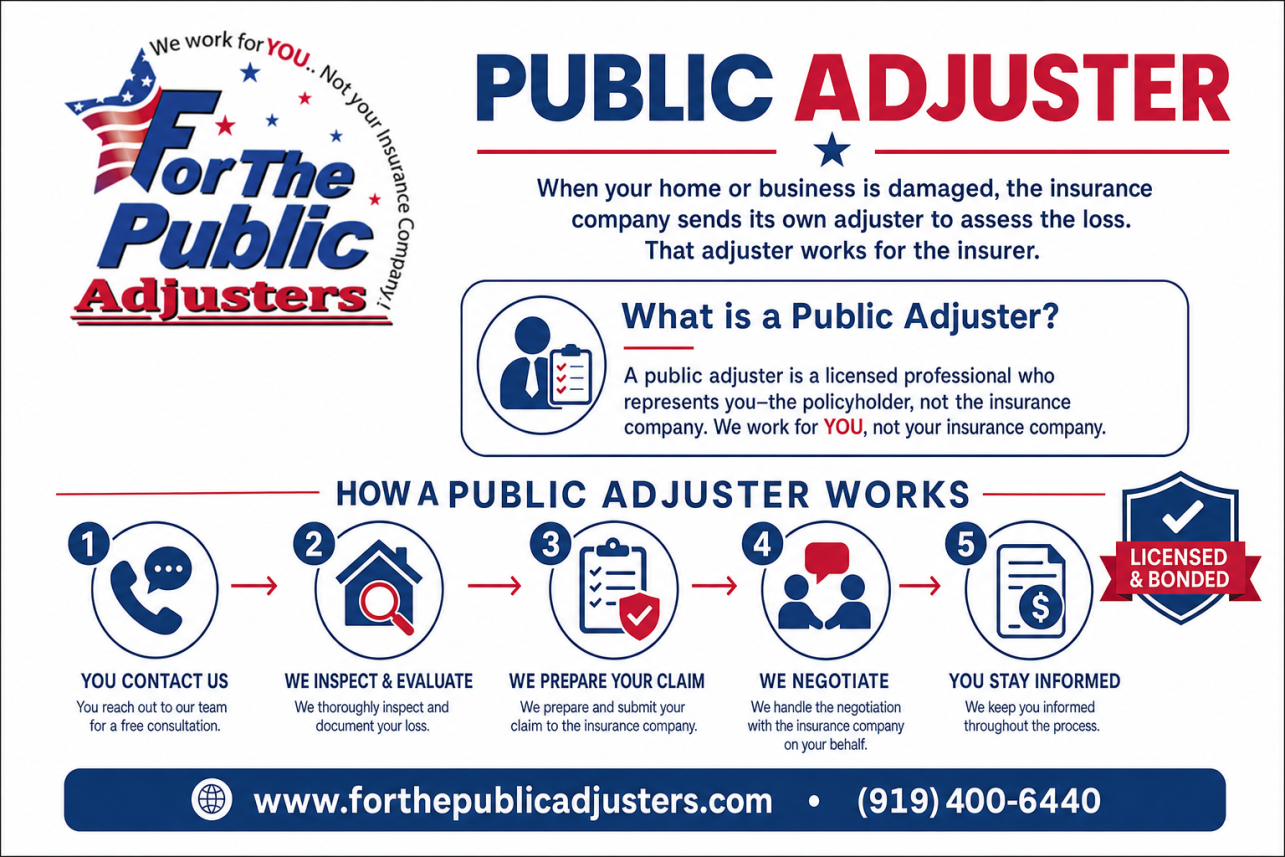
When your home or business is damaged, the insurance company sends its own adjuster to assess the loss. That adjuster works for the insurer. A public adjuster is the licensed professional who works for the policyholder instead — reviewing your policy, building a complete inventory of structural damage and contents, preparing a properly supported estimate, and negotiating directly with the carrier.
In North Carolina, public adjusters are licensed and regulated, and the NCDOI Public Adjusters Guide explains the role clearly: we represent the insured's interests in first-party property claims. That covers fire damage, water damage, smoke damage, hurricane and tornado losses, tree damage, vandalism, arson claims where you are the innocent policyholder, and even situations where a car strikes your home.
We serve Princeton and the surrounding communities, including nearby Four Oaks homeowners filing property claims and businesses across eastern Johnston County. Our fee is a percentage of the recovered settlement, so our interests are aligned with yours from day one.
Common Problems
What Does It Cost, And Is Hiring One Actually Worth It On A Smaller-Town Claim?
Public adjusters in North Carolina typically work on contingency — a percentage of what the insurer pays, agreed in writing before any work begins. There is no hourly bill and no upfront retainer with our firm.
Whether it's worth it depends on the gap between what the carrier offers and what your policy actually owes. On Princeton-area losses, that gap often hides in missed line items: code-upgrade coverage on older frame houses, contents that were never inventoried, smoke residue in rooms the fire never touched, or moisture damage behind walls. We cannot guarantee any specific outcome, but a properly documented claim gives the carrier far less room to underpay.
My Settlement Offer Seems Too Low — Can A Public Adjuster Princeton Homeowners Hire Actually Dispute It?
Yes. Underpayment and denial are exactly what we exist to challenge. We re-scope the loss, obtain contractor-level pricing, invoke the policy's appraisal clause when appropriate, and put the dispute in writing so the carrier must respond on the record.
Policyholders do win these fights. In State Farm Lloyds v. Nicolau, the Texas Supreme Court upheld a jury verdict for homeowners whose foundation damage claim had been wrongly denied — a reminder that insurers can be held accountable when they reject a legitimate structural loss. If a claim in our area reaches the point of litigation, we coordinate with experienced insurance dispute lawyers, just as we do for clients from Kenly, where our public adjusters handle disputed claims as well.
Should I Just Handle The Claim Myself, Or How Do I Judge Who To Hire?
You can file on your own, and for very small losses that may be fine. The trouble starts with larger fire, water, or hurricane claims, where policy language, depreciation, overhead-and-profit, and matching rules decide thousands of dollars — and the insurer's adjuster is not obligated to point out coverage you missed.
When you compare adjusters, ask three things: are they licensed and bonded in North Carolina, will they put their fee in writing before you sign, and can they explain your specific policy rather than reciting a sales pitch? A good adjuster shows you the scope of loss line by line. We do that for every client, whether the property is in Princeton or over in Benson, where our public adjusting team works the same way.
Our Process
Free Policy And Damage Review
We read your actual policy — declarations, endorsements, and exclusions — then inspect the damage in person. You'll know what coverage applies and roughly what a full claim should include before you commit to anything.
Documentation And Valuation
We photograph and measure the loss, test for hidden moisture or smoke migration, inventory damaged contents room by room, and build a detailed estimate using current local repair pricing. Thorough documentation is what separates a paid claim from an underpaid one.
Negotiation And Settlement
We present the claim to your carrier, meet their adjuster on site, answer every request for information, and negotiate until the offer reflects the documented loss. If the carrier won't move, we pursue appraisal or connect you with insurance dispute counsel.
| What Happens | Filing the Claim Yourself | With For The Public Adjusters |
|---|---|---|
| Damage documentation | You rely on the carrier's adjuster, who works for the insurance company | Independent slope-by-slope, room-by-room documentation with photos, moisture readings, and weather data |
| Policy interpretation | You read the policy alone and often miss matching, code upgrade, and ALE provisions | Every applicable coverage is identified and claimed, including provisions carriers rarely mention |
| Estimate accuracy | Carrier estimates frequently price repairs below real Johnston County contractor costs | Line-item estimates built on actual local repair and replacement pricing |
| Negotiation | You negotiate against trained claims professionals on your own | A licensed advocate negotiates on your behalf and meets the carrier's adjuster on site |
| Your time | Weeks of calls, emails, and paperwork during an already stressful loss | We manage communications, deadlines, and proof-of-loss filings start to finish |
| Cost | Free, but underpaid claims routinely leave thousands unrecovered | A percentage of the settlement — you pay nothing unless your claim is paid |
Commonly Overlooked In The Public Adjusting Industry
- Matching provisions for discontinued shingles and siding — Carriers quietly price a partial repair even when the material is discontinued and North Carolina matching standards support full replacement of the damaged surface.
- Ordinance and law (code upgrade) coverage — Older Johnston County homes often can't be repaired to pre-loss condition without code-required upgrades, but this coverage is rarely paid unless someone specifically claims it.
- HVAC duct contamination after fire or smoke loss — Soot circulates through the duct system into rooms far from the fire, and a visual inspection of clean-looking walls misses it entirely.
- Additional living expenses beyond the first hotel bill — Policyholders don't realize ALE can cover months of increased housing, mileage, and meal costs, so they stop tracking receipts after the first week.
- Wind-creased shingles that look intact from the ground — Creased shingles have broken seals and will fail, but they only show up in a hands-on slope inspection — not the drone flyover or ground photos many carrier adjusters use.
- Business income and extra expense on commercial claims — Structure and contents get estimated first, and the lost-revenue calculation requires financial records the carrier will never assemble on the owner's behalf.
- Recoverable depreciation left unclaimed — Many replacement-cost settlements hold back depreciation that's only released after repairs, and homeowners who don't submit final invoices forfeit thousands.
- Saturated insulation above water-stained ceilings — A dry-looking ceiling patch gets estimated for paint alone, while the soaked insulation and decking above it go untested and unpaid.
Case Studies
Case Study #1
Situation: A family on Holts Pond Road outside Princeton had a hail and windstorm rip through Johnston County in late spring. Their brick ranch took visible shingle damage, and water began staining the ceiling in two bedrooms within a week.
Problem: The homeowner's carrier sent an adjuster who spent under twenty minutes on the roof and issued a repair-only estimate of $4,200 — enough to patch one slope, but nothing for the interior water damage, the damaged ridge vents, or the matching issue on the remaining slopes.
Investigation: Our team performed a full roof inspection with slope-by-slope photo documentation, moisture-mapped the attic decking and both bedroom ceilings, and pulled local weather data confirming hail size and wind gusts recorded near Princeton on the date of loss.
Findings: We documented bruising and granule loss across all four slopes, cracked pipe boots, wind-creased shingles that could not be repaired, saturated insulation above both bedrooms, and a manufacturer discontinuation that made shingle matching impossible — triggering full replacement under the policy's matching provisions.
Solution: We prepared a line-item estimate with photo exhibits tied to each damage point, submitted a supplemental claim citing the policy language on direct physical loss and matching, and met the carrier's re-inspection adjuster on the roof to walk every documented item.
Outcome: The claim was revised from $4,200 to $38,600 — a full roof replacement, interior drywall and insulation remediation in both bedrooms, and paint. The family paid their deductible and nothing more out of pocket.
Lesson: A quick carrier inspection often catches only the most obvious damage. Slope-by-slope documentation and weather data can turn a patch job into the full replacement the policy actually owes.
Case Study #2
Situation: The owner of a small feed and farm supply store on the edge of Princeton had a kitchen fire spread from an attached break room into the retail space, causing smoke and soot contamination throughout the building and inventory.
Problem: The carrier's initial offer covered structural repairs to the break room only. It excluded most of the smoke-damaged inventory, ignored the business income loss during closure, and undervalued the HVAC system that had circulated soot through the ductwork.
Investigation: We inventoried the stock item by item with the owner, collected soot samples showing contamination in areas the carrier claimed were unaffected, obtained an HVAC contractor's assessment of the duct system, and reconstructed twelve months of sales records to establish the business income claim.
Findings: Soot residue was present on inventory three aisles away from the fire origin, feed products were unsellable under health standards even where packaging looked intact, the duct system required full cleaning and partial replacement, and the store's documented daily revenue supported a substantial business interruption figure the carrier had never calculated.
Solution: We filed a detailed proof of loss covering structure, contents, and business income with supporting exhibits, and negotiated directly with the carrier's large-loss adjuster over three rounds of documentation exchanges.
Outcome: The settlement grew from an initial $27,000 offer to just over $141,000 — covering full inventory replacement, duct remediation, structural repairs, and eleven weeks of lost business income. The store reopened without taking on debt.
Lesson: Fire claims are rarely just about what burned. Smoke, soot, contaminated inventory, and lost income often make up the majority of a commercial loss — and carriers almost never volunteer those numbers.
| Your Situation | Should You Call Us? | Why It Matters |
|---|---|---|
| Claim denied outright | Yes — immediately | Denials are often based on selective policy reading; NC law allows disputes, and appraisal or re-filing deadlines run fast |
| Settlement offer feels low | Yes, before you sign anything | Accepting payment can limit supplements; we routinely find underpayments of 2-5x on storm and fire claims |
| Large loss (fire, hurricane, major water) | Yes, before the carrier's first inspection | Early documentation preserves evidence and prevents the carrier's estimate from anchoring the whole claim |
| Small claim near your deductible | Probably not | If the loss barely exceeds your deductible, adjuster fees may outweigh the gain — we'll tell you honestly in a free review |
| Carrier is delaying or ignoring you | Yes | Documented demand letters and proof-of-loss filings create deadlines carriers must answer under NC claim-handling rules |
| Hidden damage suspected (mold, ducts, decking) | Yes | Carriers pay only what's documented; moisture mapping and soot testing find damage a visual walkthrough misses |
| You already accepted payment but repairs cost more | Yes — many claims can be reopened | Supplemental claims are common when contractor bids exceed the original estimate, especially after storms |
Reviews
Our insurance company offered us $6,000 after Hurricane damage tore up our roof and porch. For The Public Adjusters found damage the first adjuster never even photographed — wind-lifted shingles on the back slope and water in the soffits. Final settlement was over $31,000. I honestly didn't know what a public adjuster did before this. Now I tell everyone in Johnston County.
Darlene M., Princeton NC
Pipe burst under our slab while we were out of town. Carrier tried to blame it on 'long-term seepage' and deny the whole thing. These folks brought in documentation showing it was a sudden break, cited the actual policy language, and got the denial reversed. Took a couple months of back and forth but they handled every call so I didn't have to.
Ray T., Johnston County
Kitchen fire in February. The insurance estimate didn't include smoke cleaning for our bedrooms or replacing the ductwork, which stunk for weeks. Our adjuster from For The Public walked the whole house, tested for soot in rooms the carrier skipped, and nearly tripled the settlement. Only reason it's not perfect is I wish we'd called them on day one instead of week three.
Melissa H., Princeton
Frequently Asked Questions
What Does A Public Adjuster Princeton Homeowners Hire Actually Do For My Insurance Claim?
A public adjuster works exclusively for you, the policyholder — never for the insurance company. When you file a claim for storm damage, fire, water intrusion, or another covered loss, the insurer sends its own adjuster whose job is to protect the company's bottom line. Our job is the opposite: to document, value, and negotiate your claim so you recover everything your policy owes you.
For a typical Princeton homeowner, that starts with a thorough inspection of the property. We photograph and measure the damage, review your policy line by line, and prepare a detailed estimate using the same professional software insurance carriers use. That estimate often includes items the carrier's adjuster missed — hidden moisture behind walls, matching requirements for siding or shingles, code-upgrade costs, and additional living expenses if you had to leave your home.
From there, we handle all communication with the insurance company. We attend re-inspections, respond to requests for documentation, push back on lowball estimates, and negotiate until the settlement reflects the true cost of repairs in Johnston County, where contractor pricing has climbed sharply in recent years.
You stay informed at every step, but you no longer have to argue with the carrier yourself. For most families, that alone is worth the call — and because we work on a contingency fee, our incentive is aligned with yours: a larger, fairer settlement.
How Much Does It Cost To Hire A Claims Adjuster In Princeton, NC?
At For The Public Adjusters, Inc., we work on a contingency-fee basis, which means you pay nothing up front and nothing out of pocket. Our fee is a percentage of the settlement we recover for you, agreed to in writing before any work begins. If we don't recover money for you, you don't owe us a fee.
North Carolina regulates how licensed adjusters can charge, and every agreement we sign complies with state requirements. There are no hidden costs, no hourly billing, and no charges for inspections, estimates, or negotiations along the way.
Here's why the math usually works strongly in a policyholder's favor: industry studies and our own experience across Johnston County show that professionally handled claims routinely settle for substantially more than what carriers initially offer. When a first offer on a hail-damaged roof comes in at a fraction of the actual replacement cost — a common scenario after the storms that roll through this part of eastern North Carolina — the increase we negotiate typically exceeds our fee many times over.
We're also transparent about when hiring us doesn't make sense. If your claim is small, straightforward, and being paid fairly, we'll tell you that in a free consultation rather than sign you up. Our reputation in a town the size of Princeton depends on giving neighbors honest answers, and that's exactly what you'll get when you call.
My Insurance Company Already Sent Their Adjuster And Made An Offer. Is It Too Late To Bring In A Public Adjuster In Princeton?
No — in most cases it is not too late, and a low first offer is actually the most common reason people call us. As long as your claim hasn't been fully closed and released, and you're within your policy's deadlines, we can step in, reassess the damage, and reopen negotiations with your carrier.
We see this constantly with wind and hail claims in Johnston County. A carrier's adjuster spends thirty minutes on the roof, writes an estimate for a handful of shingles, and the homeowner receives a check that wouldn't cover a fraction of a real replacement. When we re-inspect, we frequently find damage to soffits, gutters, window screens, HVAC fins, and interior ceilings that never made it into the original report.
Even claims that were underpaid months ago can often be supplemented. North Carolina policies generally allow a set period to dispute a settlement or submit additional documentation, and we know how to build the evidence — photos, moisture readings, contractor-grade estimates, and policy language — that forces a carrier to take a second look.
Denied claims are also worth reviewing. Denials based on "wear and tear" or "pre-existing damage" are sometimes reversible when the documentation is done properly. Bring us the denial letter and your policy, and we'll give you a straight answer at no cost about whether the decision can be challenged. The one mistake to avoid is signing a final release before getting a second opinion.
What Types Of Property Damage Claims Do You Handle Around Princeton And Johnston County?
We handle the full range of residential and commercial property claims that affect this part of eastern North Carolina. The most frequent by far are wind and hail claims — Princeton sits in a corridor that takes regular hits from severe thunderstorms, and the remnants of tropical systems moving up from the coast add heavy rain and straight-line winds most summers. Roof damage, siding damage, and the water intrusion that follows make up a large share of our work.
We also represent policyholders on fire and smoke claims, which are among the most complex losses to value correctly. Smoke migrates far beyond the burn area, and contents inventories are easy to underestimate. Our team documents structure, contents, and additional living expenses so nothing is left on the table.
Water and plumbing losses are another major category: burst pipes, water heater failures, and appliance leaks that soak flooring, drywall, and cabinetry. Carriers often try to limit these claims to visible damage, while moisture trapped in wall cavities leads to mold if it isn't addressed and paid for properly.
Beyond homes, we work with farm and commercial property owners throughout Johnston County — poultry houses, equipment barns, shops, and small business buildings damaged by storms or fire. Business-interruption coverage adds another layer that most owners have never had to interpret before.
If you're unsure whether your loss qualifies, call us. Every consultation is free, and as the local public adjuster Princeton property owners rely on, we'll tell you honestly whether your claim is worth pursuing.
How Long Will My Claim Take If I Work With A Public Adjuster Princeton Property Owners Trust?
Every claim is different, but most residential claims we handle in Princeton settle within 45 to 90 days from the date we take over the file. Straightforward claims, like a roof damaged in a single hailstorm, often wrap up faster. Larger losses involving fire or extensive water damage can run longer because of engineering reports, contents inventories, and mortgage company sign-offs.
Here's what actually drives the timeline. North Carolina insurers are required to acknowledge claims promptly and pay undisputed amounts within 30 days of agreeing on a settlement figure. Delays usually happen before that agreement, when documentation is thin or the carrier's estimate misses damage. Our job is to eliminate those delays by delivering a complete, well-documented claim package the first time.
When you hire a public adjuster Princeton insurers know will scrutinize every line item, adjusters on the carrier side tend to respond faster and negotiate more seriously. We photograph and measure everything, write our own Xactimate estimate, and handle every phone call and email so nothing sits in someone's inbox for weeks.
If a claim has already been dragging on before you call us, we can often break the logjam within a few weeks by identifying exactly what the carrier is missing or disputing and forcing a specific response. We'll give you an honest timeline estimate after we inspect your Johnston County property, and we'll keep you updated at every stage so you're never left guessing where things stand.
My Claim Was Denied Or The Payment Barely Covers Anything. Can You Still Help?
Yes, and this is actually one of the most common situations that brings Princeton homeowners to our door. A denial letter or a lowball check is not the end of the road. In North Carolina, you generally have three years from the date of loss to pursue a property claim, though your specific policy may set shorter deadlines for certain steps, so acting quickly matters.
When we take on a denied or underpaid claim, we start by reading your full policy, not just the summary page. Carriers often deny claims based on exclusions that don't actually apply to your situation, or they misclassify the cause of loss. Wind-driven rain, for example, gets wrongly labeled as flood damage more often than you'd think in eastern Johnston County.
Next, we re-inspect the property ourselves. Insurance company adjusters frequently miss hidden damage, like moisture trapped in wall cavities, compromised roof decking, or smoke residue in HVAC systems. We document everything with photos, moisture readings, and a detailed line-item estimate, then submit a formal supplement or dispute with evidence the carrier can't wave away.
If the carrier still won't move, we can invoke the appraisal clause found in most policies, which brings in a neutral umpire to resolve the dispute without a lawsuit. Many of our best outcomes for Princeton-area clients started as denials. Bring us the denial letter and your policy, and we'll tell you honestly whether the claim is worth reopening.
Is For The Public Adjusters, Inc. Licensed In North Carolina, And How Do I Verify That?
Yes. North Carolina requires anyone negotiating insurance claims on behalf of a policyholder to hold a public adjuster license issued by the North Carolina Department of Insurance. We are fully licensed and bonded as the state requires, and we're happy to provide our license number before you sign anything.
Verifying a license takes about two minutes and we encourage every homeowner to do it. Visit the NC Department of Insurance website and use their licensee lookup tool, or call the Department directly in Raleigh. Search by the company name or the individual adjuster's name. If someone claiming to be an adjuster in Princeton can't produce a verifiable license, walk away immediately.
This matters more than most people realize. After major storms roll through Johnston County, out-of-state operators and unlicensed "claim consultants" show up knocking on doors. Some are contractors improperly negotiating claims, which is illegal in North Carolina. Others collect a fee and disappear. Working with an unlicensed person can jeopardize your claim and leaves you with no recourse.
Beyond the license itself, North Carolina law also caps our fees, requires written contracts with clear cancellation rights, and prohibits us from having any financial interest in your repairs. Those rules exist to protect you, and a legitimate firm will follow every one of them without being asked. We'll walk you through the contract line by line, answer every question, and give you time to review it before you commit. That's how it should work.

Do You Handle Commercial Buildings And Farm Properties Near Princeton, Or Just Houses?
We handle both, and around Princeton that distinction matters. Johnston County has a real mix of property types: family homes in town, poultry and row-crop operations along the rural routes, and small commercial buildings serving the Highway 70 corridor. Each requires a different approach to the claim.
For commercial claims, the stakes usually go beyond the building itself. Business interruption coverage, lost inventory, equipment breakdown, and code-upgrade costs are all areas where carriers routinely underpay because documenting them properly takes real work. We build out those losses with financial records, vendor quotes, and detailed schedules so nothing gets left off the settlement.
Farm and agricultural claims come with their own complications. Damage to barns, grain storage, poultry houses, irrigation systems, and outbuildings often falls under separate policy schedules with different limits and deductibles. We've seen carriers apply the wrong schedule or overlook covered structures entirely. Knowing how these policies are built lets us catch that.
Residential work remains a big part of what we do, from hail-damaged roofs to kitchen fires to burst pipes in winter. The process is the same regardless of property type: we inspect thoroughly, document everything, write our own independent estimate, and negotiate directly with your carrier until the settlement reflects what your policy actually owes.
If you're not sure whether your property or your type of loss is something we take on, call us. The consultation costs nothing, and we'll give you a straight answer either way.
What Should I Do Right After Storm Damage, Before A Public Adjuster Princeton Residents Recommend Can Get To My Property?
First, make sure everyone is safe and the property is secure. Your policy requires you to prevent further damage, so tarp a torn roof, board broken windows, and shut off water to a burst line. Keep every receipt for tarps, plywood, and emergency labor — those costs are typically reimbursable.
Next, document everything before you touch it. Take wide photos of each room and close-ups of individual damage, and shoot video walking the whole property. Around Princeton, wind and hail damage often extends beyond what you can see from the ground, so photograph fence lines, outbuildings, and HVAC units too.
Do not throw anything away yet, even ruined contents. The carrier's adjuster may want to inspect damaged items, and disposing of them early can complicate your claim. If something is a health hazard, photograph it thoroughly and note why it was removed.
Finally, be careful with recorded statements. You must report the loss promptly, but you are not required to guess at causes or values on the spot. A simple, factual report of what happened and when is enough. If you call us early, we can guide the initial notice, handle communication from that point forward, and make sure the file starts on the right footing rather than trying to correct problems later. Many of the toughest claims we see in Johnston County went sideways in the first 48 hours, not months in.
Will Bringing In Your Firm Slow Down My Claim Or Make My Insurance Company Treat Me Differently?
It usually does the opposite. Carriers assign claims to desk adjusters juggling hundreds of files, and claims often stall because documentation is incomplete or estimates go back and forth. When we submit a claim, it arrives fully documented — line-item estimates, photos, moisture readings where relevant, and policy citations — which gives the carrier fewer reasons to delay or request more information.
Insurance companies deal with licensed adjusters representing policyholders every day. It is a normal, legally protected part of the process in North Carolina, and adjusters on the carrier side often prefer working with a professional who speaks their language and uses the same estimating software they do.
What changes is the dynamic. Instead of you calling for updates on your lunch break and waiting on hold, we track deadlines, follow up in writing, and push the file forward. If the carrier misses response timeframes, we document it. That paper trail matters if a dispute ever escalates.
Will the carrier be thrilled? Sometimes not, because well-documented claims tend to settle for more. But retaliation against a policyholder for hiring representation would violate North Carolina's unfair claims practices rules. In our experience serving Princeton and the surrounding Johnston County area, claims we manage move at a steadier pace and close with fewer surprises, because problems get identified and addressed early instead of surfacing after a lowball check arrives.
The Insurance Company Is Holding Back 'depreciation' On My Payment. Can You Help Me Recover It?
Yes, and this is one of the most common places Princeton homeowners leave money on the table. If you have a replacement cost policy, your carrier typically pays in two stages. The first check reflects actual cash value — the replacement cost minus depreciation for age and wear. The held-back amount, called recoverable depreciation, is released after you complete the repairs and prove what you spent.
Problems come up in several ways. Some policyholders never realize a second payment exists and simply pocket the first check, forfeiting thousands. Others complete repairs but miss the deadline to submit invoices — many policies give you only 180 days to two years from the date of loss, depending on the language. Still others get shorted because the carrier's depreciation percentages were too aggressive in the first place.
As a public adjuster Princeton property owners can call before or after that first check arrives, we review the depreciation schedule line by line. A three-year-old architectural shingle roof should not be depreciated like a twenty-year-old one, and we challenge those numbers with documentation.
We also manage the recovery process itself: tracking your deadline, compiling contractor invoices, and submitting the proof the carrier requires so the withheld funds are actually released. If your repairs cost more than the original estimate, we pursue supplements at the same time. Bring us your settlement letter and we will tell you exactly what is still owed and how to collect it.
What Documents Should I Gather Before Our First Meeting About My Johnston County Claim?
The single most important document is your complete insurance policy — not just the declarations page, but the full policy with all endorsements. If you cannot find it, request a certified copy from your agent or carrier in writing; they are required to provide it. We read the entire thing, because coverage often hides in endorsements most people never look at.
If a claim is already open, gather everything the carrier has sent you: the claim number, the adjuster's estimate, any reservation of rights or denial letters, and copies of checks or payment stubs. Emails and notes from phone calls help us build a timeline.
For the damage itself, pull together your own photos and videos, contractor estimates or repair invoices, and receipts for emergency work like tarping or water extraction. If contents were damaged, start a room-by-room list with approximate purchase dates and prices — old photos from birthdays or holidays are surprisingly useful for proving what you owned.
Do not worry if you are missing pieces. Plenty of clients around Princeton come to us with nothing but a claim number and a leaking roof, and we build the file from there. We conduct our own inspection, produce our own estimate, and request records directly from the carrier when needed.
The one thing we ask you not to do before we meet: do not sign anything from the insurance company, especially a release or a contractor's assignment of benefits, until we have reviewed it together.
Is There A Deadline To File Or Reopen A Claim In North Carolina, And Can A Public Adjuster Princeton Property Owners Call Still Help If Time Has Passed?
Yes, deadlines matter, but you may have more time than you think. Most North Carolina property policies require "prompt" notice of loss, and the state generally allows up to three years to pursue a claim dispute, though your specific policy language controls and some policies shorten that window by contract.
That means storm damage from last spring, or even a hail event from two seasons ago, may still be claimable if the damage is documentable and falls within your policy period. We regularly inspect roofs in Princeton and the surrounding Johnston County countryside and find wind or hail damage the owner never noticed until a leak appeared months later.
The key is acting now rather than waiting longer. Evidence degrades: shingles weather, water stains get painted over, and it becomes harder to tie damage to a specific covered event. When our team evaluates an older loss, we pull weather data for the date of the storm, photograph the damage in detail, and build a timeline that connects the two.
If your claim was already closed or underpaid, reopening is often possible through a supplemental claim, and North Carolina policyholders also have appraisal rights in many disputes. Bring us your policy and any correspondence from your carrier. We will tell you honestly whether the clock has run out or whether there is still a real path to recovery. There is no charge for that initial review, so a phone call costs you nothing but a few minutes.
My Settlement Check Has My Mortgage Company's Name On It. How Does That Work, And Can You Help?
This surprises a lot of homeowners. If you have a mortgage, your lender is listed on your policy as a loss payee, so insurance checks for structural damage are typically made out to both you and the mortgage company. You cannot simply deposit it.
Each lender has its own loss-draft process. Smaller local banks serving Johnston County may endorse a modest check quickly, while national servicers often require inspections, contractor W-9s, signed repair contracts, and staged disbursements before releasing funds. On larger losses, they may hold the money in escrow and pay it out as repairs progress.
As your Princeton public adjuster, we help you navigate this so repairs are not stalled by paperwork. We prepare the documentation lenders ask for, coordinate with their loss-draft departments, and make sure the scope of repairs we negotiated with your insurer matches what the lender expects to see completed. When those two documents do not line up, disbursements get delayed, and we work to prevent that.
One important note: money for personal property (contents) and additional living expenses is usually payable to you alone, without the lender's name. We make sure your carrier separates those categories correctly on the settlement so you are not waiting on a mortgage company to access funds that are rightfully yours to spend now.
If you are already stuck with a two-party check and a slow lender, bring it to us. We have walked plenty of Princeton-area families through the process, and knowing exactly what each servicer requires up front saves weeks of frustration.
Will Filing A Claim Raise My Insurance Rates, And How Do I Know If The Damage Is Even Worth Claiming?
It is a fair concern, and the honest answer is: it depends on the type of loss. In North Carolina, claims from named storms and widespread weather events generally affect rates across an entire region regardless of whether you personally file. If a hurricane or hailstorm sweeps through Johnston County, rates in the area may adjust either way, so leaving legitimate damage unclaimed rarely saves you money in the long run.
What you want to avoid is filing small claims that barely exceed your deductible. Every claim goes on your CLUE report, and a pattern of minor claims can affect your renewal. That is exactly why an honest evaluation matters before you pick up the phone to your carrier.
When a Princeton homeowner calls us, the first thing we do is inspect the damage and give you a realistic estimate of what the loss is actually worth under your policy. If the numbers say the claim is not worth filing, we tell you that plainly and you have lost nothing. Since we only earn a fee when we recover money for you, we have no incentive to push a claim that does not make sense.
Where we earn our keep is on the losses that look small but are not. A "minor" roof leak often involves damaged decking, insulation, drywall, and flooring once you open things up. Wind damage that seems cosmetic can compromise an entire roof slope. Homeowners routinely underestimate their losses by thousands of dollars, and that is the gap a professional evaluation closes before you commit to anything.

My Damage Might Be From Flooding Rather Than Wind Or Rain. Does A Public Adjuster Princeton Residents Hire Handle Flood Claims Differently?
Yes, and the distinction is critical here in eastern North Carolina. Standard homeowners policies cover wind-driven rain and water that enters through storm-created openings, but they exclude rising water. Flood damage falls under separate NFIP or private flood policies, which have their own rules, forms, and much shorter deadlines, including a proof of loss typically due within 60 days.
Why does this matter so much in Princeton? Because when a hurricane or tropical system moves through Johnston County, many properties suffer both types of damage at once. Wind tears the roof while the Little River or a swollen creek pushes water into the crawlspace. Insurance carriers sometimes point at the other policy to minimize what each one pays, and homeowners get caught in the middle.
Our job is to separate the loss properly. We document which damage came from wind and wind-driven rain, which came from rising water, and we present each claim to the correct policy with the evidence to support it. That includes water lines, debris patterns, weather data, and elevation details that show how the water behaved on your specific property.
If you carry flood coverage, we prepare the sworn proof of loss and inventory your damaged contents at the detail level NFIP requires, because incomplete flood paperwork is one of the most common reasons those claims get shorted. If you do not carry flood coverage, we work to maximize every dollar legitimately owed under your wind and homeowners coverage. Either way, do not let a carrier label everything "flood" and walk away. Get a second set of eyes on it first.
Local Relevance
Princeton sits in eastern Johnston County, squarely in the path of the tropical systems that push inland across eastern North Carolina. Hurricanes Matthew and Florence both brought damaging wind and severe flooding to this part of the state, and homes near the Neuse River basin and its low-lying creeks remain exposed when heavy rain events stall over the region.
Flood losses here deserve special attention because standard homeowners policies exclude flood — those claims run through a separate flood policy, and the Federal Emergency Management Agency (FEMA) publishes clear guidance on how flood insurance claims must be documented and filed. We help Princeton policyholders keep the wind claim and the flood claim properly separated so neither carrier can point the finger at the other.
Beyond storms, much of the local housing stock is older frame construction — farmhouses and mid-century homes with aging plumbing, older wiring, and mature pines and hardwoods standing close to the roofline. That mix drives the water damage, kitchen fire, smoke, and tree damage claims we see most often here, the same pattern we work in neighboring Micro, where our public adjusters handle similar losses and in Pine Level just up the road.
Many Princeton-area homes were built decades before modern building codes, so a fire or major water loss often triggers code-upgrade costs — rewiring, re-plumbing, or structural updates — that insurers tend to leave out of the first estimate unless the policy's ordinance-or-law coverage is specifically claimed. Checking for that endorsement before you accept a settlement is one of the most valuable steps a local policyholder can take.
Get A Straight Answer On Your Princeton Claim
Before you accept the insurance company's number, let For The Public Adjusters, Inc. review your policy and your damage at no cost. We're licensed and bonded in North Carolina, we work on contingency, and we'll tell you honestly whether your claim is being handled fairly.
Request Your Free Claim Review
Call us: (919) 400-6440
Helpful Resources
- NCDOI Public Adjusters Guide
- Federal Emergency Management Agency (FEMA)
- National Flood Insurance Program (NFIP)
- North Carolina Department of Insurance — State regulator that licenses public adjusters and publishes consumer claim guidance
Our services in this city
Service pages for this city are coming soon.
Last updated: August 24, 2026