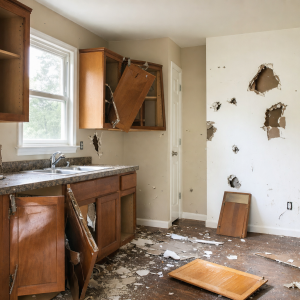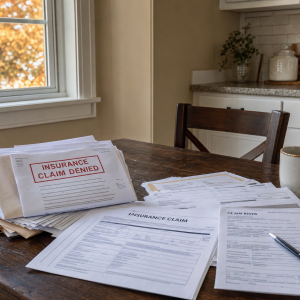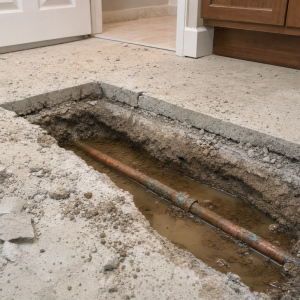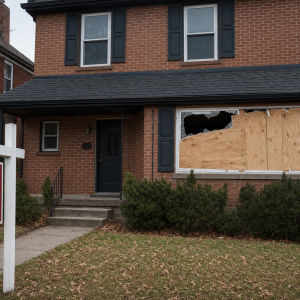
The storm hit days ago. The panic should be over by now. Instead, you're staring at an insurance estimate that doesn't come close to paying for the roof, the interior water damage, the soaked insulation, or the siding your carrier barely mentioned.
That anger is justified. An insurance claim for storm damage often turns into a second disaster once the adjuster's report shows up. After Hurricane Helene, approximately 25% of insured homeowners in North Carolina received no payment for their storm claims, leaving one out of every four policyholders with damage and no payout at all, according to Policygenius homeowners insurance statistics. Carriers know policyholders are often overwhelmed, under-documented, and in a hurry to move on. That's when low-ball offers land.
Now, you stop reacting and start fighting.
Table of Contents
- Your Storm Damage Claim Fight Starts Now
- Decoding Insurer Tactics for Denied Claims
- Building Your Evidence Package to Fight Back
- The Special Case of Flood Damage and NFIP Disputes
- How to Formally Dispute a Denied or Low-Ball Claim
- Get Claim Help and Stop Fighting Alone
Your Storm Damage Claim Fight Starts Now
You come home after a storm, see water stains spreading across the ceiling, find shingles in the yard, and call your carrier. A few days later, an adjuster spends twenty minutes outside, barely looks at the interior, and sends an estimate that covers a patch job and little else. Then the insurer acts like the discussion is over.
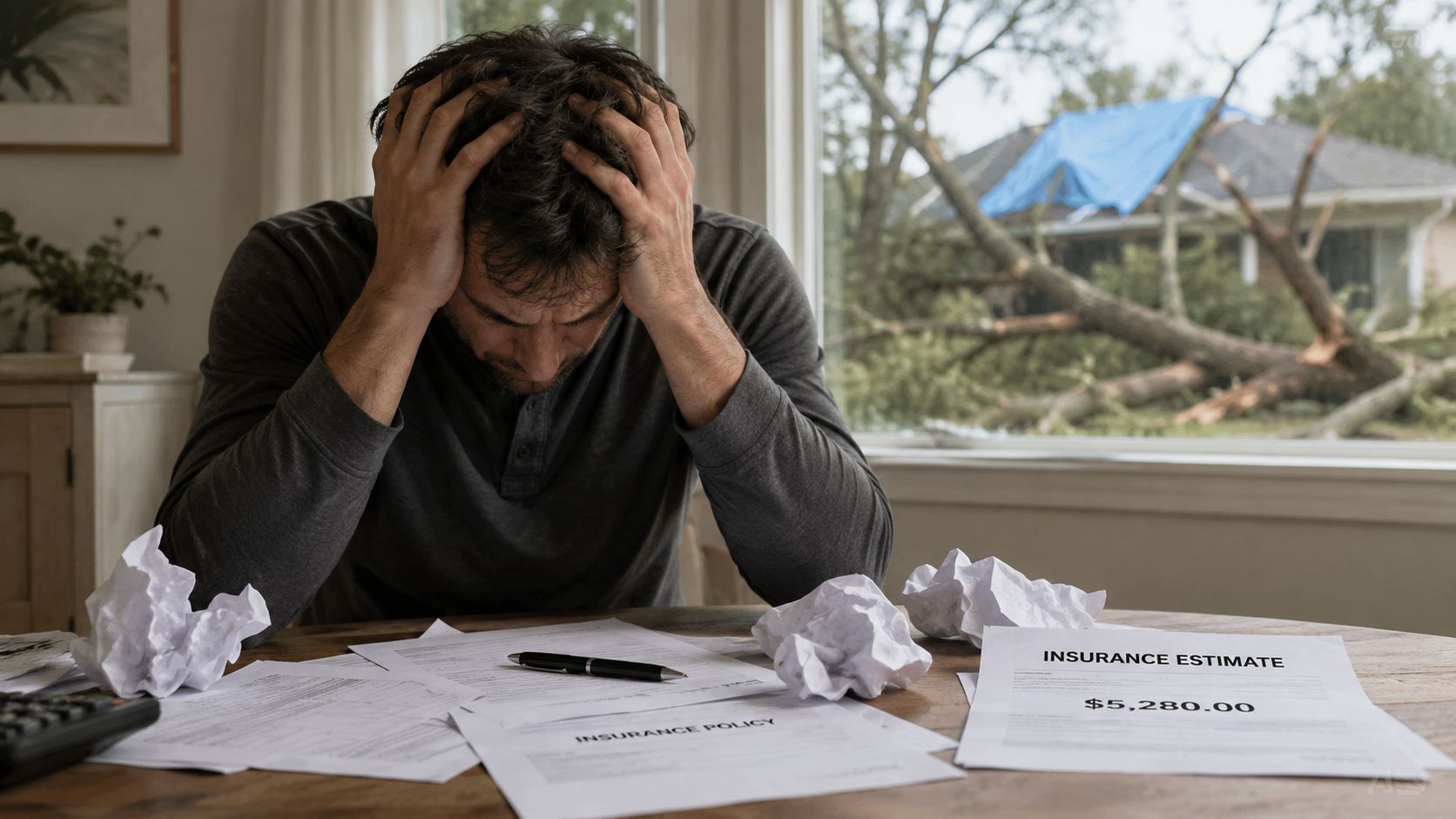
That is where many storm claims go off the rails. The fight usually starts before any formal denial. It starts with an inspection built to keep the scope small, separate connected damage, and pin as much as possible on age, wear, or “other causes.”
I've watched this happen for years. A homeowner reports roof damage, interior staining, and water intrusion after a major storm. The carrier writes for a small repair, ignores full-slope damage, skips code items, and treats interior moisture as if it showed up on some unrelated date. Then they send a check designed to make you tired enough to quit.
That's a pressure tactic. Treat it like one.
What this fight usually looks like
The first estimate is often the source of the dispute. It looks official, but it is often incomplete by design. If you're dealing with roof damage, it helps to see how contractors and policyholders approach managing storm damage roof claims in practice, because the same carrier shortcuts show up again and again. If matching becomes part of the argument, learn how ITEL testing is used in property claims before the insurer corners you into a spot repair that does not restore the property.
Here's what policyholders usually find in that first round:
- A low estimate that omits materials, labor, overhead, profit, or hidden storm damage
- A rushed inspection with limited photos, weak notes, and obvious missed areas
- A coverage story that keeps shifting depending on who you talk to
- A quick payment or quick denial meant to set the tone and make you defend your own loss
Practical rule: If the insurer moved fast, review every line like you're auditing someone else's mistake, because you probably are.
Storm losses are handled in volume after major weather events. That volume leads to shortcuts, template language, and stripped-down scopes. The company may call that efficiency. You should call it what it is when your claim comes in short.
You are not overreacting
If your gut says the estimate is light, trust that instinct and prove it.
You are not being difficult by questioning a weak scope. You are doing the job the carrier failed to do. A fair claim requires a full inspection, a valuation that reflects the actual damage, and written reasoning that lines up with the policy instead of hiding behind vague adjuster language.
Get angry if you need to. Then get organized. Anger by itself does nothing. A documented, disciplined response wins.
Decoding Insurer Tactics for Denied Claims
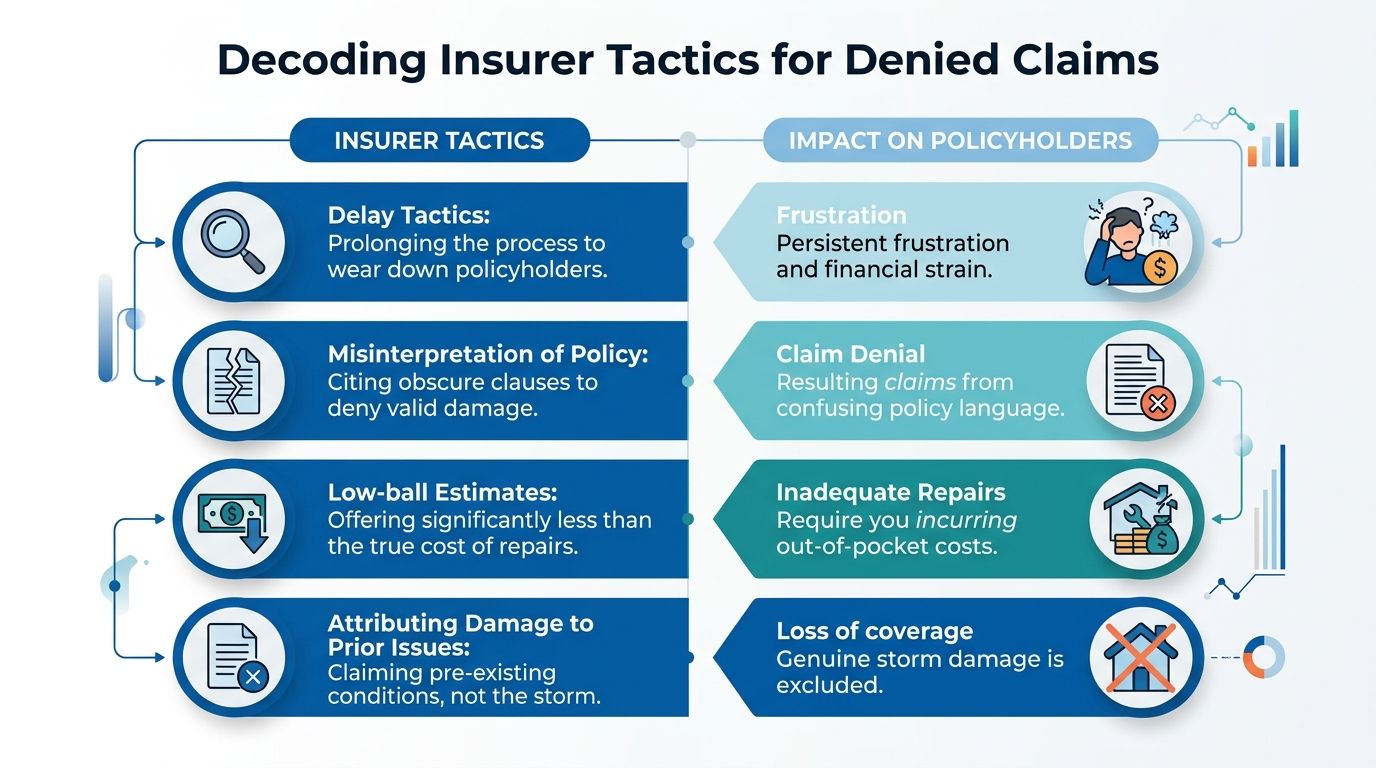
The insurance company rarely says, “We're trying to save money.” They use cleaner language. “Excluded peril.” “Pre-existing condition.” “Minimal storm-related damage.” “Observed wear.” Same result. Less money for you.
Why the first estimate is often the real problem
A bad claim doesn't always begin with a denial. It often begins with an estimate that is intentionally incomplete. The adjuster includes what's easy to see and excludes what's expensive to prove.
That's where a lot of roof and siding disputes start. Matching issues, brittle materials, impact marks, lifted shingles, underlayment problems, interior moisture migration, and code-driven repair requirements don't always show up in a quick insurer scope. If you've never looked into material matching and testing, the discussion around what ITEL is and how it's used in property claims can help you understand why carriers and policyholders often fight over replacement versus spot repair.
The denial language insurers lean on
One of the biggest tactics in major storm losses is concurrent causation. That's when the insurer points to an excluded cause, usually flood, to avoid paying for covered wind damage. In major hurricane events, over 60% of initial claim denials are based on flood exclusions despite significant wind damage, according to this discussion of underpaid storm damage claims and concurrent causation.
That matters because a house can suffer multiple causes of loss in the same storm. Wind tears the roof. Rain enters. Water rises. The carrier then tries to pin the whole mess on the excluded part.
The question isn't whether flood was present. The question is whether covered wind damage also caused part of the loss.
Another tactic is the growing use of virtual adjusters. If the carrier tries to assess hidden water damage through photos, video calls, or a rushed remote review, expect missed issues. Walls can hold moisture long after they look dry. Insulation can be soaked while drywall still appears intact. A remote review is convenient for the insurer because it limits what gets documented.
Then there's the ordinance or law trap. Many homeowners learn too late that code upgrades aren't always fully covered unless the policy says so. If local code now requires different materials, decking, flashing, or installation methods, the rebuild cost can jump fast. The carrier may approve a partial repair figure that doesn't come close to what a legal rebuild requires.
| Insurer tactic | What it looks like in practice | Why it hurts you |
|---|---|---|
| Concurrent causation | Blaming the damage on flood when wind also caused loss | Covered damage gets pushed into an exclusion |
| Scope omission | Missing line items for roofing, siding, or interiors | The payment is too low from the start |
| Virtual inspection | Reviewing by phone or photos instead of in person | Hidden damage stays undocumented |
| Policy misdirection | Quoting exclusions without full context | You give up before testing the denial |
You don't beat these tactics with anger alone. You beat them with documentation that is more specific than the insurer's file.
Building Your Evidence Package to Fight Back
Arguing with the adjuster before you've built your evidence package is a waste of energy. Your opinion won't move the claim. Your documentation might.
Build proof before you argue
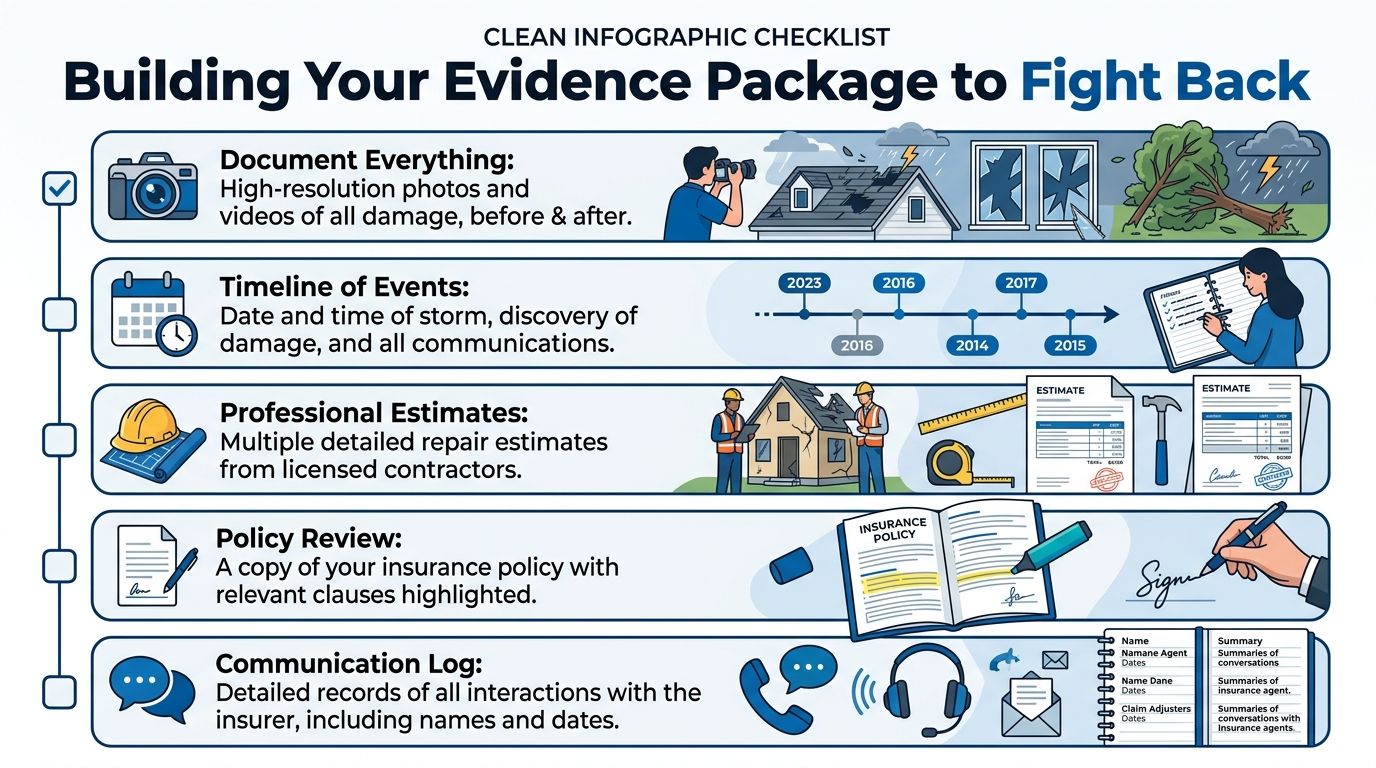
The strongest storm claim disputes are built like a case file. You need weather evidence, a damage timeline, repair pricing, photos, videos, and written support from people who can explain what they saw.
Obtaining multiple independent repair estimates from licensed contractors within 72 hours of a storm increases settlement accuracy by 30% to 45% in disputed claims, and insurers often underpay by 20% to 40% on initial offers due to scope omission errors, according to this breakdown on using weather data and repair estimates for storm claims. That's why relying on the insurer's preferred vendor is a mistake. You need your own numbers.
For roof-heavy losses, some contractors use tools such as Exayard roofing estimating software to organize measurements, scopes, and estimate details in a way that makes omissions easier to spot. The software doesn't win the argument by itself, but a clear scope beats a vague complaint every time.
Here's a video that helps frame the documentation mindset you need before pushing the dispute harder.
What your evidence package should include
Start with official weather proof. The carrier may hint that the damage was old, minor, or unrelated to the reported event. Counter that with NOAA storm data for your location and storm date, including peak wind speed, hail size, and rainfall rate from the Storm Events Database. Pair that with your photos and a sworn proof of loss. If you need a clearer picture of that document, review what a proof of loss is and why it matters in a property claim.
Then build the file like this:
- Timestamped photos and video of every elevation, roof area, stained ceiling, wet flooring, detached materials, and personal property impact
- A written timeline with the storm date, when you first noticed damage, temporary repairs, and every insurer contact
- At least two bids for major repairs from licensed contractors
- Witness statements from neighbors, tenants, employees, or anyone who saw the storm or the immediate damage
- Receipts and invoices for tarping, drying, emergency mitigation, and related work
- A corrected scope of damage from a contractor, engineer, or public adjuster if the insurer's estimate is incomplete
If you can't point to a photo, a report, a bid, or a weather record, the insurer will treat your damage like a debate instead of a fact.
One more point. Be present for every inspection. Walk the property. Point out every leak path, cracked shingle tab, dented metal component, water stain, and damaged room. Silence helps the wrong estimate survive.
The Special Case of Flood Damage and NFIP Disputes
Flood changes everything. Homeowners hear “storm damage” and assume one claim will cover all of it. That's not how these losses work.
Why flood claims are a different fight
Standard homeowners policies typically cover wind damage but exclude water entering from the outside, such as floodwater or storm surge. Flood losses fall into the National Flood Insurance Program and FEMA system, not the standard homeowners claim lane. These claims are handled by NFIP or Write Your Own company adjusters and they are notoriously difficult to dispute, which is why help from a public adjuster is essential in many of these cases, as explained in this overview of flood insurance claim disputes and NFIP claim help.
That difference matters because the rules are stricter, the documentation burden is heavy, and the insurer's “that's flood” position can shut down the wrong claim fast. If rising water touched the property, or if the carrier is trying to reclassify wind-driven damage as flood loss, you need to separate the causes carefully.
The coverage structure also catches people off guard. Standard policies usually cover wind. They usually do not cover flood. A separate flood policy is required for that peril, and the limits are different. The NFIP offers up to $250,000 for home structure losses and $100,000 for contents losses, according to this hurricane and flood coverage breakdown. If the house is heavily damaged, that may not be enough.
What to do if flood damage is part of the loss
Don't lump every form of damage into one narrative. Split the story by cause.
Use this approach:
- Identify where water came from. Roof opening, wind-driven rain, rising water, or storm surge are not the same thing.
- Separate damaged areas. Wind damage to roofing and siding should be documented independently from flood-affected lower areas.
- Preserve moisture evidence. Photos, moisture readings, mitigation records, and contractor notes matter.
- Challenge vague denials. If the carrier says “flood exclusion,” force them to explain exactly which damage they are excluding and why.
NFIP disputes are technical. They're rigid. And they punish sloppy documentation. If flood is in the picture, treat it like a specialized battlefield, not a routine homeowners claim.
How to Formally Dispute a Denied or Low-Ball Claim
You sent photos. You answered their questions. You waited. Then the carrier sends a denial letter packed with vague policy jargon, or a payment so low it does not cover the roof, the interior, and the hidden damage you already know is there. That is the moment to stop talking like a cooperative customer and start writing like a claimant building a record for appraisal, a regulator, or a lawsuit.
A formal dispute changes the file. It forces the adjuster to respond to facts instead of stalling you with phone calls, half-answers, and shifting excuses. It also exposes a common tactic. The carrier blames "wear and tear," "pre-existing damage," or another excluded cause to muddy a storm loss and set up a concurrent-causation defense later. Your job is to pin them down in writing.
What your dispute letter must say
To formally dispute a low-ball claim, you must send a certified demand letter requesting a written response within fifteen (15) business days, and the letter must state the insurer's offer, rebut their reasoning point by point, and present the correct settlement amount based on independent estimates, as outlined in this guide on how to dispute an insurance claim.
Keep the letter tight. Angry is fine. Sloppy is expensive.
Include these parts:
The claim identification
Policy number, claim number, property address, and date of loss.The insurer's position
State the exact offer amount or quote the denial reason they gave you. Use their words.Your rebuttal
Answer each point with proof. If they claim wear and tear, show storm-created openings, fresh creasing, broken seals, impact marks, moisture mapping, or contractor findings that tie the loss to the storm. If they mix covered and excluded causes together, force them to identify which damage they say came from which cause.Your demand
State the amount you believe is owed based on the enclosed documentation. Use your estimate, not theirs.Your deadline
Demand a substantive written response within fifteen business days.
“Please provide your written explanation, including the specific policy language you contend supports your position, and respond with a revised settlement decision within fifteen business days of receipt.”
The paper trail creates your advantage
If the claim was denied, the insurer is required to give a written explanation and identify the exact policy language used to deny the loss, according to the Minnesota House guidance on challenging a denied property claim. If they did not do that, demand it in writing and make them commit to a position they cannot quietly rewrite later.
Keep a clean communications log too. Save every email. Save portal upload confirmations. Keep the certified mail receipt and the return receipt. If the carrier changes adjusters, changes theories, or pretends they never received a document, your file shuts that down. If you need regulatory help, appraisal, counsel, or a reopened claim, this paper trail provides the proof you need.
Use this standard:
| Document | Why it matters |
|---|---|
| Certified demand letter | Proves you made a formal dispute |
| Independent estimates | Counters the insurer's scope and pricing |
| Photos and weather data | Connects the damage to the storm event |
| Written denial language | Locks the insurer into a stated position |
The goal is simple. Make the insurer answer your evidence, explain its position with actual policy language, and stop hiding behind vague conclusions. That is how low-ball offers and weak denials start to crack.
Get Claim Help and Stop Fighting Alone
A lot of homeowners wait too long to get backup. They assume they should “see what the carrier does first.” By the time they realize the estimate is broken, deadlines have tightened, damage has worsened, and the insurer's version of events is already in the file.
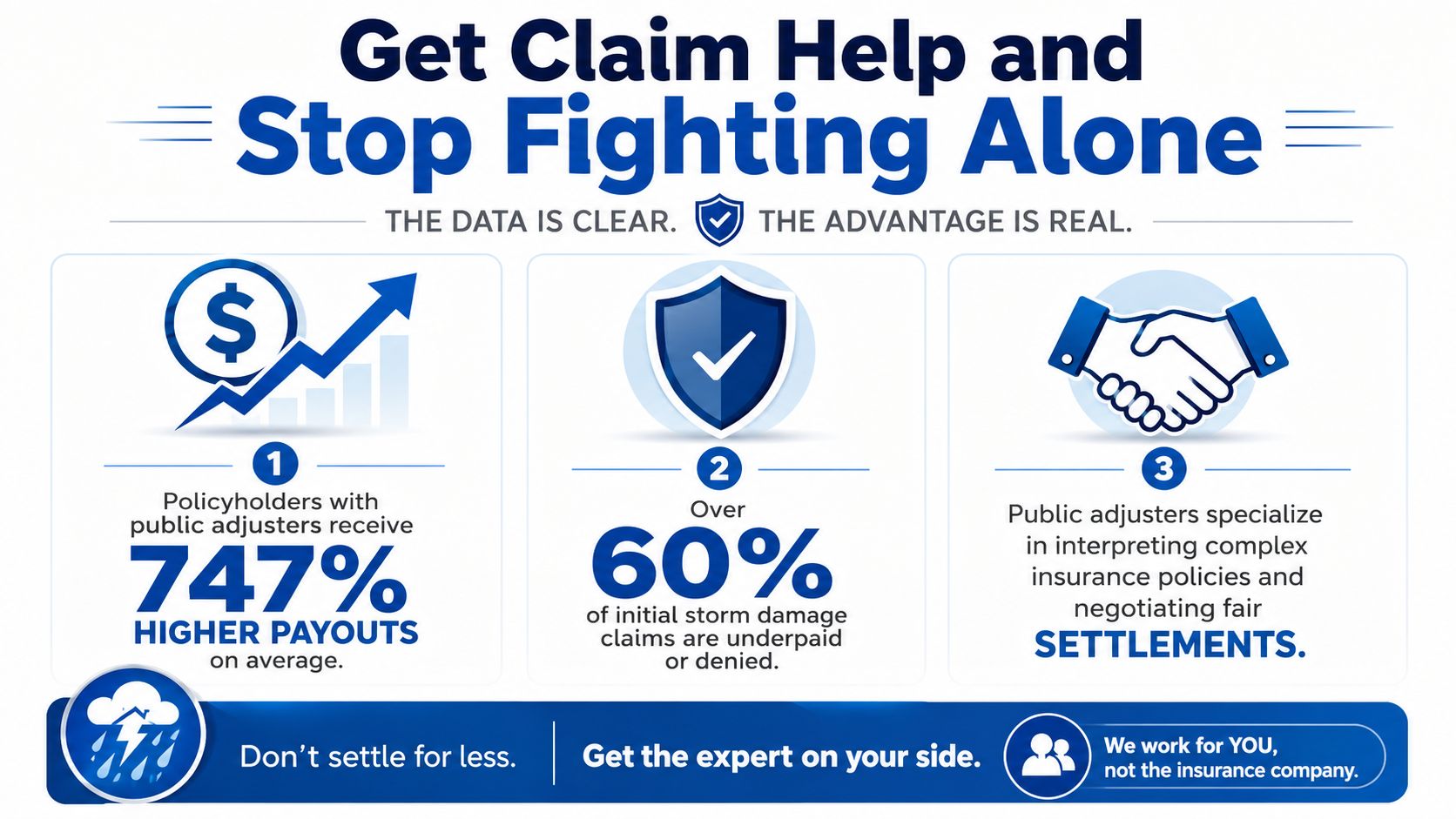
Why professional representation changes outcomes
Policyholders who engage a licensed public adjuster before final settlement receive 30% to 60% higher average recoveries, and storm damage claims average $28,500 when professionally adjusted versus $18,200 when self-negotiated, according to independent claim resolution benchmarks discussed here. That gap exists for a reason. A public adjuster knows how to read the estimate, challenge omissions, document hidden damage, and force a second look.
And no, this isn't only for catastrophic losses. A claim can be worth disputing even when the insurer paid something. In many storm files, the main problem is under-scoping, not outright denial.
I'm also blunt about this point. If the carrier is using flood language to dodge wind damage, if they relied on a virtual inspection, if they skipped code-related items, or if they're ignoring interior moisture evidence, you're already in a technical dispute. Act like it.
What frustrated policyholders usually say after getting help
The same themes come up over and over in client feedback and conversations:
- They finally understood the policy because someone translated the exclusions, endorsements, and settlement language into plain English
- They stopped chasing the adjuster because someone else took over the communication and documentation
- They saw damage the insurer ignored once the property was inspected with a claim-focused eye
- They felt less manipulated because every insurer statement got tested against evidence
For The Public Adjusters, Inc. is one option for homeowners and business owners in North Carolina dealing with storm, wind, hail, water, and related property claim disputes. The firm represents policyholders, not insurers, and handles inspection, documentation, estimate preparation, and negotiation for property losses.
You don't need more generic advice. You need an advantage, documentation, and someone who knows the insurance company's habits well enough to push back effectively.
If your insurance claim for storm damage has been denied, delayed, or low-balled, For The Public Adjusters, Inc. can help you challenge the carrier's position with a documented, policy-focused dispute strategy. Have your water damage claim questions answered at NO COST. Call 919-400-6440 to speak with a licensed Public Insurance Adjuster or Contact Us here with questions. WE Work For YOU… NOT Your Insurance Company!