Can You Reopen a Closed Claim With Your Insurance Company?
Yes, in most cases you can reopen a closed claim with your insurance company in North Carolina and Virginia. A “closed” claim usually just means the insurer finished its internal file — not that you gave up your rights. Unless you signed a full release, you can typically request supplemental payment for missed or underpaid damage.
Key takeaways
- A signed settlement release usually ends your claim permanently, but a denied or closed claim without a release can often be reopened.
- You can typically reopen a closed claim if new evidence emerges, your condition worsens, or the insurer acted in bad faith or made a clerical error.
- Statutes of limitations still apply — if the legal deadline has passed and no exception fits, reopening a claim is generally not possible.
- Workers’ compensation and some insurance claims have their own reopening rules and deadlines that differ from personal injury lawsuits.
- Consulting an attorney before accepting any settlement is the best way to avoid needing to reopen a claim later.
This surprises a lot of homeowners. When the check arrives and the adjuster stops calling, it feels final. But in the insurance world, “closed” is largely an administrative label. Insurers close files constantly — sometimes within days of issuing a payment — and they routinely reopen those same files when a policyholder comes back with new documentation, contractor estimates, or damage that wasn’t visible during the first inspection.
Closed vs. Settled vs. Released: Three Very Different Things
Understanding the difference between these three terms tells you where you actually stand:
- Closed claim: The insurance company has stopped actively working the file. This is an internal status, not a legal barrier. You can generally contact the carrier, submit new evidence, and ask them to reopen or supplement the claim.
- Settled claim: You accepted a payment for the loss. In most property claims, cashing a check does not waive your right to additional money — especially if the payment was based on an incomplete scope of damage. Accepting an actual cash value (ACV) payment, for example, often still leaves recoverable depreciation and supplements on the table.
- Signed release: This is the one that can truly end a claim. A release is a written agreement waiving further payment in exchange for a final settlement. Releases are common in liability claims but relatively rare in standard homeowner property claims. If you never signed one, the door is usually still open.
Why “Closed” Rarely Means “Final”
Property damage has a way of revealing itself over time. Hidden water damage shows up behind drywall, a contractor’s real repair bid comes in far above the insurer’s estimate, or storm damage to the roof turns out worse once someone actually gets up there. Because insurers know initial estimates are often incomplete, most carriers have an established process for supplemental claims — and your policy generally doesn’t require the file to still be “open” for you to use it.
The main limits are practical and legal: your policy’s deadlines, your state’s statute of limitations, and your ability to document the additional damage. Those time limits matter (we cover the NC and VA rules in the next section), which is why it pays to act as soon as you suspect the payout fell short. Many homeowners bring in a licensed professional — such as a public adjuster who works exclusively on the policyholder’s side — to review the closed file and identify what the first estimate missed.
Bottom line: if you never signed a release and you’re still within the time limits, a closed claim is often just a paused claim.

How Long Do You Have to Reopen a Closed Claim in NC and VA?
In most cases, you can reopen a closed claim until the deadline to sue your insurer expires: generally three years for breach of a written contract in North Carolina and five years in Virginia. However, your policy may contain a suit-limitation clause that shortens this window, so check your policy language first.
Those two deadlines — the state statute of limitations and the contractual limitation written into your policy — work together, and the shorter one usually controls. Here is how each piece fits.
Check Your Policy’s Suit-Limitation Clause First
Most homeowners policies include a “Suit Against Us” or “Legal Action Against Us” provision. This clause sets a contractual deadline for filing a lawsuit over the claim, and courts in both states generally enforce these provisions when they are properly worded. Common versions require suit within one, two, or three years of the date of loss. Because your practical leverage to reopen a closed claim disappears once you can no longer sue, treat this clause as your real deadline. You will find it in the “Conditions” section of your policy — read it before assuming you still have time.
North Carolina: The Three-Year Contract Statute
North Carolina’s general statute of limitations for actions on a contract is three years. An insurance policy is a written contract, so a dispute over an underpaid or wrongly closed claim typically falls under this period. Key points for NC homeowners:
- The three-year period is the outer boundary — a shorter policy suit-limitation clause can still apply.
- The clock generally runs from the date of loss or the date the insurer breached the policy, depending on the policy wording, so do not wait until the final months to act.
- Reopening or supplementing a claim informally with the insurer does not automatically pause these deadlines.
If you are unsure how much time you realistically have, a licensed public adjuster in North Carolina can review your policy’s conditions section and tell you where you stand.
Virginia: Five Years for Written Contracts
Virginia gives policyholders more breathing room. The statute of limitations for a written contract in Virginia is five years, which typically applies to disputes over a homeowners policy. Even so, the same caution applies: many policies sold in Virginia contain their own suit-limitation language, often two years from the date of loss, and that contractual deadline can arrive long before the five-year statutory period would.
Supplemental Claim Language in Your Policy
Separate from lawsuit deadlines, many policies address supplemental payments directly — for example, requiring you to notify the insurer promptly when you discover additional damage, or setting a time limit to claim recoverable depreciation after repairs are complete (frequently 180 days to one year, depending on the policy). Missing these smaller internal deadlines can cost you money even when the statute of limitations has not run, so read the loss settlement provisions carefully before you start repairs or accept a final payment.
What Reasons Qualify for Reopening or Supplementing a Property Claim?
You can typically reopen a closed claim if you discover new damage after settlement, the insurer’s payout was based on a lowball estimate, items were missed, recoverable depreciation was never collected, code-required upgrades weren’t paid, or actual contractor pricing exceeds what the insurance company allowed. Insurers call this a supplemental claim.
Not every disappointment with a settlement justifies going back to the insurance company, but more situations qualify than most homeowners realize. Here are the grounds that carry real weight.
Newly Discovered or Hidden Damage
Some damage simply isn’t visible when the adjuster walks the property. Common examples include:
- Hidden water damage — moisture that soaked into wall cavities, subfloors, or insulation and only reveals itself weeks later through staining, warping, or odor.
- Mold growth — often a delayed consequence of a covered water loss, discovered when repairs open up walls or ceilings.
- Structural issues — cracked framing, roof decking damage, or foundation movement that a contractor uncovers during demolition or repair.
If the new damage traces back to the same covered event, you have a legitimate basis to reopen a closed claim and request additional payment.
A Lowballed or Incomplete Repair Estimate
Insurance estimates are frequently written from a brief inspection using software pricing that may not reflect your local market. If the adjuster’s scope left out trades, undermeasured square footage, or priced materials below what any contractor will actually charge, the gap between the estimate and reality is grounds for a supplement.
Missed or Undervalued Contents
Personal property claims are easy to shortchange. Homeowners often discover damaged items after the claim closes, or realize items were valued far below replacement cost. An updated inventory with photos and receipts can support additional payment.
Recoverable Depreciation You Never Claimed
If you have a replacement cost policy, the insurer likely withheld depreciation from the initial payment, releasing it only after repairs are completed and documented. Many policyholders never submit that final paperwork — which means money they’re entitled to is still sitting with the insurer. Claiming withheld depreciation is one of the most straightforward reasons to go back to a closed file.
Code Upgrade Costs
Building codes change, and repairs often trigger requirements that didn’t exist when your home was built — updated electrical, hurricane straps, or current roofing standards. If your policy includes ordinance or law coverage, those mandated upgrade costs may be payable even after the original claim settled.
Contractor Pricing That Exceeds the Payout
When every legitimate bid you receive comes in above the insurer’s figure, that discrepancy itself is evidence. Submitting detailed contractor estimates that itemize the shortfall is a standard, accepted way to justify a supplemental payment.
The common thread in all of these: documentation. Photos, contractor reports, invoices, and itemized estimates turn a request into a claim the insurer has to take seriously.
Have Policyholders Actually Won More Money After a Lowball Settlement?
Yes. Policyholders have successfully challenged denials and low payouts, both in court and through the supplemental claim process. In DENC, LLC v. Philadelphia Indemnity Insurance Co., the Fourth Circuit upheld coverage for a collapsed North Carolina apartment structure after the insurer denied the claim. Results vary, but pushing back can work.
A Court Case Where the Policyholder Prevailed
The DENC case is a useful real-world example for property owners in North Carolina and Virginia because it went through the federal court system covering both states. DENC owned an apartment building in North Carolina, and part of the structure collapsed. Philadelphia Indemnity denied the claim, but DENC sued — and won at the trial court level. The insurer appealed, and the U.S. Court of Appeals for the Fourth Circuit affirmed that the loss was covered under the policy’s collapse provision.
A few takeaways matter for everyday policyholders:
- An insurer’s denial is not the final word. A denial letter reflects the insurance company’s interpretation of the policy — courts sometimes disagree with that interpretation.
- Policy language is read carefully by courts. Ambiguous terms in a property policy are often construed in favor of the insured, which is one reason challenges succeed.
- Documentation drove the outcome. Engineering evidence about the condition of the building and how the collapse occurred was central to the dispute.
Wins That Never Make It to a Courtroom
Litigation is the exception, not the rule. Far more often, policyholders recover additional money through a well-documented supplement or a reopened claim — no lawsuit required. Public adjusters routinely find damage the first estimate missed, such as:
- Hidden water damage inside wall cavities, under flooring, or in insulation that the initial inspection never opened up.
- Roof and structural issues that only a detailed inspection — not a quick walkthrough — reveals.
- Code-upgrade costs (ordinance or law coverage) that the original estimate ignored even though the policy included them.
- Underpriced line items, where the insurer’s estimate used outdated labor or material costs that don’t reflect what contractors actually charge.
When that missing damage is documented with photos, moisture readings, contractor bids, or engineering reports, insurers frequently issue supplemental payments rather than fight over facts they can no longer dispute.
The Honest Caveat
None of this guarantees a specific result. Every claim turns on its own policy language, evidence, and deadlines. What these examples do show is that a low settlement or even a denial is often a starting point for negotiation — not the end of your claim. If you believe your payout missed real damage, the effort to reopen a closed claim is frequently worth making.
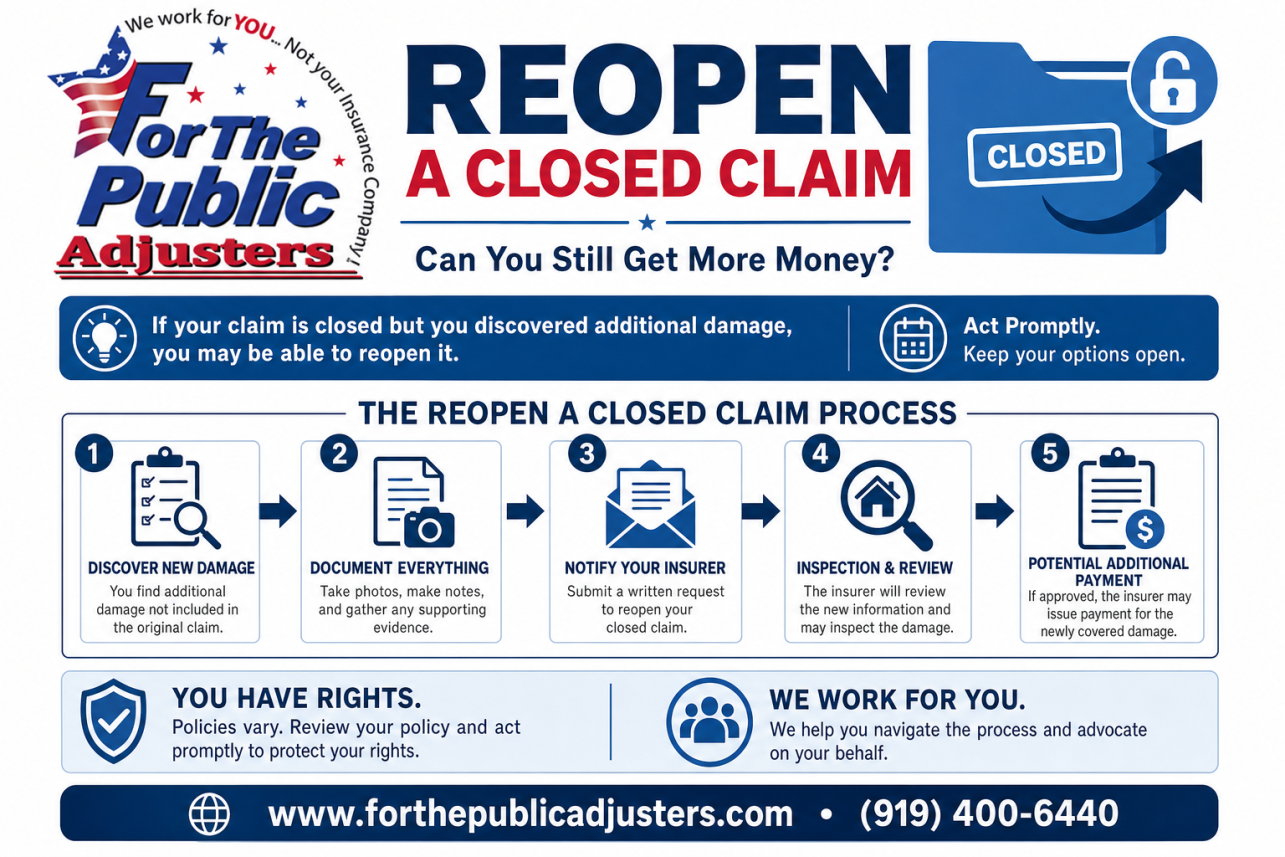
How Do You Reopen a Closed Claim Step by Step?
To reopen a closed claim, gather your settlement paperwork and policy, confirm you’re still within the filing deadline, document the new or undervalued damage with photos and independent repair estimates, then submit a written supplemental claim to your insurer. If the insurer refuses, escalate through the policy’s appraisal clause or legal channels.
Each of those steps matters, and skipping one can give the insurance company an easy reason to say no. Here’s how to work through the process in order.
Step 1: Pull Your Settlement Paperwork and Policy
Start by collecting everything from the original claim: the insurer’s estimate, the settlement letter, proof of payment, and any release you may have signed. Then read your full policy, not just the declarations page. Look for the loss settlement provisions, the supplemental claim language, and the appraisal clause. If you signed a full release of all claims, reopening may be difficult, so know that before you invest more time.
Step 2: Confirm Your Deadlines
Before doing anything else, verify that you’re still within the time limits in your policy and under state law. If a deadline is approaching, send written notice to the insurer right away that you intend to file a supplemental claim, even if your documentation isn’t complete yet.
Step 3: Document the New or Undervalued Damage
The strength of a reopened claim comes down to evidence. Build a file that includes:
- Date-stamped photos and video of the damage, including wide shots and close-ups
- At least one independent, itemized repair estimate from a licensed contractor
- Invoices or receipts showing repairs cost more than the insurer paid
- Reports from specialists (roofers, engineers, mold assessors) if the damage is hidden or technical
- A side-by-side comparison showing what the insurer’s estimate missed or underpriced
Step 4: Submit a Written Supplemental Claim
Contact your insurer and ask for their supplemental claim procedure, then follow it in writing. Reference your original claim number, explain what was missed or has since been discovered, and attach your documentation. Send it by a method that creates a record, such as email or certified mail, and keep copies of everything. Request a written response and a reinspection if the adjuster disputes your evidence.
Step 5: Escalate If the Insurer Refuses
If the insurer denies your supplemental claim or offers less than your documentation supports, you still have options:
- Invoke the appraisal clause. Most property policies let each side hire an appraiser, with an umpire resolving disputes over the amount of loss.
- File a complaint with your state’s department of insurance if you believe the claim was handled unfairly.
- Consult a professional. A public adjuster or an attorney experienced in property claims can evaluate whether the denial is worth challenging further.
Working through these steps methodically, in writing, and with strong documentation gives you the best chance of turning a closed file back into an open one.
When Should You Bring in a Public Adjuster for a Reopened Claim?
Bring in a licensed, bonded public adjuster when the gap between your damage and the insurer’s payment is significant, the reopened claim involves complex or hidden damage, or the carrier keeps pushing back on your supplement. A public adjuster re-scopes the loss, documents it properly, and negotiates with the insurance company on your behalf.
Reopening a claim is fundamentally a documentation and negotiation exercise. The insurance company already closed the file once, which means you now need stronger evidence than you had the first time. That’s exactly the work a public adjuster is trained and licensed to do.
What a Public Adjuster Actually Does on a Reopened Claim
- Re-scopes the entire loss. A public adjuster inspects the property line by line, catching hidden or overlooked damage — moisture behind walls, roof decking issues, code-required upgrades — that the original estimate missed.
- Values your contents correctly. Personal property is one of the most commonly underpaid parts of a claim. A public adjuster builds a detailed contents inventory with accurate replacement values instead of the rough figures many original settlements rely on.
- Prepares the supplemental estimate. They write the claim in the same estimating language and format carriers use, which makes it harder for the insurer to dismiss.
- Negotiates directly with the carrier. From reinspections to disputed line items, the adjuster handles the back-and-forth so you’re not arguing with a claims professional on your own.
Situations Where Professional Help Matters Most
- The shortfall is large enough that a percentage-based fee still leaves you meaningfully better off.
- Damage has worsened or new damage was discovered after the claim closed.
- The insurer denied your supplement or is slow-walking the reopened file.
- The loss involves multiple trades — roofing, water mitigation, contents, structural — that are easy to underscope.
- Flood damage is involved, which follows different rules under the National Flood Insurance Program. FEMA explains the flood claim and appeal process at FEMA.gov.
Honest Limits You Should Know
A reputable public adjuster will never guarantee a specific outcome or dollar amount — no one ethically can, and you should be wary of anyone who does. Public adjusters also handle property claims only, not injury, liability, or auto claims. Before hiring anyone, verify their license through your state’s insurance department; the National Association of Insurance Commissioners links to every state regulator where you can confirm licensing and check for complaints.
If your reopened or supplemental claim feels stalled — or you simply suspect the first settlement didn’t reflect the true scope of your loss — a consultation with a licensed, bonded public adjuster is a low-risk way to find out whether pursuing more is worth it.
When You Can (and Can’t) Reopen a Closed Claim
| Situation | Can You Reopen? | Key Consideration |
|---|---|---|
| Claim denied, no release signed | Often yes | Appeal or refile before the statute of limitations expires |
| Settlement accepted and release signed | Rarely | Only in cases of fraud, coercion, or clear mutual mistake |
| New injuries or worsening condition discovered | Sometimes | Depends on release language and state discovery rules |
| Insurer bad faith or clerical error | Often yes | Bad-faith conduct may open a separate legal claim |
| Workers’ compensation claim closed | Sometimes | Many states allow reopening within a set statutory window |
Illustrative Example: A Denied Claim Gets a Second Look
Illustrative example
Consider a hypothetical driver whose claim was denied after the insurer argued her back pain was pre-existing, and she let the file close without signing a release. Months later, new medical imaging linked her worsening condition directly to the crash. Because she had never signed a settlement release and the statute of limitations had not yet run, her attorney was able to reopen negotiations with the new evidence. This composite scenario shows why a closed claim is not always a dead end — the details of what was signed and when the deadline falls make all the difference.
Frequently asked questions
Can I reopen a closed claim to get more money?
It depends on how the claim was closed. If the insurer simply closed the file due to inactivity or a denial, you can often ask to reopen it by contacting the adjuster and providing new evidence, such as additional medical records or repair estimates. However, if you signed a settlement release, reopening is usually not possible because the release waives your right to seek further compensation for that claim.
What’s the difference between a closed claim and a settled claim?
A closed claim means the insurer has stopped actively working on the file, often because of inactivity, missing documentation, or a denial. It can typically be reopened. A settled claim means you accepted payment and signed a release, which is a binding legal agreement. Settled claims are generally final, with limited exceptions like fraud, coercion, or a mistake in the agreement itself.
Is there a deadline to reopen a closed claim?
Yes. You are generally still bound by the statute of limitations for filing a lawsuit, which varies by state and claim type, as well as any deadlines in your insurance policy. Waiting too long can permanently bar recovery even if the insurer would otherwise consider reopening the file, so it’s best to act quickly and confirm the applicable deadlines for your situation.
What can I do if I already signed a settlement but my injuries got worse?
Unfortunately, a signed release usually covers future and unknown injuries related to the claim, so worsening symptoms alone typically won’t undo the agreement. Possible exceptions include settlements obtained through fraud or misrepresentation, releases signed under duress, or agreements involving a minor that lacked court approval. A personal injury attorney can review your release language and advise whether any exception applies.
Related local pages
- Public Adjuster Burlington NC: Fire, Water & Storm Damage Claims Handled On The Policyholder’s Side
- Public Adjuster Elon NC — Fire & Water Claim Help For Alamance County Homeowners
- Public Adjuster Cary NC — Licensed Help For Fire, Storm, Water & Tree Damage Claims In Wake County
Think your claim settled for less than it should have? Contact our licensed and bonded public adjusters for a free review of your closed or underpaid claim in NC or VA. Get in touch.
Last updated: August 4, 2026