
Insurance Dispute Lawyers Burlington searches usually mean one thing: your insurance company has denied, delayed, or underpaid a property claim, and you want someone on your side. Before you commit to litigation, know that most home and business claim disputes in Alamance County can be resolved by a licensed public adjuster who documents the loss, rebuts the carrier’s position, and negotiates directly with the insurer. For The Public Adjusters, Inc. is licensed and bonded, works exclusively for policyholders, and coordinates with attorneys when a dispute genuinely requires court.
What This Service Is
When a fire, burst pipe, fallen tree, or storm damages your home or business, you file a claim expecting your insurer to honor the policy. When the carrier disputes coverage, blames the loss on an exclusion, or offers a fraction of the repair cost, the disagreement becomes an insurance dispute. Many policyholders assume a lawyer is the only answer, but the North Carolina Department of Insurance regulates a second kind of advocate: the licensed public adjuster, and its NCDOI Public Adjusters Guide explains how these professionals represent policyholders rather than insurance companies.
Our role is to build the case the carrier cannot ignore. We inspect the damage, prepare a line-item estimate, inventory contents, and handle every communication with the insurer’s adjuster. That covers residential homeowners claims, commercial business claims, fire and smoke losses, water damage, tree damage, vandalism, and even a car striking a home.
Courts have repeatedly shown that a well-documented policyholder can prevail. In Broussard v. State Farm Fire & Casualty Co., a federal jury sided with homeowners whose house was destroyed after Hurricane Katrina, rejecting the insurer’s attempt to attribute the covered loss to excluded flooding. Cases like that begin with the same thing we build for Burlington policyholders: evidence. When a claim does escalate to counsel, the file we prepare — like the documentation our fire claim adjuster in Wake Forest assembles on total-loss fires — becomes the backbone of the legal case.
Common Problems
What Will Fighting My Insurance Company Actually Cost Me?
Litigation is expensive, and attorneys handling property disputes typically take a contingency percentage plus costs, with cases often running many months. A public adjuster works for a percentage of the recovered claim, with no upfront fee, and most disputes settle without a lawsuit ever being filed.
The real cost question is what your claim is actually worth. Carriers frequently omit code-upgrade costs, undervalue plaster and hardwood common in older Burlington homes, and depreciate contents aggressively. An independent, line-item estimate often reveals the gap between the offer and the true repair cost — and that gap is what any dispute, legal or otherwise, is really about. We never promise a specific outcome, but we make sure the number on the table reflects the full documented loss.
The Insurer Denied Or Lowballed My Claim. What Now?
First, get the denial or the offer in writing with the specific policy language the carrier is relying on. Insurers must state their reasoning, and vague blanket denials are often the weakest ones.
Second, do not accept the carrier’s inspection as the final word. We routinely find missed damage — hidden smoke residue, moisture inside wall cavities, structural cracking from impact. On a recent tree damage insurance claim help in Carrboro matter, the difference came down to roof decking damage the carrier’s adjuster never opened up to see.
Third, respond within your policy’s deadlines. North Carolina policies contain time limits for proof of loss and for suit, and missing them can forfeit rights even when your claim is legitimate.
Insurance Dispute Lawyers Burlington: Do I Need An Attorney Or A Public Adjuster First?
If your carrier is acting in bad faith — ignoring you entirely, misrepresenting the policy, or refusing to pay an undisputed amount — an attorney belongs in the conversation. But most disputes are really valuation and documentation fights, and those are won with evidence, not motions.
A practical approach many policyholders take: bring in a licensed public adjuster first to rebuild the claim properly. If the carrier still refuses a fair settlement, you walk into an attorney’s office with a complete, professionally documented file instead of a shoebox of photos. When judging any advocate, verify licensing, ask who they represent (never the insurer), and ask them to explain — in writing — exactly how their fee works. For The Public Adjusters, Inc. is licensed and bonded and represents policyholders only.
Our Process
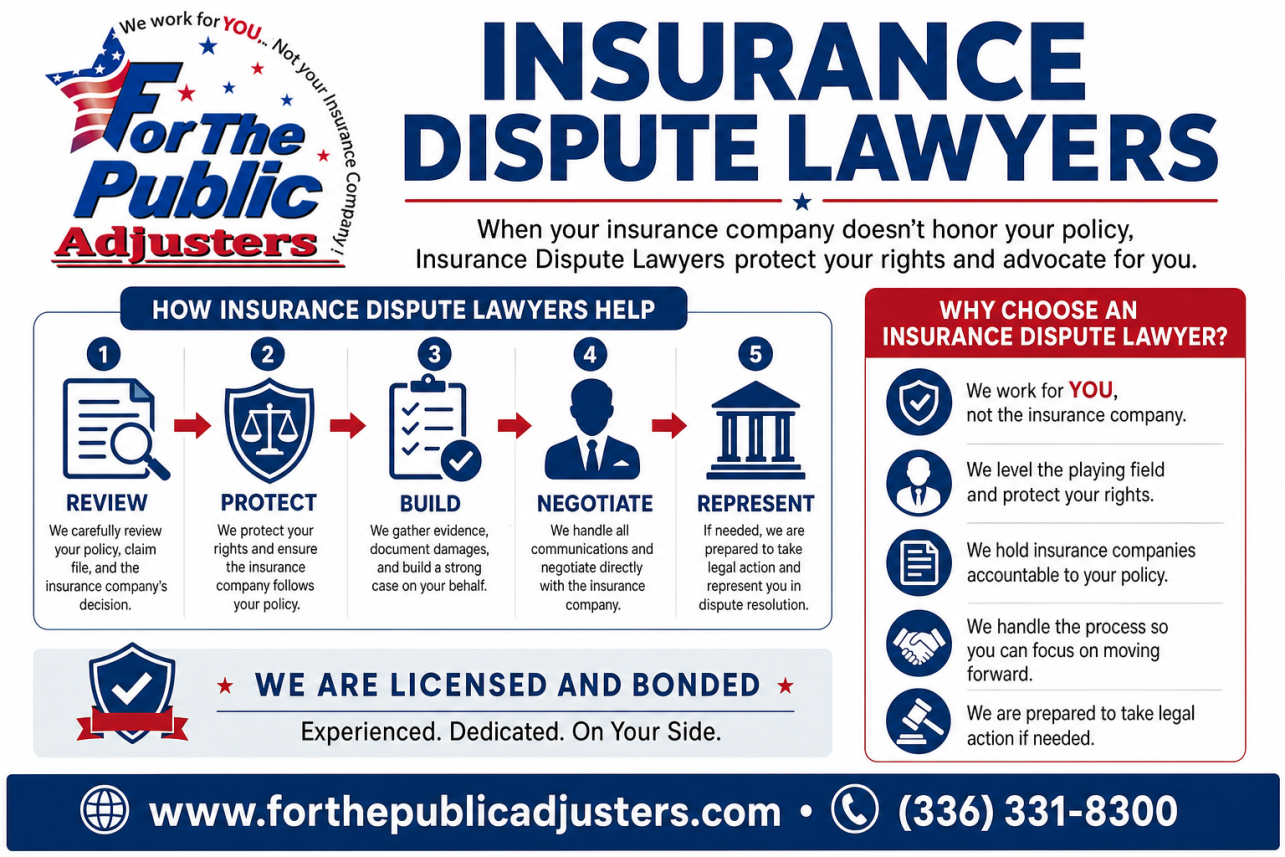
Free Policy And Claim Review
We read your full policy — declarations, endorsements, exclusions — and compare it against the carrier’s position. Many disputes collapse at this stage because the denial rests on language that does not say what the insurer claims it says.
Independent Damage Documentation
We inspect the property ourselves, photograph and measure everything, test for hidden moisture or smoke migration, and prepare a detailed line-item estimate with a full contents inventory. This is the same standard of documentation our public adjuster in Rougemont NC clients rely on, and it becomes the factual record for negotiation or, if necessary, litigation.
Negotiation, Appraisal, Or Escalation
We present the documented claim to the carrier and negotiate on your behalf. If the insurer still refuses a reasonable settlement, we can invoke the policy’s appraisal provision where appropriate, or hand the complete file to an attorney of your choosing so nothing has to be rebuilt from scratch.
| Factor | Public Adjuster | Insurance Dispute Attorney | Handling It Yourself |
|---|---|---|---|
| Best for | Underpaid, delayed, or partially denied claims where damage documentation is the issue | Bad-faith conduct, full denials on coverage grounds, litigation and lawsuits | Small, straightforward claims the carrier is paying fairly |
| Typical cost | Contingency percentage of the recovered amount — no fee if no recovery | Contingency or hourly; litigation costs can run into the thousands | Free, but frequently leaves 30-50% of covered damage unclaimed |
| Timeline | Often weeks to a few months via supplements and appraisal | Months to years if the case goes to court | Depends entirely on the carrier’s pace |
| Who does the damage scoping | Licensed adjuster inspects, estimates, and negotiates line by line | Attorney argues law and coverage; usually hires experts for the estimate | You rely on the carrier’s adjuster’s numbers |
| Escalation power | Supplements, proof of loss, appraisal clause, NC DOI complaints | Demand letters, lawsuit, bad-faith and unfair-practices claims | Phone calls and complaint letters |
| When to combine both | First stop for most Alamance County property claims | Brought in when the carrier denies coverage outright or acts in bad faith | Not recommended for losses over a few thousand dollars |
Commonly Overlooked In The Public Adjusting Industry
- The appraisal clause buried in the policy’s Conditions section — Most policyholders never read past the declarations page, so they fight over price for months without knowing they can force a binding valuation without a lawsuit.
- Matching requirements for discontinued shingles and siding — Carriers pay to patch one slope or elevation, and homeowners don’t realize North Carolina practice often supports full replacement when materials can’t be reasonably matched.
- Ordinance and law coverage for code upgrades — Rebuilding to current Alamance County code costs more than replacing what was there, and that coverage sits unclaimed unless someone specifically documents the code triggers.
- Recoverable depreciation left on the table — Carriers withhold depreciation until repairs are complete, and thousands of dollars go unclaimed because nobody tells the homeowner to submit final invoices to release it.
- The contractual suit-limitation deadline versus the statute of limitations — Many policies quietly shorten the time to sue below North Carolina’s default three years, and people discover it only after the window has closed.
- Hidden moisture and smoke migration beyond the visible loss — Carrier adjusters scope what they can see, so contamination inside wall cavities and HVAC ductwork gets excluded unless independent testing is done early.
- Seasonal income adjustments in business interruption calculations — Carriers default to flat annual averages from tax returns, which quietly shortchanges any Burlington business that lost its peak months.
- Signing a full release on a partial payment — A release page slipped into settlement paperwork can bar supplements for damage found later, and most people sign it without knowing what they gave up.
Case Studies
Case Study #1
Situation: A family on Glencoe Street in north Burlington filed a claim after a spring hailstorm damaged their roof, gutters, and vinyl siding. Their carrier sent an adjuster within a week and issued a settlement offer of $6,400.
Problem: The offer covered spot repairs on two roof slopes only, ignoring visible hail bruising across all four slopes and cracked siding on the west elevation. The homeowners were told the remaining damage was ‘wear and tear’ predating the storm. Their roofer’s repair estimate came in at $27,800 — more than four times the offer.
Investigation: Our team performed a full exterior inspection with test squares on every roof slope, documented hail strike density per square, and pulled NOAA and CoCoRaHS storm data confirming 1.25-inch hail over that section of Alamance County on the date of loss. We photographed spatter marks on the AC condenser and mailbox — fresh, dated evidence the carrier’s adjuster never noted.
Findings: Hail bruising exceeded the manufacturer’s repairability threshold on all slopes, and the discontinued siding profile could not be patch-matched, triggering the policy’s matching considerations under North Carolina practice. The carrier’s report had been written after a 20-minute inspection that never included test squares.
Solution: We prepared a line-item Xactimate estimate, filed a formal supplement with the storm data and photo documentation, and invoked the appraisal clause when the desk adjuster refused to reinspect. Our appraiser and the carrier’s appraiser met on site within three weeks.
Outcome: The appraisal award came in at $31,150 — full roof replacement, full west and south elevation siding replacement, gutters, and code-required drip edge. That’s nearly five times the original offer, and the family paid nothing out of pocket beyond their deductible.
Lesson: A quick carrier inspection is not the final word. Independent storm data and proper test squares routinely reveal covered damage that a rushed adjuster labels ‘wear and tear.’
Case Study #2
Situation: A small restaurant owner near downtown Burlington suffered a kitchen fire that closed the business for what the carrier estimated would be six weeks. The commercial policy included business interruption coverage, and the carrier advanced $18,000 based on the prior year’s tax return.
Problem: Six weeks became five months once smoke remediation revealed contamination in the HVAC ductwork and dining room finishes. The carrier refused to extend the interruption period, arguing the owner had failed to mitigate, and denied the ductwork cleaning as ‘pre-existing grease accumulation.’
Investigation: We brought in an independent industrial hygienist to test for combustion byproducts in the duct system, then reconstructed the true business income loss using twelve months of POS reports and seasonal sales trends — not just a flat annual average that undercounted the busy fall season the restaurant missed.
Findings: Lab results confirmed fire-related soot and char throughout the ductwork, directly contradicting the pre-existing condition denial. Our forensic income analysis showed the flat tax-return method had understated the interruption loss by roughly 40%, because the closure spanned the restaurant’s highest-revenue months.
Solution: We submitted a documented proof of loss covering the full remediation scope and the corrected period of restoration, backed by the hygienist’s report and month-by-month sales data. When the carrier’s response stalled, we sent a demand letter citing North Carolina’s unfair claim settlement practices statute and coordinated with dispute counsel to preserve the owner’s bad-faith remedies.
Outcome: The claim resolved for $214,000 across property damage and business interruption — compared to roughly $61,000 the carrier had positioned as its final number. The restaurant reopened fully remediated, with lost income covered through the actual reopening date.
Lesson: Business interruption claims live or die on documentation. Averaged annual figures almost always shortchange seasonal businesses, and ‘pre-existing condition’ denials should be tested by an independent expert, not accepted at face value.
| Your Situation | Best First Move | What It Depends On |
|---|---|---|
| Carrier’s offer feels low but claim is open | Get an independent line-item estimate and file a supplement | Whether the carrier’s scope missed damage — most Alamance County hail and water claims have gaps in the first estimate |
| Claim delayed with no decision after 30+ days | Send a written status demand; NC rules require timely claim handling | Whether the delay is a documentation request you can satisfy or unjustified stalling |
| Partial denial (‘wear and tear’, ‘pre-existing’) | Hire a public adjuster to gather storm data, expert reports, and photos | Whether physical evidence and weather records contradict the carrier’s reasoning |
| You and the carrier disagree only on the dollar amount | Invoke the appraisal clause in your policy | Whether coverage itself is admitted — appraisal decides value, not coverage |
| Full denial based on a coverage exclusion | Have the denial letter reviewed, then consult dispute counsel | Whether the exclusion actually applies to your facts — many denials misread the policy |
| Evidence of bad faith (misrepresenting the policy, ignoring proof) | Document everything in writing and involve an attorney | Whether the carrier’s conduct violates North Carolina’s unfair claim settlement practices statute |
| Deadline pressure (statute of limitations approaching) | Act immediately — NC property claims generally carry a three-year window | Your date of loss and any shorter contractual suit-limitation period in the policy |
| Claim already settled but new damage found | Reopen with a supplement before signing any full release | Whether you signed a release and whether the new damage ties to the original loss |

Reviews
State Farm offered me $4,200 for hail damage and said the rest of my roof was just old. For The Public Adjusters did test squares on every slope, pulled the actual storm reports for Alamance County, and pushed the claim into appraisal. Final award was over $29,000 — full roof and siding. I honestly thought I’d need to hire a lawyer and go to court, but they handled the whole dispute without it.
Marcus T., Burlington NC
Our water damage claim was denied as ‘long-term seepage’ even though the pipe burst overnight. This team documented everything — moisture readings, plumber’s report, photos of the failed fitting — and forced the carrier to reverse the denial. When the carrier still lowballed the drywall and flooring, they invoked appraisal and we ended up with more than triple the first offer. They also told us upfront when a dispute attorney would and wouldn’t be worth it, which I appreciated.
Denise R., Elon
I was searching for Insurance Dispute Lawyers Burlington after my commercial fire claim stalled for four months. A friend pointed me to For The Public Adjusters instead, and it was the right call for my situation. They rebuilt my business interruption numbers from actual monthly sales, got an independent hygienist to disprove the carrier’s denial, and coordinated with an attorney only for the bad-faith piece. Settled for far more than the carrier’s ‘final’ offer. Only reason it’s not perfect — appraisal took longer than I hoped, but that was the carrier dragging its feet, not them.
James H., Graham
Frequently Asked Questions
When Should I Contact Insurance Dispute Lawyers Burlington Homeowners Trust Instead Of Handling My Claim Alone?
The right time to bring in professional help is the moment your claim stops moving in your favor. That could mean a flat-out denial, a lowball settlement offer, weeks of silence from your adjuster, or a request for a recorded statement that feels like an interrogation rather than a conversation.
At For The Public Adjusters, Inc., we regularly see Alamance County property owners wait too long. They accept a first offer on hail or wind damage, sign a release, and only later discover the roof decking or interior water damage the carrier never accounted for. Once you sign, your options shrink dramatically.
A good rule of thumb: if the gap between your contractor’s repair estimate and the insurance company’s offer is more than a few thousand dollars, or if the carrier is citing policy exclusions you don’t fully understand, get a professional review before you respond. Most reputable firms, including ours, will evaluate your denial letter or settlement offer at no cost.
North Carolina also has strict deadlines. Most property insurance disputes must be filed within three years, and some policies contain shorter contractual limitation periods buried in the fine print. Storm damage from a spring hailstorm in Burlington can look minor in June and become a full roof failure by November, so document everything early and don’t let the clock run out while you negotiate on your own.
What Types Of Insurance Disputes Do You Handle For Burlington And Alamance County Property Owners?
We handle the full range of first-party property claim disputes that Burlington homeowners and business owners face. The most common involve wind and hail damage to roofing, which is a constant issue here given the severe thunderstorm activity that rolls through Alamance County most springs and summers.
Beyond storm claims, we regularly fight underpaid or denied claims involving water damage from burst pipes and appliance failures, fire and smoke losses, lightning strikes, fallen trees, and vandalism. For commercial clients along South Church Street, downtown Burlington, and the industrial corridors near I-40/85, we also handle business interruption disputes, where carriers frequently undervalue lost income during repairs.
Dispute types vary as much as damage types. Some carriers deny claims outright, citing wear and tear or pre-existing damage. Others accept coverage but pay a fraction of true repair costs, using pricing software that doesn’t reflect what local contractors actually charge in the Triad market. Still others delay indefinitely, requesting document after document while your property deteriorates.
We also assist with appraisal clause invocations, a powerful but underused tool written into most North Carolina policies that lets you demand an independent valuation when you and the carrier disagree on the amount of loss. Whether your dispute is over coverage, valuation, or delay, the first step is the same: a detailed review of your policy language and a thorough, independent inspection of the damage itself.
How Much Does It Cost To Hire Insurance Dispute Lawyers Burlington Residents Can Actually Afford?
Cost is the number one concern we hear from Insurance Dispute Lawyers Burlington clients, and the answer is usually more encouraging than people expect. Most insurance dispute work in North Carolina is handled on a contingency basis, meaning you pay nothing upfront and fees come only from the recovery, not out of your pocket.
Contingency percentages typically run between 25 and 40 percent depending on the complexity of the case and whether it resolves through negotiation, appraisal, or litigation. A straightforward underpayment on a hail-damaged roof in the Glen Raven or Elon area might settle through negotiation at the lower end of that range. A denied fire claim requiring expert witnesses and depositions will cost more, but the fee only exists if you win.
At For The Public Adjusters, Inc., initial consultations and policy reviews are free. We’ll tell you honestly whether your dispute is worth pursuing, because taking a case with no realistic upside helps no one.
It’s also worth knowing that North Carolina law provides remedies beyond the claim amount itself. When a carrier’s conduct rises to bad faith or an unfair claims practice under the state’s statutes, additional damages may be available, and in some circumstances the insurer can be made to bear costs. Those possibilities often change the math on whether professional representation pays for itself, and in our experience across Alamance County, it usually does, many times over.
How Long Does An Insurance Dispute In Burlington Typically Take To Resolve?
Timelines vary widely based on how the dispute resolves, but most cases we handle in the Burlington area fall into three general tracks.
Negotiated settlements are the fastest. When we present a carrier with a properly documented supplemental estimate, engineering reports, and photographic evidence, many disputes resolve in 30 to 90 days. Insurance companies respond differently when they know someone is watching the file who understands policy language and North Carolina’s claims-handling regulations.
Appraisal, the independent valuation process built into most policies, typically takes three to six months. Each side selects an appraiser, the appraisers choose an umpire, and the resulting award is binding on the amount of loss. For valuation disputes, like a carrier paying $8,000 on a roof that legitimately costs $22,000 to replace, appraisal is often the most efficient path.
Litigation in Alamance County Superior Court is the longest road, generally 12 to 24 months from filing to resolution, though many suits settle at mediation well before trial. Cases involving coverage denials, bad faith allegations, or large commercial losses are the most likely to end up here.
One local factor worth noting: after major storm events hit the Triad, carriers get flooded with claims and everything slows down. Filing complete, well-documented demands early puts you ahead of that backlog. Whatever track your case takes, you’ll get a realistic timeline at the outset, and we’ll keep you updated at every stage rather than leaving you guessing.
What Evidence Should I Gather Before Meeting With Insurance Dispute Lawyers Burlington Policyholders Recommend?
The more documentation you bring to your first consultation, the faster we can evaluate the strength of your claim. Start with a complete copy of your insurance policy, including all endorsements and declarations pages. If you don’t have it, your carrier is required to provide one upon written request.
Next, gather every piece of correspondence with your insurer: denial letters, reservation-of-rights letters, adjuster emails, and notes from phone calls with dates and names. In Burlington disputes, we often find that a carrier’s own written statements contradict their final position, and that becomes powerful leverage.
Photograph and video the damage thoroughly before any repairs, and keep damaged materials when possible. Save receipts for emergency mitigation like tarping, water extraction, or temporary housing, since these are typically recoverable. Contractor estimates from local Alamance County builders are especially useful because they reflect real regional labor and material costs, which carriers frequently underestimate.
If your dispute involves a business, pull profit-and-loss statements, tax returns, and payroll records to support any business interruption claim. For homeowners, a room-by-room inventory of damaged contents with approximate purchase dates and values strengthens personal property claims significantly.
Don’t worry if your records are incomplete. Part of what we do is reconstruct claims using weather data, permit records from the City of Burlington, and independent expert inspections. But arriving with whatever you have lets us give you an honest, specific assessment of your options on day one rather than weeks later.
My Insurance Company Offered A Settlement That Seems Low. Can A Burlington Insurance Dispute Team Actually Get Me More?
In many cases, yes. Lowball first offers are one of the most common problems we see across Alamance County. Carriers frequently base initial settlements on software-generated estimates that miss code-upgrade requirements, undervalue local contractor rates, or overlook hidden damage like moisture behind walls or compromised roof decking.
Before you sign anything or cash a check marked as final payment, have the offer reviewed. Once you accept a full-and-final settlement, reopening the claim becomes much harder, so timing matters.
Our process starts with an independent damage assessment. We bring in our own inspectors, estimators, and when needed, engineers who evaluate the loss without the insurer’s cost pressures. We then compare that documented scope of loss against the carrier’s estimate line by line. The gap is often substantial, sometimes tens of thousands of dollars on a typical Burlington home after storm or fire damage.
From there, we present a formal, evidence-backed demand to the insurer. North Carolina law requires carriers to handle claims in good faith, and when they undervalue a loss without reasonable justification, they expose themselves to bad-faith liability and, in some cases, treble damages under the state’s unfair trade practices statute. Insurers know this, which is why documented, professionally presented disputes tend to settle at meaningfully higher figures.
Even if you’ve already accepted a partial payment, you may still have options. Supplemental claims are common when additional damage is discovered during repairs, and we regularly pursue them for clients throughout Burlington, Graham, and Mebane.
Do Insurance Dispute Lawyers Burlington Property Owners Hire Handle Storm And Hail Damage Denials Specifically?
Absolutely, and it’s one of the most frequent dispute types we handle in this part of the Piedmont. Burlington sits in a corridor that regularly sees severe thunderstorms, hail, high straight-line winds, and the occasional remnants of tropical systems moving up from the coast. Roofs, siding, gutters, and HVAC units here take a beating.
The problem is that carriers often deny or minimize these claims by attributing damage to “wear and tear,” “pre-existing conditions,” or “improper installation” rather than the covered storm event. We counter those arguments with hard evidence: certified weather data showing hail size and wind speeds at your specific address on the date of loss, forensic roof inspections that distinguish hail strikes from blistering or foot traffic, and documentation of your roof’s condition before the storm when available.
Another common tactic is partial approval, where the insurer pays for a few shingles when the entire slope or roof needs replacement. North Carolina matching considerations and manufacturer repairability guidelines often support full replacement, and we build that case with contractor and manufacturer documentation.
We also handle interior water damage that follows storm-created openings, tree impact claims, and disputes over fence, outbuilding, and detached garage coverage that Alamance County homeowners are sometimes surprised to learn exists in their policies.
If your storm claim was denied, underpaid, or delayed past North Carolina’s prompt-payment expectations, bring us the denial letter. A short review usually tells us whether the carrier’s reasoning holds up, and in our experience around Burlington, it frequently doesn’t.

What’s The Difference Between Hiring Your Firm And Just Filing A Complaint With The North Carolina Department Of Insurance?
Both have their place, but they accomplish very different things. Filing a complaint with the NC Department of Insurance is free, and the Department will forward your complaint to the carrier and require a written response. That can be useful for documenting a pattern of bad conduct. However, the Department generally cannot force an insurer to pay a specific amount, interpret disputed policy language, or resolve disagreements about the value of your loss. Most valuation disputes fall outside what a regulatory complaint can fix.
When you work with our Burlington team, you get direct advocacy focused on the dollar outcome. We build an independent, documented valuation of your loss, invoke policy tools like the appraisal clause when appropriate, negotiate directly with the carrier’s adjusters and counsel, and escalate to formal legal action when an insurer won’t deal fairly. A regulatory complaint puts your issue in a queue; representation puts pressure on the specific people deciding your claim.
The two approaches also aren’t mutually exclusive. In some cases we recommend filing a Department complaint alongside our efforts, because a documented regulatory record can strengthen a later bad-faith argument under North Carolina’s unfair claim settlement practices laws.
For smaller, straightforward issues, like a carrier simply failing to respond, a complaint alone may resolve things. For denied claims, significant underpayments, or disputes involving fire, storm, or water damage to Alamance County homes and businesses, professional representation almost always produces a better result. We’re happy to review your situation and tell you honestly which route makes sense before you commit to anything.
My Claim Was Already Denied And I Signed Some Paperwork. Can Insurance Dispute Lawyers Burlington Policyholders Rely On Still Reopen It?
In many cases, yes. A denial letter is not the end of the road, and most paperwork insurers ask you to sign along the way does not permanently close your claim. The critical exception is a full release or final settlement agreement, so bring every document you signed to your first consultation and we will tell you exactly where you stand.
North Carolina generally gives policyholders three years from the date of loss to pursue a breach-of-contract action, though some policies shorten that window, so timing matters. If your denial came after a hailstorm or wind event here in Alamance County, we often find the carrier’s inspection was rushed or relied on a desk review rather than a proper roof examination.
Our team starts by requesting the complete claim file, the adjuster’s notes, and any engineer or estimator reports the insurer used. We then compare those against an independent inspection of your Burlington property. Discrepancies between what the carrier documented and what actually exists on your roof, siding, or interior are the foundation of most successful reopened claims.
Even partial payments do not lock you in. Accepting an initial check for undisputed amounts does not waive your right to pursue the rest of what your policy owes. We regularly recover supplemental payments for homeowners who were told, incorrectly, that cashing that first check ended the matter. Bring us the denial, the policy, and your photos, and we can usually tell you within one meeting whether the claim is worth fighting.
Will Disputing My Claim Cause My Insurer To Cancel My Policy Or Raise My Rates?
This is one of the most common fears we hear from Burlington homeowners, and it keeps far too many people from pursuing money they are legitimately owed. Here is the reality: North Carolina law restricts when and why an insurer can non-renew or cancel a homeowner’s policy, and exercising your contractual right to dispute a claim decision is not a lawful basis for retaliation.
Your premium is influenced by claims filed, not by whether you accepted the first offer or fought for a fair one. If you filed a hail claim after a storm rolled through Alamance County, that claim is already on your record. Disputing the payout amount does not add a second claim or a separate mark against you.
In fact, insurers know which policyholders have representation and which do not. Carriers frequently resolve disputes faster and more fairly once a Burlington insurance dispute advocate is involved, because dragging out a documented, well-supported claim exposes them to bad-faith liability under North Carolina’s unfair claims settlement practices statutes.
If an insurer ever did attempt improper cancellation or non-renewal in retaliation for a dispute, that conduct itself creates additional legal exposure for them, and it is something we would address directly. We monitor for exactly this kind of behavior throughout the process.
The bottom line: the financial risk of accepting an underpaid settlement on a roof, water, or fire loss almost always outweighs any realistic risk to your policy. Do not let that fear cost you thousands on a legitimate claim.
What Is The Appraisal Clause In My Policy, And Is It Better Than Litigation For A Burlington Claim Dispute?
Most homeowner and commercial policies sold in North Carolina include an appraisal provision, and it can be a powerful tool when the disagreement is about how much a loss is worth rather than whether it is covered at all. Either side can invoke it. Each party selects an appraiser, those two appraisers choose an umpire, and any two of the three can set a binding amount for the loss.
For many Burlington disputes, appraisal is faster and less expensive than a lawsuit. A contested hail or wind claim that might take a year or more in Alamance County courts can sometimes resolve through appraisal in a few months. That speed matters when you have a tarp on your roof or a business interruption eating into revenue.
But appraisal is not always the right move. It only resolves the dollar amount, not coverage denials. If your carrier is claiming your damage is excluded, pre-existing, or caused by wear and tear, appraisal cannot fix that, and invoking it prematurely can actually weaken your position. It also generally will not address bad-faith conduct or recover the extra damages that litigation can.
Our approach is to evaluate which path fits your specific situation. Sometimes we invoke appraisal strategically; sometimes we file suit; sometimes the credible threat of either is enough to bring the carrier to the table with a fair number. What matters is choosing based on your policy language, your evidence, and your damages, not the insurer’s preference.
Do You Handle Commercial And Business Insurance Disputes In Burlington, Or Only Residential Claims?
We handle both, and commercial disputes make up a significant part of our work. Insurance Dispute Lawyers Burlington business owners bring us tend to involve higher stakes and more complicated policy language than residential claims, which makes underpayment even more common and more costly.
Burlington’s commercial base runs from retail properties along Church Street and Huffman Mill Road to manufacturing and warehouse facilities near the interstate corridors. We regularly see disputes over roof damage to large flat-roof commercial buildings after hailstorms, water intrusion claims for offices and restaurants, fire losses, and business interruption claims where the carrier disputes lost income calculations.
Business interruption is where commercial policyholders lose the most money. Insurers frequently challenge the revenue projections, apply the wrong restoration period, or exclude ongoing expenses your policy actually covers. We work with forensic accountants when needed to build a documented income loss the carrier cannot easily dismiss.
Commercial policies also carry traps that catch owners off guard: coinsurance penalties, protective safeguard endorsements, and vacancy provisions that carriers invoke to slash payouts. Reviewing your policy before the dispute escalates lets us anticipate these arguments and counter them early.
Whether you own a strip center, run a restaurant, manage rental properties across Alamance County, or operate a single storefront downtown, the process starts the same way. We review the policy, the carrier’s estimate, and your actual damages, then show you the gap. For most Burlington business owners, that gap is far larger than they expected, and it is recoverable.
How Long Do I Have To Dispute A Denied Or Underpaid Property Claim In North Carolina?
In North Carolina, the general statute of limitations for a breach of contract claim against your insurer is three years, but your policy itself often shortens that window considerably. Many homeowner and commercial policies written in Alamance County require any lawsuit to be filed within one or two years of the date of loss, and courts here routinely enforce those contractual deadlines.
There are also shorter internal deadlines that matter just as much. Proof-of-loss requirements can give you as little as 60 days to submit sworn documentation, and appraisal demands typically need to be made while the claim is still open. Missing one of these can weaken your position even if the lawsuit deadline hasn’t passed.
Storm losses complicate the timeline further. After a hail event moves through Burlington, damage to shingles or flat commercial roofs may not become obvious until months later when leaks appear. The clock, however, usually starts on the date of the storm, not the date you discovered the problem.
Our practical advice: pull your declarations page and the ‘Suit Against Us’ provision the moment you suspect a dispute is coming. If you can’t locate your full policy, request a certified copy from your carrier in writing — they’re required to provide it. Then get a professional review quickly. The Insurance Dispute Lawyers Burlington policyholders work with can evaluate your deadlines in a single consultation and, if needed, preserve your rights with a timely appraisal demand or filing before the window closes.
What Happens After I First Contact Insurance Dispute Lawyers Burlington Property Owners Recommend At For The Public Adjusters, Inc?
The first step is a no-obligation case review. We ask you to bring or upload your policy, the claim number, all correspondence with the carrier, photos of the damage, and any estimates or denial letters you’ve received. Within that initial meeting, we can usually tell you whether the insurer’s position is defensible or whether you have real grounds to push back.
Next comes the investigation phase. For a typical Burlington property loss, that means an independent inspection of the damage, a line-by-line comparison of the carrier’s estimate against actual local repair costs, and a close reading of the exclusions the adjuster cited. We frequently find that denials rest on a single sentence of policy language that doesn’t actually apply to the facts.
Once we understand the gap between what you were offered and what you’re owed, we put the carrier on written notice. That formal demand, backed by documentation, changes the tone of the conversation. Insurers respond differently when they know the file is being built for potential litigation.
From there, most disputes resolve through negotiation, appraisal, or mediation without ever seeing a courtroom in Alamance County. If the carrier won’t move, we’re prepared to escalate. Throughout the process, you’ll get plain-English updates — no legalese, no wondering where your claim stands. Most clients hear from us at every milestone, and you can always call the office directly with questions.
Can I Recover More Than My Policy Limits If The Insurer Acted In Bad Faith?
Sometimes, yes. North Carolina recognizes claims that go beyond the contract itself when a carrier’s conduct crosses the line from a legitimate coverage disagreement into unfair treatment. Under the state’s Unfair and Deceptive Trade Practices Act, damages can be trebled — tripled — when an insurer engages in conduct like misrepresenting policy provisions, failing to conduct a reasonable investigation, or refusing to pay without a legitimate basis.
That’s a meaningful lever for Burlington policyholders. A carrier that lowballed a $60,000 fire claim faces very different exposure when the dispute includes a potential unfair-practices count rather than a simple contract disagreement. In our experience, raising these issues early — with documentation to support them — often prompts a more serious settlement posture.
That said, bad faith is not automatic. A denial you disagree with isn’t necessarily unlawful; the insurer has to have acted unreasonably or deceptively. What we look for are patterns: unexplained delays past the timeframes in North Carolina’s claims-handling regulations, inspections that ignored obvious damage, estimates using pricing that no Alamance County contractor could actually work from, or shifting explanations for the denial.
Document everything. Save every email, note the date and substance of every phone call, and keep copies of anything you sign. If your gut tells you the carrier is stalling or playing games with your Burlington claim, bring the file to us. We’ll tell you honestly whether you have a straightforward underpayment dispute or something that supports extra-contractual damages — and we’ll build the case accordingly.

Do You Only Serve Burlington, Or Can You Help With Claims In Graham, Mebane, And The Rest Of Alamance County?
We serve all of Alamance County and the surrounding Piedmont Triad area. While our core work is helping Burlington insurance dispute clients, we regularly handle claims for property owners in Graham, Mebane, Elon, Gibsonville, Haw River, Green Level, and Swepsonville, as well as nearby communities in Guilford and Orange counties.
Local knowledge matters more than people expect in these cases. Carriers often price repair estimates using regional software averages that don’t reflect what roofers, framers, and restoration contractors in this part of North Carolina actually charge. Because we work these claims across the county every week, we know current local labor and material costs and can challenge an estimate line by line with real numbers.
Geography also affects the damage itself. Homes near Haw River and low-lying parts of Graham deal with water intrusion issues that get wrongly denied under flood exclusions. Older mill-era homes in downtown Burlington and Glencoe raise ordinance-and-law coverage questions when repairs trigger current building codes. Newer subdivisions off University Drive and in Mebane see hail and wind claims disputed over ‘cosmetic damage’ language. We’ve handled all of these fact patterns.
If your dispute ends up in litigation, venue typically lies in Alamance County civil court in Graham, where we’re comfortable practicing. For an initial consultation, we can meet at our office, at your property for an inspection, or by phone or video if that’s easier. Wherever you are in the county, the first case review costs you nothing.
Local Relevance
Burlington grew up as a Piedmont textile town, and much of its housing stock reflects that era — early and mid-twentieth-century homes with plaster walls, original hardwoods, and aging plumbing and electrical systems. Those features are exactly where claim disputes flare up: carriers often price repairs with modern tract-home materials, and older systems get blamed for losses that are actually covered sudden events.
The local climate adds its own pressure. Alamance County sees severe summer thunderstorms, occasional tornadoes, ice storms in winter, and the soaking remnants of hurricanes moving inland from the coast. Heavy rain events also push water into low-lying properties, which is why the Federal Emergency Management Agency (FEMA) encourages inland homeowners — not just coastal ones — to understand flood coverage, since standard homeowners policies exclude flood. We recently guided a family through flood damage claim help in Mebane, just up the interstate, where the coverage question turned entirely on how the water entered the home.
When a Burlington fire, water, tree, or storm claim goes sideways, having a local advocate who understands both the housing stock and how carriers handle Piedmont losses changes the conversation.
Burlington’s mill-era and mid-century homes often carry plaster, true-dimension lumber, and original hardwood that carriers routinely price as modern drywall and builder-grade flooring — so in this market, many claim disputes are less about whether the loss is covered and more about whether the estimate reflects what the house is actually built from.
Disputing A Denied Or Underpaid Claim In Burlington?
Before you accept the carrier’s number — or pay for a courtroom fight — let a licensed, bonded policyholder advocate review your claim for free. For The Public Adjusters, Inc. serves Burlington and all of Alamance County, and we only get paid when your claim does.
Call us: (336) 331-8300
Helpful Resources
- NCDOI Public Adjusters Guide
- Federal Emergency Management Agency (FEMA)
- North Carolina Department of Insurance — State regulator overseeing insurers and public adjusters in NC
- FEMA flood insurance resources — Federal guidance on flood coverage and the NFIP
Serving Burlington · Alamance
Last updated: September 12, 2026