
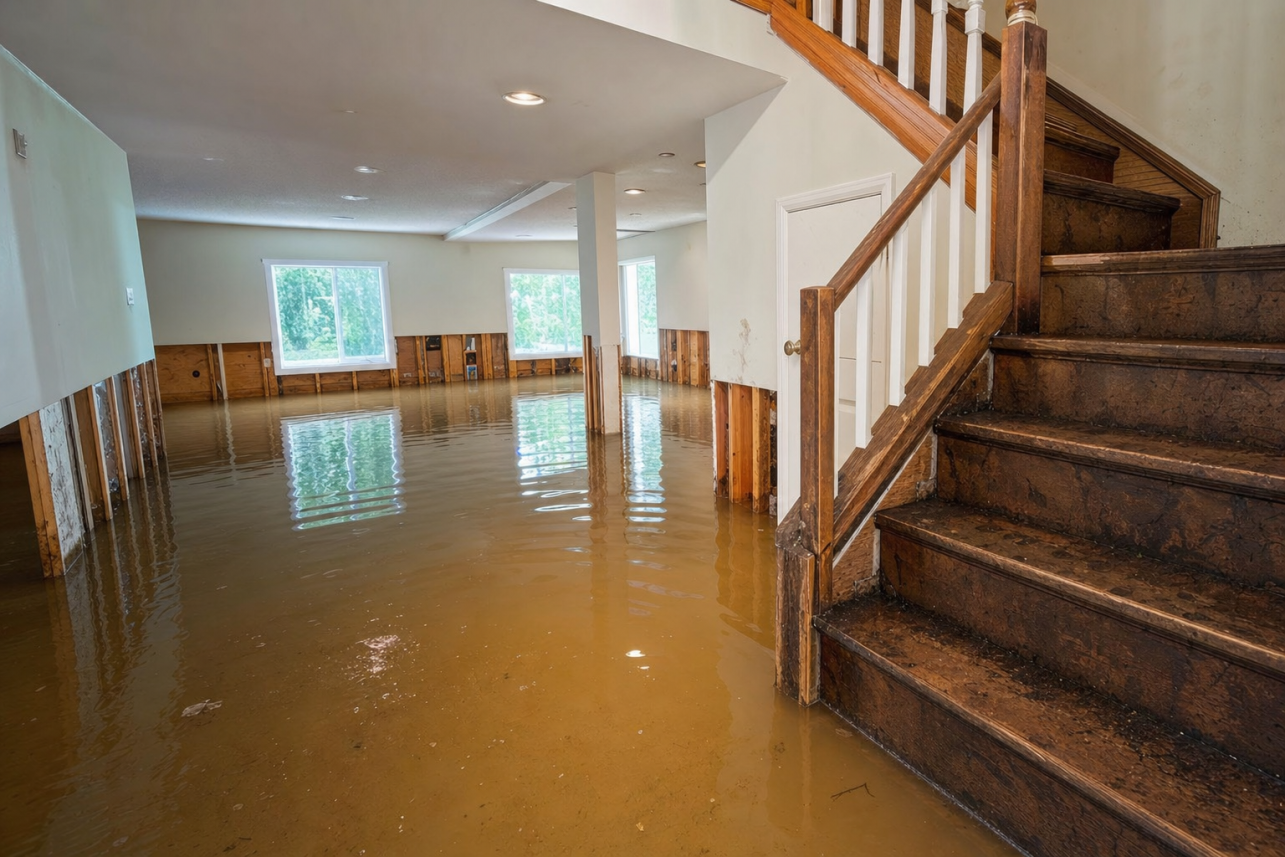
Flood damage claim help Mebane NC homeowners need most often comes down to three things: documenting the damage correctly, meeting the strict federal paperwork deadlines, and pushing back when the payout doesn't cover the real cost of repairs. For The Public Adjusters, Inc. is a licensed and bonded public adjusting firm that handles all three on your behalf. We work for you — the policyholder — not the insurance company, and we're paid a contingency fee only from what your claim recovers.
Key takeaways
- For The Public Adjusters, Inc. provides expert flood damage claim help Mebane NC homeowners and businesses can rely on to maximize their insurance settlements.
- As licensed public adjusters, the team works exclusively for policyholders in Mebane and Orange County, NC — never for the insurance company.
- Professional flood damage claim help includes thorough damage documentation, policy review, and negotiation to secure the full payout you're entitled to.
- Flood claims are often underpaid or denied, and having a public adjuster in Mebane, NC can significantly increase your final settlement.
- Contact For The Public Adjusters, Inc. for a free claim review before accepting any flood damage settlement offer from your insurer.
What This Service Is
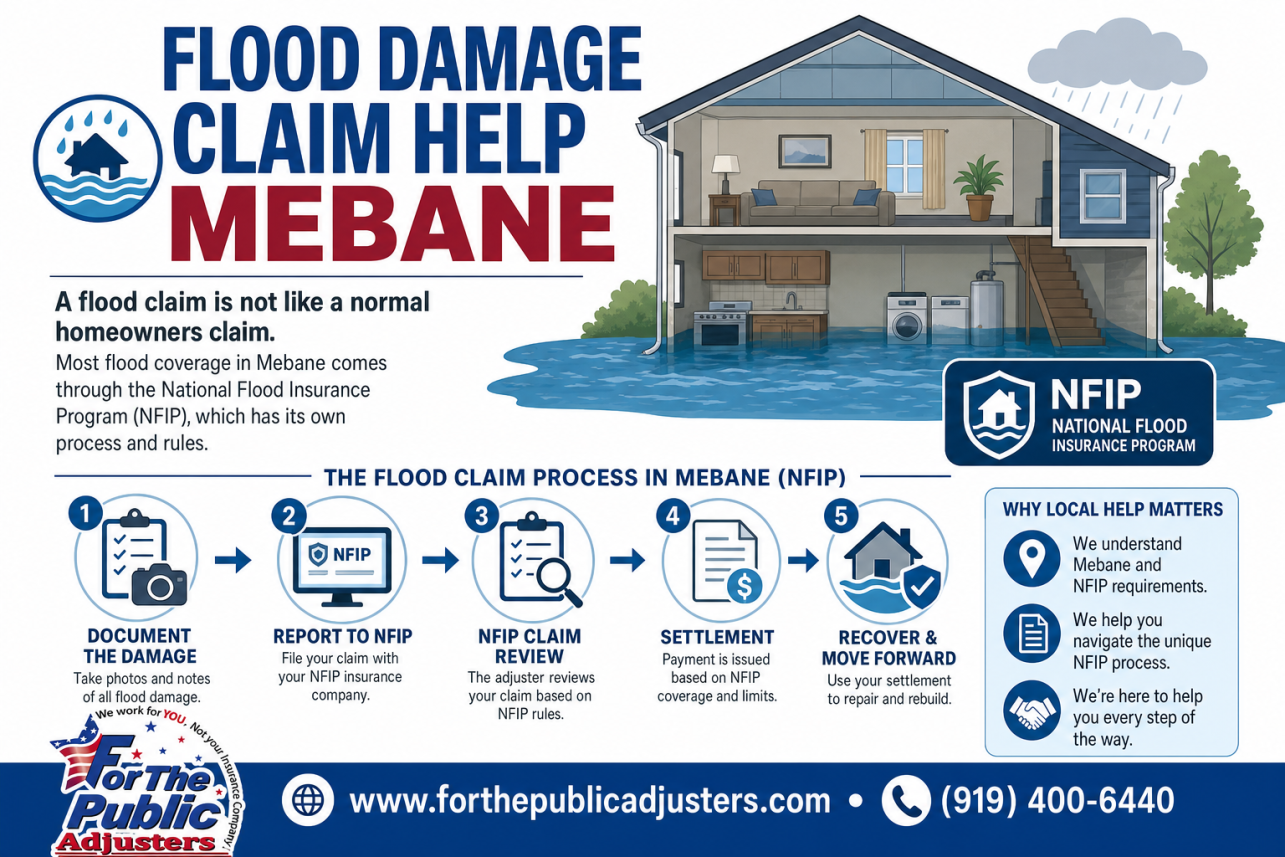
A flood claim is not like a normal homeowners claim. Most flood coverage in Mebane comes through the National Flood Insurance Program (NFIP), which has its own rules, its own forms, and a firm deadline for submitting a signed, sworn proof of loss — usually just 60 days after the flood. Miss that window or fill it out wrong, and even a legitimate claim can be denied.
As your public adjuster, we take that burden off you. We read your flood policy line by line, inspect and photograph the structural damage, build a room-by-room inventory of ruined belongings, and prepare independent repair estimates that reflect what rebuilding actually costs in Alamance and Orange County today — not what a software program says it should cost.
Then we present that documentation to your insurer, negotiate the settlement, and if the offer is still short, we handle the appeal. We also help with related losses that often ride along with flooding, including water damage claims, tree damage from the same storm, and commercial business claims for flooded shops and offices. We never promise a specific dollar outcome — no honest adjuster can — but we make sure your claim is measured fully and argued professionally.
Common Problems
Flood Damage Claim Help Mebane NC Policyholders Ask For Most: Fixing A Lowball Offer
The adjuster the insurance company sends works for the insurance company. Their estimate often misses damage hidden inside walls, under floors, and in crawl spaces — common in Mebane's older homes.
When the first check won't come close to covering repairs, you're staring at out-of-pocket costs you never planned for. Courts in North Carolina have sided with policyholders in exactly these disputes. In Gaston County Dyeing Machine Co. v. Northfield Insurance Co., the North Carolina Supreme Court ruled for the insured in a property damage coverage fight, holding that ambiguous policy language must be read in the policyholder's favor. That principle is a real tool — but only if someone on your side knows how to use it.
The 60-Day Proof Of Loss Clock Is Already Running
Federal flood policies require a signed, sworn proof of loss within roughly 60 days of the flood — and that document has to be complete, accurate, and supported by evidence.
Most homeowners are still ripping out soaked drywall and dealing with contractors when that deadline arrives. If the paperwork is late or the numbers are wrong, the claim can be denied outright. We prepare and submit it correctly the first time, so a technicality never costs you the claim.
Mold Doesn't Wait For The Insurance Company
In a Piedmont summer, floodwater plus humidity means mold can start spreading inside wall cavities within days. But flood policies generally won't pay for mold you could have prevented, so waiting for the insurer before drying things out can hurt you twice.
We help you document everything before and during emergency drying, so mitigation happens fast without destroying the evidence your claim depends on. That includes tracking what the water ruined — from HVAC systems in the crawl space to furniture, appliances, and personal belongings on your contents claim.
Our Process
Free Policy Review And Damage Inspection
We start by reading your flood policy — coverage limits, deductibles, and whether contents are insured at actual cash value or replacement cost. That distinction alone can swing a settlement by thousands, because actual cash value subtracts depreciation from everything you own.
Then we inspect the property ourselves, from foundation and subfloor to insulation and wiring, so nothing gets left off the claim.
Documentation, Inventory, And Independent Estimates
We photograph and measure the structural damage, build a detailed personal property inventory with values, and prepare repair estimates based on real local contractor pricing.
This is the evidence package the insurer must respond to. FEMA and flood insurers expect thorough claim documentation, and claims backed by professional-grade files are far harder to shortchange.
Negotiation, Proof Of Loss, And Appeal If Needed
We submit your sworn proof of loss on time, present the full claim to the insurance company, and negotiate the settlement directly so you don't have to.
If the offer is still unfair or the claim is denied, we handle the appeal process, including supplemental documentation and re-inspections. Our fee is a percentage of the recovery — if your claim doesn't pay, neither do we.
| What Happens | Going It Alone | With For The Public Adjusters |
|---|---|---|
| Damage documentation | Carrier's adjuster scopes what's visible above the waterline | Moisture mapping, subfloor readings, and equipment teardowns document hidden damage |
| NFIP proof of loss (60-day deadline) | Homeowner often learns about it after it passes | Filed complete, signed, and on time with full supporting evidence |
| Estimate pricing | Carrier's software pricing, often below local Mebane contractor rates | Line-item estimate built to actual local repair costs and code requirements |
| Denied or lowballed items | Denial usually accepted as final | Formal rebuttals using policy language and the carrier's own file |
| Time cost to you | Dozens of hours of calls, forms, and re-inspections | We handle the carrier; you handle getting your life back |
Commonly Overlooked In The Public Adjusting Industry
- The NFIP 60-day proof of loss deadline — Homeowners assume filing the claim starts the process, not realizing a signed, sworn proof of loss must be submitted within 60 days or supplemental money can be forfeited entirely.
- Moisture migration above the visible waterline — Carriers scope to the stain on the wall, but drywall and insulation wick water 12 to 24 inches higher, and that hidden saturation is where mold starts.
- Silt inside HVAC and electrical equipment — Equipment that still powers on after a flood looks fine from the outside, so nobody opens the cabinet to find the corrosion and contamination already underway.
- The difference between flood coverage and homeowners water coverage — Water often enters a Mebane home from two directions at once, and claims get wrongly denied when damage is assigned to the wrong policy.
- Code-required upgrades during flood repairs — Replacing a submerged panel or reframing a wall triggers current building code requirements that carriers quietly omit unless someone puts them in the estimate.
- Documenting discarded contents before the dumpster arrives — Cleanup crews and exhausted families throw out ruined belongings fast, and contents that were never photographed or inventoried are contents that never get paid.
- Depreciation held back as recoverable — Policyholders see the first check as the final settlement and never file the paperwork to recover the depreciation they're owed after repairs are complete.
- Subfloor and crawlspace drying verification — Once new flooring goes down, trapped moisture underneath is invisible until it rots or molds, so drying should be verified with meter readings, not a visual check.
Case Studies
Case Study #1
Situation: A family off South Fifth Street in Mebane came home after a weekend of heavy rain to find nearly eight inches of standing water in their finished basement. The water had come up through the slab and a walkout door after Back Creek overflowed.
Problem: Their flood carrier's field adjuster spent forty minutes on site and issued an estimate of $11,400 — enough to tear out carpet and drywall two feet up, but nothing for the HVAC air handler, the electrical panel that had been partially submerged, or the engineered flooring upstairs that wicked moisture through the subfloor.
Investigation: We brought in moisture mapping equipment and documented readings in the subfloor and wall cavities well above the two-foot flood line the carrier had used. We photographed silt lines inside the air handler cabinet and pulled the panel cover to document corrosion already forming on the breaker bus.
Findings: The carrier's scope stopped at the visible waterline instead of the actual moisture migration line. NFIP guidelines allow replacement of electrical components and mechanical equipment that contacted floodwater, and both had — the carrier's adjuster simply never opened them up.
Solution: We rebuilt the estimate line by line under NFIP pricing, added the air handler replacement, panel replacement, subfloor drying and engineered flooring, and submitted a documented proof of loss before the strict 60-day NFIP deadline with supporting photos and moisture logs.
Outcome: The claim settled at $47,900 — more than four times the original offer — and the family was able to replace the HVAC system before summer instead of patching around it.
Lesson: Floodwater travels farther than the stain it leaves. If the estimate stops at the visible waterline, money is almost certainly being left inside the walls and equipment.
Case Study #2
Situation: The owner of a small machine shop near the Mebane Oaks Road corridor had six inches of water move through his building during a flash flood. Inventory, two CNC machines, and the office buildout all took water.
Problem: His commercial flood policy claim stalled for three months. The carrier kept requesting the same documentation in different formats, then denied the machinery portion outright, claiming the damage was 'pre-existing wear' rather than flood-related.
Investigation: We pulled the machines' maintenance logs, obtained a written assessment from an industrial equipment technician confirming water intrusion in the spindle housings and control cabinets, and cross-referenced the carrier's own field photos, which clearly showed silt residue inside the electrical enclosures.
Findings: The 'wear' opinion came from a desk adjuster who never saw the equipment. The carrier's own site photos contradicted its denial letter, and the policy contained business personal property coverage that fully applied to the machinery.
Solution: We filed a formal proof of loss with the technician's report attached, itemized the inventory loss from purchase records, and invoked the appraisal-style review process available under his policy when the carrier wouldn't move.
Outcome: The machinery denial was reversed and the claim settled at $212,000, including business personal property and code-required electrical upgrades. The shop reopened within the same quarter.
Lesson: A denial letter is an opinion, not a verdict. When the carrier's own file contradicts its conclusion, a properly documented rebuttal changes the outcome.
| Item Touched by Floodwater | Usually Salvageable? | What It Depends On | Claim Tip |
|---|---|---|---|
| Drywall and insulation | No — cut out to above the moisture line | Floodwater is Category 3; wet insulation never fully dries | The cut line should follow moisture readings, not the visible stain |
| Hardwood or engineered flooring | Rarely | Cupping and subfloor moisture usually appear days later | Get moisture readings before it's dried out — evidence disappears fast |
| HVAC air handler and ductwork | Sometimes ducts, rarely the unit | Whether silt and water reached internal components | Insist the cabinet be opened and photographed, not judged from outside |
| Electrical panels, outlets, wiring | No, if submerged | Corrosion starts immediately even if it still works today | Code upgrades required at replacement are often claimable |
| Kitchen cabinets | Sometimes uppers, rarely lowers | Particleboard swells permanently; solid wood may survive | Matching rules can mean full-run replacement, not just wet boxes |
| Appliances and water heater | Usually no | Submerged motors, insulation, and gas valves are unsafe to reuse | Claim at replacement cost with model numbers, not a flat allowance |
| Concrete slab and foundation | Yes, structure usually fine | Silt removal and sealing still cost real money | Cleaning, disinfecting, and sealing belong in the estimate |
| Personal property and documents | Case by case | Porous items absorb contaminated water and can't be sanitized | Photograph everything before disposal — discarded items still get paid |

Reviews
After the creek behind our house flooded, our insurance company offered us less than a third of what the repairs actually cost. For The Public Adjusters found floodwater damage in our crawlspace and ductwork that the first adjuster never even looked at. Our final settlement covered everything, including the ducts. I honestly didn't know a homeowner could hire their own adjuster until a neighbor told me.
Darlene W., Mebane
The 60-day proof of loss deadline on our NFIP flood claim almost sank us — nobody at the insurance company mentioned it until it was nearly too late. These folks stepped in, rebuilt the whole estimate with moisture readings and photos, and got it filed with days to spare. The difference between the carrier's first number and where we ended up was over $30,000.
Marcus T., Orange County
Our flood claim on a rental property in Mebane was denied because the carrier said the water came from 'surface runoff' and not flooding. For The Public Adjusters knew exactly how the flood definition worked and proved the denial was wrong using rainfall data and the carrier's own inspection notes. Denial reversed, claim paid. Four stars only because the process still took a couple of months, but that was the insurance company dragging, not them.
Renee H., Mebane
Frequently Asked Questions
How Do I Get Flood Damage Claim Help In Mebane NC After My Home Floods?
Start by calling For The Public Adjusters, Inc. before you sign anything from your insurance carrier or accept a first offer. We provide flood damage claim help Mebane NC homeowners can rely on from the very first day, beginning with a free review of your policy and the damage itself.
Our process starts with a walkthrough of your property. Flooding in Mebane often comes from heavy tropical remnants pushing Back Creek and low-lying drainage areas past capacity, and water finds its way into crawl spaces, subfloors, and wall cavities where carriers frequently under-scope the damage. We document everything with moisture readings, photos, and a detailed line-item estimate.
Next, we determine whether your loss falls under an NFIP flood policy, a private flood policy, or a homeowners policy with an endorsement, because each has different deadlines and proof-of-loss rules. NFIP claims, for example, generally require a signed proof of loss within 60 days, and missing that window can sink an otherwise valid claim.
From there, we handle communication with the carrier's adjuster, attend inspections on your behalf, and negotiate the settlement. You focus on your family and your home; we handle the paperwork, the pushback, and the follow-up. Most Mebane clients tell us the biggest relief is simply not having to argue with the insurance company alone.
What Does A Public Adjuster In Mebane Charge For A Flood Claim, And Is It Worth It?
For The Public Adjusters, Inc. works on a contingency fee, meaning we're paid a percentage of what we recover for you. There are no upfront costs, no hourly billing, and no fee at all if we don't recover anything. The percentage is agreed to in writing before we start, so there are never surprises.
Is it worth it? For most flooded properties in Mebane, yes, and often significantly so. Carrier adjusters frequently miss damage that's common in this area: saturated insulation in crawl spaces under older homes near downtown, wicking in drywall above the visible waterline, damaged HVAC ductwork running under the house, and contaminated flooring that must be replaced rather than dried. Each missed item is money left on the table.
We also know how flood settlements are calculated. NFIP policies pay actual cash value on many items, and depreciation is where homeowners lose the most. We challenge excessive depreciation, document the true age and condition of materials, and push for correct pricing based on real Orange County and Alamance-area contractor costs, not outdated software defaults.
In practical terms, our clients typically recover far more than they would have on their own, even after our fee. Just as important, you avoid the missed deadlines and paperwork errors that get flood claims denied outright. When your largest asset is soaked, professional representation usually pays for itself many times over.
My Flood Claim Was Underpaid Or Denied. Can Your Adjusters Still Step In?
Yes. A large share of our work in Mebane involves claims that were already denied, delayed, or settled for far less than the real cost of repairs. A lowball check or a denial letter is not the end of the process, and in many cases it's just the carrier's opening position.
When you bring us an underpaid claim, we start by comparing the carrier's estimate against the actual damage. We re-inspect the property, take fresh moisture and mold readings where relevant, and build our own detailed scope. It's common to find entire categories missing from the insurer's estimate, such as subfloor replacement, electrical inspection after submersion, or code-required upgrades during repairs.
For denials, we dig into the stated reason. Flood denials often hinge on disputes over the source of water, whether it was surface flooding versus a plumbing failure or wind-driven rain, and that distinction determines which policy responds. We gather weather data, engineering input when needed, and documentation to challenge an incorrect determination.
Timing matters, though. Flood policies have strict deadlines for proof of loss, supplements, and appeals, and North Carolina statutes limit how long you have to dispute a claim. If your Mebane property flooded months ago and the settlement never covered the repairs, call For The Public Adjusters, Inc. now rather than later. We can usually tell you within one conversation whether the claim can be reopened and what it will take.
Does Homeowners Insurance Cover Flooding In Mebane, Or Do I Need Separate Flood Damage Claim Help?
Standard homeowners policies in North Carolina almost never cover rising water from outside the home. Flooding from overflowing creeks, storm surge runoff, or saturated ground pooling against your foundation requires a separate flood policy, usually through the National Flood Insurance Program or a private flood carrier. This surprises many Mebane homeowners, especially those outside mapped flood zones who flooded anyway during heavy tropical rain events.
That said, the line between covered and excluded water damage is where claims get complicated, and where flood damage claim help Mebane NC property owners often needs the most. If wind tore off shingles and rain entered through the roof, that's typically a homeowners claim. If a storm knocked out power and your sump pump failed, coverage depends on your endorsements. If water backed up through a floor drain, that may fall under a sewer backup endorsement. Carriers sometimes point to the flood exclusion to deny damage that actually has a covered cause.
For The Public Adjusters, Inc. sorts this out for you. We read the actual policy language, identify every coverage that could apply, and pursue each one properly. Some Mebane losses involve two claims at once, a flood policy for rising water and a homeowners policy for wind or interior water damage, and coordinating both correctly prevents each carrier from pointing at the other.
If you're unsure what your policy covers, we'll review it at no cost before disaster strikes or after, and tell you plainly where you stand.
How Long Does A Flood Claim Take To Settle In Mebane, And Can Flood Damage Claim Help Mebane NC Speed Things Up?
A straightforward flood claim in Mebane typically settles in 45 to 90 days, but claims involving structural damage, mold growth, or disputes over the water source can drag on for six months or more. NFIP claims add their own pressure: federal rules require a signed, sworn Proof of Loss within 60 days of the flood, and missing that deadline can sink an otherwise valid claim.
Professional flood damage claim help Mebane NC makes the biggest difference in the first two weeks. When For The Public Adjusters, Inc. is brought in early, we document the loss before repairs alter the evidence, prepare the Proof of Loss correctly the first time, and submit a complete, line-item estimate the carrier can't easily kick back for missing information. Incomplete files are the number one reason claims stall.
We also handle every follow-up. Insurers often go quiet after the initial inspection, and homeowners in Orange County frequently wait weeks for a response that never comes. Our adjusters set deadlines in writing, escalate when the carrier misses them, and keep the file moving.
Realistically, we can't promise a specific date, because carrier response times vary. What we can do is eliminate the delays caused on the policyholder's side and push back immediately when the insurer creates delays on theirs. Most of our Mebane flood clients see movement within days of our involvement, simply because the carrier now knows someone is watching the clock.
What Should I Document Before Your Adjusters Arrive At My Flooded Mebane Home?
Start with photos and video before you touch anything. Walk every affected room slowly, filming baseboards, flooring, drywall, cabinets, and contents where they sit. Capture the waterline on walls and foundation, standing water depth, and any water still entering the home. Exterior shots of your yard, crawlspace vents, and the street help establish how the water arrived, which matters enormously for coverage.
Next, protect the property without destroying evidence. You have a duty to mitigate, so it's fine to extract standing water, run fans, and move soaked belongings, but don't throw anything away yet. Cut samples of wet carpet and flooring can be kept in a garage or shed. If drywall must be cut, photograph each section first with something showing scale, like a tape measure.
Keep every receipt: water extraction, dehumidifier rentals, tarps, hotel stays, even meals if you're displaced. These fall under different coverage categories, and our team at For The Public Adjusters, Inc. sorts them so nothing gets missed.
Finally, gather your policy declarations page, any prior inspection reports, and photos of the home before the flood if you have them. Pre-loss photos are gold when a carrier argues damage was pre-existing.
When we arrive at your Mebane property, we bring moisture meters, thermal imaging, and detailed scoping tools, so don't worry if your documentation is imperfect. Anything you capture in those first hours simply strengthens the file we build for you.
My Insurer Says The Damage Came From Groundwater, Not The Storm. How Do You Fight That In Mebane?
This is one of the most common flood claim disputes we see in Mebane, especially in neighborhoods near Mill Creek, Moadams Creek, and the low-lying areas off Highway 70. Carriers know that most flood policies distinguish between surface flooding, groundwater seepage, and sewer backup, and each category triggers different coverage. Labeling your loss as 'seepage' or 'hydrostatic pressure' is often a shortcut to a denial.
Our adjusters fight this with evidence, not arguments. We document waterlines inside and outside the structure, map the flow path across your lot, pull rainfall data and creek gauge readings for the date of loss, and photograph neighboring properties that flooded the same way. When the water clearly moved across the surface before entering your home, the seepage label doesn't hold up.
We also read the policy language itself, closely. Many denials cite exclusions that don't actually apply to the facts, or ignore exceptions written into the same clause. NFIP policies in particular define 'flood' in a specific way, and homes in Mebane's mapped flood zones often meet that definition even when the carrier's field adjuster says otherwise.
If the carrier won't move, For The Public Adjusters, Inc. can bring in independent engineers or hydrologists to establish causation formally. That level of documentation changes the conversation. A dispute that started as your word against theirs becomes a technical file the insurer has to answer on the merits, and that's where wrongly denied claims get paid.

Can You Handle Flood Claims For Mebane Businesses And Rental Properties, Not Just Homes?
Yes. For The Public Adjusters, Inc. represents commercial property owners, landlords, and business operators throughout Mebane and the surrounding Orange and Alamance County area, and these claims are frankly where a public adjuster earns their fee many times over.
Commercial flood losses involve layers a residential claim doesn't. Beyond the building itself, there's business personal property, tenant improvements, inventory at cost versus retail value, and business interruption or loss of rents. Carriers routinely undervalue these categories or deny them outright because the documentation requirements are demanding. We build the financial side of the claim with profit-and-loss records, rent rolls, and inventory logs, then defend those numbers through the negotiation.
For landlords, we handle the lost-rents calculation and coordinate documentation across multiple units, which matters for the duplexes and small multifamily properties common around downtown Mebane. For retail and restaurant owners along the commercial corridors, we push for a claim scope that gets you reopened quickly, because every closed day compounds the loss.
We also manage the coverage maze. Many Mebane businesses carry an NFIP commercial policy plus excess flood coverage or a business owner's policy with limited water endorsements, and losses often have to be allocated correctly across them. Get that allocation wrong and money is left on the table.
Our fee remains a percentage of what we recover, so there's no upfront cost while your revenue is disrupted. If your commercial property took on water, call us before you sign anything the carrier sends over.
Do You Handle NFIP Flood Claims, Or Only Private Flood Insurance Policies In Mebane?
We handle both, and the distinction matters more than most Mebane homeowners realize. Many flood policies here are written through the National Flood Insurance Program, and NFIP claims follow strict federal rules that don't apply to standard homeowners insurance.
The biggest trap is the Proof of Loss deadline. NFIP requires a signed, sworn Proof of Loss — with full documentation of your damages — typically within 60 days of the flood. Miss it or submit an incomplete one, and you can lose the right to recover money you were otherwise owed. We prepare that document correctly and on time, every time.
NFIP policies also exclude or limit items people assume are covered, like most basement contents, and they pay actual cash value on certain property rather than replacement cost. Knowing where those lines fall lets us build a claim that maximizes what the policy actually allows instead of leaving recoverable dollars on the table.
Private flood policies are different animals altogether. Coverage terms, deadlines, and dispute procedures vary carrier by carrier, and some offer broader protection than NFIP if you know how to invoke it.
When you call For The Public Adjusters, Inc., the first thing we do is read your actual policy — declarations, forms, and endorsements — so our strategy fits the contract you have, not a generic checklist. That policy-first approach is where a Mebane flood claim is won or lost.
Should I Start Cleaning Up And Making Repairs Before My Flood Claim Is Settled?
You should mitigate, but you should not fully repair — and knowing the difference protects your claim. Your policy requires you to take reasonable steps to prevent further damage. In practical terms for a flooded Mebane home, that means extracting standing water, running dehumidifiers and fans, and removing soaked carpet or drywall that will breed mold in North Carolina's humidity within 48 to 72 hours.
What you should not do is rebuild before the damage has been properly documented and measured. Once new drywall goes up, proving the true scope of the loss becomes much harder, and carriers use that gap to justify lower payments.
Here's how we recommend handling it. Photograph and video everything before you touch it. Cut flood-damaged drywall in clean, straight lines and keep sample sections. Don't haul debris to the curb until it's been documented — ideally, keep damaged contents in the garage or yard until an inspection happens.
Save every receipt for water extraction, tarps, dehumidifier rentals, and emergency labor. Those mitigation costs are typically reimbursable, but only if you can prove them.
If a restoration company is pressuring you to sign a broad work authorization on the spot, slow down. Some contracts assign your insurance benefits away or lock you into pricing before coverage is confirmed. Call our adjusters first — we can usually tell you within one conversation what to do today and what to hold off on until the claim is positioned properly.
The Insurance Company's Adjuster Already Inspected My House. Why Would I Need Flood Damage Claim Help Mebane NC On Top Of That?
Because the adjuster who inspected your house works for the insurance company, not for you. That's not an accusation of bad faith — it's simply how the system is built. Their estimate reflects the carrier's interests, their pricing software settings, and often a 20-minute walkthrough of damage that deserves hours of inspection.
Flood losses are especially easy to underscope. Water wicks up inside wall cavities well above the visible flood line. It saturates insulation, subfloors, sill plates, and ductwork under the house — all common in Mebane's crawl-space construction. A quick inspection that measures only the stained drywall can miss half the real damage.
When we provide flood damage claim help Mebane NC homeowners get an independent, line-by-line estimate built from moisture readings, thermal imaging where appropriate, and current local repair pricing — not the carrier's default numbers. We then compare our scope against theirs and negotiate the difference with documentation, not opinions.
It's also worth knowing that an initial payment is not a final payment. Accepting the first check generally doesn't close your claim, and supplemental claims are routine when new damage is uncovered during repairs.
If the carrier's estimate genuinely covers your loss, we'll tell you that honestly and you've lost nothing but a phone call. But in our experience reviewing flood estimates in Orange and Alamance counties, the first offer rarely reflects the full cost of putting a home back the way it was.
I Live Just Outside Mebane City Limits — Do Your Adjusters Still Cover My Area?
Yes. Mebane sits right on the Orange and Alamance county line, and we work flood claims on both sides of it. Whether you're in a downtown neighborhood, out along Highway 70, near Efland, Buckhorn, or in the rural stretches between Mebane and Hillsborough, our adjusters will come to you.
That local footprint matters for flood claims specifically. Properties near creeks and low-lying drainage areas around Mebane flood differently than homes hit by wind-driven rain, and carriers scrutinize the water source closely because it determines which policy responds. An adjuster who knows the local terrain and drainage patterns can document the cause of loss far more convincingly than one working from photos alone.
Being nearby also means we can move fast. After a major storm, out-of-town adjusters get booked out for weeks while your home sits wet and your Proof of Loss clock keeps running. We can typically inspect quickly, get moisture readings while the evidence is fresh, and attend the carrier's inspection alongside you so nothing gets minimized on-site.
We also understand local rebuilding costs. Repair pricing in the Triangle and Triad corridor has climbed sharply, and estimates built on outdated or regional-average pricing consistently come in short. Our scopes use what contractors in this area actually charge.
If you're unsure whether your address falls within our service area, call For The Public Adjusters, Inc. and ask. If your property flooded anywhere in or around Mebane, the answer is almost certainly yes.
What Is A Proof Of Loss, And Can Flood Damage Claim Help Mebane NC Keep Me From Missing The Deadline?
A proof of loss is a sworn, signed statement of the dollar amount you are claiming, and it is the single most missed requirement on flood claims. Under NFIP rules you generally have just 60 days from the date of loss to submit it, and an incomplete or late filing can sink an otherwise valid claim.
That is exactly where flood damage claim help Mebane NC makes the biggest difference. We prepare the proof of loss for you, backing every line with a room-by-room scope, measurements, photos, and unit pricing that matches what contractors actually charge in Alamance and Orange County. A vague number gets rejected; a documented one gets paid.
Many Mebane homeowners assume the insurance company's adjuster handles this paperwork. They do not — the burden is entirely on you as the policyholder. We have seen families near Mill Creek and downtown lose thousands simply because their submission left out flooring underlayment, insulation, or code-required electrical work.
If your deadline is approaching, call us immediately. We can request extensions in writing when circumstances justify it, and we can file a partial proof of loss to protect your position while the full damage assessment is completed. If you already submitted one and now realize it was too low, we can prepare a supplemental proof of loss for the difference. The key is acting before the window closes, not after.
Water Sat In My Mebane Home For Days And Now I'm Seeing Mold. Will The Flood Policy Pay For That?
It can, but only if the mold is tied directly to the flood event and you acted reasonably to prevent it. Flood policies typically exclude mold that results from a policyholder's failure to mitigate — meaning if you left the house wet for weeks without drying it out, the carrier will push back hard.
The good news for Mebane homeowners is that mold appearing within days of a flood, before you could reasonably access or dry the property, is usually compensable. Our adjusters document the timeline carefully: when the water receded, when you regained access, when drying began, and moisture readings inside wall cavities that prove the contamination stems from floodwater, not a pre-existing condition.
Mold remediation is expensive in this area — proper containment, HEPA filtration, removal of affected drywall and insulation, and post-remediation testing can run well into five figures on a single-story home. Carriers often offer a token cleaning allowance instead. We price the full remediation protocol and fight for it line by line.
One practical tip: do not paint over or seal moldy surfaces before the damage is inspected and photographed. It destroys the evidence you need. Ventilate, run dehumidifiers, and photograph everything, but leave demolition of visibly contaminated materials until it has been documented. If the carrier has already denied your mold-related damages, we can often reopen that portion of the claim with proper industrial hygienist support.
My House May Be Declared Substantially Damaged. What Is ICC Coverage And How Do You Help Me Claim It?
ICC stands for Increased Cost of Compliance, and it is a separate pot of money — up to $30,000 under most NFIP policies — that many flooded homeowners never know exists. It pays toward the cost of bringing your home into compliance with floodplain regulations when local officials declare it substantially damaged, generally meaning repair costs exceed 50% of the structure's market value.
For a Mebane property in or near a flood zone, that money can fund elevating the home, relocating it, floodproofing, or in some cases demolition. It is paid in addition to your building claim, but it requires its own documentation trail: a substantial damage determination letter from the local floodplain administrator, compliant repair plans, and a separate proof of loss.
Our adjusters coordinate that entire process. We work with the town's permitting office and the county floodplain administrator to obtain the determination, then assemble the contractor estimates and engineering documentation the carrier requires before releasing ICC funds. Timing matters — the compliance work usually must be completed within a set period, so we get the paperwork moving early rather than after your main claim settles.
We also make sure your underlying building claim is maximized first, because an artificially low damage estimate can prevent you from crossing the 50% threshold and cost you the ICC benefit entirely. If you have received a letter mentioning substantial damage or a repair permit hold, bring it to us before you respond.
The Storm Brought Both Wind And Flooding. Do I File One Claim Or Two, And Who Sorts Out Which Policy Pays?
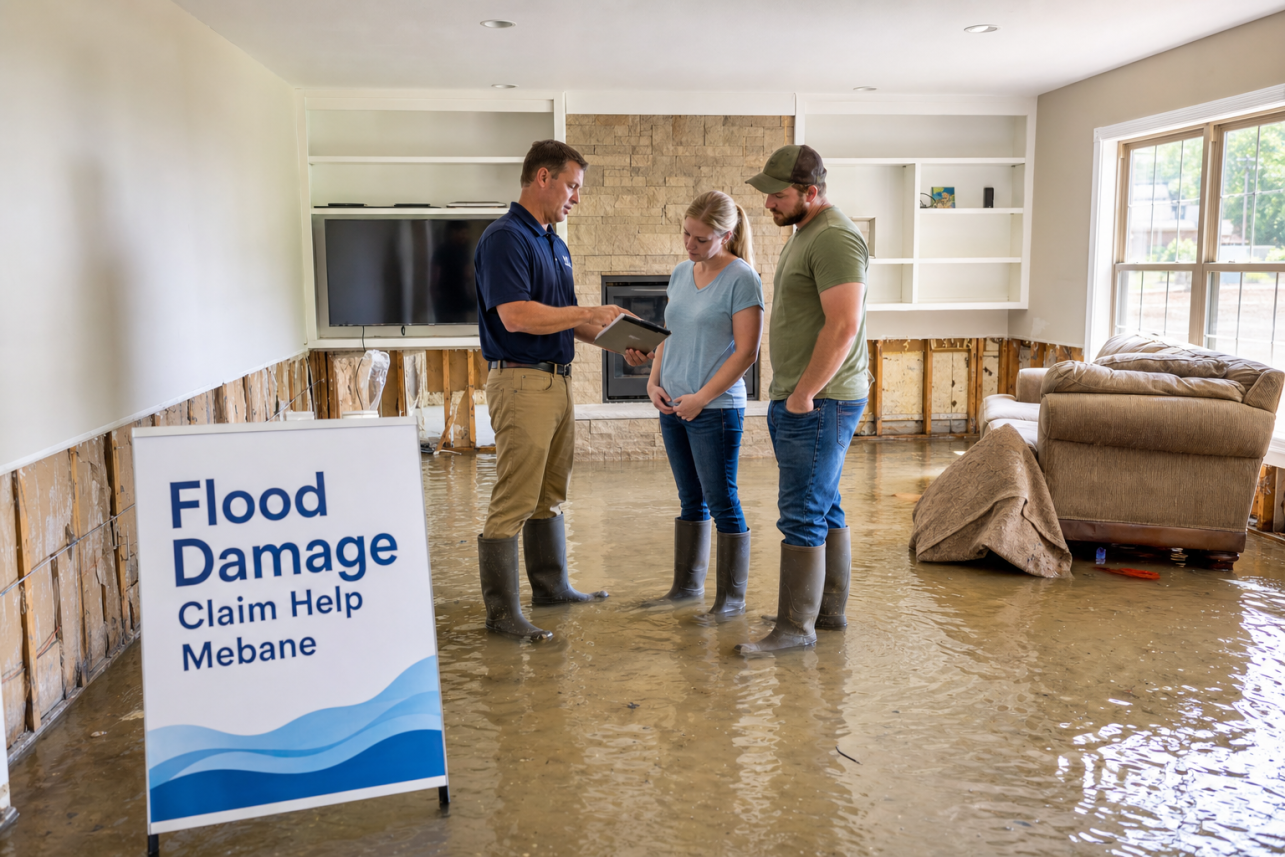
You file two separate claims — one under your homeowners policy for wind damage, and one under your flood policy for rising water — and this is where things get contentious fast. Each carrier has a financial incentive to blame the other peril, and homeowners in Mebane can get caught in the middle with both companies pointing fingers.
A classic example: wind tears shingles off the roof and rain enters from above, while floodwater rises through the first floor. The roof, attic, and upper-wall damage belong on the homeowners claim; the flooring, lower drywall, and contents soaked by rising water belong on the flood claim. Drawing that line accurately, room by room, is technical work — and if it is drawn wrong, damage falls into a gap and nobody pays.
When you bring in flood damage claim help in the Mebane area from our team, we manage both claims in parallel. We map the water lines, analyze the direction and source of intrusion, and prepare two separate scopes so each carrier receives exactly the damage its policy covers. That prevents the double-denial trap where the wind carrier calls everything flood and the flood carrier calls everything wind.
We also track the different deadlines, deductibles, and documentation rules for each policy, since NFIP requirements differ sharply from standard homeowners procedures. Handled together and handled early, dual-peril claims from the same storm typically recover far more than homeowners manage when juggling two adjusters and two sets of paperwork alone.
Local Relevance
Mebane sits in the rolling Piedmont between the Triangle and the Triad, and summer here brings the two things that flood houses: slow-moving severe thunderstorms and the soaked remnants of tropical systems drifting up from the coast. When several inches of rain fall in an afternoon, the creeks and low-lying yards around town fill fast, and water finds its way into basements, crawl spaces, and slab-on-grade additions.
A lot of Mebane's housing stock — from older mill-era homes near downtown to newer subdivisions built during the area's recent growth — was never designed with flooding in mind. And because standard homeowners policies exclude flood, many families discover after the water recedes that their only path to recovery runs through a federal flood policy with its own strict rules.
One more local wrinkle: many Mebane homeowners assume they don't need flood insurance because they're outside a mapped high-risk zone. Yet flooding regularly hits properties well outside those zones, and new NFIP policies typically carry a 30-day waiting period — so the time to sort out coverage is before hurricane season peaks, not after the storm.
Many homes around Mebane rely on vented crawl spaces, and in a humid Piedmont summer, floodwater trapped under the house often goes unnoticed until subfloors cup and ductwork corrodes — damage insurers frequently undervalue because it isn't visible from the living space. Insisting on a full under-house inspection before agreeing to any flood settlement tends to be where local claims gain the most ground.
Flooded In Mebane? Talk To An Adjuster Who Works For You
The proof of loss deadline is running and mold won't wait. For The Public Adjusters, Inc. is licensed and bonded, and your consultation costs nothing. We review your flood policy, inspect the damage, and tell you honestly where your claim stands — before you sign anything the insurance company puts in front of you.
Call us: (919) 400-6440
Helpful Resources
- National Flood Insurance Program (NFIP)
- Federal Emergency Management Agency (FEMA)
- FEMA flood insurance information — FEMA's overview of flood insurance, claims, and policyholder resources
Last updated: July 25, 2026