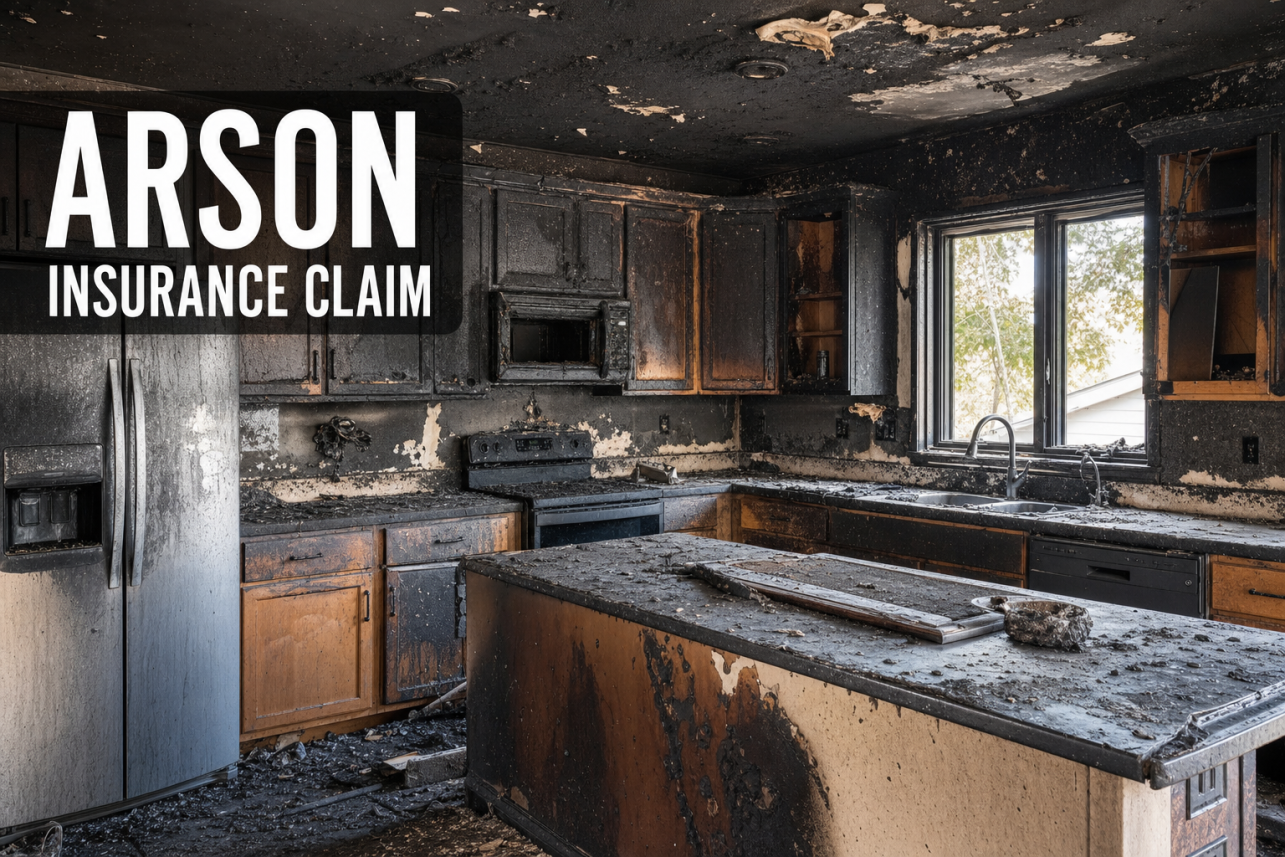
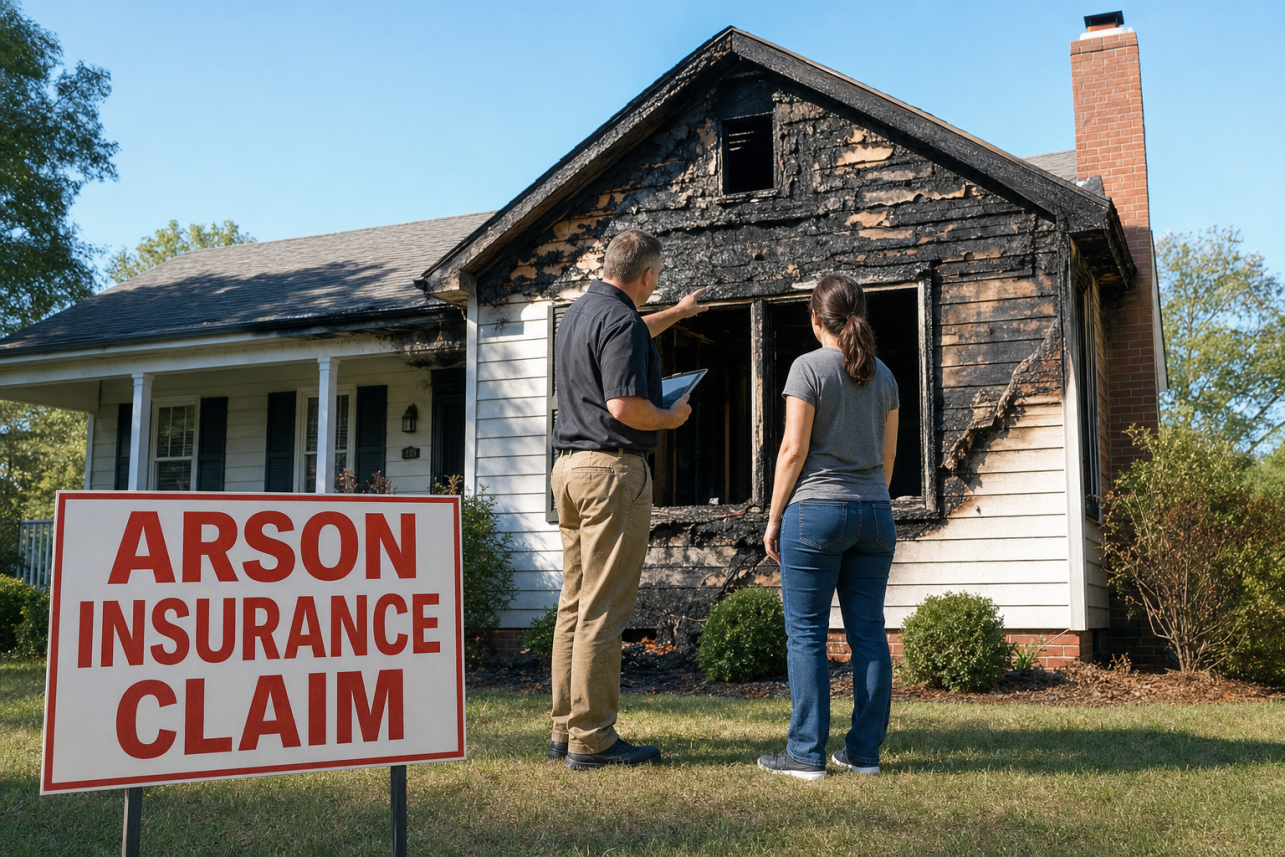
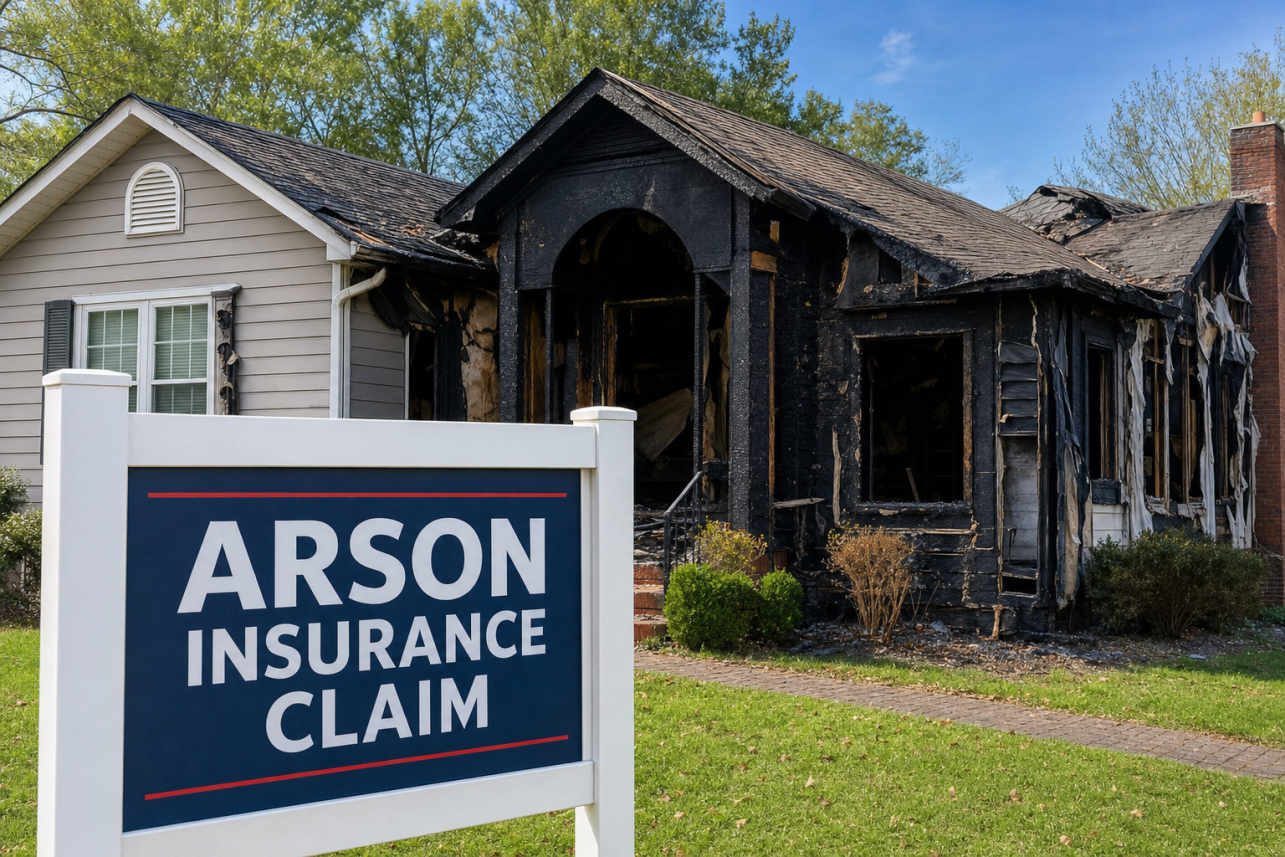
If you are facing an arson insurance claim Pittsboro insurers are refusing to pay because they suspect you started the fire, you have the right to push back — and the burden of proving arson rests on the insurance company, not on you. For The Public Adjusters, Inc. is a licensed and bonded public adjusting firm that represents Chatham County homeowners, not the insurer. We document the loss, challenge unsupported accusations, and negotiate the claim on your behalf.
What This Service Is
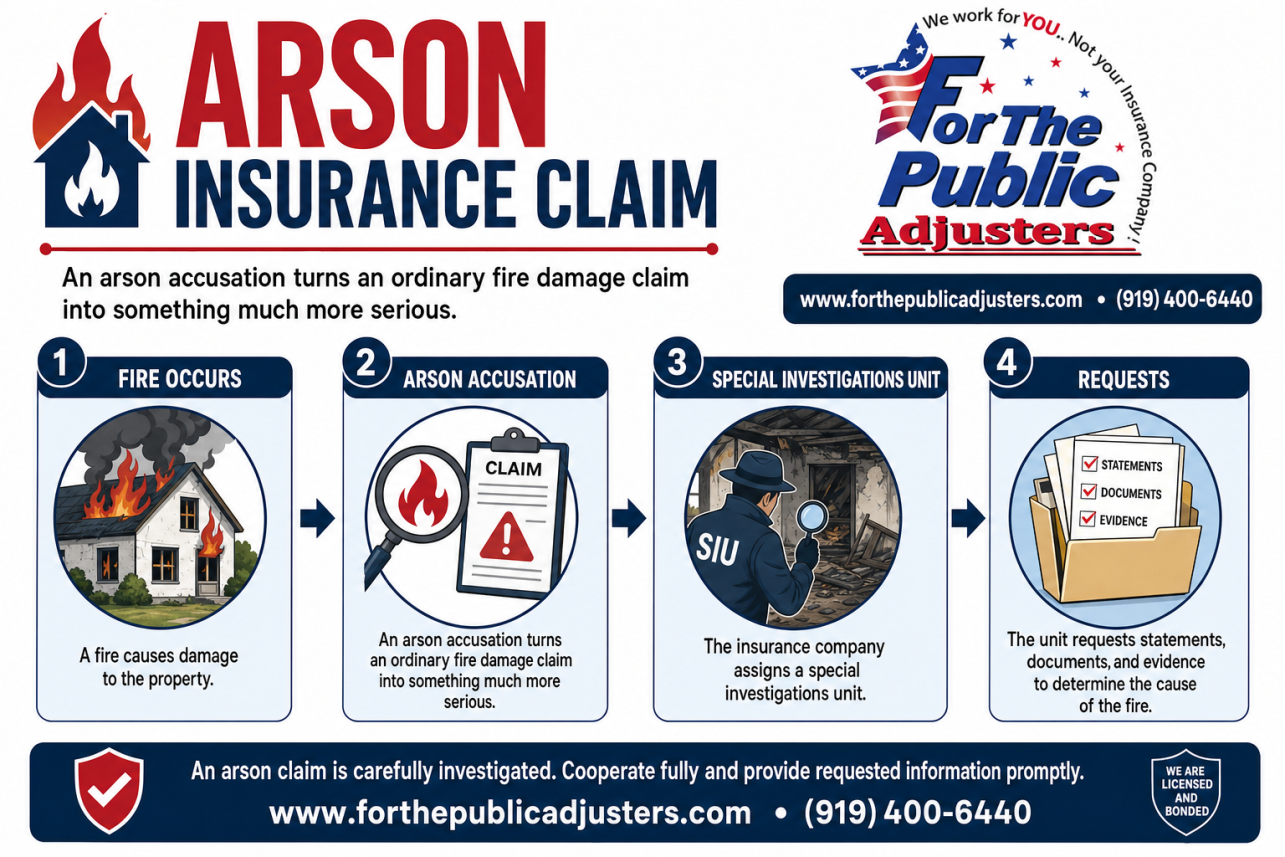
An arson accusation turns an ordinary fire damage claim into something much more serious. The insurance company assigns a special investigations unit, requests examinations under oath, demands financial records, and often delays or denies payment while it builds a theory that the policyholder had motive and opportunity.
A public adjuster works exclusively for you, the policyholder. We review your policy language, inventory your damaged contents, document structural and smoke damage, and manage every communication with the carrier so nothing you say is taken out of context.
In North Carolina, public adjusters are licensed and regulated, and the NCDOI Public Adjusters Guide explains exactly what we are permitted to do on your behalf — including negotiating the settlement directly with your insurer. That oversight matters when the stakes are this high.
Importantly, an accusation is not proof. Courts have repeatedly required insurers to establish incendiary origin, motive, and opportunity with real evidence before denying a fire loss. In the landmark case Anderson v. Continental Insurance Co., the Wisconsin Supreme Court recognized that a policyholder whose property claim is wrongfully denied can hold the insurer accountable for bad faith — a principle that has shaped first-party claim law nationwide. We build the factual record that makes unsupported denials very hard to defend.
Common Problems
What Is My Fire Loss Actually Worth If The Insurer Is Calling It Arson?
The accusation itself does not shrink your coverage. Your policy still owes for the dwelling, detached structures, contents, smoke and soot damage, and often additional living expenses while your home is uninhabitable.
What happens in practice is different: carriers under suspicion of fraud often lowball the structural estimate, skip contents entirely, or cut off temporary housing early. We prepare an independent, line-item valuation of the full loss — including hidden smoke damage in walls, ductwork, and insulation — so the number on the table reflects what the policy actually promises. We can never guarantee a specific outcome, but we make sure nothing covered is left off the estimate.
The Arson Insurance Claim Pittsboro Insurers Keep Stalling — What Do I Do?
Delay is the most common tactic in a suspected-arson file. The carrier requests document after document, schedules an examination under oath, then goes quiet for months while the mortgage and the tarp on your roof both keep costing you.
North Carolina policyholders are entitled to a timely, good-faith investigation. We keep the file moving by responding to every legitimate request quickly and in writing, objecting to fishing expeditions that exceed the policy, and documenting each delay. That paper trail is exactly what pressures a carrier to decide the claim on the evidence — and what supports a bad-faith complaint if it refuses to.
Should I Handle The Accusation Myself Or Hire Someone — And Who?
Going it alone against a special investigations unit is risky. Their investigators do this every day; a homeowner does it once, usually while displaced and grieving the loss of the house.
A good public adjuster is licensed by the state, bonded, works on the policyholder's side only, and has direct experience with fire and arson homeowners claims — not just routine water or tree damage files. Ask any adjuster you interview whether they have handled examinations under oath, whether they coordinate with cause-and-origin experts, and how they document contents losses. Those answers separate a claims professional from a name in a search result.
Our Process
Free Policy And Denial Review
We start by reading your homeowners policy and every letter the carrier has sent — reservation of rights, document requests, or denial. This tells us what the insurer must prove, what deadlines apply, and where its position is weakest.
Independent Documentation Of The Fire Loss
We photograph and inventory the structure and contents, capture smoke and soot damage that surface inspections miss, and prepare a detailed estimate. Where cause and origin is disputed, we help coordinate qualified fire experts whose findings can counter the insurer's investigator.
Negotiation And Resolution
We present the documented claim, respond to the carrier's fraud theory point by point, and negotiate toward a settlement consistent with your policy. If the insurer will not act in good faith, our file becomes the foundation your attorney can take straight into litigation.
| Stage of the Claim | Homeowner Alone | With For The Public Adjusters |
|---|---|---|
| Recorded statements & interviews | Answers open-ended SIU questions unprepared; words often quoted out of context later | Prepared in advance; statements reviewed, transcripts obtained, context protected |
| Fire cause evidence | Relies entirely on the carrier's investigator, who works for the insurer | Independent certified origin-and-cause investigator examines the scene before demolition |
| Document demands | Hands over years of bank, tax, and phone records without knowing what's actually required | Requests evaluated against the policy; only what's legally owed is produced, on our timeline |
| Examination Under Oath | Attends alone, often unaware it can make or break the claim | Fully prepped and accompanied; scope of questioning monitored |
| Proof of loss & valuation | Accepts the carrier's numbers or misses filing deadlines while the accusation drags on | Complete itemized proof of loss filed on time, with delay damages documented |
| Final result | Denial or lowball settlement is common when suspicion goes unchallenged | Carrier forced to prove incendiary origin and involvement — or pay the claim in full |
Commonly Overlooked In The Public Adjusting Industry
- Getting the fire scene independently examined before demolition or cleanup — Once the debris is hauled away the carrier's origin-and-cause report becomes the only version of events, and most homeowners let cleanup start within days.
- Requesting the lab confirmation behind a canine accelerant alert — SIU reports lean heavily on the dog alert while quietly omitting that the debris samples came back negative or were never tested at all.
- The carrier's two-part burden of proof under North Carolina law — Insurers must prove both incendiary origin and the policyholder's involvement, but frightened homeowners act as if suspicion alone can sink the claim.
- Proof of loss deadlines that keep running during the investigation — Homeowners assume the clock pauses while they're under suspicion, and a blown deadline hands the carrier a clean, arson-free reason to deny.
- Full transcripts of recorded statements — Carriers quote fragments out of context in denial letters, and almost no one asks for the complete recording to check what was actually said.
- Overbroad document demands dressed up as policy duties — Five years of bank, tax, and phone records is a fishing expedition, but people hand everything over because refusing 'looks guilty.'
- Additional living expenses and delay damages during a frozen claim — Months of hotel bills, rent, and mortgage penalties caused by the investigation are compensable, yet they rarely make it into the final settlement demand.
- Reservation of rights letters that quietly shift the denial theory — Carriers often pivot from arson to 'misrepresentation' or 'lack of cooperation' mid-claim, and homeowners miss that the goalposts have moved.
Case Studies
Case Study #1
Situation: A retired couple living off Hanks Chapel Road in Pittsboro lost their detached workshop and part of their home's rear wall to a fire that started around 2 a.m. The Chatham County fire marshal noted an accelerant-detection dog alerted near the workshop door, and the insurer's Special Investigations Unit (SIU) took over the file within a week.
Problem: The carrier stopped all payments, demanded an Examination Under Oath, and requested five years of bank statements, tax returns, and cell phone records. The couple felt the insurer was building an arson case against them because the husband had recently listed the workshop equipment for sale online, which the SIU flagged as a supposed financial motive.
Investigation: Our team pulled the fire marshal's full report, hired an independent certified fire investigator to re-examine the scene before demolition, and documented the couple's whereabouts through pharmacy security footage and a neighbor's doorbell camera. We also reviewed the equipment listing history and their financial records ourselves before the carrier saw anything.
Findings: The independent origin-and-cause investigation traced the fire to a failing battery charger left plugged into a workbench outlet — a known recall item. The canine alert was never confirmed by lab analysis of debris samples, a detail the SIU report glossed over. The equipment sale was for a planned move to a smaller shop, documented in emails months before the fire.
Solution: We prepared the couple for the Examination Under Oath, sat with them through it, submitted the recall documentation and lab-sample discrepancy in writing, and delivered a complete, itemized proof of loss for the structure, tools, and additional living expenses.
Outcome: The carrier withdrew the arson theory and paid the claim in full — roughly $214,000 for the dwelling, workshop, contents, and displacement costs — within seven weeks of our findings letter.
Lesson: A canine alert is not proof of arson. Carriers know this, but they'll ride the accusation as long as no one on the homeowner's side demands the lab results and an independent origin-and-cause analysis.
Case Study #2
Situation: A single mother renting out half of a duplex she owned near downtown Pittsboro had a fire start in the vacant unit between tenants. Because the unit was empty and she was behind on the mortgage, the insurer's adjuster immediately treated the loss as suspicious and referred it to SIU.
Problem: The reservation of rights letter arrived within days, citing 'financial motive and opportunity.' The carrier's investigator interviewed her twice without counsel present, and her recorded statements were later quoted out of context to suggest she'd admitted the property was 'a burden.' Payments were frozen while interest and late fees piled up on the mortgage.
Investigation: We obtained both recorded statements in full and transcribed them, showing the quoted phrases were about a plumbing repair, not the property itself. We tracked down the former tenant, who confirmed a space heater had been left behind, and had our fire investigator inspect the remaining electrical evidence at the scene.
Findings: Burn patterns and the arc-mapped wiring pointed to an origin at the outlet where the abandoned space heater had been plugged in — consistent with an electrical event, not an incendiary fire. The carrier's own investigator had noted the heater in scene photos but never mentioned it in the written report.
Solution: We submitted a rebuttal package pairing the full statement transcripts with the independent electrical findings, then demanded the carrier either produce affirmative evidence of arson or pay under North Carolina's unfair claims practices standards. We also documented the mounting mortgage damages caused by the delay.
Outcome: The claim settled for $148,500, including lost rental income for the eleven months the file sat frozen. The mortgage was brought current out of the settlement before foreclosure proceedings could begin.
Lesson: Financial pressure is a suspicion, not evidence. If a carrier can't prove incendiary origin and your actual involvement, the accusation cannot legally stand — but someone has to hold them to that burden.
| Red Flag the Insurer Cites | What It Proves on Its Own | Your Smartest Response |
|---|---|---|
| Canine accelerant alert at the scene | Nothing — dog alerts must be confirmed by lab analysis of debris samples, and many aren't | Demand the lab results in writing; if samples were negative or never tested, say so on the record |
| Recent financial trouble or late mortgage payments | Motive only — the law requires proof of incendiary origin AND your involvement, not just money stress | Provide honest context once, in writing, with an adjuster reviewing it first; don't volunteer extra records |
| Coverage increased shortly before the fire | Suspicion only — most increases follow a renovation, agent review, or rising rebuild costs | Document why the increase happened (agent emails, renovation invoices) before the SIU asks |
| You weren't home when the fire started | Opportunity is absent, not present — being away actually cuts against involvement | Lock down your timeline early: receipts, cell records, doorbell and business camera footage |
| Fire started in a vacant or between-tenant unit | Vacancy raises questions but is a common fire scenario (abandoned appliances, squatters, wiring) | Get an independent origin-and-cause investigation before the scene is demolished or altered |
| Request for Examination Under Oath | The carrier is building a file — refusing can void coverage, but going in cold is dangerous | Never skip it and never go unprepared; get professional representation before you sit down |
| Reservation of rights letter received | The carrier hasn't denied yet — it's preserving the option while it investigates you | Keep meeting every policy duty on time; missed deadlines become the denial reason instead of arson |
Reviews
After our garage fire, the insurance company's investigator basically treated my husband like a criminal — asking about our credit cards, our savings, everything. For The Public Adjusters brought in their own fire investigator who proved it was the golf cart charger. They handled every letter and phone call so we never had to talk to the SIU alone again. We got paid in full when the carrier had offered us nothing.
Darlene M., Pittsboro
My carrier sat on my house fire claim for four months hinting at arson because I'd just increased my coverage. Turns out I'd increased it because my agent told me to after a renovation. These folks documented the whole paper trail, prepped me for my examination under oath, and the accusation just evaporated. Settlement came in about $60k higher than what the adjuster first floated.
Kevin R., Chatham County
I was terrified when the SIU letter came — I'd never even had a claim before. The team explained exactly what the insurance company had to prove and what I did and didn't have to hand over. It still took a few months, which was stressful, but they kept me informed the whole time and the claim was paid. I wouldn't wish that process on anyone without an adjuster in their corner.
Sandra T., Pittsboro
Frequently Asked Questions
What Should I Do If My Insurance Company Is Accusing Me Of Arson On My Pittsboro Fire Claim?
First, do not panic and do not go silent. An arson accusation is the insurer's way of shifting the burden onto you, and how you respond in the first few weeks often determines the outcome. Continue cooperating with reasonable requests, but understand that anything you say in a recorded statement or examination under oath can be used to deny your claim.
Second, preserve everything. Keep the fire scene as untouched as possible until independent experts can examine it, and hold onto receipts, mortgage statements, utility records, and photos of the home before the loss. In Chatham County, the fire marshal's report and any SBI involvement will shape the insurer's position, so request copies of every official report as soon as they're available.
Third, get your own representation before the insurer's special investigations unit builds a one-sided file. For The Public Adjusters, Inc. works arson-accusation cases across Pittsboro and the surrounding communities, and we coordinate with independent cause-and-origin investigators who answer to you, not the carrier.
Remember that an accusation is not proof. To deny a claim on arson grounds in North Carolina, the insurer generally must show the fire was intentionally set, that you were responsible, and that you had motive. Many denials fall apart when a qualified expert challenges the carrier's origin theory or when the supposed financial motive doesn't hold up. Acting early gives your experts the best chance to document the scene before evidence degrades.
Can A Public Adjuster Help With An Arson Insurance Claim Pittsboro Homeowners Are Fighting?
Yes, and this is exactly the situation where professional representation matters most. When a carrier's special investigations unit gets involved, the claim stops being a routine damage assessment and becomes an adversarial investigation. A licensed public adjuster levels that playing field.
On an arson insurance claim Pittsboro homeowners face several distinct battles at once: proving the cause and origin findings are wrong or inconclusive, documenting the full scope of structure and contents damage, and pushing back on delay tactics while additional living expenses pile up. We handle all three tracks simultaneously.
Practically, that means we review the fire marshal's findings and the insurer's expert reports line by line, retain independent cause-and-origin specialists when the carrier's theory is weak, and prepare a complete, documented estimate of your loss so the value of the claim is never in dispute. We also prepare you for the examination under oath, which is often where carriers try to manufacture inconsistencies.
For The Public Adjusters, Inc. works on contingency, so our fee comes from the recovery we obtain, not from upfront charges while you're displaced. We know the local landscape too — how Chatham County fire investigations typically proceed, which carriers writing policies in this part of North Carolina lean hardest on arson defenses, and what documentation moves them off a denial.
If the accusation escalates to a formal denial or a criminal referral, we coordinate with attorneys experienced in fire litigation. Most cases, however, resolve once the insurer sees the homeowner has expert-backed evidence and isn't going to fold.
What Does The Insurance Company Have To Prove Before Denying My Fire Claim As Intentional?
In North Carolina, the burden sits with the insurer, not with you. To deny a fire loss on intentional-act grounds, the carrier generally has to establish three things: the fire was incendiary in origin, you set it or arranged for it to be set, and you had a motive — usually financial.
Each element is a real hurdle. Cause-and-origin science has tightened considerably in recent years, and conclusions that investigators once treated as proof of arson, like certain burn patterns or 'pour marks,' are now recognized as unreliable indicators that can also appear in accidental fires. An independent expert reviewing the scene of a Pittsboro house fire can often show the carrier's origin determination doesn't meet current NFPA 921 standards.
Motive claims deserve equal scrutiny. Insurers frequently point to a mortgage, a listing, or ordinary debt as evidence of financial pressure. Owing money on a home is not motive for burning it, and we routinely dismantle these arguments with tax records, bank statements, and appraisals showing the property was worth more standing than the policy would pay.
Also important: a criminal charge is not required for a civil denial, and the absence of one cuts in your favor. If the Chatham County fire marshal or the SBI declined to pursue charges, that undercuts the insurer's position significantly. Our job is to force the carrier to actually prove its theory with admissible evidence rather than suspicion, and when it can't, to secure full payment for the structure, contents, and your living expenses.
How Long Does A Fire Claim Take To Resolve When Arson Is Suspected In Chatham County?
Longer than a standard fire loss, and you should plan for that. A routine house fire claim might settle in two to four months. When a carrier flags a Pittsboro fire for its special investigations unit, expect six months to a year or more, depending on how aggressively the insurer pursues its theory and how quickly the official investigation closes.
Several things drive the timeline. The Chatham County fire marshal's report has to be completed and released. The insurer will request extensive documentation — financial records, phone records, sometimes years of bank statements — and will likely demand an examination under oath. Each of those steps can add weeks, and carriers sometimes use them to run out the clock while you're paying for temporary housing.
North Carolina law does put limits on this. Insurers must acknowledge and investigate claims with reasonable promptness, and unjustified delay can expose them to bad-faith liability and claims under the state's unfair trade practices statute, which allows for tripled damages. We document every delay in writing so that leverage exists if we need it.
In the meantime, we push for what can't wait: additional living expense payments so your family has housing, advances on undisputed contents, and emergency mitigation costs. An arson insurance claim Pittsboro families are stuck fighting shouldn't leave them homeless while the investigation drags on, and a properly documented file gives the insurer little excuse to withhold those interim payments. Getting representation early consistently shortens the overall timeline, because the carrier receives complete, organized proof instead of trickling documentation it can keep questioning.
Should I Sit For An Examination Under Oath If My Insurer Suspects Arson On My Pittsboro Fire Claim?
In most cases, yes — but never without preparation. Nearly every homeowner policy sold in North Carolina makes an examination under oath (EUO) a condition of coverage, so refusing outright can give the carrier grounds to deny the claim for non-cooperation. That said, an EUO is not a friendly conversation. It is a sworn, recorded proceeding conducted by the insurer's attorney, and your answers can be used to build a fraud or misrepresentation defense.
Before you agree to a date, get every document the carrier has requested organized and reviewed. Inconsistencies between your EUO testimony, your proof of loss, and your earlier recorded statement are exactly what defense attorneys look for.
Homeowners in Pittsboro and the surrounding Chatham County area often walk into these examinations alone, assuming honesty is enough. Honesty is essential, but so is precision. Questions about your finances, your whereabouts on the day of the fire, prior claims, and even your mortgage balance are standard when arson is on the table.
For The Public Adjusters, Inc. helps clients prepare by reviewing the claim file, the origin-and-cause findings, and the document demands before testimony. Where the questioning strays into harassment or the carrier is clearly building a denial rather than adjusting a loss, we work alongside policyholder attorneys who handle EUOs regularly. Preparation is the difference between an EUO that closes the issue and one that hands the insurer its denial letter.
What Red Flags Make An Insurance Company Suspect Arson On An Arson Insurance Claim Pittsboro Homeowners File?
Carriers train their special investigations units (SIU) to look for a familiar checklist. Understanding it helps you see why your claim was flagged — and why a flag is not proof of anything.
Common triggers include financial pressure such as a recent foreclosure notice, missed mortgage payments, or a home listed for sale that didn't move. Investigators also look at the fire itself: multiple points of origin, evidence of accelerants, a fire that started when the house was empty, or valuables and pets removed shortly beforehand. A recent increase in coverage or a policy purchased weeks before the loss will almost always draw scrutiny.
Here is what matters: every one of those factors has innocent explanations. Plenty of Chatham County families refinance, update coverage after a renovation, or happen to be away when an electrical fault sparks a fire. Suspicion is cheap; proof is not. Under North Carolina law, the insurer carries the burden of establishing an intentional act before it can deny on that basis.
When an arson insurance claim Pittsboro residents submit gets routed to SIU, the worst response is silence or panic. The right response is documentation — bank records that explain your finances, receipts that support your contents inventory, and an independent origin-and-cause expert when the carrier's investigator reaches conclusions the physical evidence doesn't support. For The Public Adjusters, Inc. builds that counter-file so the accusation has to stand up to scrutiny, not just suspicion.
The Fire Marshal Ruled My Pittsboro House Fire 'undetermined' — Can The Insurance Company Still Accuse Me?
It can try, but an undetermined ruling seriously weakens its position. When the Chatham County fire marshal or an NC State Bureau of Investigation examiner classifies a fire as undetermined, it means the evidence does not support a specific cause — accidental or incendiary. That is very different from a finding of arson.
Insurers sometimes hire their own cause-and-origin engineers who reach a more convenient conclusion than the public investigators did. If your carrier's expert says 'incendiary' while the official report says 'undetermined,' that conflict is a pressure point in your favor, not theirs. To lawfully deny, the company generally needs credible evidence the fire was intentionally set and that you were connected to it. An undetermined cause makes the first element hard to establish.
What you should not do is treat the ruling as automatic victory and go passive. Carriers use undetermined findings to justify long, open-ended investigations, hoping delay pushes you toward a discounted settlement. Keep your proof-of-loss deadlines, keep documenting your damages, and keep the pressure on for a coverage decision.
Our team at For The Public Adjusters, Inc. handles disputed fire losses across Pittsboro, Siler City, and greater Chatham County. We obtain the full official report, compare it against the insurer's expert findings line by line, and document the structure and contents loss properly so that when the accusation collapses, the payout that follows actually reflects what you lost — not what the carrier hoped you'd accept after months of stalling.
How Much Does It Cost To Hire For The Public Adjusters, Inc. For A Disputed Fire Claim In Pittsboro?
Public adjusters in North Carolina work on contingency, meaning the fee is a percentage of what the insurer actually pays — nothing up front, and nothing if there is no recovery. State law caps and regulates those fees, and every contract must disclose the percentage in writing before work begins, so you know the terms before you commit.
For a fire loss where the carrier is alleging the homeowner set the blaze, that structure matters. These claims can drag on through SIU investigations, document demands, and expert disputes. You should not be paying hourly bills while the insurance company runs out the clock. Our incentive is aligned with yours: the claim gets paid, or we don't.
It's fair to ask whether the fee is worth it. On a straightforward kitchen fire with a cooperative adjuster, it might not be. On an accusation case, the math usually changes dramatically. When a carrier is building toward a denial, the alternative to professional representation is often zero recovery on a loss worth hundreds of thousands of dollars. Recovering most of a real claim beats keeping all of a denied one.
If you're facing an arson insurance claim Pittsboro carriers are treating as suspect, we'll review your policy, the denial risk, and the documented damages in a free consultation first. You'll know exactly where the claim stands — and what representation would cost — before signing anything. We serve homeowners throughout Pittsboro and Chatham County, and we only take cases where we believe we can genuinely improve the outcome.
What Evidence Can Help Clear My Name If My Insurer Says I Set The Fire?
The strongest defense against an accusation like this is a documented timeline paired with independent expert analysis. On an arson insurance claim Pittsboro homeowners are disputing, we start by locking down where you were before and during the fire — cell phone location data, receipts, toll records, witness statements, and doorbell or security footage from neighbors along your street or out toward Moncure and Bynum can all establish an alibi.
Next comes cause-and-origin evidence. Insurers often lean on their own fire investigator, whose conclusions may go unchallenged unless you push back. We bring in an independent certified fire investigator to re-examine the scene, review burn patterns, and test whether the carrier's ignition theory actually holds up under NFPA 921 standards, which is the recognized guide for fire investigation.
Financial records matter too, because carriers build motive arguments around money problems. Bank statements showing you were current on your mortgage, proof of recent improvements to the home, and evidence that your coverage limits were set years ago — not raised right before the fire — all undercut the motive narrative.
Finally, preserve everything. Do not let the property be cleaned, demolished, or altered until both sides have documented the scene. Spoliation of evidence can wreck an otherwise winnable dispute. A Pittsboro public adjuster who has handled accused-arson cases knows which pieces of proof carriers respect and how to present them so the accusation falls apart before it hardens into a formal denial.
Will An Arson Accusation On My Fire Claim Lead To Criminal Charges In Chatham County?
Not automatically, and in most cases, no. An insurance company suspecting arson and a prosecutor filing charges are two very different things with very different standards of proof.
The carrier's Special Investigation Unit only needs to convince itself — and potentially a civil jury later — that it is more likely than not you were involved. Criminal charges in Chatham County would require the district attorney to believe guilt can be proven beyond a reasonable doubt, a far higher bar. Many homeowners face aggressive claim investigations that never come anywhere near a courtroom.
That said, take the situation seriously. Insurers in North Carolina can and do refer suspected fraud to the North Carolina Department of Insurance, and fire marshals share findings with law enforcement. Anything you say in a recorded statement or examination under oath can be obtained by investigators later, which is why your answers need to be accurate, consistent, and carefully prepared.
If the fire investigation has been referred for criminal review, you need a criminal defense attorney — that is not a public adjuster's role, and we will tell you plainly when that line is crossed. What we handle is the insurance side: documenting your loss, challenging the carrier's cause-and-origin theory, and making sure the claim itself is not quietly starved to death while everyone waits on the criminal question.
In our experience with Pittsboro-area fires, most accusations dissolve once the homeowner presents organized evidence. The carrier's suspicion is often built on assumptions, and assumptions rarely survive scrutiny.
My Arson Insurance Claim Pittsboro Denial Letter Just Arrived — What Are My Options Now?
A denial letter is not the end of your claim. It is the carrier's opening position, and denials built on arson allegations get overturned more often than most homeowners realize.
Start by reading the letter closely. North Carolina requires insurers to state the specific policy provisions and reasons for denial. Note whether they cite the intentional-acts exclusion, alleged misrepresentation, or a failure to cooperate. Each ground gets attacked differently.
Next, request the complete claim file, including the fire investigator's report, photographs, lab results, and the SIU findings. Carriers frequently deny based on an investigator's opinion that has never been tested. When our independent experts review the same scene evidence, we often find the origin theory does not eliminate accidental causes — electrical faults, appliance failures, or chimney issues common in older Chatham County homes.
From there, you have several paths. We can prepare a formal rebuttal with new evidence and demand reconsideration. You can file a complaint with the North Carolina Department of Insurance, which requires the carrier to respond on the record. And if the denial was made without a reasonable basis, an attorney can pursue bad-faith and unfair-trade-practices claims, which in North Carolina can multiply damages.
Timing matters. Your policy and state law impose deadlines for contesting a denial and filing suit, often three years from the loss but sometimes shorter under the policy language. Bring the denial letter to us quickly so nothing lapses. Most Pittsboro homeowners we help after a denial recover far more than the carrier ever intended to pay.
Do I Have To Hand Over My Financial Records And Phone Data To The Insurance Company's Investigator?
Your policy's cooperation clause does require you to provide documents that are material to the investigation — but that duty has limits, and this is exactly where accused homeowners get hurt by handing over too much, too casually.
When a carrier suspects an intentional fire, its SIU will typically request bank statements, credit reports, tax returns, mortgage records, and sometimes cell phone data. They are building a motive-and-opportunity case. Refusing everything outright can give them grounds to deny for non-cooperation, so a blanket refusal is usually a mistake. But so is dumping years of unrelated records on an investigator who is looking for anything to twist into a motive.
The smarter approach is a controlled production. We help Pittsboro homeowners respond to each request in writing, provide what is genuinely relevant to the loss, and push back on demands that are overbroad or fishing expeditions — with the objection documented so the carrier can never claim you stonewalled. If a request crosses into territory that could matter criminally, we bring an attorney in before anything is produced.
Context is everything with financial records. A single late payment looks sinister in isolation; the same payment alongside proof of steady income and a home you were actively improving tells the opposite story. We package your records with that context so the investigator's narrative never gets to write itself.
Before you send the SIU anything, get a copy of every request in writing and have someone experienced with accused-arson claims review it. What you produce in week two shapes everything that happens in month six.
Will My Insurance Company Keep Paying Additional Living Expenses While My Arson Insurance Claim Pittsboro Investigation Drags On?
Often they won't — and that's one of the hardest parts of being under suspicion. Once an insurer flags a fire as potentially intentional, many carriers quietly cut off additional living expense (ALE) payments, leaving Pittsboro families paying rent on a temporary place while still covering the mortgage on a burned home.
Here's what matters: your policy doesn't allow the carrier to simply stop paying because it has questions. Until the company formally denies the claim with a stated basis, it generally remains obligated to handle your loss in good faith, and that includes ALE where the policy provides it.
When we take on a disputed fire loss in Chatham County, one of our first moves is demanding in writing that ALE payments continue or that the insurer state its specific contractual grounds for withholding them. Insurers know that financial pressure pushes homeowners toward accepting lowball settlements or abandoning claims, and putting the demand on paper changes that calculus.
We also document every displacement cost — short-term rentals near downtown Pittsboro, hotel stays off US-64, extra mileage for the commute to work or school in Siler City or Chapel Hill, pet boarding, storage units. Those figures become part of the claim and, if the carrier acts in bad faith, part of the leverage. Keep every receipt from day one, even if the insurer has gone silent.
Can I Get My Own Fire Cause-And-Origin Expert To Counter The Insurance Company's Investigator?
Yes, and in a suspected-arson dispute it's often the single most important step you can take. The investigator your insurer hires works for the insurer. Their report frequently leans toward findings that support a denial — incendiary origin, presence of accelerants, points of origin that don't match accidental causes.
An independent cause-and-origin expert examines the same scene with no financial stake in the outcome. In cases we've handled around Pittsboro and greater Chatham County, independent experts have traced fires the carrier called 'suspicious' back to aging aluminum wiring, failed lithium battery chargers, wood stove flue defects, and lightning strikes — all common in the mix of older farmhouses and newer construction in this area.
Timing is critical. Fire scenes degrade fast in North Carolina weather, and once debris is hauled away, evidence is gone forever. Do not authorize demolition or cleanup until an independent expert has documented the scene, and notify the insurer in writing that the property must be preserved.
As your public adjuster, For The Public Adjusters, Inc. coordinates the expert inspection, ensures the carrier's investigator doesn't have exclusive access to the scene, and folds the independent findings into a rebuttal package. When an insurer accusing a homeowner of setting a fire is confronted with a credentialed expert's contrary report, denials that once looked certain often become negotiated settlements.
Does An Arson Accusation Affect My Mortgage, And Should I Keep Making Payments On My Burned Pittsboro Home?
Keep paying your mortgage if you possibly can. Your loan obligation doesn't pause because the house burned or because the insurer is investigating you, and a default during a disputed fire claim creates two serious problems.
First, missed payments damage your credit and can trigger foreclosure proceedings even while the claim is pending. Second — and this is the part insurers rarely explain — falling behind on the mortgage can actually be used against you. Financial distress is one of the 'motive' factors carriers cite when they accuse a homeowner of intentionally setting a fire. Staying current undercuts that narrative.
Your lender is also named on the policy as a mortgagee, which gives it independent rights. Under the standard mortgage clause used in North Carolina policies, the lender may be entitled to payment even if the carrier denies your personal claim, because the mortgagee's interest is protected separately from the homeowner's. That's a pressure point we use in negotiations.
Notify your loan servicer in writing about the fire and the pending claim, and ask about forbearance options before you miss a payment — many servicers offer disaster-related relief for Chatham County borrowers. When For The Public Adjusters, Inc. handles a disputed fire loss, we communicate with the mortgagee directly so payments the insurer does release aren't tied up in the lender's escrow longer than necessary, and so your standing with the bank stays intact while we fight the accusation.
What If Someone Else — A Tenant, Ex-Spouse, Or Vandal — Set The Fire? Is My Claim Still Covered?
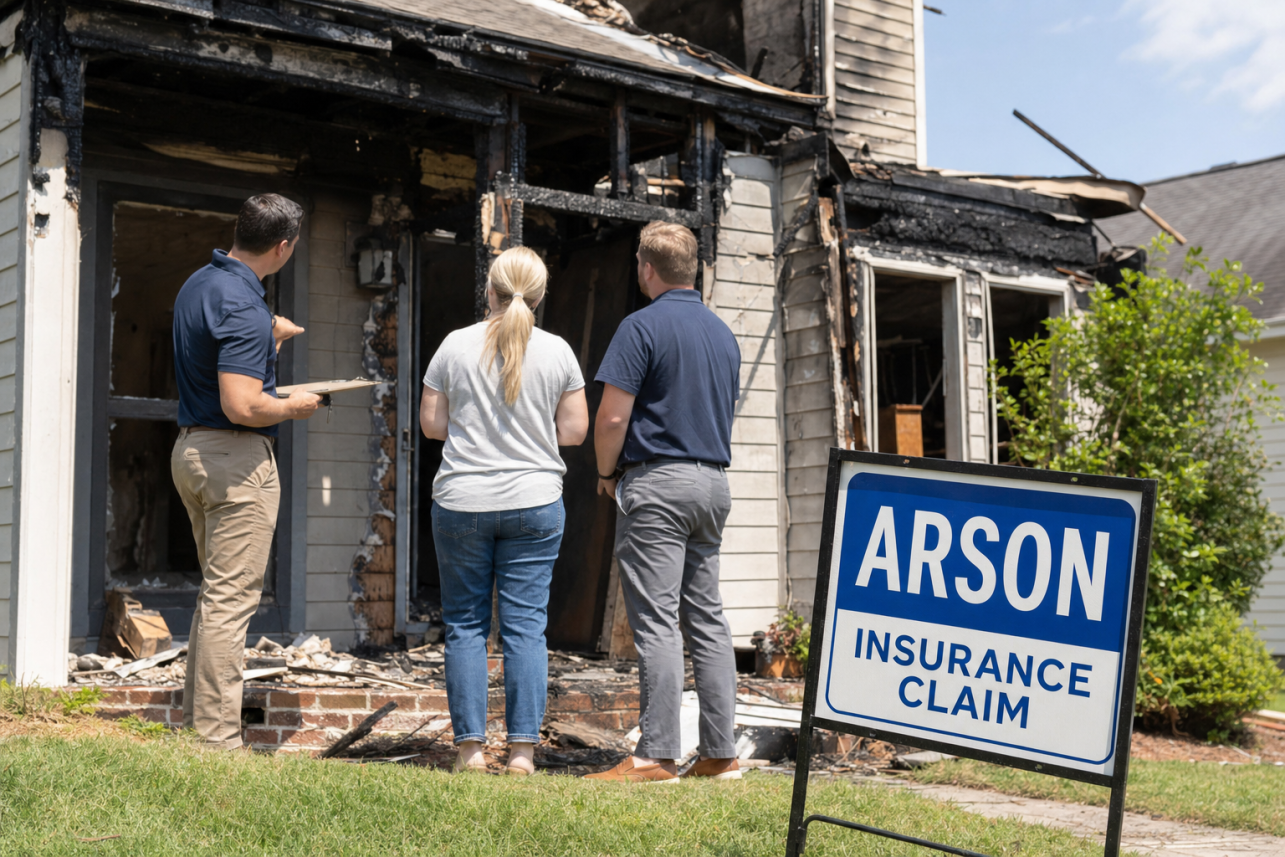
In most cases, yes. A standard homeowner's policy excludes intentional acts committed by 'the insured' — meaning you or, depending on the policy language, other insureds under the same policy. A fire set by a vandal, a burglar, a disgruntled tenant, or a stranger is exactly the kind of loss fire coverage exists for, even if investigators confirm the blaze was incendiary.
Where it gets complicated is when the suspected person is connected to you. North Carolina courts have addressed 'innocent co-insured' situations — for example, one spouse sets a fire and the other had nothing to do with it. Whether the innocent spouse can recover often turns on the exact policy wording, such as whether it excludes acts by 'an insured' versus 'the insured.' Those few words can decide the entire claim.
This is a common battleground in an arson insurance claim Pittsboro homeowners bring after a separation, an eviction, or a property dispute — situations we see across Chatham County, from rental properties near town to farmland with tenant houses. The carrier may try to lump every household member together to deny everyone.
Our job is to separate you from the act: documenting your whereabouts, showing you neither directed nor benefited from the fire, and holding the insurer to the policy's actual language rather than its broadest interpretation. If a third party set the fire, we press for full payment and remind the carrier that its remedy is pursuing the arsonist, not punishing the victim.
Local Relevance
Pittsboro sits at the heart of Chatham County, and much of its housing stock reflects that history — older frame farmhouses on rural acreage, historic homes near the traditional downtown, and newer construction arriving with the area's rapid growth. Older wood-framed homes burn differently than modern builds, and investigators unfamiliar with balloon framing or aged wiring sometimes read normal burn patterns as suspicious.
Rural properties around Pittsboro also face longer response times than homes in larger Triangle cities, which means fires often burn longer and destroy more of the evidence that could clear a homeowner. When less physical evidence survives, carriers lean harder on circumstantial theories about the policyholder.
The National Fire Protection Association has long emphasized that fire cause determinations must follow a systematic, evidence-based methodology — not assumptions. We hold insurers in Chatham County to that standard on every fire and arson file we handle, and we bring the same discipline to related smoke damage and vandalism claims when a loss involves more than one peril.
Many homes in and around Pittsboro are older frame houses set on wooded rural lots, where fires tend to burn longer before crews arrive and consume the very evidence that would establish an accidental cause. Homeowners here should photograph the scene early and avoid recorded statements until they have representation, because a thin evidence record is exactly where arson suspicion takes root.
Accused Of Arson? Don't Face The Insurer's Investigators Alone
For The Public Adjusters, Inc. is licensed and bonded, and we represent only policyholders — never insurance companies. If your fire claim in Pittsboro or anywhere in Chatham County has been delayed, denied, or turned into a fraud investigation, call us before your next conversation with the carrier. The review is free, and everything you tell us stays on your side of the table.
Call us: (919) 400-6440
Helpful Resources
- NCDOI Public Adjusters Guide
- National Fire Protection Association (NFPA)
- U.S. Fire Administration — Federal fire safety and post-fire guidance for homeowners
- North Carolina Department of Insurance — State regulator overseeing insurers and public adjusters in NC
Last updated: August 10, 2026