A public adjuster Selma NC policyholders hire works for you — not the insurance company — to document, value, and negotiate your property damage claim. For The Public Adjusters, Inc. is licensed and bonded, and we handle fire, water, smoke, flood, tree, and hurricane-related damage claims for homes and commercial buildings throughout Johnston County. Because we represent your side of the claim from the first inspection to the final settlement, the insurer’s estimate is never the only number on the table.
What This Service Is
When your home or business is damaged, your insurance company sends its own adjuster to inspect the loss and write an estimate. That adjuster is paid by the insurer. A public adjuster is the licensed professional who does the same work on your behalf — inspecting the damage, reading the policy line by line, building a detailed scope and estimate, and negotiating directly with the carrier.
In North Carolina, public adjusters are regulated by the state, and the NCDOI Public Adjusters Guide explains exactly what we are permitted to do for policyholders: represent you, document your loss, and advocate for a fair settlement under the terms of your policy.
We handle residential homeowners claims and commercial business claims involving fire, smoke, water, flood, vandalism, arson (where you are the innocent insured), fallen trees, vehicles striking a structure, and hurricane or tornado damage. We do not handle claims involving cell phones, motor vehicles, health, or life insurance. Our neighbors in nearby communities use the same service — see our pages for a public adjuster in Pine Level NC and a public adjuster in Micro NC.
Common Problems
What Does Hiring My Own Adjuster Cost, And Is It Worth It?
We work on a contingency fee — a percentage of what the insurance company pays on your claim. There is no hourly bill and no upfront charge, so our interests are aligned with yours from day one.
The value comes from what insurers routinely leave out: hidden water migration behind walls, smoke residue in HVAC systems, code-upgrade costs on older Selma homes, and contents that were never fully inventoried. We cannot guarantee any specific outcome — no honest adjuster can — but a complete, professionally documented claim is very different from a quick walk-through estimate.
The Insurance Company Delayed, Underpaid, Or Denied My Claim. Now What?
This is the most common reason Johnston County homeowners call us. A lowball estimate or a denial letter is not the end of the claim — policies contain appraisal and dispute provisions, and claims can often be supplemented or reopened with better documentation.
Courts have long held insurers accountable when they wrongly refuse to pay. In the landmark case Anderson v. Continental Insurance Co., the Wisconsin Supreme Court allowed a policyholder to pursue a bad-faith claim after the insurer refused to pay for damage to the insured’s home — a decision that helped establish that carriers owe their own customers fair dealing on property claims.
We build the evidence file that makes disputes winnable: moisture readings, photo documentation, line-item estimates, and policy analysis. When a claim requires litigation, we work alongside insurance dispute lawyers so nothing is lost in the handoff.
How Do I Choose A Public Adjuster Selma NC Property Owners Can Actually Rely On?
Start with licensing. North Carolina requires public adjusters to be licensed, and you can verify any license with the state before signing anything. We are licensed and bonded, and we encourage you to check.
Then ask about experience with your specific loss type. A fire damage claim with smoke contamination is documented very differently from a burst-pipe water loss or a tree through the roof. Ask who will actually inspect your property, how contents will be inventoried, and how supplements are handled.
Finally, be wary of anyone who knocks on your door right after a storm promising a specific dollar figure. Legitimate adjusters explain the process; they never guarantee the result.
Our Process
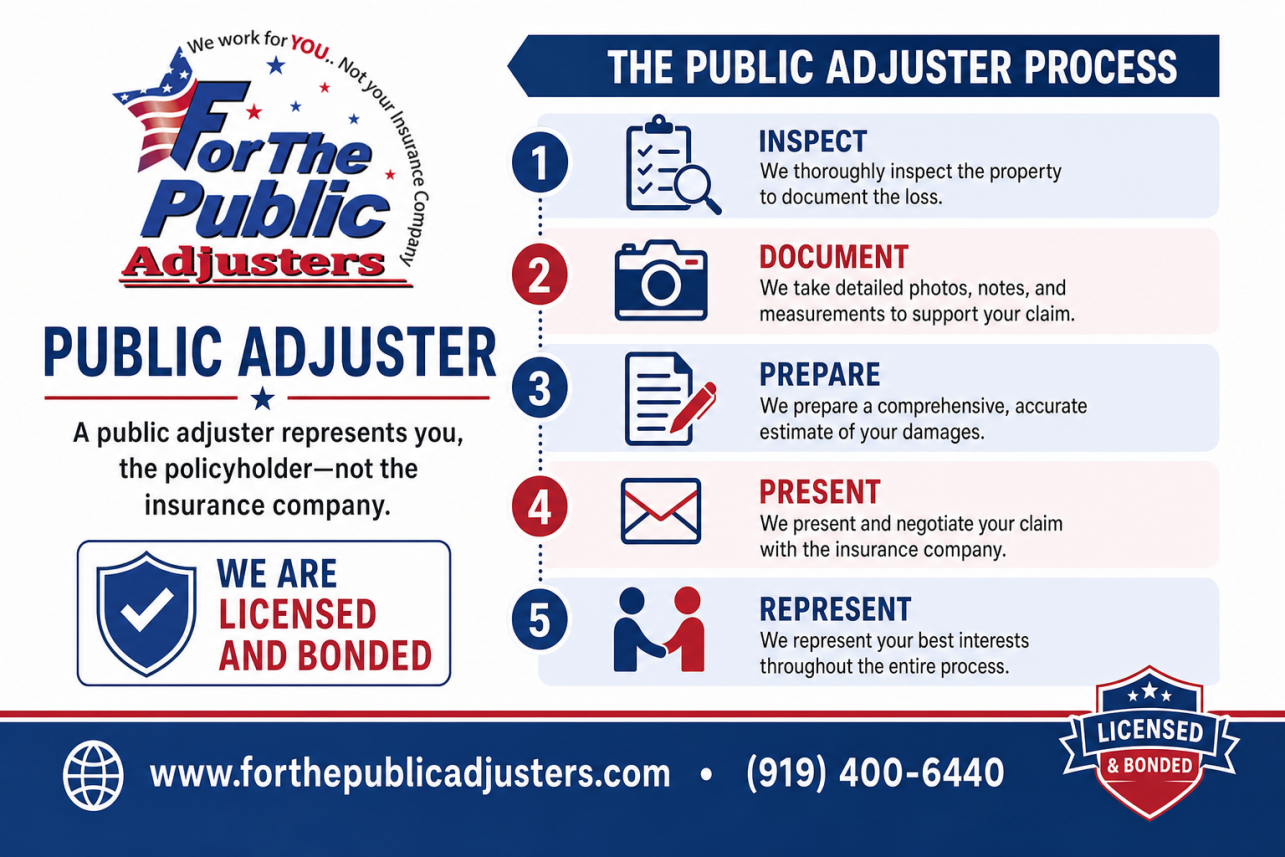
Free Policy And Damage Review
We start by reading your actual policy — coverage limits, endorsements, deductibles, and exclusions — and inspecting the damage in person. Many Selma homeowners are surprised to learn what their policy already covers, from code upgrades to additional living expenses while repairs are underway.
Full Documentation And Independent Estimate
We photograph and measure the loss, test for hidden moisture and smoke residue, inventory damaged contents room by room, and build a line-item repair estimate using the same estimating platforms insurers use. This becomes the factual backbone of your claim, whether it is a kitchen fire, a water damage claim like those we handle in Wake Forest, or hurricane damage across the roof and interior.
Negotiation Through To Settlement
We present the claim to the carrier, meet its adjuster on site, and negotiate every disputed line item. If the carrier’s position doesn’t move, we pursue the policy’s dispute options and, where needed, coordinate with attorneys who handle insurance litigation. You are kept informed at every step, and nothing is settled without your approval.
| What Happens | Going It Alone | With For The Public Adjusters |
|---|---|---|
| Damage documentation | You rely on the carrier’s adjuster’s photos and one brief inspection | Independent inspection with moisture mapping, photo logs, and specialist reports where needed |
| Estimate accuracy | Carrier’s estimate, often missing hidden damage, code upgrades, and matching costs | Line-item estimate built in the same software carriers use, including everything the policy owes |
| Policy interpretation | You take the carrier’s word on exclusions and coverage limits | Every denial and limit checked against your actual declarations and endorsements |
| Negotiation | Adjusters negotiate claims daily; you may do it once in a lifetime | A licensed advocate who negotiates with carriers for a living, on your side only |
| Your time | Weeks of phone calls, paperwork, and re-inspections on your own | We manage the file, meetings, and deadlines while you get back to normal life |
| Typical result | Accepting the first or second offer | Documented claims frequently settle for multiples of the initial offer |
Commonly Overlooked In The Public Adjusting Industry
- Matching requirements for continuous flooring, siding, and roofing — Carriers pay to patch one room or one slope, and homeowners don’t know North Carolina claim standards often support replacing the whole continuous run so materials match.
- Ordinance and law coverage for code upgrades — Rebuilding to current Johnston County code costs more than the original construction, and this coverage sits unused because nobody itemizes the upgrade costs.
- Moisture trapped in wall cavities and subfloors — Carrier adjusters rarely open walls or run moisture meters, so damage that later becomes mold never makes it into the estimate.
- The appraisal clause in the policy — Most policyholders have no idea their policy contains a built-in dispute mechanism, so they accept lowball offers thinking litigation is the only alternative.
- Additional living expenses and loss of use — Families pay for hotels, meals, and storage out of pocket without saving receipts, forfeiting money the policy explicitly owes them.
- Smoke and soot damage beyond the fire room — Soot travels through ductwork and settles in attics and closed cabinets, but estimates typically stop at what’s visible in the room where the fire started.
- Depreciation recovery deadlines — Recoverable depreciation is only paid after repairs are documented within the policy’s time window, and thousands are lost every year to missed deadlines nobody flagged.
- Verifying cited exclusions against the actual policy — Adjusters sometimes reference endorsements that were never added to that policy year, and almost no one pulls their declarations page to check.
Case Studies
Case Study #1
Situation: A family on Ricks Road in Selma came home from a weekend in Wilmington to find their kitchen ceiling on the floor. A supply line to the upstairs bathroom had failed, and water had been running for nearly two days through the second floor, kitchen, and crawl space.
Problem: Their carrier’s field adjuster spent forty minutes on site and issued an estimate of $18,400 — enough to replace drywall and some flooring, but nothing for the saturated subfloor, the kitchen cabinets that had wicked water up their bases, or the mold remediation the crawl space clearly needed in Johnston County’s humidity.
Investigation: We brought in moisture mapping equipment and documented readings in the wall cavities the carrier never opened. We pulled cabinet toe kicks to photograph swelling, had a licensed remediation contractor scope the crawl space, and matched the flooring across the open-concept first floor to establish continuous damage.
Findings: The subfloor moisture content was above 28% in three rooms, well past salvageable. The cabinets were particle-board construction that cannot be dried and reused. Because the kitchen, dining, and living areas shared one continuous flooring run, North Carolina matching standards supported replacing the entire run — not patching one room.
Solution: We prepared a line-item estimate using the same pricing software carriers use, submitted the moisture logs and remediation protocol, and requested a re-inspection with the carrier’s adjuster present alongside our documentation.
Outcome: The claim settled at $67,900 — more than three and a half times the original offer — including full cabinet replacement, continuous flooring, subfloor replacement, and crawl space remediation. The family also recovered additional living expenses for the six weeks they couldn’t use their kitchen.
Lesson: A carrier’s first estimate reflects what their adjuster saw in one short visit, not what the damage actually is. Hidden moisture and matching rules routinely double or triple what a water claim is worth.
Case Study #2
Situation: The owner of a small commercial building near downtown Selma, just off US-301, took hail and wind damage during a spring storm that rolled through Johnston County. His metal roof showed denting, and two HVAC units on the roof had crushed condenser fins.
Problem: The insurance company denied the roof entirely, calling the dents ‘cosmetic’ under a cosmetic damage exclusion, and offered $2,100 to comb the HVAC fins. The owner had a tenant threatening to leave over roof leaks that started three weeks after the storm.
Investigation: We reviewed the actual policy language and found the cosmetic exclusion endorsement had never been added to this policy year — the carrier was citing an exclusion the owner never had. We hired an engineer to inspect the standing-seam panels and documented punctured coating and compromised seams at fastener points, plus test data showing the HVAC coils were leaking refrigerant.
Findings: The ‘cosmetic’ denial had no basis in the policy on file. The engineer’s report showed functional damage: coating breaches that would rust through and seam displacement that explained the active leaks. Both rooftop units needed replacement, not fin combing, because the coils themselves were breached.
Solution: We filed a formal supplement with the engineer’s report, the policy declarations showing no cosmetic endorsement, and a complete replacement estimate for the roof system and both HVAC units. When the carrier stalled, we invoked the appraisal clause in the policy.
Outcome: Before the appraisal hearing, the carrier reversed the denial and settled for $148,300 — full roof replacement, two new rooftop units, and interior repairs to the tenant space. The tenant stayed.
Lesson: Always verify a denial against the actual policy documents. Carriers sometimes cite exclusions that were never endorsed onto the policy, and ‘cosmetic’ is one of the most abused words in hail claims.
| Your Situation | Should You Call Us? | Why It Matters |
|---|---|---|
| Claim denied or partially denied | Yes, immediately | Denials often rest on misapplied exclusions; you have limited time to dispute under NC policy deadlines |
| Settlement offer feels too low to rebuild | Yes | Carrier estimates commonly omit hidden damage, code upgrades, and material matching that the policy actually covers |
| Major fire, storm, or water loss just happened | Yes, before the carrier inspects | Early documentation and mitigation protect the claim; statements made in the first days shape everything after |
| Small claim near or under your deductible | Probably not | If the loss barely exceeds your deductible, a fee-based advocate may not add value — we’ll tell you that honestly on a free review |
| Carrier delaying, ignoring calls, or requesting endless paperwork | Yes | Documented pressure and knowledge of NC claim-handling standards moves stalled files forward |
| Business interruption or lost rental income involved | Yes | Income losses require financial documentation most owners assemble incorrectly, leaving money unclaimed |
| Claim already settled and check cashed | Call to ask | Some claims can be reopened or supplemented in North Carolina if new damage tied to the loss is found within policy time limits |
Reviews
Our insurance company offered us $22,000 after a tree came through our roof on Pollock Street during that ice storm. For The Public Adjusters found damage their adjuster completely skipped — trusses, insulation, the works. Final settlement was over $61,000. Wish I’d called them the day it happened instead of waiting two months.
Darlene M., Selma
I run a small warehouse outside Selma and got denied on a wind claim. Searched for a public adjuster Selma NC could actually count on and found this team. They caught that the carrier was quoting policy language that didn’t even apply to my coverage year. Denial overturned, claim paid in full. They earned every penny of their fee.
Kevin T., Johnston County
Kitchen fire in February. The smoke damage went way beyond what the insurance estimate covered — they wanted to just paint over soot in the ductwork and attic. This team documented everything room by room and got the settlement raised enough to actually restore the house properly. Honest, patient, and they explained every step in plain English.
Angela R., Selma
Frequently Asked Questions
What Does A Public Adjuster Selma NC Homeowners Can Hire Actually Do For My Insurance Claim?
A public adjuster works exclusively for you, the policyholder — never for the insurance company. When you hire For The Public Adjusters, Inc., we take over the entire claim process: documenting the damage, reading your policy line by line, preparing a detailed estimate, and negotiating directly with the carrier’s adjuster on your behalf.
That matters because the adjuster your insurance company sends is paid by the insurer. Their estimate often reflects the carrier’s interests, not yours. We build an independent scope of damage using the same industry pricing software insurers use, so our numbers stand up in negotiations.
For Selma homeowners, common claims we handle include wind and hail damage from spring and summer storms rolling through Johnston County, water damage from burst pipes, tree strikes, fire and smoke losses, and hurricane-related damage when tropical systems push inland off the coast.
We also handle the paperwork most policyholders find overwhelming — proof of loss forms, supplemental claims, recorded statement preparation, and deadline tracking. Missing a single deadline in your policy can jeopardize your entire recovery, and we make sure that never happens.
In practical terms, hiring a public adjuster in Selma means you have a licensed professional whose only job is maximizing your settlement while you focus on your family, your home, or your business. Studies and state insurance department data consistently show that represented policyholders recover significantly more than those who negotiate alone.
How Much Does It Cost To Hire A Selma Public Adjuster, And Is It Worth It?
We work on a contingency fee basis, which means you pay nothing upfront and nothing out of pocket. Our fee is a percentage of the settlement we recover for you, agreed to in writing before we begin. If we don’t recover money for you, you don’t owe us a fee.
North Carolina regulates public adjusting, and licensed adjusters must disclose their fees clearly in the contract. You’ll know exactly what you’re agreeing to before you sign anything — no surprises later.
Is it worth it? For most Johnston County policyholders, yes, and often dramatically so. Insurance carriers frequently underpay claims by overlooking hidden damage — moisture trapped behind walls, compromised roof decking under shingles, smoke residue in HVAC systems. We find and document what the carrier’s adjuster missed or minimized.
Here’s a real-world example of how the math works: if an insurer initially offers $20,000 and we negotiate the claim to $45,000, even after our fee you walk away with substantially more than the original offer. Our incentive is aligned with yours — the more we recover, the better we both do.
There’s also the time factor. Handling a disputed claim yourself can mean weeks of phone calls, estimates, and back-and-forth letters. We handle all of it. For Selma families juggling work, kids, and a damaged home, that alone is often worth the fee — the increased settlement is what makes it an easy decision.
When Should I Call A Public Adjuster In Selma — Before Or After Filing My Claim?
The best time to call is before you file, or as early in the process as possible. When For The Public Adjusters, Inc. is involved from day one, we can document the damage properly before repairs or cleanup disturb the evidence, present the claim correctly the first time, and prevent the missteps that give carriers reasons to underpay or deny.
That said, it’s rarely too late. Many of our Selma and Johnston County clients call us after one of three things happens: the insurance company’s offer seems far too low, the claim gets denied outright, or the process drags on for months with no resolution. We can step in at any of those stages, reopen negotiations, file supplemental claims, and push the file toward a fair settlement.
Even claims that were already paid can sometimes be revisited. If you accepted a settlement and later discovered additional damage — say, hidden water intrusion behind drywall or roof damage a contractor found during repairs — North Carolina policies generally allow supplemental claims within the policy’s time limits. We review closed claims regularly and often find money left on the table.
One word of caution: don’t give a recorded statement, sign a release, or accept a final payment before having your claim professionally reviewed. Those steps can limit your options. A quick call to us costs nothing, and the initial claim review is free. Whether your storm-damaged roof is in downtown Selma or out toward Pine Level or Micro, we’ll tell you honestly whether representation makes sense for your situation.
What Types Of Property Damage Claims Does For The Public Adjusters, Inc. Handle In The Selma Area?
We handle virtually every type of first-party property claim for homeowners, landlords, and business owners across Selma and greater Johnston County.
Storm damage is the most common. Selma sits in a part of North Carolina that sees severe thunderstorms, straight-line winds, hail, and occasional tornado activity, plus heavy rain and wind when hurricanes track inland from the coast. Wind-lifted shingles, hail-bruised roofing, siding damage, and fallen trees make up a large share of our caseload every spring and summer.
Water and fire losses are close behind. Burst pipes during winter cold snaps, water heater failures, appliance leaks, and slow hidden leaks that cause mold all fall within our expertise. For fire claims, we document not just the burned areas but smoke and soot contamination throughout the structure and contents — damage carriers routinely undervalue.
We also represent commercial policyholders. If you own a shop near downtown Selma, a restaurant, rental properties, or a warehouse, we handle building damage, business personal property, and business interruption claims, which involve lost-income calculations that most owners shouldn’t tackle alone.
Every claim starts the same way: a free, no-obligation review of your policy and your damage. As a public adjuster Selma NC property owners can reach quickly, we inspect in person rather than relying on photos alone, because carriers respond to thorough, on-site documentation. If we believe your claim was handled fairly and there’s nothing more to recover, we’ll tell you that too — honest answers first, always.
My Insurance Company Already Made A Settlement Offer — Can A Public Adjuster Selma NC Residents Trust Still Help Me?
Yes, and this is one of the most common situations we handle. An initial offer from your insurance carrier is rarely the final word. In many cases, that first check reflects only the damage the company’s adjuster documented during a brief walkthrough — not the full scope of your loss.
Our team can review the offer, re-inspect your property, and compare the carrier’s estimate line by line against actual repair costs in Johnston County. Local labor and material prices around Selma often run higher than the standardized pricing software insurers rely on, and we know where those gaps typically appear.
If we find the settlement falls short, we can file a supplemental claim on your behalf. That means presenting new documentation — photos, contractor estimates, moisture readings, engineering reports — that supports a higher payout. Insurance policies in North Carolina generally allow supplements as long as the claim remains within the policy’s time limits, so even a claim you thought was closed may still have room to move.
One important note: cashing the initial check usually does not prevent you from pursuing additional funds, since most payments are issued as partial or undisputed amounts rather than final releases. Still, it is smart to have us review the paperwork before you sign anything. If you are looking at an offer that does not seem to cover what it will actually cost to make your home whole again, bring it to us before you accept it as final.
How Long Does The Claim Process Take With A Selma Public Adjuster Involved?
Every claim is different, but most residential claims we handle in the Selma area resolve within 30 to 90 days from the date we get involved. Straightforward losses — a single-room water leak or limited wind damage to a roof — often settle on the shorter end. Large fire losses or claims that require engineering reports can take longer.
North Carolina law works in your favor here. Insurers operating in the state are expected to acknowledge claims promptly and act in good faith on settlement once liability is reasonably clear. When a carrier drags its feet, we know how to document delays and push the file forward.
It may sound counterintuitive, but bringing in a professional adjuster frequently speeds things up rather than slowing them down. We prepare complete, well-documented claim packages the first time — detailed estimates, itemized contents inventories, photographs, and policy citations. That leaves the carrier fewer reasons to request additional information, which is where most homeowner-handled claims stall.
We also manage all the back-and-forth communication, inspections, and scheduling so you are not playing phone tag with a desk adjuster in another state. Throughout the process, you will get regular updates on where the claim stands and what happens next.
If your claim has already been sitting for months without movement, that is a strong signal to get help. Stalled claims in Johnston County are something we deal with regularly, and a fresh, properly documented submission often breaks the logjam quickly.
Will Hiring An Adjuster To Fight My Claim Hurt My Relationship With My Insurance Company?
No — and this concern keeps far too many homeowners from getting the settlement they are owed. Hiring a public adjuster Selma NC policyholders can rely on is a legal right under North Carolina law, and your carrier cannot cancel your policy, raise your rates, or retaliate against you simply because you brought in licensed representation.
Think of it this way: the insurance company has trained adjusters working on its behalf from day one. Retaining your own advocate simply levels the playing field. Carriers deal with professional adjusters constantly, and most claims handled this way proceed in a businesslike, professional manner.
In fact, the process often becomes less adversarial, not more. Because we speak the same technical language as the carrier’s adjusters — construction terminology, policy provisions, estimating software — disputes tend to get resolved through documentation rather than frustration. You stop being the homeowner arguing about a number and become a policyholder with a professionally prepared claim.
Your premiums are affected by the fact that you filed a claim and the nature of the loss, not by who represented you during the process. That is true whether you handle the claim yourself or hire us.
We also handle all communication going forward, which removes a lot of stress. Once you sign with For The Public Adjusters, Inc., the carrier’s calls, emails, and inspection requests come to us. You stay informed and in control of every decision, but you are no longer the one doing the negotiating.

What Should I Gather Before My First Meeting With For The Public Adjusters, Inc.?
The most important document is your full insurance policy — not just the declarations page, but the complete policy with all endorsements. If you cannot locate it, do not worry; we can request a certified copy from your carrier on your behalf, and North Carolina insurers are required to provide it.
Beyond the policy, helpful items include your claim number and any correspondence from the insurance company, especially estimates, reservation-of-rights letters, or denial letters. If the carrier’s adjuster has already inspected, bring whatever paperwork they left behind.
Photos and videos are extremely valuable. Pictures of the damage taken right after the loss, plus any older photos showing the property’s condition beforehand, help us establish the full scope. If a storm moved through Selma or the surrounding Johnston County area, dated photos also help tie the damage to that specific event.
Receipts matter too. Keep records of emergency repairs, tarping, water extraction, hotel stays, and meals if you were displaced. Many policies cover additional living expenses, and homeowners routinely leave that money on the table because they did not save documentation.
Finally, jot down a timeline: when the damage happened, when you reported it, who you spoke with, and what was said. Memories fade quickly, and those details can matter in a dispute.
That said, do not delay calling because your paperwork is incomplete. The consultation is free, and we can help you reconstruct much of this information. Getting eyes on the damage early is more important than arriving with a perfect file.
Is A Public Adjuster Selma NC Property Owners Hire Required To Be Licensed In North Carolina?
Yes. North Carolina requires every public adjuster to be licensed through the NC Department of Insurance, and that license comes with real obligations — passing a state exam, carrying a surety bond, completing continuing education, and following strict rules about contracts and fees.
Before you sign with anyone, ask for their license number and verify it on the Department of Insurance website. It takes two minutes and protects you from unlicensed ‘claim consultants’ who sometimes appear in Johnston County after major storms, knock on doors, and disappear once they’ve collected a fee.
For The Public Adjusters, Inc. is fully licensed in North Carolina, and we’re glad to provide our credentials in writing at the first meeting. Licensing matters for a practical reason too: state law dictates what our contract must disclose, including your right to cancel within a set window after signing. A legitimate adjuster will walk you through that document line by line rather than rushing your signature.
One more thing worth knowing — North Carolina law also governs when and how adjusters can solicit work after a loss. If someone shows up at your door in Selma hours after a fire or tornado pressuring you to sign immediately, that’s a red flag. A licensed professional will give you time, answer questions, and encourage you to check their standing with the state first. When you hire a public adjuster Selma NC regulators actually oversee, you get accountability that unlicensed operators simply can’t offer.
What’s The Difference Between A Selma Public Adjuster And The Adjuster My Insurance Company Sends Out?
The difference comes down to one word: loyalty. The adjuster your insurance company sends works for the carrier. Even the most courteous company adjuster is paid by the insurer, trained by the insurer, and evaluated on how they manage claim costs. Independent adjusters hired by the carrier are the same — different business card, same client.
A public adjuster works exclusively for you, the policyholder. We’re the only type of adjuster legally allowed to represent your interests in the claim. That means when we scope hail damage on a roof off Highway 70 or document smoke damage in an older Selma home, we’re measuring the full loss — not the minimum the carrier can justify paying.
The practical differences show up fast. Company adjusters often spend twenty or thirty minutes on site. We spend hours, sometimes multiple visits, pulling moisture readings, photographing hidden damage, and building a line-item estimate that accounts for local Johnston County labor and material costs rather than generic pricing software defaults.
There’s also the policy itself. Carriers rarely explain coverages that work in your favor — code upgrade coverage, additional living expenses, matching requirements for siding and shingles. Part of our job is reading your policy the way an advocate reads it, then holding the carrier to every provision.
You don’t have to choose one or the other; the carrier will still send its adjuster. But having your own expert in the room changes the conversation entirely.
My Claim Was Denied — Can For The Public Adjusters, Inc. Still Get Involved?
In many cases, yes. A denial letter is the carrier’s position, not the final word. Policyholders in Selma and across Johnston County have the right to dispute a denial, and a significant number of denied claims are reversed or partially paid once new documentation and a proper policy analysis enter the picture.
The first thing we do is read the denial letter carefully alongside your full policy. Carriers must cite specific policy language when they deny a claim, and sometimes that language is being applied too broadly. A common example around here: wind-driven rain damage denied as ‘flood’ or ‘surface water,’ or storm damage denied as ‘wear and tear’ on a roof that was actually sound before the storm.
Next, we re-inspect the property ourselves. Denials often rest on a brief inspection or a desk review of someone else’s photos. A thorough on-site examination — checking attic decking, tracing water paths, documenting impact marks — frequently produces evidence the original file never contained.
From there, we present a formal, documented rebuttal to the carrier. If the dispute continues, options like appraisal (a process built into most policies) or a complaint to the NC Department of Insurance may come into play, and we’ll explain each honestly, including when a claim genuinely isn’t covered.
Timing matters, though. North Carolina policies have deadlines for disputing claims and filing suit, so don’t sit on a denial. Bring us the letter, your policy, and any photos, and we’ll give you a straight answer about whether the denial is worth fighting.
Does Your Public Adjuster Team Serve Areas Outside Selma, Like The Rest Of Johnston County?
Yes. While Selma is home base for much of our work, For The Public Adjusters, Inc. handles claims throughout Johnston County — Smithfield, Clayton, Pine Level, Micro, Kenly, Wilson’s Mills, Princeton, Benson, and Four Oaks — as well as surrounding communities in eastern Wake and neighboring counties.
That regional footprint matters more than people realize. Storm systems don’t respect town lines. When a severe thunderstorm or tropical remnant tracks up the I-95 corridor, it typically hits Selma, Smithfield, and Kenly in the same afternoon. Because we work claims across the whole area, we know what carriers paid on comparable losses two streets over or two towns away, and we use that knowledge when your carrier’s estimate comes in light.
Local familiarity also shapes how we document damage. Housing stock in this part of North Carolina ranges from historic homes near downtown Selma to newer builds around Clayton and rural farm structures outside Princeton. Each type fails differently in wind, hail, and water events, and each requires different repair pricing — something out-of-area adjusters and software defaults routinely miss.
If you’re outside Johnston County, call anyway. We’ll tell you honestly whether your location and claim are a good fit, and if we’re not the right choice, we’ll try to point you toward a licensed public adjuster Selma NC neighbors would recognize as reputable, or one closer to you. There’s never a charge for that first conversation, wherever you’re calling from.
Can A Public Adjuster Selma NC Homeowners Hire Reopen A Claim That Was Underpaid Years Ago?
In many cases, yes. North Carolina generally allows up to three years from the date of loss to pursue a property claim, though your specific policy may set its own deadlines for supplementing or disputing a settlement. That means a storm claim from last year — or even the year before — may still be eligible for review.
Underpaid claims are common in Johnston County, especially after hurricanes and severe hail events when carriers are processing thousands of files at once. Roof damage gets scoped as a partial repair when a full replacement is warranted, or interior water damage gets missed entirely because the initial inspection was rushed.
When we review a closed or settled claim, we start with your policy, the carrier’s estimate, and any photos or reports from the original inspection. Then we conduct our own detailed inspection of the property. If we find damage that was overlooked or line items that were priced below actual local repair costs, we prepare a supplemental claim with documentation the carrier has to respond to.
The key is acting before the clock runs out. If you cashed a settlement check but the money didn’t come close to covering repairs, that doesn’t automatically close the door — accepting an initial payment is not the same as signing a full release in most situations. Bring us your paperwork and we’ll tell you honestly whether the claim is worth reopening. If there’s nothing left to recover, we’ll say so, because we only get paid when you do.
I Already Started Repairs After The Storm — Can Your Team Still Help With My Claim?
Yes, though the earlier you call, the stronger your position. Starting repairs doesn’t disqualify you from recovering what your policy owes — in fact, your policy likely requires you to make reasonable temporary repairs to prevent further damage, like tarping a roof or drying out wet drywall.
The challenge with completed repairs is documentation. Once damaged materials are torn out and hauled away, we lose the physical evidence that supports the claim. If you’ve already begun work, stop and gather everything you have: photos and video from before and during demolition, contractor invoices, receipts for materials, and any written estimates you collected.
We work with Selma and Johnston County homeowners in this exact situation regularly. Contractors’ invoices, moisture readings, dated photos, and even neighbors’ documentation of the same storm can help us reconstruct the scope of loss. We also know how storms track through this area, which helps us tie your damage to a specific covered event.
If repairs are only partially done, we’ll ask you to pause anything that isn’t urgent until we’ve inspected and documented what remains. From there, we build the claim around both the completed work and what still needs to be done, priced at actual local rates rather than the carrier’s software defaults.
One caution: don’t sign a contractor’s assignment-of-benefits paperwork or a final release from your insurer before talking to us. Those documents can limit what we’re able to recover on your behalf.
Does Homeowners Insurance Around Selma Cover Hurricane And Wind Damage — And What About Flooding?
Most standard homeowners policies in this part of North Carolina do cover wind and hail damage, which is what typically hits Johnston County during hurricanes, tropical storms, and the severe thunderstorms that roll through in spring and summer. Roof damage, siding damage, fallen trees, and wind-driven rain that enters through a storm-created opening are usually covered perils.
Flooding is different. Rising water — whether from the Neuse River backing up, Moccasin Creek overflowing, or standard flash flooding after heavy rain — is excluded from nearly every homeowners policy. Flood coverage requires a separate policy, usually through the National Flood Insurance Program or a private flood carrier.
Where things get complicated is when both happen at once. A hurricane can tear off shingles, letting rain pour in from above, while floodwater comes in at ground level. Carriers sometimes try to attribute all the damage to the excluded flood, minimizing the covered wind portion. Sorting out which damage came from which cause is exactly the kind of dispute where a public adjuster Selma NC property owners work with earns their fee.
We inspect the property, document water lines, damage patterns, and points of entry, and separate covered wind and rain damage from excluded flood damage with evidence the carrier can’t wave away. We also review your policy for wind or hurricane deductibles, which in eastern North Carolina are often calculated as a percentage of your dwelling coverage rather than a flat dollar amount — a detail that surprises many homeowners at settlement time.

Do I Need To Be Home For Inspections, And How Involved Will I Be Once You Take Over?
You’ll be as involved as you want to be, but the heavy lifting is ours. For the initial inspection, we do prefer you’re present if possible — you know your home better than anyone, and homeowners often point out damage or pre-loss conditions we’d want documented. If your schedule doesn’t allow it, we can inspect with your permission and walk you through our findings afterward by phone or in person.
Once we’re engaged, all communication with your insurance carrier runs through us. That means no more waiting on hold, no more confusing letters you have to interpret, and no more carrier adjusters showing up while you’re at work. When the insurance company’s adjuster inspects the property, we attend that inspection alongside them so nothing gets minimized or missed.
Your job is mostly to make decisions. We’ll present you with the carrier’s positions, our documentation, and our recommendation, and you decide whether to accept an offer or keep pushing. Nothing gets settled without your approval.
Most of our Selma-area clients spend a fraction of the time on their claim that they would handling it alone. We handle the estimates, the policy analysis, the correspondence, the deadlines, and the negotiation. You get regular updates — we’re a local operation, so you’re calling a person who knows your file, not a call center.
Expect a short intake meeting, one or two property inspections, occasional check-in calls, and a final review of the settlement. That’s typically the full extent of what we need from you.
Local Relevance
Selma sits in the heart of Johnston County, where humid summers, severe thunderstorms, and the remnants of Atlantic hurricanes are simply part of life. Inland hurricanes have historically pushed heavy rain and damaging wind through this part of the coastal plain, which means roof damage, wind-driven rain intrusion, and downed trees on homes are recurring claim types here — and flooding along the Neuse River basin has affected the wider county more than once.
Selma’s housing stock adds another layer. The town grew up around the railroad, so many homes date to the early and mid-1900s, with plaster walls, original hardwoods, and older wiring — features that carriers frequently underprice when they estimate repairs with modern tract-home materials. Newer subdivisions built during the Triangle’s growth bring their own issues, especially slab plumbing leaks and builder-grade roofing that fails early in hail and wind events.
For flood losses specifically, standard homeowners policies exclude rising water, so coverage typically runs through a separate flood policy backed by the Federal Emergency Management Agency (FEMA). We handle those flood insurance claims too, and they follow different rules and deadlines than a standard homeowners claim. We serve all of Johnston County, including Four Oaks and Kenly.
Many of Selma’s railroad-era homes have plaster-and-lath walls and true hardwood floors, and insurer estimates often price their repair as if they were modern drywall and laminate — a gap that tends to understate fire, smoke, and water losses in the older neighborhoods near downtown. Documenting original materials before demolition begins is one of the most valuable things a Selma policyholder can do.
Get A Second Opinion On Your Selma Claim
Whether the damage happened yesterday or the insurance company already sent a check that doesn’t come close to covering repairs, it costs nothing to have us review your policy and your loss. For The Public Adjusters, Inc. is licensed and bonded, and we only get paid when your claim does.
Request Your Free Claim Review
Call us: (919) 400-6440
Helpful Resources
- NCDOI Public Adjusters Guide
- Federal Emergency Management Agency (FEMA)
- North Carolina Department of Insurance — State regulator where consumers can verify adjuster licensing
- FEMA flood insurance information — Official resource on the National Flood Insurance Program
Our services in this city
Last updated: August 28, 2026