

If you're in a water damage claim dispute clayton NC homeowners face a hard truth: the adjuster who inspected your home works for the insurance company, not for you. When that adjuster minimizes the damage, delays your file, or offers far less than the repairs actually cost, you have the right to bring in your own licensed advocate. For The Public Adjusters, Inc. represents Clayton policyholders — documenting the full loss, challenging lowball estimates, and negotiating directly with the carrier so you don't have to argue alone.
What This Service Is
A public adjuster is a licensed insurance professional who works exclusively for the policyholder — never for the insurance company. When your water claim goes sideways, we step in as your representative for the entire process.
That starts with reading your actual policy, not the summary the carrier gave you over the phone. Coverage limits, your deductible, exclusions, and how the policy treats depreciation all shape what you can recover. Most homeowners find out about these details only after the insurer uses them to cut a check short.
From there, we build our own damage assessment. Water rarely stays where you can see it. It wicks up drywall, soaks subfloors, saturates insulation, and settles into crawl spaces — and if the carrier's adjuster only wrote up the visible stain on your ceiling, the estimate is wrong from day one. We document hidden moisture, structural concerns, mold risk, and damaged contents, then prepare the sworn proof of loss and repair pricing that supports a fair settlement.
For The Public Adjusters, Inc. is licensed and bonded in North Carolina. We handle disputed water losses from burst pipes, roof leaks, appliance failures, and storm-driven intrusion, along with fire, smoke, tree damage, and other residential and commercial property claims. One important distinction: rising floodwater is usually covered under a separate flood policy through the National Flood Insurance Program, not your homeowners policy — and carriers sometimes deny water claims by mislabeling the cause. Sorting out which policy actually owes for the loss is often the heart of the dispute, and it's work we do every week.
Common Problems
The Check They Offered Won't Come Close To Covering The Repairs. Why?
The most common reason is depreciation. Many carriers first pay the 'actual cash value' — the replacement cost minus wear and age — and only release the held-back depreciation after repairs are done, if you know to claim it. Homeowners who don't understand that mechanic leave real money on the table.
The second reason is scope. The insurer's estimate may price new flooring for one room when three rooms absorbed water, or allow for drying out a wall that actually needs to be opened, treated, and rebuilt. Emergency mitigation costs — the water extraction and drying you paid for out of pocket in the first 48 hours — are frequently left off entirely, along with damaged furniture, electronics, and other contents.
A low offer is a starting position, not a verdict. When we re-estimate the loss with proper measurements, moisture readings, and current local repair pricing, the gap between their number and the real cost becomes hard for the carrier to defend.
What Do I Do When My Water Damage Claim Dispute Clayton NC Stalls Because The Adjuster Stops Cooperating?
This is the complaint we hear most: calls go unreturned, the file gets reassigned, the carrier asks for the same documents twice, and weeks turn into months while your subfloor stays open. Delay works in the insurer's favor — many homeowners simply give up and accept whatever is offered.
North Carolina policyholders are not powerless. Your policy sets deadlines and duties for both sides, and the North Carolina Department of Insurance accepts complaints against carriers that drag their feet without cause. Courts have also pushed back when insurers deny first and justify later. In Corban v. USAA, a homeowner's dispute after Hurricane Katrina, the Mississippi Supreme Court held that the insurance company bears the burden of proving a policy exclusion actually applies before it can refuse to pay — the insured won, and the ruling is still cited in wind-versus-water disputes today.
When we take over a stalled file, everything moves in writing, on the record, with deadlines. Carriers respond differently when a licensed adjuster is documenting every missed commitment.
Should I Just Handle The Insurance Company Myself, Or Is Hiring A Public Adjuster Worth It?
You can absolutely negotiate your own claim, and for a small, clean loss with a cooperative carrier, you may not need help. The problem is that disputed water claims are rarely small or clean — hidden moisture, mold growth, and disagreements over cause turn them technical fast.
The NCDOI Public Adjusters Guide explains the difference plainly: the company adjuster represents the insurer, an independent adjuster is hired by the insurer, and only a public adjuster represents you. In North Carolina, public adjusters must be licensed, and reputable ones work on a regulated percentage of the recovery — no upfront fee, and nothing owed if nothing is recovered.
When you're vetting anyone in this field, ask for the license number, confirm they're bonded, and be wary of anyone who guarantees a specific dollar outcome — no honest adjuster can promise what a carrier will pay. What a good one does promise is complete documentation, accurate pricing, and a negotiator who has read your policy more carefully than the person across the table.
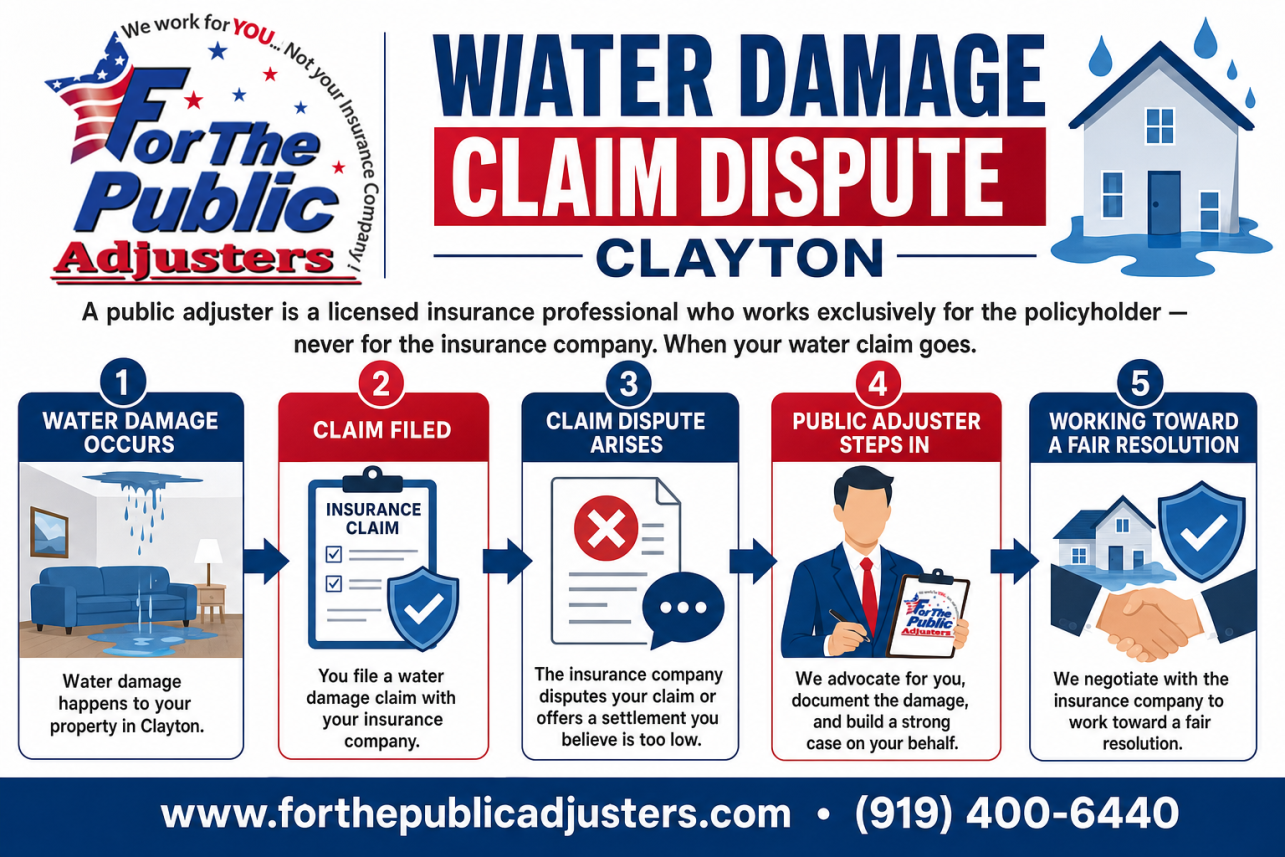
Our Process
Free Policy And Claim Review
We start by reviewing your policy, the carrier's estimate, any denial or reservation-of-rights letters, and photos of the damage. Within that first look, we can usually tell you whether the offer is reasonable, whether the denial rests on a shaky exclusion, and whether the dispute is worth pursuing. There's no cost or obligation for this review.
Independent Damage Documentation
Next, we inspect the property ourselves — moisture mapping, photographs, measurements, and a room-by-room inventory of damaged contents. Water losses in Clayton homes often extend into crawl spaces and wall cavities the carrier's adjuster never opened. We prepare a detailed repair estimate at real local pricing and assemble the proof of loss documentation your policy requires.
Negotiation And Settlement
We present the documented claim to your insurer, respond to their engineer or re-inspection requests, and negotiate line by line until the numbers reflect the actual loss. You approve every decision along the way. If the carrier still won't move, we'll explain your remaining options honestly — including appraisal under your policy or a complaint to state regulators — so you're never guessing what comes next.
| What Happens | Homeowner Alone | With For The Public Adjusters |
|---|---|---|
| Carrier adjuster stops returning calls | You leave voicemails for weeks with no leverage | We send written demands citing NC claims-handling standards, creating a documented record the carrier must answer |
| Hidden moisture in walls and subfloor | Usually missed — visible damage only gets scoped | Moisture mapping and thermal imaging document saturation the carrier's twelve-minute inspection skipped |
| 'Wear and tear' or 'seepage' pushback | Verbal denial with no explanation, claim stalls | We force a written coverage position, then counter it with plumber reports and a documented loss timeline |
| Lowball repair estimate | You accept it or argue without proof | Line-item Xactimate estimate with local Johnston County pricing, matching provisions, and code upgrades included |
| Claim deadlocks completely | Most homeowners give up or accept the last offer | We invoke appraisal or escalate formally — deadlock is a tool the carrier uses, not the end of the road |
| Cost to you | Free, but Clayton disputes handled alone settle for a fraction of documented value | Contingency fee only — we're paid a percentage of what we actually recover for you |
Commonly Overlooked In The Public Adjusting Industry
- Moisture readings inside wall cavities, not just on surfaces — Carrier adjusters typically test only what's visible, so saturated framing and insulation get left out of the scope and grow mold months later.
- Flooring matching provisions when planks are discontinued — Insurers pay to patch the wet boards, but if the flooring can't be matched, North Carolina policies often require replacing continuous flooring — a difference of tens of thousands.
- Getting verbal denials converted into written coverage positions — Homeowners accept a phone-call 'that's not covered' as final, when a carrier forced to cite actual policy language often can't support the denial.
- Additional living expenses and fair rental value coverage — Carriers rarely volunteer these coverages, so displaced homeowners and Clayton landlords eat hotel bills and lost rent they were insured for.
- Code-required upgrades triggered by the repair — Reopened walls in older Johnston County homes often require updated electrical, plumbing, or insulation work that carrier estimates silently omit.
- Documenting the loss date before the 'long-term seepage' argument appears — Weeks into a dispute, carriers reframe sudden pipe failures as gradual leaks, and by then the physical evidence proving a one-time event has been demolished.
- Certified drying logs from the mitigation company — Without daily moisture documentation, the carrier can later claim structural drying was complete when it wasn't — and deny the resulting damage.
- Deadlines buried in the policy for disputing the carrier's estimate — Homeowners assume they can argue indefinitely, but proof-of-loss and appraisal windows quietly expire while the adjuster runs out the clock.
Case Studies
Case Study #1
Situation: A homeowner off Amelia Church Road in Clayton came home from a weekend trip to find a failed supply line under the kitchen sink had soaked the cabinets, hardwood floors, and the finished room below in the crawlspace-level basement.
Problem: The carrier's field adjuster spent twelve minutes in the home, refused to open the cabinet toe kicks, and issued an estimate for $6,400 that covered surface drying and a few boards of flooring. When the homeowner called to question it, the adjuster stopped returning calls for three weeks and the desk adjuster who took over said the file was 'closed pending your response.'
Investigation: We brought in moisture mapping equipment and documented readings inside the wall cavities behind the sink run, under the hardwood, and in the subfloor. We photographed hidden saturation the carrier's adjuster never tested for, pulled the manufacturer specs on the discontinued hardwood, and obtained a certified drying log from the mitigation company.
Findings: Moisture had wicked into the wall framing and subfloor well beyond the visible stain lines. The hardwood species and plank width were no longer manufactured, which under the policy's matching provisions meant continuous flooring through the open-concept first floor had to be addressed, not just the wet boards. The carrier's estimate also omitted cabinet replacement, drywall, baseboard, and code-required electrical work in the affected wall.
Solution: We prepared a line-item Xactimate estimate supported by the moisture data and matching documentation, submitted a formal supplement, and required all further communication in writing so the file could not go quiet again. When the desk adjuster disputed the flooring scope, we requested a joint re-inspection and walked their new field adjuster through every reading.
Outcome: The claim settled at $58,700 — roughly nine times the original offer — covering full first-floor flooring, kitchen cabinetry, drywall, and proper structural drying. The homeowner paid nothing out of pocket beyond their deductible.
Lesson: A quick walkthrough and an unreturned phone call are not a final answer. When an insurance company's adjuster won't test hidden moisture or engage with the policy's matching language, documented evidence and written pressure change the conversation entirely.
Case Study #2
Situation: A landlord with a rental duplex near Clayton's Riverwood community had a water heater rupture in one unit, flooding both sides of the shared wall and displacing a tenant.
Problem: The insurance company assigned three different adjusters in six weeks. Each one asked for the same documents again, and the third adjuster verbally implied the damage was 'long-term seepage' excluded under the policy — without ever putting that position in writing or citing a policy provision. Meanwhile the tenant's lost rent was piling up.
Investigation: We demanded the carrier state its coverage position in writing as North Carolina claims-handling standards require. We hired an independent plumber to document the tank failure as a sudden rupture, photographed the corrosion pattern showing a single catastrophic event, and built a timeline proving the loss date from the tenant's texts and the emergency plumbing invoice.
Findings: The seepage theory had no support — the tank failed at a weld seam in one event, which is squarely covered. The carrier had also never acknowledged the fair rental value coverage on the landlord policy, and the shared-wall damage in the second unit had never been inspected at all.
Solution: We submitted the plumber's report, the timeline, and a full two-unit estimate, then formally invoked the policy's appraisal clause when the carrier stalled another thirty days. Appraisal forced the file in front of an independent umpire process instead of a rotating cast of adjusters.
Outcome: The claim resolved before the umpire ruled: $41,200 for repairs across both units plus four months of lost rental income the carrier had never even discussed. Total recovery came to just over $52,000 against an initial verbal position of near-zero.
Lesson: Adjuster turnover and vague verbal denials are stall tactics, not coverage decisions. Forcing the carrier to commit its position to writing — and knowing when to invoke appraisal — turns a runaround into a resolution.
| Adjuster Behavior | What It Usually Means | Your Best Move |
|---|---|---|
| Won't return calls for weeks | Overloaded desk file or deliberate stall — files that go quiet often close quietly | Put everything in writing with dates; a documented paper trail creates obligations a voicemail never will |
| Inspection lasted under 15 minutes | Scope was limited to visible damage only; hidden moisture was never tested | Get independent moisture readings before drying finishes and demand a re-inspection |
| Verbal hints at 'wear and tear' or 'seepage' but nothing in writing | The carrier hasn't committed to a denial it would have to defend | Request the coverage position in writing citing specific policy language — vague denials often evaporate |
| New adjuster assigned every few weeks | File churn that resets your claim's momentum and 'loses' your documents | Resubmit everything in one organized written package each time and log every reassignment |
| Offer covers drying but not repairs | Mitigation and reconstruction were treated as one, leaving rebuild costs unpaid | Demand a full line-item repair estimate including flooring matching, cabinets, drywall, and code work |
| Pressure to accept a quick check | Early checks are often partial payments framed as final settlements | Cash it only after confirming in writing it's a partial, undisputed payment — not a release |
| Refuses to discuss additional living expenses or lost rent | Coverage you paid for is being quietly ignored | Pull your declarations page and claim ALE or fair rental value in writing with receipts |
| Flat refusal to negotiate at all | The carrier believes you have no escalation path | This is exactly when appraisal or a public adjuster changes the math — deadlock is not a final answer |

Reviews
Our insurance adjuster was impossible — he'd promise to call back and never did, then a new person would take over and act like our pipe burst claim was brand new. For The Public Adjusters took over every call and email, and suddenly the carrier started responding within days. Our payout went from $9,000 to over $47,000 for the water damage in our kitchen and dining room. I only wish we'd hired them the week it happened.
Melissa T., Clayton NC
The company adjuster told us our hardwood floors just needed 'sanding and refinishing' after a washing machine flood, even though the boards were cupping badly. These guys came out with moisture meters, showed the subfloor was still wet weeks later, and proved the flooring couldn't be matched. The carrier ended up paying to replace flooring through the whole first level. Professional, persistent, and worth every penny of their fee.
Daryl W., Flowers Plantation
I fought my insurance company alone for four months over a slab leak and got nowhere — the adjuster kept hinting it was 'wear and tear' but would never put anything in writing. For The Public Adjusters forced them to state their position, tore it apart with a plumber's report, and settled my dispute for six times the original offer. The only reason it's not perfect is I'd have liked more frequent status updates mid-process, but the result speaks for itself.
Renee C., Clayton
Frequently Asked Questions
What Should I Do If I Have A Water Damage Claim Dispute Clayton NC Homeowners Face When The Insurance Adjuster Stops Returning Calls?
First, put everything in writing. When an insurance company adjuster goes quiet, send a dated email or certified letter summarizing your claim number, the date of loss, and every unanswered call or message. Under North Carolina's fair claims handling standards, insurers are expected to acknowledge and respond to communications within a reasonable time, and a paper trail proves when they haven't.
Second, do not let silence stall your mitigation duties. Keep drying equipment running, save every receipt, and photograph the damage as it evolves. In Johnston County's humid climate, water intrusion turns into mold fast, and carriers sometimes use delay to argue that secondary damage was your fault.
Third, request the adjuster's supervisor in writing and ask for a written status of your claim. If that still produces nothing, this is exactly the point where For The Public Adjusters, Inc. steps in for Clayton homeowners. As licensed public adjusters, we represent you, not the carrier, and insurers tend to respond quickly once a licensed professional is documenting their delays.
We re-inspect the property, build an independent line-item estimate, and take over all communication so you are no longer chasing someone who works for the insurance company. Most stalled water claims in this area move again within weeks once the carrier knows every deadline is being tracked.
The Insurance Company's Adjuster Lowballed My Water Damage Estimate In Clayton. Can That Number Actually Be Challenged?
Yes, and it should be. The carrier's estimate is an opinion, not a final ruling. Insurance company adjusters in this area frequently write water losses using minimal drying time, partial drywall replacement, and paint-only repairs when the actual damage requires full flood cuts, cabinet removal, and flooring replacement throughout connected rooms.
A common example we see in Clayton neighborhoods like Flowers Plantation and Riverwood: a supply line bursts, water runs under continuous flooring, and the insurer pays to replace only the visibly wet section. North Carolina policies generally require matching or reasonably uniform repairs, so a room-by-room patch job often isn't a legitimate settlement.
To challenge the number, you need your own detailed estimate written in the same Xactimate format carriers use, backed by moisture readings, thermal imaging, and photographs. That's what our team at For The Public Adjusters, Inc. builds for every dispute we handle in Johnston County. We then negotiate line by line, invoking the specific policy language the carrier's estimate ignored.
If negotiation stalls, most policies include an appraisal clause, a formal process where each side names an appraiser and disagreements go to an umpire. We prepare and present these cases regularly, and the gap between the insurer's first offer and the final settlement is often substantial. Never sign a release or cash a check marked "final" until you've had the estimate independently reviewed.
Why Does The Insurance Adjuster Keep Blaming My Clayton Water Damage On 'long-Term Seepage' Or Maintenance Issues?
This is one of the most common denial tactics we see in water damage claim disputes across Clayton and the rest of Johnston County. Most homeowner policies exclude damage from continuous or repeated seepage over 14 days or more, so carriers have a financial incentive to label a sudden pipe failure as a slow, long-standing leak.
The adjuster may point to staining, corrosion on a fitting, or mold growth as "proof" the leak was old. But those signs don't automatically mean the loss falls under an exclusion. Mold can appear within 48 to 72 hours in North Carolina humidity, and mineral deposits on a fitting say nothing about when the pipe actually failed. The burden of proving an exclusion applies generally rests with the insurer, not with you.
Fighting this classification takes evidence: plumber's invoices and failure statements, the failed component itself (never throw it away), moisture mapping, and sometimes a forensic plumbing or engineering opinion. Timeline documentation matters too, such as when you were last in the room and when you first noticed water.
For The Public Adjusters, Inc. builds exactly this kind of causation file for Clayton homeowners. We coordinate the expert opinions, cross-reference the carrier's own inspection notes, and push back with the policy language and North Carolina case standards that govern sudden-and-accidental losses. Many claims initially denied as "seepage" get paid once the evidence is properly assembled and presented.
How Does Hiring A Public Adjuster Help With A Water Damage Claim Dispute Clayton NC Insurers Are Dragging Out, And What Does It Cost?
A public adjuster levels the playing field. The insurance company's adjuster is trained, licensed, and paid to protect the carrier's bottom line. When you hire For The Public Adjusters, Inc., you get that same expertise working exclusively for you, which changes the entire tone of a difficult claim.
Here's what that looks like in practice for a disputed water loss in Clayton. We start with a full re-inspection using moisture meters and thermal imaging to find damage the carrier's walkthrough missed, hidden saturation inside wall cavities, subfloors, and insulation being the usual culprits. We then write an independent, code-compliant estimate and audit your policy for coverages the insurer never mentioned, such as additional living expenses, code upgrade coverage, and mold remediation sublimits.
From there, we take over every call, email, and inspection. Carriers behave differently when a licensed North Carolina public adjuster is documenting response times and citing specific policy provisions. If the dispute still won't resolve, we can invoke appraisal or prepare the file for an attorney, though most claims settle well before that.
As for cost, we work on contingency: a percentage of the recovery, capped by North Carolina regulation, with no upfront fees. If your claim doesn't pay, you owe nothing. Given that disputed water claims in the Clayton area often settle for multiples of the original offer once properly documented, most clients come out far ahead even after our fee. A free initial claim review will tell you whether your situation is worth pursuing.
The Insurance Adjuster Keeps Demanding A Recorded Statement About My Clayton Water Loss. Do I Have To Give One, And Can It Hurt My Claim?
Most homeowner policies do require you to cooperate with the investigation, and that can include a recorded statement. But you are entitled to prepare for it, schedule it at a reasonable time, and have a representative present. You are not required to speculate or answer on the spot without your documents in front of you.
Recorded statements are where a lot of water losses in Clayton go sideways. An innocent guess like "the pipe was probably leaking for a while" can be twisted into an admission of long-term seepage, which many policies exclude. Adjusters trained in claim defense know exactly which phrases to fish for.
Before any statement, gather your plumber's invoice, photos, and a timeline of when you first discovered water. Answer only what you actually know. "I don't know" is a complete and acceptable answer.
When For The Public Adjusters, Inc. represents a Johnston County homeowner, we typically attend the statement, object to misleading questions, and make sure the record reflects the facts rather than the carrier's preferred narrative. If a statement has already been taken and used against you, it can often still be countered with physical evidence — moisture readings, plumber findings, and material condition all speak louder than a nervous answer given under pressure.
My Claim Has Been Passed Between Three Different Insurance Adjusters. How Do I Handle A Water Damage Claim Dispute Clayton NC Residents See Dragged Out By Constant Reassignment?
Adjuster turnover is one of the most common frustrations we hear from Clayton homeowners, and it is rarely accidental in effect even when it is innocent in cause. Every new desk adjuster "needs time to review the file," and each handoff resets the clock while your drywall stays open and your floors stay torn up.
Start by putting everything in writing. Email each new adjuster a dated summary of the claim history: date of loss, what was reported, what was inspected, what was promised, and what is still outstanding. This creates a paper trail no reassignment can erase.
North Carolina insurance regulations require carriers to acknowledge communications and act on claims within reasonable timeframes. Repeated reassignment does not suspend those obligations. If deadlines keep slipping, a written complaint to the NC Department of Insurance often gets a stalled file moving.
In a water damage claim dispute clayton NC carriers handle this way, we step in as the single consistent point of contact. We rebuild the file, document every delay, and hold the company — not just whichever adjuster answers this week — accountable to the policy and to state claim-handling standards. Once a carrier knows every handoff is being tracked and every deadline logged, the musical-chairs routine usually stops quickly, and the conversation shifts back to what actually matters: the scope of your damage and what you're owed.
The Company Adjuster Only Approved Patching Part Of My Flooring, But The Water Ruined A Continuous Floor Through My Kitchen And Living Room. Is Partial Replacement All I'm Owed?
Not necessarily, and this is one of the most disputed issues in Clayton water losses. When continuous flooring — LVP, hardwood, or tile running through an open floor plan — is damaged in one area, patching often can't produce a uniform result. Discontinued product lines, dye-lot differences, and visible transition seams are real, documentable problems.
North Carolina doesn't have a matching statute the way some states do, but your policy language controls, and many policies obligate the carrier to repair or replace with materials of "like kind and quality." A patched floor with mismatched planks and an awkward seam in the middle of your kitchen is arguably neither.
The key is evidence. Get written confirmation from flooring suppliers that your product is discontinued or that dye-lot matching isn't achievable. Photograph the continuous installation from room to room. Document that there is no natural break point where a repair could stop cleanly.
We make this argument for Clayton and Johnston County homeowners regularly, and it frequently changes a few-hundred-dollar patch allowance into full replacement of the continuous run. The same logic applies to cabinets in a matched kitchen set and to painted walls in an open-concept space. Insurance adjusters count on homeowners accepting the first scope; a properly documented matching argument, backed by policy language, is often what forces a fair one.

The Insurer Already Denied My Claim Citing Their Adjuster's Report. Can A Water Damage Claim Dispute Clayton NC Homeowners Have Lost Still Be Reopened?
Yes, in many cases. A denial letter is the carrier's position, not a final judgment. If the denial rests on the company adjuster's conclusions — sudden versus gradual leak, pre-existing damage, or an exclusion applied too broadly — those conclusions can be challenged with better evidence.
First, request the complete claim file, including the adjuster's report, photos, and any engineer's findings. You have a right to know exactly what the denial is based on. In our experience with Johnston County water losses, these reports often rely on a brief walkthrough, no moisture mapping, and no plumber consultation.
Second, build the counter-evidence: an independent leak-detection report, your plumber's written cause-of-loss opinion, moisture readings, and a timeline showing the loss was sudden and accidental. Clayton's mix of newer slab-on-grade construction and older crawlspace homes matters here — the failure mechanism differs, and a generic denial rationale often doesn't fit the actual house.
Third, submit a formal written request for reconsideration citing the specific policy provisions that support coverage. If the carrier won't move, options include appraisal (for scope disputes), a complaint to the NC Department of Insurance, or litigation as a last resort.
For The Public Adjusters, Inc. reviews denied Clayton water claims at no charge. Some denials are legitimate — but a surprising number collapse once the file is tested against the physical evidence and the actual policy wording. Time limits apply to reopening and to suit deadlines under NC policies, so don't sit on a denial.
The Insurance Company's Adjuster Spent Ten Minutes At My House And Never Checked Inside The Walls. Is That Enough For A Water Damage Claim Dispute Clayton NC Homeowners Can Win?
A quick walkthrough is one of the most common reasons water claims in Clayton get underpaid, and yes, it can absolutely be challenged. Water travels. It wicks up drywall, soaks into subfloors, and pools inside wall cavities where a visual glance sees nothing. If the company adjuster never used a moisture meter or thermal imaging, their scope is almost certainly incomplete.
When For The Public Adjusters, Inc. takes on a dispute like this, we start with a full moisture-mapping inspection. In Johnston County homes, especially crawl-space construction common around Clayton, we routinely find saturated insulation, wet subflooring, and elevated moisture readings two or three rooms away from the visible leak. Every reading gets documented with photos and meter logs.
That documentation becomes the backbone of the dispute. We compare the insurer's scope line by line against what the moisture evidence actually shows, then submit a supplemental estimate demanding the missed items be added. Insurance companies have a much harder time defending a ten-minute inspection when they're facing a room-by-room moisture map.
Don't rip out or dry anything beyond emergency mitigation before it's documented. Once wet materials are gone, proving the true extent of damage gets harder. Call us first, and we'll preserve the evidence the company adjuster never bothered to look for.
The Adjuster Is Pressuring Me To Accept A Quick Settlement Check For My Clayton Water Loss. If I Cash It, Is My Claim Closed For Good?
In most cases, no — and that pressure tactic tells you something. In North Carolina, cashing a claim check generally does not waive your right to seek additional payment unless you've signed a release stating the payment is full and final. Read the check and any accompanying letter carefully before depositing anything, and never sign a release without understanding exactly what you're giving up.
Insurers push fast checks on water losses because the real cost usually reveals itself later. Baseboards swell weeks after the loss. Cabinets delaminate. Odors and staining show up once humidity cycles through a Clayton summer. A quick payment issued before the damage fully presents itself almost always falls short.
Our team handles this by treating the first check as a starting point, not a settlement. We document the loss thoroughly, build an independent estimate at current Johnston County repair pricing, and file a supplement for the difference. If the insurer already got you to sign something, bring it to us — some releases are narrower than they appear, and some claims can still be pursued.
Before you deposit that check or sign anything, get a second opinion. The consultation costs you nothing, and it may be the difference between a partial repair and a fully restored home.
The Insurance Adjuster Insists I Have To Use Their Preferred Water Mitigation Company And Contractor. Do Clayton Homeowners Actually Have To Comply?
No. In North Carolina, you have the right to choose your own mitigation company and repair contractor. The insurer's 'preferred vendor' programs exist mainly to control costs — those vendors work under pricing agreements with the insurance company, and their loyalty runs to the carrier that sends them steady volume, not to you.
That matters in a dispute. A preferred vendor's drying report or repair scope often mirrors exactly what the company adjuster wants to pay, which can lock in a lowball number before you realize what happened. We've seen Clayton homes where the program contractor scoped a partial floor repair when the entire continuous run needed replacement, simply because that's what the desk adjuster approved.
When a homeowner in a dispute with their insurer over water damage brings us in, we recommend independent, licensed local contractors and mitigation firms who document properly — moisture logs, daily readings, photos — and who price work at real Johnston County market rates. That independent documentation gives us leverage the insurer's own vendor would never provide.
If the adjuster implies your claim will be delayed or denied unless you use their vendor, get that statement in writing. That kind of pressure can cross the line under North Carolina's unfair claims practices rules, and it becomes useful evidence when we escalate your claim.
The Company Adjuster Keeps Requesting The Same Documents Over And Over And My Claim Isn't Moving. How Do You Break That Cycle In A Water Damage Claim Dispute Clayton NC Insurers Seem To Stall On Purpose?
Repetitive document requests are a classic delay tactic, and breaking the cycle starts with creating a paper trail the insurer can't ignore. Every water damage claim dispute clayton NC policyholders bring to us begins the same way: we pull together everything already submitted, log the date each item was sent, and put the carrier on written notice that the requests are duplicative.
From there, we take over all communication. Instead of you fielding another vague email asking for 'additional documentation,' we demand specifics in writing — exactly what document, exactly why it's needed, and exactly which policy provision requires it. Vague requests tend to stop when someone forces the insurer to justify them.
North Carolina also gives us deadlines to work with. Insurers are expected to acknowledge communications and make claim decisions within reasonable timeframes, and a documented pattern of stalling can support a complaint to the NC Department of Insurance. We reference those standards directly in our correspondence, which changes the tone quickly.
While the pressure builds, we're also rebuilding the claim itself — independent inspection, moisture documentation, and a complete estimate at current Clayton-area pricing. Stalling usually means the carrier knows the file is weak on their end. Once they're facing organized evidence, firm deadlines, and a licensed public adjuster tracking every response, most claims that sat idle for months start moving within weeks.
The Insurance Adjuster Won't Budge On My Payout. Can Appraisal Resolve A Water Damage Claim Dispute Clayton NC Policyholders Can't Settle Any Other Way?
Often, yes. Nearly every homeowner policy sold in North Carolina contains an appraisal clause, and it exists precisely for the situation you're describing — when both sides agree the loss is covered but disagree on what it's worth. When a company adjuster digs in on a low number, appraisal moves the pricing decision out of their hands.
Here's how it works. You name an independent appraiser, the insurer names theirs, and the two select a neutral umpire. Any two of the three can sign an award, and that award sets the amount of loss. The stubborn adjuster who's been stonewalling you no longer controls the outcome.
That said, appraisal isn't something to invoke casually. The demand has to be worded correctly, the scope of the loss has to be fully documented first, and coverage disputes — like arguments over whether the water intrusion is excluded — generally can't be decided in appraisal. Invoking it too early, before the damage is properly measured and priced, can actually lock in a weak position.
For The Public Adjusters, Inc. handles disputed water losses in Clayton and across Johnston County, and we build the estimate and documentation before appraisal is ever on the table. In many cases, a properly supported estimate gets the carrier to negotiate seriously without a formal appraisal. When it doesn't, we make sure the appraisal demand is timed and prepared to protect your position rather than weaken it.
The Adjuster Paid My Clayton Water Claim At 'actual Cash Value' And Is Holding Back Thousands In Depreciation. Will I Ever See That Money?
If you have replacement cost coverage — and most Johnston County homeowner policies do — that withheld depreciation is recoverable. The insurer pays actual cash value up front, then releases the depreciation after you complete the repairs and submit proof. The problem is that adjusters rarely explain the recovery process clearly, and many homeowners in Clayton simply never claim money they're owed.
Two things commonly go wrong. First, the adjuster over-depreciates. Flooring, drywall, cabinets, and trim get aged aggressively, sometimes depreciated as if they were decades old when they weren't. Depreciation percentages can be challenged, and we routinely push them back down with documentation of the materials' actual age and condition.
Second, policies impose deadlines — often 180 days or a set period after the loss or the ACV payment — to complete repairs and request the holdback. Miss the window because the carrier dragged out approvals, and they may try to keep the depreciation. We track those deadlines and put the carrier on written notice when their own delays are the reason repairs haven't started.
There's also a labor issue worth knowing: in many estimates, labor gets depreciated along with materials, which inflates the holdback. That's frequently disputable.
Before you accept an ACV payment as final, have the estimate reviewed. On water losses in Clayton we regularly find both an undervalued replacement cost figure and an inflated depreciation deduction — meaning you're being shorted twice on the same claim.
My House Isn't Livable While It Dries Out, But The Company Adjuster Says My Clayton Water Loss Doesn't Qualify For Hotel Or Living Expenses. Is That True?
Don't take that answer at face value. Additional living expenses coverage — sometimes called loss of use — kicks in when a covered loss makes your home unfit to live in. Adjusters frequently apply a much stricter standard than the policy actually requires, telling families the house is 'habitable' while industrial dryers roar in the kitchen, the subfloor is torn out, and there's no working bathroom.
Habitability isn't just whether the structure is standing. If you can't cook, can't safely use the plumbing, have small children or elderly family members around exposed subfloor and equipment, or the humidity and noise from drying machines make normal living impossible, you have a strong argument for ALE. We document those conditions with photos, mitigation logs, and equipment placement records so the carrier can't wave the issue away.
ALE covers more than a hotel room. It pays the increase in your living costs — extra meals out because you have no kitchen, pet boarding, additional mileage, laundry, even a short-term rental if the repairs run long. Keep every receipt from day one, even before coverage is confirmed.
One caution: some adjusters offer a small flat 'goodwill' amount for inconvenience and treat it as full settlement of loss of use. That's rarely what you're owed. For Clayton families displaced by water losses, we calculate ALE properly, tie it to the realistic repair timeline, and push back when the insurer's own delays are what's keeping you out of your home.
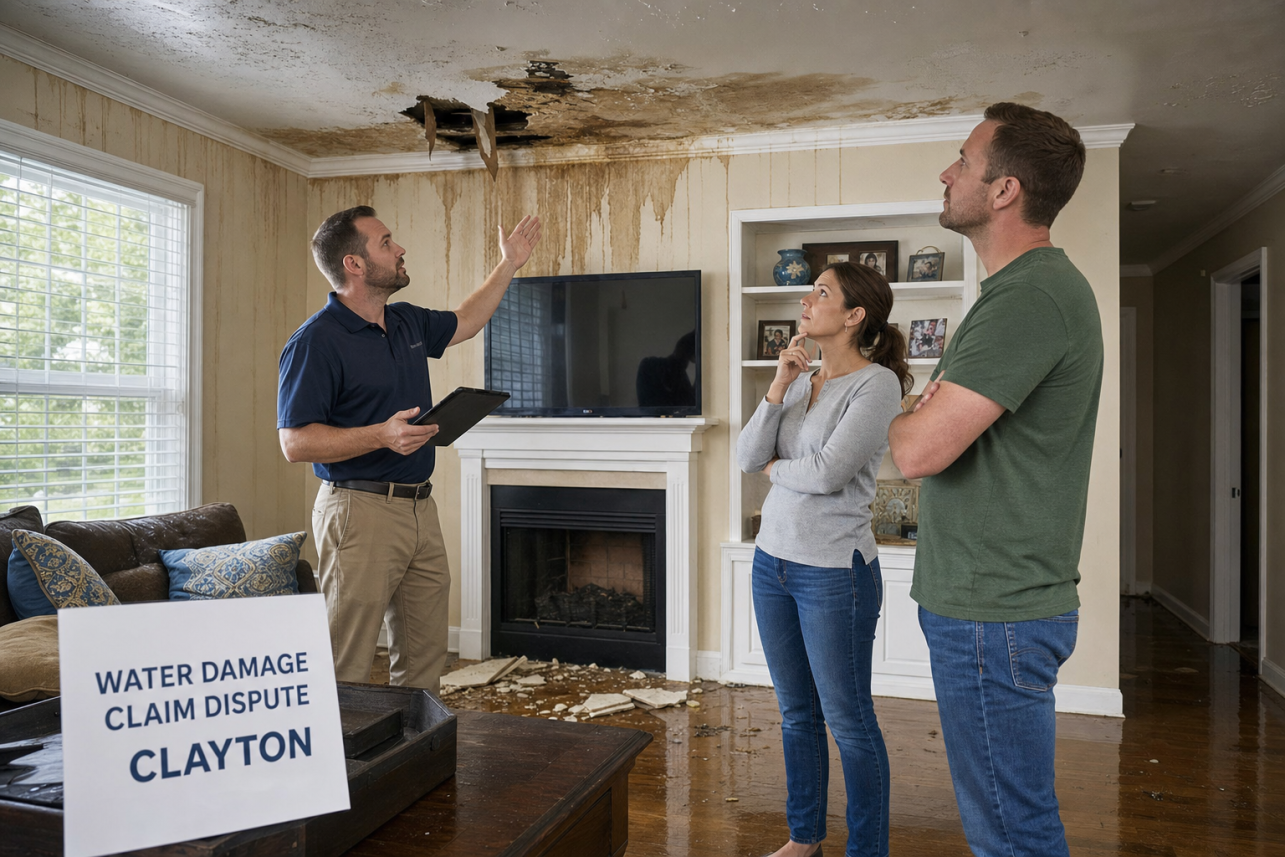
Mold Showed Up Behind My Walls After The Water Loss, And The Insurer's Adjuster Says It's Excluded. How Do You Handle That In A Water Damage Claim Dispute Clayton NC Families Are Fighting?
This is one of the most common flashpoints in a water damage claim dispute clayton NC homeowners bring to us, and the adjuster's blanket 'mold is excluded' answer is often wrong. Most policies exclude mold as a standalone cause of loss, but many still cover mold that results directly from a covered water event — a burst supply line, a failed water heater, an appliance leak. The distinction matters enormously, and adjusters routinely blur it.
The key questions are what caused the mold and how fast it appeared. In Clayton's humid climate, mold can bloom inside a wall cavity within 48 to 72 hours of a sudden pipe failure. That's resulting damage from a covered peril, not a maintenance problem. We bring in documentation — moisture mapping, mitigation records, photos with timestamps — that ties the mold growth directly to the covered water event, cutting off the insurer's argument that it developed over months.
Also check your policy for a limited fungi endorsement. Many North Carolina policies include $5,000 to $10,000 in mold remediation coverage even where broader mold damage is excluded. Adjusters frequently fail to mention it exists.
One more thing: never let the carrier's delay create the mold problem and then blame you for it. If their adjuster sat on approvals while your home stayed wet, that goes in the file in writing. For The Public Adjusters, Inc. builds that timeline for Johnston County homeowners so the party responsible for the delay — not you — absorbs the consequences.
Local Relevance
Clayton sits in one of the fastest-growing corners of the Triangle, and that growth shapes the water claims we see. Newer subdivisions bring builder-grade plumbing connections and water heaters now reaching the age where failures start; established neighborhoods closer to downtown have older supply lines, mature trees over roofs, and decades of settling.
Johnston County's humid subtropical climate makes everything harder. Summer thunderstorms drive water in through roof and flashing failures, tropical-system remnants have soaked this region more than once, and the occasional hard winter freeze bursts pipes in unconditioned spaces. Once water gets in, our humidity means mold can take hold quickly — which is exactly why a carrier's 'just dry it out' estimate so often understates the real repair.
The wind-versus-water and flood-versus-leak arguments matter here too. When a storm pushes water into a home near the Neuse River corridor or a low-lying lot, carriers may point to the flood exclusion and send you toward a separate flood policy — sometimes correctly, sometimes not. Getting the cause of loss classified accurately is often the difference between a paid claim and a denied one, and it's a fight local homeowners shouldn't take on alone.
Most homes in and around Clayton are built over vented crawl spaces, and in our humid climate a slow plumbing or drainage leak under the floor can go unnoticed for months — which is why so many local water disputes involve carriers arguing the damage is 'long-term' and excluded. Documenting when the leak actually began, with moisture readings and plumber records, is often what turns those denials around.
Get A Second Opinion On Your Water Claim
If the insurance company's adjuster has denied, delayed, or underpaid your water loss, don't accept their number as final. For The Public Adjusters, Inc. is licensed and bonded in North Carolina, and we'll review your Clayton claim at no cost and tell you honestly whether it's worth fighting.
Request Your Free Claim Review
Call us: (919) 400-6440
Helpful Resources
- NCDOI Public Adjusters Guide
- National Flood Insurance Program (NFIP)
- North Carolina Department of Insurance — State regulator overseeing insurers and public adjuster licensing
Last updated: August 12, 2026