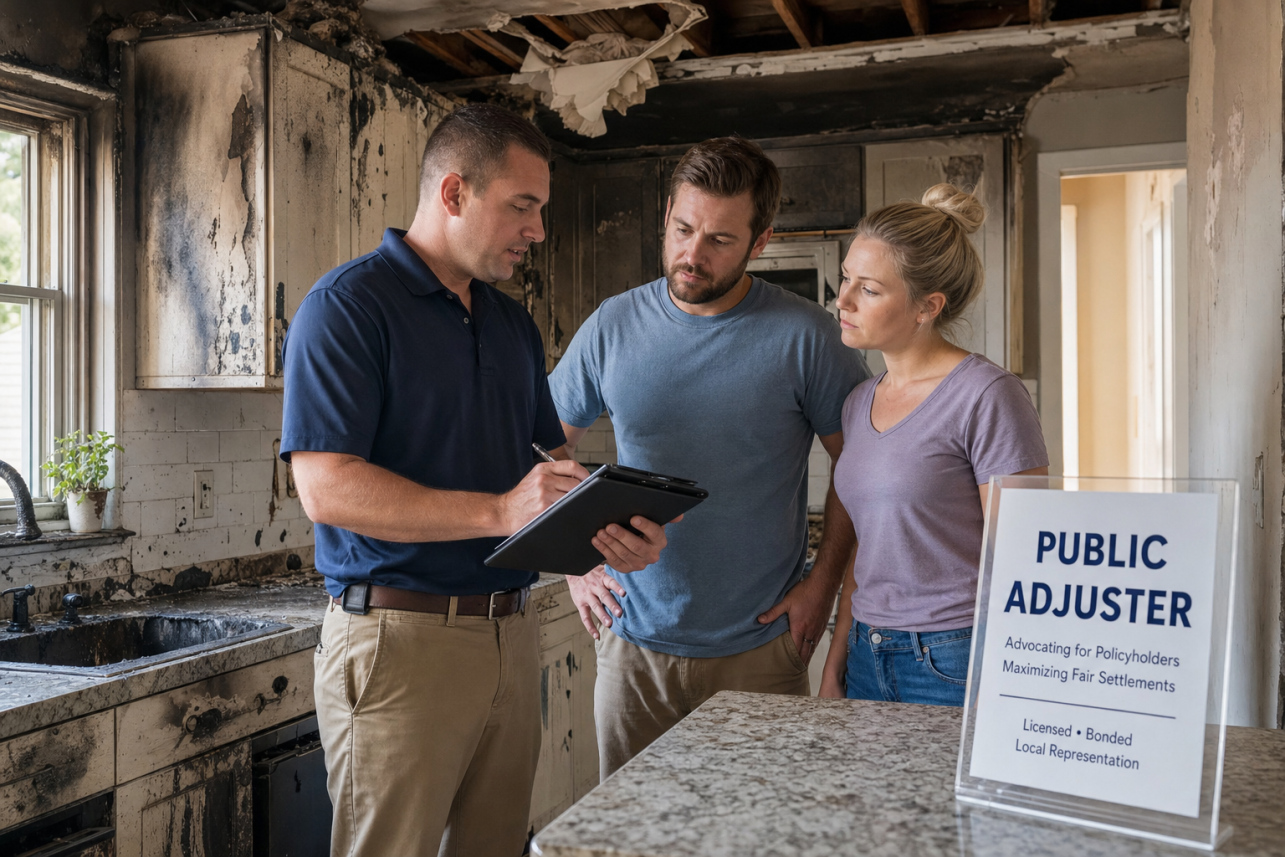
A public adjuster Wilsons Mills NC property owners can call after a fire, burst pipe, fallen tree, or hurricane is a licensed professional who works for you — not the insurance company. For The Public Adjusters, Inc. is licensed and bonded, and we prepare, document, and negotiate residential and commercial property claims on the policyholder’s behalf. Our job is to make sure your loss is measured completely and presented properly before the insurer sets a number.
What This Service Is
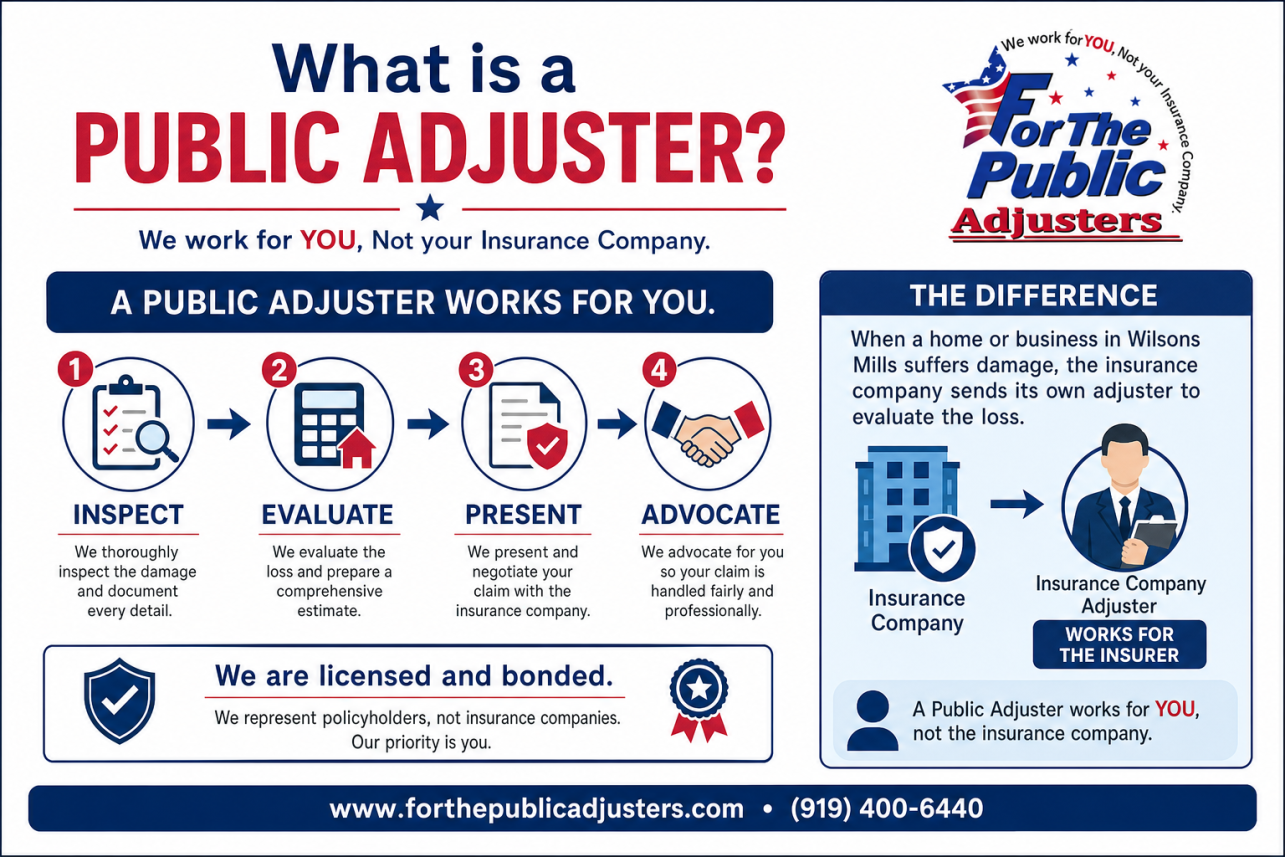
When a home or business in Wilsons Mills suffers damage, the insurance company sends its own adjuster to evaluate the loss. That adjuster works for the insurer. A public adjuster does the same technical work — inspecting the damage, reading the policy, pricing the repairs, inventorying contents — but does it for the policyholder alone.
We handle fire damage claims, smoke damage, water damage from plumbing failures, tree damage, vandalism, car-hits-home losses, flood insurance claims, and hurricane-related wind losses. We also work commercial business claims, where lost inventory and interruption of operations often go undervalued.
The North Carolina Department of Insurance regulates our profession, and the NCDOI Public Adjusters Guide explains that public adjusters must be licensed in this state and act solely in the insured’s interest. That regulatory framework matters: it means the person negotiating your claim answers to you, and to the state — not to the carrier.
We are paid a percentage of the recovery, so our incentive lines up with yours. We never guarantee a specific outcome — no honest adjuster can — but we do guarantee that your claim will be fully documented and professionally argued. Policyholders across Johnston County, from Princeton to Benson, hire us for exactly that reason.
Common Problems
What Does A Public Adjuster Wilsons Mills NC Homeowner Hires Actually Cost — And Is It Worth It?
We work on contingency: a percentage of what the insurance company pays, agreed in writing before we start. There is no hourly bill and no upfront fee, and if the claim pays nothing, you owe nothing for our adjusting work.
The value question comes down to what gets missed. Insurance company estimates routinely omit code-required upgrades, hidden moisture behind walls, smoke residue in HVAC systems, and full contents inventories. A settlement that looks reasonable at first glance can be thousands short once those items are priced.
We cannot promise a bigger check — nobody legitimately can. What we can promise is a complete, defensible claim file, which is the foundation every fair settlement is built on.
The Insurance Company Is Delaying, Lowballing, Or Denying My Claim. What Now?
This is the most common reason people call us after they’ve already filed on their own. The carrier’s first offer arrives, it doesn’t come close to real repair costs, and every follow-up call gets a different answer.
Policyholders can and do win these fights. In Sproull v. State Farm Fire and Casualty Co., the Illinois Supreme Court sided with a homeowner over how the insurer calculated actual cash value on a damaged dwelling, ruling that labor costs could not be depreciated the way the carrier had done. Cases like that exist because insurers’ numbers are not the final word.
Our role is to re-open the conversation with evidence: independent estimates, photographic documentation, and policy language. When a dispute needs to escalate beyond negotiation, we work alongside insurance dispute lawyers so nothing falls through the cracks. We take the same approach on losses we handle in Four Oaks and throughout Johnston County.
Should I Just Handle The Claim Myself, And How Do I Judge A Good Adjuster If I Don’t?
For a very small, clear-cut loss, handling it yourself can make sense. The trouble starts when damage is layered — a kitchen fire that also caused smoke and water damage, or a fallen tree that opened the roof to weeks of rain. Those claims involve multiple coverages, and undervaluing any one of them shrinks the whole settlement.
When you evaluate an adjuster, ask three things. Are they licensed in North Carolina and bonded? Will they show you a written contract with the fee percentage stated plainly? Can they explain, in your policy’s own language, what they intend to claim and why?
A good adjuster also tells you what is not covered before you sign, not after. We’d rather decline a claim honestly than take a fee for work that can’t help you. For reference, we do not handle claims involving vehicles themselves, health, life, or cell phones — our work is buildings, homes, and their contents.
Our Process
Free Inspection And Policy Review
We walk the property, photograph and measure the damage, and read your actual policy — endorsements, exclusions, and deductibles included. Then we tell you plainly whether the claim is worth pursuing and what coverage applies. There is no charge and no obligation for this step.
Documentation And Claim Preparation
We build the claim file: line-item repair estimates, contents inventories with values, moisture readings or lab reports where relevant, and a written statement of loss. For flood losses, we prepare documentation to the standards the National Flood Insurance Program expects, because flood claims live or die on paperwork.
Negotiation And Settlement
We present the claim to your carrier, meet their adjuster on site, and answer every pushback with evidence. Supplemental claims are filed when hidden damage surfaces during repairs. You review and approve any settlement before it is accepted — the decision is always yours.
| What Happens | Filing Alone | With For The Public Adjusters, Inc. |
|---|---|---|
| Damage documentation | Homeowner photos and the carrier’s brief inspection | Full moisture mapping, thermal imaging, and line-item scope of every affected area |
| Estimate accuracy | Carrier writes its own estimate, often below true repair cost | Independent estimate built at real contractor pricing for Johnston County |
| Policy interpretation | Carrier’s reading of exclusions goes unchallenged | Coverage provisions, matching rules, and code upgrades cited and enforced |
| Negotiation | One homeowner vs. trained claims staff | Licensed adjuster negotiating on your side with documented evidence |
| Typical result | Underpaid or delayed settlements are common | Claims regularly settle for multiples of the initial carrier offer |
| Your time investment | Weeks of calls, paperwork, and disputes | We manage the entire claim while you focus on your family or business |
Commonly Overlooked In The Public Adjusting Industry
- Shingle and siding matching provisions — Carriers pay to patch a small area, but when matching materials are discontinued, North Carolina policy language often supports replacing the entire slope or elevation.
- Hidden moisture in wall cavities and insulation — Field adjusters rarely carry moisture meters, so saturated insulation and wet framing behind intact drywall never make it into the estimate.
- Code upgrade (ordinance or law) coverage — Johnston County building code changes since original construction can add thousands in required work that homeowners never think to claim.
- HVAC duct contamination after fire or smoke — Soot pulled through return vents contaminates the whole duct system, but it’s invisible in a walkthrough and quietly left off the scope.
- Depreciation recoverable at completion — Many homeowners cash the actual-cash-value check and never file for the withheld depreciation they’re owed once repairs are done.
- Additional living expenses beyond the hotel bill — Extra mileage, pet boarding, laundry, and increased food costs during displacement are all claimable but almost never itemized.
- Deadlines buried in the policy conditions — Proof-of-loss and suit-limitation clocks run quietly, and missing one can forfeit an otherwise valid claim entirely.
- Detached structures and landscaping sub-limits — Sheds, fences, workshops, and tree removal carry their own coverage that adjusters skip when the homeowner doesn’t specifically raise them.
Case Studies
Case Study #1
Situation: A family on a wooded lot off Wilsons Mills Road came home after a spring thunderstorm to find a mature oak limb had punched through the roof decking over their master bedroom. Rainwater had run down the interior wall cavity for several hours before they discovered it.
Problem: The insurance carrier’s field adjuster inspected quickly and issued an estimate for roof patching and one bedroom ceiling. The payment came to just under $9,400. The homeowners could see water staining spreading into the hallway and smelled a musty odor, but the carrier’s report said interior damage was ‘limited and cosmetic.’
Investigation: Our team performed a full moisture-mapping inspection with thermal imaging and pin-type moisture meters. We traced the water path from the impact point down through the wall cavity, opened inspection points in the drywall, and documented saturated insulation and wet top plates the carrier’s adjuster never checked.
Findings: Moisture had migrated into two adjoining rooms and the hallway. Insulation in three wall cavities was saturated, early microbial growth was visible on the back side of the drywall, and the roof decking damage extended well beyond the patch area the carrier had scoped. Matching the aging architectural shingles was also not feasible, which under the policy language supported a larger slope replacement.
Solution: We rebuilt the claim with a line-item estimate covering full decking repair, proper shingle replacement across the affected slopes, controlled demolition of wet drywall and insulation, drying equipment, microbial remediation, and matching finishes. We submitted the moisture logs, photos, and policy citations, then negotiated directly with the carrier’s desk adjuster.
Outcome: The carrier reopened the claim and issued a revised settlement of just over $46,000 — roughly five times the original payment. The family completed repairs without paying out of pocket beyond their deductible.
Lesson: Water travels far beyond what’s visible on a ceiling. If a carrier’s estimate is based on a 20-minute walkthrough with no moisture testing, it’s almost certainly incomplete.
Case Study #2
Situation: A small business owner operating a commercial kitchen near the US-70 corridor in Johnston County had a grease fire that was contained quickly by the suppression system. The flames never spread past the hood line, so the owner assumed the claim would be simple.
Problem: The carrier paid for the hood, one wall section, and basic cleaning — about $22,000. It denied smoke and soot damage to the dining area and refused business interruption beyond two weeks, arguing the restaurant ‘could have reopened’ faster. The owner was losing revenue daily and burning through savings.
Investigation: We brought in independent testing for soot and protein residue contamination throughout the dining room, HVAC ductwork, and inventory storage. We also reconstructed the true reopening timeline using health department requirements, equipment lead times, and contractor availability, then compiled twelve months of financials to establish the actual income loss.
Findings: Protein smoke residue — which is nearly invisible but corrosive and odorous — had contaminated the entire HVAC system and dining area finishes. Every duct run needed cleaning or replacement, and food-contact equipment required certified decontamination. The realistic restoration period was fourteen weeks, not two.
Solution: We presented the lab results, code-required remediation scope, and a documented business interruption calculation to the carrier, then pushed the timeline dispute to appraisal-ready posture. Faced with independent evidence, the carrier’s large-loss team came back to the table.
Outcome: The final settlement exceeded $135,000 including the extended business interruption period and full contamination remediation. The restaurant reopened with all systems certified clean and its lost income substantially recovered.
Lesson: Fire claims are rarely about the flames. Smoke, soot, and lost income are usually the biggest dollars — and the easiest for a carrier to shortchange if no one measures them.
| Your Situation | Best Move | Why It Matters |
|---|---|---|
| Carrier’s offer seems low but you’re not sure | Get a free claim review before cashing any check | Once repairs start on an underpaid scope, recovering the difference gets harder |
| Claim denied outright | Have the denial letter and policy reviewed immediately | Many denials rest on misapplied exclusions and can be reversed with evidence |
| Water or storm damage you can see spreading | Document everything and get independent moisture testing now | Hidden saturation drives mold and structural claims carriers routinely undercount |
| Large loss (fire, hurricane, major flood) | Bring in representation before the carrier’s first inspection | The initial scope sets the tone for the whole claim; it’s easiest to get right the first time |
| Claim stalled with no response for 30+ days | Escalate with formal documented demands | NC carriers face prompt-handling obligations; a paper trail creates leverage |
| Business interruption after commercial damage | Compile financials and a realistic restoration timeline early | Lost income is often the largest and most disputed portion of a commercial claim |
| Small claim near your deductible | Weigh repair cost against filing at all | An honest adjuster will tell you when a claim isn’t worth pursuing |
Reviews
Hurricane wind drove rain under our shingles and the insurance company offered us $6,200 total. For The Public Adjusters found damage in the attic and two rooms their adjuster never even looked at. Our final settlement was over $38,000. They handled every call and every document so I didn’t have to fight the carrier myself.
Danielle R., Wilsons Mills
Our claim for a burst pipe under the kitchen sat in limbo for almost three months before we called them. Within weeks they had a moisture inspection done, a real estimate written, and the carrier finally responding. Went from a $4,000 offer to a settlement that actually covered the flooring, cabinets, and mold remediation.
Marcus T., Johnston County
After lightning hit our detached workshop, the insurer tried to call half the electrical damage ‘wear and tear.’ These folks documented everything, cited the actual policy language, and got the denial reversed. Honest about their fee up front and worth every penny. I’d recommend them to any neighbor dealing with a difficult claim.
Sherry W., Wilsons Mills
Frequently Asked Questions
What Does A Public Adjuster Wilsons Mills NC Homeowners Hire Actually Do For An Insurance Claim?
A public adjuster works exclusively for you, the policyholder — never the insurance company. When you hire For The Public Adjusters, Inc., we take over the entire claim process from documentation to final settlement negotiation.
That starts with a thorough inspection of your property. Storm damage in Johnston County often hides in places carriers overlook: wind-lifted shingles that don’t show from the ground, moisture trapped behind siding, or foundation issues after heavy rain along the Neuse River basin. We document everything with photos, moisture readings, and line-item estimates using the same software insurance companies use.
From there, we review your policy in detail. Most homeowners in Wilsons Mills have never read their full policy, and carriers rarely volunteer coverage you didn’t specifically ask about — things like code upgrade coverage, additional living expenses, or debris removal. We identify every applicable coverage and build the claim around it.
Finally, we handle all communication and negotiation with the insurance company’s adjuster. If the carrier’s initial offer is low — and in our experience, first offers usually are — we push back with documented evidence until the settlement reflects the true cost of repairs at current local contractor rates.
You stay informed at every step, but you’re no longer the one arguing with the carrier. That’s our job, and it’s the reason policyholders who use licensed adjusters consistently recover more than those who handle claims alone.
How Much Does It Cost To Hire A Claims Adjuster In Wilsons Mills, And Is It Worth It?
For The Public Adjusters, Inc. works on a contingency fee, which means you pay nothing upfront and nothing out of pocket. Our fee is a percentage of the settlement we recover for you, and North Carolina law caps what licensed adjusters can charge, so the structure is regulated and transparent from day one.
If we don’t recover money for you, you don’t owe us anything. That aligns our interests completely with yours — we only get paid when your claim gets paid.
Is it worth it? Consider what typically happens without representation. The insurance company sends its own adjuster, who may spend twenty minutes at your property and write an estimate based on regional averages rather than what contractors in the Smithfield and Clayton area actually charge. Depreciation gets applied aggressively, and coverages you’re entitled to often go unmentioned.
Studies of claim outcomes have consistently shown that policyholders with professional representation recover significantly more than those without — often several times the original offer on complex claims. Even after our fee, most clients net substantially more than they would have accepted on their own.
For smaller claims, we’ll tell you honestly during the free consultation if representation makes financial sense. Sometimes it doesn’t, and we’d rather earn your trust for the future than take on a claim that won’t benefit you. For significant storm, fire, or water damage in Johnston County, though, the numbers almost always favor hiring an advocate.
My Insurance Company Already Denied My Storm Damage Claim. Can A Wilsons Mills Public Adjuster Still Help?
Yes, and denied claims are actually one of the most common situations we handle. A denial is not the end of the process — it’s the carrier’s opening position, and it can be challenged with the right documentation.
Most denials in this area fall into a few categories. The carrier may claim the damage is pre-existing wear and tear rather than storm-related, which comes up constantly with roof claims after the hail and straight-line wind events that roll through Johnston County. They may argue the damage falls under an exclusion, or that you reported it too late. Sometimes the denial simply rests on their adjuster’s brief inspection missing the actual damage.
When you bring us a denied claim, we start with an independent inspection and a full review of the denial letter against your policy language. Denial letters often cite exclusions that don’t actually apply, or interpret policy terms more narrowly than North Carolina law allows.
We then build a documented rebuttal — weather data confirming the storm event at your address, photographic evidence, moisture mapping, and detailed repair estimates — and formally reopen the claim. Carriers respond differently when a licensed adjuster presents evidence they’ll have to answer for.
Timing matters, though. North Carolina policies contain deadlines for disputing claims and filing suit, typically within three years but sometimes shorter depending on your policy. If you’ve received a denial, call us for a free review before those windows close. There’s no cost to find out whether the denial can be overturned.
What Types Of Property Damage Claims Do You Handle For Homes And Businesses In The Wilsons Mills Area?
For The Public Adjusters, Inc. handles the full range of property claims that affect homeowners and business owners in Wilsons Mills and the surrounding Johnston County communities.
Wind and hail claims are our most frequent work here. Severe thunderstorms moving through the I-95 and US-70 corridor regularly damage roofs, siding, gutters, and windows — and this damage is frequently underpaid because it isn’t obvious from the ground. We inspect from the roof itself and document every impact point.
Water damage claims are a close second: burst pipes in winter cold snaps, water heater failures, HVAC condensation leaks, and storm-driven rain intrusion. These claims turn on proving the source and timeline of the damage, and carriers often try to reclassify covered sudden losses as excluded long-term seepage. We know how to counter that.
We also handle fire and smoke claims, which involve far more than visible burn damage — smoke residue, odor remediation, and contents losses are routinely undervalued. Hurricane and tropical storm claims are significant here as well, given how storms tracking inland from the coast still hit Johnston County with damaging wind and flooding rain.
For commercial policyholders — including the farms, shops, and small businesses along US-70 Business — we additionally handle business interruption claims, which require careful documentation of lost income during repairs.
Whether your claim is new, underpaid, or denied, the first step is the same: a free, no-obligation inspection and policy review. Being local, a public adjuster Wilsons Mills NC property owners can reach quickly makes a real difference when damage needs documenting before repairs begin.
How Soon After Property Damage Should I Contact A Public Adjuster Wilsons Mills NC Residents Can Rely On?
The best time to call is before you file the claim, or immediately after. Once you’ve given a recorded statement or accepted an initial estimate, your position gets harder to improve, so early involvement matters.
That said, most homeowners call us after the damage has happened and the claim is already underway, and that’s perfectly fine. We regularly step in mid-claim for families in Wilsons Mills and across Johnston County, review what the carrier has offered, and build a proper damage estimate from scratch.
North Carolina weather doesn’t give you much warning. A summer thunderstorm can drop a pine limb through your roof, and hurricane remnants coming up I-95 can push water into places you won’t notice for weeks. The sooner a trained adjuster documents the damage, the less room the insurance company has to argue that it’s old, pre-existing, or maintenance-related.
Keep in mind that North Carolina claims also have deadlines. Your policy sets time limits for reporting damage and submitting proof of loss, and waiting too long can jeopardize the claim entirely. Even if you’re just unsure whether the damage is worth filing over, a quick call costs you nothing. We’ll take a look, tell you honestly whether a claim makes sense, and if it doesn’t, we’ll say so. If it does, we handle the documentation, the deadlines, and the negotiation from day one.
What’s The Difference Between The Insurance Company’s Adjuster And One Who Works For Me?
This is the question that surprises most homeowners. The adjuster your insurance company sends is employed by, or contracted to, the insurance company. Their estimate protects the carrier’s interests, and they have no obligation to point out coverage you didn’t claim.
A public adjuster works exclusively for you, the policyholder. Under North Carolina law, we’re licensed by the Department of Insurance and legally bound to represent your interests, not the carrier’s. We read your policy the way an advocate reads it, looking for every coverage that applies to your loss.
Here’s what that looks like in practice around Wilsons Mills. A carrier’s adjuster might spend twenty minutes on your roof after hail moves through and write up a repair for one slope. We’ll document the entire roof, check the gutters, screens, and siding, test for moisture intrusion in the attic, and account for matching requirements so you’re not left with a patchwork roof that hurts your home’s value.
We also handle the parts homeowners rarely know exist: additional living expenses if you have to leave the house, code-upgrade coverage when repairs must meet current Johnston County building requirements, and depreciation recovery on replacement-cost policies.
The carrier’s adjuster isn’t necessarily dishonest, but they’re not on your team. When you have your own adjuster, the negotiation happens between two professionals reading the same policy, and that levels the field considerably.
How Long Does The Insurance Claim Process Usually Take With A Johnston County Public Adjuster Involved?
Every claim is different, but most residential claims we handle in the Wilsons Mills area resolve within 30 to 90 days from the time we take over. Straightforward roof or water claims often settle on the shorter end. Large fire losses, commercial claims, or disputes headed toward appraisal can take longer.
Here’s the honest truth: involving your own adjuster sometimes adds a little time up front, because we’re doing what the carrier’s adjuster didn’t. That means a full inspection, moisture readings, a line-item estimate, contents inventories, and a complete proof of loss. That thoroughness is exactly what produces a better settlement.
North Carolina also gives us some leverage on timing. Insurance companies operating here are expected to acknowledge, investigate, and respond to claims within reasonable timeframes, and unjustified delays can constitute an unfair claims practice. When a carrier drags its feet, we know how to document that and push back.
After a major storm hits Johnston County, carriers get flooded with claims and response times stretch for everyone. Homeowners handling claims alone often wait weeks for a callback. Because we manage the file professionally, submit complete documentation the first time, and follow up relentlessly, our clients’ claims tend to move through that backlog faster, not slower.
During your free initial review, we’ll give you a realistic timeline based on your specific damage, your carrier, and how far along the claim already is. No inflated promises, just a straight answer.
Is A Public Adjuster Wilsons Mills NC Homeowners Hire Required To Be Licensed In North Carolina?
Yes, and this is important. Anyone acting as a public adjuster Wilsons Mills NC property owners engage must hold an active license issued by the North Carolina Department of Insurance. Operating without one is illegal, and unlicensed ‘claim consultants’ occasionally show up after big storms, so it pays to check.
Verifying a license takes about two minutes. Visit the NC Department of Insurance website, use the licensee lookup tool, and search by name or license number. Any legitimate adjuster will hand over their license number without hesitation. If someone dodges the question, walk away.
North Carolina licensing isn’t just a formality. Licensed adjusters must pass a state examination, carry a surety bond, complete continuing education, and follow strict rules on contracts and fees. For example, our fee agreement must be in writing, and state law caps public adjuster fees, which protects you from predatory arrangements.
Beyond the license itself, ask a few practical questions before signing anything. How many claims like yours has the firm handled? Will you work directly with a licensed adjuster or get passed to an assistant? Can they provide references from Johnston County clients?
For The Public Adjusters, Inc. is fully licensed in North Carolina, and we encourage every homeowner to verify that independently before hiring us or anyone else. A trustworthy professional welcomes the scrutiny. Your insurance claim may be worth tens of thousands of dollars, and the person negotiating it should be accountable to state regulators, not just to a handshake.
My Insurance Company Already Paid My Claim, But The Check Seems Low. Can A Public Adjuster Wilsons Mills NC Property Owners Trust Reopen It?
In most cases, yes. A low payment is not the end of the road, and accepting a check does not automatically close your claim in North Carolina. If the settlement did not fully cover your damage, we can request a supplemental claim and present new documentation to support a higher payout.
We start by reviewing the insurance company’s estimate line by line. Underpayments around Wilsons Mills often come from missed items: matching issues on roofing shingles, hidden moisture behind drywall, damaged insulation in attics, or code-upgrade costs required by Johnston County when repairs are made. Carrier estimates frequently use pricing that does not reflect what local contractors along the US-70 corridor actually charge.
Once we identify the gaps, we prepare our own detailed estimate, gather photos, contractor bids, and moisture readings where needed, and submit a formal supplement to your insurer. From there, we handle the negotiation directly so you are not stuck going back and forth with the adjuster’s office.
Timing matters. Most policies give you a limited window to file supplemental claims, often tied to the date of loss, so it is smart to have your settlement reviewed sooner rather than later. Even if you cashed the first check months ago, bring us the paperwork. We will tell you honestly whether there is enough left on the table to pursue, and if there is not, you will know your claim was handled fairly. That review costs you nothing upfront.
What Should I Have Ready Before My First Meeting With Your Team In Wilsons Mills?
The most important document is your full insurance policy, including the declarations page and any endorsements. If you cannot find it, do not worry — we can request a certified copy from your carrier on your behalf. Many homeowners only have the declarations page, and the details that decide a claim are usually buried in the endorsements.
Beyond the policy, gather anything that documents the damage and your communication with the insurer. That includes photos or videos of the property before and after the loss, the claim number, letters or emails from the insurance company, any estimates you have received from contractors, and receipts for emergency repairs like tarping a roof or extracting water.
If your claim involves damaged belongings, start a simple list of items with approximate ages and replacement costs. You do not need it perfect — we help Johnston County families build complete contents inventories all the time, and we know how to value items properly under replacement-cost coverage.
Finally, jot down a timeline: when the damage happened, when you reported it, who you spoke with, and what was said. Storm losses in this part of Johnston County often involve multiple adjuster visits and phone calls, and a clear record strengthens your position.
If you are missing pieces, come anyway. Part of our job is reconstructing the file, requesting documents from the carrier, and inspecting the property ourselves. The consultation is free, and we will tell you exactly what we need and what we can obtain for you.
Will Hiring A Claims Professional Make My Insurance Company Cancel My Policy Or Raise My Rates?
No. Bringing in a public adjuster Wilsons Mills NC homeowners choose to represent them is a legal right, and North Carolina law prohibits insurers from retaliating against you for exercising it. Carriers deal with licensed adjusters representing policyholders every day — it is a normal, established part of the claims process.
Your rates are tied to factors like the type and frequency of claims you file, regional storm activity, and industry-wide loss trends, not to who represents you during a claim. Filing the claim itself is what appears in your claims history, and that happens whether you handle it alone or with professional help. Hiring representation does not add anything negative to that record.
In fact, professional handling often works in your favor. A well-documented, accurately scoped claim tends to resolve more cleanly, with fewer disputes, re-inspections, and drawn-out supplement battles. That means less friction with your carrier, not more.
Some policyholders around Wilsons Mills also worry that pushing back on a low settlement will label them as difficult. In our experience, the opposite is true — insurance companies respond to organized documentation and policy-based arguments. When they see a licensed professional has measured the roof, tested for moisture, and cited the specific coverage language, negotiations become more businesslike, not more hostile.
If your insurer ever suggested you should not seek independent representation, that alone would be worth documenting. You paid your premiums; you are entitled to advocate for the full value of your loss, and the law protects you when you do.
Do You Handle Claims For Businesses, Farms, And Rental Properties Around Wilsons Mills, Or Just Houses?
We handle all of it. Wilsons Mills and the surrounding stretch of Johnston County include a real mix of property types — established neighborhoods, newer subdivisions, working farmland, small commercial buildings near US-70, and rental homes serving families commuting toward Smithfield, Clayton, and the Triangle. Each of those creates different claim challenges, and we work across every category.
For commercial property owners, the biggest gap in a claim is often business interruption. When wind or fire damage shuts down operations, your policy may owe you for lost income and continuing expenses, not just the building repairs. Documenting that loss correctly requires financial records, projections, and a clear timeline, and it is where carriers most often underpay.
For farms and agricultural buildings, we handle damage to barns, equipment sheds, outbuildings, and fencing — losses that hurricanes and severe thunderstorms in this part of North Carolina cause regularly. These structures are frequently undervalued because carriers apply depreciation aggressively or misclassify construction types.
For landlords, we manage claims on rental houses and small multi-family properties, including loss-of-rents coverage when a unit becomes uninhabitable. If your tenant had to relocate after a fire or major water loss, that lost rental income may be covered, and we make sure it is claimed.
Whatever the property, the process starts the same way: we inspect the damage ourselves, read your specific policy, and build a claim that reflects the true cost of putting things back the way they were. If you own property anywhere in Johnston County, we can help.
Once I Hire A Public Adjuster Wilsons Mills NC Property Owners Recommend, Do I Still Have To Deal With My Insurance Company Myself?
No — and for most of our clients, that’s one of the biggest reliefs. Once you sign a representation agreement with For The Public Adjusters, Inc., we notify your insurance carrier that all claim communication should come through us. From that point forward, the adjuster calls, the document requests, the scheduling back-and-forth, and the negotiation all land on our desk instead of yours.
You’ll still be kept in the loop. We update you at every meaningful stage, and nothing gets settled without your approval. But you won’t be stuck on hold with a claims department during your lunch break or trying to interpret policy language after a long day.
There are a few moments where your participation helps. The carrier may require a recorded statement or an examination under oath, and only you can provide that. We prepare you thoroughly beforehand so you know exactly what to expect. You may also need to sign certain documents, like a proof of loss, which we draft and review with you first.
For homeowners and business owners around Wilsons Mills who are already juggling repairs, displaced family members, or a disrupted business, handing off the claim itself makes an enormous difference. Our job is to carry that weight so you can focus on getting your property and your routine back to normal, not on fighting for a fair settlement.
What Happens During Your First Inspection Of My Damaged Property In Wilsons Mills?
The initial inspection is where the real work of your claim begins, and we’re thorough by design. We’ll walk your entire property — not just the obvious damage — because losses from storms, water, and fire in Johnston County homes often extend well beyond what’s visible at first glance.
We photograph and document everything: roofing, siding, gutters, interior ceilings and walls, flooring, insulation, HVAC systems, and personal property. For water and fire losses, we check for hidden moisture, smoke penetration, and structural issues that carrier adjusters frequently miss or minimize. Wind-driven rain from the tropical systems that push up through this part of North Carolina is notorious for creating damage inside wall cavities that doesn’t show up for weeks.
While we’re on site, we also review your policy in detail. Coverage for ordinance and law upgrades, additional living expenses, debris removal, and matching materials can add significant value to a claim, and many policyholders don’t realize those provisions exist.
From that inspection, we build a line-item estimate using the same professional estimating software insurance companies use, so we can challenge their numbers item by item rather than arguing in generalities. Most initial inspections at Wilsons Mills properties take one to three hours depending on the size of the loss. You’re welcome to walk it with us — many clients find it eye-opening to see how much damage a quick carrier visit overlooked.
What If The Insurance Company Still Refuses To Pay Fairly After A Public Adjuster Wilsons Mills NC Homeowners Hire Gets Involved?
Most claims settle once we’ve documented the loss properly and presented a professional estimate — carriers know a well-supported claim is hard to dismiss. But when an insurer digs in, you still have real options, and we guide you through each one.
The most common next step is invoking the appraisal clause in your policy. Nearly every homeowner and commercial policy written in North Carolina includes one. Each side selects an independent appraiser, those two appraisers choose a neutral umpire, and the panel determines the amount of the loss. It’s faster and far less expensive than a lawsuit, and it takes the final number out of the carrier’s hands. A public adjuster Wilsons Mills NC policyholders work with can often serve as your appraiser in that process.
If the dispute involves coverage itself rather than the dollar amount — say the carrier claims the damage is excluded entirely — appraisal may not apply. In those situations, we can refer you to experienced insurance attorneys we’ve worked with on Johnston County claims. Because our file is already built with photos, estimates, and correspondence, an attorney can move quickly rather than starting from scratch.
You can also file a complaint with the North Carolina Department of Insurance, which regulates carrier conduct in the state. The important thing to know is that a lowball offer or a stubborn adjuster is not the end of the road. It’s simply the point where documentation and persistence start to matter most — and that’s exactly what we bring.
Are There Deadlines For Filing Or Disputing A Property Insurance Claim In North Carolina?
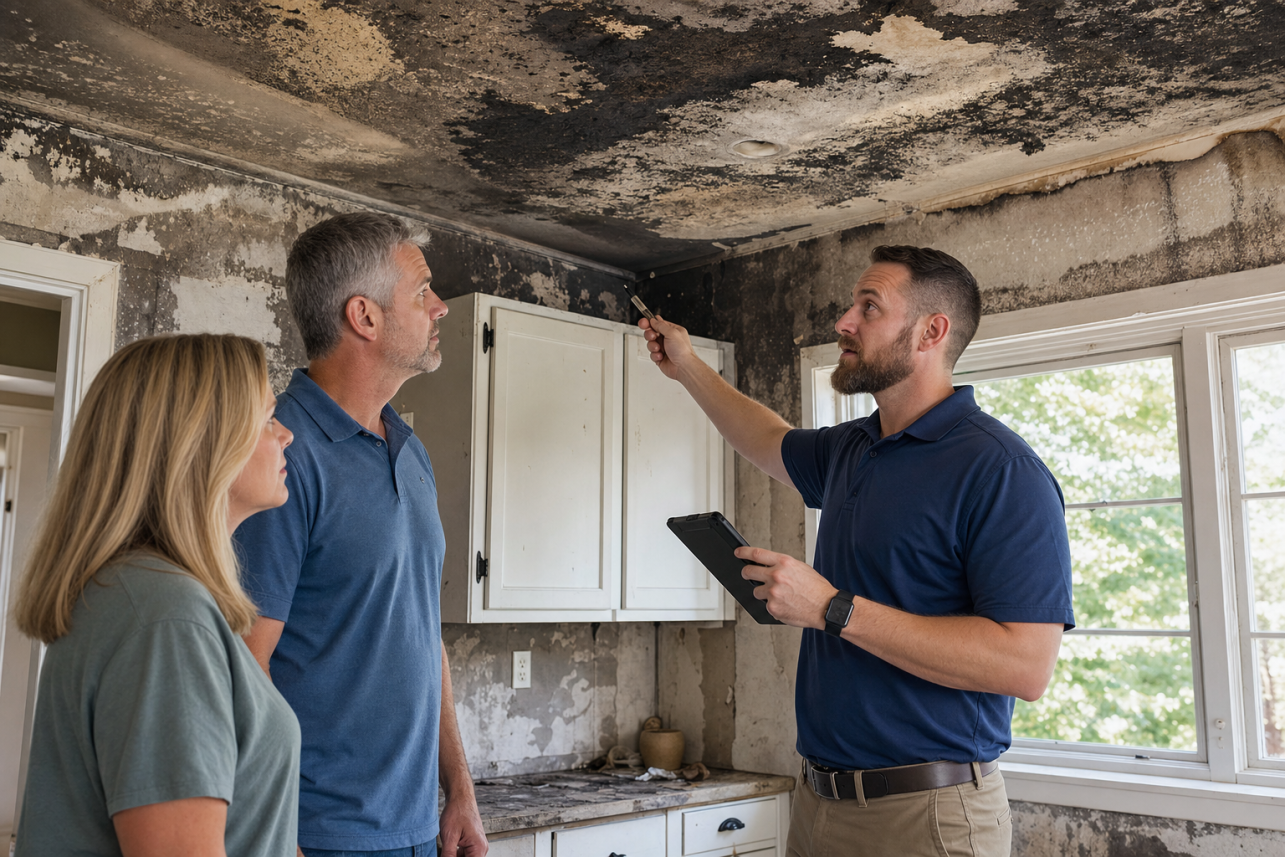
Yes, and missing them can cost you your entire claim, so this is worth understanding early. In North Carolina, the general statute of limitations for breach of an insurance contract is three years, but your policy itself can shorten that window — many policies require legal action within one or two years of the date of loss. The controlling deadline is whichever is enforceable under your specific policy language, which is one of the first things we review.
Your policy also imposes shorter practical deadlines. Most require “prompt” notice of the loss, and a sworn proof of loss is typically due within 60 days of the carrier requesting it. Miss that proof of loss deadline and the insurer may argue you’ve forfeited coverage, even on an otherwise valid claim.
For storm damage around Wilsons Mills, timing matters for another reason: evidence degrades. Hail bruising on shingles weathers, water stains get painted over, and it becomes harder to tie the damage to a specific storm date. After a hurricane or severe thunderstorm rolls through Johnston County, documenting the damage within days rather than months makes your claim substantially stronger.
If you’re already months past your loss date, don’t assume you’re out of time. We regularly take on claims where homeowners delayed because they didn’t realize the damage was significant, or because a contractor spotted problems long after the storm. Call us, and we’ll tell you honestly where you stand and whether your claim is still viable under your policy and North Carolina law.
Local Relevance
Wilsons Mills sits in the heart of Johnston County, where the housing stock ranges from older farmhouses and mid-century homes to the newer subdivisions that have grown up along the I-40 corridor. That mix matters for claims: older homes hide damage in plaster, original framing, and aging plumbing, while newer builds raise code-upgrade questions that insurers often leave out of estimates.
The weather here does real damage. Hurricane remnants tracking inland have repeatedly brought damaging winds, downed trees, and flooding to Johnston County, and the humid climate means any roof opening or plumbing leak turns into a mold and rot problem fast. Tree damage claims and water damage claims are two of the most common losses we work in this area — the same pattern we see in Pine Level and nearby communities.
For properties in low-lying areas near the Neuse River basin, flood coverage is a separate policy from homeowners insurance, and the Federal Emergency Management Agency oversees the flood program those policies come from. If you’re unsure whether your loss falls under your homeowners policy or a flood policy, that is exactly the kind of question we sort out during the free inspection. We also handle water damage claims in Wake Forest and across the Triangle, so we see how different carriers treat the same type of loss.
Many Wilsons Mills losses start as hurricane-season tree and roof damage but end up costing more in the water intrusion that follows, because Johnston County’s humid summers push hidden moisture into mold territory quickly — which is why we document interior moisture on every storm claim here, even when the visible damage is just shingles and limbs.
Get A Free Claim Review In Wilsons Mills
Before you accept the insurance company’s number, find out what your claim is really worth. For The Public Adjusters, Inc. is licensed and bonded, we work only for policyholders, and the inspection costs you nothing. Fire, water, smoke, tree, hurricane, vandalism, or flood — if it damaged your home, business, or contents in Johnston County, we’ll tell you honestly whether we can help.
Call us: (919) 400-6440
Helpful Resources
- NCDOI Public Adjusters Guide
- Federal Emergency Management Agency (FEMA)
- National Flood Insurance Program (NFIP)
- North Carolina Department of Insurance — State regulator that licenses public adjusters
Our services in this city
Service pages for this city are coming soon.
Last updated: August 28, 2026