
Low-Balled After the River Rose: One Eastern NC Homeowner’s Story — When a Flood Insurance Claim Is Too Low
A flood insurance claim too low to cover real repairs is a common problem after NFIP inspections, because adjusters often scope only the visible waterline. One eastern North Carolina homeowner received an estimate for just two feet of flood-cut drywall — but a professional re-inspection with moisture mapping documented significantly more covered damage. The first estimate is not the final word.
Key takeaways
- A flood insurance claim too low is often the result of scoping only the visible water line, even though water wicks up drywall and insulation well above where the flood crested.
- NFIP adjusters rarely open HVAC ducts, wall cavities, or flooring systems — hidden saturation in these areas is a leading reason flood payouts come in short.
- You generally have the right to file a supplemental NFIP claim with new documentation, so a low first estimate is not the final word.
- Professional moisture mapping with meters and thermal imaging creates the objective evidence needed to support a higher, more accurate covered repair estimate.
- Courts have sided with policyholders when carriers underscoped hidden storm damage — in Broussard v. State Farm Fire & Casualty Co. (5th Cir. 2007), Louisiana homeowners prevailed on their claim that the insurer wrongly denied covered damage to their home after Hurricane Katrina.
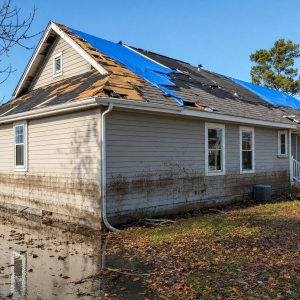
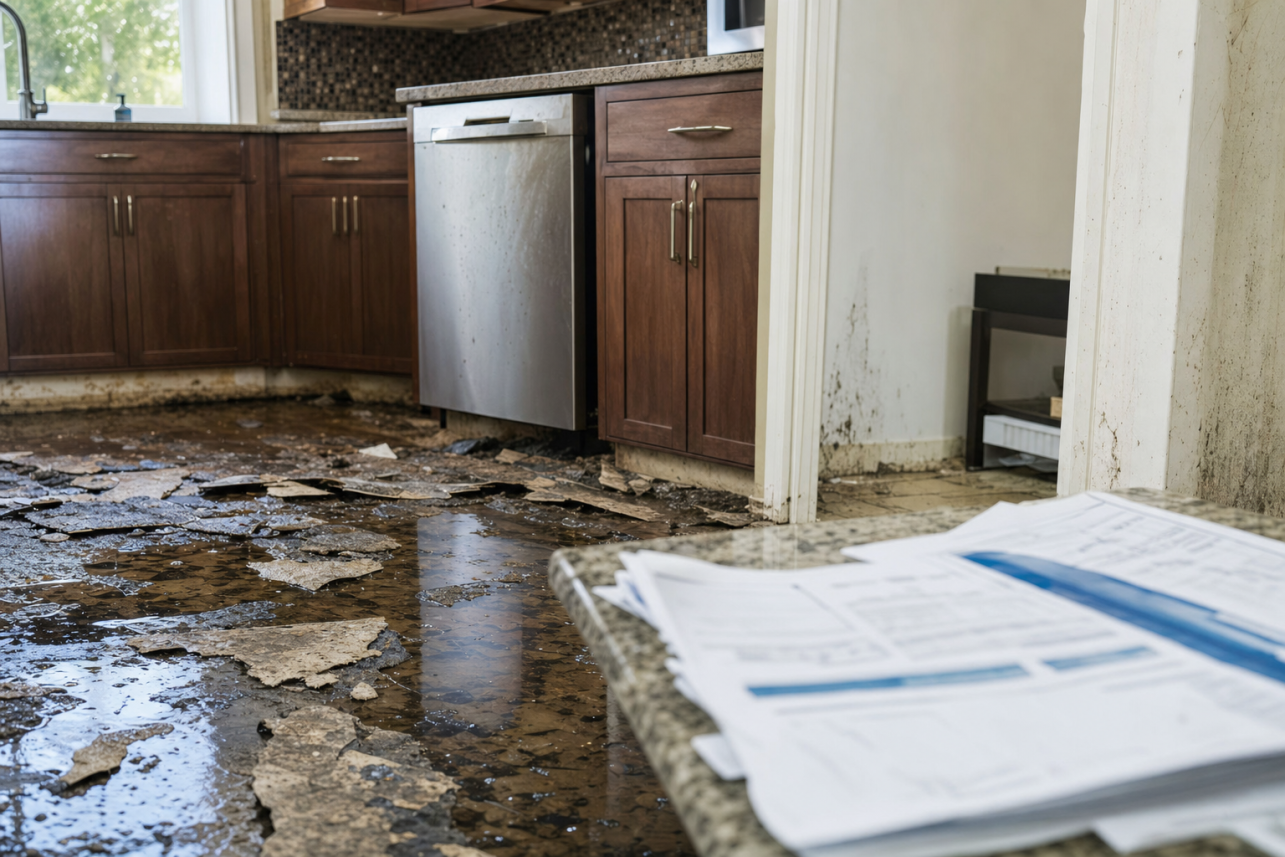
Here is how it played out. After a river near this homeowner’s property crested and the water finally receded, the NFIP adjuster walked the home, noted the stain line on the walls, and wrote an estimate to remove and replace roughly two feet of drywall, plus flooring and some baseboard. On paper, it looked reasonable. In reality, it missed much of what the flood actually did to the house.
What the First Estimate Missed
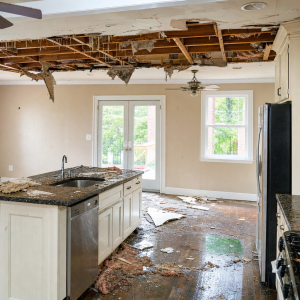
When the homeowner brought in a licensed public adjusting team for a second look, moisture mapping and a room-by-room re-inspection told a different story. Water does not politely stop at the line it leaves on the paint. The re-inspection documented:
- Moisture wicked up inside wall cavities well above the visible waterline
- Saturated insulation hidden behind drywall that looked dry on the surface
- Water trapped under flooring layers and inside the subfloor
- Wet framing and sill plates that needed drying and treatment to prevent decay and mold
- Damaged contents and built-ins the original scope never listed
Each of those items was documented with moisture readings, photos, and a detailed line-item scope — the kind of evidence NFIP requires to support additional payment. The supplemented claim reflected the true cost of putting the home back together, not just patching the stain line. We never guarantee any specific outcome, but we can promise that a thoroughly documented claim gives you a far stronger position than an estimate built on a quick visual walkthrough. Homeowners dealing with similar shortfalls often start by getting flood insurance claim help in Garner or wherever their property sits, before signing off on the carrier’s first number.
Why This Story Matters for Your Claim
NFIP flood policies pay based on what is documented. If hidden damage is never measured, it is never paid. That is the quiet reason so many flood payouts come in low — not bad faith in every case, but a scope that simply stopped where the water stain stopped. You have the right to question the estimate, submit additional documentation, and pursue a supplemental payment or appeal.
If your settlement feels thin compared to what contractors are quoting, a licensed, bonded public adjuster in Hillsborough or your own community can re-inspect, remeasure, and rebuild the claim on evidence. The sections below walk through exactly how that works — and what your options are under the NFIP.
Why Was My Flood Insurance Claim Too Low After the Water Went Down?
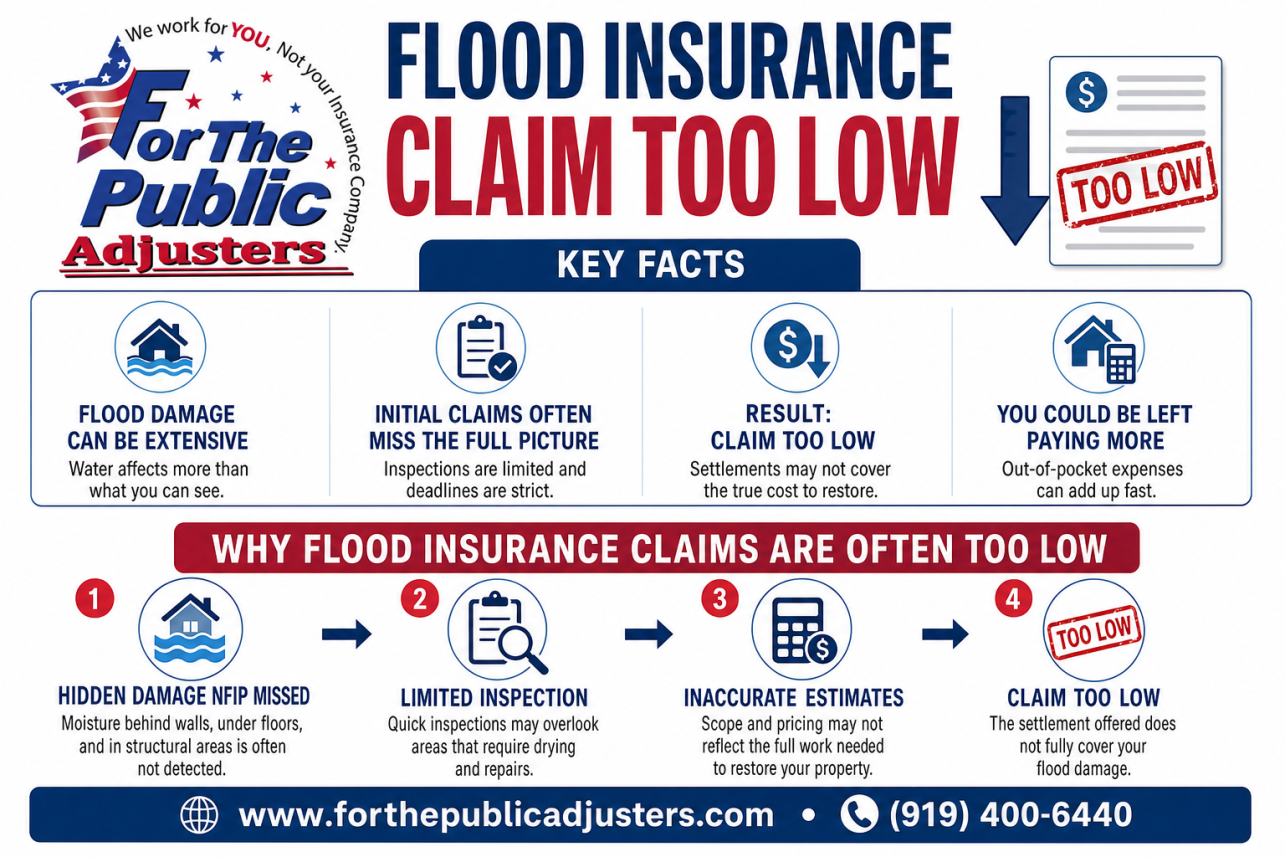
Most NFIP estimates come in low because the adjuster scopes only what is visible at inspection time — typically the dried flood line on the walls. Rushed schedules, standard two-foot flood-cut assumptions, and inspections that never open walls, floors, or ductwork mean damage that water actually caused is simply never written into the estimate.
If that sounds like your experience, you are not alone, and it does not mean the damage is not real. It means the inspection stopped before the damage did. Understanding how these shortfalls happen is the first step toward correcting a flood insurance claim too low to actually repair your home.
Time Pressure and the “Visible Line” Problem
After a major flood, NFIP adjusters often carry heavy caseloads and may spend only a short time at each property. Under that kind of pressure, the natural shortcut is to measure to the high-water mark and write the estimate from there. The trouble is that a high-water mark only shows where standing water paused — not where moisture traveled afterward. Water wicks upward through drywall and insulation, migrates sideways under flooring, and settles into wall cavities and crawlspaces long after the surface looks dry. Homeowners pursuing flood damage insurance claim help in Durham and across eastern North Carolina see this pattern again and again: the estimate matches the stain on the wall, not the saturation behind it.
Common Shortcuts That Shrink Flood Estimates
- The standard two-foot flood cut: Estimates often assume drywall removal to two or four feet, even when moisture has wicked higher inside the wall cavity.
- No invasive inspection: Walls, baseboards, and subfloors are rarely opened during the initial visit, so saturated insulation, swollen sill plates, and wet sheathing go unrecorded.
- Ductwork ignored: Floodwater that enters underfloor or slab ducts carries contamination through the system, yet duct interiors are seldom inspected.
- Dried surfaces mistaken for dry structures: A wall can read dry to the touch while the cavity behind it holds enough moisture to breed mold and rot framing.
Courts Have Recognized the Inadequate-Investigation Problem
This is not just a homeowner complaint — courts have held insurers accountable for it. In State Farm Fire & Casualty Co. v. Simmons, the Texas Supreme Court upheld a judgment in favor of homeowners after finding the insurer failed to conduct a reasonable investigation of the damage to their home before resolving the claim. The lesson is the same in flood claims: an estimate is only as good as the inspection behind it. Policyholders seeking flood insurance claim help in Holly Springs often discover that a thorough, documented inspection tells a very different story than the original scope — and the NFIP process does allow that story to be told, as we cover in the sections that follow.
How Does Moisture Mapping Find Flood Damage You Can’t See?
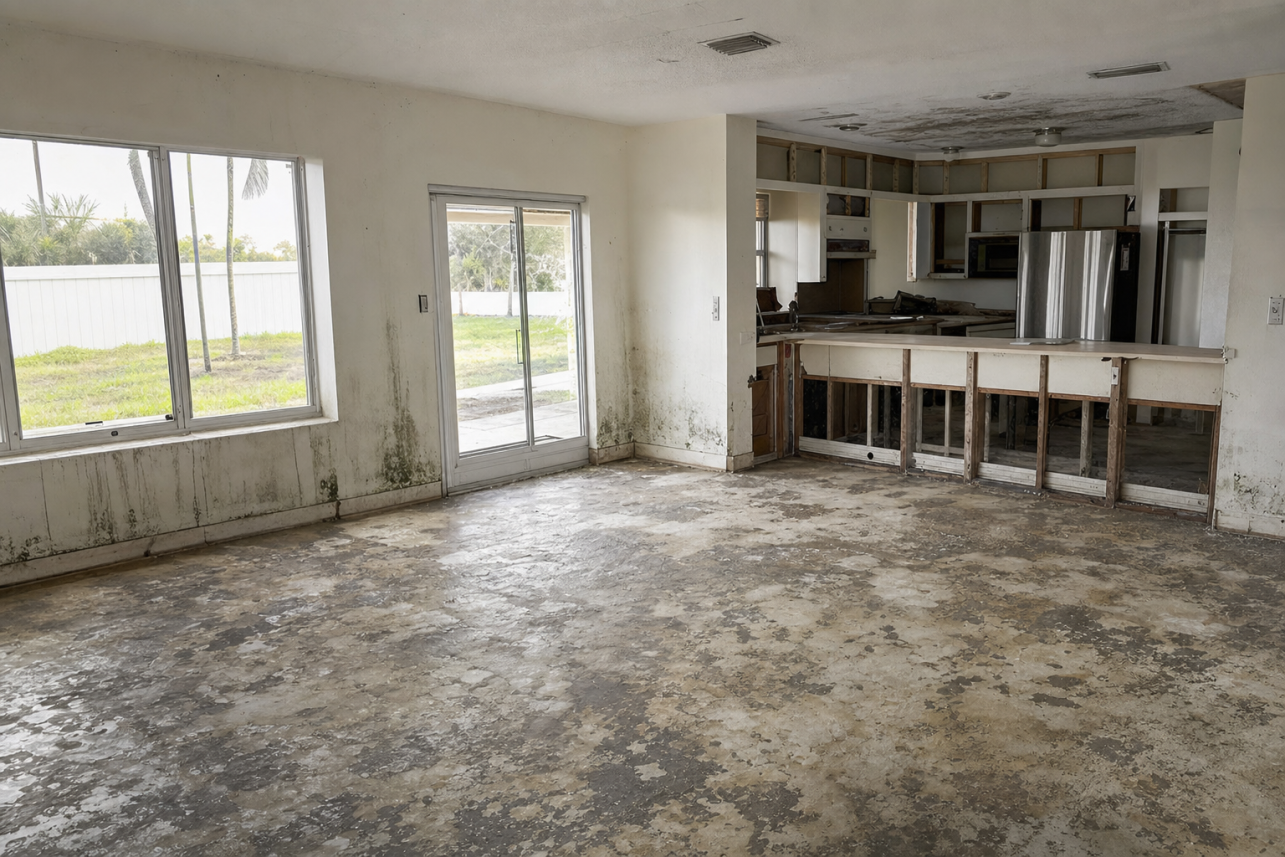
Moisture mapping uses thermal imaging cameras and penetrating moisture meters to measure water hidden inside walls, floors, insulation, and ductwork. By recording readings room by room, it creates a documented picture of where floodwater actually traveled — often several feet above the visible water line and into rooms the water never appeared to reach.
In this homeowner’s case, the carrier’s adjuster measured from the visible flood line and stopped there. The moisture map told a very different story — and it’s a common reason a flood insurance claim too low turns out to be missing thousands of dollars in legitimate, covered damage.
What the Thermal Camera and Meters Revealed
- Water wicking more than four feet above the flood line. Drywall and wood framing act like a sponge. Meter readings showed saturation well above where the water visibly stopped, meaning far more drywall and framing needed removal than the original estimate allowed.
- Soaked batt insulation inside closed walls. Fiberglass batts hold floodwater long after surfaces feel dry. Thermal imaging flagged cool, wet pockets behind walls that looked fine from the outside — insulation that cannot be dried in place and must be replaced.
- Cupped hardwood in “dry” rooms. Flooring in rooms the water never visibly entered was cupping because moisture migrated under the subfloor. Those rooms weren’t in the carrier’s scope at all.
- A contaminated HVAC duct system no one opened. Floodwater is Category 3 contaminated water. Ducts that took on water need cleaning or replacement — but the carrier’s adjuster never opened the system to look.
Why This Documentation Changes the Outcome
Hidden moisture isn’t a judgment call — it’s measurable. When readings, thermal images, and photos are logged and tied to specific locations, the supplemental claim rests on evidence the carrier can verify, not on a disagreement of opinion. That documented record is exactly what supports a flood insurance claim dispute in Raleigh or anywhere else in North Carolina where the initial scope missed hidden damage.
Courts have recognized how much documentation matters in flood-related disputes. In Corban v. United Services Automobile Association, the Mississippi Supreme Court sided with homeowners after Hurricane Katrina, holding that the insurer bears the burden of proving that damage falls under a flood exclusion — the policyholder doesn’t have to disprove it. The lesson carries over: thorough, professional documentation of what the water actually did puts the facts on the homeowner’s side.
If your home took on water and the estimate only covers what was visible, a properly documented flood damage insurance claim in Durham or the surrounding area should account for everything the moisture map reveals — not just what the first adjuster could see from the doorway.
Can I Dispute a Flood Insurance Claim Too Low Under the NFIP?
Yes. You can dispute a low NFIP flood payout by filing a supplemental claim with additional documentation, submitting a signed proof of loss for the full amount you believe you are owed, or filing a formal written appeal with FEMA after a denial. Deadlines are strict, so acting quickly protects your rights.
The key thing to understand is that the first check is rarely the final word. The NFIP process is built to allow revisions when a policyholder comes back with better evidence — photographs, moisture readings, contractor estimates, and itemized contents inventories. The burden, fairly or not, falls on you to prove the gap between what was paid and what the damage actually costs to repair.
Your Three Main Options, in Plain Language
- Supplemental claim: If you discover additional damage after the first payment — hidden moisture, buckled subfloors, damaged wiring — you can submit new documentation and request an additional payment on the same claim.
- Proof of loss: This is the sworn statement setting out the amount you are claiming. Under standard NFIP policy terms, it generally must be submitted within 60 days of the loss, though FEMA has extended that deadline after some major disasters. If your number is higher than the adjuster’s, your proof of loss should reflect your documented figure, not theirs.
- FEMA appeal: If part of your claim is denied in writing, you can appeal directly to FEMA, typically within 60 days of the denial letter, with a written explanation and supporting evidence.
Homeowners in fast-growing areas hit by river and creek flooding often pursue a flood insurance claim dispute in Raleigh and across the Triangle using exactly these tools — and documentation is what separates disputes that succeed from those that stall.
Courts Have Sided With North Carolina Policyholders
Pushing back is not a long shot. In Studio Frames, Ltd. v. Standard Fire Insurance Co., a North Carolina policyholder whose property flooded during Hurricane Fran fought its insurer over building coverage under a flood policy — and prevailed. The case is a reminder that when an insured presents solid documentation and holds firm on what the policy actually covers, courts do rule in the policyholder’s favor. Insurers know this, which is why a well-supported supplemental claim or appeal often gets a second, more serious look.
If your flood insurance claim is too low, don’t simply cash the check and move on. Gather your evidence, watch your deadlines, and get experienced flood damage insurance claim help in Cary or wherever your property is located before the window to act closes. While no one can guarantee a specific outcome, a properly documented dispute gives you the strongest possible footing.
What Does a Public Adjuster Do When Your Flood Insurance Claim Is Too Low?
A public adjuster works for you, not the insurance company. On a flood claim, that means independently documenting every bit of damage, moisture mapping hidden saturation, rebuilding the repair scope line by line, preparing a complete proof of loss, and negotiating a supplement with the NFIP or your Write-Your-Own carrier on your behalf.
When your flood insurance claim is too low, the problem is almost always the paperwork behind it — a repair scope that is missing rooms, materials, or entire categories of damage. A public adjuster’s job is to close that gap with evidence the carrier cannot easily dismiss.
The Work, Step by Step
- Independent inspection and documentation. We photograph, measure, and inventory the loss ourselves rather than relying on the carrier adjuster’s walkthrough, which may have lasted less than an hour.
- Moisture mapping and hidden-damage investigation. Using meters and thermal imaging, we trace water migration into wall cavities, subfloors, and insulation so saturated materials don’t get left out of the estimate.
- Rebuilding the scope line by line. We compare the carrier’s estimate against what’s actually required to restore the property — demolition, drying, materials, and code-required upgrades — and document every missing item.
- Preparing the proof of loss. NFIP claims live or die on a timely, properly supported proof of loss. FEMA sets strict deadlines and documentation standards, and we build the file to meet them.
- Negotiating the supplement. We present the revised scope and supporting evidence to the carrier and push the claim toward what the policy actually owes.
Licensed, Bonded, and Transparent About Fees
We are licensed and bonded in North Carolina, and our fees are disclosed up front in writing before any work begins — no surprises. One important point of honesty: no one can guarantee a specific outcome or dollar amount on a claim, and you should be cautious of anyone who promises otherwise. What a public adjuster can do is make sure your claim is fully documented and professionally presented. If you want to understand how NFIP coverage is supposed to work, the official FloodSmart.gov resource from the National Flood Insurance Program is a good starting point.
Courts have repeatedly sided with policyholders when insurers undervalue or deny storm and water losses. In Corban v. United Services Automobile Association (Mississippi Supreme Court, 2009), a Hurricane Katrina case, the court rejected the insurer’s broad reading of its anti-concurrent causation clause, preserving the homeowners’ right to coverage for wind damage that occurred before floodwater arrived. Documentation and a correct reading of the policy made the difference — exactly what we focus on when providing flood damage insurance claim help in Cary and across the Triangle.
If your home flooded and the payout doesn’t come close to the real cost of repairs, talking with a public adjuster in Garner or the surrounding area costs you nothing but a conversation — and it may be the step that gets your claim documented the way it should have been from day one.
Flood Insurance Claim Too Low? Carrier Scope vs. Full Moisture Mapping
| Damage Area | Typical Carrier Flood Scope | What Moisture Mapping Often Documents |
|---|---|---|
| Drywall & insulation | Flood cut at the visible water line (often 2 feet) | Wicking and saturated insulation 1–2+ feet above the flood line, requiring 4-foot cuts or full-wall removal |
| Flooring | Materials in rooms with standing water | Cupped hardwood and wet subfloor in rooms water migrated to beneath the surface |
| HVAC system | Exterior visual check only | Contaminated ductwork and components that were never opened or tested |
| Documentation | Photos of visible damage | Meter readings, thermal imaging, and room-by-room moisture logs supporting a supplemental claim |
Illustrative Example: The Two-Foot Flood Cut That Missed a House Full of Damage
Illustrative example
Consider a hypothetical eastern North Carolina homeowner whose NFIP adjuster scoped only a two-foot flood cut after river flooding, based on the visible water line. A public adjuster’s moisture mapping later documented water that had wicked several feet up the walls, saturated insulation throughout the first floor, cupped hardwood flooring in rooms the water never visibly reached, and a contaminated duct system the carrier’s adjuster never opened. With meter readings, thermal imaging, and a room-by-room moisture log, a supplemental claim was submitted that substantially increased the documented covered repair scope. This composite scenario is for illustration only — every claim is different and no specific outcome can be promised — but it shows why a low initial flood estimate deserves a second, more thorough look.
Frequently asked questions
Flood insurance claim too low — what are my options?
You have real options, and accepting the first estimate is not one of them. You can request a reinspection, submit a supplemental claim with new documentation, file a formal appeal with FEMA after a written denial, or hire a licensed public adjuster to re-scope the damage independently. The key is evidence: photos, moisture readings, and a detailed line-item estimate showing what the original adjuster missed. Act promptly, because NFIP deadlines are strict.
How much does a public adjuster cost for a flood claim?
Most public adjusters work on contingency, meaning their fee is a percentage of the additional money recovered on your claim — not an hourly rate or upfront charge. Fee limits vary by state, and the percentage should be spelled out clearly in a written contract before any work begins. Always confirm the adjuster is licensed and bonded in your state. If no additional recovery is documented, reputable adjusters typically charge nothing.
Can I reopen my NFIP flood claim after I already cashed the check?
Yes, in most cases. Cashing an NFIP payment is generally not a final release of your claim. If you discover additional flood damage the adjuster missed, you can submit a supplemental claim with supporting documentation, including a signed proof of loss for the added amount. Document everything before repairs cover the evidence, and move quickly — supplemental claims still fall under NFIP deadlines, which FEMA sometimes extends after major flood events.
Is there a deadline to dispute a flood insurance payout?
Yes, and they’re firm. Under the standard NFIP policy, you generally must submit a signed, sworn proof of loss within 60 days of the date of loss, though FEMA often extends this after major flooding events. If your claim is formally denied in writing, you typically have 60 days from the denial letter to file an appeal with FEMA. Missing these windows can forfeit your rights, so calendar them immediately.
Does flood insurance cover damage you can’t see, like wet insulation inside walls?
NFIP policies cover direct physical damage caused by flooding, and that includes hidden damage — water wicking up inside wall cavities, saturated insulation, and moisture that migrates into rooms the floodwater never visibly reached. The challenge is proof. Carriers pay what’s documented, so hidden damage must be verified with moisture meters, thermal imaging, or opened wall sections. Note that mold can be excluded if the policyholder fails to mitigate promptly, so dry out quickly and document everything.
Should I appeal to FEMA myself or hire a public adjuster?
It depends on the gap and the complexity. If the dispute is small and well documented, a FEMA appeal you handle yourself may resolve it. If the underpayment is significant or involves hidden damage — inside walls, under floors, in ductwork — a licensed public adjuster brings inspection tools, estimating software, and NFIP claim experience most homeowners don’t have. Many homeowners consult a public adjuster first, since the review typically costs nothing and clarifies whether an appeal alone is enough.
What are the biggest mistakes homeowners make after a lowball flood payout?
The most costly mistakes: tearing out damaged materials before documenting them, which destroys your evidence; missing the proof of loss deadline; assuming the adjuster’s scope is final; starting repairs that hide damage before a re-inspection; and discarding receipts for cleanup and temporary living costs. Another common one is trusting a verbal reassurance that ‘more is coming’ without anything in writing. Photograph everything, keep all paperwork, and get every commitment documented.
Have homeowners actually won in court against insurance companies over storm damage?
Yes. A well-known example is Corban v. United Services Automobile Association, where the Mississippi Supreme Court ruled in favor of homeowners after Hurricane Katrina, rejecting the insurer’s attempt to use policy language to deny covered damage to the home. Cases like this show courts will hold insurers to their policies. That said, most underpaid flood claims are resolved through documentation, supplements, and appeals long before litigation becomes necessary.
Will disputing my flood claim take a long time or delay my repairs?
A supplemental claim or FEMA appeal can take weeks to a few months depending on documentation, flood volume in your area, and whether a reinspection is needed. You don’t have to stop living your life — emergency mitigation like drying and mold prevention should happen immediately, and you can proceed with repairs once the hidden damage is thoroughly documented. Preserving evidence first, then repairing, protects both your home and your claim.
How do I know if my flood adjuster missed hidden damage?
Warning signs include an estimate that only covers materials below the visible water line, no moisture meter readings in the report, no inspection of wall cavities, subfloors, or HVAC ducts, and musty odors, cupping floors, or peeling paint appearing after the payout. If the adjuster spent only a short time on site or never opened anything up, there’s a reasonable chance the scope is incomplete and an independent inspection is worth pursuing.
NFIP Flood Claims help near you
Related local pages
If your flood payout doesn’t come close to covering real repairs, request a free claim review from our licensed and bonded NC public adjusters today. Get in touch.
Last updated: November 28, 2026