
When a storm rips through your neighborhood, dealing with the aftermath of wind damage insurance claims can be an emotional task. However, dealing with your insurance company shouldn’t be a second disaster, but for far too many homeowners and business owners, that’s exactly what it becomes.
Disputing a wind damage insurance claim often feels like stepping into the ring for a fight you didn’t ask for. The process is stacked against you from the very beginning.
Why Your Insurance Company Is Not on Your Side

Let’s get one thing straight: your insurance provider is not your partner in recovery. It’s a for-profit business, and big players like Allstate and State Farm have one primary goal—protecting their bottom line by minimizing payouts.
This creates a fundamental conflict of interest. Their financial incentive is to pay out as little as possible on your claim. They achieve this by delaying, denying, and underpaying what you’re rightfully owed. It’s not personal; it’s just their business model. They have entire departments of adjusters and attorneys trained to find any reason to slash your settlement.
The Financial Stakes of Wind Damage
The numbers behind wind-related disasters are staggering, and they put immense pressure on insurers to tighten their purse strings.
In the first half of 2025 alone, global insured losses from natural catastrophes, mostly severe windstorms, skyrocketed to between $80 billion and $100 billion. The U.S. took the biggest hit, shouldering over 90% of those insured losses after a brutal season of thunderstorms and tornadoes ripped through the Midwest and South.
When insurers are facing that kind of financial bleeding, you can bet they’re going to scrutinize every single detail of your wind damage claim, looking for any excuse to pay less. You can read more about these global disaster loss trends and see for yourself how they impact the industry’s approach to your claim.
Once you accept that the claims process is a business negotiation, not a plea for help, everything changes. You stop asking for what’s fair and start demanding what your contract promised.
This shift in mindset is your most powerful tool. It transforms you from a victim into an advocate. Every photo you take, every email you send, and every conversation you have with their adjuster is another piece of evidence. You’re not just reporting damage; you’re building a rock-solid case to force them to honor the policy you paid for.
Insurer Tactics vs Your Counter-Strategy
Insurance companies have a playbook they use to minimize payouts. They count on you not knowing the rules of the game. It’s time to even the odds. Here’s a look at their common moves and how you can fight back.
| Common Insurer Tactic | Their Goal | Your Counter-Strategy |
|---|---|---|
| Delaying Communication | Frustrate you into accepting a lowball offer or giving up. | Document every single attempt to communicate. Follow up phone calls with a summary email. Create a paper trail they can’t ignore. |
| Requesting a Recorded Statement | Get you to say something on record they can use against you later, like downplaying the damage. | Politely decline. You are not obligated to provide one. Instead, state you will provide all necessary information in writing. |
| Sending an Underqualified Adjuster | Have someone assess complex damage (like structural issues) who lacks the expertise, leading to a low estimate. | Get your own independent estimates from qualified, local contractors before the adjuster’s visit. |
| Using Confusing Policy Language | Overwhelm you with jargon and complex clauses to justify a denial or partial payment. | Ask them to cite the exact policy language in writing. If you don’t understand it, consult a public adjuster or an attorney. |
| Offering a Quick, Low Settlement | Get you to sign away your rights for a fraction of what you’re owed, preying on your need for immediate funds. | Never accept the first offer. Treat it as the starting point for negotiation, not the final word. |
By anticipating these tactics, you stay one step ahead. It’s about being prepared, organized, and relentless in pursuing the full and fair settlement you deserve.
Build an Unshakeable Record of Your Damage

Let’s be blunt. After a storm, your insurance company’s team has one primary mission: find reasons to pay you as little as possible. Your most potent weapon in this fight is overwhelming, undeniable proof. To win your wind damage insurance claim, you need to build a fortress of evidence that their adjuster simply can’t argue with.
This isn’t about snapping a few quick pictures on your phone. It’s about creating a meticulous, unshakeable record that systematically dismantles their favorite excuses, like blaming “pre-existing conditions” or “wear and tear” for your shredded roof or dented siding.
From Simple Snapshots to a Fortress of Evidence
Your documentation needs to be so thorough that it leaves zero room for their interpretation. The goal is to paint a picture of the damage that is too compelling for them to ignore, dispute, or downplay.
Start with the big picture. Fire up your phone’s video camera and do a complete walk-through of your property, both inside and out. As you record, narrate what you’re seeing. Point out specific damage and, most importantly, state the current date and time out loud. This locks in your timeline.
Now, zoom in. Switch to high-resolution photos and get obsessive about the details. Capture every single piece of damage from multiple angles—get up close, then take a shot from further away for context. A single missing shingle, a dented gutter, a cracked window pane; document it all. Remember, what looks minor to you could be a symptom of a much bigger, hidden problem.
Your evidence isn’t just to show what broke. It’s to prove your property was in good shape before the storm, which directly shoots down the insurer’s go-to ‘wear and tear’ denial tactic.
This is where you dig into your old files. Pull together any and all pre-storm documentation you can find. Think creatively:
- Maintenance Records: Receipts from that new roof you installed five years ago? Gutter cleaning invoices? Siding repair bills? Gold.
- Old Photos: Dig up old holiday pictures or even the real estate listing photos that show your property’s exterior before the storm hit.
- Home Inspection Reports: If you bought your home recently, that inspection report is a treasure trove of third-party validation about its prior condition.
The Global Squeeze on Wind Damage Claims
The intense scrutiny you’re facing isn’t personal—it’s part of a huge industry trend. Globally, insured losses from natural disasters are skyrocketing, projected to hit nearly $145 billion in 2025, with severe wind events being a major driver. Because the U.S. market has such high insurance rates, it ends up accounting for over 90% of those global insured losses. This puts immense pressure on domestic insurance carriers to minimize what they pay out on every single claim.
This meticulous approach to documentation is absolutely vital. For more strategy on building your case, check out our guide on how to manage a storm damage claim. Putting together this detailed inventory isn’t just busywork; it’s the first and most critical move you can make to force your insurer to pay what you’re actually owed.
Managing the Adjuster and Their Agenda
Let’s be crystal clear about one thing: the insurance adjuster visiting your property is not on your team. Their title might say “adjuster,” but their loyalty is to the company that writes their checks.
Whether they’re a direct employee (a “company adjuster”) or an outside contractor (an “independent adjuster”), their goal is exactly the same. They are there to find reasons to minimize the payout on your wind damage insurance claim.
This isn’t personal; it’s just the business model. Big-name insurers like Allstate and State Farm spend a fortune training their people to protect the company’s bottom line. They show up with a skeptical eye, actively looking for any excuse—pre-existing “wear and tear,” supposed poor maintenance, you name it—to chip away at the value of your claim.
Controlling the Inspection Narrative
You have to take charge of the inspection from the second they step out of their car. Whatever you do, don’t just let them wander around your property alone. You or someone you trust needs to be their shadow, guiding them through the damage and controlling the story.
Before they even start, hand them a full copy of your damage inventory and the estimates you’ve already gotten from contractors. This simple act immediately frames the conversation around your evidence, not their assumptions. As you walk the property together, physically point out the specific damages you’ve documented.
- Be Assertive, Not Aggressive: If the adjuster tries to brush off a cracked window or a dented piece of siding, politely redirect them. Say, “Let’s look at my contractor’s report on that siding—it details how the wind pressure caused that specific damage.”
- Use Specifics: Don’t say, “The wind messed up the roof.” Instead, say, “As noted in my roofer’s report, the storm on April 15th lifted and creased these specific shingles, breaking their seals. That has compromised the entire slope.”
- Never Guess: If they ask a question you don’t have a solid answer for, the best response is, “I’m not sure about that, but I will find out and get back to you.” Speculating only gives them ammunition to use against you.
The adjuster’s mission is to close your claim as fast and as cheaply as they can. Your mission is to build such an overwhelming, evidence-based case that it makes it impossible for them to justify a lowball offer.
Learning to read their playbook is half the battle. For a much deeper dive into this dynamic, check out our guide on how to negotiate with an insurance adjuster. It’s packed with advanced strategies for this critical conversation.
Recognizing the red flags of an adjuster who isn’t playing fair—like rushing the inspection or refusing to put their findings in writing—is your first and best defense against a bad settlement.
How to Dispute a Lowball Settlement Offer
When that settlement check arrives and it’s a fraction of what you need, don’t panic. It’s not a mistake; it’s a tactic. Insurance giants like State Farm and Allstate often treat their first offer as an opening bid in a negotiation. They’re betting you’ll just take it and go away.
Your job is to prove them wrong.
This isn’t just a simple disagreement. It’s a formal dispute, and it demands a strategic, evidence-based response. A weak, emotional reply gets tossed aside. But a powerful, documented rebuttal makes it more expensive for them to fight you than to just pay what you’re owed. This is how you take back control of your wind damage insurance claim.
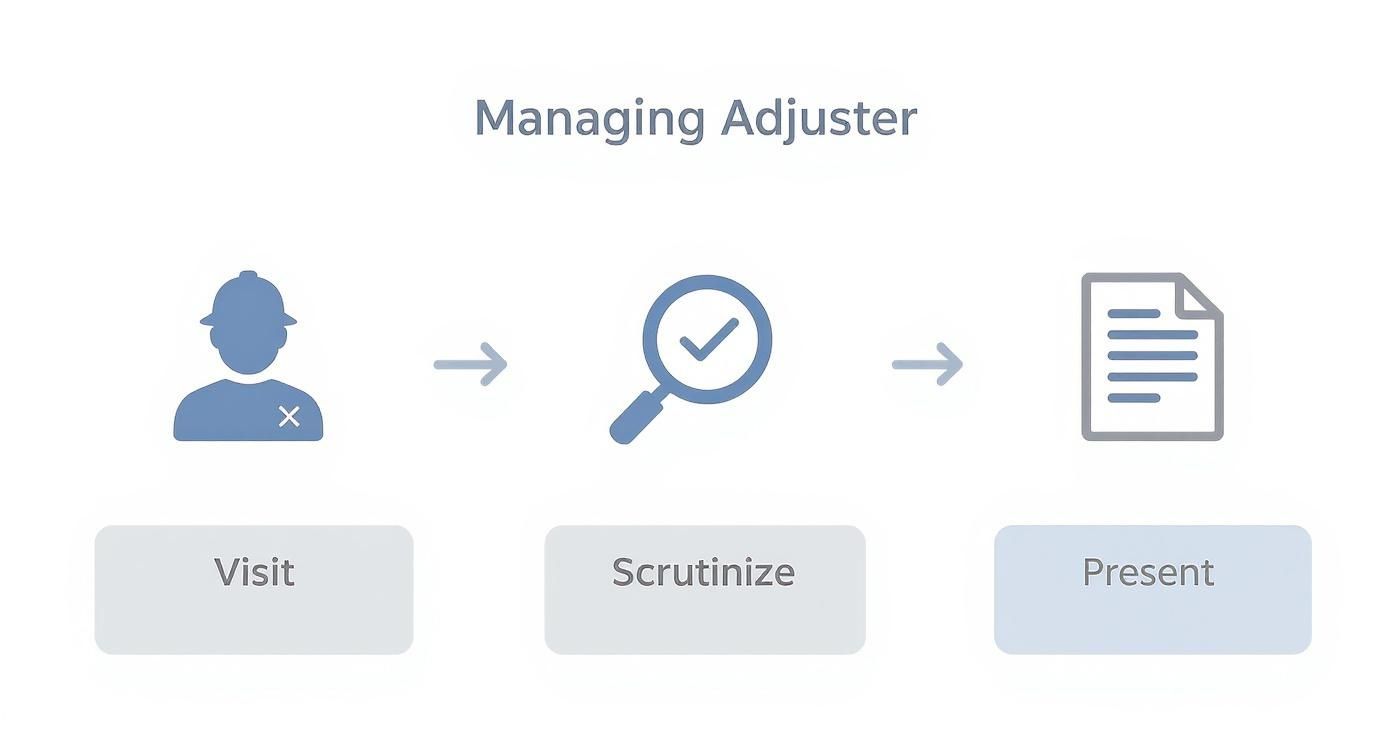
The infographic lays it out perfectly: prepare before the adjuster shows up, scrutinize every detail of their findings, and then hit them with your counter-evidence. This is the blueprint for building a dispute that forces the insurance company to take you seriously and re-evaluate their insulting offer.
Draft a Formal Dispute Letter
Your first real move is to put your rejection in writing. A phone call won’t cut it—you need a paper trail. This letter becomes the foundation of your entire dispute, and you need to make every single word count.
In this letter, you’re going to methodically pick apart their offer and line it up against your own hard evidence. Don’t just make a vague complaint like “your offer is too low.” That’s amateur hour. You need to be specific, almost surgical, in your arguments.
A dispute letter isn’t about complaining; it’s about proving. You must connect every point of disagreement directly back to a piece of evidence—your contractor’s estimate, your policy language, or your damage photos.
Organize your letter with clear headings for each item you’re disputing. For example, if they shorted you on the roof, create a section titled “Discrepancy in Roof Repair Estimate.” Under that heading, state their offer, then present your contractor’s much higher, itemized bid. Make sure to attach the full estimate as an exhibit.
A well-structured letter is your roadmap for the dispute. Here are the essential pieces you need to include to make it professional and effective.
| Component | Purpose | Example Snippet |
|---|---|---|
| Clear Rejection | Formally state that you are rejecting their offer. | “This letter is to inform you that I formally reject your settlement offer of $12,500 for the aforementioned claim, as it is insufficient to cover the full cost of repairs.” |
| Specific Discrepancies | List each item you disagree with, citing their estimate vs. yours. | “Your estimate allocates only $7,800 for the roof replacement, whereas our attached contractor bid from ABC Roofing details the actual cost at $14,200.” |
| Supporting Evidence | Reference all attached documents (estimates, photos, reports). | “Please refer to Exhibit A, the detailed estimate from ABC Roofing, and Exhibit B, photos of the code-required underlayment that your estimate omitted.” |
| Policy Language | Quote the section of your policy that supports your position. | “As per Section I – Coverage A of my policy, you are required to cover the cost to ‘repair or replace with comparable material and quality’.” |
| Demand for Action | Clearly state what you want them to do next. | “I demand a re-evaluation of this claim and a revised settlement offer that reflects the true cost of repairs, as detailed in the attached documents.” |
| Professional Closing | Maintain a firm but professional tone. | “I anticipate your prompt response and a revised offer within the next 15 business days. I have documented all communication and will escalate this matter if necessary.” |
By including these elements, your letter transforms from a simple complaint into a legal document that they have to take seriously.
Secure Independent Repair Estimates
Let’s be clear: the adjuster’s estimate isn’t an objective assessment. It’s an opinion, and it’s crafted to serve their employer’s bottom line. The single most powerful tool you have for blowing up their lowball number is a detailed, competing estimate from a trusted local contractor. Better yet, get two or three.
When you have contractors come out, don’t just ask for a price. Ask them for a highly detailed, line-item estimate that breaks everything down. It needs to include:
- Labor Costs: The specific rates and the total hours needed to do the job right.
- Material Costs: The exact type, brand, and quantity of materials required (e.g., CertainTeed Landmark® architectural shingles, not some basic 3-tab).
- Building Code Requirements: The costs for any upgrades needed to bring your property up to current local codes. Insurers love to “forget” these.
- Overhead and Profit: This is a standard, non-negotiable part of any legitimate contractor’s bid.
When you hand these estimates to your insurer, you aren’t just showing them a different number. You’re showing them that a real, reputable professional in your area has assessed the damage and calculated the true, market-rate cost to make you whole again. It makes it incredibly difficult for them to stand by their own inadequate figures.
Escalate Your Claim When The Insurer Refuses to Pay
When your formal dispute goes unanswered and the insurance company digs in its heels, it’s a clear signal they’re daring you to give up.
Don’t. This isn’t the end of the road; it’s when you shift from negotiation to escalation. You have powerful options to force their hand and hold them accountable for their bad-faith tactics.
One of the most effective first moves is to file a formal complaint with your state’s Department of Insurance. This is more than just a complaint form; it’s an official action that puts real regulatory pressure on the insurer. Suddenly, they aren’t just ignoring you—they have to justify their lowball offer or denial to a government body that oversees their license to operate.
Bringing In Professional Reinforcements
While a state complaint can light a fire under the insurance company, some battles require bringing in an expert who fights this war every single day. This is the time to consider hiring a public adjuster or an experienced insurance attorney.
Unlike the company adjuster sent by your insurer, a public adjuster works exclusively for you, the policyholder. They bring a deep understanding of policy language, damage valuation, and negotiation tactics to the table. They’ll conduct their own thorough inspection, create a new, comprehensive estimate, and take over all communication with your insurer to demand a fair settlement.
Recognizing you’re outmatched is not a sign of weakness; it’s a strategic decision to level the playing field. Insurers have teams of experts, and it’s time you had one, too.
Knowing When to Hire an Attorney
You should always consider a Public Adjuster first. However, some situation may require concil. Consulting with a Public Insurance Adjuster first can help you make an informed, educated decision if you should go that route or not. If your wind damage insurance claims process has devolved into an outright denial, accusations of fraud, or if the insurer is clearly operating in bad faith by delaying or lowballing you, it may be time to consult an attorney. An insurance lawyer can take the fight to the next level, using the threat of litigation to get results.
They are essential in situations where:
- The insurer is refusing to cover a significant loss with no valid reason.
- They are dragging out the process for an unreasonable amount of time.
- You have evidence they have misrepresented your policy’s terms.
Learning how to appeal a denied insurance claim often involves knowing when to pass the baton to a professional. Bringing in an attorney, like Robert Jessup in NC, sends a clear message to your insurer: you will not be bullied, and you are prepared to do whatever it takes to secure the payment you are rightfully owed under your policy.
Answering Your Questions About Wind Damage Claims
When you’re in the trenches fighting an insurance company over a wind damage claim, the same frustrating questions come up time and time again. These aren’t just hypotheticals; they are the real-world obstacles and excuses that carriers like State Farm and Allstate use to wear you down.
Let’s cut through the noise and get you direct answers to the most common battles you’re likely to face.
What If My Insurer Calls the Damage Cosmetic?
“My insurer says the wind damage is just ‘cosmetic’ and won’t pay for a full roof replacement. What can I do?”
This is a classic, calculated tactic. Their goal is to minimize your payout by dismissing real damage as a simple scuff mark. But “cosmetic” damage is often a mask for serious functional problems that absolutely compromise the integrity and lifespan of your entire roofing system. Those dings and dents they want to ignore can lead to granule loss, premature failure, and leaks down the road.
Your immediate countermove is to arm yourself with written proof. Get at least two reputable, licensed local roofing contractors to perform a detailed inspection. Don’t just get a quote—ask them for a formal report that explicitly states the damage is functional, has shortened the roof’s life, and requires a full replacement to prevent future issues and meet manufacturer specs.
Once you have those expert reports, submit them with a formal dispute letter. You need to point directly to the part of your policy covering losses from “sudden and accidental” events. Argue forcefully that the windstorm caused a tangible financial loss by destroying your roof’s service life. That’s a structural issue, not a cosmetic one.
What Are My Rights If the Insurance Company Delays My Claim?
“The insurance company has been delaying my claim for months. What are my rights?”
Insurance companies have a legal and contractual duty to act in “good faith.” That standard absolutely includes processing your claim in a timely and reasonable manner. Deliberate, unexplained delays are a classic bad faith tactic designed to frustrate you into either accepting a lowball settlement or just giving up entirely.
You have rights, but you have to enforce them by documenting everything. I mean everything.
Create a meticulous log of every single interaction:
- Every phone call
- Every email
- Every letter you send or receive
Note the date, time, the name of the person you spoke with, and a summary of what was discussed. This log is your ammunition.
Next, send a formal demand letter via certified mail. In it, professionally demand a status update and a final decision on your wind damage insurance claim by a specific, reasonable date (say, 15 business days). If they continue to stall or ignore you without a valid, written reason, it’s time to escalate. File a complaint with your state’s Department of Insurance and seriously consider talking to an attorney who specializes in bad faith insurance claims.
Can I Start Repairs Before the Claim Is Settled?
“My roof is leaking right now. Can I start repairs before the claim is settled?”
Yes, but you have to be incredibly careful. Your policy has a clause that requires you to “mitigate further damage.” This means you have a duty to take reasonable steps to stop the problem from getting worse—like putting a tarp over a hole in the roof to stop water from pouring into your home.
Before you touch a single thing, document the existing damage with obsessive detail. Take hundreds of photos from every angle and a narrated video where you walk through and point out the damage. Keep every single receipt for any materials or labor you spend on these temporary fixes. These costs should be reimbursed.
Crucial Warning: Do NOT perform permanent repairs or sign a contract for a full roof replacement until you have a signed, written agreement from your insurer on the approved scope of work and cost. Starting major repairs prematurely gives them the perfect excuse to deny your claim, arguing that you destroyed the evidence they needed to inspect.
When your insurance company refuses to do the right thing, you need an expert on your side. The team at For The Public Adjusters, Inc. fights exclusively for policyholders—never the insurance companies—to get you the maximum settlement you are owed. If you’re facing a denied, delayed, or underpaid claim, contact us for a no-cost claim review today.