
You can’t win a negotiation during the negotiation. You win it with the prep work you do before you even pick up the phone. It’s all about building an undeniable, evidence-backed case that puts you in the driver’s seat from day one. So, let’s break down how to negotiate with insurance adjuster.
How To Negotiate With Insurance Adjuster
Laying the Groundwork for a Strong Negotiation

From the moment you file your claim, the clock is ticking. Remember, the adjuster’s job is to close your case as quickly and inexpensively as possible. Your goal is to get a fair settlement that makes you whole again. The negotiation happens in that gap, and how well you prepare determines who comes out on top.
This isn’t about picking a fight; it’s about presenting cold, hard facts. Before you have that first real conversation, you need to have a file so thorough it leaves no wiggle room on the value of your damages.
Document Everything Visually
In an insurance claim, a picture isn’t just worth a thousand words—it can be worth thousands of dollars. But don’t just take a few quick snaps.
- Create a visual timeline. Grab your smartphone and start taking videos and photos, making sure the timestamp feature is on. Get shots from every angle—close-ups to show detail and wider shots to show the context of the room.
- Narrate your videos. While you’re recording, talk through what you’re seeing. Say something like, “This is the water stain on the ceiling in the master bedroom, which we first saw on Monday morning.” That narration adds a layer of context they can’t dispute.
- Don’t clean up yet. It’s tempting to start tidying up, but resist the urge. You need to document the immediate aftermath before anything is moved or repaired. That initial chaos is your most powerful evidence.
Gather Independent Repair Estimates
Never, ever accept the adjuster’s first estimate—or the one from their “preferred” contractor—at face value. Their numbers are just a starting point, often based on generic software pricing that doesn’t account for your local labor market or the specific quality of materials needed.
Your best negotiating tool is a detailed, line-item estimate from a licensed and trusted, public adjuster. It immediately shows the adjuster you’ve done your homework and you know what the real-world costs are.
Taking this step completely changes the conversation. Instead of arguing about their numbers, you’re now discussing documented proof from your public adjuster. The process might feel slow, but patience is a huge strategic advantage. If you’re wondering about timelines, you can learn more about how long an insurance company has to settle a claim in our detailed guide.
Maintain a Communication Log
Every single email, phone call, and letter from your insurance company needs to be tracked. It’s not overkill; it’s essential. Set up a simple log in a notebook or a spreadsheet and record:
- The date and time of every interaction
- The full name and title of who you spoke with
- A quick summary of what was discussed
- Any promises made or next steps agreed upon
This log becomes your bible. It prevents “he said, she said” arguments and keeps the adjuster accountable. While homeowners negotiate claims on their property, businesses do the same with their premiums. Companies with strong safety records, for example, can often negotiate premium reductions of 20% to 40%—proof that having your data in order really pays off.
Your Pre-Negotiation Checklist For How to Negotiate With Insurance Adjuster
Before that first call, run through this checklist. It’s a simple way to make sure you have all your ducks in a row and are ready to present a rock-solid case.
| Task | Why It’s Important | Quick Tip |
|---|---|---|
| Complete Visual Documentation | Photos and videos provide undeniable proof of the “before” state and the full extent of the damage. | Use your phone’s timestamp feature. Narrate your videos to explain what is being shown. |
| Get 2-3 Independent Estimates | This grounds the negotiation in real-world costs, not the insurer’s standardized pricing. | Choose local, reputable contractors, not storm chasers. Ask for line-item details. |
| Start a Communication Log | Creates a factual record of every conversation, promise, and deadline, preventing miscommunication. | Keep a dedicated notebook or a simple spreadsheet. Log every call and email immediately. |
| Review Your Policy | Know your coverage limits, deductibles, and any specific exclusions that might apply to your claim. | Keep a printed or digital copy handy and highlight the relevant sections. |
Having these items checked off doesn’t just make you feel more prepared—it fundamentally shifts the power dynamic in your favor.
Understanding the Adjuster’s Playbook
https://www.youtube.com/embed/n6xDgy7y5M0
If you want to negotiate effectively with an insurance adjuster, you first need to get inside their head. It’s not personal—it’s strictly business. Their job is to protect their company’s bottom line, which means their goal is to settle your claim for the lowest amount they can legally and ethically justify.
They are trained professionals who see hundreds, if not thousands, of claims. That experience gives them a huge advantage if you walk in unprepared. They know exactly which buttons to push and often bank on the fact that most homeowners don’t understand the ins and outs of the claims process.
Spotting Common Adjuster Tactics
An adjuster’s main objective is to control the conversation and the pace of your claim. The first step to pushing back is recognizing their go-to strategies. They’ll almost always start with a friendly, disarming tone to build rapport, hoping it will make you lower your guard.
Keep an eye out for these classic tactics:
- The Quick, Lowball Offer: This is their opening move, and it’s a classic for a reason. The adjuster throws out a fast settlement offer early on, hoping you’re stressed and just want it all to be over. This initial offer almost never covers the true cost of your damages.
- Requesting a Recorded Statement: They might ask you to give a recorded statement about what happened. It sounds like a standard procedure, but it’s often a fishing expedition. They’re trying to get you on record with details they can use to find inconsistencies and poke holes in your claim later.
- Downplaying Your Damages: Don’t be surprised if an adjuster suggests your contractor’s estimate is overblown or that some repairs aren’t actually necessary. They use their own pricing software, which often fails to reflect the real-world costs of local labor and materials in your area.
“The first offer you receive is just that—a starting point. It’s an invitation to a negotiation, not a final decision. Responding with documented evidence, rather than emotion, is the key to moving the number in your favor.”
Once you understand that these are just standard business practices, it helps take the emotion out of it. The situation shifts from a personal fight into a strategic, fact-based negotiation. You can learn more about how to handle these situations by reading our guide on common insurance claims and disputes.
Their Goal Is a Fast and Final Settlement
Insurance companies measure their adjusters’ success by how efficiently they can close claims. A quick settlement saves them a ton of time and administrative costs. But here’s the thing: this pressure to close cases can actually work to your advantage, but only if you are patient and have all your ducks in a row.
They evaluate claims by looking at your documented damages, and their goal is almost always to settle as quickly as possible for the lowest defensible amount. This is precisely why those initial offers come in so low—they are testing to see if you’ll take the easy money and go away.
How to Respond Professionally
When you run into these tactics, the most powerful tool you have is a calm, professional response. Instead of getting angry or frustrated, your job is to calmly steer the conversation back to the cold, hard facts of your claim.
Here are a few simple, professional scripts you can keep in your back pocket:
- If you get a lowball offer: “Thank you for the initial offer. Could you please email me a detailed breakdown showing how you arrived at that number? I’d like to compare it with the estimates I’ve collected.”
- If asked for a recorded statement: “I’m not comfortable providing a recorded statement at this time. However, I’m happy to answer any specific questions you have in writing via email.”
- If they question your estimates: “My contractor is certified and based this estimate on current local costs for materials and labor. Let’s go through the line items where our numbers don’t match up.”
This kind of professional approach immediately signals that you’re organized, you mean business, and you’re ready for a productive discussion. It keeps the focus right where it belongs: on the evidence.
Setting Your Terms with a Demand Letter
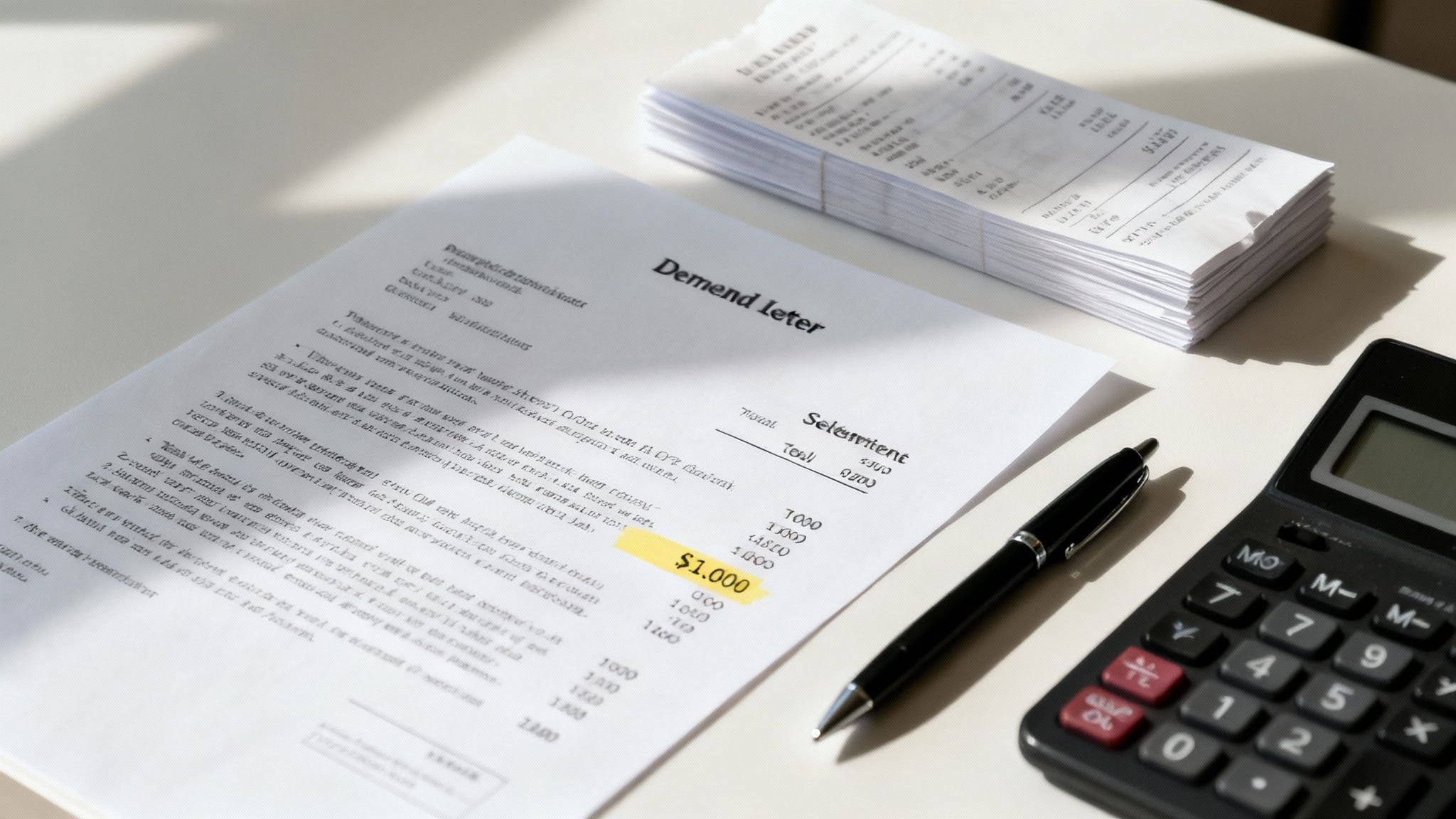
Don’t wait around for the adjuster to make the first move. You can—and should—set the tone for the entire negotiation right from the start. The best way to do that is with a formal demand letter.
This isn’t some angry, emotional rant. Think of it as a professional, fact-based document that lays out your case with undeniable clarity. It officially puts everything in writing: the incident, a detailed breakdown of your damages (backed by all that evidence you gathered), and the total settlement amount you’re seeking.
Sending this letter immediately shows the insurance company you’re organized, serious, and ready for a negotiation based on facts, not fuzzy estimates.
Calculating Your Settlement Figure
The single most critical part of your demand letter is the number you put at the bottom. This isn’t just about adding up a few receipts. It’s about building a comprehensive, undeniable case for the full cost to make your property whole again, accounting for every single detail your policy covers.
Start by pulling together all the direct costs. This means every contractor estimate, every receipt for temporary repairs, and the replacement costs for any damaged personal belongings. But that’s just the beginning.
Dig into your policy to find additional coverages that are easy to overlook. For instance, if you had to move out while repairs were underway, you should be including all your Additional Living Expenses (ALE), like hotel bills and meal costs. Did you have to hire a special cleaning crew to deal with smoke damage? That goes in the total, too.
Every single expense, no matter how small, needs to be documented and added to your claim.
When you present a total that is meticulously broken down and justified, it’s much harder for an adjuster to dismiss. Your goal is to show them not what you want, but what you are owed based on the evidence and the terms of your policy.
Defining Your Walk-Away Number
Before you even think about sending that letter, you need to get two numbers straight in your own mind: your ideal settlement and your walk-away number. This is your absolute bottom line.
Your ideal settlement is the full amount you’ve calculated and presented in your demand letter—the total cost to cover everything. Your walk-away number is the lowest possible figure you’ll accept before you decide to escalate things.
- Ideal Settlement: This is your opening bid. It’s the full, documented amount required to restore your life and property completely.
- Walk-Away Number: This is the line in the sand. It’s the minimum you’ll take before you bring in a public adjuster or an attorney.
Knowing your walk-away number from the get-go is a game-changer. It keeps you grounded and prevents you from making a bad decision out of frustration or emotion during a tense negotiation. It gives you a clear definition of success and empowers you to reject a lowball offer with total confidence, because you’ve already decided what’s unacceptable. This one step is crucial for staying in control of the process.
Mastering the Counteroffer Conversation

Alright, the moment of truth has arrived: the insurance adjuster has presented their first settlement offer. This is where the real work begins.
It’s tempting to get frustrated or angry when you see a low number, but it’s critical to remember this is their opening move, not their final word. Getting emotional is exactly what they expect. Responding with calm, strategic logic is how you take back control.
Treat this initial offer for what it is—an invitation to negotiate. Your first move isn’t to argue, it’s to gather intelligence. Politely thank the adjuster and immediately ask for a detailed, line-by-line breakdown explaining exactly how they arrived at that figure. This simple request completely shifts the dynamic and forces them to justify their valuation.
Once that document is in your hands, the real analysis begins. This is where all your meticulous preparation is about to pay off.
Deconstructing Their Offer
Lay the adjuster’s breakdown right next to your own estimates and documentation. Your job is to pinpoint the specific gaps. Don’t get hung up on the final number; instead, dive into the individual line items that are either completely missing or seriously undervalued.
You’ll often find their numbers fall short in a few common areas:
- Labor Costs: Adjusters frequently rely on standardized pricing software that simply doesn’t reflect the cost of local, skilled labor. Your contractor’s estimate is based on the real-world price of hiring qualified professionals in your area.
- Material Quality: Their estimate might price out builder-grade flooring when your home had high-end hardwood. Your policy almost certainly requires materials of “like kind and quality,” and you need to hold them to that.
- Scope of Work: They might have overlooked critical steps. Maybe they forgot the cost of permits or didn’t include the need for a specialized smoke remediation crew after a fire. These small omissions add up.
This methodical approach turns the conversation from a subjective argument over a lump sum into an objective discussion about facts. It’s the most powerful way to negotiate with an insurance adjuster.
An adjuster can argue with your opinion all day long. What they can’t easily argue with is a certified contractor’s detailed estimate or a receipt for a necessary service. Facts are your leverage.
Crafting Your Counteroffer Script
Now, it’s time to build your counteroffer. You’re not just asking for more money; you are professionally pointing out the errors and omissions in their assessment.
Here’s a practical way to structure your response, whether it’s over the phone or in an email:
“Thank you for sending over the detailed breakdown. I’ve had a chance to compare it with my estimates, and I’ve found a few key areas where our numbers don’t align. For instance, your estimate for the drywall repair doesn’t seem to account for the current local labor rates, which my contractor has documented at $X per hour. Additionally, I noticed your estimate overlooks the cost of bringing in a certified electrician, which my policy requires for this type of repair.”
This approach is professional, non-confrontational, and anchored in solid evidence. It immediately shows you’ve done your homework and are serious about getting a fair settlement.
And don’t forget, this back-and-forth is a proven strategy. Industry data shows that specialized negotiation services can reduce billed amounts with a success rate of about 60%, leading to average overall savings of around 30% on claims. You can see more about how negotiation impacts claim savings on Enlyte.com. By sticking to the facts, you give yourself the best possible shot at a similar outcome.
When to Escalate or Bring in a Professional

Even with perfect preparation, sometimes the negotiation just stalls out. You might hit a brick wall where the adjuster flat-out refuses to budge, no matter how much proof you show them. It’s frustrating, but it’s a surprisingly common part of the game. Knowing what to do next is everything.
The first step is learning to recognize the signs of a dead end. Is the adjuster suddenly impossible to reach? Are they using endless delay tactics? Did they give you a lowball offer but refuse to justify it in writing? These are all red flags telling you that your current approach has run its course.
This isn’t the time to give up. It’s time to change the game.
Escalating Your Claim Internally
Before you go looking for outside help, your first move should always be to go up the ladder inside the insurance company. Every single adjuster has a boss, usually a supervisor or a claims manager, and these folks have more authority to approve a higher payout.
Start by sending a polite but firm email. Explain that you’ve reached an impasse and you’d like to speak with their supervisor to review the claim. Frame it as a good-faith effort to find a reasonable solution, not just a complaint. You’d be surprised how often this professional approach can break the logjam.
Knowing When It’s Time for a Public Adjuster
What if escalating doesn’t work? Or what if your claim is massive and complicated from the get-go? This is when you should seriously consider bringing in a public adjuster.
These are state-licensed professionals who work for you, not the insurance company. Their entire job is to represent your best interests.
A good public adjuster takes the entire claims process off your plate. They handle everything from documenting the damage in minute detail to negotiating directly with the insurer on your behalf. Since they typically work on a contingency fee—a small percentage of the final settlement—they are completely motivated to get you the maximum payout you’re entitled to. You can learn more here about the role of a public insurance adjuster and how they advocate for homeowners.
Bringing in a professional sends a clear signal to the insurance company: you’re serious, and you won’t be pushed into an unfair settlement. It completely changes the dynamic from a stressed-out homeowner versus a massive corporation to a professional versus a professional.
Public Adjuster vs. Attorney: Who Do You Call?
While a public adjuster is your go-to expert for most property damage claims, there are situations where you might need a lawyer instead. It’s crucial to know the difference.
- A Public Adjuster: Specializes in assessing property damage, interpreting your policy, and negotiating the value of your claim.
- An Attorney: Steps in when there’s a legal dispute. This could be a bad faith claim (where the insurer isn’t holding up their end of the contract) or if there are liability issues, like a personal injury that happened on your property.
If your insurer has outright denied a claim you know is valid or is accusing you of something like fraud, call an attorney. But if the fight is over the dollar amount of the damages, a public adjuster is almost always the right professional for the job.
Simply knowing these options are available gives you the leverage to keep your claim moving forward, no matter what roadblocks the insurance company throws in your way.
Your Top Questions About Insurance Negotiations, Answered
Going head-to-head with an insurance company can feel like you’ve been dropped into a bureaucratic maze. The terms are confusing, the process is slow, and it’s easy to feel outmatched. When you’re trying to figure out how to handle an adjuster, a few direct answers can make all the difference.
Should I Accept the First Settlement Offer?
Let me be blunt: almost never.
Think of the insurance adjuster’s first offer as their opening bid in a negotiation, not their final word. It’s almost always a lowball number, designed to see if you’ll take a quick, easy payout. They’re banking on you being stressed out and ready to just get it over with.
Your best move? Politely turn it down and immediately ask for a detailed, line-by-line breakdown of how they arrived at that number. This simple request completely changes the game. It forces them to justify their low offer and gives you the perfect opening to present your own evidence and counteroffer. Negotiation is just part of the process, so don’t be afraid to engage.
What Should I Avoid Saying to an Insurance Adjuster?
The golden rule is to keep your communication tight, factual, and professional. The adjuster is listening for anything that could minimize your claim.
Here are a few things to keep out of the conversation:
- Admitting Fault: Never, ever apologize or say anything that could be twisted into an admission of guilt. Don’t say “I’m sorry” or “I should have…”
- Guessing or Speculating: If you don’t know the full extent of the damage, don’t guess. Stick to what your documentation proves.
- Casual Small Talk: An offhand “I’m doing fine” can be used against you later to argue that your situation wasn’t that serious, especially since many issues with a property (or an injury) don’t show up right away.
- Giving a Recorded Statement: You are under no obligation to give a recorded statement right away. It’s always better to communicate in writing, where you can choose your words carefully and build a paper trail.
The only things that matter are the facts you can prove. Your photos, your contractor’s estimates, and your communication log are your power. Everything else is just chatter that can be used to chip away at your settlement.
How Long Does an Insurance Negotiation Usually Take?
This one really depends. The timeline for settling a claim is all over the map and hinges on how complex your situation is.
A simple claim for a small roof leak might wrap up in a few weeks. But if you’re dealing with major structural damage, a fire, or a liability dispute, you could be looking at a process that stretches on for several months.
Being organized and responding promptly will absolutely help move things along, but the most important thing is not to let the timeline pressure you. Don’t let frustration push you into accepting a bad offer. Patience, paired with persistent, professional follow-up, is how you win. The insurance company is counting on you getting tired of the fight.
Can I Really Negotiate a Claim Without a Professional?
Yes, for many common claims, you absolutely can. If you’ve done your homework, gathered solid documentation, and stay organized and persistent, you can hold your own and secure a fair settlement. The strategies in this guide are built to give you the tools to do just that.
But you also have to know when to call in for backup. If you’re facing a massive, complex claim, or if you feel the insurance company is starting to play games—like using ridiculous delay tactics or outright denying a valid claim—it’s time to bring in a professional. A good public adjuster or an attorney levels the playing field in a big way.
Are you facing a stalled or underpaid insurance claim? The team at For The Public Adjusters, Inc. is here to help you get the full settlement you deserve. We represent you, not the insurance company. Get a no-cost claim review today and let our experts take the fight off your hands. Learn more and contact us for a free consultation at forthepublicadjusters.com.



My insurance adjustor requested metigation repairs immediately 24-48 hrs to prevent mold now want receipts of repairs after repairs are complete and done while the line to line estimate its extremely low to cover cost per sq or linear ft as a new construction and no restoration in addition they complete ignored code request for permits and work to be done in a certain way
Depending on the state you live in, you have up to 1-3 years from the Date of Loss to complete repairs. Have you had the mitigation completed yet? If not, have an IICRC Certified mitigation company to complete the mitigation. It does not matter what that costs, it’s covered under the claim. Then have the mitigation company submit their bill direct to the adjuster and copy you on all emails. This way, the mitigation company can answer all the adjuster’s questions about the mitigation, and you do not have to fight with him/her.