

When you get a denied insurance claim, appealing it means you’re formally pushing back on the insurer’s decision. So, How to Appeal a Denied Insurance Claim, you ask? It’s not just about complaining; it’s about building a case. You’ll need to write a detailed appeal letter, gather every piece of relevant documentation—like photographic proof or a contractor’s repair estimate—and hit every single deadline.
Winning this fight almost always comes down to a well-organized, fact-based argument that directly dismantles the insurance company’s reason for saying no.
Your Insurance Claim Was Denied. Now What?
Getting that denial letter in the mail feels like a punch to the gut. It’s usually filled with cold, confusing jargon that leaves you feeling angry and completely powerless. But here’s the most important thing to remember: a denial is almost never the final word.
Think of it as the start of a conversation, not the end of one.

A lot of claims get kicked back for simple, fixable reasons. So, your first move is to flip a mental switch from feeling defeated to getting proactive. A denial doesn’t mean your claim has no merit. It just means the insurance company needs a much stronger push from you.
Why Denials Happen and Why You Should Fight Back
Insurance companies have a whole playbook of reasons for denying claims, and many of them are not as solid as they want you to believe. It’s a numbers game. They know a huge percentage of people will just give up after the first “no.”
Look at the stats. In 2023, insurers on the U.S. ACA marketplace denied around 19% of in-network claims. That’s almost 73 million denials in a single year. And yet, fewer than 1% of people actually appealed. The ones who did? About 44% of those internal appeals got the denial overturned. The data is clear.
The big takeaway here is that appealing works way more often than people think. Your refusal to back down can be the one thing that gets you the coverage you’ve been paying for.
Understanding why your claim was denied is the first step to building your case. Often, the reasons aren’t as scary as they sound.
Common Reasons Your Insurance Claim Was Denied
Let’s break down some of the most common denial reasons I see and what you should do right away. This isn’t just theory; this is what happens on the ground every day.
| Denial Reason | What It Means | Initial Action Step |
|---|---|---|
| Administrative Errors | This is the low-hanging fruit. A misspelled name, wrong policy number, or a missing form. It’s a system-generated denial, not a human one. | Call the insurer immediately. Correct the error over the phone and ask them to re-process the claim. Don’t start a formal appeal yet. |
| Lack of Medical Necessity | The insurer is saying a procedure or treatment wasn’t medically required. This is a common tactic, especially with expensive treatments. | Get a “Letter of Medical Necessity” from your doctor. It should detail why the treatment was essential and include supporting medical literature if possible. |
| Policy Exclusions | They’re claiming the service isn’t covered under your plan’s terms. Insurance policies are dense, and their interpretation often favors them. | Request a copy of your full policy document (not the summary). Read the specific exclusion clause they cited. Often, the language is ambiguous and can be challenged. |
| Lapsed Coverage | The insurer claims your policy wasn’t active when the service occurred. This could be due to a payment processing error or a grace period misunderstanding. | Gather proof of payment (bank statements, cleared checks). Check your state’s laws on “grace periods” for premium payments. |
| Pre-Authorization Required | You didn’t get the insurer’s approval before receiving care. Many plans require this for non-emergency procedures. | This is tough, but you can appeal on the grounds of urgency or miscommunication from the provider’s office about who was responsible for getting the authorization. |
These are just the starting points. Each denial has a path forward, but you have to know which path to take.
Your Path Forward: An Actionable Overview
It helps to know how long an insurance company has to settle a claim because it gives you a timeline to work with. The appeal process isn’t a chaotic mess; it’s a structured system, and you can absolutely navigate it if you’re methodical.
It all starts the second you open that denial letter.
Your first job is to find the exact reason for the denial. They have to state it. That reason is now your target. From there, your mission is to gather the evidence, write a powerful appeal letter, and follow their official process to the letter. You’re back in control.
Gathering Evidence for a Strong Appeal
You don’t win an appeal with an emotional letter. You win it with a mountain of organized, undeniable evidence that leaves the insurance company no room to maneuver. Before you even think about writing your appeal, your only job is to build that case.
This is where you go on the offensive. Let’s walk through how to gather every single piece of proof you need.
A key piece of federal law, the Health Insurance Portability and Accountability Act (HIPAA), is your best friend here. It gives you the legal right to get copies of your own medical information.

This isn’t just a suggestion; it’s your right. When an insurer denies a claim based on “medical necessity,” using your HIPAA rights to get your own records is the first step to proving them wrong.
Start by Demanding Your Entire Claim File
Your first move? Formally request your complete claim file from the insurance company. I’m not just talking about the denial letter. You want everything—internal notes, the reports from their so-called “independent” medical reviewers, and any other documents they used to make their decision.
By law, they have to give it to you. Getting this file is like being handed your opponent’s playbook before the game even starts. It shows you exactly who said what and why they denied you, giving you a precise roadmap for tearing their arguments apart.
Get Every Last Medical Record
If your claim is health-related, your medical records are the foundation of your entire case. Don’t just grab the records from your last doctor’s visit. You need to tell the whole story, from beginning to end.
Pull together everything you can find, including:
- Physician’s notes from every relevant appointment.
- Test results, including lab work, X-rays, MRIs, and any other diagnostic scans.
- The official treatment plans your doctor laid out.
- Records of past treatments that didn’t work, which helps justify the current one.
Once you have the documents, put them in chronological order. This creates a powerful timeline that shows the clear progression of your condition and makes your doctor’s treatment decision look like the logical, necessary step it was.
Get a Knockout Letter of Medical Necessity
This is your silver bullet. A Letter of Medical Necessity from your doctor is often the single most persuasive piece of evidence you can have. This isn’t a simple prescription note; it’s a detailed, professional argument written on your behalf.
Your doctor’s letter needs to clearly explain:
- Your specific diagnosis and relevant medical history.
- Why this exact treatment or medication is essential for you.
- The potential consequences if you don’t receive this care.
- A clear explanation of why cheaper alternatives are not medically appropriate for your specific situation.
A strong letter from a respected medical professional can flip a denial on its own. You need to work with your doctor’s office to make sure this letter is detailed, firm, and hits the insurance company’s denial reason head-on.
Pro Tip: As you get these reports and records, grab a highlighter. Mark every key phrase, diagnosis, and conclusion. It forces you to understand the material and makes it incredibly easy to pull direct quotes for your appeal letter later.
Don’t Forget Other Supporting Documents
Think outside the medical box. Depending on your claim, other types of proof can make your case airtight.
Consider adding these to your evidence file:
- Photos and Videos: For property damage claims, this is non-negotiable. Take pictures with timestamps to show the condition before and after.
- Receipts and Invoices: Did you pay for anything out-of-pocket, like temporary repairs or medical supplies? Every receipt is evidence.
- Expert Opinions: For a leaky roof, this might be a report from an independent contractor. For a medical issue, it could be a second opinion from another specialist that confirms the diagnosis.
- Correspondence Logs: Keep a running log of every call you make. Note the date, time, the person you spoke with, and a summary of the conversation. Save every single email.
Get a binder or create a dedicated folder on your computer and organize everything. When you finally sit down to write, you’ll have an arsenal of evidence ready to go, making your argument not just compelling, but irrefutable.
How to Write an Appeal Letter That Actually Works
This letter is your formal shot at overturning the denial. It’s not just a complaint—it’s a structured, written argument designed to dismantle the insurance company’s reasoning, point by painful point. The goal is to be so clear, professional, and evidence-based that they have no choice but to reconsider.
Forget emotion. This isn’t a plea for sympathy. Think of it more like a legal brief where facts, policy language, and medical records do all the heavy lifting. Logic is what wins this fight.
Nail the Tone from the Very First Sentence
Before you even start writing, you have to get your head in the right place. The tone should be firm and professional, but never angry. A letter that’s dripping with frustration or accusations just makes the reviewer defensive, and a defensive reviewer isn’t going to help you.
You’re not asking for a favor here. You’re making a formal request for a review based on the facts. Let your documentation do the talking. While it’s okay to briefly mention the impact of the denial (like ongoing pain or financial stress), the heart of your letter has to be objective and business-like.
The Anatomy of a Winning Appeal Letter
A powerful appeal letter has a clean, logical flow. Each piece builds on the last, making your argument easy for the reviewer to follow and hard for them to poke holes in.
Make sure your letter hits these essential points:
- Your Identifying Info: Right at the top, list your full name, policy number, and the claim number. Leave zero room for confusion.
- A No-Nonsense Opening: Get straight to the point. The first sentence should say it all: “I am writing to formally appeal the denial of claim number [Your Claim Number] for [Service/Treatment], which was denied on [Date of Denial Letter].”
- The Factual Backdrop: Give them a quick, clean summary of the situation. What was the diagnosis? What treatment was recommended? When did it happen? This sets the stage.
- The Rebuttal: This is where you win or lose. You need to take the exact reason they gave for the denial and systematically tear it apart with the evidence you’ve collected.
- A Clear Demand: Your closing needs to be direct. Tell them exactly what you want. “I request a complete reversal of this denial and prompt payment for the services covered under my policy.”
Look, the person reading your letter is probably swamped. They’ve seen hundreds of these. A well-organized letter that uses headings, bullet points, and bold text to highlight the key facts will get way more attention than a three-page wall of text.
Building Your Case, Piece by Piece
This is where you connect the dots between your evidence and their denial. Let’s run through a real-world scenario. Say they denied physical therapy because they deemed it wasn’t “medically necessary.”
Here’s how you structure your rebuttal to shut that down:
- State Their Reason for Denial: Lead with their own words. “Your denial letter from [Date] states the claim was denied because the physical therapy was not considered medically necessary.”
- Unleash Your Counter-Evidence: Hit them with the proof immediately. “To establish medical necessity, I’ve enclosed a detailed letter from my physician, Dr. Emily Carter. As she explains, this specific therapy was prescribed only after two other treatments failed to resolve the issue.”
- Tie It Back to Your Policy: This is the knockout punch. “My policy, under Section 4, subsection B, explicitly covers ‘restorative physical therapy prescribed by a specialist.’ The enclosed records confirm this treatment fits that definition perfectly.”
- Use a Timeline to Show Diligence: A simple timeline can be incredibly effective. “As the treatment records show, we pursued more conservative options for six months before Dr. Carter determined this therapy was the only viable path forward to avoid surgery.”
This methodical takedown leaves no wiggle room. You’ve acknowledged their argument and then completely dismantled it with facts and their own policy language.
The Dos and Don’ts of an Effective Appeal Letter
Keep these simple rules in mind to give your letter the best chance of success.
Do:
- Use a professional, business-letter format.
- Keep it as short as possible. No fluff, no long-winded stories.
- Reference every single attachment. For example, “see attached MRI report from 10/15/2023.”
- Proofread it twice. Then have someone else read it. Typos make you look sloppy.
Don’t:
- Get emotional. Ditch phrases like “this is so unfair” or “I’m begging you.”
- Threaten them. Mentioning lawyers in your first appeal is a bad move. It just escalates things unnecessarily.
- Go off on tangents. Stick to the facts of this specific claim.
- Apologize for anything. You did nothing wrong by using your benefits.
By writing a letter that’s organized, evidence-based, and professional, you dramatically improve your odds of turning that denial into an approval.
Navigating the Internal and External Appeals Process
Once your appeal letter is ready and your evidence is stacked, it’s time to dive into the formal appeals process. This isn’t just a single event; it’s a structured path with multiple stages. Knowing this path is everything, because one missed deadline or a misdirected submission can kill your appeal before it even gets off the ground.
The whole thing is split into two main phases: the internal appeal and the external review. You always start with the internal appeal. This is where you go back to the insurance company and ask them to take another look at their own decision.
The First Battleground: The Internal Appeal
The internal appeal is your first direct challenge. You’re essentially telling the insurer, “You got this wrong, and here’s the proof.” Thanks to the Affordable Care Act, every regulated insurance plan has to offer an internal appeals process, so you have a formal right to this re-evaluation.
You have to follow their rules perfectly. Your denial notice should lay out the instructions, including where to send everything and, most importantly, the deadline. That deadline is set in stone. Miss it by a single day, and the insurer has every right to toss your appeal out.
When you’re ready to submit, send that package via certified mail with a return receipt. This gives you a legal paper trail that proves exactly when they got it, which can be a lifesaver if there’s any dispute later. Once they have it, their clock starts ticking. Insurers generally have 30 to 60 days to give you an answer, depending on your claim.
This visual guide breaks down what a strong appeal submission looks like, making sure you hit all the key points.
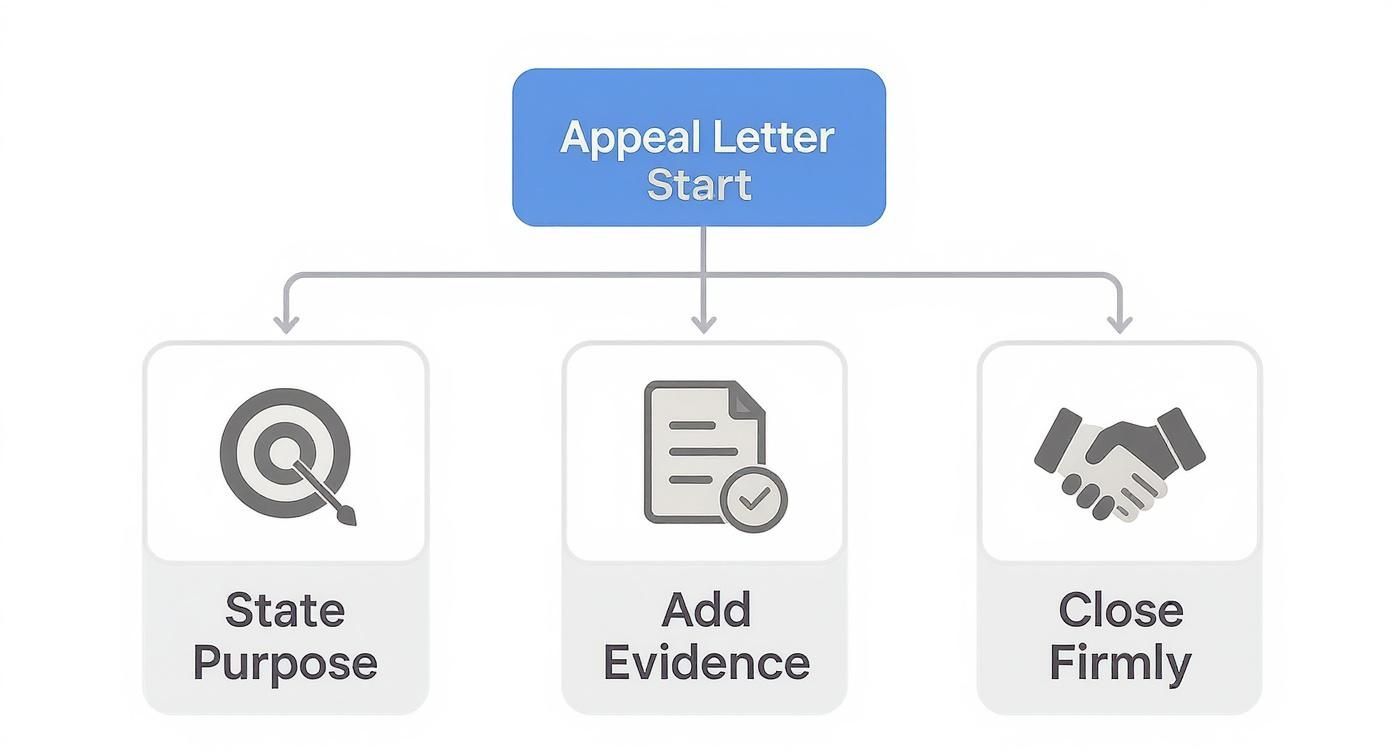
The big takeaway here? A winning appeal is built on a clear purpose, rock-solid evidence, and a firm, professional argument.
When the Insurer Still Says No: Escalating to External Review
If the insurance company denies your internal appeal, don’t throw in the towel. Honestly, this happens a lot. But that denial opens the door to your most powerful weapon: the external review. This is where your case gets handed over to an Independent Review Organization (IRO)—a neutral third party that has zero connection to your insurance company.
The IRO’s decision is legally binding. This is a massive advantage because it takes the final call away from the company that saves money by denying you. Your second denial letter has to include instructions and deadlines for requesting this external review, and you usually have about 60 days to act.
Here’s the thing, though: almost no one uses this step. A 2021 KFF analysis of ACA marketplace plans found that out of 48 million initially denied claims, consumers only filed internal appeals for less than 0.2% of them. Of the appeals that were upheld, even fewer were escalated to an external review, despite the fact that 41% of internal appeals were overturned. You can dig into the numbers in this study on claim denials and appeals from kff.org.
Not escalating is a huge missed opportunity. The success rates at the external review stage are often surprisingly high for one simple reason: the reviewer is impartial. Their only job is to look at the facts—your records, the policy, the medical standards—without any bias. Understanding the ins and outs of these insurance claims and disputes is what gives you the confidence to keep fighting.
Your persistence is your greatest asset. The appeals system is designed with multiple levels for a reason. Don’t let an initial denial—or even a second one—be the end of your fight.
Internal vs External Appeal: A Head-to-Head Comparison
To play your cards right, you need to understand the key differences between these two critical stages of the insurance appeal process. Each has its own rules, players, and potential outcomes.
| Feature | Internal Appeal | External Review |
|---|---|---|
| Who Reviews It? | The insurance company itself, often a different department or medical director. | An independent, state-certified third-party organization (IRO). |
| Bias Potential | High. The reviewer works for the company that denied the claim. | Low. The reviewer is neutral and has no financial stake in the outcome. |
| Binding Decision | The decision is binding on you (you must accept it before moving on) but not final for the insurer if they approve. | The decision is legally binding on the insurance company. They must pay the claim if the IRO sides with you. |
| Your Goal | To present clear, overwhelming evidence that forces the insurer to reverse its own decision based on its own policies. | To prove to an impartial expert that the insurer’s decision was incorrect based on medical standards and policy terms. |
Successfully navigating this process is all about meticulous organization and a refusal to take “no” for an answer. By understanding both the internal and external appeal pathways, you’re setting yourself up to see the fight through to the end.
When You Need to Escalate Beyond a Standard Appeal
You’ve done everything right. You put together a rock-solid appeal, sent in all your documentation, and waited. And then, another denial lands in your lap.
It’s an incredibly frustrating moment, but this is not the end of the road. When the standard appeals process isn’t getting you anywhere, or you suspect the insurer is just giving you the runaround, it’s time to change tactics.
This is the point where you stop playing their game and start bringing in outside firepower to hold them accountable.
Recognizing the Signs It’s Time to Escalate
How do you know when you’ve hit that wall? It’s not always about getting that final “no.” Sometimes, the insurance company’s behavior is all the proof you need to kick things up a notch.
Keep an eye out for these classic red flags:
- Unreasonable Delays: Is your claim stuck in limbo? If the insurer is blowing past deadlines or asking for the same documents over and over, they’re likely stalling.
- Shifting Excuses: The reasons they give for the denial keep changing, or worse, they directly contradict the language in your own policy.
- Stonewalling: They refuse to provide you with your complete claim file or the so-called “independent” expert reports they used to deny you.
- Insulting Lowball Offers: After all your hard work on an appeal, they come back with a settlement offer that doesn’t even begin to cover your documented losses.
If any of this sounds familiar, continuing to send letters back and forth is probably just spinning your wheels. These are clear signals that you need to take a more aggressive approach.
Filing a Complaint with Your State’s Department of Insurance
Every single state has a regulatory body—usually called the Department of Insurance (DOI)—that acts as a watchdog over the insurance industry. Filing a formal complaint here is one of the smartest and most effective moves you can make.
It’s completely free, and it instantly puts your case in front of a government regulator.
Think of the DOI as the referee. Once you file a complaint, the insurer is legally required to respond to the state, not just to you. This outside pressure often works wonders. The possibility of regulatory action or fines is frequently all it takes for an insurance company to suddenly re-evaluate its position and decide to offer a fair settlement.
A complaint to the Department of Insurance isn’t just another letter—it’s an official record of potential misconduct. It forces the insurer to justify its actions to a higher authority, which can change the entire dynamic of your dispute.
When to Bring in Professional Reinforcements
You can absolutely handle many parts of the claims process on your own, but there are times when calling in a professional is not just a good idea—it’s essential. The insurance landscape is getting tougher to navigate. In fact, 89% of health systems have reported a surge in claim denials, yet a staggering 66% of those denied claims are eventually paid when appealed correctly. You can get more context by reading about these challenges in the healthcare system.
This tells you one thing loud and clear: expertise matters. Here are the pros who can step in and fight for you:
- Public Adjusters: For any property damage claim—think fire, water, or storm damage—a public adjuster is your best weapon. They are licensed experts who work exclusively for you, the policyholder, not the insurance company. They’ll take over the entire process: assessing the real value of your damages, documenting everything, and negotiating directly with the insurer. If you’re on the fence, it helps to understand when you should hire a public adjuster to see if it fits your situation.
- Attorneys: If you have solid proof that your insurer is acting in “bad faith” or if your claim is particularly large and complex, you need an attorney who specializes in insurance law. They have the power to take legal action if the insurance company has broken the law or violated the terms of your policy.
Don’t wait until you’re completely burned out from the fight. Bringing in a professional early can save you an immense amount of time and stress, and it significantly boosts your chances of walking away with the full settlement you’re owed.
Common Questions About Insurance Claim Appeals
Even with the best game plan, trying to appeal a denied claim can feel like trying to find your way out of a maze blindfolded. It’s totally normal to have a bunch of “what-if” questions pop up. Getting straight answers is the only way to keep your cool and push your appeal forward without making a costly mistake.
Let’s dig into some of the most common questions people ask when they decide it’s time to fight a denial.
How Long Do I Have to File an Appeal After a Claim Is Denied?
This is the single most important deadline you need to worry about, and there’s no room for error. Your denial letter is required to state the exact timeframe you have to submit an internal appeal. Under federal law, it’s often up to 180 days from when you get the notice, but don’t just assume that. Your specific plan and state laws can change that number.
The very first thing you should do after getting a denial letter is hunt for that deadline. Circle it. Highlight it. Put it on your calendar with a dozen reminders. If you miss that date, even by one day, you could lose your right to appeal forever. If you can’t find it, get on the phone with your insurer’s member services line immediately and don’t hang up until they give you a specific final date for submission.
Can I Ask My Doctor’s Office for Help with the Appeal?
Not only can you, but you absolutely should. Think of your doctor’s office as your number one ally in this fight. They aren’t just a place to get records; they’re your expert witness.
You need to be proactive here. Ask your doctor to write a detailed “Letter of Medical Necessity” that directly argues against the insurance company’s reason for the denial. Many larger hospitals and medical groups actually have people on staff—patient advocates or insurance specialists—whose entire job is to handle these kinds of disputes. They know the system, they know the language insurers respond to, and they can be an incredible resource. Don’t be afraid to lean on them.
What Happens if My Appeal Is Denied Again?
Okay, getting a second denial after you put in all that work for the internal appeal is a gut punch. I get it. But this is actually where the tables can start to turn in your favor. Your next move is to demand an external review.
This is your legal right, and the second denial letter must include instructions on how to file for one. An external review sends your entire case to a neutral, third-party Independent Review Organization (IRO). These folks have zero ties to your insurance company. Their only job is to look at the medical facts and your policy and make an objective call.
Here’s the crucial part: The IRO’s decision is legally binding. If they rule in your favor, your insurance company must pay the claim. Period. The odds of success often go way up at this stage because you’ve finally removed the insurer’s bias from the equation.
Is It Worth Hiring a Lawyer for My Insurance Appeal?
That’s a strategic call, and it really depends on your specific situation. For a lot of simpler denials—say, a coding error or a clear-cut case of medical necessity—you can definitely win on your own by being organized and persistent.
But there are times when bringing in a legal expert is a very smart move. You should seriously think about hiring an attorney who specializes in insurance law if:
- The stakes are high: When you’re dealing with a very expensive claim, the cost of an attorney is an investment in protecting yourself.
- The denial is complicated: If the insurance company is hiding behind confusing policy language or a complex interpretation of an exclusion.
- You suspect bad faith: If you feel the insurer is deliberately dragging its feet, giving you the runaround, or being dishonest.
If you’ve already gone through the external review and lost, an attorney becomes pretty much essential if you’re thinking about taking the fight to court. Many of these lawyers will give you a free initial consultation, which is a great way to get a professional opinion on your chances without any commitment.
When your property is damaged, the last thing you need is a fight with your insurance company. The team at For The Public Adjusters, Inc. works exclusively for you, the policyholder, to document your loss, navigate the complex claims process, and secure the full and fair settlement you are owed. Get a no-cost claim review today and let our experts handle the fight for you. Learn more at https://forthepublicadjusters.com.