Is Arson Fire Covered Under Insurance? YES & NO – Standard homeowners insurance covers “accidental” fire. Because arson is an intentional, criminal act, the fire is excluded under the “Intentional Acts” provision, ONLY if the insurer proves the fire was intentionally set by the policyholder or at their direction, they will deny the claim entirely.
However, if the fire is intentionally set by a non policyholder, although it is in fact arson, that is an act vandalism by way of malicious mischief. In such cases, the fire damage to your house and belongings from arson IS fully covered up to the limits of your policy.
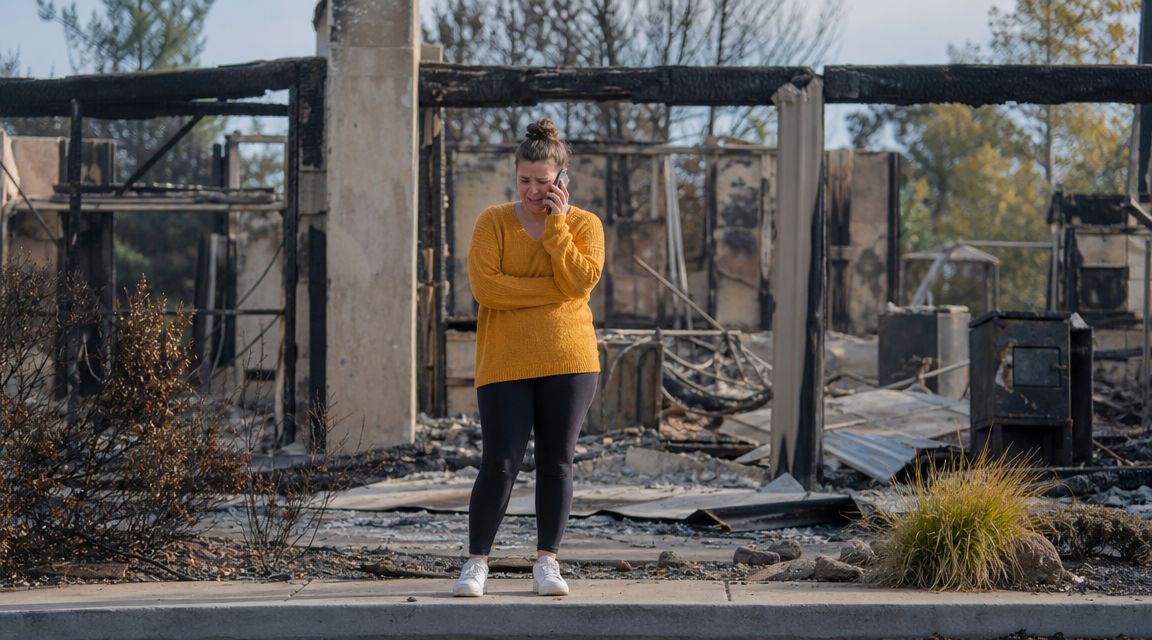
A fire tears through your home or business. You’re already dealing with smoke damage, water damage, lost belongings, and the shock of seeing your life in ruins. Then the insurance company changes tone. The questions get sharper. The adjuster stops sounding helpful. Someone starts using the phrase arson fire.
That’s when many policyholders realize the actual fight is just starting.
If your insurer is hinting that the fire was intentionally set, you need to understand what’s happening. They’re no longer just valuing damage. They’re building a defense to avoid paying. In the United States, an estimated 282,600 intentional fires were reported annually between 2007–2011, causing $1.3 billion in direct property damage each year, and 18% involved structures, according to U.S. arson awareness reporting summarized here. Insurers know arson is real. They also know that accusing a policyholder of involvement can stop a claim cold.
That doesn’t mean their accusation is right.
You paid for coverage. A suspicious insurer doesn’t get to replace proof with assumptions.
Table of Contents
- Introduction The Worst Day of Your Life Just Got Worse
- Understanding the Arson Defense in Insurance Claims
- Behind the Curtain How Insurers Investigate Arson
- Fighting Back When the Insurer’s Arson Theory is Flawed
- Your First Moves A Policyholder’s Defense Checklist
- Your Best Defense Hiring a Public Adjuster for an Arson Dispute
- North Carolina Customer Review After a Disputed Fire Claim
- North Carolina Case Study: Challenging a Wrongful Arson Fire Claim Denial
- Conclusion Don’t Let an Unproven Accusation Destroy Your Recovery
Introduction The Worst Day of Your Life Just Got Worse
It’s a common expectation that an insurance company will step up after a fire. That’s the deal, or at least that’s what they think they bought. You suffer a covered loss, you report it, and the carrier pays what it owes. Simple.
It stops being simple the moment the insurer suspects an arson fire.
A homeowner in this situation usually tells the same story. The first call feels routine. Then a different adjuster appears. Then an investigator. Then the requests start piling up. Bank records. Phone records. Receipts. Social media questions. Details about your marriage, your debts, your whereabouts, your routines. You’re trying to find a place to sleep, replace clothes, and keep your business or household functioning. The insurer is testing whether it can turn your claim into a denial.
That shift is deliberate.
Why this feels so personal
A fire claim already puts you in a vulnerable position. You’ve lost control of your property and probably a large part of your daily life. When the insurance company starts circling around motive, opportunity, and “suspicious circumstances,” it doesn’t feel like claims handling. It feels like an accusation.
And that’s exactly why people make mistakes. They talk too much. They guess. They try to sound helpful. They agree with an investigator’s assumptions because they think cooperation will speed things up.
It usually does the opposite.
Practical rule: when an insurer starts treating your fire loss like a fraud file, every casual conversation becomes evidence.
The question people ask too late
People search “Is arson fire covered under insurance” after the company starts raising eyebrows. The honest answer is blunt. Intentional fire set by the insured is not something the carrier wants to cover. But that does not give the insurer a free pass to label your loss arson and walk away.
They still need a defensible basis for the denial. They still have to investigate fairly. They still have to do more than point at ugly burn patterns and claim the scene “looks suspicious.”
That distinction matters because wrongful arson accusations happen when insurers rely on weak fire science, incomplete scene work, or motive theories built from ordinary financial stress. A late mortgage payment, a struggling business, or an argument at home doesn’t prove you set a fire.
If your claim is being pushed into that direction, stop thinking of this as a routine property claim. Start treating it as a dispute that requires evidence, discipline, and your own experts.
Understanding the Arson Defense in Insurance Claims
An insurer’s arson defense is not just a dramatic label. It’s a legal position. The carrier is saying the fire was intentionally set and that the insured either did it, arranged it, or materially participated in it. If they can support that position well enough, they’ll deny the claim.
That’s why policyholders get blindsided. They think, “No one charged me with a crime, so the insurer can’t deny this.” That’s wrong.
What the insurer is really trying to prove
A criminal court and an insurance claim are not the same battlefield. In criminal court, the government faces a far heavier burden. In an insurance dispute, the carrier doesn’t need a criminal conviction to deny a property claim.
What they usually try to build is a three-part story:
-
The fire was intentionally set.
They’ll rely on origin-and-cause analysis, burn patterns, debris testing, witness interviews, and scene observations. -
You caused it or had it caused.
Rarely do they have direct proof. More often, they try to assemble circumstantial pieces and call it a complete picture. -
You had a motive.
Financial pressure, pending foreclosure, business trouble, family conflict, recent policy changes, or removal of items before the fire all get pushed into a “motive” narrative.
That’s the insurer’s formula. It sounds neat on paper. Real life is usually messier.
Why bad investigations still happen
One of the most important cases for policyholders is Fabian v. State Farm. In that case, the court ruled that the insurer acted in bad faith by denying a claim based on a flawed arson investigation. The insurer’s expert failed to rule out accidental causes, and the court found State Farm had prioritized its own financial interests over a fair investigation, as described in the Fabian v. State Farm decision.
That case matters because it exposes a common problem. Some carriers move too fast from “suspicious fire” to “deny the claim.” They treat gaps in the evidence like proof. They focus on motive before they’ve done solid cause analysis. They lean on experts who sound certain but didn’t eliminate ordinary accidental sources.
Here’s another place policyholders get trapped. The insurer may demand an Examination Under Oath, which is a formal sworn interview. If you’re facing one, read this guide on what to expect in an examination under oath or EUO. It’s not a friendly chat. It’s part of the carrier’s claim defense process.
What motive does and doesn’t mean
A motive theory is not proof of arson. It’s an argument layered on top of other evidence.
Use this simple comparison:
| Insurer argument | What it actually means |
|---|---|
| You had financial problems | Many people have financial problems and never commit arson |
| Coverage had changed recently | Policy updates happen for legitimate reasons |
| Some valuables weren’t destroyed | Items may have been removed, stored, gifted, sold, or simply elsewhere |
| Your timeline has minor gaps | Trauma and displacement affect memory |
If the carrier can’t firmly establish cause, motive alone shouldn’t carry the claim denial.
When you understand that, you stop reacting emotionally to the accusation and start attacking the weak points in the insurer’s theory.
Behind the Curtain How Insurers Investigate Arson
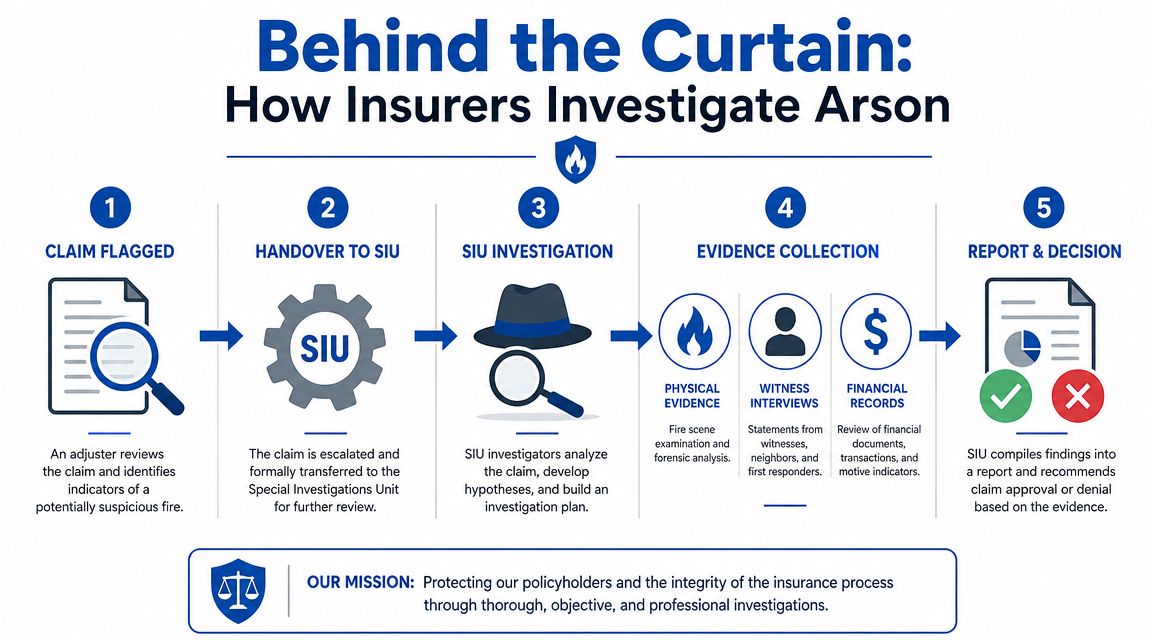
Once a fire claim gets flagged, the ordinary adjuster often stops being the main player. The file moves into a more aggressive channel. That’s where many insureds lose control of the claim without realizing it.
Insurance company Special Investigation Units are a central part of the anti-fraud system, and property-casualty insurers refer hundreds of thousands of claims to SIUs annually, with fire claims carrying one of the highest referral rates because of the risk of total loss and suspected fraud, according to the Insurance Information Institute’s background on insurance fraud and SIUs.
What happens after your claim gets flagged
The internal sequence is usually predictable.
-
Initial flagging
A field adjuster, desk adjuster, or supervisor notices something they consider unusual. That could be the severity of the loss, timing, occupancy questions, inconsistent statements, or scene observations. -
SIU takeover or parallel review
The file gets routed to investigators whose job is to test fraud indicators. Their mission is not rebuilding your house or reopening your business. Their mission is scrutiny. -
Origin and cause inspection
The insurer hires an origin-and-cause expert. That expert inspects the scene, maps burn damage, evaluates the area of origin, and may recommend debris collection and laboratory analysis. -
Document sweep
The insurer asks for financial records, proof of ownership, purchase documentation, prior claim history, and communications that they think reveal motive or planning. -
Recorded statements and sworn testimony
They may take statements early, then later demand an EUO after they’ve developed a theory they want to test against your answers.
If you want a plain-English breakdown of that process from the policyholder side, this overview of an arson fire investigation and insurance dispute is worth reviewing before you answer broad insurer requests.
What they look for beyond the fire scene
A lot of policyholders assume the investigation is all about burn marks. It isn’t. The carrier is also building a behavioral file.
Common targets include:
- Finances: mortgage status, business cash flow, debt load, recent collection pressure
- Property changes: vacant periods, renovations, security issues, recent coverage adjustments
- Personal circumstances: divorce, partnership disputes, inheritance issues, employee conflicts
- Pre-fire activity: whether contents were removed, alarms were disabled, utilities were disconnected, or access was limited
Some of those issues can matter. Many don’t. Insurers still pursue them because circumstantial pressure helps them negotiate from strength.
How to protect yourself while they investigate
You can’t stop an SIU investigation, but you can stop helping the insurer build a distorted story.
Cooperate with legitimate requests. Don’t volunteer theories, guesses, or emotional explanations that can be twisted later.
A few disciplined moves matter early:
- Keep your answers factual. If you don’t know, say you don’t know.
- Preserve your paperwork. Financial records and purchase records can support legitimacy, not just invite scrutiny.
- Don’t alter the scene. Even well-meaning cleanup can trigger “evidence spoliation” accusations.
- Get your own guidance early. Delay gives the insurer time to lock in its version first.
If you own a commercial property, prevention still matters after the dispute too. Practical resources on strategies to protect your business from fire can help reduce future vulnerabilities, especially around access control, monitoring, and workplace fire risks.
Fighting Back When the Insurer’s Arson Theory is Flawed
A slick arson report can scare people into surrender. It’s full of technical language, scene photos, diagrams, and firm conclusions. Don’t confuse polished formatting with reliable science.
Modern fire investigation guidance rejects many of the old visual shortcuts that insurers and investigators used for years. Older “rules of thumb” such as alligatoring or crazed glass are not conclusive signs of accelerant use, and a defensible conclusion requires a totality-of-evidence approach, as explained in this fire investigation analysis on modern methodology and the limits of visual indicators.
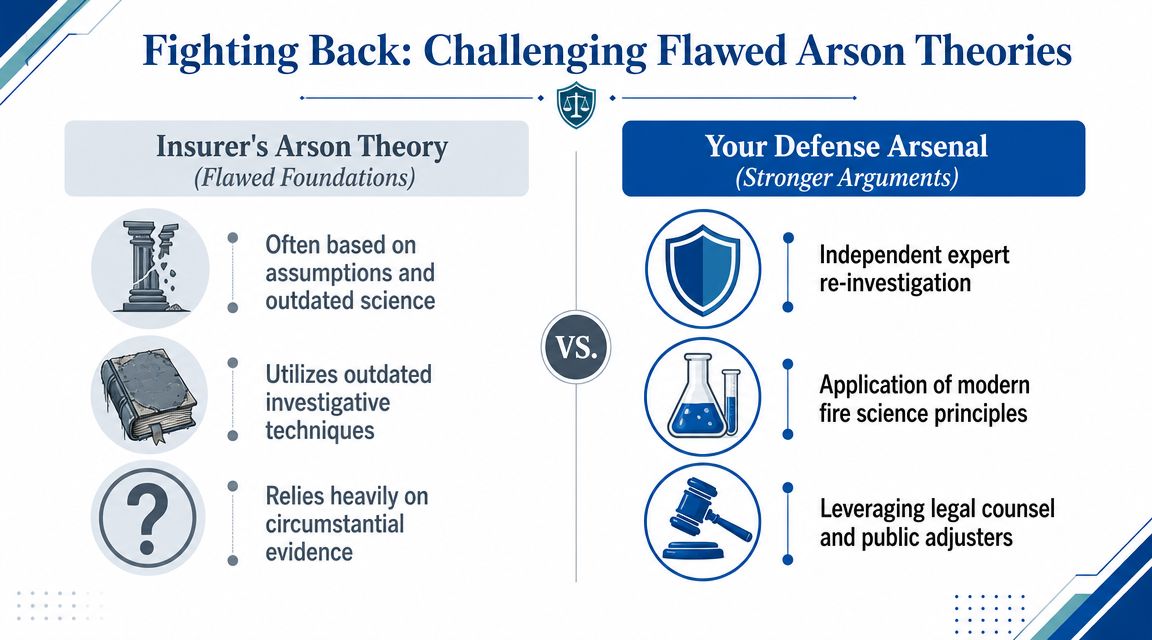
Old fire myths still poison claims
A lot of weak arson defenses begin with visual mythology. The investigator sees deep char, irregular burning, low burn patterns, shattered glass, or dramatic damage and treats those things like a confession written in soot.
That’s bad science.
Fire behavior changes with ventilation, fuel load, room geometry, suppression efforts, collapse, and post-flashover conditions. Accidental fires can create ugly, uneven, intense damage. If the insurer’s expert jumps from “unusual pattern” to “incendiary fire” without rigorous support, you have an opening.
Watch for these warning signs in the carrier’s report:
| Weakness in insurer report | Why it matters |
|---|---|
| Heavy reliance on burn appearance | Visual patterns alone can mislead |
| Thin discussion of accidental causes | A real investigation rules alternatives out |
| No meaningful lab support | Scene appearance is not enough by itself |
| Strong motive narrative, weak cause analysis | That’s argument, not proof |
A fire investigator should eliminate accidental causes before accusing the insured. If that step is missing, the conclusion is vulnerable.
Accidental causes that can look suspicious
Another major defense angle is alternative ignition. Fires often start in ways that are technical, hidden, or badly misunderstood. Utility interfaces, malfunctioning appliances, wiring failures, self-heating materials, and other non-criminal causes can produce severe damage that looks suspicious after the fact.
That’s why a serious rebuttal asks different questions:
- Was the electrical system fully examined?
- Were appliances, HVAC components, or connected equipment analyzed?
- Was debris collected and tested where necessary?
- Did the investigator document the scene before disturbance?
- Did anyone seriously evaluate non-incendiary ignition paths?
Policyholders dealing with this kind of technical dispute can benefit from broader reading on handling property insurance disputes, especially when the carrier presents its theory as final before the evidence supports it.
An insurer’s arson theory falls apart when it rests on assumptions, skips alternate causes, or overstates what the physical evidence can prove. Your goal isn’t to tell a better story. Your goal is to expose the holes in theirs.
Your First Moves A Policyholder’s Defense Checklist
The first few days after a fire matter more than is often realized. You don’t need to solve the cause. You need to protect your position.
What to do immediately
-
Report the loss promptly
Notify the insurer and cooperate with fire department and emergency response personnel. Delay gives the carrier room to question your conduct. -
Secure the property without disturbing evidence
Board-up, fencing, and emergency protection are fine when done properly. Digging through debris, moving burned contents, or discarding damaged materials is not. -
Photograph and video everything
Capture wide shots, close-ups, entry points, utility areas, appliances, detached structures, and all visible contents damage. Do it before conditions change further. -
Start a loss record
Create a running list of damaged or destroyed items, temporary living expenses, emergency purchases, and all conversations with the insurer. -
Pull your documents together
Gather your policy, endorsements, mortgage records, leases if applicable, receipts, renovation records, business inventory records, and proof of ownership.
What not to do
People often damage their own case by trying too hard to be helpful.
- Don’t guess about cause. If you aren’t a fire investigator, don’t act like one.
- Don’t exaggerate or minimize. Both can be used against you.
- Don’t clean up the scene casually. That’s one of the easiest ways to trigger accusations about destroyed evidence.
- Don’t sign broad statements without understanding them. Recorded and written statements get mined for inconsistencies later.
- Don’t discuss the claim loosely with neighbors or online. Insurers pay attention to stray comments.
Keep a claim diary. Write down dates, names, requests, inspections, and what was said. Memory fades. Paper doesn’t.
The right communication style
When the adjuster asks questions, keep your answers short and factual. If a timeline detail is uncertain, say it’s uncertain. If you need records to answer accurately, say you’ll provide records.
That approach protects you better than trying to sound cooperative by filling silence with speculation.
A policyholder under pressure often thinks confidence helps. Accuracy helps more.
Your Best Defense Hiring a Public Adjuster for an Arson Dispute
An arson fire dispute is not an even contest. The insurer has its adjusters, its SIU personnel, its experts, its counsel, and control over the pace of the claim. If you walk into that alone, you’re reacting to their process instead of building your own case.
That’s why serious disputed fire claims often need a public adjuster.
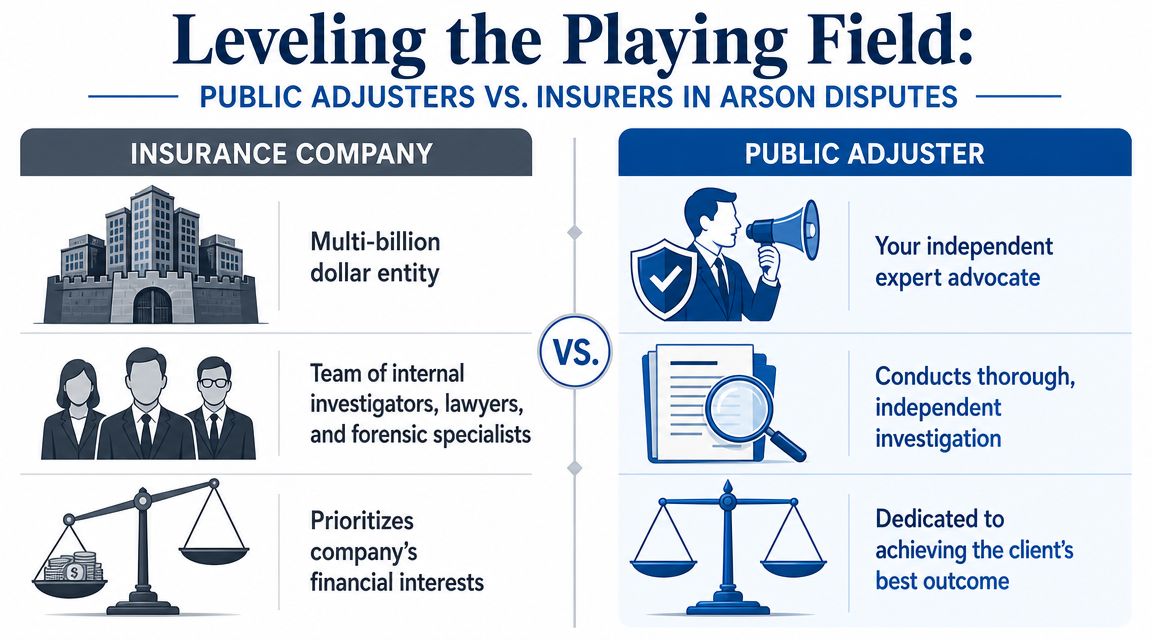
Why you need your own side’s expert
A key problem in fire claims is misclassification. Fire investigation science has evolved, yet investigators may still over-rely on misleading visual cues, and a public adjuster can challenge those assumptions by pressing for a more rigorous analysis that rules out accidental causes first, as discussed in this reporting on how arson investigation techniques are catching up with science.
That’s the heart of it. A public adjuster doesn’t just argue about money. In an arson dispute, the adjuster helps challenge the foundation of the denial itself.
For homeowners and commercial policyholders, that usually means bringing order to a chaotic situation:
- reviewing the policy language and exclusions
- analyzing the insurer’s requests
- coordinating independent experts where needed
- documenting building, contents, and business property losses
- organizing proof in a format the carrier can’t easily dismiss
If you want a straightforward overview, this explains what a public adjuster does in property insurance disputes.
A short video can also help clarify the role before you decide how to proceed.
What a public adjuster actually does in an arson fire claim
This isn’t about hand-holding. It’s about counterweight.
A capable public adjuster will scrutinize the insurer’s theory line by line. Was the scene preserved properly? Did the carrier’s expert really rule out accidental ignition? Are there gaps between the photos, the testing, and the conclusion? Is the company inflating “motive” because it lacks strong cause evidence?
In a disputed fire case, For The Public Adjusters, Inc. can assist policyholders by assessing damages, organizing claim documentation, and communicating with the carrier while the origin-and-cause dispute is being challenged.
What strong representation changes
Representation changes the pressure dynamics.
Without help, the insured often gets dragged into endless requests while the carrier controls the frame. With help, the claim becomes structured. The responses tighten up. The evidence gets assembled. Weak assumptions are challenged. The actual value of the loss is documented so that if the arson accusation collapses, the settlement doesn’t get low-balled on the back end.
The insurer has professionals working the file from day one. You should too.
Public adjusters are not criminal defense lawyers, and they don’t replace legal counsel when criminal exposure exists. But in the insurance dispute itself, they can be the difference between a policyholder being managed and a policyholder being defended.
North Carolina Customer Review After a Disputed Fire Claim
A review like this reflects what many policyholders experience during disputed fire claims. Once the insurer starts using arson language, the claim can feel less like a repair process and more like an investigation. That is exactly when organized documentation, careful communication, and policyholder-side representation become critical.
“After the fire, we thought the hardest part would be cleaning up and figuring out where to live. Then the insurance company started asking questions that made us feel like we were being accused of something. The claim slowed down, the requests kept coming, and nobody would give us a straight answer about what was actually covered.
For The Public Adjusters helped us organize the damage, understand the insurer’s requests, and push back when the carrier seemed more focused on suspicion than facts. They helped document the smoke, water, contents, and structural damage that had been overlooked while the company was questioning the cause of the fire.
Having someone on our side changed the whole process. We finally felt like the insurance company had to answer the evidence instead of controlling the story.”
— Mary F. Holly Springs, NC
This type of case shows why arson fire claim disputes require fast, disciplined action. A policyholder should not let an insurer replace proof with suspicion, and the value of the loss should not be minimized while the carrier tests an unsupported denial theory.
North Carolina Case Study: Challenging a Wrongful Arson Fire Claim Denial
A stronger claim file was built around photographs, repair documentation, contents records, expert review, and direct questions about the insurer’s origin-and-cause conclusions. Instead of accepting vague references to suspicious circumstances, the homeowner demanded that the carrier identify the specific evidence supporting its arson theory and explain which accidental causes had been ruled out.
The claim changed when the dispute stopped being emotional and became evidence-driven.
The problem was that the carrier’s theory was incomplete. The investigation did not clearly rule out accidental ignition sources, including electrical components and possible appliance involvement near the reported area of origin. The damage estimate also failed to fully account for smoke contamination, water damage from suppression efforts, debris removal, contents documentation, and the cost of restoring affected living areas.
The insurer requested financial records, questioned the homeowner’s timeline, and pointed to burn patterns it described as suspicious. The first coverage position leaned heavily on motive-based assumptions, including ordinary financial pressure and the fact that several personal items were not inside the home at the time of the fire.
After a serious residential fire in North Carolina, the homeowner expected the insurance claim to focus on rebuilding, smoke damage, water damage, and damaged contents. Instead, the carrier shifted the file into a more aggressive investigation and began suggesting that the fire may have been intentionally set.
Conclusion Don’t Let an Unproven Accusation Destroy Your Recovery
An arson accusation from your insurance company is not the final word. It’s the insurer’s position. Those are not the same thing.
If the carrier is delaying, digging, or denying based on an arson fire theory, the issue is no longer just damage valuation. The issue is whether the insurer can support what it’s implying. Many can’t. They rely on pressure, technical language, and the hope that a stressed policyholder will give up, contradict themselves, or accept a denial they should be fighting.
Don’t make it easy for them.
The strongest response is disciplined and evidence-driven. Preserve the scene. Control your communications. Gather your records. Push back on weak fire science. Demand that accidental causes be ruled out, not brushed aside. If the company’s case is built on suspicion more than proof, expose that clearly and early.
For commercial insureds and some homeowners, financial records can become a major part of the insurer’s narrative. When that happens, outside professionals who help resolve complex financial problems can sometimes play an important supporting role in untangling the story the carrier is trying to build.
You are not required to accept a bad investigation just because the insurer paid someone to write it up. You are not required to prove your innocence to a company that hasn’t done its own job properly. You are entitled to challenge the denial, the process, the methodology, and the valuation.
That’s how wrongful arson denials get overturned. Not with outrage. With preparation.
If you’re in North Carolina or Virginia and your fire claim is being delayed, disputed, or denied because the insurance company is raising arson, get help before the insurer’s theory hardens into a denial letter.
2. Can an insurance company deny a claim just because the cause is "undetermined"?
Direct Answer: No, but they often try to stall. Insurers frequently use the "undetermined" label to delay payment. However, they cannot deny a claim based on mere speculation. Under NC and VA law, the burden of proof rests on the insurance company to provide "scientifically verifiable evidence" that the fire was incendiary. You are not required to prove it was accidental; they must prove it was arson.
3. What is the "Innocent Co-Insured" doctrine, and how does it protect me?
Direct Answer: This doctrine protects a spouse or co-owner who was not involved in the arson. The Policyholder Solve: Historically, if one person on a policy committed arson, the entire claim was voided. Modern courts in many jurisdictions now view interests as "several" rather than "joint." If your spouse or a co-owner sets the fire without your knowledge or participation, an experienced advocate can argue that you are an "innocent co-insured" and entitled to your portion of the settlement.
4. What should I do if the insurance company’s investigator is asking to interview me?
Direct Answer: Proceed with extreme caution. The Strategy: You are contractually obligated to cooperate, but you are not obligated to be interrogated without representation. If you are being asked for an Examination Under Oath (EUO), you have the right to have an attorney or a public adjuster present. Anything you say in these interviews is recorded and can be used to deny your claim later if they find a single "material misrepresentation."
5. Why is the insurer asking for my personal financial records?
Direct Answer: They are looking for "Motive." The Deep Dive: In arson investigations, carriers look for the "Means, Motive, and Opportunity." By requesting your bank statements, tax returns, and debt history, they are attempting to show you were in financial distress—suggesting a motive to "cash out" via an insurance claim. Only provide financial records that are directly relevant to the property or the claim.
6. Can I hire my own fire investigator?
Direct Answer: Absolutely. The insurance company’s investigator works for them. If their report says "Arson" but the official Fire Marshal’s report says "Undetermined" or "Accidental," you have a major conflict. Hiring an independent, certified Fire Cause and Origin expert to conduct a second investigation can provide the "second opinion" necessary to challenge a denial.
7. What if the insurance company suspects arson but can't prove it?
Direct Answer: They may try to hold the claim in "pending" status indefinitely. The Strategy: Insurers often use the "investigation" period to wait for you to make a mistake or to simply wear you down so you abandon the claim. In both NC and VA, you can pressure the carrier by demanding a formal decision in writing or by filing a regulatory complaint with the NCDOI or VA Bureau of Insurance for "bad faith delay."
8. Does the "Arson Reporting Immunity Act" affect my privacy?
Direct Answer: Yes. Under the Arson Reporting Immunity Acts in both NC and VA, insurance companies are protected from civil liability if they share "suspected" arson information with law enforcement. This means they can share your private records with the police without fear of you suing them for defamation, provided they believe they have reasonable grounds for suspicion.
9. Can I be denied even if I’m never charged with a crime?
Direct Answer: Yes. The burden of proof for an insurance company to deny a claim (a "preponderance of the evidence"—meaning it's more likely than not that arson occurred) is much lower than the "beyond a reasonable doubt" standard required for a criminal conviction. You can have your claim denied for arson even if the District Attorney refuses to prosecute you.
10. What are the "Red Flags" that usually trigger an arson investigation?
Adjusters are trained to look for:
Property status: Homes that were recently listed for sale, foreclosed upon, or vacant.
Financial stressors: Recent bankruptcies or high-interest personal debt.
Policy changes: Significant increases in coverage amounts just before the fire.
Physical evidence: Unusual burn patterns (e.g., pour patterns), the presence of accelerants (gasoline/kerosene), or disabled fire/smoke alarm systems.
Strategic Advice
The "Science" Defense: If you are accused of arson, ensure your legal team challenges the "scientific" methodology of the carrier's expert. Modern fire science (like NFPA 921 standards) has debunked many old "myths" about burn patterns that were once used to falsely accuse homeowners.
Preserve Everything: Never clean or repair the fire site until the official investigation is concluded. "Spoliation of evidence" is a common trap used to deny claims.
Professional Advocacy: If arson is even whispered by an adjuster, you are no longer in a "claims" scenario; you are in a "litigation" scenario. Involve a property damage attorney or a highly specialized Public Adjuster immediately.
If your homeowner or commercial property fire claim is being questioned, delayed, low-balled, or denied, For The Public Adjusters, Inc. can review the claim, help assess the damage, and support your dispute with the insurance company. When the carrier treats you like a suspect instead of a policyholder, getting experienced claim representation early can protect both your evidence and your recovery.


Husband started fire. We’re separated and he doesn’t live with me. And he is not the owner or on the insurance.
One question is if he is on the DEED? Also, in community property states, assets bought during marriage belong to both spouses equally, even if only one name is on the deed.
The good news is, in most cases, the insurance company will still pay the innocent owner, provided the owner had no involvement in the arson. The insurance claim turns heavily on “who” holds the policy, how the policy defines an “insured,” and the “Innocent Spouse Doctrine.”