Let’s get one thing straight: when you file a water damage claim insurance issue, you are not entering into a partnership. You’re kicking off a negotiation against a corporate giant.
It’s you versus a massive corporation like State Farm or Allstate, whose entire business model is built on collecting premiums and minimizing payouts. The moment you report that leak, you’re on opposite sides of the table. Understanding this cold, hard fact from the get-go is the only way to protect yourself from their tactics.
Your Insurer Is Not Your Partner
To put it bluntly, you and your insurance company have completely different goals. You need every last dollar you’re entitled to so you can properly fix your home or business. Your insurer, on the other hand, wants to close your claim for the absolute lowest amount possible to protect their bottom line.
This conflict is why so many homeowners and business owners get hit with a lowball offer right out of the gate. It’s a gut punch.
That first estimate will almost certainly ignore hidden damage, use cheap materials for pricing, and conveniently forget about things like the potential for mold growth. It’s not a mistake; it’s a strategy. They’re testing you to see if you’ll take the quick, cheap check and just go away.
Common Tactics Insurers Use
Insurance companies have a well-worn playbook of tricks designed to wear you down and pay you less. Recognizing them is your first line of defense.
- Delay, Delay, Delay: They know you’re stressed and vulnerable. The longer they drag out the process with “lost” paperwork, unreturned phone calls, and constant requests for documents you’ve already sent, the more likely you are to give in. It’s a war of attrition.
- Death by Fine Print: The adjuster will start quoting obscure policy language and complicated exclusions you’ve never heard of. They are banking on the fact that you haven’t memorized your 100-page policy. This is how they justify denying parts of your claim or the entire thing.
- The “Preferred” Contractor Trap: Your insurer will push you to use one of their approved contractors. It sounds helpful, but be careful. These contractors have a cozy relationship with the insurance company, and their estimates often magically align with the insurer’s lowball offer, not with the actual cost of a quality repair.
Success Story: We saw this exact scenario play out with a Raleigh homeowner. A major pipe burst, flooding his kitchen. His national insurance company, known for its lowball tactics, offered a measly $8,000, claiming the damage was minor. The homeowner knew better and hired a public adjuster. We uncovered severe rot in the subfloor and mold already starting to grow. The final settlement? Over $45,000. More than five times the company’s initial offer.
This story isn’t an exception; it’s the norm. It’s proof that you have to treat your water damage claim insurance process like the business negotiation it is. To get a better handle on the entire fight ahead, this homeowners guide to property insurance claims is a great resource.
At the end of the day, the adjuster sent by your insurance company works for them. Their job is to protect the company’s money, not to help you. To even the odds, you need an expert in your corner—someone who works only for you. This is exactly why a public adjuster is your most critical ally in getting paid what you’re truly owed.
Building an Ironclad Case Against Your Insurer
When you’re up against an insurance giant like Allstate or State Farm, a few blurry photos from your phone just won’t cut it.
If you want to fight back against a lowball offer or an outright denial of your water damage claim insurance, you need to build a case. A case so thorough, so detailed, and so undeniable that it leaves them no room to argue. You need to start thinking like a detective gathering evidence for a trial, because that’s exactly what this is.
Your insurer will try to poke holes in your story. They’ll downplay the severity of the damage and question the value of everything you’ve lost. Your job is to seal every one of those holes with indisputable proof before they even find them. This isn’t just about listing what was damaged; it’s about building an evidence locker they simply cannot ignore.
Go Beyond Basic Photos
Snapping a few pictures is the bare minimum, and the bare minimum gets you a bare minimum settlement. To build a powerful case, you have to elevate your documentation game. The goal is to capture the full scope of the disaster in a way that puts the adjuster right in the middle of your flooded living room.
- Film a Narrated Video Walkthrough. Grab your smartphone and record a slow, detailed video of every single affected area. As you record, speak clearly. Narrate what you’re seeing. State the date and time, describe the smell, point out the high-water marks on the walls, and get close-ups showing how water has seeped under baseboards or into cabinetry. This creates a timestamped, immersive record that a simple photo could never replicate.
- Photograph Everything Individually. After the video, it’s time for photos. And I mean lots of photos. Take high-resolution pictures of every single damaged item. Get wide shots of the rooms, then zoom in on specific damage—warped floorboards, stained ceilings, ruined electronics. Take way more photos than you think you’ll ever need.
The Power of a Meticulous Inventory
Proving your losses is the core of any strong claim, and that means creating a detailed home inventory for insurance claims is absolutely essential.
Vague descriptions like “damaged furniture” are just an open invitation for your insurer to assign a rock-bottom value. Don’t give them that opening.
Instead, create a spreadsheet listing every single item. For each one, include:
- Item Description (e.g., “Samsung 65-inch 4K Smart TV”)
- Brand and Model Number
- Age of the Item
- Original Purchase Price (dig up receipts or credit card statements if you can)
- Estimated Replacement Cost (look up current prices online)
This level of detail makes it incredibly difficult for the adjuster to undervalue your property. It replaces their vague estimates with cold, hard data.
Success Story: A business owner in Virginia had his retail store flooded after a pipe burst. His insurance company, notorious for its delay tactics, offered a settlement that wouldn’t even cover the cost of new flooring. Frustrated, he hired a public adjuster. We guided him through a meticulous documentation process, creating a video walkthrough and a 20-page inventory of damaged merchandise, fixtures, and equipment—all complete with replacement cost analysis. Faced with this mountain of evidence, the insurer’s initial offer was completely dismantled. The final settlement was nearly 250% higher, fully covering the business’s recovery.
This is a stark reminder: the thoroughness of your documentation directly impacts the size of your settlement check. The process below shows the critical stages you’ll navigate when disputing a claim.
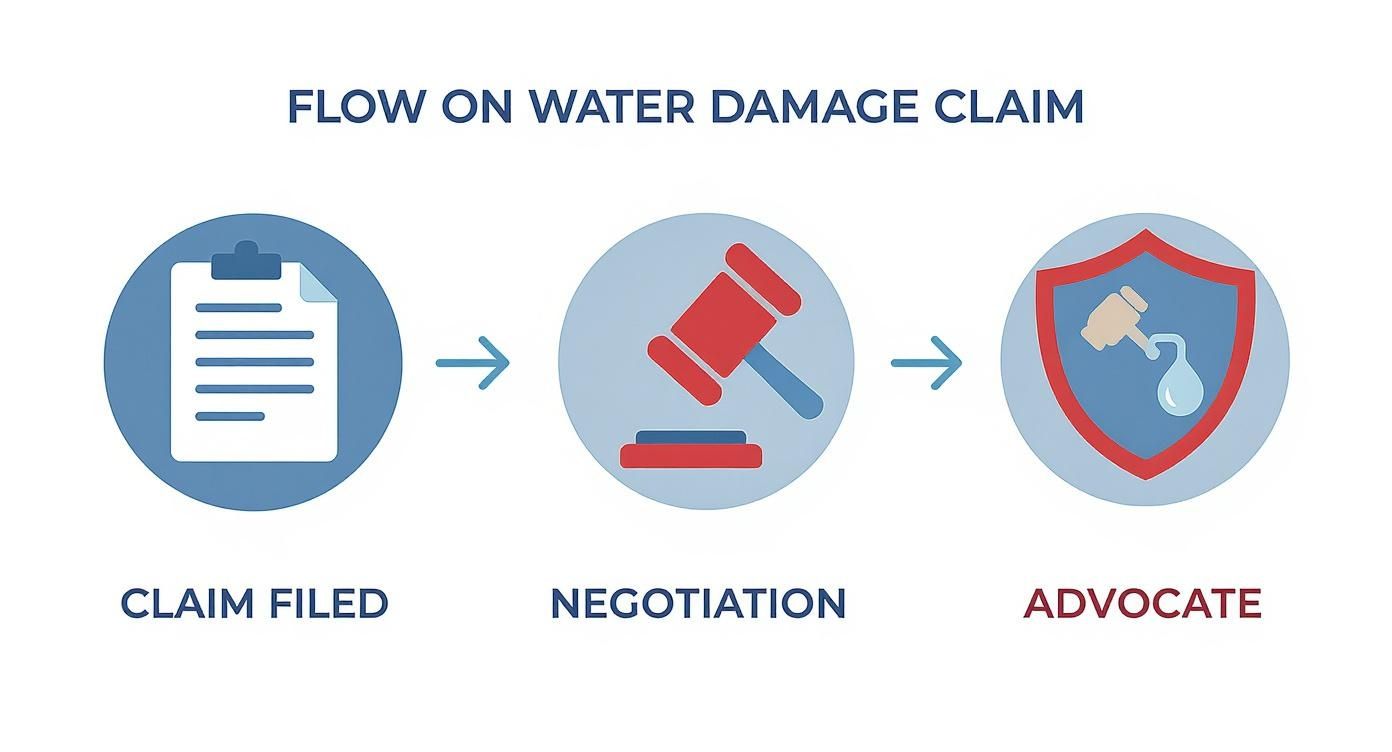
As you can see, filing the claim is just the beginning. The real fight happens during the negotiation, which is where having a professional advocate becomes absolutely crucial.
The following checklist details the kind of proof that puts real pressure on an insurer.
Your Evidence Checklist Insurers Hate to See
| Evidence Type | Why It’s Critical | Pro Tip |
|---|---|---|
| Narrated Video Walkthrough | Creates an immersive, timestamped record of the initial damage scene. It captures details photos can miss. | State the date and time at the beginning. Speak slowly and clearly, pointing out specific damages as you film. |
| High-Resolution Photos | Provides clear, undeniable proof of individual items and structural damage from multiple angles. | Take more photos than you think you need. Get wide shots, close-ups, and pictures of serial numbers or brand labels. |
| Detailed Personal Property Inventory | Replaces vague descriptions with specific data (model, age, cost), making it hard for adjusters to undervalue your belongings. | Use a spreadsheet. For electronics or appliances, find current online prices for the same or comparable models. |
| Independent Contractor Estimates | Gives you real-world repair costs from trusted professionals, directly countering the insurer’s lowball figures. | Get at least two or three itemized estimates from reputable local contractors. Never rely solely on the insurer’s “preferred” vendor. |
| Receipts & Proof of Purchase | Establishes the original value and ownership of damaged items, leaving no room for the insurer to guess. | Scan or photograph old receipts. If you don’t have them, check credit card or bank statements for proof of purchase. |
| Communication Log | Creates a paper trail of every promise, statement, and deadline discussed with your adjuster, holding them accountable. | After every phone call, send a polite follow-up email summarizing the conversation. (“Just to confirm our discussion…”) |
This isn’t just a list; it’s your battle plan for getting the money you are owed.
Arm Yourself With Independent Estimates
Never, ever accept your insurer’s estimate at face value.
They will almost certainly recommend their “preferred” contractors, whose quotes often align suspiciously with the lowball number the insurance company wants to pay. You have to get your own quotes from independent, reputable contractors that you trust.
Get at least two to three detailed, itemized estimates for all the repair work. These documents are powerful ammunition. They demonstrate the true, real-world cost to restore your property to its pre-loss condition using quality materials and labor. When your insurer says the repairs should only cost $15,000 but you have three detailed bids from respected local builders averaging $40,000, their argument begins to fall apart.
Document Every Single Interaction
Finally, keep a meticulous log of every single conversation you have with your insurance company. After every phone call with the adjuster, send a follow-up email that summarizes the discussion: “Hi [Adjuster’s Name], just to confirm our conversation today, you stated that…”
This creates a paper trail. It holds them accountable and prevents them from conveniently “forgetting” or denying what they promised you on the phone.
You’re dealing with an industry where the stakes are massive. Water damage and freezing claims account for nearly 28% of all homeowners insurance losses, and the average payout is around $13,954—a number that insurers are always, always trying to minimize. Every piece of evidence you gather is a shield against their cost-cutting tactics.
Decoding and Disputing a Lowball Offer
It’s the moment that makes your stomach drop.
After weeks of stress and documenting every last detail of your loss, the settlement offer for your water damage claim insurance finally arrives. You open it, and the number you see feels like a slap in the face. It’s an amount that wouldn’t even cover the cost of materials, let alone the skilled professionals needed to put your home or business back together.
This isn’t a mistake. It’s a calculated business move by your insurer, whether it’s State Farm, Allstate, or any other industry giant. They are testing you, banking on the hope that you’re too exhausted and overwhelmed to fight back. Accepting that first offer is exactly what they want. It’s the last thing you should do.
Unpacking the Adjuster’s Lowball Estimate
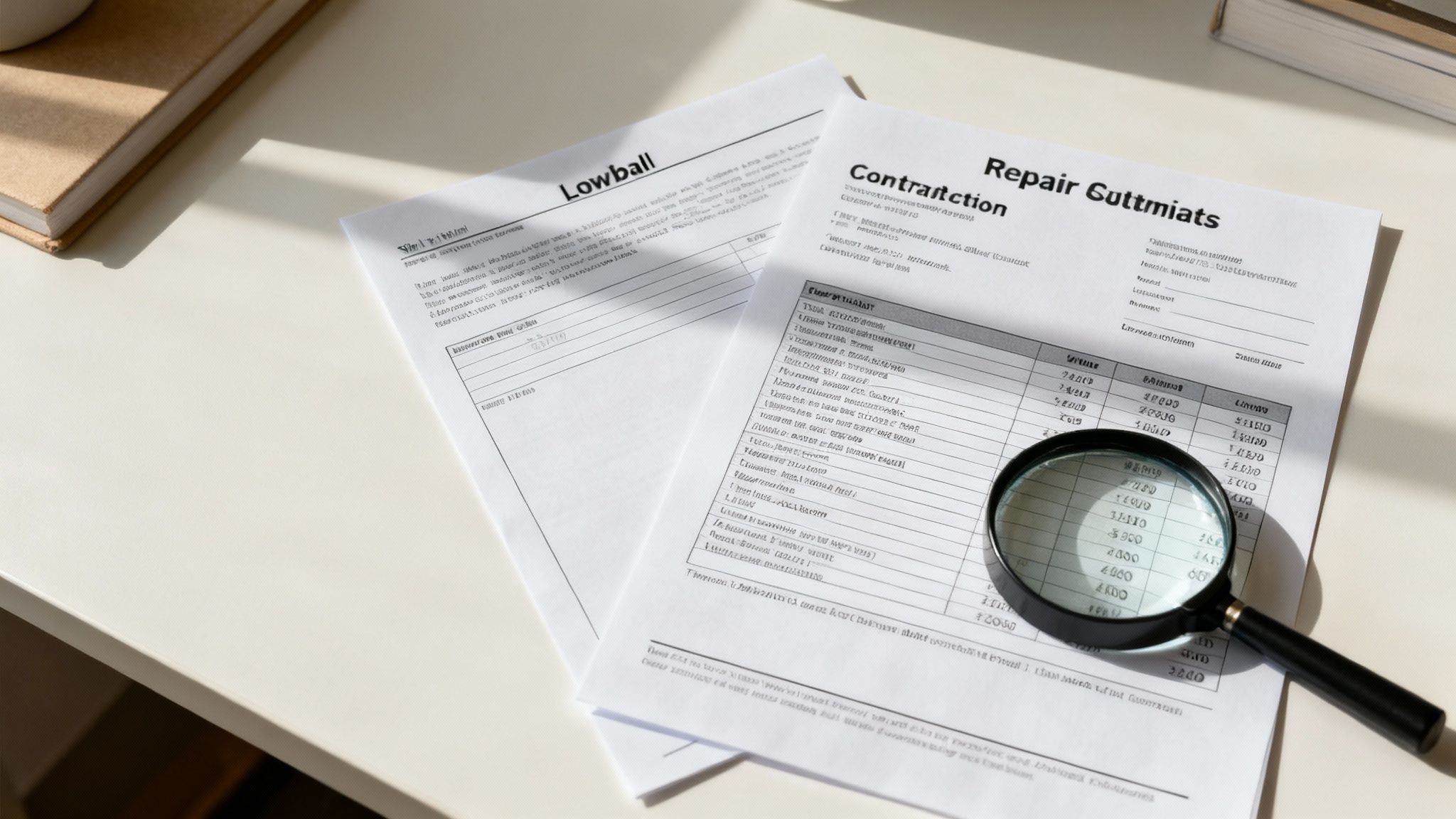
To fight their offer, you first have to understand how they built it to fail. Insurance adjusters are masters at minimizing costs on paper, creating an estimate that looks official but is fundamentally broken. You have to go through their “scope of work” line by painful line.
Here’s what you’re looking for:
- Substandard Materials: They’ll spec out cheap, builder-grade laminate to replace your solid hardwood floors or basic paint when you had a premium, washable finish.
- Underestimated Labor Rates: Their estimate will almost certainly use generic, national-average labor costs that don’t reflect what it actually costs to hire a skilled, local plumber or drywaller in your town.
- Omitted Critical Steps: Does their scope include the cost of professional mold testing and remediation? What about the industrial-grade dehumidifiers needed to dry everything out properly? These are the kinds of “details” they conveniently leave out to shrink the total.
- Ignoring Code Upgrades: If local building codes have changed since your home was built, any repairs have to meet the new, modern standards. Insurers love to “forget” to include these mandatory—and often expensive—upgrades.
This tactic is especially rampant with water claims. In the U.S., water damage and freezing now account for over 43% of all home insurance claims, making it the biggest category of loss by far. With that kind of volume, insurers have perfected the art of the lowball offer to protect their profits.
Drafting a Powerful Dispute Letter
Once you’ve taken their flimsy estimate apart, it’s time to formally dismantle it. A phone call isn’t enough. You need to draft a professional dispute letter that systematically breaks down their offer and presents your counter-demand, backed by the mountain of evidence you’ve been gathering.
Keep the letter structured, professional, and firm. This isn’t the time for emotion. Focus on a logical, fact-based argument that they can’t easily brush aside. For more in-depth strategies, our guide on how to negotiate with an insurance adjuster is an essential read for this conversation.
Your dispute letter must clearly:
- State that you formally reject their settlement offer.
- Provide a specific, itemized list of every single discrepancy in their scope of work.
- Include copies of your independent contractor estimates as hard proof of real-world costs.
- Attach your photos, videos, and detailed inventory of damaged items.
- Present your own settlement demand—the real number it will take to make you whole again.
Case Study: A Business Owner’s Victory
A local Holly Springs, NC restaurant owner had a major plumbing line fail, flooding his entire dining room and kitchen. His insurer, a huge national carrier, offered him $48,000. That number wouldn’t even cover the replacement of his custom millwork, let alone the commercial-grade flooring and kitchen equipment.With For The Public Adjusters in his corner, he fired back with a detailed dispute. It included an independent bid from insurance damage contractor, a forensic analysis of the water damage, and a business interruption report. The evidence proved their initial offer was nearly 60% below the actual cost of repairs. Faced with a meticulously documented claim they couldn’t refute, the insurer caved. The final settlement was over $115,000, allowing him to rebuild his business properly.
This story drives home a critical truth: a lowball offer is just the start of the negotiation. By refusing to be intimidated and hitting back with overwhelming evidence, you completely change the power dynamic and force your insurer to treat your water damage claim insurance with the seriousness it deserves.
How to Handle Delays and Denials
When your home or business is a mess from water damage, the last thing you want is radio silence from your insurance company. But that’s often exactly what you get. A slow-moving water damage claim insurance process isn’t just bad service—it’s a tactic. They’re hoping to wear you down until you’re desperate enough to take whatever lowball offer they throw your way.
An outright denial feels even worse, like a door slamming shut. You have to understand that both delays and denials are often just the insurer’s opening moves. They are betting on your frustration. They want you to give up. The first step in fighting back is seeing their playbook for what it is.
Recognizing Bad Faith Insurance Practices
The term “bad faith” isn’t just something to yell into the phone; it’s a real legal concept. It means your insurance company broke its contractual promise to handle your claim fairly and honestly. These massive corporations have armies of lawyers. They know the rules—they’re just betting you don’t.
Here are the classic signs that your insurer is playing games:
- Ghosting You: Your adjuster suddenly stops returning calls or answering emails. Every time you call, they’re conveniently “out of the office” or “in a meeting.”
- The Document Black Hole: They keep asking for photos, receipts, or forms you’ve already sent, claiming they “never received them.” This is a classic stall tactic.
- Twisting the Policy Language: The adjuster starts quoting obscure sections of your policy, bending the words to justify denying something that should clearly be covered.
- Insultingly Low Offers: They send a settlement check that doesn’t even come close to covering the estimates you got from your own contractors. It’s not a negotiation; it’s an insult.
If you’re seeing these red flags, this is no longer just a slow process. It’s a calculated strategy to underpay or deny your claim.
Taking Action When You Suspect Bad Faith
You cannot let them get away with it. If you believe your insurer is acting in bad faith, it’s time to escalate. The single most powerful first step you can take is filing a formal complaint with your state’s Department of Insurance.
This isn’t just sending an angry email. A formal complaint creates an official record and legally requires the insurance company to answer to a government regulator—not just to you. It has a funny way of getting their attention. When an insurer’s denial is baseless, you must fight back. You can get more information on how to appeal a denied insurance claim and start building your case.
A landmark case, State Farm Mut. Auto. Ins. Co. v. Campbell, sent a shockwave through the insurance industry. The Supreme Court upheld a massive $145 million punitive damages award against State Farm for its bad faith actions in refusing to settle a claim. This ruling made it clear: companies can’t operate with impunity, and their malicious behavior can justify a verdict that dwarfs the original claim amount.
This isn’t just legal history; it’s leverage. It proves that courts will hold insurers accountable for malicious behavior. Your complaint is the first shot fired in a battle to make them take your water damage claim insurance dispute seriously.
Why a Public Adjuster Is Your Strongest Ally
When your property is drowning in water, your insurance company will send their own adjuster to the scene. They’ll sound professional and seem helpful, but you need to remember one critical, unshakeable fact: they work for the insurance company.
Their entire job is to assess the damage from one perspective—protecting their employer’s profits. That almost always means minimizing your water damage claim insurance payout. It’s an unfair fight from the very beginning. Your insurer has a professional on their side. Shouldn’t you?
This is precisely where a public adjuster becomes your most powerful weapon. A public adjuster is a state-licensed insurance expert who works only for you, the policyholder. They have zero loyalty to any insurance carrier. Their one and only mission is to manage every detail of your claim to get you the maximum, fair settlement you’re entitled to under your policy.

Leveling the Playing Field Against Insurers
Think of a public adjuster as your personal advocate—an expert negotiator who lives and breathes this stuff. They know the complex language of insurance policies, the real-world costs of construction, and every tactic insurers use to lowball claims. While you’re overwhelmed trying to piece your life back together, they are methodically building an ironclad case on your behalf.
This kind of professional muscle is more crucial than ever. The insurance industry is getting hammered by a tsunami of claims. In just the first nine months of one recent year, global insured losses from natural disasters hit an estimated $105 billion.
That immense financial pressure gives carriers every incentive to slash payouts on individual claims like yours.
A public adjuster is your countermeasure. Here’s how they fight for you:
- They conduct a forensic-level inspection. Forget the company adjuster’s quick walk-through. A public adjuster uses moisture meters, thermal cameras, and other tools to uncover hidden water damage lurking behind walls, under floors, and soaked into your home’s framing.
- They build a real-world scope of loss. They create a detailed, contractor-grade estimate that reflects the true cost of rebuilding with quality materials and skilled local labor—not the cheap, corner-cutting alternatives your insurer will push.
- They take over all communications. Every frustrating phone call, every delay tactic, every endless email chain—they handle it all. This frees you up to focus on your family or business, not on fighting a corporate giant.
The Financial Impact of Hiring an Expert
Some property owners get hung up on the fee, which is usually a small percentage of the final settlement. But that’s looking at it all wrong. The fee isn’t a cost; it’s an investment that pays for itself over and over by unlocking the true value of your claim.
Success Story: Uncovering $60,000 in “Missed” Damages
A business owner in Apex, NC, had a catastrophic roof leak flood his office. His insurance carrier’s adjuster did a quick inspection and offered a paltry $25,000. The owner knew it was a ridiculously low number and hired a public adjuster.The public adjuster immediately brought in thermal imaging cameras. He discovered that water had saturated the insulation and seeped deep into the wall cavities across three separate offices—damage the company adjuster conveniently “missed.” He also found several code upgrade requirements the insurer had completely ignored. After presenting a mountain of new evidence, the final settlement came in at $85,000. That’s an increase of $60,000. The public adjuster’s fee was just a fraction of the money he recovered for the client.
This isn’t a fluke; it’s what public adjusters do. They find the damage the insurance company hopes you never see. They fight for every single dollar, turning a lowball offer into a settlement that gives you the funds to actually rebuild your life. You can learn more about this vital role by reading our guide explaining what is a public adjuster in more detail. When you’re up against a stubborn insurer, they are the expert ally you need to win.
Common Questions in a Disputed Claim Fight
When you’re going head-to-head with your insurance company over a water damage claim insurance settlement, the questions and confusion can be completely overwhelming. Here are some straight answers to the roadblocks insurers love to throw up when they don’t want to pay what they owe.
What if My Insurer’s Contractor Gives a Laughably Low Estimate?
Here’s a critical truth: you are never obligated to use your insurance company’s “preferred” contractor.
Insurers like Allstate and State Farm push their network of vendors for one simple reason: those contractors are known for writing estimates that just so happen to match the lowball number the insurance company wants to pay. It’s a rigged game.
Your best weapon is to get two or three of your own detailed, independent estimates from local, reputable contractors—people you actually trust. These aren’t just numbers on a page; they’re your primary negotiation ammo. Use them to prove the real-world cost of materials and labor needed to do the job right, and throw their bogus offer right back at them.
How Long Is Too Long for My Claim to Be Sitting There?
While every claim is different, state laws absolutely protect you from “unreasonable delays.” This isn’t just about bad service; it’s often a tactic.
Is your adjuster ghosting your calls? Are they asking for the same documents you’ve already sent three times? Is your claim just sitting in limbo for weeks or months with no valid explanation? They might be acting in bad faith.
This is a deliberate strategy designed to exhaust you into giving up and accepting a low offer. Your first move is to document everything and send a formal, certified letter demanding a status update and a decision by a specific, reasonable date. If they keep dragging their feet, your next call is to your state’s Department of Insurance to file a formal complaint. That legally forces a response.
That first lowball offer isn’t the end of the road. It’s the starting line for the real fight. It’s the moment you realize your insurer isn’t your friend, and it’s the perfect time to bring in a professional advocate who is.
Is It Too Late to Hire a Public Adjuster After They’ve Already Lowballed Me?
Not at all. In fact, that insulting lowball offer is the number one reason homeowners and business owners finally decide to hire a public adjuster. It’s the moment the gloves come off and you see your insurer’s true intentions.
A public adjuster can jump into the fight right at this stage. They’ll reopen negotiations and systematically tear apart the company adjuster’s flawed, incomplete estimate. They bring in a fresh set of expert eyes, find all the damage the insurer conveniently “missed,” and build an aggressive, evidence-backed counter-offer that forces the carrier back to the negotiating table.
What if They Denied My Claim, Blaming “Neglect” or “Flooding”?
Insurers love to hide behind vague policy language. Denials based on “long-term neglect” or misclassifying damage as “flooding” are two of their favorite tricks.
- “Neglect” is their go-to excuse to blame you for a slow leak behind a wall that you couldn’t possibly have seen.
- “Flooding” is supposed to mean natural, rising groundwater. But adjusters will try to slap that label on a massive pipe burst to get out of paying, since most standard policies exclude flood damage.
Fighting these denials means getting technical. It requires a deep understanding of your policy’s fine print and often involves bringing in forensic experts. An experienced public adjuster can hire engineers or leak detection specialists to prove the real origin and timeline of the water loss, showing that the denial is based on a wrongful, self-serving interpretation of the facts.
How can I prove the water damage was sudden and accidental and not a maintenance issue?
You can prove it was sudden by obtaining a detailed report from a licensed plumber or restoration company immediately after the loss. This report must explicitly state the source of the leak, the nature of the failure (e.g., burst connection, sudden crack), and that it was not due to long-term neglect. You should consider speaking with a local Public Adjuster as well.
What steps should I take immediately after the damage to avoid having my claim denied later?
You have a duty to mitigate further damage. Immediately take clear, date-stamped photos and videos of the damage and its source before cleanup begins. Then, safely stop the water source (if possible) and hire a professional water mitigation company to dry the structure, keeping all invoices and receipts. This is all new to most people. It's a good idea to consult with a Public Adjuster before doing anything.
What is the "Proof of Loss" and what role does it play in fighting a disputed claim?
The Proof of Loss (POL) is a formal, sworn statement detailing your damages and the compensation you are claiming. If your claim is disputed, a professionally prepared POL (often done by a Public Adjuster) backed by expert documentation forces the insurer to address the true valuation of your loss, not just their low estimate.
My claim was denied because of a mold exclusion. How do I fight this?
Most standard policies exclude mold damage if it is a consequence of an unrepaired, gradual leak. To fight this, you must first successfully dispute the denial of the original water damage event by proving it was sudden. If the initial water event is covered, resulting mold damage related to the covered event often must be addressed. A Public Adjuster can answer all your questions on this issue.
Can a Public Adjuster help me re-open a water damage claim that was already denied or underpaid?
Yes. Public Adjusters specialize in fighting denials. They review the entire claim file, bring in independent experts (like forensic engineers or hydrologists), and submit a comprehensive appeal package that often overturns denials by proving the insurer misapplied the policy or overlooked evidence.
The insurance adjuster's estimate is too low to cover the repairs. What is my next move?
Do not accept the first offer. Your next move is to hire a Public Adjuster to conduct an independent, detailed estimate using industry-standard software (like Xactimate). This creates a formal counter-demand based on true costs, shifting the negotiation power back to you.
Will the insurance company pay for my temporary living expenses (ALE) if my home is uninhabitable due to water damage?
Yes, if the water damage is from a covered peril, your policy's Additional Living Expense (ALE) coverage should pay for temporary housing, food, and other necessary extra costs. Your Public Adjuster ensures ALE coverage is maximized and paid out efficiently while your home is under repair.
What should I do if the adjuster claims there was pre-existing damage and denies the claim based on that?
If an adjuster claims pre-existing damage, they must provide reasonable evidence. A Public Adjuster counters this by providing dated records, maintenance logs, and expert reports that demonstrate the most recent damage was caused by the current covered event, not a historical issue.
Is it necessary to hire a Public Adjuster versus an Attorney to fight a water damage claim dispute?
In the initial dispute and negotiation phases, hiring a Public Adjuster is usually more efficient and cost-effective. PAs are claims experts who fight the denial using claims procedures and policy language. If the denial is based on bad faith or a complete legal impasse, an attorney is the next step, but a PA often resolves the issue sooner.
When your insurance company decides to fight you instead of helping you, you need a professional fighter on your side. The team at For The Public Adjusters, Inc. has the expertise to challenge lowball offers, bad-faith delays, and wrongful denials to get you the full and fair settlement you’re owed.
Visit us at https://forthepublicadjusters.com for a no-cost claim review and find out how we can help you win your fight.