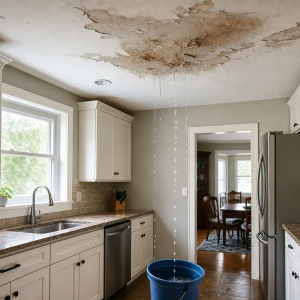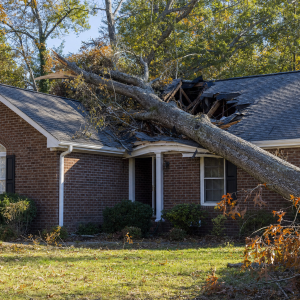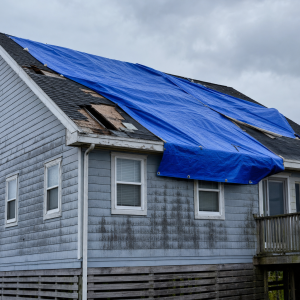
A clean insurance check can still leave you unable to finish the repairs. The carrier’s adjuster may have priced visible damage, while your contractor finds wet insulation, damaged subfloor, missing code-required work, or rooms that can’t be restored without matching adjacent materials. That gap is where insurance claim supplements matter.
A supplement isn’t a favor from the carrier, and it isn’t a second chance to submit a completely different loss. It’s a documented demand for additional payment under the original claim. The carrier can inspect, question, reduce, or deny individual items, but it shouldn’t be allowed to close an incomplete scope just because the first estimate looked tidy.
Table of Contents
- When the Insurance Company’s First Check Is Not Enough
- What an Insurance Claim Supplement Actually Is
- Common Reasons Supplements Get Missed on the First Estimate
- Documentation Checklists for Homeowners, Contractors, and Public Adjusters
- Submitting the Supplement and Negotiating Line by Line
- Dispute Strategies When the Carrier Still Low-Balls the Supplement
- North Carolina and Virginia Timelines and NFIP Flood Rules
- The Long Game How Supplements Show Up on Claims History
When the Insurance Company’s First Check Is Not Enough
A water heater line bursts on a Tuesday. By dinner, a mitigation crew has removed baseboards and set drying equipment. The insurance adjuster visits Thursday, takes photographs, and writes an estimate based on what can be seen without opening more walls. Two weeks later, the check arrives.
Then the rebuild contractor walks the property carefully. The insulation behind the master bathroom is saturated. The subfloor has begun to swell. Drywall in the hallway has to be removed farther than the first cut line, and the paint won’t blend with the undamaged wall. The estimate also misses permit-related electrical work and leaves depreciation applied to items the homeowner must buy immediately.
That first check isn’t necessarily the final value of the claim. It’s the carrier’s first position, based on the information available when the estimate was written. A supplemental insurance claim is the formal request to correct that position when the original scope missed damage, pricing, or necessary work. Industry guidance describes supplements as follow-up requests tied to the same loss and policy, generally supported by revised estimates, photographs, invoices, and inspection reports (industry guidance on supplemental claim payments).

The mistake homeowners make is treating the first payment as a verdict. Treat it as a scope to audit. Compare the carrier’s estimate with the contractor’s actual repair plan, then identify every difference that comes from the covered loss rather than from an elective upgrade.
Kitchen-table advice: Don’t argue that the check “feels low.” Show the carrier exactly which necessary line items are absent, what condition requires them, and which document proves the need.
A supplement can lead to a reopened file, a reinspection, and negotiation over individual line items. Once the carrier agrees to the additional items, industry guidance says supplemental payments are commonly issued within about 30 days (supplement payment guidance). The work is not finished when the first check arrives. It’s finished when the approved scope funds the covered restoration.
What an Insurance Claim Supplement Actually Is
An insurance claim supplement is a formal request for additional payment connected to the original loss. It remains attached to the original claim number, policy, peril, and date of loss. It doesn’t create a new water loss, fire loss, wind loss, or hail loss because someone discovered more damage after the first inspection.
That distinction controls the carrier’s workflow. The adjuster may call the next step a supplement, revised estimate, reinspection, reopened claim, or supplemental Proof of Loss. The labels differ, but the central question stays the same: what additional covered work is necessary to restore the property, and what evidence supports it?
Florida’s statutory definition provides a clear example. It describes a supplemental claim as additional loss or damage from the same peril the insurer already adjusted, or costs incurred while completing repairs under an open claim when timely notice was given (Florida supplement definition and submission discussion).
Think of the original claim as a restaurant order. If the kitchen forgot part of the meal, you return to correct the same order. You don’t open an unrelated tab, and you don’t pretend the missing food was a new dinner. A supplement corrects the original scope.

What can trigger a supplement
Common triggers include:
- Hidden damage: Demolition exposes wet insulation, deteriorated framing, damaged decking, or concealed smoke residue.
- Omitted work: The estimate excludes debris handling, surface preparation, trim, paint transitions, or necessary detach-and-reset work.
- Code requirements: A permit or building official requires work that wasn’t present in the carrier’s original scope.
- Actual repair pricing: A qualified contractor documents quantities, labor, materials, and access conditions that the first estimate understated.
- Incomplete loss information: Additional invoices, engineering findings, or contents documentation changes the supported scope.
A supplement isn’t the same as a new claim. It also isn’t automatically a coverage lawsuit or proof of bad faith. Approval isn’t guaranteed, and neutral guidance stresses that written notice, evidence of the gap, reinspection timing, and applicable deadlines all matter (supplement versus reopened claim guidance).
For a separate roof issue, use the policy and loss facts that apply to the property. A general resource on storm damage roof repair Phoenix may help explain roof repair terminology, but it doesn’t replace a claim-specific estimate, policy review, or code analysis.
Common Reasons Supplements Get Missed on the First Estimate
Carriers often write the first estimate from limited access and limited information. The result is a scope that may address visible damage but fail to capture the work required to complete the repair correctly.
Hidden conditions appear after tear-out
A wall can look dry while insulation behind it remains wet. A floor can look stable until the affected finish is removed and the contractor finds swollen subflooring. Thermal images, moisture maps, demolition photographs, and dated inspection notes connect the concealed condition to the reported loss.
Don’t send the carrier a photograph without context. Label the room, identify the affected assembly, record the moisture finding, and tie the proposed repair to the original damage path.
Code-required work gets treated as an upgrade
A municipality may require hard-wired smoke detectors, electrical corrections, structural work, or other permitted repairs before it will approve the rebuild. The carrier may call that an upgrade, but the key question is whether the work is required to complete the covered repair under applicable code and policy provisions.
Provide the permit documents, the relevant code citation, the contractor’s explanation, and photographs showing the existing condition. A vague statement that “code requires this” is weak. A specific citation paired with a line item is much harder to dismiss.
Estimate templates omit practical work
The carrier’s estimate may leave out drywall matching, paint modulation, debris haul-off, trim replacement, or the coordination required across multiple trades. On a roof, the same problem can affect flashing, ventilation, pipe boots, ridge caps, or detach-and-reset work.
Review the estimate beside the contractor’s scope, not beside your memory of the damage. A missing line is recoverable only when someone identifies it and explains why it belongs.
Drying and monitoring continue beyond the initial visit
Water mitigation doesn’t always end when the adjuster finishes the inspection. Equipment readings, daily monitoring, environmental conditions, and access limitations can support additional drying or labor when the property hasn’t reached a safe repair condition.
Keep the mitigation company’s logs, readings, photographs, equipment records, and invoices. The carrier can challenge unnecessary duration, but it should address the documented reason for each additional service day.
Large losses need more than a residential repair scope
A fire, hurricane, or major water loss can affect temporary housing, business operations, contents, debris handling, and coordination across trades. Homeowners may underestimate additional living expenses, while business owners may fail to preserve records supporting interruption-related losses under their commercial policy.
Public adjuster guidance emphasizes that supplements are strongest when supported by itemized measurements, photographs, invoices, and inspection evidence that shows precisely why the first estimate was incomplete (documentation standards for supplemental claims).
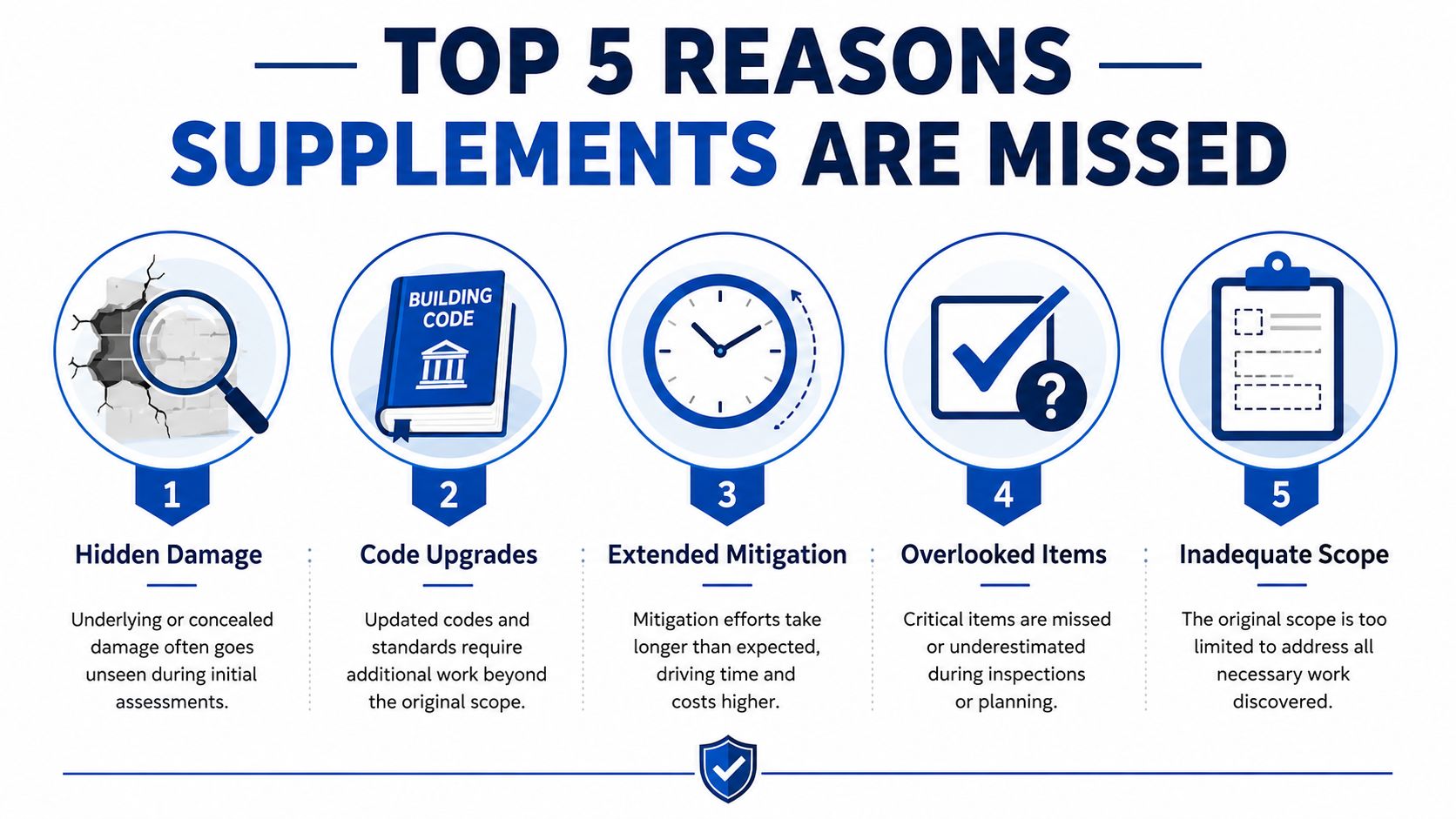
The practical test is simple. Every added line should answer three questions: What was missed? Why is it necessary? What evidence proves it?
Documentation Checklists for Homeowners, Contractors, and Public Adjusters
A supplement wins on organization. Throwing a stack of photographs and invoices at an adjuster forces the carrier to reconstruct your argument, and carriers rarely do that work for you.

Homeowner checklist
Keep a property file with:
- Pre-mitigation evidence: Photographs and video showing rooms, finishes, contents, and the apparent source of damage before removal.
- Contents inventory: A room-by-room list of damaged belongings, descriptions, purchase information when available, and photographs.
- Emergency invoices: Mitigation, plumber, electrician, temporary repair, storage, hotel, and other directly related receipts.
- Communication log: Dates, names, claim references, promises, inspection appointments, and unanswered follow-ups.
- Carrier documents: The policy, declarations, first estimate, payment explanation, correspondence, and every revised scope.
Don’t rely on the contractor’s records as your only file. You need your own copy of the claim history.
Contractor checklist
The contractor should provide:
- Measured scope: Room dimensions, affected assemblies, quantities, labor, materials, access conditions, and disposal requirements.
- Condition evidence: Moisture maps, drying records, demolition photographs, thermal imaging, and inspection notes.
- Line-item estimate: An itemized estimate using the estimating platform appropriate to the project, with quantities and clear descriptions.
- Code analysis: The permit requirement, applicable citation, and explanation of why the original condition can’t be replaced without compliance work.
- Variance letter: A direct comparison showing what the carrier included, what the contractor added, and why each difference is necessary.
For NFIP flood claims, supporting records commonly include itemized building estimates, contractor invoices, repair bills, engineering reports, and photographs. FEMA-aligned supplemental Proof of Loss packages should bundle updated estimates and supporting reports before the applicable deadline (NFIP Proof of Loss documentation guidance). Homeowners handling that process should also review this guide to understand a Proof of Loss.
Public adjuster checklist
A public adjuster should add a policy-centered file:
- Coverage analysis: Relevant coverage grants, exclusions, endorsements, limits, deductibles, and loss-settlement provisions.
- Scope reconciliation: A comparison between the carrier estimate, contractor estimate, invoices, and observed damage.
- Valuation review: Replacement cost, actual cash value, depreciation, and payment calculations.
- Position record: Written coverage arguments, carrier responses, inspection findings, and unresolved items.
- Negotiation tracker: Each disputed line, proposed resolution, responsible contact, and promised follow-up date.
The person submitting the supplement should be able to open any line item and produce the evidence without searching through unrelated files.
Submitting the Supplement and Negotiating Line by Line
A strong supplement starts with a cover letter that tells the carrier exactly what changed. Identify the original claim number, date of loss, property, inspection history, new findings, added scope, supporting documents, and requested action. Ask for a reinspection when the carrier needs to see concealed damage or completed demolition evidence.
The reinspection is not a ceremonial visit. Have the contractor or public adjuster present, walk the adjuster through the disputed areas, and keep the discussion tied to the estimate. If the carrier says a line is excluded, ask for the policy provision. If the carrier says a quantity is excessive, ask what measurement supports its quantity.
A realistic negotiation sequence
Consider a water-loss supplement package requesting $24,000 on a $112,000 claim. Those figures are an example of negotiation structure, not a promised recovery.
- Submission: The package adds wet insulation, expanded drywall removal, subfloor repair, matching-related work, code-required electrical corrections, additional drying, and updated contractor pricing.
- Reinspection: The carrier accepts the visible insulation damage but questions the subfloor and asks for demolition photographs.
- Evidence response: The contractor provides dated photographs, moisture readings, measurements, invoices, and the permit-related documentation.
- Line-item negotiation: The carrier agrees to the subfloor, reduces the requested paint scope, disputes matching, and accepts additional drying after reviewing the monitoring records.
- Resolution: The parties revise the estimate line by line. Once the carrier agrees to the approved additional items, industry guidance commonly places supplemental payment within about 30 days (supplement payment timing guidance).
That process is normal. A partial agreement isn’t the same as a complete resolution, and a request for more evidence isn’t automatically a denial.
Florida’s statutory framework illustrates why the supplement remains tied to the original event. It covers additional damage from the same peril already adjusted and costs incurred while repairs proceed under an open claim with timely notice (Florida supplemental claim framework). Your state and policy may impose different requirements, so read the policy rather than assuming Florida’s rule controls a North Carolina or Virginia claim.
Negotiation script: “Please identify the specific policy language and factual basis for reducing this line. We’re providing the measurement, photograph, invoice, and repair explanation that support it.”
If calls stop producing answers, send that request in writing. Give the carrier a clean list of unresolved items and ask for a written response. For broader context on organizing claim-related work, you can browse our insurance claims page, but your supplement still needs to follow the policy and carrier handling requirements that govern your property.
A focused settlement strategy is more effective than sending repeated general complaints. Use this guide on how to negotiate an insurance settlement when you need to turn disputed items into a documented negotiation record.
Dispute Strategies When the Carrier Still Low-Balls the Supplement
A low supplement response is not the end of the claim. The carrier may approve some line items, reduce others, and deny the rest. Treat the response as an audit trail. Every change requires a specific answer, and every unsupported reduction should remain visible in the file.
Request a written explanation for each denied or reduced line. Require the adjuster to identify the policy language, causation position, measurement, pricing basis, or missing document behind the decision. “Not covered” is incomplete unless the carrier names the provision and explains its application.
Use the escalation ladder
- Written reconsideration: Send a concise, line-by-line reply. Attach the missing photographs, measurements, invoices, code requirements, and repair explanation. Ask for payment of each supported item or request a reinspection.
- Regulatory complaint: If the carrier delays, avoids a clear explanation, or mishandles communications, consider contacting the North Carolina Department of Insurance or the Virginia State Corporation Commission, based on the policy and property location.
- Appraisal: Check the policy’s appraisal clause when the dispute concerns the amount of loss rather than coverage. Appraisal does not decide every denial or coverage question.
- Legal review: If the file indicates a serious coverage or claim-handling violation, consult a qualified insurance attorney about available remedies.
Keep criticism factual. Policyholders may have strong opinions about State Farm, Allstate, Liberty Mutual, or Universal Property, but the carrier must answer the estimate, policy language, evidence, and communications in your file. Do not accuse an adjuster of bad faith solely because the first figure is low. Establish the record before making that argument.
Common carrier positions include wear and tear, depreciation, narrow code interpretations, desktop reviews, and causation disputes. Answer each one directly. Separate pre-existing deterioration from damage caused by the loss. Show why a code item is required for the covered repair. Provide field photographs, measurements, and contractor findings that a remote review could not capture.
Use line-item examples, not general complaints. If the carrier removes roof replacement, identify the storm-created damage, matching or code requirement, measurements, and repair cost. If it cuts drywall, flooring, or mitigation, connect the quantity and method to photographs, moisture records, invoices, and the scope of work.
The practical standard: A carrier may challenge a line. It must explain the challenge.
Guidance on supplement disputes and reopening claims confirms that supplements require written notice and documentation, and approval is not automatic. It also distinguishes supplements from reopened claims, since timing, documentation, reinspection, and limitation periods can affect the result.
North Carolina and Virginia Timelines and NFIP Flood Rules
Flood claims require special care because an NFIP policy isn’t handled like a standard homeowners policy. FEMA governs the federal flood program, while a Write Your Own Company, or WYO, may service the policy and handle claim communications.
For an NFIP flood claim, FEMA requires a completed, signed, and sworn Proof of Loss with supporting documentation within 60 days after the date of loss, unless FEMA grants an extension (FEMA NFIP Proof of Loss rules). If additional flood damage is discovered after submission, FEMA states that the policyholder may request additional payment by promptly notifying the insurer and filing a new Proof of Loss within 180 days after the flood damage occurred (FEMA supplemental flood claim guidance).
| Filing Type | Deadline | What to Submit |
|---|---|---|
| Initial NFIP Proof of Loss | 60 days after the date of loss, unless FEMA grants an extension | Completed, signed, and sworn Proof of Loss, estimates, photographs, invoices, and supporting records |
| Supplemental NFIP request | 180 days after the flood damage occurred | Prompt notice, new Proof of Loss, updated estimates, photographs, invoices, engineering reports, and repair documentation |
Treat the 180-day period as a closing date for supplemental flood documentation, not as a suggestion to wait. Hidden damage found during demolition, an engineering disagreement, or an incomplete initial scope should be reported promptly to the insurer or WYO company.
What North Carolina and Virginia policyholders should preserve
For hurricane, tropical storm, and riverine flood losses, keep the original field notes, every wet-item photograph, demolition record, drying document, engineering report, contractor estimate, and repair invoice. If an insurer-hired engineer changes or narrows a causation position, respond with a qualified counter-report or detailed technical explanation, not a general objection.
The same-date-of-loss link still matters. A supplemental flood request addresses additional damage from the flood event covered by the NFIP policy. It shouldn’t be used to fold unrelated later water intrusion into the file.
Homeowners facing a low flood offer can review this resource on how to dispute a low insurance offer for flood damage. Flood deadlines are unforgiving, and a public adjuster or qualified flood-claim professional should review the file before a deadline passes.
The Long Game How Supplements Show Up on Claims History
The final payment doesn’t erase the claim file. Insurer-shared claims records can help insurers set home insurance prices, and CLUE reports can include a property’s claim history even when the current owner wasn’t living there when the loss occurred (LexisNexis CLUE Property information).
That means a supplement paid later can matter beyond the added check. The carrier may document the reinspection, revised scope, engineering report, additional payment, and unresolved coverage positions within the same claim history. It’s still the original loss, but the file has more activity and more detail.
Preserve the complete record
Keep these materials together:
- Claim identity: Policy, declarations, claim number, date of loss, and carrier correspondence.
- Scope history: Every carrier estimate, contractor estimate, revision, supplement, and written response.
- Technical proof: Photographs, moisture readings, engineering reports, code documents, permits, and inspection notes.
- Payment trail: Checks, payment explanations, depreciation calculations, invoices, and receipts.
- Communication log: Calls, emails, inspection dates, promises, disputes, and unresolved items.
Store the file in two locations, including a secure digital copy. A future insurer, buyer, lender, contractor, or attorney may need to understand why the property shows a loss and how the repairs were completed. Don’t discard the evidence when the repairs look finished.
If the supplement is stuck, a no-cost review by a licensed public adjuster can separate recoverable scope from unsupported demands. For The Public Adjusters, Inc. provides claim assessment, documentation, policy review, estimate preparation, and carrier negotiation for residential and commercial property losses in North Carolina and Virginia, including denied, delayed, and underpaid claims. The firm represents policyholders rather than insurers, which gives the homeowner an advocate focused on the documented scope and policy benefits.
How does hiring a Public Adjuster instantly shift the leverage in my favor during a dispute?
Hiring a Public Adjuster immediately signals that the policyholder is represented by a licensed expert who understands the policy, the industry's estimating software (Xactimate), and the legal framework. This shifts the insurer from dealing with an inexperienced policyholder to dealing with a knowledgeable adversary.
If my insurer sends a "Reservation of Rights" (ROR) letter, what is the immediate strategic response?
An ROR letter is a warning that the insurer is investigating but reserves the right to deny the claim later. The immediate strategic response is to engage a Public Adjuster to provide an overwhelming amount of objective evidence that satisfies all policy conditions, narrowing the insurer's window for a technical denial.
What is the critical difference between the Proof of Loss document I submit and the one the insurer wants me to sign?
The Proof of Loss is your sworn statement of the damages claimed. The insurer wants you to sign a form agreeing to their low valuation. A Public Adjuster prepares a detailed, maximized Proof of Loss backed by expert estimates, creating a contractual benchmark for the full value of your dispute.
How is the Appraisal Clause used as the most effective tool for resolving disputes over the amount of loss?
The Appraisal Clause is a contractual right for resolving disagreements only over the cost of the damage (not coverage). Both sides hire an appraiser, and their neutral umpire's decision is binding, often achieving a full settlement faster and cheaper than litigation, as the Public Adjuster acts as your appointed appraiser.
If the insurer delays my claim unnecessarily, how does that constitute a "bad faith" dispute?
Unreasonable delay (slow-walking the investigation, failure to respond timely) can be evidence of bad faith. A Public Adjuster meticulously documents every communication and delay, citing the state's Fair Claims Settlement Practices Act timelines to pressure the insurer and preserve the policyholder's right to legal action.
What specific evidence must a Public Adjuster use to rebut a "gradual damage" or "wear and tear" exclusion?
The rebuttal requires a forensic engineering report that scientifically concludes the loss was caused by a sudden and accidental event (e.g., latent defect, pressure failure) rather than the long-term deterioration excluded by the policy. This expert analysis reframes the claim from excluded to covered.
Can a Public Adjuster reopen a previously disputed or closed claim, and what is the process?
Yes. A Public Adjuster specializes in filing a Supplemental Claim or formally challenging a denial, provided the loss is within the state's statute of limitations. The process involves gathering all-new forensic evidence and submitting a professional, corrected scope of loss.
How does a Public Adjuster ensure the final settlement fully covers all local building code upgrade costs?
The Public Adjuster verifies the presence of the Ordinance or Law endorsement and incorporates the costs of all current, legally required upgrades (e.g., modern wiring, stricter foundations) into the settlement demand, preventing the insurer from only paying for the cheaper, non-compliant pre-loss construction.
Should I appeal my dispute directly to the State Department of Insurance (DOI)?
You can file a complaint with the DOI, which documents the dispute and triggers a regulatory review of the insurer's conduct. However, the DOI cannot force the insurer to pay or determine the value of your claim. The best strategy is to appeal internally with a Public Adjuster while simultaneously filing the DOI complaint for leverage.
If I accept the insurer's low settlement under duress, can a Public Adjuster still help me recover the remaining money?
If you signed a release, it complicates the case, but the claim may still be recoverable if the amount was grossly inadequate or if the insurer misrepresented facts. A Public Adjuster will review the settlement documents to determine if the release can be challenged due to unfair claims practices.
What is the measurable financial advantage of hiring professional help for a claim dispute?
Independent studies consistently show that policyholders who hire Public Adjusters receive settlements that are significantly higher—often by hundreds of percent—than the insurer's initial offer, ensuring the contingent fee is more than offset by the increased final recovery.
For The Public Adjusters, Inc. can review your underpaid, delayed, or disputed property supplement and help organize the evidence needed to challenge the carrier’s line-item position. Visit For The Public Adjusters, Inc. for claim help, or call 919-400-6440 to speak with a licensed public insurance adjuster about your North Carolina or Virginia property loss.