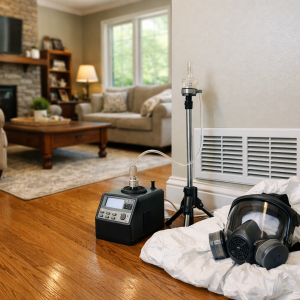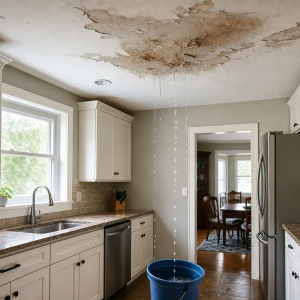
You come home after a storm and find shingles across the yard, water staining the ceiling, and insulation on the floor. You report the loss, cooperate with the adjuster, and expect the policy you’ve paid for to respond. Instead, a one-page letter arrives stating that your insurance denied the claim, or offering an amount that won’t cover the repairs.
That letter isn’t necessarily the end of the road. A denial may reflect a genuine coverage dispute, but it may also result from incomplete documentation, a desk adjuster’s narrow scope, an unsupported cause-of-loss conclusion, or policy language applied without considering the full damage. The right response is not an angry phone call. It’s a controlled rebuild of the claim file.
Table of Contents
- What It Really Means When an Insurer Denies Your Claim
- The Real Reasons Carriers Deny or Low-Ball Property Claims
- What to Do in the First 72 Hours After a Denial Letter
- How to Write a Demand Letter That Forces a Re-Review
- When a Public Adjuster Pays for Itself on a Denied Claim
- NC and VA State Complaint Options and NFIP Appeal Routes
- Your Action Checklist and How We Help Open the File
What It Really Means When an Insurer Denies Your Claim
A Durham homeowner returns from a weekend away after strong winds moved through the area. The roof is visibly damaged, water has entered the attic, and a claim is filed. Two weeks later, the insurer sends a short denial letter citing “wear and tear” without identifying the specific roof condition, policy provision, or inspection evidence supporting that conclusion.
That’s where the fight begins. A coverage-driven denial argues that the policy doesn’t cover the event or resulting damage. The carrier may cite an excluded peril, an alleged lack of a covered loss, misrepresentation in the application, or a limitation within an endorsement. Your first task is to challenge the interpretation of the policy and the facts supporting it.
A process-driven denial accepts that damage occurred but attacks the claim’s presentation. The carrier may allege that the Proof of Loss was incomplete, notice was late, receipts were missing, or the repair scope wasn’t adequately supported. That requires a different response, one focused on reconstructing the evidence rather than debating the existence of the loss.
Read the letter for what it leaves out
A meaningful denial should identify the factual basis for the decision and connect that basis to the applicable policy language. You should be able to locate the relevant exclusion, condition, limitation, or endorsement in the complete policy, not just in a generic paragraph copied into a form letter.
Practical rule: A vague denial is not a reason to give up. It’s a reason to demand the facts, policy provisions, photographs, estimates, and inspection notes behind the decision.
Look for the date of loss, claim number, policy number, stated cause of loss, cited policy language, and appeal instructions. If the letter says “wear and tear,” ask what sudden event was investigated, which components were inspected, and why wind, hail, water intrusion, or another covered cause was rejected. If the carrier says the loss is excluded, ask whether it denied the entire claim or only particular components.
Homeowners dealing with roof disputes in another jurisdiction can also review this resource on Florida roof claim denied help, especially for examples of how roof damage disputes turn on inspection details and policy interpretation. The governing policy and state rules still control your claim, but the underlying documentation problem is familiar across property losses.
The Real Reasons Carriers Deny or Low-Ball Property Claims
Carriers rarely write “we chose the cheapest scope.” They use policy terms and estimating judgments that make the short payment look technical. In North Carolina and Virginia property claims, the dispute often turns on whether the file contains enough specific evidence to challenge the adjuster’s conclusion.
An incomplete Proof of Loss gives the carrier a procedural opening. The policy may require a signed form describing the loss, the amount claimed, and supporting details. If a homeowner submits a rough total without itemized contents, repair estimates, or documentation explaining the calculation, the adjuster’s notes may characterize the submission as “unable to substantiate amount claimed.” The counter is a corrected, properly supported Proof of Loss tied to photographs, invoices, measurements, and a room-by-room scope.
Scope undervaluation is more subtle. The carrier may accept coverage but omit damaged drywall, insulation, cabinets, trim, electrical work, contents handling, or required access work. A desk estimate might include a small ceiling patch even though moisture traveled through multiple assemblies. The claim notes may say “limited visible damage” or “repairs to be localized.” A reinspection, moisture documentation, contractor scope, and line-item estimate can expose the gap.
The labels that require a closer review
“Wear and tear” is often applied to a sudden loss without separating pre-existing deterioration from new damage. The policy may exclude deterioration but still cover ensuing damage caused by a covered peril. If hail breaks a previously aged shingle and water enters during the storm, the carrier can’t resolve the entire dispute by pointing to age alone. The evidence must address the condition before the event, the timing of the damage, and the pathway of resulting water intrusion.
Code-upgrade disputes can hide inside an actual cash value calculation. The carrier may depreciate or exclude ordinance-and-law work, while the policy’s endorsements provide different treatment when local building requirements force replacement or upgraded construction. Review the declarations page, endorsement schedule, and estimate line items together.
Concurrent-causation arguments deserve particular scrutiny. An adjuster may attribute the loss to a combination of covered wind and excluded maintenance, then claim the excluded condition defeats the entire claim. That conclusion must match the policy’s wording and the physical evidence. Don’t accept an invented exclusion just because it appears in a confident paragraph.
| Denial Trigger | Policy Language Cited | Strongest Counter |
|---|---|---|
| Incomplete Proof of Loss | Duties after loss, sworn statement, documentation condition | Submit a corrected, itemized form supported by estimates, receipts, photographs, and a valuation schedule |
| Narrow damage scope | Limits, exclusions, or repair-only wording | Compare the carrier’s estimate with field measurements, moisture evidence, trade scopes, and contractor pricing |
| Wear and tear label | Deterioration, marring, maintenance, or neglect exclusion | Separate pre-existing condition from sudden damage and document the covered event’s direct physical effects |
| Application misrepresentation | Concealment, fraud, or misrepresentation provision | Identify the exact statement, show its relevance, and provide the application record and supporting facts |
| Code upgrades omitted | Actual cash value or ordinance-and-law limitation | Locate the endorsement and document the code-required work through contractor or municipal evidence |
| Concurrent causation theory | Anti-concurrent-causation language | Analyze the exact wording and provide a cause-and-origin opinion addressing each alleged cause |
A low-ball offer works like a soft denial. The carrier admits some coverage, pays a fraction of the reasonable repair cost, and shifts the dispute to the difference. Before accepting, compare the estimate line by line and preserve every objection in writing. For practical documentation ideas after water damage, review document your claim with AMPM Restoration, then adapt the records to your own policy and loss.
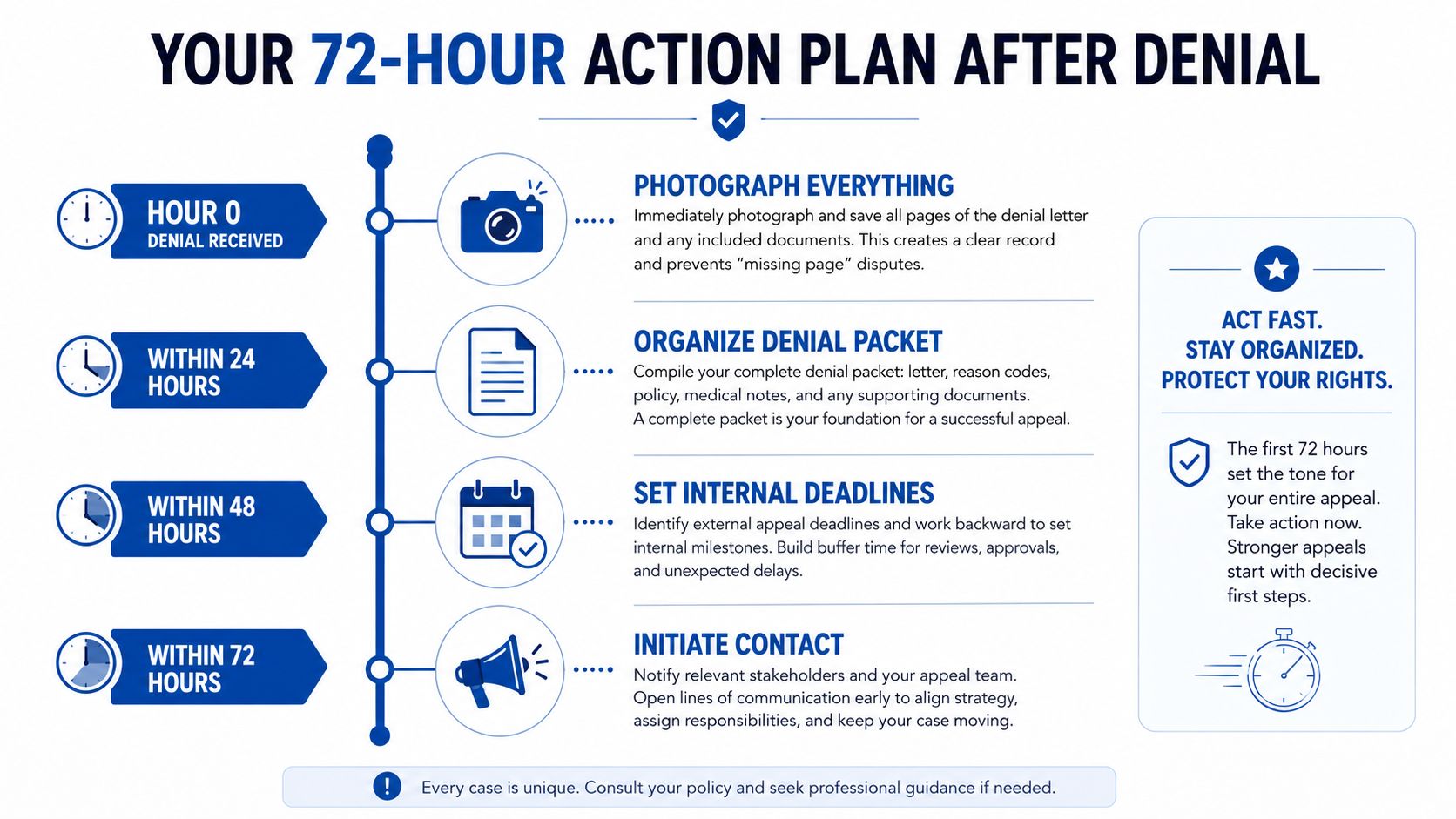
What to Do in the First 72 Hours After a Denial Letter
The first three days are about preserving the record, not persuading the adjuster on the phone. Treat the denial package as evidence.
Hour zero through the first day
Photograph the envelope, the postmark, every page of the denial, and any enclosure. Save a scanned copy with the date received. Then photograph and video the property in its current condition, including exterior elevations, roof-related interior staining, crawlspaces, attics, mechanical systems, contents, and areas the insurer says it inspected.
Create a cloud folder that the carrier can’t alter or access. Include the policy, declarations page, endorsements, denial, estimates, photographs, receipts, emails, text messages, and a written call log. Ask the insurer in writing for the complete claim file, including adjuster photographs, recorded statements, inspection reports, estimates, engineer materials, internal coverage correspondence where available, and payment calculations. State-specific disclosure procedures can affect what you receive in North Carolina and Virginia, so make the request precise and keep proof of delivery.
The second and third days
Write a timeline while the calls and inspections are fresh. Record the date, person, role, telephone number, subject, promises made, documents requested, and what happened next. Mark every deadline in the denial letter and policy. A verbal assurance that “the deadline won’t be a problem” isn’t protection unless the carrier confirms it in writing.
Hold off on a recorded statement until you understand the request and have reviewed the file. Don’t post damage theories, repair plans, or angry accusations on social media. Don’t sign a release, waiver, final settlement, or partial-payment agreement without independent review. A partial payment may be useful, but the accompanying language can affect whether the carrier treats the claim as resolved.
Keep the property safe, but don’t destroy evidence. Perform emergency mitigation, save removed materials where practical, and photograph conditions before and during necessary work.
How to Write a Demand Letter That Forces a Re-Review
A denial letter does not end the claim. It defines the carrier’s position, and your demand letter should force the reviewer to test that position against the policy and a rebuilt evidence file.
Put your name, property address, claim number, policy number, date of loss, date of denial, and certified-mail tracking number in the header. Identify the letter as a formal demand for reconsideration. State whether you challenge coverage, the amount offered, or both.
Keep the opening facts brief. Describe the event, visible damage, inspection, carrier decision, and result you want. Then organize the argument under numbered headings that follow the denial letter, so the reviewer cannot answer one objection while ignoring another.
Match each objection to proof
Use the same sequence for every reason the carrier gives:
- State the carrier’s position. Quote or accurately summarize the denial language.
- Identify the policy provision. Cite the Dwelling Policy section, endorsement, definition, condition, or limit.
- Explain the factual error. Show what the inspection, photographs, contractor estimate, engineer opinion, or timeline establishes.
- Name the exhibit. Refer to a specific attachment, such as “Exhibit C, roof elevation photographs,” instead of writing “see attached documents.”
- State the correction requested. Ask for reversal, a revised scope, payment of an undisputed amount, or a new inspection.
This sequence should govern the entire package. Attach the claim-file request and delivery proof, sworn Proof of Loss, estimates, photographs, receipts, mitigation records, correspondence, and any available recorded-statement transcript. Highlight omitted estimate line items and explain why each belongs under the policy. A properly supported Proof of Loss explanation helps connect the amount claimed to the evidence instead of presenting an unsupported round-number demand.
Set a firm response framework
Once each objection has a documented response, set the carrier’s next obligations in the same letter. Request a written response within 30 days, unless the policy or applicable rule requires another period. Ask the carrier to identify every policy provision and factual finding supporting any continued denial. If the file shows delay, an incomplete investigation, or refusal to address material evidence, state that you may report the handling to the appropriate regulator.
Close with specific demands:
- Reverse the denial and confirm coverage.
- Issue payment for undisputed damage.
- Provide a revised, itemized estimate.
- Arrange a reinspection of the disputed areas.
- If the carrier maintains its position, explain it with specific policy and factual citations.
Send the complete package by a trackable method. Preserve the exact submission, attachments, delivery record, and response. If the first appeal stalls, that organized record gives a public adjuster or a North Carolina or Virginia regulator something concrete to review, rather than another general complaint.
When a Public Adjuster Pays for Itself on a Denied Claim
A public adjuster earns a place in the process when the dispute is about more than a missing receipt. The value is strongest when the insurer relied on a desk estimate, never inspected interior damage, used an excluded-peril conclusion without independent forensic support, or issued an actual cash value payment that ignores applicable code-upgrade coverage.
The public adjuster’s job is to rebuild the file from the property outward. That usually means a new inspection, measurements, photographs, room-by-room documentation, moisture or material observations where appropriate, and a line-item scope prepared in estimating software such as Xactimate or Symbility. The adjuster compares that scope with the carrier’s estimate and identifies omissions, unsupported depreciation, incorrect quantities, missing trades, and repair methods that don’t restore the property.
What changes inside the claim file
A serious re-review package may include:
- Re-scoping: Matching each damaged assembly to labor, materials, access, disposal, testing, and required restoration work.
- Cause analysis: Separating storm damage, resulting water damage, prior condition, and maintenance issues instead of allowing the carrier to blend them into one exclusion.
- Evidence control: Organizing photographs, invoices, mitigation records, contractor proposals, and policy provisions so the reviewer can follow the argument.
- Negotiation: Presenting the dispute to the carrier’s claim manager, supervisor, or regional desk rather than repeatedly explaining it to a rotating call-center representative.
- Statement review: Checking prior recorded statements and correspondence for accidental wording that the carrier may have used against the claim.
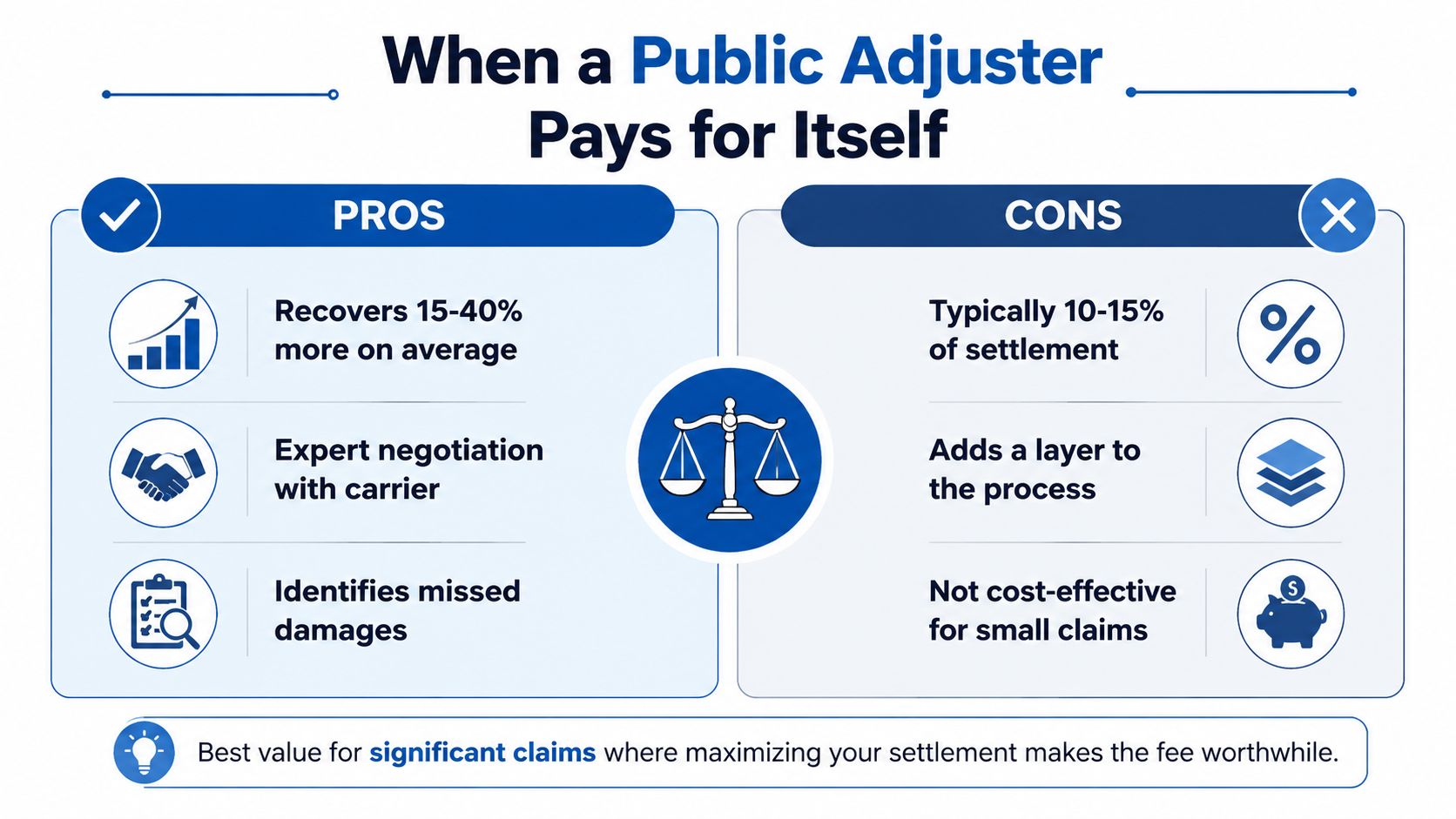
The fee trade-off must be clear before signing. Public adjuster agreements in North Carolina and Virginia commonly use a contingency fee model, often 5% to 12% of additional recovery, paid from proceeds recovered. That range is not a guarantee, and the written contract controls. Ask whether the fee applies to the entire settlement or only additional funds, who pays expert costs, how cancellation works, and whether the firm handles supplemental payments.
The claim should also be large or complex enough to justify professional involvement. A public adjuster may not be cost-effective where the dispute is minor, the evidence is complete, and the policy clearly excludes the damage. Be cautious with anyone who promises a guaranteed result, discourages mitigation, asks you to inflate damage, or cannot explain the scope line by line.
The requested comparison image includes recovery figures that aren’t supported by the verified information available for this article, so the practical test is more reliable than a headline percentage. Compare the expected additional recovery, the fee, the time required, and the strength of the coverage argument. More guidance on that decision appears in whether a public adjuster is worth it.
NC and VA State Complaint Options and NFIP Appeal Routes
Regulatory pressure works best when the complaint asks for something the regulator can evaluate. A regulator may not calculate your full repair scope or act as your advocate in a coverage lawsuit, but it can require a carrier to respond, explain its position, and address apparent claim-handling problems.
North Carolina homeowners can contact the North Carolina Department of Insurance Consumer Services Division and submit a Request for Assistance with the policy, denial, correspondence, timeline, and supporting evidence. The department generally gives the carrier an opportunity to respond, commonly within 30 days, and examiners can identify broader patterns when similar complaints involve the same insurer or handling practice.
Virginia homeowners can use the Virginia State Corporation Commission Bureau of Insurance complaint process, including the applicable Form 99-A route for insurance complaints. Make sure a property and casualty complaint is routed correctly, rather than using a life or health pathway. Include the final denial, policy excerpts, estimates, photographs, and a concise explanation of the unresolved issue.
The NAIC complaint portal can provide another documented channel. It doesn’t replace a state regulator, internal appeal, or legal action, but it can create regulator-to-regulator contact and require the insurer to answer a clearly stated record.
Flood claims follow a different route
NFIP claims are governed by federal flood-program rules, even when a Write-Your-Own company handles the file. A policyholder generally must submit a signed Proof of Loss within 60 days after the loss, and United Policyholders explains that missing the deadline can lead to denial unless FEMA expressly waives it in writing. FEMA has also extended the filing period from 60 days to 365 days for the referenced bulletin period, so check the rule applicable to your loss rather than relying on a general deadline. Detailed estimates and supporting documentation should be presented to the adjuster.
A written NFIP denial carries its own appeal deadline. Louisiana’s insurance bulletin states that an appeal must be filed with FEMA within 60 days of the insurer’s denial letter. Federal case summaries also identify a one-year period for filing an NFIP lawsuit from the date the denial is mailed. Flood policyholders should treat those dates as litigation-sensitive and obtain legal advice when the dispute remains unresolved.
| Channel | Jurisdiction | Filing Method | Typical Response Time | Escalation Path |
|---|---|---|---|---|
| North Carolina DOI Consumer Services | North Carolina property claims | Request for Assistance with policy and claim records | Carrier response commonly requested within 30 days | DOI follow-up, further regulatory review, or legal advice |
| Virginia SCC Bureau of Insurance | Virginia property and casualty claims | Bureau complaint, including applicable Form 99-A process | Depends on file complexity and carrier response | Bureau review, administrative follow-up, or legal advice |
| NAIC complaint portal | State-based insurance regulation | Online complaint routed through the applicable regulator | Varies by regulator and claim | State regulator contact and documented carrier response |
| NFIP and FEMA | Federal flood insurance | Written appeal with denial, policy, Proof of Loss, and evidence | Depends on FEMA review and file completeness | FEMA appeal process, then federal court where permitted |
For flood deadlines and documentation issues, review the focused NFIP Proof of Loss deadline guide. NFIP paperwork is not interchangeable with a standard homeowners claim, and a WYO company’s involvement doesn’t eliminate the federal requirements.
Your Action Checklist and How We Help Open the File
A denied claim becomes manageable when you stop treating it as a single argument and start treating it as a file that needs repair. Within the next 24 hours, complete the following:
- Confirm the decision: Obtain the denial reason, cited policy language, claim number, and deadline in writing.
- Secure the evidence: Save the denial, envelope, photographs, videos, estimates, receipts, mitigation records, and communications in a protected folder.
- Request the record: Ask for the complete claim file, including inspection photographs, estimates, reports, recorded statements, and correspondence.
- Rebuild the timeline: List every call, email, inspection, document submission, promise, and payment.
- Separate the issues: Identify whether the carrier disputes coverage, cause, scope, valuation, documentation, or several of these at once.
- Reconcile the amount: Compare the carrier’s estimate with actual measurements, contractor scopes, code requirements, and damaged contents.
- Calendar deadlines: Track the policy appeal date, Proof of Loss requirement, regulator complaint timing, NFIP appeal deadline, and any lawsuit limitation period.
- Control communication: Keep substantive positions in writing and don’t provide another recorded statement or sign a release without review.
- Choose the pressure point: Send a documented demand, request a reinspection, involve the state regulator, or obtain professional advice based on the dispute.
- Preserve the property: Complete necessary emergency work while photographing conditions and retaining removed materials where practical.
For The Public Adjusters, Inc. can step into that process for residential and commercial property claims involving fire, smoke, water, wind, hail, hurricanes, tornadoes, theft, or vandalism. Its adjusters review the denial and policy, inspect the property, rebuild Proof of Loss line items, prepare documented estimates, communicate with the carrier’s claim representatives, and negotiate the disputed scope. The firm serves North Carolina and Virginia, with offices in Apex, NC, and offers claim reviews and guidance without charging for the initial review.
The important distinction is representation. The insurer’s adjuster works for the insurer. A public adjuster works for the policyholder and focuses on documenting the full covered loss, not merely confirming the carrier’s first estimate. That doesn’t guarantee coverage or payment, and no ethical professional should promise either. It does give you a structured way to challenge unsupported exclusions, missing damage, low-ball valuation, and a file that was closed before the evidence was complete.
For a water loss, don’t assume the first denial is final. Review the policy, preserve the conditions, and have the claim file evaluated before accepting a release or abandoning the dispute.
How do I legally interpret the denial letter to understand the insurer's true reason for denial?
The denial letter must cite the specific policy section, exclusion, or condition they claim was violated. A Public Adjuster analyzes this legal language to determine if the insurer is misinterpreting the policy or if a valid counter-argument (e.g., an endorsement that overrides the exclusion) exists.
How can I challenge a claim denial based on "Insufficient Documentation" or "Lack of Evidence"?
You challenge this by commissioning an independent expert assessment. For property claims, this means a Public Adjuster obtains forensic engineering reports, detailed Xactimate estimates, and thermal imaging evidence that the insurer's initial adjuster overlooked or ignored.
What is the most effective way to address the insurer's denial based on alleged "lack of maintenance" or "gradual damage"?
This tactic is rebutted with forensic engineering evidence. The expert report must scientifically establish the loss was caused by a sudden, abrupt event (covered peril) and not the long-term, preventable deterioration (excluded peril) cited by the carrier.
What is the Appraisal Clause, and when is it the best option to reverse a denial?
The Appraisal Clause is a contractual dispute resolution method used only when the insurer acknowledges coverage but disputes the dollar amount. If the denial is based on low valuation, Appraisal (where both parties hire an independent appraiser) is often the quickest, most binding path to resolution.
Can I still file an appeal if I missed the insurer's initial appeal deadline?
While missing the deadline is dangerous, a Public Adjuster can still often proceed by filing a formal request for reconsideration backed by substantial new evidence or by leveraging the time allowed under the state's statute of limitations for filing a lawsuit for breach of contract.
What specific evidence must be included in a formal written appeal letter to maximize success?
The appeal letter must be a rebuttal memorandum, including: 1) A clear citation of your policy provision; 2) A direct counter-argument to the insurer's cited exclusion; and 3) Attached, new expert evidence (e.g., engineering report, contractor estimate) proving your loss is covered and valued higher.
How does filing a complaint with the State Department of Insurance (DOI) help overturn a denied claim?
While the DOI cannot force a payout, filing a complaint initiates an investigation into the insurer's claims practices. This formal regulatory scrutiny often prompts the insurer to re-evaluate the denial internally, especially if they are concerned about a finding of bad faith or improper handling.
If my claim was denied because the adjuster claims I committed "material misrepresentation," how is that proven wrong?
A denial based on alleged misrepresentation (e.g., policy application or claim statement) is countered by a Public Adjuster through the submission of objective, verifiable facts and documentation that prove any initial inaccuracy was a good-faith error and not an intentional act to defraud the insurer.
When should I stop the appeals process and start considering a bad faith lawsuit against the insurer?
Litigation should be the last resort. A Public Adjuster first exhausts all contractual remedies (Appraisal, formal appeals). A lawsuit is typically considered when the insurer's denial is unreasonable or unfounded and demonstrates a clear pattern of violating state statutes governing fair claims practices.
Does hiring a Public Adjuster after a denial delay the claim further, or does it speed up the final resolution?
Hiring a Public Adjuster generally speeds up the final resolution. The Public Adjuster assumes control of the claim, preventing the insurer from using stall tactics and applying pressure by setting strict timelines and submitting a complete, undisputed, legally-sound scope of loss.
Can a Public Adjuster help me recover money even if the claim denial was issued months or even years ago?
Yes. If the claim is within the state's statute of limitations (often 2-5 years), a Public Adjuster can gather the necessary retrospective evidence, argue that the original denial was incorrect based on policy language, and successfully file a Supplemental Claim or challenge the original decision.
Have your water damage claim questions answered at NO COST. Call 919-400-6440 to speak with a licensed Public Insurance Adjuster or Contact Us here with questions. WE Work For YOU… NOT Your Insurance Company!
For The Public Adjusters, Inc. helps homeowners and business owners challenge denied, delayed, and underpaid property claims through independent inspections, policy-based documentation, estimate review, and carrier negotiation. Visit For The Public Adjusters, Inc. to request a no-cost claim review before you accept a denial or low-ball settlement.