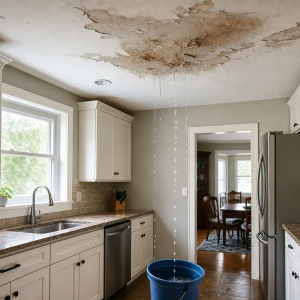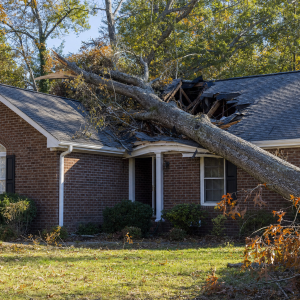
The minutes and hours after floodwaters recede are pure chaos. It’s overwhelming, but what you do right now is absolutely critical for your family’s safety and for the success of your insurance claim for flood damage. Your focus needs to be laser-sharp: get your family safe, call your insurer, and take smart, initial steps to stop the damage from getting worse. These first moves really do set the stage for your entire financial recovery.
Your First Moves After a Flood
It’s easy to feel frozen when you first see the aftermath. The water might be gone, but the mess it left behind is a gut punch. Knowing what to do first—and in what order—makes all the difference in protecting what’s left of your property and building a rock-solid insurance claim.
This is the basic flow of what needs to happen. It all starts with safety.
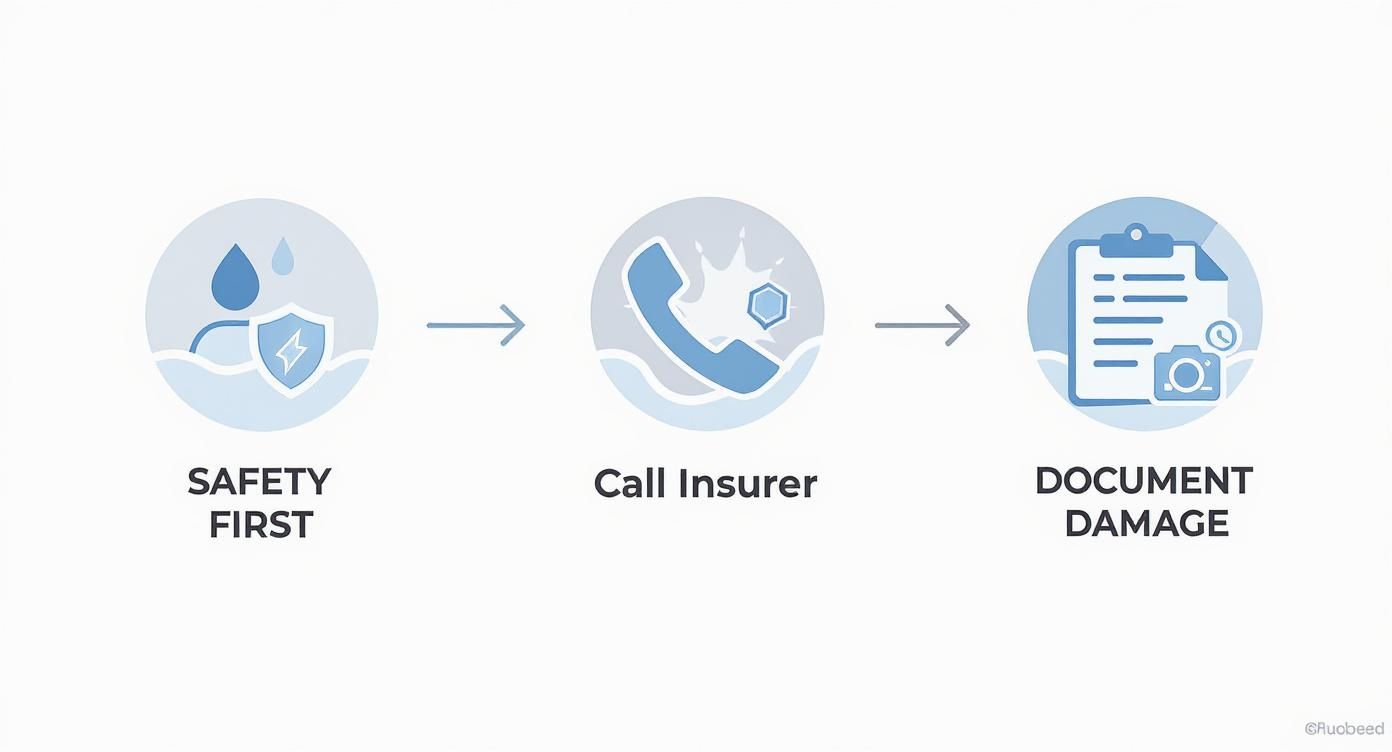
As you can see, your well-being comes before any financial or paperwork tasks. From there, you can move into filing your insurance claim for flood damage.
Prioritize Safety Above All Else
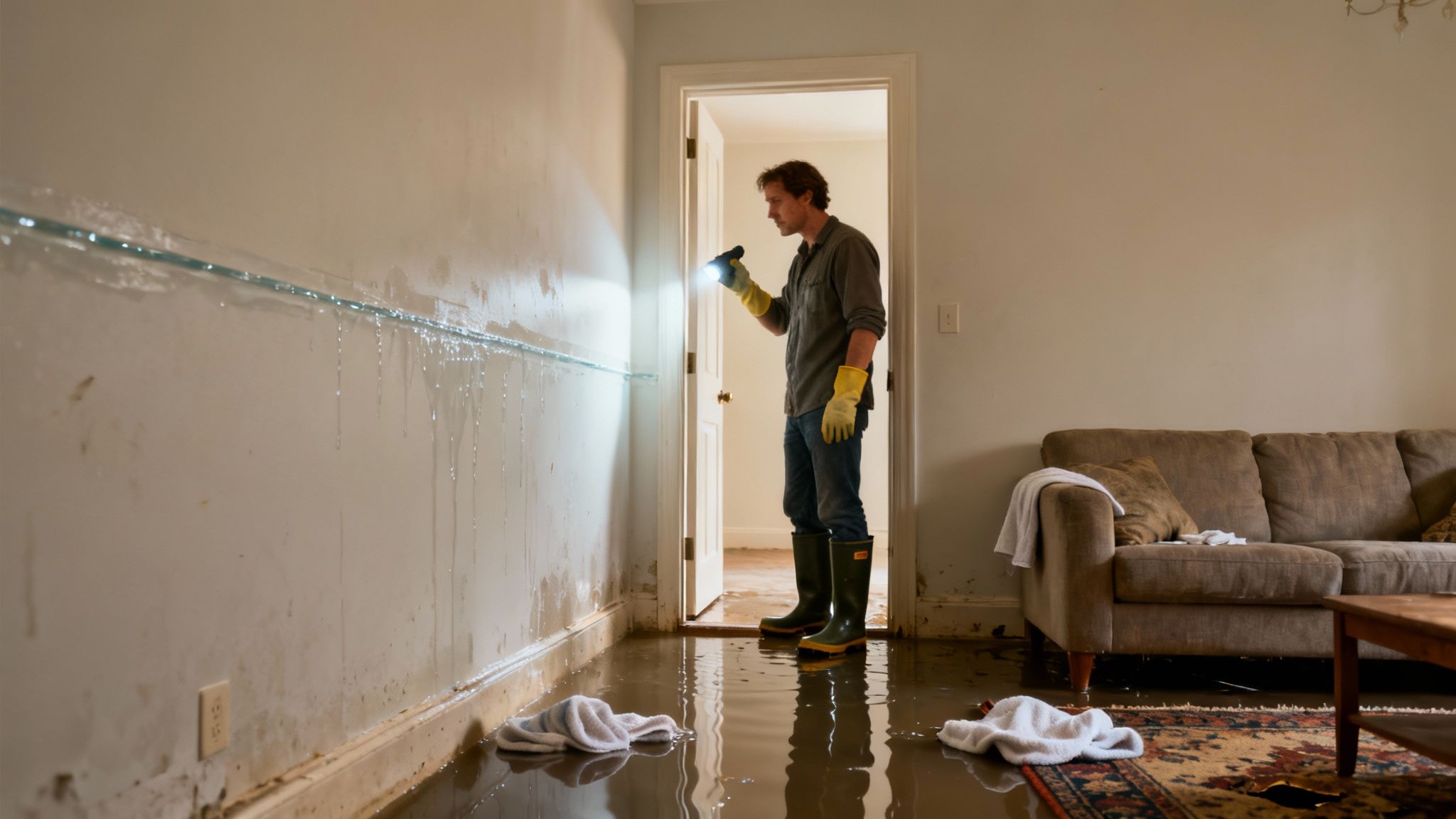
Before you even think about soaked drywall or ruined furniture, your only concern should be safety. I can’t stress this enough. Floodwater is a toxic soup of sewage, chemicals, and who-knows-what-else. Don’t even think about going back inside until the local authorities give the official all-clear.
Once you can go back, move slowly and carefully. The biggest hidden danger is electricity. If you can get to your main breaker box from a completely dry spot and know how to do it safely, shut off the power. If you have any hesitation at all, call a licensed electrician. You have to assume that any standing water is live with an electrical current.
Make the Call: Your Insurer Needs to Know Now
Your very next phone call should be to your insurance company. Do not put this off. The faster you report the flood, the faster they can get an adjuster assigned to your case and get the process moving. Every policy I’ve ever read has a clause requiring you to give “prompt notice” when filing insurance claim for flood damage.
Have your policy number handy when you call. They’ll want to know:
- A quick, general rundown of the damage.
- Where they can reach you if you’ve had to leave your home.
- If you have any urgent needs, like needing a hotel (if your policy covers Additional Living Expenses, or ALE).
This first call is what officially opens your insurance claim for flood damage. The person on the phone will walk you through the next steps, like when you can expect to hear from an adjuster and what they expect from you for documenting your losses. It’s also a good time to remember that your standard homeowners policy almost certainly doesn’t cover flooding. If you’re not sure about the details, it’s worth understanding homeowners insurance coverage a bit better. Flood damage claims are typically paid out from a separate policy, often one from the National Flood Insurance Program (NFIP).
Mitigate Further Damage—But Do It Smart
Your insurance policy requires you to take “reasonable steps” to prevent the damage from getting worse. This is called mitigation. It does not mean you should start tearing out walls or hiring contractors. Think of it as first aid for your house.
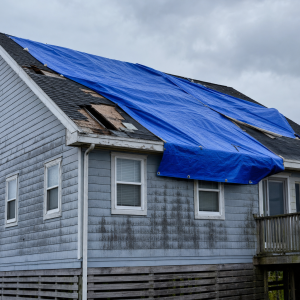
You can, for instance, move things that aren’t damaged yet to a higher, drier spot. If the flood was part of a bigger storm that punched a hole in your roof, you should absolutely cover it with a tarp to keep more rain out.
Crucial Tip: Do not throw anything away until the adjuster has seen it with their own eyes. I’ve seen claims get slashed because homeowners threw out ruined carpets and furniture before they were documented. If you need to move things, pile them in a corner of the yard, but don’t haul them to the curb.
Make sure you document everything you do to mitigate the damage. Take pictures of the tarps you put up. Keep receipts for every single thing you buy—mops, fans, cleaning supplies—because those costs are often reimbursable. This documentation proves you did your part, which is a huge piece of keeping the process smooth with your insurer.
Creating Undeniable Proof of Your Losses
Here’s the hard truth: the strength of your entire insurance claim for flood damage hangs on one thing—proof. The insurance company wasn’t there when the water came rushing in. Their adjuster only sees the aftermath. It’s your job to build a detailed, irrefutable record of what you lost, leaving zero room for them to doubt your claim or lowball the settlement.
This is about much more than just snapping a few photos on your phone. You need to construct a comprehensive case file that tells a clear story of your insurance claim for flood damage: what your home looked like before the flood, the room-by-room destruction, and the true financial cost to make you whole again. A well-documented claim isn’t just paperwork; it’s your most powerful negotiating tool.
Start With a Video Walkthrough
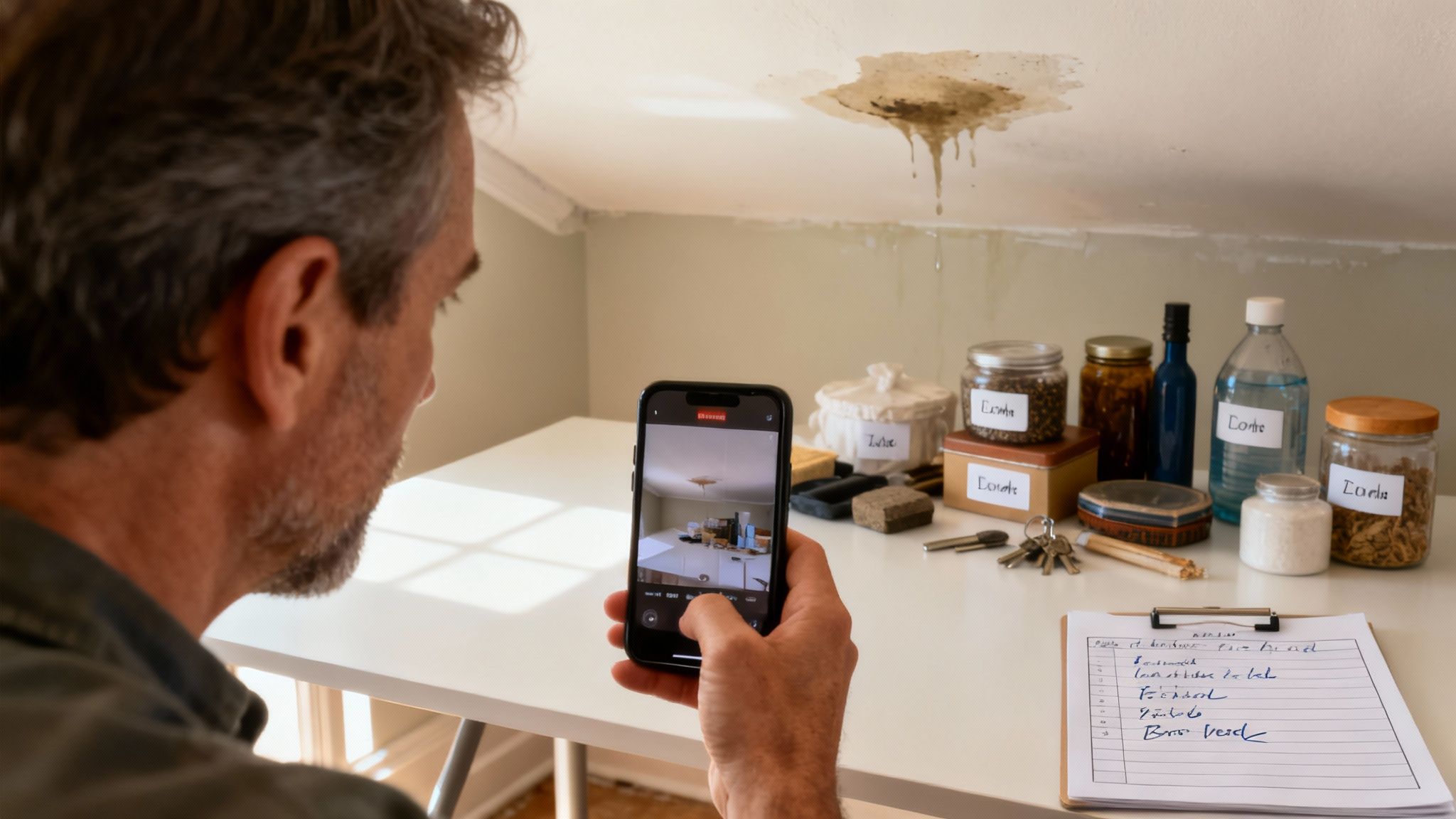
Before you move a single piece of furniture, grab your smartphone. Your very first move should be to record a video walkthrough. Hit record before you even step back inside and narrate everything you see as you experience it for the first time. MOVE SLOWLY!! Blurry videos will not help your insurance claim for flood damage.
This creates a powerful, in-the-moment narrative that photos alone can’t capture. State the date, time, and your address out loud. As you walk through each room, describe the scene. “Okay, it’s Tuesday morning. We’re entering the living room. The water line is at least three feet high on the drywall. The new sofa is completely ruined, and the hardwood floors are already starting to warp and pull up.”
This initial video captures the raw, immediate scope of the damage. It provides crucial context, showing how different damaged areas relate to one another and preserving the initial shock of the scene in a way static images can’t.
Photograph Everything. Then Photograph It Again.
Once your video tour is done for your insurance claim for flood damage, it’s time to switch to photos. Lots of them. Think like a forensic expert. For every single damaged area, you need a wide shot of the room, a medium shot of the item, and then multiple close-ups detailing the damage.
Don’t just take one picture of a waterlogged entertainment center. Get a shot of the entire living room to establish its location, then a photo of the unit itself, and finally, close-ups of the swollen particle board, the ruined electronics inside, and the model and serial number on the back.
This level of detail is non-negotiable. It stops the insurer from questioning the quality or value of what you lost. Keep yourself organized by creating folders on your computer for each room (“Kitchen,” “Basement,” “Master Bedroom”) to store the photos. It makes building your insurance claim for flood damage easier.
Capture the Subtle Structural Clues
Some of the most expensive damage isn’t the most obvious. An overworked adjuster can easily miss the subtle signs of deeper structural problems. Your camera is your tool to make sure they see everything.
Get in close and document these critical details:
- Water Lines: Get crystal-clear photos of the high-water marks on both interior and exterior walls. Hold a tape measure up to the line in the photo to show the exact height from the floor.
- Hidden Mold: Don’t be afraid to pull back a corner of peeling wallpaper or a loose baseboard. Photograph any mold you see already starting to grow.
- Foundation Cracks: Walk the perimeter of your foundation, inside and out. Look for any new cracks or shifts caused by the immense hydrostatic pressure of the floodwaters.
- Buckling Floors: Get down low. Take photos from a low angle that clearly shows how hardwood or laminate flooring has warped, lifted, and separated.
These photos prove the damage goes far beyond soaked carpets and furniture. They build the case for more extensive—and more expensive insurance claim for flood damage—repairs.
You are not just documenting what needs to be replaced; you are building a visual argument for the full scope of restoration required. Every photo adds another piece of irrefutable evidence to your claim, making it harder for an insurer to underpay.
Essential Documentation Checklist for Your Flood Claim
Your photos and videos are the heart of your claim, but they need to be organized into a clear, written record to be effective. This table breaks down exactly what you need to gather.
| Document Type | What to Capture | Why It’s Critical |
|---|---|---|
| Photos & Videos | Wide shots of each room, close-ups of specific items, serial/model numbers, structural damage (water lines, cracks), and pre-flood photos. | Provides undeniable visual proof of the loss, preventing disputes over the condition or existence of an item. |
| Home Inventory List | A detailed spreadsheet with item, description, brand, model, age, original cost, and link to a current replacement. | Translates visual evidence into a financial number, forming the basis of your settlement demand. |
| Receipts & Proof of Value | Original purchase receipts (digital or physical), credit card statements, appraisals for high-value items like art or jewelry. | Substantiates the original cost and quality of your belongings, crucial for replacement cost value (RCV) policies. |
| Repair Estimates | Written quotes from at least two or three licensed and vetted contractors for all structural repairs. | Establishes a third-party, market-rate cost for repairs, countering a low estimate from the insurer’s adjuster. |
| Additional Living Expenses | Receipts for hotel stays, meals, laundry, and any other costs incurred because you can’t live in your home. | Ensures you are reimbursed for out-of-pocket costs covered under the “Loss of Use” portion of your policy. |
A meticulously organized file like this demonstrates that you are serious, prepared, and not willing to accept an unfair offer.
Build Your Master Inventory List For Insurance Claim for Flood Damage
Now it’s time to translate all that visual evidence into a powerful written document. The best tool for the job is a simple spreadsheet. Go room by room and create a detailed inventory of every single thing that was damaged or destroyed.
Your spreadsheet should have columns for:
- Item: (e.g., “Samsung 55-inch 4K Smart TV”)
- Description: (Include model number, serial number, and any other identifiers)
- Age of Item: (An honest estimate is fine if you don’t know the exact date)
- Original Cost: (Check old emails or credit card statements if you don’t have the receipt)
- Estimated Replacement Cost: (This is key. Find a comparable new item online and paste the link directly into the spreadsheet.)
That last step is a game-changer. When you hand an adjuster a list with direct links to replacement items on a major retailer’s website, it makes it incredibly difficult for them to justify a lower value. You’re replacing their estimate with real-world, current market data.
This process takes time, but it’s your single best defense against a low settlement. Considering that direct flood damage in the U.S. cost nearly $144 billion between 2010 and 2023, insurers are watching their bottom line. Your job is to make sure your specific losses are so well-documented they can’t be ignored. You can read the full report on natural catastrophe impacts to get a sense of the massive scale of these events.
Working with Your Insurance Adjuster
After you’ve done the hard work of documenting everything, it’s time to meet the insurance adjuster. This person is the insurance company’s representative, and their job is to inspect the damage and put a number on your loss. How you handle this meeting can make or break your insurance claim for flood damage.
It helps to think of the adjuster as an investigator. They aren’t there to be your friend, but they aren’t your enemy either. Their goal is to gather facts, compare them to your policy, and write a report. Your job is to hand them a case so clear, professional, and undeniable that their report can’t help but reflect the true extent of your damages.
This is your chance to control the narrative. Be prepared, be cooperative, and build a professional dynamic that keeps your claim moving forward.
Preparing for the Adjuster’s Inspection
The adjuster’s visit is where all your detailed documentation really shines. Before they show up, get your evidence organized. Have your photo folders, video walkthrough, and detailed inventory list cued up on a tablet or laptop.
Don’t just turn them loose in your home. You or someone you trust needs to be there for the entire inspection, walking with them from room to room and pointing out the specific damages you’ve documented.
Use your inventory list as a script. For instance, when you walk into the living room, you can say, “As you can see here, the water line hit 36 inches, which we have photos of with a tape measure for scale. It completely ruined the custom entertainment center, which is on line 12 of our inventory spreadsheet. I’ve included a link to a comparable replacement.”
This approach does a few critical things:
- It forces the adjuster to see subtle but expensive damage they might otherwise miss, like warped baseboards or swollen door frames.
- It shows you’re thorough and serious, which sets a respectful tone for the entire process.
- It immediately ties the physical damage you’re showing them to the financial loss you’ve calculated.
Remember, after a major flood, that adjuster is likely juggling dozens of claims. If you make their job easier by giving them organized, clear information, you help them write an accurate report faster.
Understanding the Proof of Loss Form
One of the most important documents you’ll handle, especially if you have a policy with the National Flood Insurance Program (NFIP), is the Proof of Loss form. This isn’t just an estimate—it’s your formal, sworn statement detailing the exact amount of money you are claiming. It’s a legal document.
And the deadline is not a suggestion. For NFIP policies, you generally have just 60 days from the date of the flood to get it filed. Miss that deadline, and your claim can be flat-out denied.
The Proof of Loss form is where you officially declare the total value of your claim, backed by your documentation and repair estimates. It must be signed, notarized, and submitted with all your supporting evidence. There’s no room for error here.
If you’re still waiting on repair bids or finalizing your list of damaged personal items, you might have to file the form with the best numbers you have and amend it later. Still, it’s always better to be as complete as possible from the start. The company adjuster can give you the form, but getting it filled out accurately and submitted on time is 100% your responsibility.
The Role of a Public Adjuster
Sometimes the damage is so extensive or the policy language is so dense that you feel like you’re in over your head. The insurance company has its adjuster, but you have the right to hire your own expert, too: a public insurance adjuster. Unlike the company adjuster, who works for the insurer, a public adjuster works directly for you.
A public adjuster can take the reins on the entire claims process. They handle everything from documenting losses and filing paperwork to negotiating a final settlement with the insurance company on your behalf. They’re licensed pros who live and breathe policy language and negotiation tactics. You can learn more about the benefits of hiring a public adjuster to figure out if it’s the right move for your situation. It’s often a game-changer for large or complex claims.
With the rising frequency of natural disasters, the insurance system is under more strain than ever. In the first half of 2025 alone, global insured losses from events like floods reached about $100 billion, and the U.S. accounted for over 90% of that. These massive numbers show just how high the financial stakes are for every single claim. Having an expert on your side of the table simply levels the playing field.
Negotiating a Fair Settlement

When the insurance company’s settlement offer for your insurance claim for flood damage finally lands, it’s easy to feel a wave of relief. But hold on. It’s absolutely critical to understand that this first offer is rarely their best and final one.
Think of it as the opening bid in a negotiation, not a final verdict.
A lot of homeowners, totally worn out by the whole ordeal and desperate to rebuild, just take that first check. This can be a massive financial mistake. Insurers are businesses, after all, and their initial number is based on their adjuster’s perspective—which can easily miss key details or seriously undervalue what it actually costs to make you whole again.
Your job now is to fight for the full amount your policy owes you.
Analyze the Adjuster’s Report Line by Line
Before you even consider accepting or rejecting anything, you need to get your hands on the adjuster’s detailed report. This is often called the “scope of loss,” and it’s the document that breaks down precisely how they came up with their number. It lists every repair, every material, and every labor hour they’ve approved.
Now, grab your own inventory list and the estimates you’ve collected from contractors. It’s time for a meticulous, line-by-line comparison.
You’re looking for common gaps and lowball estimates:
- Material Quality: Did they price out cheap, builder-grade carpet when you had premium, high-end flooring? Did they budget for laminate when you had granite countertops?
- Labor Rates: Are the labor costs they’ve penciled in realistic for your area? Do they match what reputable local pros actually charge?
- Missed Items: Did they conveniently forget to include the cost of debris haul-away, replacing soaked insulation, or professional mold remediation?
- Code Upgrades: Does their estimate account for bringing your home up to current building codes? This often requires more expensive materials or construction methods than what you had before the flood.
These little discrepancies seem small on their own, but they add up fast. Finding them and documenting them is how you build a rock-solid counter-offer.
The insurer’s first settlement offer is just their opening position, based on their data. It’s not the absolute truth. Your own documentation and independent estimates are the reality check that gives you leverage.
Arm Yourself with Independent Estimates
This is probably the single most powerful tool you have for negotiation: independent repair estimates. Never, ever rely solely on the insurance adjuster’s figures. You need to call at least two—three is even better—licensed and respected local contractors to give you their own detailed bids for the restoration.
Make sure these contractors are bidding on the exact same scope of work: restoring your home to its pre-flood condition. Give them the adjuster’s report and point out where you think the insurer came up short. A sharp contractor can spot undervalued items or missing steps in a heartbeat.
Once you have these competing bids, you’re no longer just arguing your opinion. You’re presenting hard, factual data from professionals in the market. This shifts the entire conversation from a subjective disagreement to an objective discussion based on real-world costs.
Crafting and Presenting Your Counter-Offer
With all your evidence in hand, it’s time to build your case. This isn’t the time for an angry phone call. You need to draft a professional, clear-headed letter or email that lays out your position.
Start by acknowledging their offer, but state firmly that it’s not enough to cover the full extent of the damages. Then, walk them through your evidence methodically. For example: “Regarding the flooring in the living room, your report allocated $4.50 per square foot. As you can see from the attached estimates from ABC Flooring and XYZ Restorations, the local market rate for a comparable replacement is $6.75 per square foot.”
Attach everything that backs up your claim: your detailed inventory, your contractor bids, and any photos that prove your point. Keep the tone firm but professional. Your goal is to present a case so well-documented that it’s impossible to deny. For a deeper dive, our guide on how to negotiate with an insurance adjuster has practical tips and even scripts you can use.
Staying Persistent and Knowing When to Escalate
Negotiation is a dance. The insurer likely won’t agree to your full counter-offer on the first try. They may come back with a slightly better number, and you might go back and forth a few times. The key is to stay organized, keep every piece of communication in writing, and stand your ground when your evidence is solid.
If you hit a wall and the insurance company simply won’t budge, you still have options. You can ask to speak with a supervisor, enter into the formal appraisal process outlined in your policy, or file a complaint with your state’s Department of Insurance. For bigger, more complex claims, this is often the moment when hiring a public adjuster becomes your best move. They can take over the fight with professional expertise.
Common Pitfalls in a Flood Claim and How to Avoid Them
Trying to handle an insurance claim for flood damage on your own is like walking through a minefield. It’s shockingly easy to make a simple mistake that costs you thousands of dollars, and most homeowners don’t even see it coming.
When you’re overwhelmed and just trying to get your life back in order, you can unknowingly sabotage your own claim. These aren’t just what-if scenarios; they’re the real-world blunders we see every day. Knowing what they are ahead of time is your best defense.
Tossing Damaged Items Too Soon
This is one of the biggest and most costly mistakes people make. After a flood, your gut instinct is to get all the ruined, smelly stuff out of your house. That waterlogged sofa, the warped flooring, the musty drywall—you just want it gone.
You have to fight that urge. Your insurance policy is a contract, and that contract requires you to show the adjuster the damaged property you’re claiming.
If you haul everything to the curb before it’s been properly documented and inspected, you’re literally throwing away the evidence. The insurance company can—and often will—argue that the items weren’t as damaged as you claim, or they might just deny that part of your claim altogether.
- Here’s what you do instead: If you absolutely have to move things to start the clean-up, pile them up in the garage, the backyard, or on a tarp. Don’t let the trash truck take them.
- Pro tip: Before you move a single thing, take pictures. Photograph every damaged item from multiple angles, in the spot where it was damaged. Then, take photos of the pile you created. This gives you a clear and undeniable record.
Giving a Recorded Statement Cold
Sooner or later, the insurance company is going to ask for a recorded statement. It sounds innocent enough, like a simple formality. It’s not. This is a formal part of their investigation, and every word you say can be used to limit your payout.
When you’re stressed and answering questions off the cuff, it’s easy to misspeak or guess.
Let’s say the adjuster asks, “So, the water was about three feet high?” and you, trying to be helpful, say, “Yeah, something like that.” But later, you realize the water line on the wall is closer to four feet. That one-foot difference is huge—it can be the difference between replacing a little bit of drywall and a full-blown mold remediation and electrical rewiring job. That small inconsistency you gave in the recorded statement will be used against you.
A recorded statement is not a casual chat. It’s evidence. Before you agree to one, take your time. Review your photos, notes, and inventory list. Never, ever guess. It is perfectly fine to say, “I’m not sure about that, I’ll have to check my records and get back to you.”
Cashing the First Check They Send
At some point, a check from the insurance company will probably show up in your mailbox. Before you even think about depositing it, read every single word on that check and the letter that comes with it.
If you see language like “full and final payment” or “final settlement,” stop. Cashing that check can be legally interpreted as you accepting that amount as the total and complete settlement for your entire claim.
This is a classic trap. You might find extensive mold behind a wall or a cracked foundation weeks or even months down the road. But if you’ve already accepted a “final” payment, you’ve likely signed away your right to claim any of that newly discovered damage.
This is a massive issue, especially when you look at the big picture. In 2024 alone, floods were a major driver of the $368 billion in global economic losses from natural disasters, a peril that remains incredibly underinsured. To get a better handle on these growing risks, you can discover more insights from Aon’s catastrophe report.
Common Questions About Flood Claims
After a flood, you’re not just trying to put your home back together; you’re also trying to make sense of insurance policies, tight deadlines, and confusing terms. It’s completely normal to have questions. Getting straightforward answers is the first step to taking back control.
We’ve pulled together the most common questions we hear from homeowners to give you direct answers you can use right now.
What’s the Difference Between Flood and Homeowners Insurance?
This is probably the most important thing you need to know. Your standard homeowners insurance policy does not cover damage from a flood. It’s a harsh reality that catches too many people by surprise.
In the world of insurance, “flooding” specifically means damage from rising surface water that comes into your home from the outside. To get coverage for that, you need a separate flood insurance policy. Most of these are part of the National Flood Insurance Program (NFIP), but some private companies offer them too.
So, if wind shatters a window and rain gets in, your homeowners policy might cover it. But if the creek behind your house overflows and water seeps in under the door, that’s a flood, and you’ll need that dedicated flood policy.
How Long Do I Have to File a Flood Damage Claim?
You have to move fast. After a flood, the clock starts ticking immediately, and the deadlines are no joke.
If your policy is through the NFIP, you have a strict window to file your formal Proof of Loss. This signed and notarized document has to be in the insurer’s hands within 60 days of the flood.
This isn’t a friendly suggestion—it’s a hard stop. Miss it, and your claim can be flat-out denied. That’s why, after you know your family is safe, your very next call should be to your insurance agent to report the loss. Get the paperwork started.
Key Takeaway: That 60-day deadline for your Proof of Loss is one of the most ruthless in the entire insurance game. Don’t sit around waiting for an adjuster to tell you what they think you’re owed. Start your documentation on day one.
What if My Insurance Settlement Offer Is Too Low?
It’s incredibly common to get a first offer that feels like a slap in the face. Here’s what you need to remember: you do not have to accept it. An insurer’s first offer is just that—a first offer. It’s where the negotiation begins, not where it ends.
If the settlement number doesn’t add up, it’s time to build your case.
- Get the Adjuster’s Report: First, ask for a copy of the detailed report—sometimes called the “scope of loss”—that explains exactly how they arrived at their number.
- Go Through It Line by Line: Put their report next to your own inventory, photos, and estimates from your own contractors. Look for what they missed. Did they use cheap materials in their pricing? Underestimate labor costs? Leave out damaged items entirely?
- Fire Back with a Counter-Offer: Write a clear, professional email or letter explaining why their offer is unacceptable. This is where you attach your evidence—your contractor’s bid, your detailed inventory list, and anything else that proves you’re owed more.
If you hit a wall and they won’t budge, you still have options. You can ask to talk to a manager, start a formal appraisal process, or file a complaint with your state’s Department of Insurance. Honestly, this is the point where having a professional on your side can change the entire outcome.
Trying to navigate a flood claim on your own is an uphill battle. You’re at risk of accepting a lowball offer or missing a critical deadline that could cost you everything.
The team at For The Public Adjusters, Inc. only works for policyholders—never for the insurance companies. We use our expertise to document, negotiate, and settle your claim for the absolute maximum you deserve. Don’t gamble with your financial recovery. Get a no-cost claim review with us today at https://forthepublicadjusters.com.