When you’re facing a property damage claim dispute, your success hinges on three things: documenting everything, mitigating further damage to stay compliant with your policy, and keeping a meticulous record of every single action and dollar you spend.
This isn’t just about paperwork. It’s about building an ironclad foundation of evidence to fight the lowball offers and delay tactics that are standard operating procedure for major carriers like State Farm and Allstate. Consider this a go to guide on how to file property damage claim.
Your First Moves When the Insurance Company Fights Back
After your home or business is damaged, the first instinct for most people is to pick up the phone and call their insurance company.
Don’t.
That first call kicks off their process, one that’s been carefully designed to control the narrative and minimize their payout from the get-go. The first 48 hours are the most critical, and the moves you make here will dictate the course of the entire dispute. This isn’t just about how to file property damage claim; it’s about preparing your defense against the strategies companies like State Farm or Allstate use every day to protect their bottom line, often at the expense of their loyal policyholders.
Your strongest weapon in this fight is evidence they can’t argue with. Before a single thing is moved, cleaned up, or repaired, you need to create a complete visual record of the disaster. If you are unsure how to do this properly, consider speaking with a local public adjuster.
Document Everything Immediately
Grab your smartphone and start taking hundreds—if not thousands—of photos and videos. I’m not exaggerating. You need to capture every single angle of the damage, from wide shots showing the scope of the problem to extreme close-ups.
Get detailed shots of the warped floorboards, the soot staining your personal belongings, and the high-water marks on the drywall. Make sure you get into the hidden spots, too. Open up cabinets, look under sinks, and crawl into tight spaces to find any moisture or smoke damage that a company adjuster might just “happen” to miss during their quick inspection.
Your goal is to build a visual timeline that proves the full extent of the loss before the insurer can downplay it. This documentation becomes your most powerful tool when you need to prove your case and fight back against their initial lowball offer.
Mitigate and Record
Your policy has a clause that requires you to prevent further damage—and insurers absolutely love to use this against policyholders who don’t act. If a tree punched a hole in your roof, you have to get it covered with a tarp. If a pipe burst, you have to shut off the main water line.
The key here is to only perform temporary, emergency mitigations. Do not, under any circumstances, start permanent repairs.
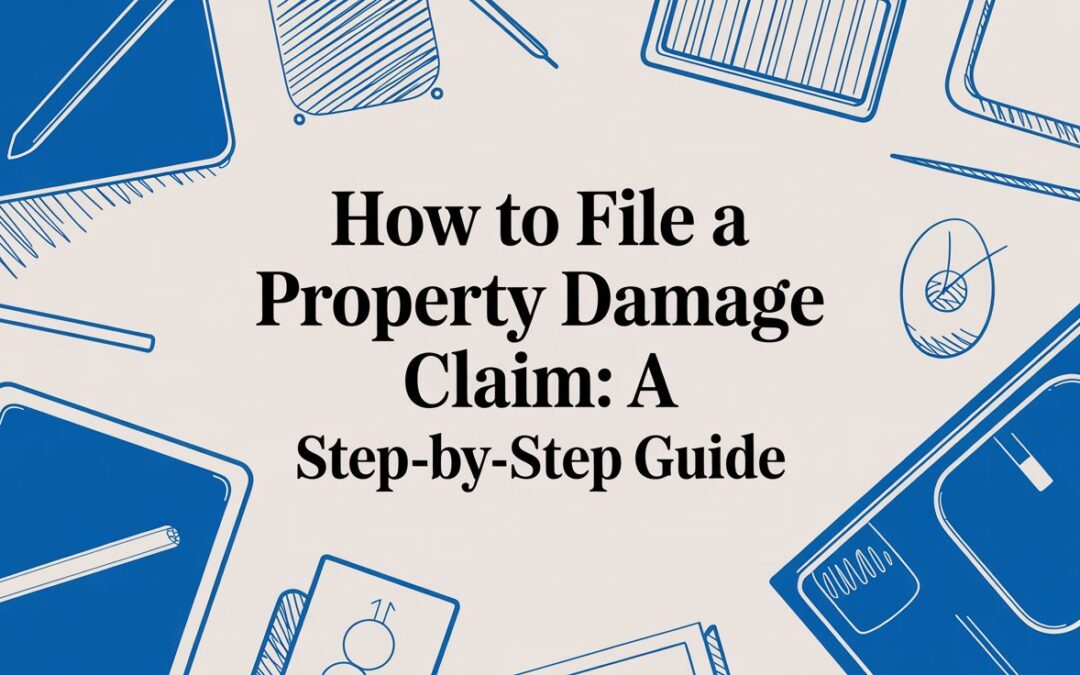
This infographic lays out the essential first moves you need to make to protect your claim.
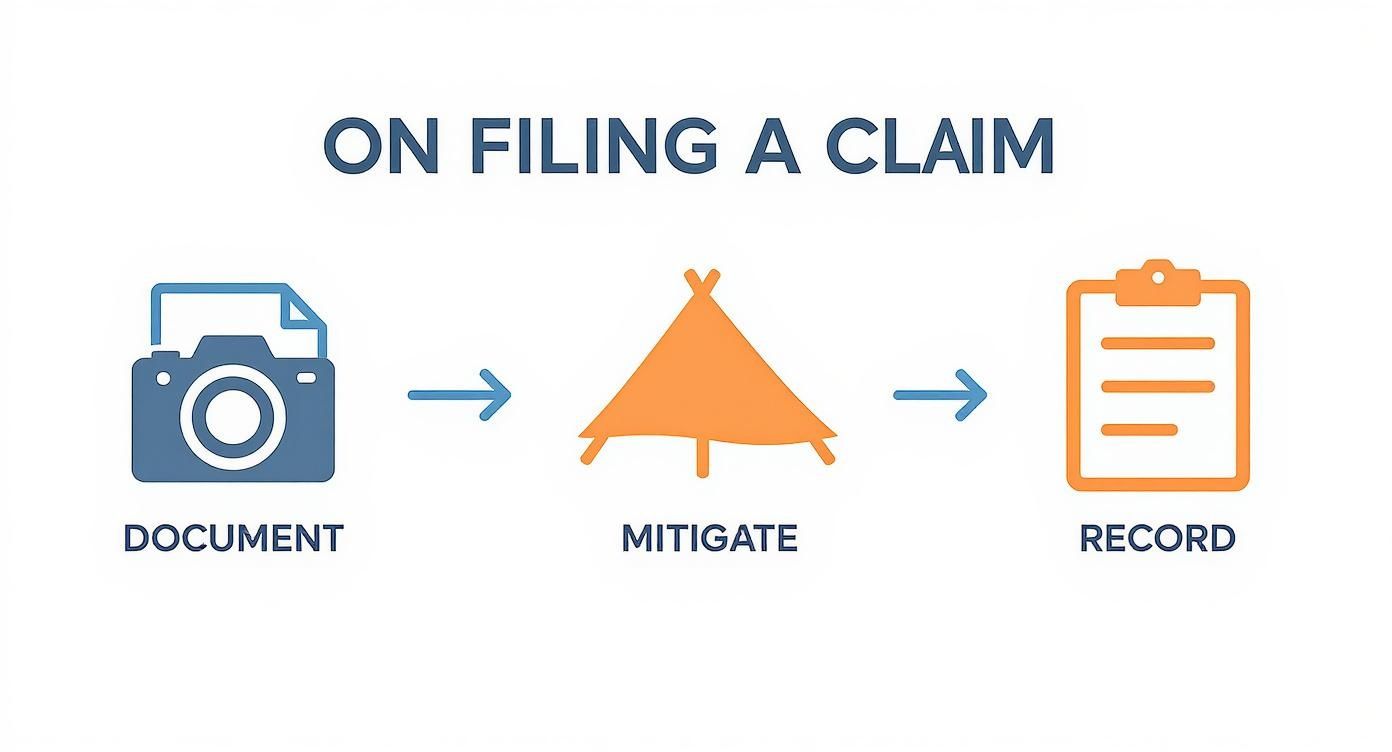
As the flow shows, documenting, mitigating, and recording are the foundational actions that have to happen in sequence to build a powerful case against the insurance company.
Keep every single receipt for those tarps, plywood, or the emergency plumber you called. On top of that, create a detailed log of every action you take, noting the date, time, and associated costs. This kind of meticulous record-keeping makes it infinitely harder for your insurer to deny reimbursement for these critical expenses.
With the increasing severity of storms, insurers are drowning in claims. Global insured losses from natural catastrophes now average $152 billion a year, which puts immense pressure on carriers to find new ways to limit what they pay out. You can learn more about the rising costs of property damage from natural catastrophes and see for yourself how it’s impacting your claim.
To help you get started, here’s a quick checklist of the immediate steps you should take. Think of this as your shield against the common tactics insurers use to reduce your settlement from day one.
Post-Damage Actions to Protect Your Claim
| Action Item | Why It’s Critical for Your Fight | Common Insurer Pushback to Expect |
|---|---|---|
| Exhaustive Photo/Video Documentation | Creates an undeniable “before” and “after” record of the damage. This is your primary evidence. | “The damage isn’t as bad as you claim.” or “Some of this damage was pre-existing.” |
| Perform Emergency Mitigations Only | Fulfills your policy duty to prevent more damage without destroying evidence of the original loss. | “You didn’t act fast enough, so the subsequent mold/water damage isn’t covered.” |
| Save All Mitigation Receipts | Provides proof of your out-of-pocket costs for necessary emergency repairs like tarps or board-ups. | “These costs are unreasonable.” or “We won’t reimburse for these specific items.” |
| Start a Detailed Action Log | Tracks every conversation, cost, and action, creating a timeline that prevents them from twisting the facts. | “We have no record of that conversation.” or “You never sent us that information.” |
| Notify Your Insurer in Writing | Creates a formal, time-stamped record of when you reported the claim, preventing “late notice” denials. | “You waited too long to report the claim, so we are denying coverage.” |
| Don’t Sign Any Early Releases/Checks | Prevents you from accidentally signing away your rights to a full and fair settlement for a quick, low payment. | “This is our final offer, take it or leave it.” (Often paired with a check that says “full and final payment.”) |
Following these steps methodically from the very beginning puts you in control. Instead of reacting to the insurance company’s process, you’re forcing them to react to your well-documented, evidence-based claim.
Building an Ironclad Inventory of Your Losses
When you file a claim, the insurance company will send out their own adjuster to look at the damage. Let’s be perfectly clear about one thing: this person works for the insurance company, not you. Their job is to protect their employer’s bottom line, which often means creating a damage assessment designed to undervalue your loss.
It’s almost a guarantee their first report will be a lowball offer. That’s just part of their game to see how little they can get away with paying.
To fight back, you need your own airtight evidence. Building a comprehensive, hyper-detailed inventory of every single damaged item is how you dismantle their weak assessment and prove the real value of your claim. Think of this list as your most powerful weapon in the fight for a fair settlement.

This process has to be painstakingly thorough. Your inventory isn’t just a quick list of broken furniture; it’s a detailed catalog covering everything from the big structural components right down to the smallest personal belongings.
Cataloging Your Damaged Property
The best approach is to go room by room, documenting every single item the damage touched. I recommend setting up a simple spreadsheet with columns for the following details:
- Item Description: Be specific. “Lamp” isn’t good enough. Instead, write “Brass floor lamp with linen shade from Crate & Barrel.”
- Manufacturer/Brand: List the brand name if you know it (e.g., Samsung, Kohler, KitchenAid).
- Model/Serial Number: This is gold. If you can safely access it, record this info. It’s crucial for getting an accurate replacement price.
- Age of Item: Give your best estimate of how old the item was when the loss happened.
- Original Cost: Dig up receipts, credit card statements, or online order confirmations to prove what you paid.
- Current Replacement Cost: This is the big one. Research what it would cost to buy a new, comparable item today. This is the number that matters most.
This level of detail is non-negotiable. An adjuster from a company like Allstate can easily wave away a vague list, but they have a much harder time arguing with a spreadsheet backed by model numbers and receipts. You can get a better handle on the different types of protection your policy offers by understanding homeowners insurance coverage in our detailed guide.
Documenting Hidden and Subtle Damages
Company adjusters are notorious for “missing” damages that aren’t immediately obvious. They tend to glide right past subtle issues that can blossom into major problems down the road. It’s on you to find and document these hidden losses.
Look for things like:
- Slight warping or buckling in hardwood floors.
- The lingering smell of smoke inside closets or cabinets.
- Moisture readings under flooring or behind baseboards (a moisture meter is a great investment).
- Soot or ash that has settled inside electronics, appliances, and HVAC systems.
An adjuster’s estimate might cover the cost of cleaning a carpet, but your detailed inventory will prove that the smoke-damaged padding and subfloor underneath need to be completely replaced. This is the difference between a superficial fix and a true recovery.
The claims environment right now is tougher than ever. In the first half of 2025 alone, global insured losses from natural catastrophes smashed $80 billion. A single event, the Los Angeles County wildfires, was responsible for $40 billion of that total, which shows you the massive scale of losses insurers are dealing with.
This immense financial pressure gives them every reason to scrutinize, delay, and minimize each and every claim. Your detailed, evidence-backed inventory is your best defense against that pressure.
Navigating the Insurance Adjuster’s Tactics
Let’s get one thing straight from the start. The moment your insurance company assigns their adjuster to your case, you’re not dealing with a neutral party. Far from it.
That friendly adjuster sent by a major carrier like State Farm or Allstate has one primary job: to protect their employer’s bottom line. These are highly trained professionals, and they come equipped with a well-established playbook of tactics designed to minimize what they pay you.
Their mission is to close your file as quickly and cheaply as possible. Knowing their game plan is the only way you can start to neutralize it and fight for the settlement you’re actually owed.
Responding to Their Initial Requests
One of the very first things the adjuster will ask for is a recorded statement. They’ll pitch it as a routine step, just a way to “get your side of the story.” Don’t fall for it.
In reality, they are fishing. They are listening for you to say anything—even something that seems completely innocent—that they can twist later to poke holes in your claim. You are not obligated to give a recorded statement, and it’s almost always in your best interest to politely decline until you’ve had time to think and get organized.
You’ll also likely feel pressure to sign release forms or other documents right out of the gate. Never sign anything you don’t fully understand. This is especially true if you see language about a “full and final settlement.” It’s a classic trap designed to get you to accept a lowball offer before anyone even knows the true scope of the damage.
A quick check from the insurance company might feel like a huge relief at first. But be careful—cashing it could legally signal your acceptance of their offer. That can shut the door on seeking more funds later when hidden damage inevitably shows up.
Spotting Common Lowball Tactics
An adjuster’s most powerful weapons are often buried deep inside their damage estimate. They are banking on the fact that most homeowners and business owners simply don’t know what they’re looking for.
To get ahead of this, our team put together an in-depth guide on how to negotiate with an insurance adjuster, which dives into more advanced strategies for handling these disputes.
For now, let’s expose some of the most common moves they make.
Common Adjuster Tactics vs Your Counter-Moves
Insurance adjusters have a standard set of plays they run to keep settlement amounts down. But for every tactic, there’s a proactive response you can use to protect your claim’s value. Think of it as a chess match where you need to anticipate their move.
| Adjuster Tactic | What It Looks Like in Practice | Your Proactive Response |
|---|---|---|
| Outdated Pricing | The estimate uses software like Xactimate but with old price lists that don’t reflect today’s cost for lumber or local labor rates. | Demand they use current, local pricing. Get independent quotes from at least three reputable contractors to prove the real-world cost. |
| Policy Misinterpretation | They point to a vague exclusion clause to deny coverage for something, claiming “your policy doesn’t cover that.” | Ask them to show you the exact language in the policy that supports their denial—in writing. Don’t take their word for it. |
| Scope Minimization | The adjuster approves a cheap “patch” for a hole in the roof when a full replacement is needed to prevent future leaks. | Document why the smaller repair is insufficient. Use your contractor’s report to explain that a patch won’t solve the underlying problem. |
| Delay and Stall | Weeks go by without a response. They “lose” your documents or claim they’re waiting on a supervisor’s approval. | Document every single interaction. Send follow-up emails summarizing your phone calls and set firm deadlines for their response. |
Recognizing these moves is half the battle. When you see them happening, you can shift from being a passive victim to an active defender of what you’re rightfully owed.
Question every single line item on their estimate. Demand they justify their pricing and their scope of work. And whatever you do, never, ever take their first offer as the final word.
How to Dispute a Lowball Settlement Offer
That gut-punch feeling when you open the adjuster’s estimate and see their offer is something we see all the time. It’s often so low it feels like an insult. But here’s the thing you have to understand: that number is rarely a mistake. It’s a calculated move—a test to see if you’ll just take the quick, easy money and disappear.
Receiving a lowball offer is where the real fight for your claim begins. This isn’t just about paperwork anymore; it’s about systematically dismantling their weak valuation and building an undeniable case for what you are truly owed.

Crafting a Powerful Dispute Letter
Your first move is to formally reject their offer, and it has to be in writing. A phone call is invisible; it leaves no paper trail. You need to craft a professional, evidence-based dispute letter that lays the groundwork for your counter-negotiation.
The letter should be direct, stating that you’re rejecting their offer because it fails to cover the full scope and cost of the damages. But you can’t just say you disagree—you have to prove it. This is where the detailed inventory and independent estimates you gathered become your most powerful weapons. Attach your evidence and methodically walk them through every discrepancy.
Your letter needs to include a few key things:
- Reference their estimate: Directly cite their report, including the claim number and the date it was issued.
- Present your counter-evidence: Attach your room-by-room inventory and the detailed estimates you got from your own trusted contractors.
- Build a line-by-line rebuttal: Go through their estimate, item by item, and point out every single error, omission, or lowballed figure.
Challenging Their Numbers Line by Line
The heart of your dispute is this direct, itemized challenge to their assessment. You can’t let them get away with vague generalizations. You have to get granular and pinpoint exactly where their numbers don’t add up.
For instance, did their estimate list “paint one wall,” when your contractor’s quote confirms the entire room needs repainting to match? Call it out. Did they price out a basic, low-grade carpet replacement when you actually had premium, high-traffic carpet before the damage? Highlight that difference in both quality and cost. This is one of their most common corner-cutting tactics.
They are banking on you not knowing the difference between cheap, builder-grade materials and the custom finishes you actually lost. Your detailed rebuttal, backed by your contractor’s professional expertise, exposes this strategy and forces them to justify their lowball figures.
When to Invoke the Appraisal Clause
So what happens if you hit a brick wall? If direct negotiation stalls and the insurance company absolutely refuses to budge on their valuation, your policy likely contains a powerful tool called the appraisal clause.
Invoking this clause allows both you and the insurer to hire independent appraisers. These two appraisers then review all the evidence and try to agree on the value of the loss. If they can’t reach an agreement, they select a neutral, third-party “umpire” who makes a final, binding decision. This move takes the decision completely out of the staff adjuster’s hands and is an incredibly effective way to break a stalemate.
And if the insurer continues to act in bad faith by delaying the process or refusing to engage in appraisal? Your final recourse is to file a formal complaint with your state’s Department of Insurance. This action puts official, regulatory pressure on them to respond and justify their actions.
When and Why to Hire a Public Adjuster
Let’s be honest. Trying to fight a massive insurance corporation like Allstate or State Farm on your own feels like an unfair fight from the very beginning—because it is.
They have entire teams of adjusters, lawyers, and experts whose entire job is to find ways to pay you as little as legally possible. This is exactly where a public adjuster comes in. They are licensed insurance professionals who work exclusively for you, the policyholder, not the insurance company.
A public adjuster’s sole purpose is to level a playing field that is intentionally tilted in the insurer’s favor. They become your advocate, using their deep knowledge of confusing policy language and claims negotiation to shut down the company adjuster’s lowball tactics and bad faith delays.
Knowing When to Call for Backup
Look, not every small claim needs a public adjuster. But there are definitely moments where bringing in a professional isn’t just a good idea—it’s absolutely essential for your financial recovery.
You should seriously consider hiring one if you’re facing any of these situations:
- The claim is large or complex: We’re talking about major events like a house fire, hurricane damage, or a widespread commercial loss. The sheer number of variables in these cases can be overwhelming for anyone.
- The insurer is showing signs of bad faith: Are you getting endless delays? Nonsensical denials? Does it feel like the company adjuster is twisting the words of your policy? You need an expert in your corner, fast.
- You just don’t have the time or expertise: Managing a difficult insurance claim is a full-time job. If you don’t have the energy or the specific knowledge to fight back effectively, a public adjuster can step in and take over the entire process.
A public adjuster takes the emotional weight off your shoulders. They manage every single part of the claim, from documenting the damage to negotiating the final check, so you can actually focus on getting your life back together. They speak the same language as the insurance company and know exactly how to dismantle a weak settlement offer.
Their pay structure is designed to align with your goals. Public adjusters typically work on a contingency basis, meaning they get paid a small, agreed-upon percentage of the final settlement. If you don’t get paid, they don’t get paid. Simple as that. It ensures they are 100% motivated to maximize your recovery.
For a deeper dive into their role, you can learn more about what a public adjuster does and how they can help your specific case.
Having this professional help is becoming more critical than ever. The global AI insurance claims market is on track to hit $2.7 billion by 2034, giving carriers even more data-driven ways to justify underpayments. On top of that, rising construction costs mean rebuilding a single-family home can easily cost $10,000 more just from material tariffs.
These are the kinds of complex factors insurers use to their advantage. You can discover more insights about these key trends shaping property claims and see for yourself why having an expert on your side is no longer a luxury—it’s a necessity.
Answering Your Toughest Claim Dispute Questions
When you’re in the middle of a heated dispute with your insurance company, it feels like you’re drowning in questions. The stress is overwhelming, and frankly, insurers often bank on your confusion to get you to accept a terrible deal.
Let’s cut through the noise. This section gives you direct, no-nonsense answers to the hardest questions homeowners and business owners face when a claim gets delayed, denied, or just plain lowballed.
What Is Considered Insurance Bad Faith?
“Bad faith” isn’t just a buzzword; it’s a legal term for when an insurer breaks the fundamental promises of your policy. We’re not just talking about a low settlement offer here. It’s a pattern of dishonest or unethical behavior designed to wear you down and save the company money.
What does it look like in the real world?
- Unreasonable Delays: Your adjuster goes silent for weeks at a time, ignoring calls and emails.
- Shoddy Investigations: They refuse to conduct a thorough investigation into the cause and extent of your damage.
- Willful Misrepresentation: They deliberately twist the language in your policy to deny a clearly covered loss.
If your adjuster is ghosting you or can’t give you a straight answer from your policy about why something isn’t covered, you might be dealing with bad faith. Start a detailed log of every single delay, every missed call, and every questionable statement. This is the evidence you’ll need to build your case.
Can I Start Repairs if the Claim Is Not Settled?
This is a huge one, and it’s a trap that many people fall into. The short answer is no, with one big exception. You should only make temporary, emergency repairs designed to prevent more damage from happening.
Think of it as your duty to mitigate the loss. This includes things like putting a tarp over a hole in your roof or boarding up a shattered window. That’s it.
Don’t even think about starting permanent reconstruction until you have a signed, written agreement with your insurer that spells out the exact scope and cost of the work. If you jump the gun, you hand them the perfect excuse to deny your claim. They’ll argue that they couldn’t inspect the original damage, and that can sink your entire claim.
Insurers love it when policyholders get impatient and start major repairs. It gives them a get-out-of-jail-free card. They can simply say, “We can’t pay for what we couldn’t see,” and wipe out a huge chunk of what you’re rightfully owed.
How Long Can My Insurer Legally Drag Out My Claim?
While the exact timelines can vary a bit from state to state, every insurance company has a legal duty to handle your claim with “reasonable promptness.” If your claim is dragging on for months with no clear explanation or forward movement, it’s almost certainly a deliberate stall tactic.
These delays aren’t accidental. It’s a strategy. They’re hoping you’ll get so frustrated and exhausted that you either give up entirely or just accept whatever crumbs they throw your way. This is a classic bad faith maneuver and a massive red flag that you need to bring in a professional to fight for you. Don’t let them wear you down.
When your insurance company is giving you the runaround, you don’t have to take them on alone. At For The Public Adjusters, Inc., we step in to take over the fight, manage the entire claims process, and secure the full and fair settlement you are entitled to. If you’re facing a dispute, get a no-cost review of your claim today by visiting us at https://forthepublicadjusters.com. Or Call (919) 400-6440.