
You bought a homeowners policy with replacement cost coverage because you thought it meant one thing. If your house was damaged, the insurer would pay what it takes to put it back the way it should be rebuilt. Then the loss happened, the carrier sent its adjuster, and the first payment landed with a thud. It wasn’t enough to start serious work, much less finish it.
That’s where a lot of homeowners in North Carolina and Virginia get blindsided. The policy says replacement cost. The check feels like actual cash value. The adjuster talks about depreciation, supplements, documentation, contractor approvals, and “what is owed at this stage.” The language sounds technical. The result is simple. You are short on money while the insurance company keeps control of the timeline.
That gap isn’t random. It’s built into how many claims are handled. Homeowners insurance replacement cost coverage can be valuable, but it is not self-executing. If you don’t understand how recoverable depreciation works, how policy limits cap recovery, and how repair documentation affects release of withheld funds, the carrier has room to low-ball, delay, and dispute.
Table of Contents
- Your Replacement Cost Policy Is Not a Blank Check
- The RCV vs ACV Shell Game Insurers Play
- Depreciation How Insurers Keep Your Money
- Winning the Claim with Endorsements
- A Public Adjusters Playbook to Fight a Lowball Offer
- Dont Settle For Less Than You Are Owed
Your Replacement Cost Policy Is Not a Blank Check
A fire tears through the kitchen. A pipe bursts behind a wall and soaks two floors. The carrier sends an adjuster, produces a clean-looking estimate, and mails a check that would not cover a proper rebuild by a reputable contractor. Then the homeowner says what I hear every week: “I bought replacement cost coverage. Why am I still short?”
Because replacement cost coverage comes with conditions, limits, and room for manipulation.
Insurers know how homeowners read the phrase. Homeowners hear “replacement cost” and expect the house to be put back the way it was, with materials of like kind and quality, subject to the policy limit. The carrier reads the same policy through its own estimate, its own pricing system, its own depreciation rules, and its own proof requirements. If any one of those pieces is tilted low, the claim starts low.
The problem often begins before the loss. Dwelling limits may lag behind local rebuild costs. Square footage, finishes, roof type, custom features, and code upgrade exposure may be wrong in the underwriting file. After the damage happens, the company treats those bad assumptions as your problem. Homeowners in North Carolina and Virginia run into this constantly, especially after major storms and water losses, when contractor pricing moves faster than the insurer’s software.
Replacement cost coverage still has value. It just does not operate on autopilot.
A policyholder needs three things for it to work the way it should: a complete scope, current unit pricing, and enough Coverage A to support the rebuild. If one of those is missing, the carrier has room to underpay while insisting it honored the policy. Homeowners who need a plain-English breakdown of actual cash value vs. replacement cost in a property claim should get clear on that distinction early, because the paperwork is built around it.
Watch for the warning signs that the dispute has already started, even if the adjuster is still being polite:
- The estimate leaves out trades or line items: insulation, detach and reset work, painting steps, debris removal, overhead and profit, permit costs, or code-related items are thin, capped, or missing.
- The adjuster keeps telling you to submit it later: that usually means the burden is being pushed onto you to prove costs the carrier should have included from the start.
- The numbers do not match contractor bids: that is often your first concrete proof that the insurer’s scope or pricing is off.
- The conversation turns to policy limits early: sometimes that is legitimate. Sometimes it is a way to avoid discussing whether the estimate itself is deficient.
The hard truth is simple. Replacement cost coverage gives you a path to full payment. It does not guarantee one. If you do not challenge a weak scope, bad pricing, or low dwelling limit with documents, bids, photos, and a line-by-line review, the insurer’s version of the loss becomes the working number.
The RCV vs ACV Shell Game Insurers Play
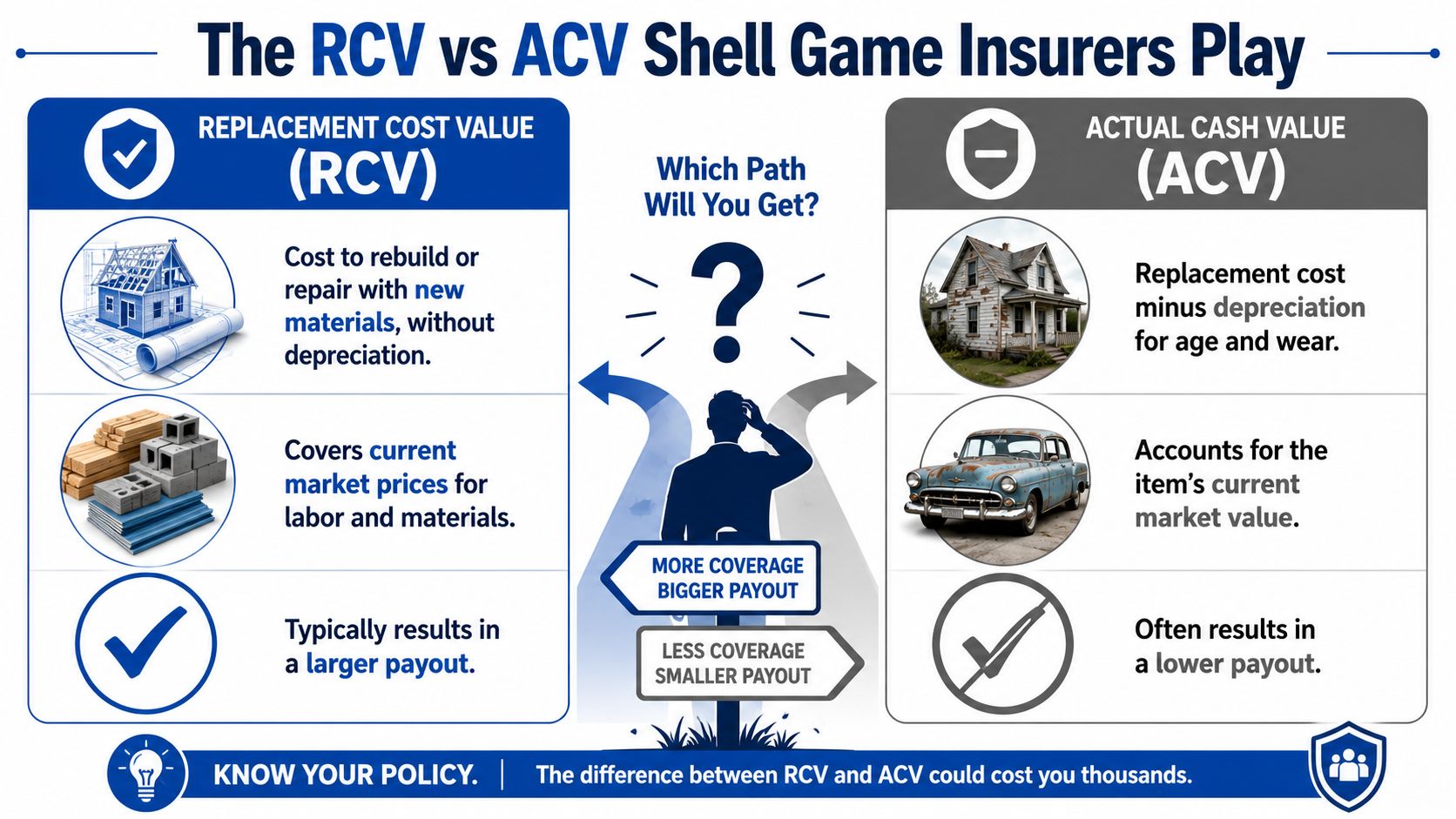
Replacement Cost Value (RCV) and Actual Cash Value (ACV) are not small technical distinctions. They are the center of the payout fight.
What the policy says and what the first check does
RCV coverage is designed to pay the cost to rebuild or replace damaged property with new materials of like kind and quality, without deducting for depreciation, up to the dwelling limit. ACV coverage pays replacement cost minus depreciation. The problem is that even when your policy provides replacement cost coverage, the first payment is often not the full replacement cost amount.
The Texas Department of Insurance explanation of replacement cost and actual cash value states that RCV claims are typically paid in two stages: the insurer first issues a check for the actual cash value, and then, after the policyholder submits proof of completed repairs, the insurer releases the remaining balance equal to the recoverable depreciation. In contrast, ACV coverage only pays the cost to repair or replace property minus depreciation.
That is the shell game. You bought replacement cost coverage, but the first check often behaves like an ACV payment.
If you want a deeper side-by-side breakdown, this overview of actual cash value vs replacement cost is useful because it tracks the payout differences the way they appear in real claims, not just policy brochures.
Why insurers like the two-step payment structure
The two-step structure gives the carrier an advantage at the exact moment you have the least bargaining power. Your house is torn apart. Contractors want deposits. Temporary living arrangements are draining cash. You need money now, but the insurer says the held-back depreciation will come later.
That “later” is where many claims stall.
The insurer isn’t just valuing damage. It’s controlling cash flow.
The company gets to say your repair scope is too broad, your contractor pricing is too high, your invoices are incomplete, your materials aren’t like kind and quality, or your work wasn’t finished in time. Each of those objections can slow or shrink release of recoverable depreciation.
A simple comparison helps:
| Coverage type | How the carrier values the loss | What usually happens first |
|---|---|---|
| RCV | Cost to replace with new materials of like kind and quality, within policy limits | Initial payment often reflects depreciated value, with the balance withheld until repairs are documented |
| ACV | Replacement cost minus depreciation | Depreciated amount is usually all you get |
The insurer benefits from confusion here. Homeowners hear “you have replacement cost coverage” and assume the settlement check reflects that promise. Often it doesn’t. It reflects the first phase of a process designed to make you spend money, prove everything, and come back asking for the rest of your own claim value.
Depreciation How Insurers Keep Your Money
Depreciation is where homeowners insurance replacement cost coverage gets twisted into a cash squeeze. A lot of policyholders think depreciation only matters on an actual cash value policy. It doesn’t. On an RCV claim, depreciation often shows up immediately. The insurer subtracts it from the first payment and tells you that you can recover it later.
That’s true in theory. In practice, “later” becomes the battlefield.
Recoverable depreciation is still your money
If your roof, flooring, cabinets, drywall, trim, or built-ins have age on them, the adjuster will assign depreciation. Some depreciation is expected. The problem is how aggressively carriers apply it, and how casually they expect homeowners to absorb the shortfall while repairs begin.
A common pattern looks like this:
- The insurer prices the work low at the start: That shrinks the whole estimate before depreciation is even applied.
- Then the insurer depreciates major line items: Roofing, finishes, and interior components often carry the biggest holdbacks.
- The homeowner has to bridge the gap: Contractors still want deposits and staged payments.
- The carrier keeps the withheld amount until it gets proof it likes: Not just proof you repaired. Proof that matches the insurer’s requirements.
For homeowners dealing with this issue, this breakdown of depreciation on insurance claims is worth reading because it shows why the holdback amount often becomes the center of the dispute.
Here is the practical trap. Even if the house must be restored, the carrier may issue a payment that leaves you unable to hire the contractor needed to do it correctly. Then, if you delay because you lack funds, the insurer can act as though your failure to complete repairs is the reason the withheld depreciation remains unpaid.
Claim reality: Recoverable depreciation isn’t a bonus. It’s part of the value you were expecting when you paid for replacement cost coverage.
How the dispute usually unfolds
The second fight starts when repairs are underway or completed. The Allstate explanation of ACV vs replacement cost notes that full replacement cost payment can be withheld if repairs are not completed within a specified timeframe or if the policyholder chooses lower-cost materials. These conditions can create disputes when an insurance company’s adjuster delays the second RCV payment by questioning the timing, scope, or documentation of repairs.
That language shows up in real-world disputes all the time. The insurer says:
- Your invoices are too vague
- The contractor substituted materials
- The work looks like an upgrade
- The repair wasn’t completed within the required time
- The final amount exceeds our estimate
- Some items weren’t damaged from this loss
None of those positions automatically ends the issue. They are negotiation positions. Homeowners get into trouble when they treat them as final decisions.
A sample claim dispute might look like this without assigning made-up numbers. The carrier pays an initial amount for a kitchen fire based on depreciated cabinets, flooring, drywall finish, and paint. The contractor’s actual rebuild proposal is higher because the estimate includes detach and reset work, matching trim profiles, proper texture, and code-related electrical touchpoints. The homeowner completes the work, submits invoices, and expects release of the depreciation holdback. The insurer then argues that portions of the invoice reflect “betterment” or “upgrades.”
That is where documentation wins or loses the claim.
Use this checklist when you submit for withheld depreciation:
- Match invoices to line items: If the insurer’s estimate names cabinet replacement, your contractor invoice should identify cabinet replacement.
- Show like kind and quality: If original materials are unavailable, have the contractor explain the nearest equivalent in writing.
- Keep date records: Emails, change orders, permits, and delivery delays matter when the carrier raises timing objections.
- Separate upgrades from required repair: If you chose a design upgrade, keep it distinct so the insurer can’t use it to attack covered work.
- Document the original condition: Pre-loss photos, inspection photos, and demolition photos make it harder for the insurer to relabel damage as pre-existing.
Depreciation is not just accounting. It’s an advantage. If you don’t answer it with organized proof, the carrier will keep your money and call it procedure.
Winning the Claim with Endorsements
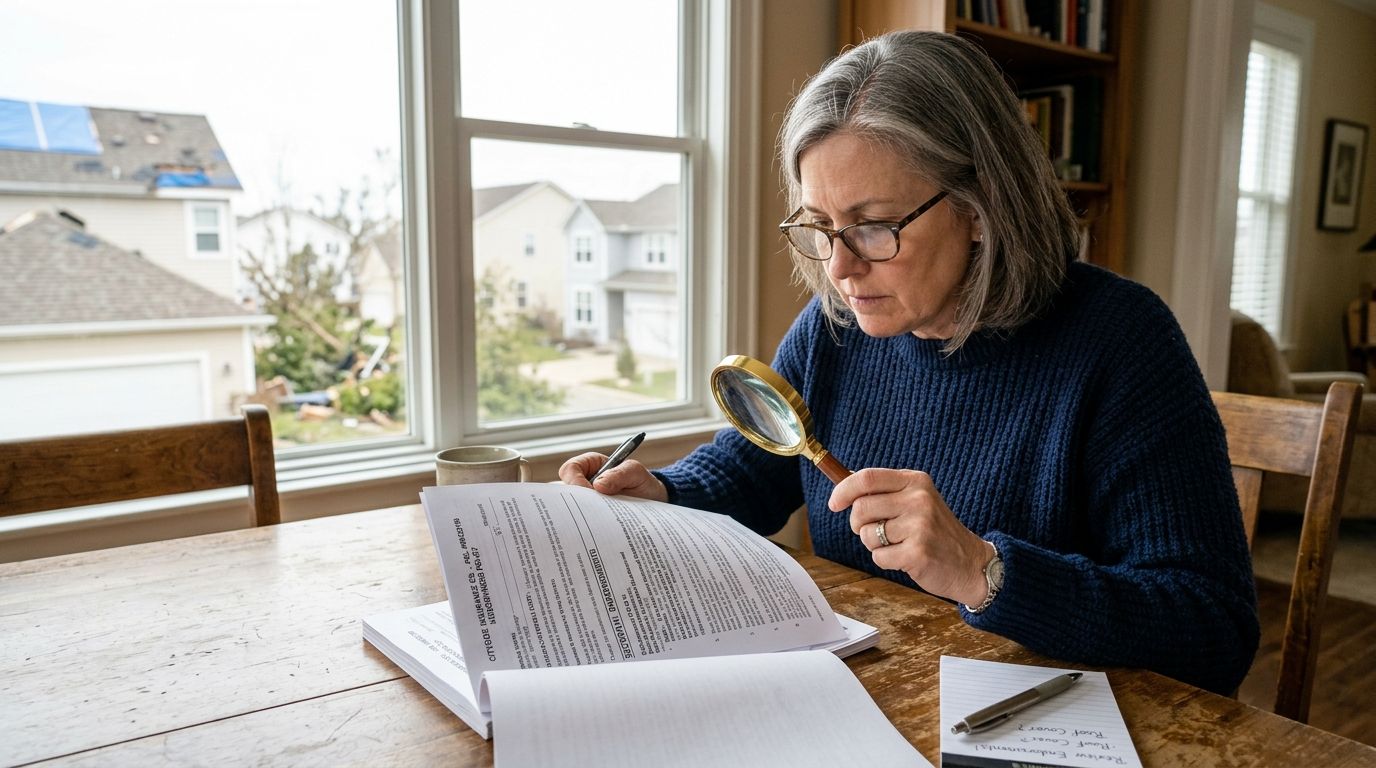
A standard replacement cost policy can still leave you underinsured. That’s the part many homeowners only learn after a major fire, wind, or water loss, when contractor pricing is current but the policy limit is old.
Coverage A has to match rebuild reality
Insurers calculate dwelling coverage based on estimated rebuild cost, not market value or purchase price. The Travelers explanation of insuring a home to replacement value notes that rebuild estimates are based on construction costs such as local labor, materials, building codes, and home features. It also states that if the actual cost to rebuild exceeds the stated dwelling coverage limit due to inflation, labor shortages, or post-event cost spikes, the policyholder remains responsible for the shortfall unless the policy includes extended or guaranteed replacement cost endorsements.
That sentence is the whole problem with relying on a basic policy. Standard RCV coverage may be solid on paper and still fail in a live claim if the limit is too low.
The replacement cost endorsement guide is useful here because it helps homeowners separate three different promises that often get lumped together:
| Policy setup | What it generally protects against | Where the fight starts |
|---|---|---|
| Standard replacement cost | Rebuild cost up to the dwelling limit | The limit itself may be too low |
| Extended replacement cost | A cushion above the dwelling limit | The cushion may still be insufficient after severe cost spikes |
| Guaranteed replacement cost | Broader protection when rebuild cost exceeds the limit | Availability and policy wording matter |
The cynical part is this. Lower dwelling limits can make a premium look more attractive at renewal. Then the homeowner carries the risk if rebuild pricing outruns the estimate.
The code and ordinance trap
Another gap sits outside the normal replacement cost conversation. Standard replacement cost coverage often does not automatically pay for all the extra expense of bringing a damaged home up to current codes or ordinances after a major loss. That’s where older homes in North Carolina and Virginia can get hit hard.
The Kin discussion of replacement cost coverage and code issues notes that a 2022 actuarial issue brief found post-catastrophe code changes can increase true replacement cost by 20–50%, while many standard policies still don’t cover those added costs unless the homeowner carries a separate ordinance or law endorsement.
If your estimate rebuilds the house to yesterday’s standards, but the building department requires today’s standards, the gap lands on you unless the policy closes it.
That is why a homeowner shouldn’t look only at “Coverage A” and stop there. Review whether the policy includes:
- Extended replacement cost: Helps when current rebuilding cost outruns the base limit.
- Guaranteed replacement cost: Offers broader protection if available in your form and market.
- Ordinance or law coverage: Critical when code upgrades are mandatory after substantial damage.
- Updated limit reviews: Replacement cost estimates are snapshots, not permanent truths.
The right endorsements won’t eliminate every claim dispute. They do reduce the number of ways the carrier can say, “That part may be necessary, but it isn’t covered.”
A Public Adjusters Playbook to Fight a Lowball Offer
The check shows up. It looks substantial until your contractor prices the actual work and the numbers are nowhere close. That gap is where insurers make money on replacement cost claims.

Start with the carrier file, not the payment letter
The payment letter is a sales document. The estimate is the actual claim decision.
Ask for the full adjusting file tied to the loss. That includes the line-item estimate, measurements, photos, depreciation worksheet, adjuster notes, and any engineer, mitigation, or consultant reports used to cut scope or price. If the carrier says the estimate is standard, ask standard for whom. A generic estimating template does not rebuild a specific house in North Carolina or Virginia.
Underinsurance can make this fight worse, as noted earlier. So can the 80% rule. But even when limits are adequate, carriers still underpay RCV claims by shrinking the scope, pricing labor too low, or holding back depreciation they know many homeowners will never recover.
Read the estimate like a contractor, not like a claimant. Missing detach and reset work, omitted overhead and profit, low waste factors, absent moisture barriers, and skimmed paint prep are common places where the offer gets shaved down.
Build a paper trail that forces a rewrite
Anger does not move a file. Documentation does.
Use this sequence:
-
Create a room-by-room damage inventory
List damaged materials, finishes, built-ins, cabinets, trim, flooring transitions, and work needed to access hidden damage. Water, smoke, and fire losses often involve steps the carrier leaves out because they are not visible in a quick inspection. -
Get independent estimates with real scope
A one-page bid is not enough. Ask contractors for detailed scopes that describe repair methods, quantities, and code-driven items. If the insurer’s number will not perform the work, get that statement in writing. -
Track the recoverable depreciation trap
On paper, the carrier says you can collect the withheld amount later. In practice, they often make it hard. Ask what documents are required, whether partial repairs trigger partial release, whether labor depreciation was applied, and what deadline applies. Get those answers in writing. -
Pin down code requirements
If the city or county requires upgrades, obtain the inspector’s comments, permit conditions, or written correction notice. Carriers often relabel required work as betterment or elective improvement to avoid paying it. -
Preserve every version of the claim
Save estimate revisions, emails, photos, receipts, invoices, permits, and logs of phone calls. Date everything. If the carrier changes position later, the file should show it.
A clean, boring, documented file beats a heated call with the adjuster.
One more point matters in water losses. Insurers often under-scope drying, access, and concealed damage, then argue the later costs were never part of the claim. If that sounds familiar, this guide for Florida water claims is useful because the same underpayment patterns show up in homeowners claims well outside Florida.
For larger losses, homeowners often bring in a public adjuster, construction consultant, or coverage attorney, depending on where the dispute sits. In North Carolina and Virginia, For The Public Adjusters, Inc. is one example of a firm that documents damage, prepares estimates, and negotiates with carriers for policyholders.
Do not sign a release just because the carrier labels a payment undisputed. Read the release itself. Some forms waive more than the current check.
And do not let the carrier hide behind process. If they withhold depreciation, make them identify the exact line items, the exact amount still held back, and the exact proof required to release it. If they claim your contractor invoice is insufficient, ask what specific information is missing. Vague objections are often a stalling tactic, not a real coverage position.
Dont Settle For Less Than You Are Owed
The first offer isn’t the claim’s true value. It’s the insurer’s opening number, built around its estimate, its depreciation assumptions, and its documentation rules. If you’re relying on homeowners insurance replacement cost coverage, you need to treat every withheld dollar as contested until the carrier proves it handled the claim correctly.

That means slowing down and reading the estimate line by line. It means questioning depreciation even on an RCV policy, because depreciation still applies until damaged materials or items are replaced and properly documented. It means pushing back when the carrier calls required work an upgrade, or when it holds back recoverable depreciation because your paperwork doesn’t match the format it wants.
If part of your loss involves water damage and you want another practical perspective on documenting and presenting those issues, this guide for Florida water claims is useful because many of the same dispute patterns show up in homeowners claims outside Florida, especially around drying, hidden damage, and incomplete scopes.
A quick video can help frame what to look for when a settlement feels off:
You don’t have to accept a low-ball number just because it came on insurance company letterhead. A disputed estimate can be challenged. A withheld depreciation payment can be documented and pursued. A bad scope can be rewritten. That’s how claims move from frustration to advantage.
Have your water damage claim questions answered at NO COST. Call 919-400-6440 to speak with a licensed Public Insurance Adjuster or Contact Us here with questions. WE Work For YOU… NOT Your Insurance Company!
If you’re dealing with a denied, delayed, or underpaid property claim, For The Public Adjusters, Inc. helps homeowners and business owners in North Carolina and Virginia document damage, review policy language, challenge low-ball estimates, and negotiate for the benefits owed under the policy.