When you file a flood damage insurance claim, you’re not asking for a favor. You’re asking for the protection you paid for. The hard truth, though, is that filing a claim is often just the beginning of a brutal fight.
Why? Because your insurance company is a business. A very profitable business. And their path to profitability is paved by paying out as little as possible on claims just like yours. This isn’t a maybe; it’s their entire business model.
Why Your Insurer Is Fighting Your Flood Claim
After a flood tears through your life, the last thing you need is a battle with the company that was supposed to be your safety net. But that’s exactly the position countless homeowners and business owners find themselves in.
Major carriers like Allstate and State Farm have entire departments dedicated to minimizing claim payouts. The adjuster they send to your property—often in a neatly pressed, company-branded red polo shirt—is a highly trained professional. Their job isn’t to help you. Their job is to find every possible reason to undervalue, delay, or flat-out deny your legitimate claim.
This isn’t personal, it’s just business. Every dollar they deny you is another dollar that pads their bottom line. Once you understand this fundamental conflict of interest, you can start to fight back effectively.
Common Tactics Used to Undervalue Claims
Insurance companies don’t just randomly deny claims. They use a well-worn playbook of tactics designed to make you feel powerless and force you to accept a fraction of what you’re truly owed.
If you’ve filed a flood claim, you’re almost guaranteed to run into some of these moves:
- Twisting Your Policy Language: They’ll dig into the fine print and use confusing, ambiguous language as a weapon against you. They’ll argue certain types of water damage aren’t covered, even when any reasonable person would say they are.
- Ridiculously Low Repair Estimates: The company adjuster will often come back with an estimate that’s shockingly low. They get there by using outdated material pricing, ignoring local labor costs, and recommending cheap, shoddy repairs.
- Delay, Delay, Delay: This is a classic. They drag their feet, “lose” your paperwork, and make you wait for weeks or months. They’re banking on the fact that your financial desperation will force you to accept their lowball offer just to get something.
- Ignoring What They Can’t See: Their inspection is often quick and superficial. They conveniently “miss” the big-ticket items—the hidden mold growing behind the drywall, the saturated insulation, the compromised foundation, or the fried electrical systems.
A classic example we see all the time: The insurer denies a claim by arguing the damage came from “groundwater seepage” instead of a “flood.” It’s a subtle distinction in the policy wording that they exploit to avoid paying out tens of thousands of dollars. This is exactly where having an expert on your side becomes non-negotiable.
This is the fight you’re in. They have teams of adjusters, engineers, and lawyers all working with one goal: to pay you as little as legally possible.
But you don’t have to face them on your own. By knowing their game and bringing in your own expert—a public adjuster—you can level the playing field and force them to honor the promise they made when they took your premium checks.
Decoding Your Insurer’s Lowball Offer
When that first settlement offer for your flood damage insurance claim finally arrives, it almost always feels like a punch to the gut. The number seems laughably low, leaving you wondering how on earth you’re supposed to rebuild with that.
Let’s be clear: this isn’t their final word. It’s an opening shot. It’s the insurance company’s first move in a negotiation they have rigged from the start.
Their strategy is a well-oiled machine. The company adjuster—the one who probably showed up in a red polo shirt and khakis—conducted a quick, surface-level inspection that was designed to miss things. Their one and only job is to write a report that justifies paying you as little as legally possible.
The Anatomy of an Undervalued Claim
Big insurance carriers like State Farm and Allstate didn’t get rich by paying claims fairly. They have a playbook, and they follow it to systematically undervalue your losses, knowing that most homeowners are too exhausted and overwhelmed to fight back.
One of their favorite tools is their own proprietary estimating software. This isn’t neutral software; it’s calibrated to serve their bottom line. It defaults to the cheapest materials imaginable and consistently lowballs what local contractors actually charge for labor. The adjuster plugs in a few basics, hits a button, and the computer spits out a lowball number that has nothing to do with the reality of repairing your home correctly.
They are also masters of ignoring what they can’t immediately see. Water is a sneaky, destructive force. The adjuster’s 30-minute walkthrough is guaranteed to “overlook” the most expensive damage.
- Foundation Damage: Waterlogged soil can destabilize your home’s foundation, leading to cracks and serious structural problems down the road.
- Electrical System Compromise: Water and electricity don’t mix. A flood can fry your entire electrical system, creating a massive fire hazard that requires a complete and costly replacement.
- Hidden Mold Growth: It only takes 24-48 hours for toxic mold to start growing inside walls and under floors. It’s a serious health risk that requires professional remediation—something their initial estimate conveniently leaves out.
- Saturated Insulation: Once insulation gets wet, it’s useless. It becomes a soggy, moldy mess that has to be torn out and replaced, a massive job they rarely account for.
Twisting Your Own Policy Against You
On top of lowballing the physical repairs, the insurance company will use the dense, confusing language in your policy against you. They’ll argue over technicalities—was it “overland flooding” or a “sewer backup”?—to justify denying parts of your claim.
This isn’t just an accident. It’s a deliberate strategy to chip away at what you’re rightfully owed for your flood damage insurance claim.
This is a massive, industry-wide problem. A recent analysis found that between 2010 and 2023, global floods caused nearly $144 billion in direct property damage. But insurance only covered about $50 billion of that—just 35%. That leaves a staggering gap between what people lost and what their insurance companies actually paid. You can discover more insights about this global insurance gap.
Knowing their playbook is the first step to fighting back. Their offer has nothing to do with your actual losses and everything to do with their profits. Your job now is to take apart their flimsy estimate and prove the real value of what it will take to make you whole again.
How to Build an Ironclad Case Against Your Insurer
That lowball offer on your flood damage insurance claim isn’t the final word. Think of it as the opening bell in a fight. To win, you can’t just argue—you need to hit back with overwhelming, undeniable proof that completely dismantles their weak assessment.
Building an ironclad case means you have to get strategic and meticulous. We’re talking about going way beyond just snapping a few pictures on your phone. The goal is to pile up so much compelling evidence that your insurer has no choice but to pay what they truly owe. You need to document everything like a crime scene investigator.
Document Everything Down to the Last Detail
Let’s be realistic. The insurance company’s adjuster probably spent less than an hour at your property before coming up with their lowball estimate. Your mission is to prove, in excruciating detail, exactly how much they missed. That all starts with a complete inventory of every single item the floodwaters touched.
- Make a Master List: Go room by room and list every single thing that was damaged or destroyed. Be brutally specific. Don’t just write “couch.” Write “Crate & Barrel, Axis II 3-Seat Sofa, Indigo Blue Velvet, purchased 2022.”
- Find Real Replacement Costs: For every item, you need to find out what it costs to replace it today. Find links to the same or similar products online. Dig up old receipts. Put it all in a spreadsheet. This shows the real-world cost, not some number their outdated software spit out.
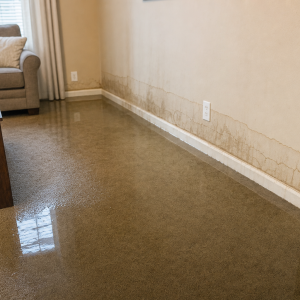
- Shoot Photos and Video of Everything: You can’t have too many. We’re talking hundreds of photos and videos. Get wide shots of the rooms, then get close-ups of the damage. Pull back carpets, open up cabinets, and make sure you get clear shots of the water lines on the walls. When you shoot video, narrate it. Explain what you’re showing and how it was wrecked by the flood.
This is how you break the cycle. Homeowners suffer damage, get a pathetic estimate, and then face a denial or a lowball offer they’re pressured to accept.
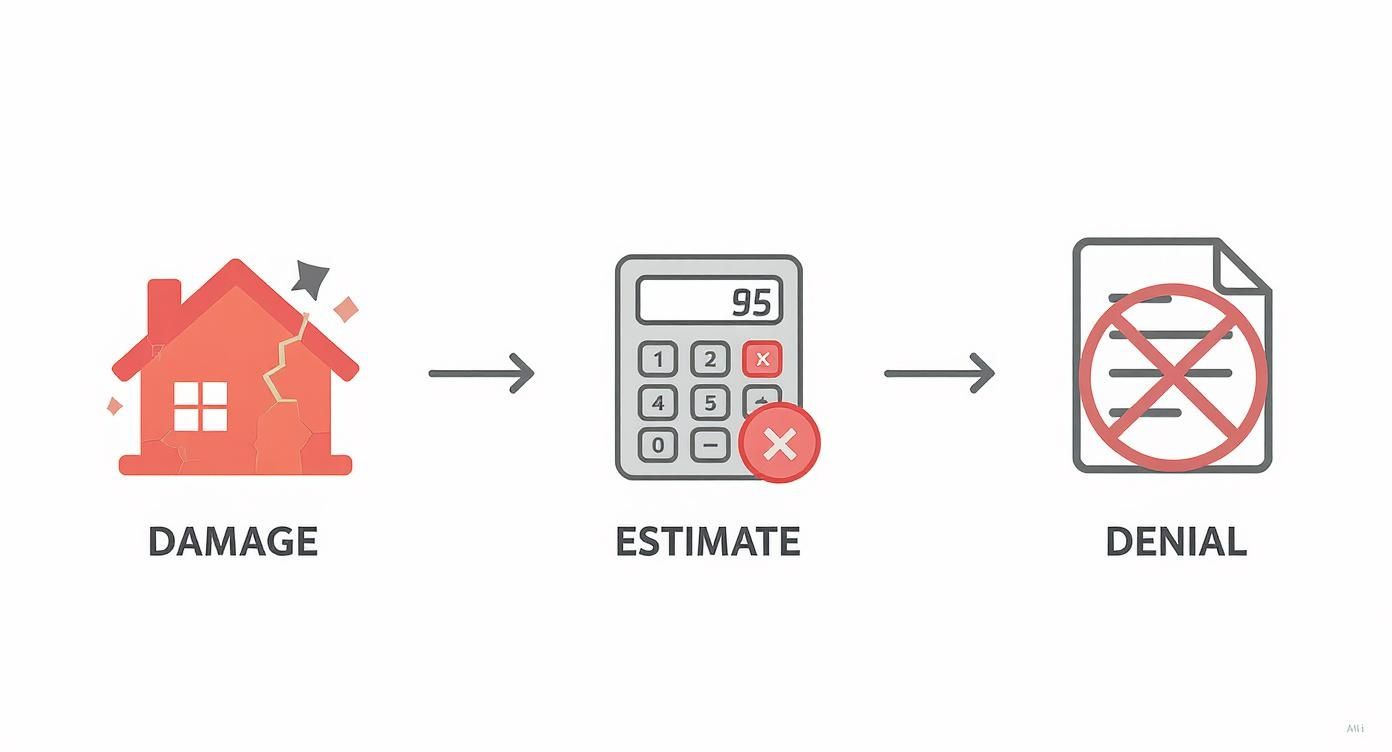
This visual perfectly illustrates the frustrating loop insurers want to trap you in. The right evidence is your way out.
Assemble Your Own Team of Experts
Your insurance company has a whole team on its side—adjusters, engineers, and their network of “preferred vendors.” All of them work to protect the company’s bottom line. You absolutely need your own team of independent professionals who work only for you.
A word of warning: never, ever use the contractors your insurer “recommends.” Their real loyalty lies with the insurance company that sends them a steady stream of business, not with you.
Crucial Tip: Keep a detailed log of every single communication with your insurance company. Every phone call, every email, every letter. Write down the date, time, who you spoke with, and a summary of what was said. This log can become a game-changing piece of evidence down the road.
Getting your own independent repair estimates is not optional. It’s mandatory. You need to get at least two or three highly detailed, itemized quotes from trusted local contractors who know the real costs of labor and materials in your area. These quotes will instantly expose just how ridiculously low the insurer’s estimate is.
For bigger, more complex damage, you may need to bring in the heavy hitters:
- A Structural Engineer: They can assess things like foundation cracks or warped framing that the company adjuster conveniently ignored.
- An Industrial Hygienist: They will find and document hidden mold growth, giving you a scientific report that proves the need for expensive, proper remediation.
- A Public Adjuster: This is your ultimate weapon. A public adjuster can manage this entire evidence-gathering process, leveraging their expertise to build the most powerful case possible on your behalf.
Here’s a look at the kind of evidence that truly makes a difference.
Evidence Checklist Your Insurer Hopes You Overlook
Most homeowners provide the bare minimum. To win a disputed claim, you have to go far beyond that, providing detailed, expert-backed proof that leaves no room for argument.
| Evidence Type | What the Insurer Expects (Basic) | What You Need to Win (Comprehensive) |
|---|---|---|
| Damage Photos | A few phone pictures of obvious damage. | Hundreds of high-resolution photos and narrated videos showing damage from every angle, including hidden areas. |
| Personal Items List | A handwritten list of lost items from memory. | A detailed, itemized spreadsheet with descriptions, age, original cost, and links to current replacement costs. |
| Repair Estimates | A single quote, often from their “preferred” contractor. | Multiple, highly detailed, line-item estimates from independent, vetted local contractors. |
| Expert Reports | None. They rely solely on their adjuster’s opinion. | Independent reports from a structural engineer (for foundation/framing) and an industrial hygienist (for mold/air quality). |
| Communication Log | Scattered notes or emails. | A meticulous, chronological log of every call, email, and letter with dates, times, names, and summaries. |
This level of professional documentation is how you dismantle the insurance company’s arguments. An engineer’s sworn report will always carry more weight than the opinion of a company adjuster who isn’t even a licensed engineer.
Every piece of evidence you gather is a hammer blow to their reasons for underpaying your flood damage insurance claim. This is how you stop arguing and start proving your case. To see how all these pieces fit together, you can learn more about documenting a flood damage claim in our detailed guide.
The Power of a Public Adjuster in Your Corner
Trying to fight a massive insurance company alone over your flood damage insurance claim is a losing battle from the start. It’s an exhausting, uphill fight. You’re not just recovering from the trauma of a flood; you’re suddenly expected to be an expert in construction costs, dense policy language, and brutal negotiation tactics.
Frankly, insurance giants like Allstate and State Farm are counting on you being overwhelmed. They count on you giving up.
But you don’t have to face them on your own. This is the moment you bring in a true professional advocate: a public adjuster. Unlike the company adjuster who shows up in a red polo shirt to protect the insurer’s bottom line, a public adjuster works for one person and one person only—you. Their entire job is to get you the maximum, fair settlement you are entitled to under your policy.

These are licensed experts who take the entire burden off your shoulders. They conduct their own detailed, independent damage assessment—one that’s far more thorough than the insurer’s quick walkthrough—and handle every last email, phone call, and negotiation.
A Real-World Case Study in Success
Let me give you a perfect example. A family in North Carolina had their home completely devastated by floodwaters. Their insurance company sent an adjuster who spent less than an hour at the property before slapping a $30,000 settlement offer on the table. The family knew it was a slap in the face. That amount wouldn’t even cover the cost of drying out the structure, let alone rebuilding their lives.
Frustrated and at their wit’s end, they hired a public adjuster. This wasn’t just an adjuster; he was an expert in both complex insurance policies and construction. The first thing he did was bring in a structural engineer. What did they find? Severe, hidden cracking in the home’s foundation—a catastrophic issue the company adjuster had conveniently missed.
Next, the public adjuster dug into the family’s policy, unearthing specific clauses for additional living expenses and code upgrade coverage that the insurer had “forgotten” to apply. Armed with the engineer’s damning report and a meticulously documented claim that was hundreds of pages long, he went back to the insurer. The final settlement wasn’t just a bit more. It was over $150,000. That’s the difference a real expert makes.
“A public adjuster is the great equalizer. The insurance company has a team of experts on their side; a public adjuster is your expert, fighting for your interests alone. They level the playing field.”
Why Their Expertise Forces Insurers to Act Fairly
Public adjusters bring a potent combination of skills to the table that insurance companies simply can’t ignore or dismiss.
Their expertise in construction means they can spot hidden damage and create brutally accurate estimates for the true cost of repairs. They use current, local pricing for labor and materials—not the cheap, outdated data the insurer’s software spits out.
More importantly, they are fluent in the dense, often deceptive language of insurance policies. They know exactly how to shut down an insurer’s attempt to twist a clause to underpay a claim. This is more critical than ever, as major floods in the U.S. now cause $18 to $22 billion in economic losses, putting immense pressure on insurers to slash every payout they can. You can read more about the rising costs of flood events.
When a public adjuster submits a flood damage insurance claim for you, the insurance company knows the game has changed. They know they can no longer use their standard delay-and-deny tactics. They’re now dealing with a professional who won’t be intimidated and who has the hard evidence to back up every single dollar demanded. If you want a deeper dive into their role, you can learn more about what a public adjuster is in our detailed article.
Escalating Your Fight When Your Insurer Refuses to Pay
https://www.youtube.com/embed/YjhZy2cr8Nk
So you’ve built an ironclad case for your flood damage insurance claim. You’ve got the independent estimates, the expert reports, and hundreds of photos to back it all up.
And still, the insurance company—a behemoth like Allstate or State Farm—won’t budge. This isn’t an accident. It’s a deliberate, infuriating tactic designed to wear you down until you just give up.
When they refuse to negotiate in good faith, it’s time to stop arguing and start fighting back. It’s time to show them you mean business. This is where you take formal, strategic steps that put real legal and financial pressure on your insurer. It’s the only language they truly understand.
Taking the Next Strategic Steps
When polite negotiation hits a brick wall, you have several powerful tools at your disposal. Each one raises the stakes and forces your insurer to take your claim seriously.
- Write a Formal Demand Letter: This isn’t just another email. This is a formal, written demand sent via certified mail. It clearly lays out your damages, the mountain of evidence you’ve gathered, and the specific dollar amount you are demanding they pay. It puts them on official notice that a serious dispute is underway.
- Invoke the Appraisal Clause: Buried in most policies is something called an appraisal clause. This is a powerful tool that allows both you and the insurer to hire independent, impartial appraisers to determine the true value of your loss. Their decision can be binding, and it’s a way to settle the money dispute without stepping into a courtroom.
- File a State Complaint: Every state has a Department of Insurance that is supposed to regulate these carriers. Filing a formal complaint against your insurer for their bad-faith tactics triggers an official investigation into their handling of your claim.
These actions turn your claim from a simple disagreement into a formal conflict. You’re creating a paper trail that becomes absolutely critical down the road. If you’re stuck with a stubborn denial, our guide on how to appeal an insurance claim denial breaks down even more strategies.
Understanding Bad Faith Insurance Practices
Sometimes, an insurer’s behavior is so outrageous it goes beyond a simple disagreement and crosses the line into what the law calls bad faith.
This is when an insurance company intentionally misrepresents your policy, creates unreasonable delays, or flat-out fails to conduct a proper investigation—all in an effort to avoid paying what they rightfully owe you.
Courts have hammered insurance companies for these dirty tricks. In one landmark case, a jury awarded a homeowner not only the full value of their claim but also massive punitive damages. They found the insurer had acted in bad faith by deliberately lowballing the repair estimate and stalling payment for months without any good reason.
This legal precedent is a weapon. By documenting every single delay, every lie, and every unreasonable action, you are building a potential bad faith case. That dramatically increases the insurer’s financial risk if they continue to stonewall your valid claim.
The numbers are staggering. In just the last five years, global flood losses hit $325 billion, but a measly $70 billion was actually covered by insurance. This massive gap shows you just how many policyholders are left high and dry. You can learn more about these global flood loss findings.
By escalating your fight, you’re taking a stand to make sure you don’t become just another one of those statistics.
Common Questions When Fighting a Flood Claim
When your life has been turned upside down by a flood, the last thing you need is a brutal fight with your insurance company. But that’s often exactly what happens. They know you’re exhausted and confused, and they use that to their advantage, hoping you’ll just give up and accept a fraction of what you’re owed.
Here are the straight answers to the questions we hear every single day from homeowners and business owners just like you.
Will My Insurer Drop Me if I Fight Back?
This is the number one fear policyholders have, and it’s a powerful one. The truth is, in most states, it is flat-out illegal for your insurance company to non-renew your policy or jack up your rates just because you filed a claim after a natural disaster.
Punishing you for disputing their lowball offer is a form of retaliation, also known as bad faith. While they can find other reasons not to renew you down the line, they can’t legally drop you for simply fighting for the money you’re entitled to. The key is to document every single interaction. If you even suspect retaliation, it’s a serious issue.
Is It Too Late to Hire a Public Adjuster?
Absolutely not. It’s almost never too late to bring in a professional advocate, even if you’ve already cashed a check or received a denial letter. A good public adjuster can reopen your claim, submit new evidence, and take over the entire negotiation process.
In fact, hiring a public adjuster after the insurance company has shown its hand can be a massive strategic advantage. It allows your adjuster to see exactly what flimsy arguments the company adjuster used and dismantle their assessment piece by piece.
One thing you can’t ignore are the deadlines. Most flood policies, especially those from the National Flood Insurance Program (NFIP), are incredibly strict. You typically have only 60 days from the date of the loss to file your formal Proof of Loss. Missing this can kill your claim before it even starts.
What if My Damage Is a Mix of Wind and Flood?
Welcome to the oldest trick in the book, especially after a hurricane. The adjuster for your homeowner’s policy will point to the flood damage and say, “Not my problem.” Then, the adjuster for your flood policy will point to the wind damage and say the same thing.
You’re left stuck in the middle, with both companies trying to pass the buck.
This is precisely where a skilled public adjuster proves their worth. They know this game and how to beat it. They will:
- Forensically Separate the Damages: They meticulously document what was destroyed by wind (which your homeowner’s policy should cover) and what was destroyed by the floodwaters.
- Quarterback Both Claims: They manage both claims at the same time, making sure nothing falls through the cracks and forcing each insurer to pay for their share of the loss.
This stops the finger-pointing dead in its tracks and prevents you from being unfairly penalized for a complex disaster.
Q2: How does the NFIP define a 'flood' for claims purposes?
A: An NFIP-covered flood is defined as a general and temporary condition of partial or complete inundation of two or more acres of normally dry land area, or of two or more properties (at least one of which is yours), from: overflow of inland or tidal waters or unusual and rapid accumulation of surface water.
Q3: What specifically is covered under a typical NFIP flood insurance claim?
A: Flood insurance covers direct physical loss caused by flooding. It is separated into: Building Coverage (structure, foundation, plumbing/electrical systems, furnaces, water heaters, built-in appliances) up to $250,000, and Contents Coverage (clothing, furniture, electronics, washer/dryer) up to $100,000, which must be purchased separately.
Q4: What should I do immediately after a flood before filing my claim?
A: After ensuring safety and turning off utilities, your first action is to document the damage thoroughly. Take extensive photos and videos of the structural damage, standing water levels, and all damaged personal property before discarding anything. Also, immediately begin necessary temporary repairs to prevent further loss and save all receipts.
Q5: How do I actually file a flood damage claim and what information is needed?
A: Promptly contact your insurance agent or company to report the loss. You will need your policy number, the name of your insurance company, and a contact number/address where you can be reached. Ask about receiving an Advance Payment to start recovery immediately.
Q6: What is a 'Proof of Loss,' and is there a deadline for filing it?
A: The Proof of Loss is a sworn statement, often prepared with your adjuster's help, that formally details the amount of money you are claiming. You are generally required to complete and submit this detailed form to your insurance company within 60 days of the date of loss. This deadline is critical.
Q7: What common types of damage are excluded from NFIP flood claims?
A: Common exclusions include: water damage from rain entering through a wind-damaged roof or window (wind-driven rain), Additional Living Expenses (ALE) for temporary housing, damage from mold/mildew that could have been avoided, and property outside the building (pools, fences, landscaping).
Q8: Is damage to finished basements and personal property in basements covered?
A: Coverage in basements is severely limited. Coverage is generally restricted to essential utility items like furnaces, water heaters, and washers/dryers. Finished walls, floors, ceilings, and most personal property (furniture, electronics, clothing) stored in a basement are not covered.
Q9: My flood claim offer is too low; how can I dispute the settlement amount?
A: If you disagree with the amount, you should contact your insurance company's claims department to discuss the discrepancy. The most effective way to dispute a low offer is to hire a Public Adjuster to professionally re-document the loss and negotiate the settlement on your behalf.
Q10: Are flood claims paid at Replacement Cost Value (RCV) or Actual Cash Value (ACV)?
A: The valuation method depends on the property: Buildings (primary residences) are generally paid at Replacement Cost Value (RCV) if specific occupancy and coverage rules are met. Personal Property (Contents) is always paid at Actual Cash Value (ACV), which is replacement cost minus depreciation.
When your insurer is playing games with your recovery, you need an expert in your corner. The team at For The Public Adjusters, Inc. fights exclusively for policyholders to get the fair settlement they deserve. Don’t let them win—schedule your free claim review today.