The Quick Answer: Only One of These Adjusters Works for You
In the public adjuster vs independent adjuster debate, the answer is simple: only the public adjuster works for you. Staff adjusters and independent adjusters are both paid by the insurance company and represent its interests. A public adjuster is the only licensed claims professional who legally represents the policyholder — you.
Key takeaways
- A public adjuster is the only type of adjuster who works exclusively for you, the policyholder — not the insurance company.
- Independent adjusters may sound neutral, but they are contractors hired and paid by the insurance company to assess your claim.
- Staff adjusters are direct employees of the insurer, so their loyalty is to their employer, not to maximizing your payout.
- Public adjusters typically charge a percentage of your claim settlement, so they only get paid when you do.
- If your claim feels undervalued or complex, hiring a public adjuster can level the playing field against the insurer’s own adjusters.
That distinction matters more than most homeowners realize. When a fire, burst pipe, hurricane, or fallen tree damages your property in North Carolina or Virginia, several people may show up calling themselves “adjusters.” Their titles sound similar, but who signs their paycheck determines whose interests they protect.
The Three Types of Adjusters, in Plain English
- Staff adjuster: A direct employee of your insurance company. Their job is to evaluate your claim on behalf of the insurer — the party that ultimately pays it.
- Independent adjuster: Despite the name, “independent” does not mean neutral. Independent adjusters are contractors hired by insurance companies, often during busy storm seasons when insurers need extra help. They are still paid by, and answer to, the insurer.
- Public adjuster: A licensed professional hired by the policyholder. Public adjusters document the damage, prepare the estimate, and negotiate with the insurance company on your behalf — typically for a percentage of the settlement, so their incentive is aligned with yours.
Why the “Independent” Label Confuses Homeowners
The word “independent” is where most people get tripped up. Many policyholders assume an independent adjuster is a neutral third party splitting the difference between them and the insurer. In reality, the independent adjuster’s client is the insurance company. They may be courteous and professional, but their duty runs to the carrier that hired them — not to you.
What This Means for NC and VA Property Owners
Both North Carolina and Virginia license public adjusters specifically to represent policyholders. If you’ve suffered property damage and the adjuster inspecting your home was sent by the insurance company, no one in that process is advocating for your side of the claim. A licensed public adjuster fills that gap by:
- Reading your policy and identifying all coverages that apply, not just the obvious ones
- Preparing an independent, detailed damage estimate rather than relying on the insurer’s numbers
- Handling documentation, deadlines, and negotiations so you aren’t outmatched by claims professionals
For example, homeowners dealing with fire, water, or storm losses in the Triangle area can work with a licensed public adjuster in Cary, NC who handles the claim entirely on the policyholder’s side.
The bottom line: if the adjuster wasn’t hired by you, they don’t work for you. The rest of this article breaks down exactly how these roles differ — and why it can significantly change the outcome of your claim.
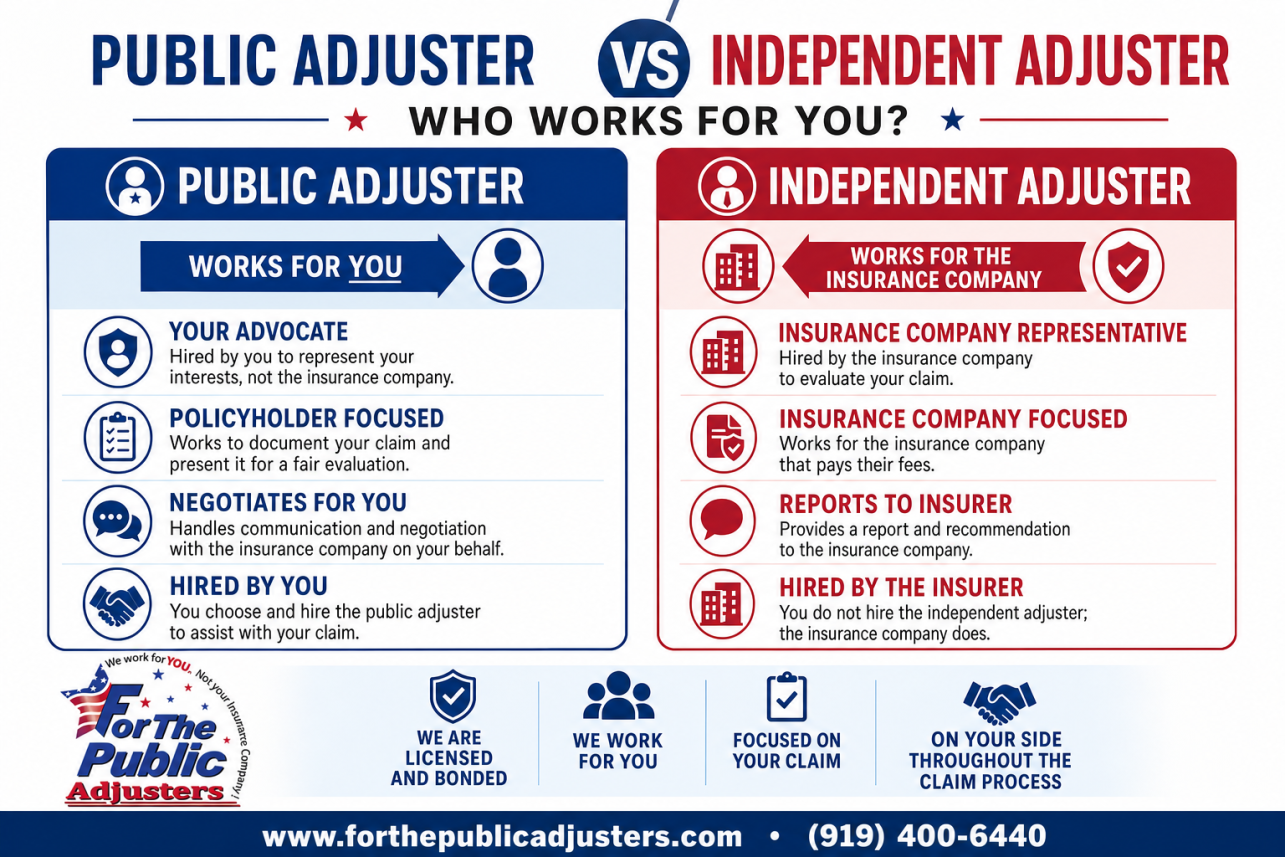
Public Adjuster vs Independent Adjuster: What’s the Real Difference?
A public adjuster is hired and paid by you, the policyholder, and is legally obligated to advocate for your interests. An independent adjuster is hired and paid by the insurance company, so despite the word “independent,” they represent the insurer’s interests when evaluating your claim — not yours.
The confusion is understandable. “Independent” sounds like “neutral,” and independent adjusters often show up at your home acting friendly and helpful. But in the public adjuster vs independent adjuster comparison, the single question that matters is: who signs their paycheck? Everything else flows from that.
Who Hires and Pays Each Adjuster
- Public adjuster: Hired directly by the homeowner or business owner. Paid by the policyholder, typically as a percentage of the claim settlement. Their compensation grows only when your recovery grows, so their financial incentive is aligned with yours.
- Independent adjuster: Hired by the insurance company, usually through a third-party adjusting firm the insurer contracts with. Paid by the insurer (via that firm). Their client — the party they answer to and want repeat business from — is the insurance company.
Why “Independent” Doesn’t Mean “On Your Side”
An independent adjuster is independent of the insurer’s payroll, not independent of the insurer’s interests. Insurance companies use independent adjusters to handle overflow after big storms or to cover regions where they don’t keep staff. The adjusting firm’s ongoing revenue depends on keeping insurance carriers happy, which means estimates and reports are prepared for the carrier’s review, using the carrier’s guidelines. That’s a very different posture from a public adjuster, who documents the loss, prepares an independent estimate, and negotiates on the policyholder’s side of the claim from start to finish.
How Each Is Licensed in North Carolina and Virginia
Both roles are regulated, but under different licensing categories:
- North Carolina: The NC Department of Insurance licenses public adjusters separately from company and independent adjusters. Public adjusters must meet examination and licensing requirements and are bound by rules governing their contracts with policyholders, including fee disclosures.
- Virginia: The Virginia Bureau of Insurance (part of the State Corporation Commission) licenses public adjusters under their own designation, distinct from adjusters working on behalf of insurers, with requirements covering examination, contracts, and conduct.
The licensing distinction isn’t just paperwork — it defines who the adjuster is legally permitted to represent. A public adjuster’s license authorizes them to act only for the insured. An independent adjuster’s license authorizes them to adjust claims on behalf of insurers. Same word, “adjuster.” Opposite sides of the table.
Who Does a Staff Adjuster Actually Work For?
A staff adjuster is a direct, salaried employee of the insurance company. They work exclusively for the carrier — not for you. While many are courteous and professional, their job performance is evaluated by the insurer, and their role is to settle claims in a way that protects the company’s bottom line.
This distinction matters more than most homeowners realize. When a staff adjuster arrives after a fire, storm, or water loss, they may be friendly, sympathetic, and genuinely helpful in explaining the process. But friendliness isn’t the same as advocacy. Every estimate they write, every coverage decision they recommend, and every settlement figure they propose flows through the insurance company’s internal guidelines and approval chain.
The Pressures Behind the Estimate
Staff adjusters operate inside a system built to control costs. That doesn’t mean every staff adjuster is acting in bad faith — most are simply doing their job the way they were trained to do it. But the incentives are worth understanding:
- Claim payouts are a cost center. Insurers track average claim severity closely, and adjusters work within pricing software, preferred vendor rates, and internal guidelines that tend to keep numbers conservative.
- Heavy caseloads limit thoroughness. After a major storm, a staff adjuster may be juggling dozens of files. A rushed 30-minute walkthrough often misses hidden damage — wet insulation, damaged sheathing, smoke residue in wall cavities.
- Depreciation and scope decisions favor the carrier. How aggressively an item is depreciated, or whether a whole roof slope is replaced versus patched, involves judgment calls — and those calls are made by the insurer’s employee.
- Contents claims get shortchanged. Staff adjusters rarely have time to inventory your personal property in detail, so contents estimates frequently rely on quick approximations rather than a room-by-room accounting.
Red Flags to Watch For During the Inspection
You can’t control who the insurer sends, but you can watch for warning signs that the inspection is producing a low estimate:
- The adjuster spends only a few minutes on-site or inspects from the ground without getting on the roof or into the attic or crawlspace.
- They discourage you from getting your own contractor estimates or tell you a repair “isn’t covered” without pointing to specific policy language.
- They take few photos, skip entire rooms, or don’t ask about damaged personal property.
- They pressure you to accept a quick settlement before the full scope of damage is known.
- They dismiss hidden damage — moisture behind walls, smoke odor, structural movement — without testing or documentation.
Understanding the staff adjuster’s role is the missing third piece of the public adjuster vs independent adjuster question. All three titles include the word “adjuster,” but the staff adjuster and independent adjuster both answer to the carrier. If you want someone measuring your loss with your interests in mind, that person has to be hired by you.
Do Policyholders Ever Win in Court When Insurers Lowball Claims?
Yes — home and business owners regularly prevail in court against insurers over underpaid and denied property claims. Juries and judges have awarded policyholders the full value of their losses, plus interest, attorney’s fees, and in some cases punitive or statutory damages when the carrier’s conduct crossed into bad faith.
These outcomes matter because they pull back the curtain on how claims get valued when no one is checking the insurer’s work. Trial records in bad-faith and breach-of-contract cases have exposed patterns that show up again and again in litigation across the country.
What Court Cases Have Revealed About Lowball Claims
When policyholders sue and cases go to discovery, internal documents and adjuster files become evidence. Courts and juries reviewing those records have repeatedly found problems such as:
- Estimates written well below actual repair costs — scopes of loss that omitted entire trades, undercounted square footage, or used pricing that no local contractor would accept.
- Structural damage minimized or reclassified — for example, framing, roofing, or foundation damage attributed to “wear and tear” or pre-existing conditions rather than the covered event.
- Contents losses undervalued — depreciation applied aggressively, or inventories cut down without inspection of the actual items.
- Engineering and expert reports shaped toward denial — some high-profile hurricane litigation uncovered reports that were edited after the fact to support a lower payout.
- Delay as a tactic — repeated requests for documents already submitted, stretching claims out until the owner accepted less just to move on.
The Legal Tools Policyholders Have Used
Winning cases generally rest on two theories. Breach of contract is the straightforward claim: the policy promised payment for a covered loss, and the insurer didn’t pay what was owed. Bad faith goes further, arguing the carrier didn’t just get the number wrong — it handled the claim unreasonably or dishonestly. In North Carolina, unfair claims practices can support claims under the state’s unfair and deceptive trade practices law, which allows damages to be trebled in appropriate cases. Virginia law also gives policyholders remedies, including the possibility of recovering costs and attorney’s fees when an insurer is found to have acted in bad faith on a claim.
What This Means for You
The lesson from these cases isn’t that you should expect to end up in a courtroom — most disputed claims never get that far. The lesson is that carrier estimates are not neutral or final. Courts have found, repeatedly, that first offers can dramatically understate a loss when the insured has no advocate documenting the damage independently. That’s the core of the public adjuster vs independent adjuster question: litigation is the expensive, last-resort way to challenge a lowball number. Bringing in your own licensed representative early — someone contractually obligated to work for you — is usually the faster, cheaper way to close that gap before it ever requires a lawyer.
How Much More Could a Public Adjuster Recover on My Claim?
Independent research suggests the difference can be substantial. A Florida legislative study (OPPAGA, 2010) found that policyholders who used public adjusters received significantly higher settlements than those who didn’t — several times higher in many claim categories. Results vary by claim, and no ethical adjuster guarantees a specific outcome.
That study is worth understanding in context, because it’s one of the few pieces of independent, government-commissioned research on the subject — not marketing material produced by the public adjusting industry.
What the Florida OPPAGA Study Found
Florida’s Office of Program Policy Analysis and Government Accountability examined citizens’ property insurance claims and compared outcomes for policyholders with and without public adjuster representation. The findings were striking:
- Non-catastrophe claims: Policyholders represented by public adjusters received payments roughly 574% higher on average than unrepresented policyholders.
- Hurricane-related claims from the 2005 storm season: Represented policyholders received payments approximately 747% higher on average.
Those percentages sound almost unbelievable until you consider why the gap exists. A public adjuster’s estimate typically captures damage that a quick carrier-side inspection misses — hidden moisture behind walls, code-upgrade costs, matching requirements for siding or roofing, full contents inventories, and proper pricing for the local market. When the estimate is more complete, the settlement is usually larger.
Why Your Results Will Be Different
An honest answer requires honest caveats. The OPPAGA data is over a decade old, comes from a single state, and reflects averages — not a promise about your specific loss. Your recovery depends on:
- Your policy language — coverage limits, endorsements, and exclusions set the ceiling on any claim.
- The nature and timing of the damage — a fresh, well-documented loss behaves differently than one reported months later.
- How much was missed initially — if the carrier’s estimate was already thorough, the gap may be modest; if it overlooked entire trades or rooms, the gap can be dramatic.
- Documentation quality — photos, receipts, and contents lists strengthen every line item.
The Real Takeaway for Policyholders
The lesson from the research isn’t a specific dollar figure — it’s that who prepares the estimate matters. In the public adjuster vs independent adjuster equation, only one of them is building a claim scoped around your full entitlement under the policy. The other is documenting the loss on behalf of the insurance company that pays their invoice.
A reputable public adjuster will review your policy and damage before taking your case, and will tell you candidly if their involvement isn’t likely to add value. If the potential recovery doesn’t justify their fee, walking away is the right answer — and any adjuster worth hiring will say so.

How Do I Choose the Right Public Adjuster in NC or VA?
Choose a public adjuster in North Carolina or Virginia by verifying their state license and surety bond, reviewing the contingency fee agreement in writing, asking about their experience with your specific type of loss, and hiring them as early in the claim as possible — ideally before you accept the insurer’s first offer.
Verify the License and Bond First
Both North Carolina and Virginia require public adjusters to be licensed and bonded. Before signing anything, look the adjuster up directly with the state:
- North Carolina: Confirm the license through the North Carolina Department of Insurance, which regulates adjusters and handles consumer complaints.
- Virginia: Check licensing through the Virginia Bureau of Insurance at the State Corporation Commission.
A legitimate public adjuster will gladly provide their license number and proof of bonding. If someone hesitates or pressures you to sign before you can verify, walk away.
Understand the Fee Agreement Before You Sign
Public adjusters typically work on contingency — a percentage of the claim settlement rather than an upfront fee. That aligns their interests with yours, but the details matter. Make sure the contract clearly states:
- The exact fee percentage and what it applies to (the full settlement, or only amounts recovered above the insurer’s initial offer)
- Whether any expenses are billed separately
- Your right to cancel within the window your state allows
Be cautious of anyone who guarantees a specific dollar outcome. No ethical adjuster can promise what an insurer will pay — they can only commit to documenting and negotiating your claim thoroughly.
Questions Worth Asking Before You Hire
- How many claims like mine — fire, hurricane, tornado, or water loss — have you handled in this state?
- Who will actually manage my claim day to day?
- Can you provide references from recent local clients?
- How will you keep me updated, and how often?
When to Bring a Public Adjuster In
Earlier is almost always better. After a fire, hurricane, tornado, or major water loss, evidence disappears fast — debris gets cleared, materials dry out, and hidden damage gets missed. Involving a public adjuster before the insurance company’s inspection means the initial documentation reflects the full scope of your loss, not a rushed walkthrough.
That said, it’s not too late if your claim is already underway. Many homeowners hire a public adjuster after receiving a settlement offer that seems too low, or after a claim stalls or gets partially denied. If your loss involves flooding, note that flood claims run through the National Flood Insurance Program with its own rules and deadlines — FEMA’s flood insurance resources explain that process, and an experienced adjuster can help you navigate it alongside any homeowners claim.
Public Adjuster vs Independent Adjuster vs Staff Adjuster: Key Differences
| Factor | Public Adjuster | Independent Adjuster | Staff Adjuster |
|---|---|---|---|
| Who they represent | You, the policyholder | The insurance company | The insurance company |
| Who pays them | You (usually a % of the settlement) | The insurer, as a contractor | The insurer, as an employee |
| Primary goal | Maximize your covered claim payout | Assess the claim per insurer guidelines | Settle the claim per insurer guidelines |
| When they get involved | When you hire them, at any stage of the claim | When the insurer assigns them, often during high claim volume | Automatically, as part of the insurer’s claims process |
| Licensing | State-licensed to represent policyholders | State-licensed to adjust claims | Licensed or certified per state and employer requirements |
Illustrative Example: A Homeowner’s Storm Damage Claim
Illustrative example
Consider a hypothetical homeowner whose roof and interior are damaged in a severe storm. The insurer’s staff adjuster inspects quickly and issues an estimate that covers only visible roof damage, overlooking water intrusion behind walls. Frustrated, the homeowner hires a licensed public adjuster, who documents the hidden moisture damage, re-reads the policy for applicable coverages, and negotiates directly with the insurance company. In this composite scenario, the revised settlement covers substantially more of the actual repair costs — illustrating why representation matters when claims are complex.
Frequently asked questions
What’s the difference between a public adjuster vs independent adjuster?
A public adjuster works for you, the policyholder, and represents your interests when documenting, valuing, and negotiating an insurance claim, typically for a percentage of the settlement. An independent adjuster works for the insurance company — despite the name, ‘independent’ just means they’re a contractor hired by insurers rather than a salaried employee. Only the public adjuster is on your side.
If an independent adjuster doesn’t work for me, who do they work for?
Independent adjusters are hired by insurance companies, often to handle overflow claims or claims in areas where the insurer doesn’t have staff, such as after a major storm. They investigate and evaluate your claim on the insurer’s behalf and report back to the company, which makes the final decision. Their duty is to the insurer that hired them, not to you.
Is a staff adjuster the same as an independent adjuster?
They’re similar in loyalty but different in employment. A staff adjuster is a direct, salaried employee of the insurance company, while an independent adjuster is a contractor the insurer brings in as needed. From your perspective as a policyholder, both represent the insurance company’s interests when evaluating your claim.
When does it make sense to hire a public adjuster?
A public adjuster can be worth considering for large or complex claims — such as significant property damage — when you disagree with the insurer’s estimate, or when you don’t have the time or expertise to document and negotiate the claim yourself. Public adjusters typically charge a percentage of your settlement, so for small, straightforward claims the cost may outweigh the benefit. Check that any adjuster you hire is licensed in your state.
Related local pages
- Public Adjuster Burlington NC: Fire, Water & Storm Damage Claims Handled On The Policyholder’s Side
- Public Adjuster Elon NC — Fire & Water Claim Help For Alamance County Homeowners
- Public Adjuster Haw River NC — Fire, Flood & Storm Claim Help For Older Mill-Town Homes Along The Haw
Not sure who’s really representing your interests on your property claim? Contact our licensed and bonded public adjusters serving North Carolina and Virginia for a free claim review today. Get in touch.
Last updated: July 22, 2026