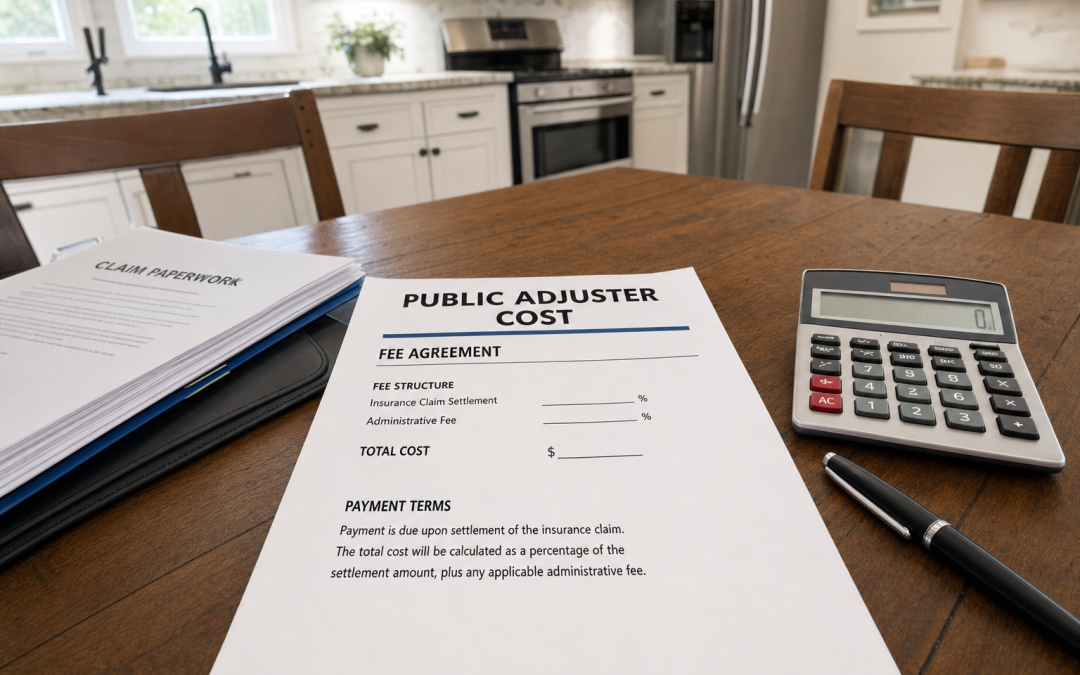
How Much Does a Public Adjuster Cost?
Public adjuster cost typically ranges from about 10% to 30% of the final insurance settlement, paid on a contingency basis. That means most homeowners pay nothing upfront — the adjuster only collects a fee if your claim is paid, with the exact percentage depending on the size and complexity of the loss.
Key takeaways
- Most public adjusters in North Carolina work on contingency, typically charging around 10%–30% of the final insurance settlement rather than upfront fees.
- You generally pay a public adjuster nothing unless they recover money on your claim, which shifts the financial risk away from the homeowner.
- North Carolina licenses and regulates public adjusters, and fee agreements must be in writing, so always review the contract before signing.
- Larger or more complex claims often qualify for a lower percentage fee, so the public adjuster cost is usually negotiable.
- Comparing fee structures — contingency, flat fee, and hourly — helps you pick the arrangement that fits the size and complexity of your claim.
If you’re weighing whether to bring in professional help on a fire, water, or storm damage claim, the fee question is usually the first thing on your mind — and understandably so. You’ve already suffered a loss, and the last thing you want is another bill. The good news is that the way most public adjusters structure their fees is designed around that reality.
The Short Version for NC Homeowners
- Contingency is the norm: Most public adjusters in North Carolina work on a percentage of what the insurance company actually pays. No recovery generally means no fee.
- Percentages vary by claim: Larger, straightforward claims often carry a lower percentage, while smaller or more complicated claims may sit at the higher end of the range.
- No upfront cost in most cases: You typically don’t write a check to hire a public adjuster — the fee comes out of the settlement itself.
- Everything should be in writing: The fee percentage, what it applies to, and how it’s calculated must be spelled out in your signed contract before any work begins.
Why Fees Vary From Claim to Claim
A total-loss house fire, a burst pipe that soaked two floors, and a tree through the roof are very different claims — and the work involved varies just as much. A public adjuster handling a complex loss may spend weeks documenting damage, preparing estimates, and negotiating with the insurance carrier. That effort is reflected in the fee percentage you’re quoted, which is why it’s smart to get quotes based on your specific situation rather than assuming a one-size-fits-all number. If you’re dealing with a loss in the Triangle area, for example, a licensed public adjuster serving Cary NC and Wake County can walk you through exactly how their fee would apply to your claim before you sign anything.
What This Article Covers
In the sections below, we’ll break down the common fee structures public adjusters use (contingency, hourly, and flat fee), how fees are regulated in North Carolina and Virginia, whether the cost is actually worth it, the questions you should ask before signing a contract, and the situations where hiring a public adjuster makes the most financial sense. By the end, you’ll be able to evaluate any fee agreement with confidence — and know when the percentage you’re paying is likely to pay for itself.
What Fee Structures Do Public Adjusters Use?
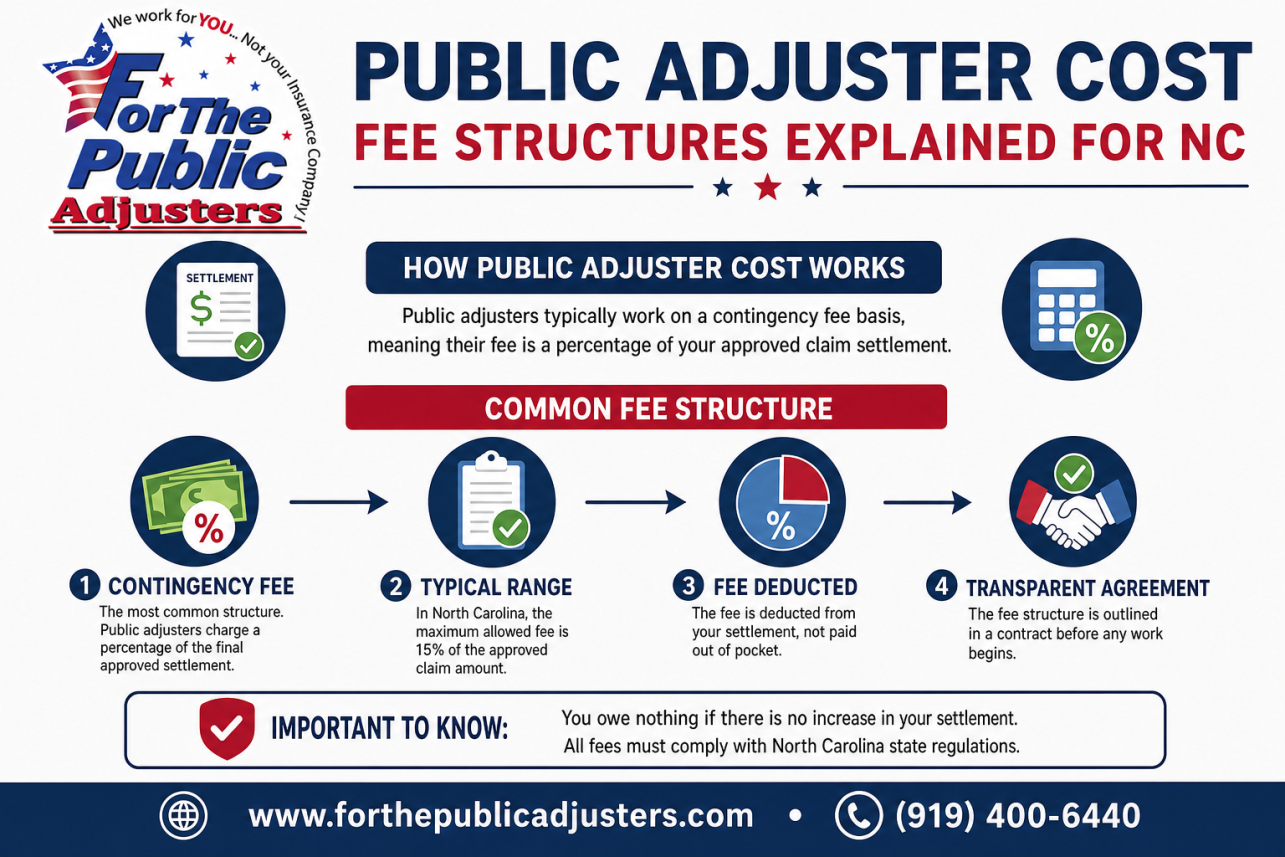
Public adjusters typically charge in one of three ways: a contingency fee (a percentage of your insurance settlement), a flat fee agreed upon upfront, or an hourly rate. Contingency is by far the most common for home and business property claims, while flat and hourly fees usually apply to smaller or more limited engagements.
Contingency Percentage Fees
Under a contingency arrangement, the adjuster’s fee is a percentage of the amount your insurance company pays on the claim. If you recover nothing, you generally owe nothing, which aligns the adjuster’s incentives with yours. This model dominates larger residential and commercial losses — think fire damage claims, major water losses, or storm damage where the final settlement amount is uncertain and the adjuster’s negotiation directly affects the outcome.
In the contract, look for language stating the exact percentage, whether it applies to the total settlement or only to amounts recovered above the insurer’s initial offer, and how payments already issued by the insurer are treated. Percentages often vary based on claim size and complexity, with larger claims sometimes negotiated at lower rates.
Flat Fees
A flat fee is a single fixed price for a defined scope of work. This structure tends to appear when:
- The claim is straightforward and the settlement amount is fairly predictable
- You need a specific service, such as preparing a detailed damage estimate or a proof of loss
- The loss is large enough that a percentage fee would be disproportionate to the work required
The contract should spell out exactly what the flat fee covers — and what falls outside the scope. If the claim later becomes contested and requires extended negotiation, an agreement written only for document preparation may not include that additional work.
Hourly Rates
Hourly billing is the least common model for typical homeowners but shows up in consulting-style engagements. Examples include reviewing an insurer’s settlement offer for reasonableness, advising a business owner mid-claim, or serving as an appraiser or expert in a dispute. If your contract uses hourly billing, it should list the rate, who performs the work, whether there is a retainer, and how time is tracked and invoiced.
How Fees Should Appear in the Contract
Regardless of the model, a legitimate public adjuster contract will state the fee structure in plain, unambiguous terms. Before signing, confirm the document clearly identifies:
- The exact percentage, flat amount, or hourly rate
- What the fee is calculated against (total claim payments vs. new money recovered)
- When payment is due and how it’s collected from settlement checks
- Any expenses billed separately, such as engineering reports or contractor estimates
Understanding which structure fits your situation is the first step in evaluating whether the public adjuster cost makes sense for your specific loss — a question the next sections address in more detail.
Are Public Adjuster Fees Regulated in North Carolina and Virginia?
Yes. Both states license public adjusters and regulate how they charge. North Carolina’s public adjuster statute caps fees and mandates written contracts with specific disclosures, while Virginia requires licensing through its Bureau of Insurance and written fee agreements. Hiring a licensed, bonded adjuster gives you legal recourse if something goes wrong.
North Carolina: A Statute Built to Protect Policyholders
Public adjusters in North Carolina are licensed and overseen by the North Carolina Department of Insurance under Article 33A of Chapter 58 of the General Statutes. This law goes beyond basic licensing — it directly regulates public adjuster cost and conduct. Key protections include:
- A statutory fee cap. North Carolina limits the percentage a public adjuster may charge for state of emergency claims, like hurricanes. Before signing anything, confirm the current cap with the NC Department of Insurance and make sure the contract’s fee falls within it. Under North Carolina law (N.C. Gen. Stat. § 58-33A-60), public adjusters are strictly limited to a maximum fee of 10% of the insurance claim settlement when the claim arises from a catastrophic incident.
- Written contract requirements. The agreement must be in writing and clearly state the adjuster’s compensation, so there should never be ambiguity about what you’ll owe.
- A right to cancel. The law gives policyholders a short window after signing to cancel the contract without penalty — important if you signed under pressure right after a loss.
- Financial responsibility requirements. Licensed adjusters must meet bonding requirements, which gives policyholders a source of recovery if the adjuster acts improperly.
Virginia: Licensing Through the Bureau of Insurance
Virginia also requires public adjusters to be licensed, with oversight handled by the State Corporation Commission’s Bureau of Insurance. Virginia’s framework requires adjusters to pass a licensing exam, meet financial responsibility standards, and use written contracts that disclose how compensation is calculated. Rather than relying on a single fixed cap for all claims, Virginia’s rules focus on ensuring fees are clearly disclosed and reasonable, and the Bureau of Insurance can discipline adjusters who overreach.
Why Licensing and Bonding Matter to You
It can be tempting to hire whoever knocks on your door first after a storm, but working with an unlicensed “claim consultant” leaves you exposed. A licensed, bonded public adjuster offers real protection:
- Verified qualifications. Licensees must pass exams and complete continuing education, so they actually understand policy language and claims procedures.
- Regulatory accountability. You can file a complaint with the NC Department of Insurance or Virginia’s Bureau of Insurance, and regulators can suspend or revoke a license.
- Financial backing. A surety bond provides a way to recover losses if an adjuster mishandles your funds or breaches the contract.
- Enforceable fee limits. In North Carolina especially, the statutory cap only protects you if the person you hire is actually subject to the statute.
Before signing, verify the adjuster’s license through the appropriate state database — it takes minutes and confirms that the fee structure you’re being quoted operates within the rules designed to protect you.
Is a Public Adjuster Worth the Cost?
For many policyholders, yes. When an insurer’s initial offer undervalues the damage, a public adjuster’s documentation and negotiation often increase the settlement by more than the fee charged. That said, results depend on the facts of your claim, and no adjuster can ethically guarantee a specific outcome.
Why Low Initial Offers Are So Common
Insurance company adjusters work for the carrier, and their damage estimates frequently miss items that a thorough, independent inspection would catch. On property claims, the gap between a first offer and the true cost of repairs often comes from:
- Hidden or secondary damage — moisture behind walls, compromised roof decking, or smoke residue in HVAC systems that a quick inspection overlooks
- Incomplete scope of work — estimates that cover patch repairs when the policy actually entitles you to full replacement or matching materials
- Underpriced line items — labor and material rates that don’t reflect current local construction costs
- Missed coverages — code-upgrade coverage, additional living expenses, or debris removal that policyholders don’t know to claim
A public adjuster’s job is to build a complete, well-documented claim before negotiations begin. When the documented loss is substantially higher than the insurer’s estimate, even a double-digit percentage fee can leave you with far more money than accepting the original offer would have.
North Carolina Courts Have Sided with Policyholders
Policyholders who push back on undervalued claims are not powerless. A notable example is Guessford v. Pennsylvania National Mutual Casualty Insurance Company, a North Carolina property-damage dispute in which a homeowner challenged the insurer’s handling of his claim and ultimately prevailed. Cases like this underscore two points relevant to the cost question:
- Insurers do not always get the valuation right the first time, and disputing an offer can be legitimate and worthwhile
- Thorough, independent documentation of the loss — exactly what a public adjuster provides — is central to proving a claim was underpaid
Most disputes never reach a courtroom. A well-supported claim presented by a licensed public adjuster is often enough to move an insurer toward a fair settlement without litigation, which itself saves policyholders significant time and legal expense.
An Honest Caveat
Public adjusters cannot manufacture coverage that doesn’t exist in your policy, and any adjuster who promises a specific dollar result should be a red flag. The honest calculation is simpler: if the adjuster’s expertise recovers meaningfully more than the insurer initially offered, the public adjuster cost pays for itself. If your claim is small, straightforward, and fairly valued from the start, the fee may not be justified — a distinction covered in more detail later in this article.
The bottom line: on complex or clearly undervalued claims, the value a public adjuster adds typically outweighs the fee. On simple claims handled fairly, it may not — which is why an upfront, no-obligation claim review is worth requesting before you sign anything.
What Should I Ask Before Signing a Public Adjuster Contract?
Before signing, ask the adjuster to confirm their exact fee percentage in writing, clarify whether the fee applies to the full settlement or only the amount they recover, review cancellation terms, verify their state license and bond, and request recent references. Clear answers to these questions protect you from disputes and surprise charges later.
A public adjuster contract is a binding legal agreement, and the details in it determine how much of your settlement you actually keep. Taking fifteen minutes to work through the questions below can save you significant money and frustration, whether you’re comparing adjusters in North Carolina or Virginia.
Questions About Fees and Payment
- What is your exact fee percentage, and is it in the contract? Verbal quotes mean nothing — the written number controls.
- What does the fee apply to? Some adjusters charge on the entire settlement; others charge only on the amount recovered above the insurer’s initial offer. This distinction can dramatically change your total public adjuster cost.
- Does the fee apply to advance payments or money the insurer already offered? You shouldn’t pay a percentage on funds you would have received anyway — negotiate this point before signing.
- Are there any additional charges? Ask specifically about fees for experts, engineers, estimators, or appraisal proceedings.
Questions About the Contract Terms
- What are the cancellation terms? Ask whether there’s a rescission period after signing and what you’d owe if you cancel mid-claim.
- Who will actually handle my claim? Confirm whether the person you’re meeting will manage the file or hand it off to someone else.
- How will you communicate with me? Get a commitment on update frequency and response times.
Questions About Credentials
- Can I see your license? Verify it directly with the North Carolina Department of Insurance or the Virginia Bureau of Insurance rather than taking a photocopy at face value.
- Are you bonded? Licensed public adjusters are typically required to carry a surety bond — ask for proof.
- Can you provide references from recent clients with similar claims? A reputable adjuster will have homeowners willing to vouch for them, ideally with the same type of loss as yours.
Red Flags to Walk Away From
- Pressure to sign on the spot, especially door-to-door solicitation immediately after a storm
- Reluctance to put the fee percentage or scope of services in writing
- Guarantees of a specific settlement amount — no legitimate adjuster can promise results
- Requests for large upfront payments before any work begins
- No verifiable license in the state where your property is located
- Vague or missing cancellation language in the contract
If an adjuster hesitates on any of these questions or discourages you from reading the contract carefully, keep looking. The best professionals welcome scrutiny because their terms hold up to it.

When Does Hiring a Public Adjuster Make the Most Financial Sense?
Hiring a public adjuster generally makes the most financial sense for large, complex claims — major fire, water, hurricane, or tornado damage to a home, commercial building, or extensive contents. For small, straightforward claims, the fee may outweigh the benefit, so professional representation delivers the greatest value when the stakes and the paperwork are highest.
Claims Where a Public Adjuster Typically Adds the Most Value
The more complicated the loss, the easier it is for damage to be undervalued or overlooked entirely. These scenarios tend to justify the public adjuster cost:
- Fire and smoke damage. Fire losses often involve hidden structural damage, smoke and soot contamination throughout the property, and a lengthy contents inventory. Documenting all of this correctly takes time and expertise most homeowners simply don’t have.
- Significant water damage. Burst pipes, roof leaks, and appliance failures can cause damage inside walls, under flooring, and in areas that aren’t visible during a quick inspection. A thorough scope of damage matters here.
- Hurricane and tornado damage. Wind events in North Carolina and Virginia frequently damage roofing, siding, windows, and interiors all at once, and insurers may be handling thousands of claims simultaneously. Detailed, well-supported documentation helps your claim get the attention it deserves. Note that flood damage is handled separately — typically through the National Flood Insurance Program (NFIP) — and comes with its own rules and deadlines, which is another situation where experienced guidance can help.
- Large contents losses. Itemizing hundreds of damaged belongings, assigning values, and applying depreciation correctly is tedious and error-prone. Public adjusters do this routinely.
- Disputed or underpaid claims. If you believe the insurer’s estimate doesn’t reflect the true scope of your loss, a professional review can identify gaps — though no adjuster can promise a specific outcome, and you should be wary of anyone who does.
When the Fee May Outweigh the Benefit
On the other hand, some claims are simple enough that paying a percentage of the settlement doesn’t make sense:
- Small claims close to or barely above your deductible
- Single-item losses with clear, undisputed values
- Claims your insurer has already handled promptly and fairly
A reputable public adjuster — licensed and bonded, as required — should tell you honestly if your claim is too small to benefit from representation. If someone pressures you to sign a contract on a minor claim, treat that as a red flag. The National Association of Insurance Commissioners (NAIC) offers consumer resources on navigating claims and understanding your rights as a policyholder.
A Simple Rule of Thumb
Ask yourself two questions: Is the damage extensive or difficult to document? And is the potential settlement large enough that professional expertise could meaningfully affect the outcome? If the answer to both is yes, the public adjuster cost is usually a sound investment. If both answers are no, you may be better off handling the claim yourself.
Public Adjuster Cost: Comparing Common Fee Structures in NC
| Fee Structure | How It Works | Typical Range | Best For |
|---|---|---|---|
| Contingency (percentage) | Adjuster is paid a share of the final settlement | Roughly 10%–30% of the payout | Most residential claims; no recovery, no fee |
| Flat fee | One agreed price for the full engagement | Varies by claim size and scope | Smaller, straightforward claims with a clear scope |
| Hourly rate | Billed for time spent on the claim | Varies by adjuster experience | Consulting, reviews, or limited-scope help |
| Hybrid/tiered | Percentage decreases as the settlement grows | Negotiated per contract | Large or complex losses like fire or hurricane damage |
Illustrative Example: A Hurricane Claim on the NC Coast
Illustrative example
Consider a hypothetical coastal North Carolina homeowner whose roof and interior were damaged in a hurricane, and whose initial insurance offer felt far lower than the visible damage suggested. In this composite scenario, the homeowner hired a licensed public adjuster on a contingency basis, agreeing to a percentage of whatever additional settlement was recovered.
The adjuster re-documented the loss, identified overlooked damage such as water intrusion behind walls, and negotiated directly with the insurer. The final settlement in this illustrative example was meaningfully higher than the original offer — enough that, even after the adjuster’s fee, the homeowner netted more than they would have by accepting the first payout. This is a hypothetical composite meant to show how contingency fees work, not a real client result.
Frequently asked questions
How much does a public adjuster cost in North Carolina?
Most public adjusters work on a contingency basis, meaning they charge a percentage of your final insurance settlement rather than an upfront fee. The exact percentage varies based on the size and complexity of your claim, and North Carolina law regulates how public adjusters operate and contract with homeowners. Before signing anything, ask for the fee to be clearly stated in writing and confirm the adjuster is licensed with the North Carolina Department of Insurance.
Do I have to pay a public adjuster if my claim is denied?
Under a typical contingency fee agreement, the public adjuster only gets paid if you recover money from your insurance company — no settlement usually means no fee. However, contract terms vary, so read your agreement carefully and ask directly whether any charges apply if the claim is unsuccessful or if you cancel the contract.
Is hiring a public adjuster worth the cost?
It depends on your claim. For large or complex losses — such as major fire, storm, or water damage — a public adjuster’s expertise in documenting damage and negotiating with the insurer can result in a higher settlement that offsets the fee. For small, straightforward claims, the fee may eat up too much of the payout to be worthwhile. Compare the potential increase in your settlement against the fee before deciding.
What fee structures do public adjusters use besides a percentage?
While contingency percentages are the most common structure, some public adjusters may offer flat fees for specific services or hourly rates for consulting work. Whatever the arrangement, North Carolina requires public adjusters to be licensed, and your contract should spell out the fee structure clearly. Get everything in writing and compare quotes from more than one licensed adjuster if possible.
Related local pages
- Public Adjuster Burlington NC: Fire, Water & Storm Damage Claims Handled On The Policyholder’s Side
- Public Adjuster Cary NC — Licensed Help For Fire, Storm, Water & Tree Damage Claims In Wake County
- Public Adjuster Garner NC — Fight for the Full Settlement You Deserve
Get a free, no-obligation claim review from our licensed and bonded public adjusters serving North Carolina and Virginia today. Get in touch.
Last updated: July 20, 2026