
When you punch “flood damage cleanup near me” into Google, you’re not just looking for a service. You’re kicking off a fight you probably don’t even see coming. Sure, the immediate chaos is about getting the water out and drying your home. But the real war starts the second you have to deal with your insurance company. This is never as simple as filing a claim and getting a check for what you’re owed.
The Unseen Conflict Behind Your Flood Damage Claim

Clawing your way back from a flood isn’t just about physical repairs; it’s about financial survival. The brutal truth many homeowners discover is that their insurance provider—the same one they’ve faithfully paid for years—suddenly acts like an opponent.
The National Flood Insurance Program (NFIP) along with their Write Your Own (WYO) all follow the flood policy. It’s not so great coverage. Their primary duty is to save money wherever possible. The model is built on one simple principle: minimize payouts.
This creates a massive conflict of interest, an environment where you’re at an immediate disadvantage. The insurance company sends their own adjuster, an employee whose entire job is to assess the damage from the company’s point of view. Their goal is to find reasons to limit the value of your claim, not to uncover the true, full extent of your loss.
Common Tactics Insurers Use Against You
Insurance companies have a well-worn playbook designed to grind you down and force you to accept less than you deserve. Spotting these tactics is the first step in fighting back.
- Delaying Tactics: They take weeks to send an adjuster. They “lose” your paperwork. They stop returning your calls. These delays aren’t accidents; they’re a strategy to make you so frustrated that you’ll jump at the first insulting offer they throw your way.
- Lowball Offers: The first settlement offer is almost always a joke. It’s a calculated move. They’re banking on you being exhausted, displaced, and desperate enough to take it without a fight.
- Misinterpreting Your Policy: Adjusters will quote confusing policy language or point to obscure exclusions to deny parts of your claim. They’re hoping you don’t have the time or expertise to challenge their twisted interpretation of the contract you both signed.
- Downplaying Damage: The company adjuster will conveniently overlook hidden moisture trapped in wall cavities, ignore the ticking time bomb of mold growth, or use laughably outdated pricing for materials and labor.
A classic scenario we see all the time is an insurer denying a mold claim, arguing it’s a separate problem. But if that mold grew as a direct result of a covered flood, it should be part of the original claim. This is a common battleground where homeowners get unfairly denied.
Your Most Powerful Ally in the Fight
You do not have to fight this battle on your own. The insurance company has their adjuster, but you have the right to bring your own professional advocate to the table: a public adjuster.
A public adjuster is a state-licensed insurance pro who works for one person and one person only: you, the policyholder. Their entire mission is to meticulously document every ounce of your loss, negotiate aggressively on your behalf, and force the insurance company to pay the maximum settlement you are entitled to under your policy.
In those first critical moments, understanding the immediate steps to minimize damage from a burst pipe is your first line of defense. This guide will walk you through the cleanup, but more importantly, it will show you how to fight back and make sure you get every penny you need to be made whole again.
How to Document Damage Your Insurer Cannot Ignore
When you’re standing in the middle of a flood-ravaged home, the first instinct is to start cleaning up, to try and bring some order back to the chaos. But you have to resist that urge.
Your insurance company’s first instinct, on the other hand, is to start looking for ways to minimize their payout. Your only real weapon in this fight is to build a fortress of undeniable evidence. This isn’t just about taking a few quick pictures; it’s about creating a record so thorough that it shuts down their arguments before they can even make them.
The hard truth is that major insurers have entire departments trained to find reasons to underpay you. They’ll argue that damage was pre-existing, that your belongings weren’t worth what you say they were, or that something can be repaired when you know it needs to be replaced. Meticulous documentation is how you win.
Go Beyond Basic Photos With Video Walkthroughs
Still photos are a must, but they don’t capture the full reality of the situation. A video walkthrough, where you narrate what you’re seeing, is a far more powerful tool. It creates a real-time record that is incredibly difficult for an adjuster to dispute.
Start your video outside to show the property and establish the date. Then, walk slowly through every single room, narrating what you see.
- Describe Everything: Don’t just point the camera at a wet carpet. Say, “This is the living room. You can see the water line is two feet high on the drywall. This wool area rug, which we bought last year for $1,200, is completely destroyed. The base of our custom entertainment center is swollen and warped.”
- Open Everything Up: Open cabinets, closets, and drawers. Show them the damage inside. Film the contents and describe what’s been lost.
- Prove It’s Broken: If an appliance doesn’t work, film yourself trying to turn it on. This shows the damage is from the flood, not some other mechanical failure.
This narrated tour gives your claim a voice. It adds a layer of context and reality that a sterile gallery of photos just can’t match, making your loss much harder for the insurance company to dismiss with a lowball number.
Create a Detailed Inventory of Every Single Loss
I know this is the most tedious, soul-crushing part of the process, but it is absolutely non-negotiable if you want to get a fair settlement. You have to create a detailed, itemized list of every single thing that was damaged or destroyed.
For every item, your inventory needs to include:
- Item Description: Be specific. Not just “TV,” but “Samsung 55-inch 4K Smart TV.”
- Brand and Model Number: Get this if you can.
- Age of the Item: An honest estimate is fine.
- Original Cost: Dig up receipts or bank statements if possible.
- Estimated Replacement Cost: This is critical. Research what it costs to buy the same or a comparable item today. This is the number that matters for a replacement cost value (RCV) policy.
Before we dive deeper, it’s helpful to see how a small amount of extra effort can completely change the outcome of your claim.
Essential vs Advanced Evidence Gathering
This table breaks down the difference between the basic documentation most people provide and the detailed evidence required to truly fight back.
| Evidence Type | Standard Approach (What Insurers Expect) | Advocacy Approach (What Wins Claims) |
|---|---|---|
| Photography | Quick snapshots of obviously damaged areas. | Hundreds of high-res photos from multiple angles, including close-ups of model numbers and damage points. |
| Video | A short, silent video panning across rooms. | A narrated, room-by-room walkthrough describing the damage, its extent, and the value of specific items. |
| Inventory | A simple list of big-ticket items like “sofa” or “TV.” | A detailed spreadsheet with links to replacement products, original receipts, model numbers, and current costs. |
| Pre-Loss Proof | Hope the adjuster takes your word for the prior condition. | Proactively provide “before” photos from social media or family albums to shut down “pre-existing damage” arguments. |
| Structural Damage | Noting a warped floorboard. | Documenting the water line on studs, moisture readings inside walls, and warped subflooring. |
The “Advocacy Approach” isn’t just about being thorough; it’s about anticipating the insurance company’s tactics and beating them to the punch. You’re building a case they simply can’t argue with.
An adjuster’s software is designed to default to the cheapest, most generic replacement values. Your detailed inventory, complete with links to new products online, forces them to work with real-world numbers. This alone can add thousands to your personal property settlement.
This meticulous, proactive approach is exactly what a public adjuster does. To get a better sense of the entire claims battlefield, you can check out our guide on how to file a property damage claim and see how this documentation fits into the bigger picture.
The Power of “Before” Photos
Nothing stops an adjuster’s favorite excuse—”pre-existing damage”—faster than a photo of your home before the flood.
Go through your phone, your social media, and your family’s photo albums. Look for pictures from holidays, birthday parties, or even random snapshots that show your home and belongings in their undamaged state. This simple step can be the difference between getting paid for your high-end hardwood floors and getting a check that only covers cheap laminate.
This level of detail is more critical now than ever. The global flood crisis is out of control, with annual losses now hitting USD 388 billion worldwide. With flood-related disasters jumping by 134% since 2000, insurers are more aggressive than ever in protecting their bottom line. You can learn more about these global flood risk findings to see the scale of the challenge that policyholders are now up against.
Navigating Cleanup Without Harming Your Claim
After a flood, that urge to start ripping out wet drywall and soggy carpets is almost overwhelming. You just want your life back. But hold on—this is a critical moment where one wrong move can give your insurance company the perfect excuse to deny a huge chunk of your claim.
Insurers like State Farm and Allstate have turned the cleanup phase into a minefield for policyholders. If you throw out damaged materials before their adjuster sees them, they’ll argue they can’t verify the loss. But if you wait too long? They might turn around and deny a later mold claim, blaming you for not acting fast enough.
It’s a calculated trap, and you need to know how to avoid it.
Mitigation vs. Repairs: The Critical Difference
Your policy has a clause that requires you to mitigate further damage. This is key. It means you must take reasonable steps to keep the situation from getting worse. It does not mean you should start permanent repairs.
Confusing these two is a brutally expensive mistake.
Mitigation looks like this:
- Getting the standing water out.
- Tarping a damaged roof to stop more rain from pouring in.
- Moving any salvageable furniture and belongings to a dry, safe area.
- Setting up fans and dehumidifiers to begin the drying process.
Repairs, on the other hand, are the actual reconstruction. We’re talking about replacing drywall, laying down new flooring, or repainting. Do not start any permanent repairs until you have a written agreement with your insurer on the scope and cost of the work.
Think about it this way: if you tear out a wall before the company adjuster inspects it, they can no longer see the waterline. They can’t test for moisture or verify the true extent of the saturation. They will use this against you to argue the damage wasn’t as bad as you claim, and they will slash your settlement.
The Dangers of Insurance-Preferred Vendors
Your insurance company will almost certainly “recommend” a cleanup crew from their preferred vendor list. It sounds helpful, but it’s a tactic to control costs—at your direct expense. These vendors get a steady stream of business from the insurance company, so guess where their loyalty lies? It’s not with you.
These crews are notorious for cutting corners to keep the invoice low and the insurance carrier happy. This often includes:
- Using too few fans or dehumidifiers, leaving behind hidden moisture that guarantees a future mold problem.
- Declaring materials “salvageable” when any honest professional would tell you they need to be replaced.
- Giving you vague, lump-sum invoices that are completely useless for documenting your claim.
You are not required to use their company. You have every right to hire your own independent, IICRC-certified restoration company. A reputable crew works for you, and they’ll provide the detailed documentation—like certified moisture readings and itemized invoices—that actually supports your claim instead of undermining it.
Choosing a Cleanup Company That Supports Your Claim
When you’re vetting a flood damage cleanup company, you need to think like a public adjuster. Ask them pointed questions to make sure they’ll be an asset in your insurance fight, not a liability.
- “Will you provide daily moisture logs and psychrometric readings?” This is the scientific data that proves the extent of the water damage and justifies the entire drying process.
- “Can you provide a detailed, itemized estimate breaking down all labor and material costs?” A simple, one-page invoice is a massive red flag.
- “Are you willing to work directly with my public adjuster?” A company that embraces collaboration with your advocate is a very good sign. To see why this partnership is so powerful, you can learn more about how public adjusters work with restoration companies to get policyholders back on their feet faster.
This infographic lays out the essential first steps for documenting damage before any real cleanup starts. This is how you build the evidence you need.
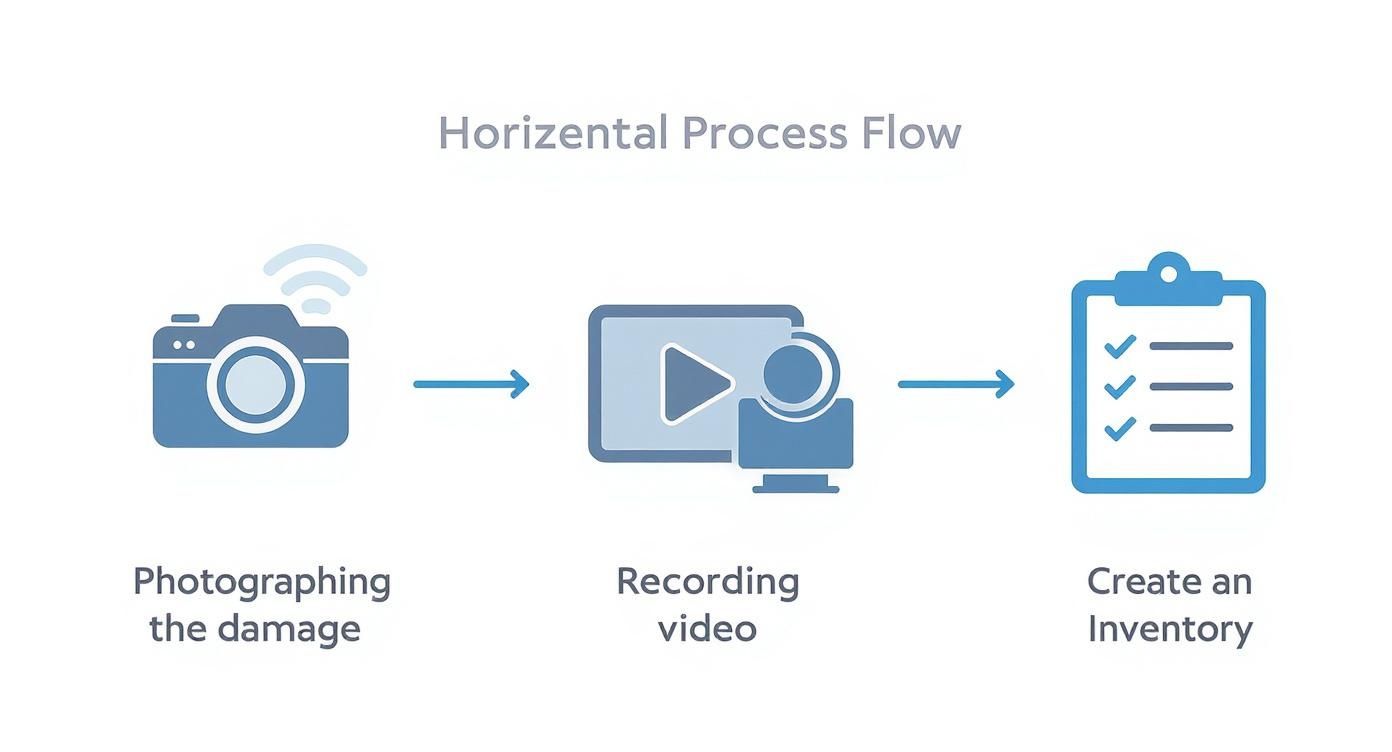
Following this simple but powerful documentation flow creates a baseline of evidence that makes it much, much harder for an insurer to dispute the initial state of your property.
Fighting Common Insurance Delay and Deny Tactics
Once you’ve managed the gut-wrenching task of cleaning up after a flood, the real battle begins. Now you’re up against the insurance company’s well-oiled machine, an institutional strategy that has a name: “delay, deny, defend.”
This isn’t some conspiracy theory; it’s a cold, calculated business model. It’s designed to wear you down until you finally give in and accept a settlement that’s a fraction of what you’re actually owed.
Large carriers know the game. The longer they drag out your claim, the more financially and emotionally exhausted you become. They are literally banking on your desperation. Recognizing their playbook is the first and most critical step to beating them.
Countering the Lowball Offer
The first settlement offer you get will almost certainly be an insult. It’s a test. They’re probing to see if you’ll just take the money and go away. An adjuster from a big-name carrier will present a shockingly low number with a confident smile, hoping you’re too overwhelmed to question it.
Don’t fall for it. Your defense is to hit back with overwhelming evidence.
- Independent Contractor Estimates: Get at least two, preferably three, detailed estimates from reputable local contractors. These need to be itemized—breaking down labor, materials, and everything in between. This gives you a real-world cost for repairs in your area, not the fantasy numbers their software spits out.
- A Public Adjuster’s Assessment: A public adjuster is your ace in the hole. They use the same estimating software the insurance company uses (like Xactimate), but they scope the damage correctly. They include everything the company adjuster conveniently “forgot,” creating a powerful, apples-to-apples comparison that’s tough to argue with.
This isn’t about arguing opinions anymore. You’re forcing a fact-based negotiation backed by professional proof.
Breaking Through the Wall of Silence
One of the most maddening tactics is the silent treatment. You send documents, and they ask for them again a month later. You call and email your assigned adjuster, and you get nothing back. This is called “ghosting.”
This isn’t just bad customer service. It’s a deliberate strategy to stall your claim, create delays, and make you feel powerless.
When an insurer ghosts you, they want you to feel hopeless. But what they don’t want you to know is that state insurance regulations often require them to communicate with you within specific timeframes. Document every single attempt you make to contact them—dates, times, and who you spoke to (or left a message for). This paper trail is your ammunition.
To fight back, you have to escalate. Send a formal, certified letter to the adjuster. Copy their supervisor and the head of the claims department. In the letter, clearly state your claim number, list all your unanswered communications, and demand a response within a specific timeframe (say, 10 business days) as required by your state’s laws. This puts them on notice and often gets your file moved to someone who will actually do their job.
Case Study: A Business Owner Fights a Wrongful Denial
A small business owner in North Carolina had his retail store destroyed when a city water main broke, flooding the entire property. His insurance carrier quickly denied the claim, pointing to a standard “flood exclusion” in the policy. The owner was facing total financial ruin.
Instead of giving up, he hired a public adjuster. The PA didn’t just take the denial at face value. He dug into the massive, 100+ page policy and found what the company hoped no one would see: contradictory language. While one section did exclude flood damage, another part of the policy defined a “flood” as rising surface water from natural sources, like a river overflowing or heavy rain.
This damage came from a man-made pipe failure. The public adjuster argued this was a “pipe burst” event, which was clearly covered. After he presented this detailed analysis and threatened to file a bad faith lawsuit, the insurance company folded. The business owner recovered over $250,000 for the cleanup, his lost inventory, and business interruption, saving his company.
Your Legal Recourse When Insurers Act in Bad Faith
When these delay and deny tactics cross the line from frustrating to illegal, you have powerful legal options. “Bad faith” isn’t just a buzzword; it’s a legal term for when an insurer fails to uphold its end of the contract. And courts have held major carriers accountable for it time and time again.
In a landmark case, State Farm Mut. Auto. Ins. Co. v. Campbell, the U.S. Supreme Court took on an insurer’s nationwide scheme to cap payouts and bully policyholders into unfair settlements. These legal battles prove that you are not powerless.
The scale of these disasters is staggering, which is exactly why insurers fight so hard to limit what they pay. In the first half of 2025 alone, global natural disasters caused over USD 131 billion in losses. You can read more about the rising costs of natural disasters on cbsnews.com to understand the economic pressure driving these denial tactics.
So when you’re searching for “flood damage cleanup near me,” remember that the physical work is only half the job. Winning the fight against an uncooperative insurance company is what truly allows you to rebuild your life.
Why a Public Adjuster Is Your Strongest Ally

Think about it this way: you’d never walk into a courtroom to face a lawsuit without a lawyer. So why on earth would you go into a high-stakes negotiation against a multi-billion-dollar insurance corporation without an expert who is 100% on your side?
Going up against a giant like Allstate or State Farm alone is a true David vs. Goliath battle. Except in this version, Goliath is armed with confusing policy language and an entire legal department. The adjuster they send to your flooded home? He’s their employee. His loyalty is to the company’s bottom line, not to making you whole again.
This is where a public adjuster completely levels the playing field. They are state-licensed professionals who work for one person and one person only: you, the policyholder. Their entire mission is to get you the maximum possible settlement you are rightfully owed.
Aligning Goals for a Maximum Settlement
The whole dynamic of your claim shifts the second you hire a public adjuster. The company adjuster is paid a salary to minimize your claim and protect the insurer’s profits. A public adjuster’s interests, on the other hand, are perfectly aligned with yours.
They almost always work on a contingency fee. That means they get paid a small, agreed-upon percentage of the final settlement after they win it for you. If you don’t get paid, they don’t get paid. Simple as that. This structure gives them every incentive to fight for every last dollar, uncover damage the company adjuster “missed,” and challenge every unfair denial.
You’re not just paying for an expert; you’re investing in a better outcome. The public adjuster’s fee is an investment that often pays for itself many times over by dramatically increasing your final settlement.
This frees you up to focus on the overwhelming job of finding “flood damage cleanup near me” and trying to put your life back together. You can leave the grueling, complex, and often adversarial insurance fight to a professional.
A Public Adjuster Success Story
Let me give you a real-world example. A homeowner in Virginia Beach had their property swamped after a brutal storm. Their insurance carrier—one of the big national brands—sent out an adjuster who did a quick walkthrough and presented a settlement offer of $42,000. The homeowner was floored. That wouldn’t even cover the cost of replacing their ruined custom kitchen cabinets, let alone the flooring, drywall, and everything else.
Feeling completely defeated, they hired a public adjuster. The PA brought in moisture meters and found saturation deep inside the wall cavities that the company adjuster conveniently ignored. He documented every single loss, line by line, and re-interpreted a confusing clause in the policy about code upgrades.
After weeks of aggressive negotiation backed by indisputable evidence, the public adjuster forced the insurance company back to the table. The final settlement? $115,000. That’s nearly three times the original insult of an offer. This is the tangible, real-money difference an advocate makes.
Navigating an Increasingly Risky World
The need for this kind of expert advocacy is only getting more critical. Climate change is amplifying flood risks on a massive scale. In fact, groundbreaking research shows that 37% of inland flood damage in the U.S. since 1988 is directly tied to climate-related precipitation changes, racking up USD 84 billion in damages.
With projections showing that nearly a quarter of the global population now faces significant flood risks, you can bet that insurance companies are getting even more aggressive in protecting their assets. Professional representation is no longer a luxury—it’s a necessity.
Finding the right professional is the most important step in this fight. For a deeper dive into what to look for, check out our guide on how to find a public insurance adjuster near me. It’s about finding a partner for one of the toughest financial battles you’ll ever face.
Questions Your Insurer Hopes You Never Ask
When your home is underwater and you’re desperately searching for “flood damage cleanup near me,” the last thing you have the energy for is a fight. That’s exactly what carriers like State Farm and Allstate are banking on.
They have engineered their entire claims process around the hope that you’ll be too exhausted and overwhelmed to ask the tough questions—the ones that force them to be accountable and protect your rights as a policyholder.
Here are the straight answers to the questions that come up when your flood damage claim is being unfairly delayed, denied, or underpaid.
Can I Hire My Own Cleanup Crew?
Yes, absolutely. You have the right to hire any licensed and insured restoration company you trust.
Be incredibly skeptical of the “preferred vendors” your insurer will try to push on you. These companies have a primary loyalty to the insurance carrier that sends them a steady stream of business, not to you. Their main goal is often to keep costs down for the insurer, which can mean they cut corners on your property’s restoration. Always, always get a detailed, itemized estimate before you let them start any work.
What if the Settlement Offer Is Too Low?
Never, ever accept a lowball offer on the spot. It’s a classic tactic.
Your first move should be to demand a detailed, line-by-line breakdown of how they calculated that number. This simple request forces them to justify their valuation. More often than not, it will expose where they’ve cut corners, used outdated pricing for materials and labor, or conveniently “forgotten” major areas of damage.
You have to counter their offer with your own hard evidence:
- Independent Estimates: Get written estimates from at least two, preferably three, reputable local contractors who work for property owners, not insurance companies.
- Your Detailed Inventory: Use the comprehensive list of every single damaged item you created earlier. Don’t let them generalize.
- A Public Adjuster’s Scope of Loss: This is your knockout punch. A scope of loss from a public adjuster is a professional, apples-to-apples comparison that systematically dismantles their lowball numbers.
The Adjuster Says My Mold Problem Is Not Covered
This is one of the oldest and most common denial tactics in their playbook. Don’t fall for it.
The first thing you should do is review your policy for any specific language on mold limitations or coverage “caps.” But here’s the key: if the mold is a direct result of the covered water damage and you took reasonable steps to mitigate the damage (like calling a cleanup crew), you have an incredibly strong case.
A public adjuster is an expert at arguing that the mold isn’t a separate, excluded event. It’s part of the original covered peril, and the insurance company is responsible for it.
How Long Can They Legally Take to Process My Claim?
Most states have “prompt payment” laws or fair claim settlement practice regulations on the books for a reason. These laws put a clock on the insurance company, setting specific timeframes for how long they have to acknowledge your claim, investigate it, and make a decision.
If your insurer is dragging its feet for weeks or months without giving you a valid reason in writing, they might be operating in “bad faith.” This is a serious issue. Document every single interaction—every phone call, every email, every letter. Dates, times, who you spoke to, what was said. This documentation is your ammunition.
Beyond these specific tactics, truly understanding your homeowners insurance coverage for water damage is fundamental to navigating the claim and knowing exactly what questions to ask.
Q2: How does the NFIP define a 'flood' for claims purposes?
A: An NFIP-covered flood is defined as a general and temporary condition of partial or complete inundation of two or more acres of normally dry land area, or of two or more properties (at least one of which is yours), from: overflow of inland or tidal waters or unusual and rapid accumulation of surface water.
Q3: What specifically is covered under a typical NFIP flood insurance claim?
A: Flood insurance covers direct physical loss caused by flooding. It is separated into: Building Coverage (structure, foundation, plumbing/electrical systems, furnaces, water heaters, built-in appliances) up to $250,000, and Contents Coverage (clothing, furniture, electronics, washer/dryer) up to $100,000, which must be purchased separately.
Q4: What should I do immediately after a flood before filing my claim?
A: After ensuring safety and turning off utilities, your first action is to document the damage thoroughly. Take extensive photos and videos of the structural damage, standing water levels, and all damaged personal property before discarding anything. Also, immediately begin necessary temporary repairs to prevent further loss and save all receipts.
Q5: How do I actually file a flood damage claim and what information is needed?
A: Promptly contact your insurance agent or company to report the loss. You will need your policy number, the name of your insurance company, and a contact number/address where you can be reached. Ask about receiving an Advance Payment to start recovery immediately.
Q6: What is a 'Proof of Loss,' and is there a deadline for filing it?
A: The Proof of Loss is a sworn statement, often prepared with your adjuster's help, that formally details the amount of money you are claiming. You are generally required to complete and submit this detailed form to your insurance company within 60 days of the date of loss. This deadline is critical.
Q7: What common types of damage are excluded from NFIP flood claims?
A: Common exclusions include: water damage from rain entering through a wind-damaged roof or window (wind-driven rain), Additional Living Expenses (ALE) for temporary housing, damage from mold/mildew that could have been avoided, and property outside the building (pools, fences, landscaping).
Q8: Is damage to finished basements and personal property in basements covered?
A: Coverage in basements is severely limited. Coverage is generally restricted to essential utility items like furnaces, water heaters, and washers/dryers. Finished walls, floors, ceilings, and most personal property (furniture, electronics, clothing) stored in a basement are not covered.
Q9: My flood claim offer is too low; how can I dispute the settlement amount?
A: If you disagree with the amount, you should contact your insurance company's claims department to discuss the discrepancy. The most effective way to dispute a low offer is to hire a Public Adjuster to professionally re-document the loss and negotiate the settlement on your behalf.
Q10: Are flood claims paid at Replacement Cost Value (RCV) or Actual Cash Value (ACV)?
A: The valuation method depends on the property: Buildings (primary residences) are generally paid at Replacement Cost Value (RCV) if specific occupancy and coverage rules are met. Personal Property (Contents) is always paid at Actual Cash Value (ACV), which is replacement cost minus depreciation.
When you’re staring down a brutal fight with your insurance carrier, you need a battle-tested expert in your corner. The team at For The Public Adjusters, Inc. advocates exclusively for policyholders. We fight to make sure you get the fair and just settlement you’re owed. Period. Contact us today for a no-cost claim review at https://forthepublicadjusters.com.

Trackbacks/Pingbacks