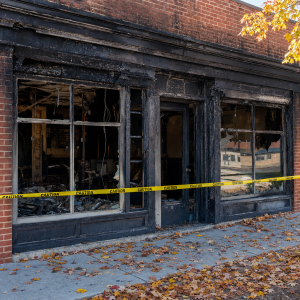
Imagine this scenario: a fire guts part of your home. You file a claim, and your insurance company agrees to pay for the repairs. So far, so good. But then the county inspector shows up and drops a bomb: the whole damaged section has to be rebuilt to meet today's building codes, using materials and methods that are way more expensive than what you had before.
Suddenly, you're on the hook for tens of thousands of dollars because your insurance company is refusing to pay. This exact nightmare is what code upgrade coverage is meant to prevent, but insurers like State Farm and Allstate will fight you tooth and nail to avoid paying it.
Why You Must Fight for Code Upgrade Coverage
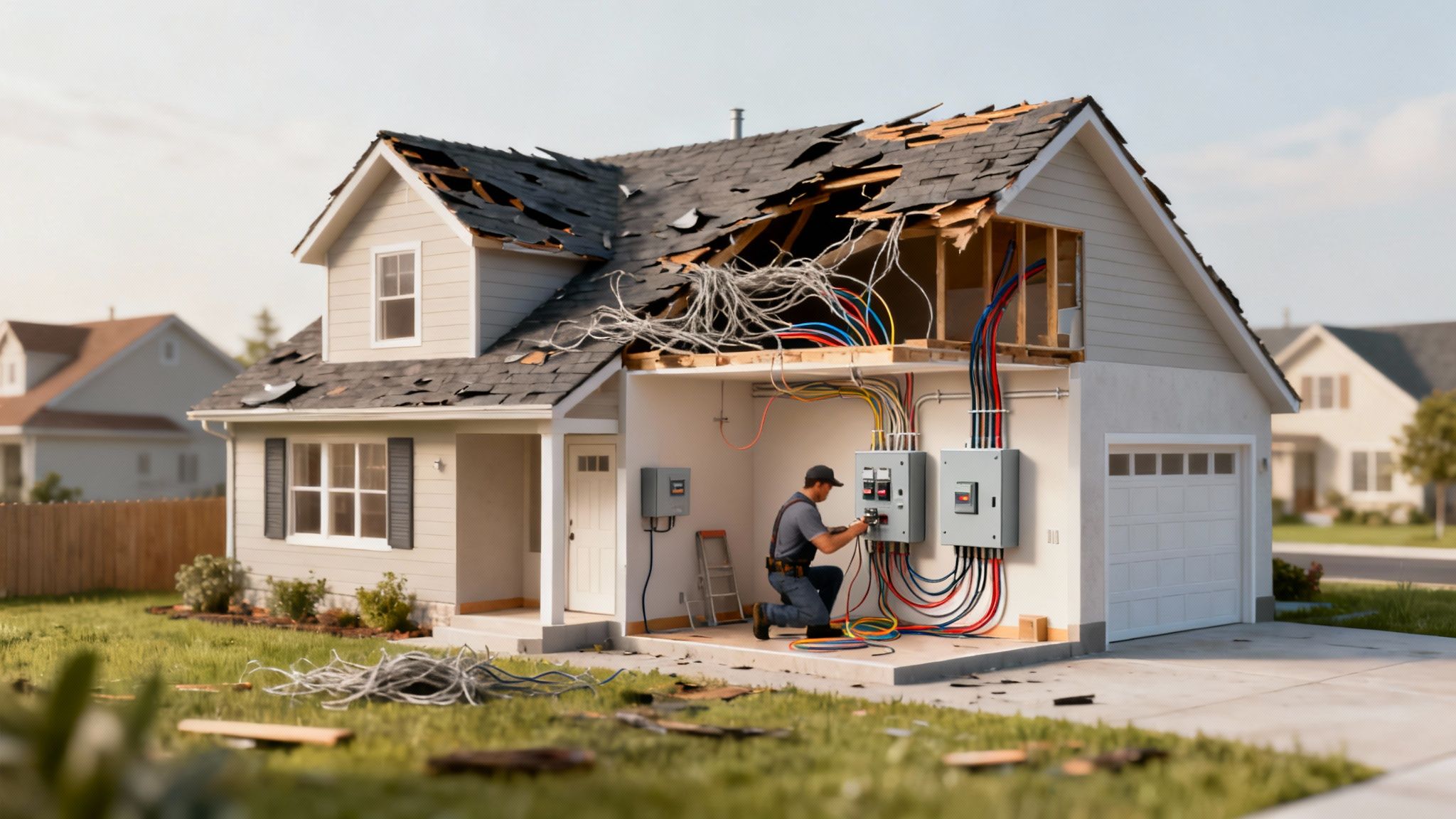
Think of your standard insurance policy as a promise to put things back the way they were. Insurers will tell you it’s written to replace what you lost with materials of “like kind and quality.” If your house had 30-year-old wiring, your insurer wants to pay you for 30-year-old wiring—a cheap and easy out for them.
The problem? Your local government doesn't care what your policy says. The law, in the form of building codes, demands you install modern, safe electrical systems. This creates a huge, expensive gap between what your insurance company’s lowball offer is and what you’re legally forced to pay to rebuild.
This is where Ordinance or Law coverage—another name for code upgrade coverage—is supposed to save the day. It’s an add-on, called an endorsement, designed specifically to cover these mandatory, increased costs of construction. Without it, you’re paying for every single one of those required upgrades out of your own pocket.
A Common Scenario Insurers Exploit to Underpay You
Let’s say a fire torches your kitchen. Your home was built in 1990. Today's codes demand things like Ground Fault Circuit Interrupter (GFCI) outlets, arc-fault breakers, and specific wiring that didn't even exist back then.
Your insurance company, whether it’s a big name like Allstate or a smaller carrier, will send an adjuster who writes a ridiculously low estimate to replace only the old-style outlets and wiring. They’ll argue their only job is to restore your kitchen to its pre-fire condition. What they conveniently leave out is that no licensed contractor on the planet can legally do the work that way. It’s a classic tactic to lowball your claim right from the start.
To really get why this matters, it helps to have a handle on what codes actually cover. You can start by understanding common building code violations.
Your insurance policy was written to protect your property, but building codes are written to protect people. When there's a conflict after a loss, the codes always win, and insurers count on you not having the right coverage to pay for it.
This gap is where the real fight begins, and it’s where having a public adjuster becomes non-negotiable. We see this battle in almost every single claim involving an older property. The insurance company's first offer is almost never enough to get the job done right and legally, leaving homeowners feeling blindsided and completely underfunded.
How Insurers Intentionally Underpay Code Upgrade Claims
Let’s be blunt: most insurance carriers treat your code upgrade coverage like an annoying line item they hope you’ll never notice. Their goal is to cover the bare minimum, and their strategy for doing it is both simple and brutally effective.
It starts with their first estimate. They’ll write up a scope of work based purely on replacing what you had before the loss—what they call "like kind and quality." They’ll intentionally, and completely, ignore all the mandatory and often expensive upgrades the law now requires to rebuild.
This isn't an oversight. It's a calculated move. An adjuster from a big-name carrier might scope a fire-damaged wall to include only the old-style wiring and basic insulation that was there before. They know full well that today's building codes demand upgraded electrical systems, much higher R-value insulation, and sometimes even different structural supports. But that won't be in their initial offer.
This tactic immediately creates a massive financial shortfall. The insurer's lowball number is based on a fantasy world where building codes don't exist, leaving you on the hook for the very real costs needed to legally and safely put your property back together.
The "Like Kind and Quality" Deception
Insurance companies love to hide behind the "like kind and quality" language in your policy. They’ll act as if it’s an unbreakable rule that stops them from paying for anything better than what you had, even if the law says otherwise. This is a deliberate misinterpretation designed to cap their payout and protect their profits.
Key Tactic: The company adjuster's first estimate is a strategic anchor. By starting with a low number that excludes all code upgrades, they frame the negotiation in their favor, forcing you to fight for every single dollar you are rightfully owed.
The whole reason code upgrade coverage exists is to override this exact limitation when a law or ordinance forces your hand. When you see them pulling this, you need to understand how to dispute an insurance claim and fight back.
Success Story: Overturning a Six-Figure Lowball Offer
A business owner in North Carolina had their commercial building ravaged by a fire. The initial settlement offer from their insurance company came in nearly $100,000 short of what it would actually cost to rebuild.
Why the huge gap? The insurance adjuster’s estimate completely ignored the new fire suppression system standards and critical ADA (Americans with Disabilities Act) compliance codes required for any new construction.
The insurer tried to argue that these were "improvements," not covered repairs. It was a classic deflection. The fight only turned when the business owner hired a public adjuster who came in armed with facts. The PA built a detailed report citing the specific municipal codes, got letters from local building officials, and proved these weren't optional upgrades—they were legal requirements. Faced with undeniable evidence, the insurer had no choice but to reverse its decision and pay the six-figure difference. This is a common story where a public adjuster forces an insurance company to pay what they rightfully owe.
The Three Parts of Ordinance or Law Coverage Insurers Don't Explain
Insurance companies know that "code upgrade coverage" sounds complicated, and they often use that confusion to their advantage. They're banking on you not realizing it isn't one single benefit but is typically broken into three distinct parts.
Pulling back the curtain on these components is the first step in fighting for the full settlement you're owed. Most policies, if they even include this critical endorsement, structure it into Coverage A, B, and C. Each part is designed to cover a specific—and often massive—cost that pops up when building codes force your hand during a repair. They're meant to work together to make you whole.
This is exactly the kind of complexity insurers exploit to create underpaid claims, and it all starts with a flawed estimate.
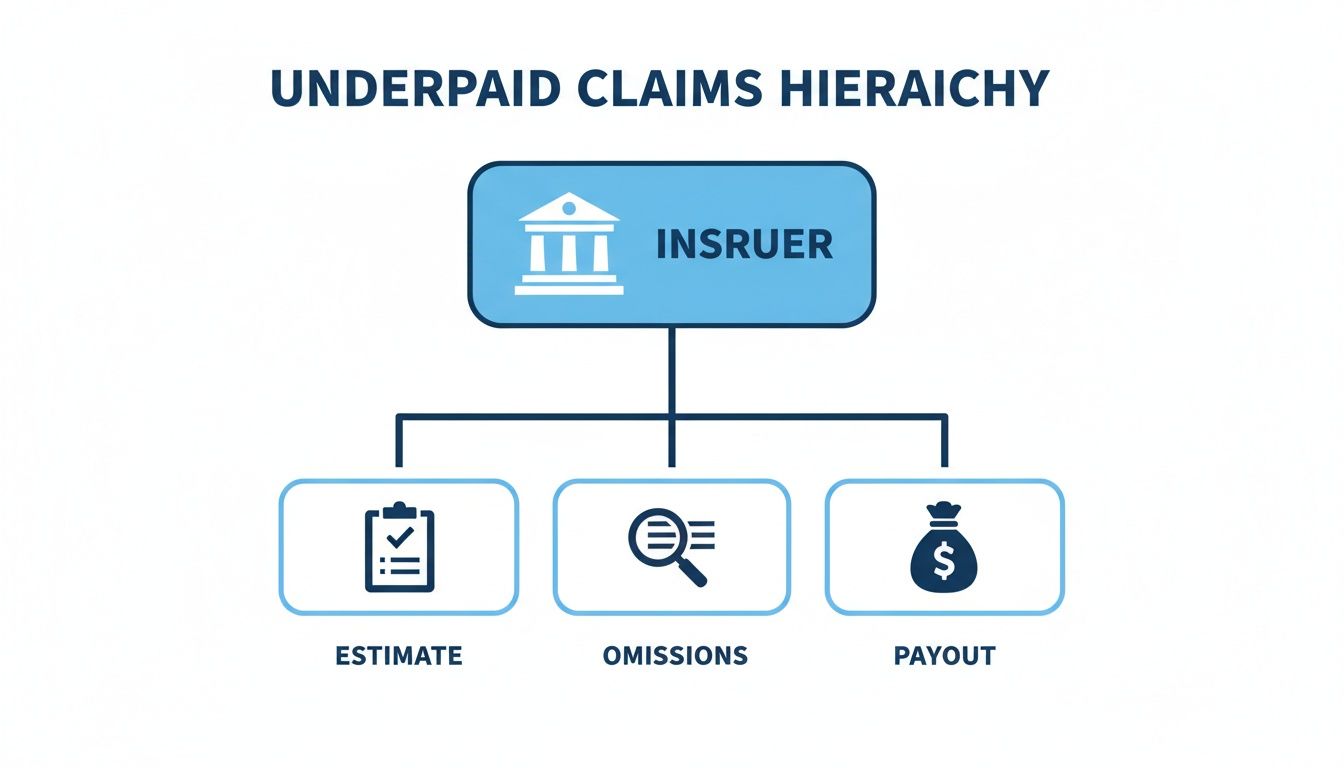
As you can see, a lowball estimate full of deliberate omissions is the foundation for an unfairly small payout. Let's break down the three pillars of this coverage so you know what they're leaving out.
The Three Pillars of Ordinance or Law Coverage
Understanding the three separate coverages within your Ordinance or Law endorsement and what each one pays for during a claim.
| Coverage Part | What It Covers | Real-World Example |
|---|---|---|
| Coverage A | Loss to the Undamaged Portion of the Building | A fire guts 40% of your property. The local code requires a total teardown if damage exceeds a certain threshold. Coverage A pays for the value of the perfectly good, untouched 60% that must now be demolished by law. |
| Coverage B | Demolition Cost | This pays for the heavy machinery, labor, and disposal fees required to tear down that undamaged 60%. Standard property coverage doesn't include demolishing undamaged property—this does. |
| Coverage C | Increased Cost of Construction | This is the "code upgrade" part. It covers the extra cost to rebuild the entire structure to meet modern codes, such as new electrical, plumbing, or structural safety requirements. |
Each of these parts is a battleground where insurers try to save money at your expense. Knowing what they cover is your first line of defense.
Coverage A: Loss to the Undamaged Portion
This is, without a doubt, the most misunderstood—and fiercely fought over—part of the coverage. Let's stick with that fire example. A fire damages 40% of your commercial building. The local building code, however, says that if more than a certain percentage of a structure is damaged, the entire building must be demolished and rebuilt to current standards.
Coverage A is designed to pay you for the value of the 60% of your building that wasn't even touched by the fire but must now be torn down by law. Without this, your insurer would only pay for the fire-damaged section, leaving you to eat the massive financial loss of your perfectly good, undamaged property.
An insurer's refusal to acknowledge Coverage A is a classic tactic. They will try to limit their payout to only the physically damaged areas, conveniently ignoring the legal requirement to demolish the rest of the structure.
Coverage B: Demolition Cost
Following that same scenario, Coverage B steps in to pay for the actual, physical act of tearing down that undamaged 60% of the building.
Think about it: demolition is an expensive, labor-intensive process. It involves heavy machinery, debris removal, and hefty disposal fees. This coverage part is crucial because your standard dwelling or building coverage absolutely does not include the cost of tearing down undamaged property. Insurers often "forget" to include these costs in their initial settlement offers.
Coverage C: Increased Cost of Construction
Finally, Coverage C is what most people think of when they hear "code upgrade coverage." This part pays for the increased expense of rebuilding the structure from the ground up to meet modern, and much stricter, building codes.
This bucket of money covers the higher costs for mandatory upgrades like:
- Superior electrical wiring and panels
- Energy-efficient windows and insulation
- Updated plumbing systems
- Hurricane-straps or fire-suppression systems
This is the money you need to legally complete the repairs. You can learn more by reading our complete guide on what is ordinance or law coverage. Understanding how all three parts work together is essential to preventing an insurer from leaving you tens or even hundreds of thousands of dollars short.
How a Public Adjuster Forces the Insurer to Pay Your Code Claim
When an insurance company demands proof that a code upgrade is necessary, they aren't just asking a question. They're building a fortress of paperwork designed to wear you down until you give up.
They’ll demand specific code citations, letters from building officials, and complex engineering reports. It’s an intentional, overwhelming burden they place on you right when you’re trying to recover from a disaster.
This is where a public adjuster completely levels the playing field. Instead of you having to become a building code expert overnight, a public adjuster takes on this fight for you. They’ve seen the insurer’s playbook a hundred times and know that winning a code upgrade coverage dispute requires undeniable evidence, not just arguments.
Building an Ironclad Case to Beat the Insurance Company
A good public adjuster’s process is methodical and aggressive. They don't just ask the insurance company to pay; they compile the exact documentation needed to force their hand.
This isn't about making a simple phone call. It’s a multi-step, forensic approach:
- Deep Code Review: We dig into all current local, state, and federal building codes that apply to your property. We pinpoint the exact statutes that mandate the upgrades, leaving no room for interpretation.
- Official Engagement: A public adjuster engages directly with municipal inspectors and building code officials on your behalf. We get the official letters and enforcement opinions that your insurer is demanding from you.
- Expert Collaboration: If the situation calls for it, we bring in structural engineers or other specialists to create detailed reports that prove the upgrades are not optional "improvements" but non-negotiable legal requirements.
In short, we handle the entire burden of proof. Understanding what a public adjuster does in these fights shows how they dismantle the insurer's delay-and-deny tactics with cold, hard facts. They systematically build a case so strong that the insurance company has no legitimate path to a denial.
A public adjuster's report isn't just a suggestion; it's an evidence-backed demand. It transforms the conversation from "if" the insurer will pay to "when" they will pay.
Success Story: Forcing an Insurer to Pay for Hurricane Windows
A homeowner in coastal Florida had their home battered by a nasty hurricane. Their insurance company, a major national carrier known for fighting claims, agreed to replace the damaged windows. But they flat-out denied the claim for the upgraded, hurricane-resistant windows now required by code.
The insurer’s logic? The old windows weren't hurricane-rated, so they only owed for a cheap "like kind" replacement. This denial would have cost the homeowner over $25,000 out-of-pocket and left their home dangerously vulnerable to the next storm.
That's when they hired a public adjuster.
The public adjuster immediately pulled the current county building codes and zeroed in on the specific wind-load requirements that had been updated since the home was built. We didn't just tell the insurer they were wrong; we presented them with an undeniable report citing the exact code sections. We even included a letter from the local building official confirming the new windows were mandatory for any permitted repair work.
Faced with clear, documented proof, the insurance company had nowhere to hide. They quickly reversed their denial and paid the claim in full, including the entire cost for the upgraded hurricane-resistant windows. That’s the power of having a real expert fighting in your corner.
Common Excuses Insurers Use to Deny Your Coverage
Insurance companies didn't get rich by paying claims fairly. They have a well-worn playbook of excuses designed to avoid paying for expensive, code-mandated repairs. They know that if they can confuse you and drag out the process, you're more likely to give up and accept a lowball offer.
Don't mistake these tactics for honest disagreements. They are calculated strategies designed to protect their bottom line at your expense. When you hear these arguments, it’s a giant red flag that you’re in for a fight and need a professional in your corner.
"The Code Was Already in Effect Before the Damage"
This one is a classic, a favorite of carriers like State Farm and Allstate. They’ll argue that since the building code was already on the books before your property was damaged, it's a "pre-existing condition" they aren't responsible for. This is a complete and deliberate misapplication of how this coverage actually works.
The trigger for Ordinance or Law coverage isn't when the code was written. It’s when the damage occurs. The loss is what forces you to make repairs, and in doing so, you are legally required to meet the current code standards. A good public adjuster shuts this nonsense down immediately by showing that the property damage is the direct cause of the required code-compliance costs.
Key Takeaway: It doesn't matter if the code is 10 days or 10 years old. If the damage to your property forces you to spend money to comply with that code during the repair, the coverage is triggered. It’s that simple.
"Your Policy Limit is Exhausted"
Here’s another sleight-of-hand trick. The insurer will claim the cost of the code upgrades pushes you over your main dwelling or building coverage limit. What they "forget" to mention is that code upgrade coverage almost always has its own, separate limit of liability.
This coverage is additional money, stacked on top of your primary policy limits. For example, your policy might have a 10% or 25% separate limit just for these costs. Insurers who try to lump everything together are banking on the hope you haven't read the fine print in your own policy.
"The Upgrade is an Improvement Not a Repair"
This is maybe the most insulting argument of them all. When a local ordinance requires you to install hurricane straps, bring your electrical panel up to spec, or add a modern fire suppression system, the insurer will try to call these "improvements" or "betterments."
This is a willful misinterpretation. You aren't choosing to add these things for fun or for cosmetic reasons; they are legally mandated repairs required to get a building permit. A public adjuster stops this argument cold by getting written documentation from building officials confirming these items are non-negotiable.
Insurers have a long and documented history of playing this game. In the landmark case Sanz v. U.S. Security Ins. Co., the court found the insurance company acted in bad faith by refusing to pay for legally required code upgrades, setting a precedent that protects policyholders from this exact tactic. When an insurer denies these required expenses, they aren't just breaking their contract—they are actively preventing you from legally and safely rebuilding your own property.
Your Top Questions About Code Upgrade Coverage Answered
Going through a property damage claim is a nightmare. The last thing you need is to get bogged down in confusing insurance jargon designed by the carrier to frustrate you. Let's cut through the noise and get you straight answers to the most common questions we hear from homeowners and business owners fighting for the code upgrade coverage they paid for.
My Adjuster Says I Don't Have Code Upgrade Coverage. What Now?
First thing's first: Never, ever take the insurance company's first "no" as the final answer. This is a classic move. They're hoping you'll just give up without digging any deeper. The reality is, many standard policies have some level of Ordinance or Law coverage built right in, even if it's not a lot.
Your next move is to demand a complete, certified copy of your entire insurance policy, including every single endorsement. Don't let them fob you off with a simple summary or declarations page. An experienced public adjuster can tear this document apart for you—they know the exact forms and contract language to look for, and they often find coverage the company adjuster conveniently "overlooked."
How Much Ordinance or Law Coverage Do I Actually Need?
This is a critical question, and the answer depends entirely on how old your property is and how strict your local building codes are. A lot of policies default to a measly 10% of your main dwelling coverage. For most homes built more than 20 years ago, that's a dangerously low number that leaves you exposed.
Think about it. If your older home suffers a major loss, the cost of bringing everything up to today's code could easily tack on an extra 25-50% to your repair bill. We always tell clients to push their agents for much higher limits—think 25%, 50%, or even 100% of your dwelling coverage. Don't let your insurer leave you with a six-figure bill you weren't expecting.
Can the Insurance Company Take My Deductible Out of the Code Upgrade Payment?
Yes, your deductible applies, but you have to watch how they apply it. Your policy deductible should only be taken out once from the total claim settlement. That total includes the direct physical repairs and the code upgrade costs combined.
Here’s a dirty little trick insurers love to pull: they’ll try to apply your deductible to different parts of the claim separately. This is just a shell game to make you pay your deductible two or three times for the same loss.
A good public adjuster will audit the final settlement to make sure your deductible is applied correctly—one time and one time only. It’s a simple way they stop the insurance company from shortchanging you and keeping money that contractually belongs to you.
If your insurance company is giving you the runaround on code upgrades or any other part of your property damage claim, you don't have to take them on by yourself. The team at For The Public Adjusters, Inc. is here to review your claim for free and make sure you get every penny you're owed. Visit us online to get the expert help you need to win this fight.