
When you file a claim for fire damage, you’re expecting a safety net. You’ve paid your premiums, and now you need the help you were promised. But the hard truth is, filing that claim is often just the beginning of a brutal fight.
You have to get one thing straight before you even make the first call: your insurance company is a business. A for-profit business. Their entire model is built on one simple equation—collect more in premiums than they pay out in claims. This isn’t a partnership; it’s a financial conflict of interest from the word go.
Why Your Insurer Is Not on Your Side
After the shock of a fire, it’s natural to want to believe your insurance company will rush in to make things right. That belief, unfortunately, is a costly mistake. Industry giants like Allstate and State Farm didn’t become corporate titans by being generous. They built their empires by mastering the art of paying as little as legally possible.
The moment you report that fire, a switch flips inside their system. You’re no longer just a policyholder; you’re a liability. A number on a spreadsheet. Your claim for fire damage represents a potential loss for them, and their internal machine is designed to do one thing: minimize that loss. It’s not personal—it’s just how their business works.
The Adjuster Works for Them, Not You
Right away, your insurer will assign an adjuster to your case. They’ll probably sound friendly, concerned, and helpful. Don’t be fooled. That adjuster’s loyalty is to one party and one party only: their employer.
Their job is to look at your devastating loss through a corporate lens. They are professionally trained to scrutinize your policy, find any reason to limit coverage, and write up an estimate that serves the company’s financial interests—not yours.
Think about it. Their job performance, their raises, their entire career path depends on how well they “manage claim severity.” That’s just corporate jargon for saving the company money by short-changing you. The conflict is baked right into the system.
Common Tactics to Reduce Your Payout
Insurance companies have a whole playbook of strategies they use to underpay, delay, and deny valid claims. If you can spot these moves, you can start to defend yourself.
- Delay, Delay, Delay: They know you’re displaced, stressed, and running out of money. The longer they drag their feet, the more desperate you become. They’re betting that eventually, you’ll get tired of fighting and accept a lowball offer just to move on with your life.
- Death by Policy Language: They’ll pull out obscure, confusing clauses from your insurance policy to justify paying for cheap repairs instead of proper replacement, or to deny coverage for items that should absolutely be included.
- The Lowball First Offer: The first settlement offer you get is almost never fair. It’s a test. They throw out a low number hoping you’re too overwhelmed or uninformed to realize how inadequate it is and just accept it.
You have to completely change your mindset. Your insurance company is not your protector. They are the other side in a legal and financial negotiation. Your policy is a contract, and you’re going to have to force them to honor it.
Understanding this adversarial relationship from day one is the most critical piece of the puzzle. Every email, every phone call, and every document you sign must be handled with the cold, hard knowledge that the people on the other side are working against you. That awareness isn’t paranoia—it’s your best defense in the fight to get a fair settlement for your claim for fire damage.
Building an Undeniable Record of Your Loss
When you’re staring down a fight with your insurance company over a claim for fire damage, you need to understand one thing: your memories don’t count. Your gut-wrenching experience means nothing to carriers like Allstate or State Farm. They live and breathe paperwork, reports, and policy loopholes.
To win, you have to beat them at their own game. That means building a mountain of undeniable evidence so thorough that it leaves them zero room to argue. This isn’t just about getting what you’re owed; it’s about systematically dismantling the lowball estimate their adjuster is trained to give you. Every photo you take, every call you log, is a weapon in your arsenal.
Documenting Structural and Hidden Damage
The insurance adjuster’s first visit is almost always a quick, surface-level inspection. They’re looking for the obvious charring and scorch marks. They are not looking for the hidden, pervasive damage that smoke and heat leave behind. Your job is to prove the real extent of the loss.
This starts with a camera. Don’t just snap a few pictures of the worst room. Get obsessive.
- Take hundreds of photos. Seriously, hundreds. Get your phone and document every single room from every possible angle. Even rooms that look fine can have soot damage.
- Shoot video walkthroughs. As you move through the property, talk to your camera. Describe the acrid smell, the greasy film on surfaces—things a picture can’t capture.
- Dig into the hidden spots. Insurers love to pretend places like attics, crawlspaces, and wall cavities don’t exist. Get in there. Peel back roof shingles and photograph the soot underneath. Open every cabinet and closet and record the smoke stains inside.
Here’s a pro tip: Smoke particles are microscopic invaders. They get into your HVAC system, your insulation, and your wiring, creating long-term health hazards. When an insurer offers to just “clean the air,” it’s often a cheap tactic to avoid a much bigger bill for proper remediation. Don’t fall for it.
This detailed visual record is your best defense when an adjuster tries to claim the damage is only cosmetic. You’re proving that the home’s structural integrity and safety have been fundamentally compromised.
This infographic lays out the playbook insurers often use, starting with delays designed to frustrate you into giving up.
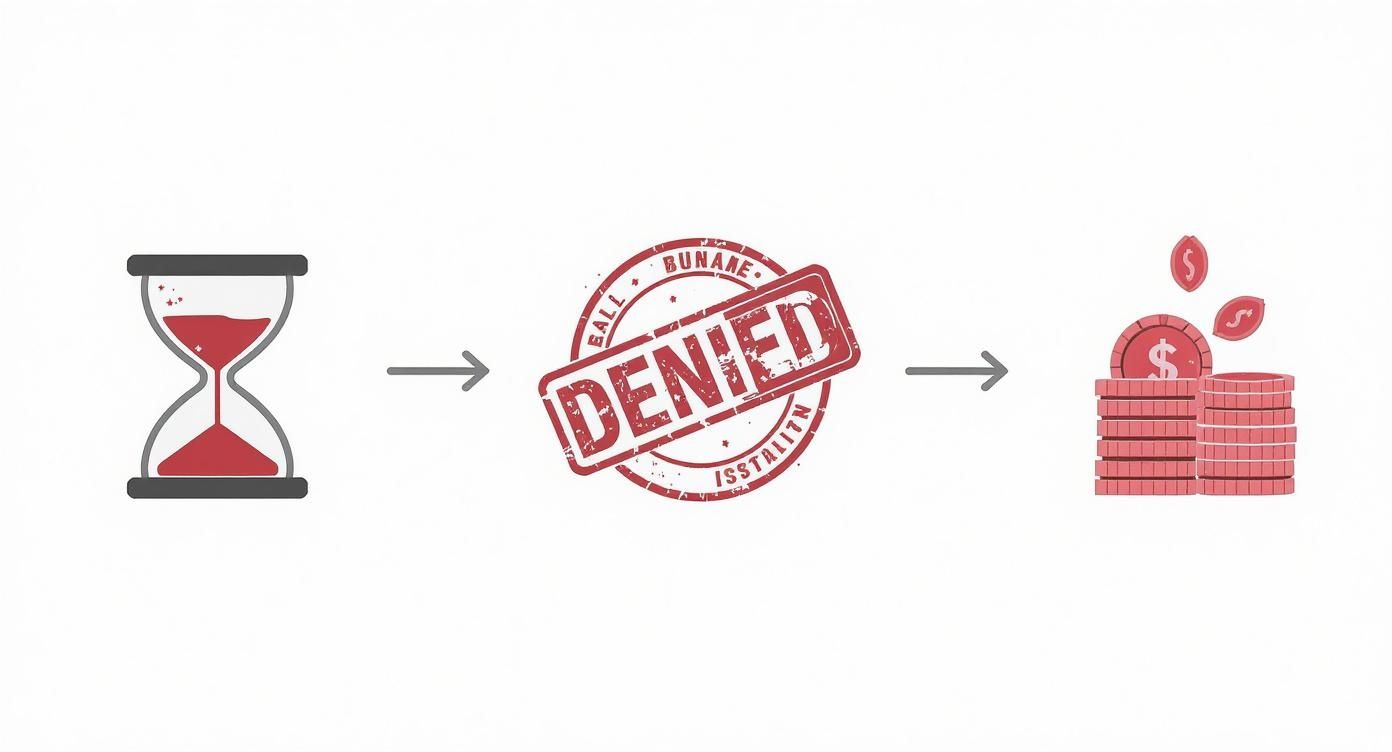
Knowing their strategy of delay, deny, and underpay allows you to get one step ahead and counter their moves with cold, hard proof.
Creating an Exhaustive Personal Property Inventory
Next comes the most tedious—and most critical—part of the process: creating a detailed list of every single thing you lost. This is where insurance companies make a fortune, by undervaluing a lifetime of your possessions. Never, ever accept their generic “contents estimation.”
You need to build your own list, ideally in a spreadsheet. For every item, include:
- Item: Be painfully specific. Not “TV,” but “Samsung 55-inch 4K Smart TV.”
- Brand and Model Number: Do your best to find this.
- Age of Item: An honest guess is perfectly fine.
- Original Cost: Dig up old receipts, credit card statements, or Amazon order histories.
- Replacement Cost: This is huge. Find a link online for the same or a very similar item being sold new today and paste the URL right into your spreadsheet.
This level of detail makes it almost impossible for the insurer to argue your stuff was worthless junk. They will try to pay you only the actual cash value (what it was worth with depreciation), but your list of replacement costs is the foundation for demanding what your policy actually owes you.
Maintaining a Meticulous Communication Log
Finally, you must document every single interaction you have with the insurance company. Let me be clear: delays and misdirection are not mistakes; they are tactics. A communication log is your timeline of their bad faith practices.
Get a dedicated notebook or start a simple Word doc. Log everything.
- The date and time of every call, email, or meeting.
- The name and title of every person you deal with.
- A summary of the conversation, including any promises they made or deadlines they gave you.
- Your claim number on every single piece of correspondence.
After every phone call, immediately send a follow-up email. It can be as simple as, “Hi [Adjuster’s Name], just wanted to confirm our phone call today, [Date], at [Time], where you stated that…” This creates a paper trail they can’t wiggle out of. This log becomes indispensable when your claim for fire damage is inevitably and unreasonably delayed.
Using Your Policy to Dismantle Their Arguments
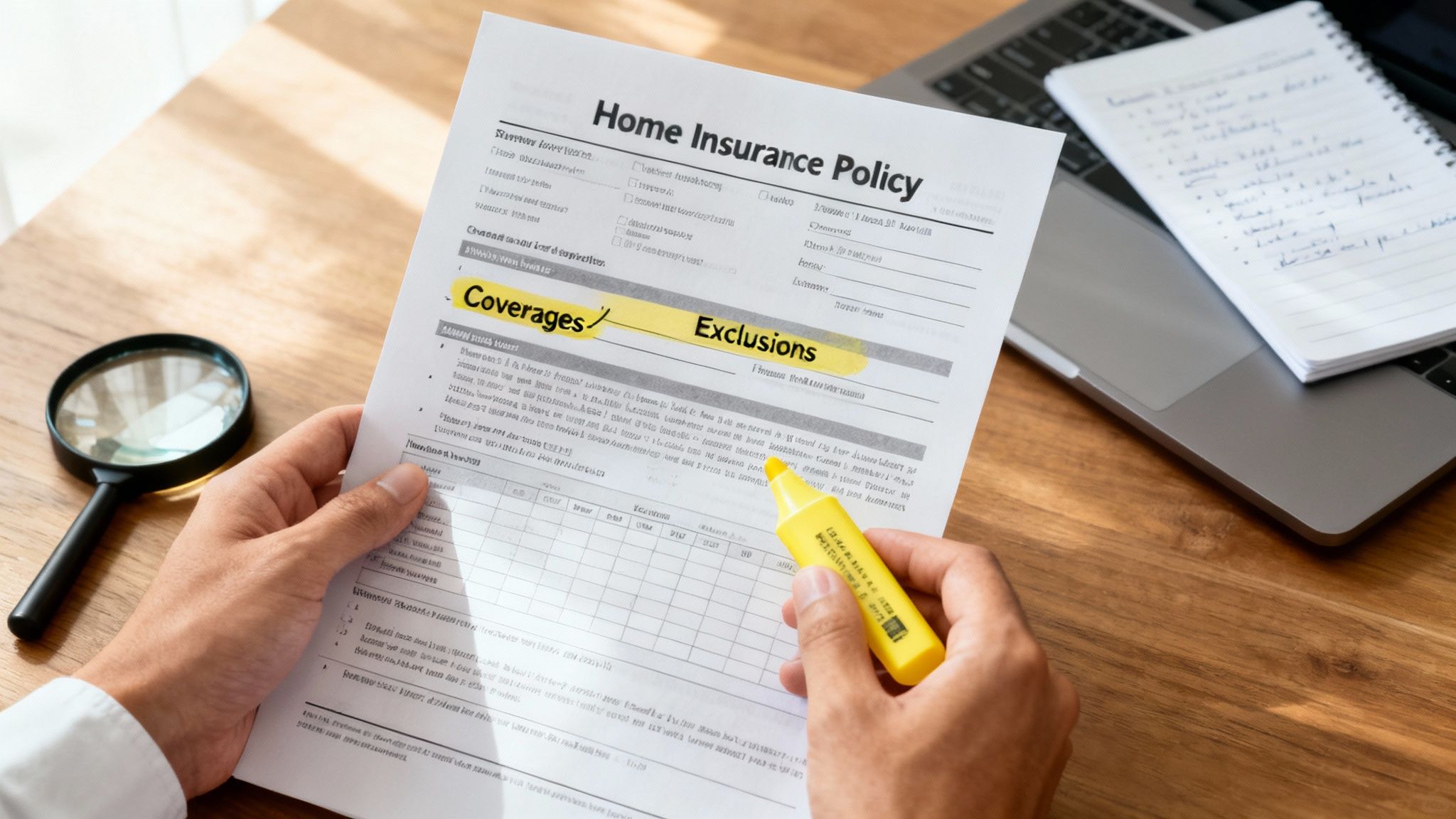
An insurance policy is a dense, legally complex contract, and carriers like State Farm and Allstate are counting on that. They know you’re not an expert. They use confusing language and obscure clauses as a smokescreen to justify lowball offers and wrongful denials on a valid claim for fire damage. To fight back, you have to learn to read your policy not as a victim, but as an adversary.
Your policy is the rulebook for this fight, and the insurance company is legally bound by it. By understanding a few key sections, you can turn their own contract against them. Never let their adjuster tell you what your policy means; find the exact language and use it to dismantle their flimsy arguments.
Know Your Core Protections
Before you can argue, you need to know what you’re actually entitled to. Your policy is broken down into specific categories of protection. For a fire claim, you need to master these areas first.
- Coverage A (Dwelling): This is for the main structure of your home or business. It’s not just the walls and roof; think built-in cabinets, flooring, and permanently installed fixtures.
- Coverage B (Other Structures): This handles structures on your property that aren’t attached to the main building—things like a detached garage, a shed, or the fence around your yard.
- Coverage C (Personal Property): This covers your belongings. Furniture, electronics, clothes, kitchenware—it’s all in here. This is often where insurers try to aggressively undervalue your loss.
- Coverage D (Loss of Use/Additional Living Expenses): If the fire forces you out, this coverage pays for reasonable expenses like hotel stays, rent for a temporary home, and even restaurant meals if you have no kitchen.
These coverages aren’t suggestions; they are your rights. When an adjuster tries to limit your payout, your first move should be to open the policy and point to the exact coverage that applies. For a closer look at these sections, you’ll find more details by understanding homeowners insurance coverage, which will help you prepare for the fight.
Uncovering The Adjuster’s Loopholes
Insurance companies are experts at misinterpreting their own policies to save a buck. They’ll latch onto a single phrase or exclusion, twist its meaning, and present it to you like it’s the final word. Your job is to call them out on this tactic with hard evidence from the contract itself.
One of the most common battlegrounds is “matching.” Let’s say a fire damages a section of your siding or roofing. The original materials are often discontinued.
The insurer may offer to replace only the damaged section with a similar—but visibly different—material, leaving your home looking like a patchwork quilt. This is a classic lowball move. Many policies contain language requiring them to restore your property to its “pre-loss condition,” which implies a uniform, matching appearance.
Smoke damage is another favorite trick. An adjuster might claim that since a room didn’t have visible flames, the smoke and soot are just a “cleaning issue.” This is nonsense. Smoke is a corrosive, toxic byproduct of fire that gets into your HVAC system, insulation, and wall cavities, posing long-term health risks.
Your policy covers “direct physical loss” from fire and smoke. That persistent, hazardous residue is a physical loss, and you have to force them to treat it that way—not as a surface-level inconvenience. By finding the exact definitions and coverage grants in your policy, you can build an airtight case that forces them to honor the full scope of your claim for fire damage.
How to Fight a Lowball Settlement Offer
Let’s be clear: the first settlement offer you get for your claim for fire damage is almost never their best one. It’s a test. Insurers like Allstate or State Farm are making a calculated business move, betting that you’re exhausted, overwhelmed, and just want the nightmare to end.
Accepting that first offer is exactly what they’re hoping you’ll do. It’s also the single biggest mistake you can make at this stage.
Don’t see their lowball figure as a final verdict. See it for what it is: an invitation to start the real fight. It’s time to formally dispute their numbers and prove the actual value of what you’ve lost.
Deconstruct Their Estimate Line by Line
Your insurer’s estimate isn’t a helpful document; it’s a weapon designed to minimize your payout. It’s almost guaranteed to be packed with low-cost materials, inaccurate measurements, and completely omitted steps. Your first job is to tear it apart.
Demand a copy of their detailed breakdown, often called a “scope of loss,” and go through it with a fine-tooth comb.
You’ll find their playbook is predictable. Look for these common tricks:
- Convenient Omissions: Did they forget to include the cost of priming walls before painting? What about the critical step of sealing the entire structure with shellac to block that stubborn smoke odor for good? These aren’t small details; they’re essential repairs.
- Faulty Measurements: Never, ever trust their numbers. Insurers are notorious for under-measuring square footage for flooring, drywall, and paint. Shaving off a few feet here and there adds up to thousands of dollars they don’t have to pay you.
- Low-Grade Replacements: They’ll price out cheap, builder-grade carpet to replace the high-end wool carpet you lost. They’ll offer flimsy laminate for the custom hardwood floors that were destroyed. This is a direct violation of their promise to restore your property to its pre-loss condition.
Your mission is to create a counter-document that flags every single one of these discrepancies. A detailed, line-by-line rebuttal sends a powerful message: you’re not going to be an easy target.
Arm Yourself with Independent Estimates
You can’t fight their biased numbers with your opinion. You need to fight them with cold, hard evidence from the real world. This is where you bring in your own team.
Get at least two or three detailed estimates from trusted, licensed contractors in your area. Whatever you do, do not use the “preferred vendors” your insurance company recommends. Those contractors have a clear conflict of interest—their loyalty is to the insurer who sends them a steady stream of business, not to you.
When you slap down multiple bids from reputable local builders, it instantly shows what it actually costs to make you whole. Their flimsy, lowball estimate suddenly has nowhere to hide.
An insurer will often claim their estimate is based on “regional cost averages” using software like Xactimate. This is code for using non-local, low-cost labor and cheap material pricing. Your local contractor’s estimate reflects the true market rate for quality work in your community, which is what you’re owed.
Insurance companies often rely on a few key tactics to wear you down and justify their low offers. Understanding their game is the first step to beating them at it.
Insurer Tactics vs Your Countermoves
| Insurer’s Tactic | What It Looks Like | Your Strategic Countermove |
|---|---|---|
| The “Regional Average” Excuse | They use software with outdated or non-local pricing to claim your contractor’s bid is “too high for the area.” | Present multiple, detailed bids from respected local contractors. This proves the true market rate and exposes their numbers as unrealistic. |
| Material Mismatch | They price out cheap, builder-grade materials to replace the custom or high-end finishes you actually had. | Provide receipts, photos, or even samples of your original materials. Reference your policy’s “like kind and quality” clause. |
| Omitted Scope | Their estimate conveniently leaves out crucial steps like smoke odor sealing, code upgrade requirements, or proper debris removal. | Have your independent contractor create a “scope to scope” comparison, highlighting everything the insurer missed. |
| Stall and Delay | They drag their feet, “lose” your documents, or become unresponsive, hoping you’ll get desperate and accept their low offer. | Communicate in writing (email is best) to create a paper trail. Set clear deadlines for a response in every message you send. |
These tactics are designed to make you feel powerless, but with the right evidence, the power shifts back to you.
Write a Formal Dispute Letter
Now that you’ve dismantled their estimate and gathered your own, it’s time to go on the offensive. Stop arguing on the phone where nothing is documented.
Draft a firm, professional dispute letter that methodically lays out your case. This creates a permanent record and signals to the insurer that you’re taking this seriously.
Your letter needs to accomplish five critical things:
- Formally Reject Their Offer: State clearly that you are rejecting their settlement offer of [$ amount] as it is grossly insufficient to cover the damages.
- Present Your Evidence: Attach your line-by-line analysis of their flawed estimate. Show them you’ve done the work.
- Submit Your Contractor Bids: Include copies of the independent estimates you secured. This is your proof of the real-world costs.
- Reference Your Policy: Quote the specific language from your policy that supports your right to be made whole, especially clauses about “pre-loss condition.”
- Set a Firm Deadline: Conclude by stating you expect a revised and fair offer within a reasonable timeframe, like 15 or 30 days.
This letter is a strategic power move. It proves you’re not just complaining; you’re building a case. By systematically taking apart their lowball offer with facts, evidence, and professional resolve, you force them to abandon their initial playbook and start negotiating seriously.
This is how you take back control of your claim for fire damage.
Hiring a Public Adjuster to Even the Odds
When the insurance company shows up to your fire-damaged home, they don’t come alone. They arrive with a team of adjusters, engineers, and lawyers whose only job is to protect their employer’s bottom line. They have a team of experts fighting for them. Who’s fighting for you?
This is the fundamental imbalance you face in a claim for fire damage. Trying to navigate this alone is like walking into a courtroom without a lawyer. You’re emotionally exhausted and just trying to piece your life back together, while they are detached, experienced, and laser-focused on minimizing their payout. This is exactly where a public adjuster becomes your most critical ally.

The Critical Difference in Adjusters
It’s easy to get confused because not all adjusters are created equal. The word “adjuster” makes it sound like you’re dealing with an impartial referee, but that’s almost never the case.
- Company Adjuster: This person is a direct employee of your insurance company. Their salary, bonus, and entire career path are tied to how well they save the company money on claims. They work for the insurer, not you.
- Independent Adjuster: Don’t let the name fool you. These are third-party contractors hired by the insurance company, usually when they’re swamped after a major storm or disaster. Their paycheck comes from the insurance company, so that’s where their loyalty lies.
- Public Adjuster: This is the only type of adjuster licensed by the state to work exclusively for you, the policyholder. They have zero ties to the insurance company and a legal and ethical duty to act in your best interests.
A public adjuster’s entire job is to level the playing field. To see just how vital this difference is, you can explore the difference between an insurance adjuster and a public adjuster and understand why having your own expert is non-negotiable.
Your Advocate from Start to Finish
Hiring a public adjuster isn’t just about getting a bigger settlement check—it’s about offloading the enormous stress and technical burden of the claims process so you can focus on your family or your business. They take over the entire fight for you.
This means they handle everything: meticulously documenting the structural damage, inventorying every single lost personal item, bringing in specialists like industrial hygienists to test for unseen smoke and soot contaminants, and digging deep into your policy’s complex language to hold the insurer accountable for every penny they owe you. They manage all the phone calls, paperwork, and negotiations, shielding you from the delay tactics and constant pressure from the insurance company’s team.
A public adjuster is your professional representative in a high-stakes financial negotiation. They know the insurer’s playbook, speak their language, and have the expertise to dismantle the lowball arguments designed to shortchange you.
A Fee Structure That Aligns with Your Goals
One of the first questions people ask is, “How much does this cost?” The good news is that reputable public adjusters work on a contingency fee basis. This means you pay nothing upfront.
Their fee is simply a small, agreed-upon percentage of the final insurance settlement they secure for you. This structure creates a powerful alliance: they only get paid if you get paid, and the more money they recover for you, the more they earn. Their success is directly tied to yours, ensuring they are 100% motivated to fight for the absolute maximum settlement for your claim for fire damage. It’s the complete opposite of the company adjuster, whose goal is to pay you as little as possible.
Recognizing When a Dispute Becomes Bad Faith
It’s one thing to argue with your insurance company over the cost of repairs. That’s a dispute.
It’s something else entirely when their behavior crosses a line into outright bad faith. This isn’t just a fancy term for terrible customer service; it’s a legal concept. It means your insurer has deliberately and unreasonably failed to live up to its side of the contract—your policy.
Companies like State Farm and Allstate are experts at toeing this line. They’ll push you to your absolute breaking point, hoping you’ll give up before they technically break the law. But when their delays, lowball offers, and ridiculous denials are clearly designed to wear you down, not settle a real claim, they may be acting in bad faith.
Spotting these red flags is the first step in fighting back.
Spotting the Warning Signs
Bad faith isn’t one single action. It’s a pattern of unreasonable behavior. It’s when the insurance company isn’t just disagreeing with your claim for fire damage—they’re actively dodging their duty to treat you fairly.
Keep an eye out for these tell-tale signs:
- Refusing to Explain a Denial: If they deny your claim, they are legally required to give you a specific reason in writing. That reason must point to the exact language in your policy that justifies their decision. A vague denial is a massive red flag.
- A Worthless Investigation: A real investigation is thorough. If their adjuster shows up for 15 minutes, ignores clear smoke damage, and refuses to look at the evidence you’ve collected, that’s not a reasonable investigation. It’s a sham.
- Intimidation and Threats: Any attempt to scare you into taking a low offer is a classic bad faith tactic. If you hear things like, “This is our final offer, take it or get nothing,” or they threaten to cancel your policy for fighting back, they are trying to bully you.
- The Obvious Lowball: There’s a difference between a negotiation and an insult. An offer that is so laughably low it doesn’t even come close to covering the actual damage shows they have no intention of negotiating fairly.
This kind of behavior isn’t just frustrating—it’s a breach of their contract with you. If you’ve submitted a valid claim that’s been unfairly denied, learning how to appeal a denied insurance claim is your next critical move.
The Consequences of Bad Faith for Insurers
When an insurance company gets caught acting in bad faith, the penalties are severe. They go way beyond just having to pay what they owed you in the first place.
A finding of bad faith gives you, the policyholder, the right to sue for damages on top of your policy benefits. This can include money for the emotional distress they caused, financial losses you suffered because of their delays, and even your attorney’s fees. In the worst cases, courts can also hit them with punitive damages, designed purely to punish the insurer and stop them from doing it to anyone else.
This is exactly why documenting every single phone call, email, and delay is so critical. You’re not just building a case for your fire claim; you might be building a case for bad faith.
When to Escalate to Legal Counsel
A public adjuster is your best weapon for managing and negotiating the claim itself. But when you suspect the fight has turned into a case of bad faith, it’s time to bring in an attorney who specializes in insurance law.
If you’ve shown them undeniable proof and the insurer still won’t budge, makes threats, or is just stringing you along with endless delays, you need to seek legal advice.
The stakes get incredibly high for insurers in these situations, especially after major disasters. Take the 2025 Los Angeles wildfires, which became the costliest wildfire event in history. It caused an estimated $52.5 billion in economic losses, with $37.5 billion of that being insured.
When losses pile up that high, insurers often use aggressive, corner-cutting tactics to limit what they pay out—and those tactics can easily cross the line into bad faith. Learn more about how California wildfires created unprecedented exposure for insurers worldwide.
A letter from an attorney sends a very clear message: the bullying stops now, and you are fully prepared to take legal action to enforce your rights.
Your Top Questions About Fire Damage Claims, Answered
After a fire, you’re overwhelmed. Homeowners and business owners just like you find themselves asking the same questions, but getting a straight answer from an insurance company is nearly impossible. Their goal isn’t clarity; it’s to confuse you, wear you down, and underpay your claim for fire damage.
Let’s cut through the noise. Here are the real answers to the questions that keep you up at night.
How Long Does My Insurance Company Have to Settle My Claim?
This is the million-dollar question, and the answer is intentionally vague. While state laws set some guidelines, every insurance company has a duty to act in “good faith,” which means they have to handle your claim in a reasonable amount of time.
But here’s the reality: powerful insurance carriers use delays as a weapon. They know that the longer they stall, the more desperate you become. When you’re financially stretched to the breaking point, you’re far more likely to accept a lowball settlement just to get some money in your hands.
Is your adjuster constantly “losing” your paperwork? Are your calls and emails going unanswered? Are they blowing past their own deadlines with flimsy excuses? These aren’t just annoyances; they are classic signs of bad faith. Track every single delay in your communication log—it’s powerful evidence.
Can I Start Repairs Before My Claim Is Settled?
Hold off on any major work. The only repairs you should make are temporary, emergency fixes to prevent the damage from getting worse. Think boarding up shattered windows to keep the elements out or throwing a tarp over a hole in the roof. That’s it.
You absolutely should not hire a contractor to begin the actual rebuild.
Make sure you take photos of everything before and after these temporary repairs and save every single receipt. These costs should be covered by your policy as part of your duty to mitigate damages. But if you jump the gun and start major reconstruction, you hand the insurer a golden excuse to deny your claim for fire damage, arguing they couldn’t inspect the “original” loss.
Crucial Reminder: Never, ever accept the insurance company’s first offer. That number isn’t a fair assessment of your loss; it’s a strategic opening bid designed to be as low as possible. It’s their invitation to a negotiation, and you better come prepared to fight.
What If The Insurer’s Contractor Gives a Much Lower Estimate?
You are under no obligation to use the contractor your insurance company pushes on you. Insurers have a network of “preferred vendors” who understand the game: to keep getting referrals, they have to produce low estimates that save the insurance company money.
Their loyalty is to the carrier that feeds them business, not to you.
These lowball estimates are almost always based on using cheap, subpar materials and cutting corners on labor. Your best defense is to get at least three detailed, independent bids from your own trusted, licensed local contractors. These real-world numbers are your most powerful leverage, proving the true cost to restore your property the right way.
???? 10 Essential FAQs: Claim for Fire Damage
Q1: Does my homeowners insurance policy cover fire damage, and what parts of the policy apply?
A: Yes, fire damage is a covered peril under standard homeowners insurance (HO-3). Coverage applies to four main areas: Dwelling (structure), Other Structures (garage, shed), Personal Property (contents), and Additional Living Expenses (ALE) if the home is uninhabitable.
Q2: Does fire insurance cover damage from smoke, soot, and water used by firefighters?
A: Yes. Standard fire coverage extends to the secondary damage caused by the event. This includes pervasive smoke and soot damage that contaminates items, as well as the water damage and chemical damage caused by firefighting efforts, which is often extensive.
Q3: What are 'Additional Living Expenses' (ALE) after a fire, and how do I claim them?
A: ALE (or Loss of Use) covers the necessary and reasonable increase in living costs if your home is rendered uninhabitable by a fire. This includes costs for temporary housing (hotel/rental), extra mileage, restaurant meals, and pet boarding, which are claimed by submitting receipts to your insurer.
Q4: What is the most critical step a homeowner must take immediately after a fire for the claim?
A: After ensuring safety, the most critical step is to mitigate further damage (e.g., emergency board-up/tarping) and document everything. Take extensive photos and videos of the damage before cleanup starts. Do not discard damaged items until they have been inspected by an adjuster.
Q5: How do I create a contents inventory list for fire damaged personal property?
A: Create a detailed room-by-room inventory list, noting: the item description, approximate age/purchase date, cost to replace, and whether the damage is from fire, smoke, or water. Gathering receipts, photos of the items pre-loss, or warranties helps prove ownership and value.
Q6: Are my structural repairs and personal belongings paid at Actual Cash Value (ACV) or Replacement Cost Value (RCV)?
A: Coverage type depends on your policy. Dwelling (structure) is usually covered at RCV (cost to replace new). Personal Property (contents) may be paid initially at ACV (RCV minus depreciation). You generally receive the RCV recoverable funds once the item is replaced and receipts are provided.
Q7: Why should I hire a Public Adjuster for a complex fire damage insurance claim?
A: A fire claim is complex due to hidden smoke/soot scope and high contents value. A Public Adjuster ensures all damages are properly documented (including hidden structural and HVAC contamination), expertly builds the contents inventory, and negotiates forcefully to counter low estimates and maximize your total settlement.
Q8: Should I hire a restoration contractor or a Public Adjuster first after a fire?
A: It is best to contact a Public Adjuster first. While a reputable contractor is crucial for repairing the damage, a Public Adjuster ensures the claim is valued correctly and that the contractor's full scope of work is paid for by the insurer before repairs begin.
Q9: My insurance claim for fire damage is delayed; what is the fastest way to accelerate the process?
A: If your claim is delayed, formally notify the insurer in writing. The most effective way to accelerate a large, complex fire claim is to hire a Public Adjuster. They take control of the file, provide comprehensive documentation immediately, and actively pressure the insurer to meet statutory claims handling deadlines.
Q10: Can a fire damage claim be denied, and what are the common reasons for denial?
A: Yes, fire claims can be denied, often due to arson (intentional acts by the policyholder), unoccupancy (if the home was vacant past the policy limit), or misrepresentation (false claims). If denied, immediately consult a Public Adjuster or attorney to challenge the insurer's investigation findings.
Don’t let your insurance company dictate what your recovery looks like. At For The Public Adjusters, Inc., we only work for policyholders—never the insurance companies. We fight to get you the full and fair settlement you’re actually owed.
If you’re dealing with a tough fire damage claim in North Carolina or Virginia, contact us for a free, no-obligation claim review. Let us show you what a real advocate can do. Learn more at https://forthepublicadjusters.com.