
You're already looking at the denial letter or the low estimate, and something doesn't add up. The carrier says the computer equipment is “partially depreciated,” the stock room line is missing half the items you listed, and the payment won't come close to replacing what burned, soaked, or was stolen. That's the moment business contents insurance stops being a policy abstract and turns into a fight over documentation, wording, and money.
Commercial contents claims get messy fast because carriers know most owners don't keep claim-ready inventories. They'll lean on depreciation, argue over whether an item is contents or part of the building, and ask for records in formats that are hard to produce after the loss. The goal here is simple, get you ready for the exact disputes that drag a contents claim down, and show you how to push back with a stronger paper trail and the right representation.
Table of Contents
- When the Contents Payout Comes Back Too Low
- What Business Contents Insurance Actually Covers
- Valuation Methods and the Average Clause Trap
- Building an Inventory That Survives a Carrier Audit
- How the Claims Process Really Unfolds
- Contents Coverage Versus Building Coverage
- Fighting Low-Ball Offers and Coverage Denials
- Why a Public Adjuster Changes the Outcome in NC and VA
When the Contents Payout Comes Back Too Low
A Raleigh shop owner gets the first estimate after a pipe bursts in the ceiling. The paper looks official, the line items are numbered, and the adjuster sounds calm on the phone. Then the owner realizes the check won't replace the desks, the POS terminals, the shelving, or the stock that was ruined when water sat overnight.
That's the usual shape of a bad contents claim. The carrier doesn't always say “no.” More often, it pays too little, leaves items off the schedule, or moves damaged property into a category that gets a smaller recovery. The result feels like a denial even when the carrier calls it a partial settlement.
Practical rule: if the first number looks neat but the loss won't restart the business, treat it as a dispute, not a settlement.
The recurring pattern is predictable. Carriers often stack depreciation, question whether items are contents at all, and demand inventory support in a way that makes the owner do the rebuilding work for them. That's why contents claims feel adversarial from the start. The insurer is trying to control the scope, the value, and the wording before the check is written.
There's a reason this keeps happening. Verisk's 2023 Executive Insights for Businessowners says property losses accounted for 62% of losses over the five-year period it studied, and fire and lightning, wind and hail, and water made up 65% of non-catastrophe property losses. The same report shows loss frequency stayed at about 22 to 25 losses per 1,000 risks from Q2 2022 to Q3 2023, which means these aren't rare events. They're recurring commercial exposures, and business contents insurance sits right in the middle of them. Verisk Executive Insights for Businessowners
The point of a contents claim dispute isn't to argue every number at once. It's to isolate the carrier move that cut the payout and attack that move with better proof, better policy language, and, when needed, a licensed advocate who knows how these files get handled.
What Business Contents Insurance Actually Covers

A good contents claim starts with a clean definition. Business contents insurance generally covers the physical property inside the business location, things like office furniture, supplies, computers, equipment, machinery, inventory, and stock. A major business-insurance guide also notes that policies can include fixtures and fittings such as flooring, lighting, and kitchen appliances, and that cover may sit alone or inside a broader commercial package. Chubb business contents overview
For a 4,000-square-foot business with a storefront, back office, and warehouse, the boundary matters. The desk in the office is contents. The laptop at the front counter is contents. The boxed inventory on the warehouse rack is contents. The built-in wall framing is not. That difference decides what line item the carrier owes, and it often decides whether a claim gets paid at all.
The messy part is the gray zone. Fixed shelving, flooring, lighting, and kitchenettes can be argued either way depending on policy wording and how the item is installed. Carriers love to use that uncertainty later in the claim, after the owner has already given a clean list and expected the adjuster to sort it out fairly.
Covered items often come from the same practical list:
- Office furniture, desks, chairs, conference tables, and storage units.
- Electronics and equipment, computers, monitors, POS systems, servers, and specialty tools.
- Inventory and stock, finished goods, retail items, raw materials, and packaged product.
- Important documents and records, where the policy wording allows recovery for business property tied to operations.
Not covered usually means the building itself, vehicles, and employee belongings. A commercial contents policy also doesn't magically turn every loss into a covered loss. Fire, theft, wind, and burst-pipe water damage are common claim triggers, while flood, wear and tear, mechanical breakdown, and some dishonesty losses can be excluded or limited depending on the form. One insurer guide notes that employee dishonesty losses may need to be reported within 10 working days of discovery to stay in play. Business contents insurance guide
In practice, the claim lives or dies on one question. Was the damaged item part of the business's movable property, or was it part of the structure? If the policyholder can answer that with photos, invoices, and installation details, the carrier has less room to recategorize the loss.
Valuation Methods and the Average Clause Trap
The declarations page can fool people. A business owner sees a contents limit and assumes that's the check size if the contents are destroyed. It isn't that simple, because the policy's valuation basis controls how the carrier prices the loss.
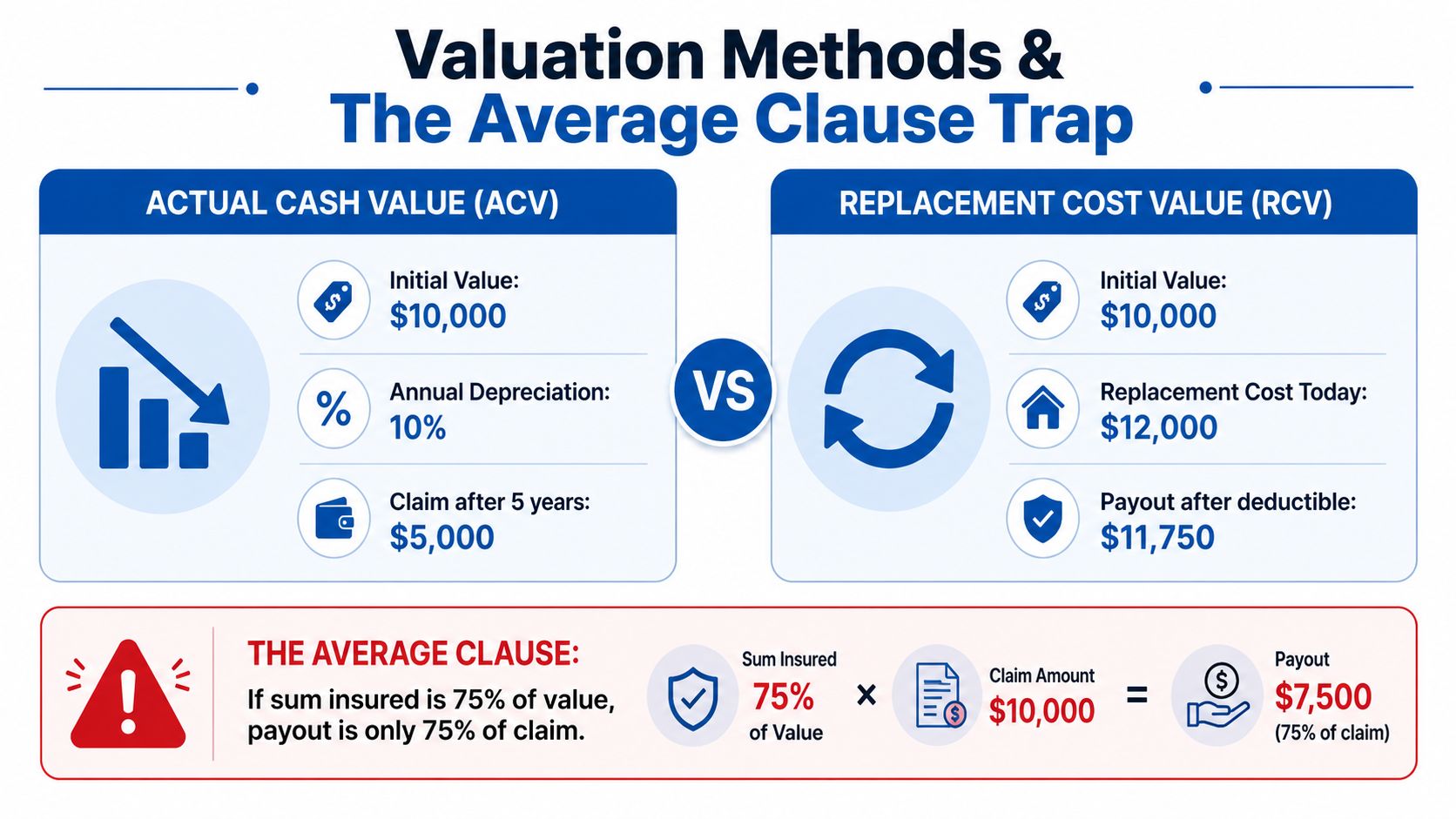
Most commercial contents policies sit on a reinstatement or new-for-old basis, which means the sum insured should reflect the current full replacement cost, not the original purchase price or book value. If the declared amount is too low, an average clause can reduce the whole claim proportionally. In other words, underinsurance doesn't just hurt the inventory line, it cuts the final payment across the board. UK Startup on business contents valuation
A useful way to think about it is this. Actual Cash Value pays after depreciation. Replacement Cost Value pays what it takes to replace the item today, subject to the policy terms and deductible. The gap gets wider when equipment is specialty-made, when suppliers are backlogged, or when replacement pricing has moved since the item was bought.
If the contents limit was based on old numbers, the claim will usually be too, unless the owner proves the replacement cost now.
Here's the trap carriers rely on. They'll accept that the item was damaged, then apply a value basis that shrinks the payment. If the policyholder never challenged the limit or never updated the schedule, the carrier treats the shortfall as the owner's problem. That's where low-ball offers start to look normal on paper.
This guide on Actual Cash Value vs. Replacement Cost helps separate the two valuation methods before a dispute starts. The key lesson is simple. A contents policy is only as strong as the number attached to it, and that number needs to reflect what it truly costs to rebuild the business's physical operation today.
Building an Inventory That Survives a Carrier Audit
A typed spreadsheet is a start. It is not a claim file. When an adjuster starts pushing back on individual line items, the inventory has to show what the item was, where it was located, what it cost, and how the owner can prove it existed before the loss.
What a usable inventory should include
A defensible inventory usually tracks the item description, quantity, age, original cost, replacement cost, serial number where available, and photo support. That sounds basic, but most business owners do not keep those pieces together until after the loss, when some of them are hard to recreate cleanly.
Photos matter more than owners expect. Wide shots show the room. Close shots prove the item. Video walk-throughs help when a room contains dozens of movable assets and the carrier later says the list was inflated. Receipts, manufacturer spec sheets, warranty cards, and cloud-stored purchase records give the claim file enough weight to survive scrutiny.
For businesses clearing out damaged space after a loss, a practical cleanup vendor can help separate salvage from trashed contents while records are still recoverable. Beyond Surplus cleanout services is one example of a resource that can support that process without turning the inventory into guesswork.
Best habit: update the inventory after major purchases and again when the business closes out the year.
If records were destroyed in the loss, start with salvage photography, vendor catalogs, credit card histories, and old email confirmations. Those breadcrumbs often rebuild the file faster than memory does. The goal is to give the carrier less room to claim the list is incomplete or the prices are inflated.
For a deeper reference on organizing contents records after fire loss, this contents inventory and valuation guide shows how adjusters expect the file to be structured. For businesses with mixed office and equipment losses, the company's own contents inventory and valuation service can also help document the list in a claim-ready format. Use that work product to force the carrier to respond to specifics, not generalities.
How the Claims Process Really Unfolds
A contents claim usually starts with a clean phone call and then turns into a paperwork fight. The carrier opens the file, assigns an adjuster, and asks for a list of contents. After that, the requests for more detail tend to arrive in waves, and each wave gives the insurer another chance to narrow the scope or chip away at the value.
The site visit is where the tone often changes. A carrier adjuster walks the damaged space with a notebook and asks questions that sound casual but affect the estimate later. If an item is unlabeled, mixed into building damage, or missing from the inventory, it is at risk of disappearing from the payment.
Where delays start
The most common delay is a documentation request that keeps growing. Another is the estimate itself, where depreciation gets applied aggressively or damaged items get classified as building-related. The owner may think the claim is moving because the adjuster keeps communicating, but the carrier may be building a narrower file.
Written follow-up changes that dynamic. Every missing item, every disputed category, and every request for clarification should be answered in writing, with the policy citation attached when possible. Certified mail still matters when a claim starts drifting, because it creates a record the carrier cannot casually deny later.
Keep the claim in writing once the first estimate comes back. Phone calls are easy to forget and harder to prove.
For policyholders in North Carolina and Virginia, the question is not just how long a claim takes, but whether the file is being handled in good faith. A small contents claim can settle faster when documentation is clean. A larger one can drag if the owner lets the carrier reset the clock every time it asks for one more spreadsheet, one more photo, or one more valuation memo.
Modern claims systems are also changing how files get reviewed. A useful modern guide for financial services on AI claims processing shows why carriers are tightening review workflows and relying more heavily on structured data. For business owners, that means sloppy inventories get punished faster, while organized claim files get traction sooner. The lesson is simple, the file has to show what was lost, why it belongs under contents, and what it costs to replace that property today.
Contents Coverage Versus Building Coverage
A fire doesn't respect policy categories. It burns the structure, the inventory, the equipment, and sometimes the tenant improvements in the same event. The mistake is assuming one form covers everything just because the building was insured.
| Damage Type | Paid Under Contents | Paid Under Building |
|---|---|---|
| Desks, computers, POS units | Yes | No |
| Inventory on shelves | Yes | No |
| Built-in walls, roof, framing | No | Yes |
| Tenant improvements tied to the lease | Sometimes, depending on wording | Sometimes, depending on wording |
A healthy building limit doesn't protect a laptop or a server rack. Building coverage pays for the structure. Contents coverage pays for movable business property. Ordinance and law coverage can come into play when code upgrades are required after a loss, but it doesn't replace contents coverage and it doesn't fix a too-small inventory limit.
The carrier argument usually sounds neat on paper. A damaged item is “part of the building,” so it belongs on the building side or not at all. That argument only works when the policy and the facts support it. A policyholder who knows the difference can push back before the estimate gets locked in.
The cleanest response is to separate the categories at the item level. If the loss involved shelving bolted to the wall, ask whether the shelf itself is treated as fixtures, fittings, or contents under the form. If the loss involved a standalone printer, there's no reason to let the carrier bury it in a building worksheet.
The claim gets better when the owner stops treating the package policy as one bucket. Different property layers answer different questions, and the adjuster knows it. The owner should too.
Fighting Low-Ball Offers and Coverage Denials
Carrier tactics on contents claims tend to repeat. Depreciation gets inflated. Inventory lines get omitted. The damaged item gets reclassified as part of the structure. The form's exclusions get quoted late, after the owner has already supplied a full list. That's not random bad luck, it's a negotiation pattern.
The moves that actually help
A formal dispute letter should do three things. State what was underpaid, identify the policy language that supports coverage, and demand a written explanation of the depreciation or classification method used. Keep it short, specific, and dated.
- Demand the depreciation schedule: ask for the line-by-line math, not just the final number.
- Resubmit the inventory: send the full audited list, with photos and purchase proof attached.
- Challenge misclassification: cite the policy wording when the carrier moves contents into the building bucket.
- Escalate in writing: if the response stalls, file the complaint trail the policy allows.
North Carolina policyholders also need to pay attention to Chapter 75 unfair and deceptive trade practices issues when a carrier's conduct becomes more than a simple disagreement. Virginia policyholders should also preserve every written exchange when the carrier starts denying or dragging out a covered contents loss. Those protections don't fix a claim by themselves, but they matter when the file turns into a formal dispute.
Real cases where insurers lost over claim handling usually turn on the same thing, weak documentation, delayed responses, or bad estimate methods. Courts don't reward vague file notes when the policyholder shows a paper trail that proves the carrier knew what was damaged and still underpaid it. The winning file is the one that forces the insurer to defend its math.
The letter that wins usually isn't emotional. It's precise, dated, and hard to dodge.
Why a Public Adjuster Changes the Outcome in NC and VA
A carrier adjuster works for the insurer. A public adjuster works for the policyholder. That distinction sounds obvious, but it's the center of nearly every bad contents claim because the insurer's file gets built by someone whose job is to control the payout, not maximize it.
A public adjuster does the work the carrier often won't do well on a contents loss. That includes inspecting the damage, rebuilding the inventory, estimating replacement cost, documenting salvage, challenging depreciation, and negotiating directly with the carrier. In a contents claim, that representation changes the file from a one-sided estimate to a documented dispute.
North Carolina and Virginia owners should also think about timing. The earlier representation comes in, the easier it is to preserve photos, salvage evidence, and inventory support before items are tossed or cleaned out. Once that evidence is gone, the carrier gets to argue about what existed, what was damaged, and what it was worth.
For commercial losses, a commercial public adjuster resource is useful context for understanding what a policyholder-side adjuster does on a business claim. The same idea applies here. When the claim involves equipment, stock, tenant improvements, or mixed office contents, the policyholder needs someone who can build the file item by item.
I've seen contents-only claims start with a token offer and end much closer to full replacement once the inventory was rebuilt and the depreciation fight was documented properly. That turnaround usually wasn't magic. It came from a better list, cleaner proof, and a representative who knew how to press back in writing.
For a plain explanation of the role, this public adjuster guide is a useful starting point. For The Public Adjusters, Inc. represents policyholders on commercial contents claims, including documentation, valuation, and direct negotiation with the carrier.
For The Public Adjusters, Inc. helps business owners document contents losses, challenge low estimates, and press for the coverage their policy promises. If your contents claim came back short, get a no-cost review and find out what the carrier left out. Visit For The Public Adjusters, Inc. and talk with a licensed public adjuster before you sign anything else.