What Is a Fire Damage Contents Inventory and Why Does It Matter?
A fire damage contents inventory is a detailed, item-by-item list of every piece of personal property damaged or destroyed in a fire — furniture, clothing, electronics, kitchenware, and more — with descriptions, quantities, ages, and replacement values. It matters because your insurer pays only for what you can document, and the burden of proving that loss falls on you.
Key takeaways
- Document every room yourself with photos, video, and a written list before the carrier’s pack-out vendor removes anything from your home.
- The pack-out vendor works for the insurance company, and their inventory frequently undercounts items, misses contents of drawers and closets, and defaults items to ‘cleanable’ when they should be total losses.
- You don’t need original receipts to prove ownership — bank statements, credit card records, order-history emails, photos, and manufacturer records can all reconstruct proof of purchase.
- Insist on classifying smoke- and heat-exposed items yourself; porous items like mattresses, upholstery, and children’s toys often cannot be safely restored even if they look intact.
- NC and VA homeowners typically have a set window to submit a proof of loss, so start your fire damage contents inventory immediately and submit it in writing to preserve your claim rights.
When a fire tears through your home, the structure claim tends to get most of the attention. But for many families, the personal property (contents) portion of the claim is just as large — sometimes larger. Everything from the sofa in your living room to the spices in your pantry has value under your policy, and none of it gets paid unless it appears on a documented list with a supportable price attached.
The Burden of Proof Is on You, Not the Insurance Company
Under standard homeowners policies sold in North Carolina and Virginia, the “Duties After Loss” conditions require the policyholder to prepare an inventory of damaged personal property. In practice, that means:
- You must identify each item — the adjuster is not obligated to hunt through debris and reconstruct your belongings for you.
- You must show quantity, description, and value — vague entries like “clothes — $2,000” invite pushback, while “12 men’s dress shirts, purchased 2–4 years ago” gets paid.
- You may need to support values with documentation — receipts, photos, bank statements, or reasonable replacement pricing.
Insurers rarely volunteer money for items that never make it onto paper. If a category of belongings is missing from your inventory, it is effectively missing from your settlement.
How the Inventory Directly Drives Your Payout
Your contents payout is essentially the sum of your inventory, adjusted for policy terms. A thorough list affects the claim in several ways:
- Completeness: The average home contains thousands of individual items. Households that inventory room by room routinely uncover far more value than a quick memory-based list captures.
- Depreciation: Age and condition notes on each item determine how much the insurer withholds as depreciation — and how much you can recover later under replacement cost coverage.
- Category limits: Jewelry, firearms, and collectibles often carry sub-limits, so identifying them separately prevents surprises.
- Negotiating power: A detailed, organized inventory is hard to dispute; a thin one is easy to underpay.
This is exactly why underpaid contents claims are so common — and why many policyholders turn to a licensed fire damage public adjuster to build and price the inventory properly. The sections below walk you through doing it room by room, so nothing you owned gets left off the list.
Why Does the Carrier’s Pack-Out Vendor’s List Often Undercount Your Belongings?
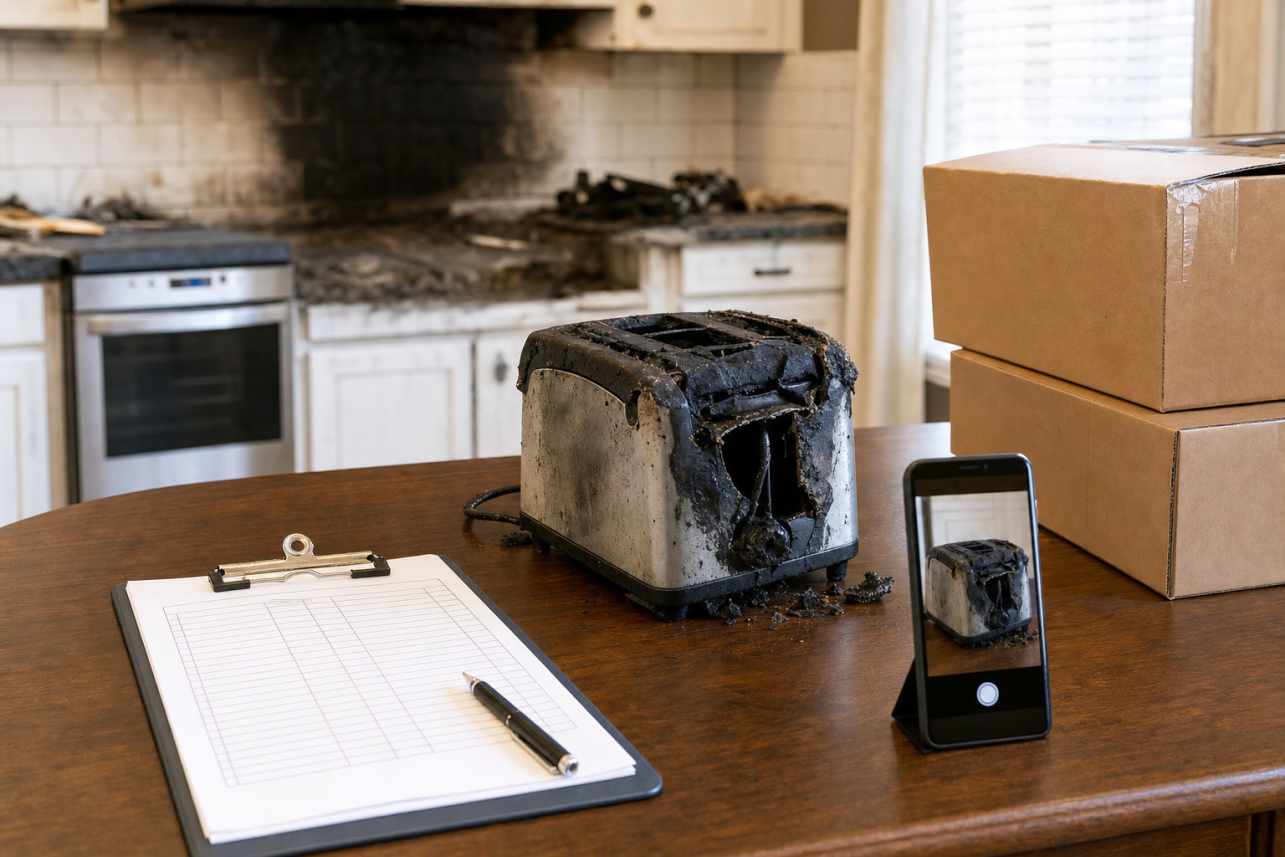
Pack-out vendors work for the insurance company, not for you. Their crews inventory quickly, lump belongings into vague categories like “box of kitchen goods,” and skip items destroyed beyond recognition. The result is a list that undercounts what you owned — which is why you should never sign off on a vendor inventory as complete.
Who the Pack-Out Vendor Actually Works For
After a fire, your insurance carrier typically dispatches a restoration or pack-out company to remove salvageable contents for cleaning and storage. It feels like they’re there to help you — and in some ways they are — but their contract, their payment, and their ongoing business relationship all run through the insurance company. Their job is to move contents efficiently, not to build the detailed fire damage contents inventory your claim depends on.
How Rushed Inventories Shrink Your Claim
Pack-out crews are usually working on tight timelines, often in a smoke-damaged, poorly lit house. Common shortcuts include:
- Vague box-level entries. A single line like “box of kitchen goods” or “misc. bedroom items” might contain a stand mixer, a knife set, and small appliances worth hundreds of dollars each — but the list gives the adjuster nothing to price.
- No brands, models, or quantities. “TV” is not the same as a 65-inch model purchased two years ago. Without detail, carriers default to low-end replacement values.
- Salvageable-only focus. Vendors inventory what they’re packing out. Items burned beyond recognition, melted into debris, or hauled away as unsalvageable often never make it onto any list at all — meaning they may never be paid for.
- Missed spaces. Attics, crawl spaces, garages, closets, and outbuildings frequently get a cursory pass or are skipped entirely.
Why You Should Never Sign the Vendor’s List as “Complete”
Somewhere in the pack-out paperwork, you may be asked to sign a form acknowledging the inventory. Signing that it’s accurate for what was packed is one thing — signing that it represents everything you owned is another. Once you certify a list as complete, the carrier gains a powerful argument to deny anything you remember later. Instead:
- Note in writing that the list reflects only packed-out items, not your full contents.
- Photograph rooms, debris piles, and boxes before anything leaves the property.
- Keep your own running inventory and reserve the right to supplement it.
If the vendor’s list has already gone to the carrier and the contents offer looks thin, you’re not stuck with it. A licensed fire damage public adjuster can rebuild the inventory item by item and push back on undercounted contents before the claim closes.
How Do I Document Total-Loss vs. Restorable Items for a Fire Damage Contents Inventory?
Work through your home one room at a time, photographing every item where it sits before anything is moved. Log each item with a description, condition notes, and a classification: total loss, smoke- or soot-damaged, or restorable. Never let a vendor default heat-exposed or porous items to “cleaning” without inspecting them yourself.
Understanding the Three Classifications
Before you start, know what you’re sorting into:
- Total loss: Burned, melted, warped, or structurally compromised items. Also includes porous goods (mattresses, upholstered furniture, stuffed toys) that absorbed smoke so deeply they can’t be safely restored.
- Smoke- or soot-damaged: Items that look intact but carry odor, residue, or corrosive soot. Electronics and appliances in this category often fail later even if they power on today.
- Restorable: Hard, non-porous items with light surface residue that professional cleaning can genuinely return to pre-loss condition.
A Practical Room-by-Room Walkthrough
Take wide shots of each room first, then close-ups of individual items, including brand labels, model numbers, and damage details. Open every drawer, cabinet, and box and photograph the contents.
- Kitchen: Photograph inside cabinets and the pantry. Food, spices, and anything in plastic packaging exposed to heat or smoke is typically a total loss. Small appliances with soot intrusion should be flagged, not just wiped down.
- Bedrooms: Mattresses, pillows, and bedding hold smoke odor and contaminants; treat them skeptically as “cleanable.” Photograph clothing in drawers piece by piece where practical, or in labeled groups.
- Closets: These are dense with value—shoes, coats, luggage, stored linens. Pull everything out, photograph in batches, and note which garments are dry-clean-only, since restoration costs can approach replacement cost.
- Garage: Log power tools, sporting equipment, and chemicals. Heat-exposed tools may have compromised motors, batteries, or calibration even without visible damage. Anything containing fuel or pressurized contents near the fire is generally unsafe to keep.
- Attic: Don’t skip stored boxes—holiday decorations, keepsakes, and off-season items are frequently forgotten. Heat rises, so attic contents often suffer more heat damage than rooms on the same floor as the fire.
Why “Cleaning” Can Shortchange You
Insurers pay less to clean an item than to replace it, so there’s built-in pressure to classify things as restorable. But heat can degrade plastics, adhesives, and electronic components invisibly, and soot is acidic and corrosive over time. If a “cleaned” item fails after you’ve signed off, reopening the claim is difficult. In your fire damage contents inventory, note your own classification for every item and request testing or a written restoration guarantee before accepting cleaning on electronics, appliances, or anything that touched significant heat. Your independent, room-by-room record is what gives you standing to push back.

How Can I Reconstruct Receipts for Items Destroyed in the Fire?
You don’t need original receipts to prove ownership. Insurers in North Carolina and Virginia accept reasonable alternative documentation, including bank and credit card statements, retailer purchase histories, email order confirmations, old photos and videos, warranty registrations, and sworn statements. Layering several of these sources for each significant item builds a claim adjusters find hard to dispute.
Paper receipts are often the first thing a fire destroys, and insurance companies know this. What matters is showing, through a reasonable preponderance of evidence, that you owned the item, roughly when you bought it, and what it cost. Here’s how to rebuild that proof, source by source.
Step-by-Step Sources for Rebuilding Proof of Ownership
- Bank and credit card statements: Request several years of statements from your bank or card issuer. Line items showing purchases at furniture stores, electronics retailers, or jewelers corroborate specific entries on your fire damage contents inventory.
- Retailer purchase histories: Log in to accounts at Amazon, Home Depot, Lowe’s, Best Buy, Target, Walmart, and similar retailers. Most keep years of order history you can print or export. Store loyalty programs often retain purchase records even for in-store transactions.
- Email confirmations: Search your inbox for terms like “order confirmation,” “receipt,” “shipped,” and “invoice.” These emails typically show the item, price, and purchase date — exactly what an adjuster wants.
- Old photos and videos: Scroll through your phone’s camera roll, cloud backups, and social media posts. A birthday photo taken in your living room can document the sofa, TV, artwork, and rug in the background all at once.
- Warranty and product registrations: Appliances, electronics, and tools you registered with the manufacturer create a record tied to your name, including model and serial numbers.
- Sworn statements: For items with no paper trail — gifts, inherited pieces, cash purchases — a notarized affidavit from you, or from family members and friends who saw the items in your home, is legitimate supporting evidence.
How Replacement Cost vs. Actual Cash Value Works in NC and VA
How you’re paid depends on your policy language, and this is standard in both states. Under actual cash value (ACV), the insurer pays replacement cost minus depreciation for age and wear. Under replacement cost value (RCV), most policies pay in two stages: the ACV amount up front, then the withheld depreciation (called recoverable depreciation) after you actually replace the item and submit proof of purchase within the deadline your policy sets.
This makes your reconstructed documentation doubly important. Strong proof of an item’s original quality and age reduces the depreciation the adjuster applies, and keeping receipts for every replacement purchase ensures you recover the full holdback rather than leaving money on the table.
Can Homeowners Really Win When the Insurer Disputes a Fire Claim?
Yes. Homeowners can and do prevail when insurers dispute or deny fire claims. In Bryant v. Nationwide Mutual Insurance Co., 313 N.C. 362 (1985), a North Carolina jury sided with the insured after the carrier refused to pay a fire loss — and well-documented contents claims are routinely negotiated upward from initial lowball offers.
A denial or a disappointing first offer is not the end of the road. It is often the beginning of a negotiation, and the policyholders who come out ahead are almost always the ones with the strongest documentation.
What Bryant v. Nationwide Teaches Policyholders
Bryant v. Nationwide Mutual Insurance Co. is one of North Carolina’s landmark insurance decisions. After a fire destroyed the insureds’ property, the carrier refused to pay the claim. The homeowners sued, a jury found in their favor, and the case ultimately reached the North Carolina Supreme Court. The decision is significant because the Court recognized that an insurer’s bad-faith refusal to pay a valid claim, when accompanied by aggravating conduct, can expose the carrier to consequences beyond simply paying the policy benefits it owed in the first place.
The practical takeaways for today’s fire victims:
- Carriers are not the final word. An insurer’s denial is a position, not a verdict. Courts and juries can — and sometimes do — disagree with the carrier.
- Documentation decides disputes. Cases like Bryant turn on evidence. A thorough fire damage contents inventory, photographs, and reconstructed proof of ownership give a homeowner something concrete to stand on.
- Insurers know litigation is a risk for them too. A well-supported claim backed by organized records is far more likely to be resolved fairly before anyone sees a courtroom.
How Contents Settlements Get Increased in the Real World
Most disputed contents claims never go to trial. Instead, they are resolved through supplemental claims and negotiation. Public adjusters and experienced policyholder advocates regularly increase lowballed contents settlements by:
- Rebuilding an item-by-item inventory that captures belongings the carrier’s pack-out vendor missed;
- Correcting undervalued line items — for example, pricing quality furniture, tools, or electronics at realistic replacement cost rather than generic low-end figures;
- Challenging improper “restorable” designations on items that were actually total losses;
- Applying depreciation accurately and pursuing recoverable depreciation the homeowner is entitled to under a replacement cost policy.
It is common for a carefully rebuilt inventory to reveal a contents claim substantially larger than the carrier’s initial valuation.
The Honest Caveat
Every claim is different. Policy language, the quality of your documentation, the facts of the loss, and state law all shape the outcome — and no result is ever guaranteed. Bryant proves homeowners can win; your inventory and evidence determine whether you are positioned to.
When Should NC or VA Homeowners Bring in a Public Adjuster for a Contents Claim?
Bring in a licensed public adjuster when your contents settlement offer seems far below replacement reality, the carrier’s inventory is incomplete, depreciation looks excessive, or the claim has stalled. A public adjuster works only for you, rebuilding and pricing your fire damage contents inventory and negotiating with the insurer on your behalf.
Warning Signs Your Contents Claim Is Being Undervalued
- The carrier’s inventory lists far fewer items than you actually owned, or lumps belongings into vague categories like “box of miscellaneous.”
- Depreciation deductions seem aggressive — nearly new items priced as if they were decades old.
- Items you know were destroyed are marked “restorable” or “clean and return.”
- Replacement prices are pulled from generic or bargain sources rather than like-kind-and-quality comparisons.
- The adjuster pressures you to sign off on the inventory quickly, or the claim has gone quiet for weeks with no explanation.
What a Public Adjuster Actually Does for a Contents Claim
A licensed and bonded public adjuster represents the policyholder — not the insurance company. On a contents claim, that typically means walking the loss room by room, interviewing family members about what was in closets, drawers, garages, and attics, and building a line-item inventory with quantities, ages, conditions, and defensible replacement pricing. They also review your policy for coverage you may not know you have, challenge improper depreciation, and package the claim so the carrier has documentation it can’t easily dismiss. Public adjusters generally work on a percentage of the recovery, so ask about fees up front. No reputable adjuster can guarantee a specific outcome — be cautious of anyone who promises one.
Deadlines and Appraisal Options in North Carolina and Virginia
Both states license public adjusters, and you can verify a license before signing anything. Check credentials through the North Carolina Department of Insurance or the Virginia Bureau of Insurance at the State Corporation Commission. A few timing points matter:
- Your policy sets deadlines for submitting a signed proof of loss and for filing suit — read those provisions carefully, because missing them can jeopardize the claim.
- Most homeowners policies include an appraisal clause, a formal process for resolving disputes over the amount of loss (not coverage). A public adjuster can help you decide whether invoking appraisal makes sense and prepare your side of it.
- The earlier a public adjuster is involved, the more they can shape the inventory — but they can also step in mid-claim if negotiations have gone sideways.
What to Expect During the Process
Expect a written contract disclosing the fee, a thorough site inspection, regular requests for your input on what you owned, and direct communication between the adjuster and your carrier. Contents claims take time to document properly, but a complete, well-priced inventory is usually what moves a stalled or undervalued claim toward a fair resolution.
Fire Damage Contents Inventory: Your List vs. the Carrier’s Pack-Out Vendor List
| Factor | Homeowner-Prepared Inventory | Pack-Out Vendor List |
|---|---|---|
| Who it serves | You — built to capture full replacement value | The carrier — built around what the vendor handles |
| Level of detail | Item-by-item with brand, age, condition, and photos | Often box-level or category-level entries like ‘misc. contents’ |
| Total-loss vs. restorable calls | You flag smoke-, heat-, and water-damaged items for replacement | Vendor may default items to ‘cleanable’ to justify restoration fees |
| Hidden and stored items | Includes closets, drawers, attic, garage, and off-site storage | Frequently misses packed-away, seasonal, and small items |
| Use in your claim | Supports your sworn proof of loss and any dispute or appraisal | Becomes the carrier’s baseline unless you challenge it |
Illustrative Example: When the Pack-Out List Told Half the Story
Illustrative example
Consider a hypothetical composite scenario: a family in the Piedmont region suffers a kitchen fire that spreads smoke throughout their home, and the carrier’s pack-out vendor produces a list with dozens of entries labeled simply ‘box of miscellaneous items.’ Rather than accepting that list, the family walks each room with their phone camera, opening every drawer and closet, and builds their own room-by-room fire damage contents inventory identifying hundreds of individual items the vendor never itemized.
They pull online order histories and credit card statements to reconstruct proof of purchase for electronics, clothing, and kitchenware destroyed in the fire, and they push back on items the vendor classified as cleanable — including smoke-saturated mattresses and children’s toys — arguing they should be total losses. With a detailed, documented inventory in hand, they submit a proof of loss reflecting substantially more items than the vendor’s list, putting them in a far stronger position to negotiate their contents settlement.
Frequently asked questions
How do I create a fire damage contents inventory if everything was destroyed and I can’t remember what I owned?
Work room by room, mentally walking through each space and listing what was there — closets, drawers, cabinets, and storage areas are commonly forgotten. Use old photos and videos on your phone or social media, past online order histories (Amazon, big-box retailers), credit card and bank statements, and emails for order confirmations to jog your memory and support values. Ask family members to review your list, since they often recall items you missed. Record each item’s description, approximate age, condition, and estimated replacement cost.
Do I have to accept the pack-out vendor’s inventory list as my final contents claim?
No. The pack-out vendor works quickly and often lists items generically (for example, ‘box of kitchen items’), which can undercount both the quantity and value of your belongings. Their list also typically covers only what they removed for cleaning — not items deemed total losses and discarded. You have the right to prepare your own detailed inventory, compare it against the vendor’s list, and submit your version to the insurer with supporting documentation. Photograph items before pack-out whenever possible.
How can I prove the value of items when the receipts burned in the fire?
Insurers generally accept alternative documentation. Pull credit card and bank statements, request purchase records from retailers where you have accounts, search your email for order confirmations, and gather photos or videos showing the items in your home. For older items without records, current retail listings for comparable replacement items can support your claimed values. A sworn statement describing the item, when you bought it, and its approximate cost is also commonly used when no other proof exists.
What’s the difference between total-loss and restorable items, and why does it matter for my claim?
Total-loss items are damaged beyond repair by fire, smoke, or water and should be replaced; restorable items can potentially be cleaned or repaired for less than replacement cost. The distinction matters because restoration attempts are often charged against your contents coverage limit — and if cleaning fails, you may have spent policy dollars on an item that still needs replacing. Document your position on questionable items (like smoke-saturated upholstery, electronics, or mattresses) and don’t assume the vendor’s restorable designation is final; you can dispute it with the adjuster.
Related local pages
- Public Adjuster Burlington
- Public Adjuster Elon NC — Fire & Water Claim Help
- Public Adjuster Cary NC
Overwhelmed by your contents claim? Our licensed and bonded public adjusters help NC and VA homeowners document every item and fight for a fair settlement. Call for a free claim review. Get in touch.
Last updated: August 3, 2026