You arrive at the property early, expecting an ordinary inspection. Instead, your flashlight catches spray-painted siding, a splintered door frame, and shattered glass across the floor. The carrier's first response may sound routine, but the questions that follow about occupancy, prior damage, security, and who had access can shape the entire claim.
Vandalism coverage is commonly included in homeowners and commercial property policies, yet legitimate losses still get denied, narrowed, or priced below the cost of repair. The problem usually isn't the absence of a coverage label. It's the carrier's attempt to recast intentional damage as wear and tear, an excluded vacancy loss, unrelated storm damage, or a repair item that supposedly falls outside the policy.
Table of Contents
- When Vandalism Hits Your Property
- What Vandalism Coverage Means in Practice
- Exclusions That Erase Vandalism Claims
- Documenting the Loss to Maximize Your Settlement
- Common Denial Tactics and How to Fight Back
- Case Studies of Vandalism Claims Recovered
- NC and VA Claim Rules and When to Hire Help
When Vandalism Hits Your Property
The first hours matter because the property owner creates the initial record before an adjuster ever visits. Report the damage to law enforcement, preserve the scene as much as safety allows, and notify the carrier in writing. Don't guess about the offender, motive, timing, or cause. A careless explanation can later appear in a recorded statement as an admission.
Protect the claim before protecting the optics
Photograph the entire property before cleanup. Capture the street, entrances, locks, windows, rooms, exterior elevations, damaged fixtures, and small fragments that show how the damage occurred. Keep the police report number, names of responding officers, security-company records, and every invoice for emergency boarding or temporary repairs.
Secure the building, but don't destroy evidence. Board broken openings, stop additional water entry, and preserve damaged components for inspection unless they create an immediate hazard. Ask contractors to photograph concealed damage before replacement.
Practical rule: Report facts, not theories. “The rear window was intact during the last inspection and broken when I arrived” is useful. “A former tenant definitely did this” can create a dispute you may not be able to prove.
Occupancy deserves immediate attention. A property between tenants, a seasonal home, or a building under renovation can trigger a vacancy dispute even when the owner still considers it active. Gather lease documents, utility bills, maintenance visits, delivery records, security logs, and neighbor statements showing how the property was used and monitored.
The carrier may ask for a recorded statement during the first call. You can provide prompt notice without improvising a detailed account before reviewing the policy and evidence. Ask for the questions in writing, confirm the applicable coverage form, and keep communications factual and organized.
The settlement ceiling often gets established before the first estimate arrives. A complete inventory, clear photos, receipts, serial numbers, contractor scopes, and proof of recent occupancy give you something stronger than a verbal disagreement with an adjuster. They give you a claim file the carrier must answer.
What Vandalism Coverage Means in Practice
A broken window, spray-painted wall, or damaged equipment can qualify as a covered loss, but the policy wording decides whether the carrier pays. Standard U.S. homeowners and commercial property forms commonly treat vandalism and malicious mischief as covered perils, either as named perils or as causes of loss not excluded by the selected form. The Texas Department of Insurance residential guide lists vandalism among commonly covered residential causes of loss, alongside fire, windstorm, hail, explosion, smoke, theft, and riot or civil commotion.
The declarations page is only the starting point. Read the Section I property coverage provisions, exclusions, conditions, endorsements, and deductible language. For commercial property, identify whether the policy uses a basic, broad, or special form, then check every endorsement that adds, narrows, or removes protection. A sales summary cannot override the policy.
The coverage split many owners miss
Dwelling coverage often follows an open-peril structure. The carrier generally must identify an applicable exclusion to avoid paying for covered physical damage. Personal property commonly receives named-peril treatment, which requires the policyholder to connect damaged belongings to a listed cause such as vandalism.
That difference can decide the claim. Damage to walls, doors, roofing, or other building components may receive broader treatment, while damaged furniture, electronics, tools, or business contents may need a clear factual connection to the named peril. Limits, deductibles, valuation rules, and category sub-limits still control the payment.
| Coverage | Peril Type | Vandalism Trigger | Common Limit |
|---|---|---|---|
| Dwelling or commercial building | Often open peril or named peril, depending on form | Physical damage caused by an intentional, unexcluded act | Coverage limit, deductible, and applicable exclusions |
| Personal property or business contents | Often named peril | Vandalism must be listed or otherwise covered under the selected form | Contents limit, category sub-limits, valuation, and deductible |
| Trees, shrubs, and other plants | Limited treatment under some homeowners forms | Covered damage must fit the policy's landscaping provision | HO 00 03 limits this protection to 5% of the dwelling limit and no more than $500 per item. Check the policy's Additional Coverage, Trees, Shrubs and Other Plants provision |
Landscaping damage deserves separate attention. A carrier may acknowledge vandalism but still apply the plant sub-limit, leaving a large gap between the repair estimate and the available payment. Identify that limit before treating landscaping as part of the general dwelling claim.
Pull the exact language before arguing
Confirm whether the deductible is a flat amount or a percentage. Check whether payment uses replacement cost or actual cash value, and determine whether an endorsement changes valuation. Review forms such as HO 04 22, HO 04 25, and commercial equivalents only when they appear in your policy. An online sample cannot establish coverage under your contract.
Vandalism has long appeared among insured property perils. The Library of Congress history of homeowners insurance identifies a modern homeowners policy launched in 1958 by North America Companies that expressly protected against vandalism among other listed losses. That history supports the general expectation of protection. The enforceable answer remains the wording, limits, conditions, and exclusions in your policy.
Exclusions That Erase Vandalism Claims
Carriers often accept that vandalism occurred, then attack the conditions surrounding the loss. Vacancy, intentional conduct, landscaping limits, and competing causes give them ways to reduce or deny payment. Read those provisions before accepting the adjuster's first explanation.

Vacancy is the first pressure point
ISO HO 00 03 excludes vandalism and malicious mischief after a dwelling has been vacant for more than 60 consecutive days. Check your own policy form because some filings use a 30-day trigger. “Vacant” and “unoccupied” can carry different meanings, so the carrier must apply the exact wording instead of relying on a casual label.
The carrier's usual position is blunt: nobody lived there, so the vandalism coverage ended. Fight that conclusion with records. Utility use, furniture, lease extensions, routine maintenance, lawn-care invoices, contractor visits, mail, security footage, and neighbor statements may show that the property was not abandoned or that the policy's vacancy condition was not met.
Temporary absence can still create a dispute. Storm displacement, renovations, delayed re-occupancy, and a property between tenants all require careful documentation. Notify the carrier about a material occupancy change when possible. Keep records showing why the property became empty, what work occurred, and when regular use resumed.
Endorsements and landscaping limits can shrink the check
A commercial policy may include a vandalism exclusion such as ISO CP 10 50, removing loss or damage by vandalism to described property. If the carrier relies on that endorsement, demand the complete form, effective date, schedule, and proof that it was attached to your policy.
Landscaping requires separate analysis. The landscaping sub-limit discussed earlier does not justify reducing structural, fencing, or cleanup items to the same amount. Those components require their own coverage analysis, damage assessment, and repair documentation.
Finally, separate intentional damage by an unknown third party from accidental damage, deterioration, and conduct by an insured or permitted occupant. Adjusters sometimes assign motive without reliable proof. Counter with the physical damage pattern, police findings, access records, video, witness accounts, and maintenance history. The question is whether the exclusion applies to the established facts, not whether the carrier has found a convenient theory.
Documenting the Loss to Maximize Your Settlement
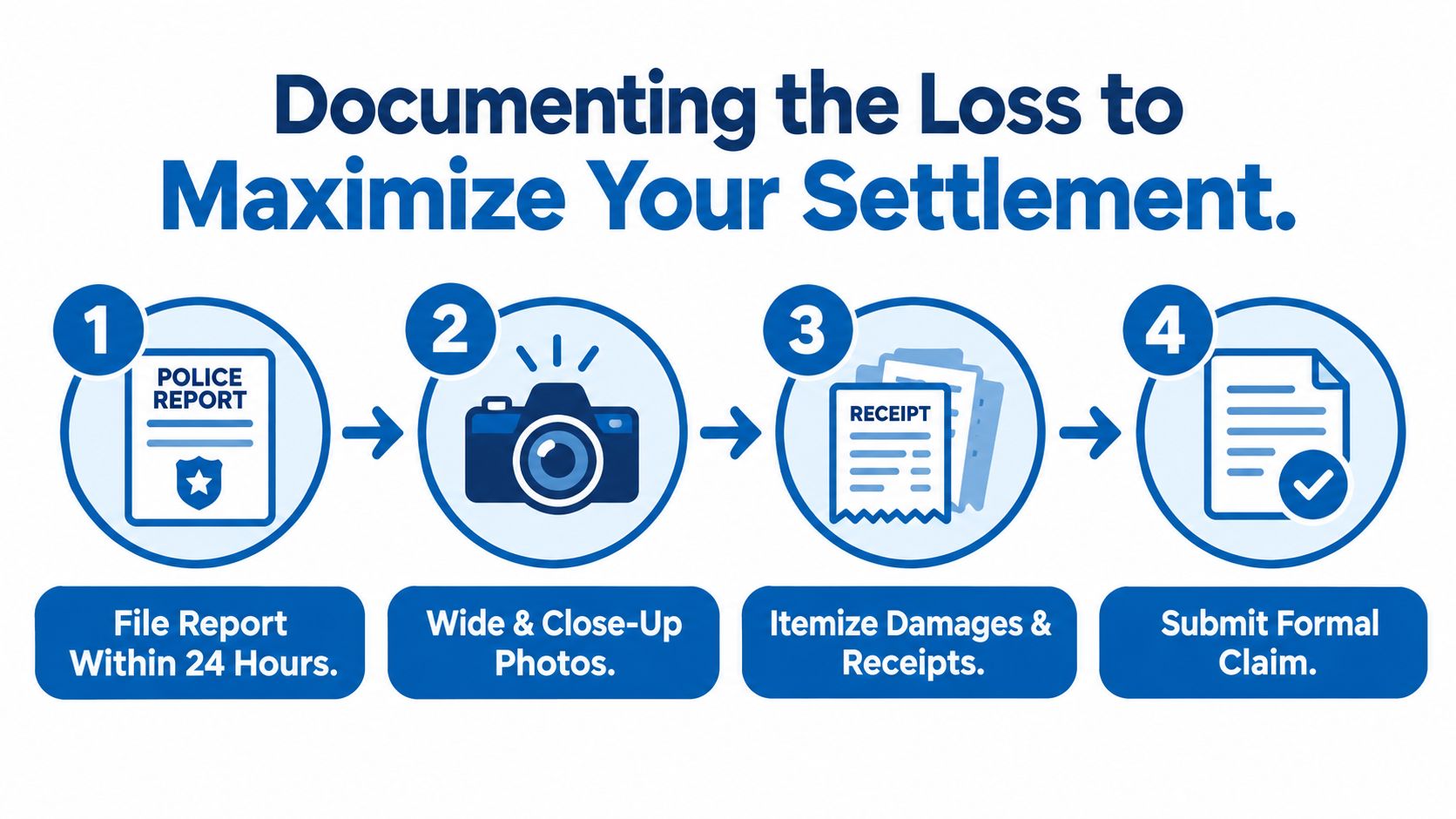
A vandalism claim should read like a controlled investigation. Start with the event, preserve the evidence, identify each damaged component, and connect every requested dollar to a policy-covered repair or replacement.
Build the record in chronological order
Create the official incident record. Contact law enforcement promptly and retain the report, incident number, officer information, and any supplemental report. The planned sequence in your records should show discovery, notification, inspection, emergency protection, and permanent repair.
Preserve visual evidence. Take wide and close-up photographs from multiple angles. Preserve original files and their timestamps when available. Save doorbell and security footage immediately because systems may overwrite older clips.
Inventory damaged property. List each item, location, description, age, condition, serial number, receipt, photograph, and replacement source. For business contents, add asset tags, purchase records, vendor invoices, and depreciation information.
Separate emergency work from permanent work. Boarding, tarping, glass removal, and security measures may prevent further damage. Keep invoices and photographs, but don't let emergency cleanup erase proof of the original condition.
For a useful plain-language reference on preserving evidence, review this guide on how to document your damage before filing. It should supplement, not replace, the wording and conditions in your policy.
Write notice without volunteering a denial
Your initial notice should identify the insured property, date discovered, apparent physical damage, police report information, emergency measures, and a request for inspection. Avoid statements about who caused the damage, whether the property was “empty,” or whether any item was already defective unless you have verified the facts.
A proof of loss requires more than a pile of receipts. It should reconcile the inventory, estimates, photographs, ownership records, valuation method, deductible, and any disputed item. Use the insurer's requested form when required, but attach a detailed schedule that makes omissions difficult.
Contractor estimates should identify labor, material, access, protection, removal, disposal, cleaning, surface preparation, matching, permits when applicable, and necessary related repairs. An Xactimate-formatted estimate can make scope comparison easier, but software formatting doesn't prove coverage. The line items must still describe the actual work.
Use this proof of loss resource to organize the submission before signing anything.
Handle recorded statements carefully
A recorded statement can lock in wording that later gets used against you. You can answer basic notice questions, but don't speculate about:
- Unknown motive: Don't identify a suspect without evidence.
- Exact timing: Don't convert an estimate into a fact.
- Prior condition: Don't describe old photographs from memory.
- Occupancy status: Don't use “vacant” or “unoccupied” casually.
- Repair scope: Don't concede that visible damage is the entire loss.
Keep a chain-of-custody folder containing original photos, exported footage, police documents, invoices, estimates, correspondence, inspection dates, and names of everyone who handled damaged property. That folder gives your attorney or public adjuster a reliable timeline instead of a reconstructed story.
Common Denial Tactics and How to Fight Back
The carrier's first estimate isn't the final truth. It's the carrier's position. The strongest rebuttal matches each disputed conclusion with contemporaneous evidence and exact policy language.
Seven arguments that deserve a written response
Pre-existing damage often appears when the adjuster finds old underwriting photographs or general maintenance issues. Answer with dated listings, inspection photos, repair invoices, tenant move-in records, and close-ups showing the new damage pattern.
Vacancy is frequently treated as automatic. It isn't. Demand the exact vacancy provision, the date the carrier says the period began, and the evidence supporting that date. Then provide utility records, visits, occupancy documents, security logs, and statements from people who used or monitored the premises.
Wear and tear doesn't explain fresh tool marks, shattered glass, cut locks, forced entry, graffiti, or deliberate breakage. Describe the physical mechanism and separate old deterioration from the new event.
Causation re-labeling turns broken windows into storm damage, settling, accidental impact, or unrelated maintenance. Use police observations, video, weather records when relevant, photographs, and a qualified contractor's cause-and-scope explanation.
Malicious-mischief semantics can become a distraction. The carrier may argue that the offender's motive isn't proven. Focus on physical intentional damage and the policy's actual trigger. Don't let an unknown perpetrator's mental state replace an analysis of the exclusion.
Proof-of-ownership demands can eliminate legitimate contents from the estimate. Receipts help, but they aren't the only evidence. Use bank records, photographs, serial numbers, manuals, warranties, tax records, vendor confirmations, and witness statements.
Scope compression reduces a damaged assembly to a cosmetic patch. Compare the adjuster's estimate with a complete contractor scope, including access, matching, preparation, replacement, cleanup, and code-related work where the policy provides it.
| Denial Tactic | Carrier Argument | Rebuttal Evidence |
|---|---|---|
| Pre-existing condition | The damage existed before the reported event | Dated photos, listings, inspections, and repair records |
| Vacancy | The property exceeded the policy's vacancy period | Utility use, leases, visits, maintenance, and security records |
| Wear and tear | The condition reflects age or ordinary use | Forced-entry evidence, fresh breakage, graffiti, and incident records |
| Unrelated cause | Damage came from storm, settling, or impact | Video, police observations, expert analysis, and event chronology |
| Missing ownership proof | No receipt means no covered item | Serial numbers, photographs, bank records, and warranties |
| Narrow scope | Only visible surfaces require repair | Contractor estimate, concealed-damage inspection, and matching analysis |
| Excluded endorsement | A form removes vandalism coverage | Complete policy, endorsement schedule, effective date, and attachment proof |
If the carrier still refuses to engage, document the dispute in a coverage letter and consider regulatory escalation or appraisal where the policy permits it. A practical overview of roof-related scope disagreements is available in this roof insurance adjuster guide, and the same discipline applies to vandalism estimates. For a separate dispute path involving valuation disagreements, review contesting an appraisal.
Case Studies of Vandalism Claims Recovered
Claim examples can show how evidence changes a carrier's position, but invented success stories are worse than useless. The recovery amounts and locations described in a marketing pitch should be verifiable in the file, not repeated because they sound persuasive.
The documented lesson from vandalism disputes is consistent. A denial often survives only while the carrier controls the chronology, occupancy label, and repair scope. Once the policyholder presents contemporaneous records and a defensible estimate, the carrier must address the actual loss rather than a simplified version.
The evidence shift that changes a vacancy dispute
A Raleigh rental property may appear empty to an adjuster reviewing a single inspection date. That snapshot doesn't settle whether the vacancy condition applied. A lease extension, utility activity, tenant communications, maintenance visits, and dated interior photographs can establish continued use or monitoring.
The public adjuster's role in that situation is not to invent occupancy. It is to assemble existing proof, compare it to the policy's wording, and force the carrier to identify the exact date and condition it believes created the exclusion. The claim turns on the evidence and policy language, not the adjuster's shorthand description of a rental as “vacant.”
Repeated break-ins require a complete scope
A Chesapeake storefront under renovation may experience repeated forced entry, damaged openings, broken fixtures, cleanup needs, and security expenses. A narrow estimate that prices only the most obvious broken component can leave the owner paying for connected work.
Security footage, vendor delivery logs, renovation schedules, photographs from each incident, and a re-measured scope can show how the damage accumulated. The carrier's own pricing platform can help compare line items, but it shouldn't dictate whether necessary work belongs in the estimate.
Graffiti requires a condition timeline
A Charlotte homeowner facing a pre-existing-damage denial should gather original siding photographs, property-listing records, maintenance documents, and dated neighborhood or security footage. If the carrier says the graffiti or paint condition existed earlier, the carrier should identify the evidence supporting that conclusion.
An independent technical opinion may help when paint age or layering matters, but the expense should be weighed against the disputed scope. The broader principle is straightforward: a denial based on old condition requires old-condition evidence. A carrier can't convert uncertainty into proof merely by placing the burden on the homeowner.
For The Public Adjusters, Inc. provides policyholders with claim reviews, inspections, documentation, scope and estimate preparation, and communication with carriers for residential and commercial property losses in North Carolina and regional Virginia service areas. Ask for the underlying file support behind any claimed recovery, whether the representative is a public adjuster, attorney, contractor, or consultant.
NC and VA Claim Rules and When to Hire Help
North Carolina and Virginia policyholders should track deadlines from the beginning, not after negotiations fail. A coverage dispute can consume time while the property remains damaged, estimates change, and evidence becomes harder to locate.
Put the legal clock on the calendar
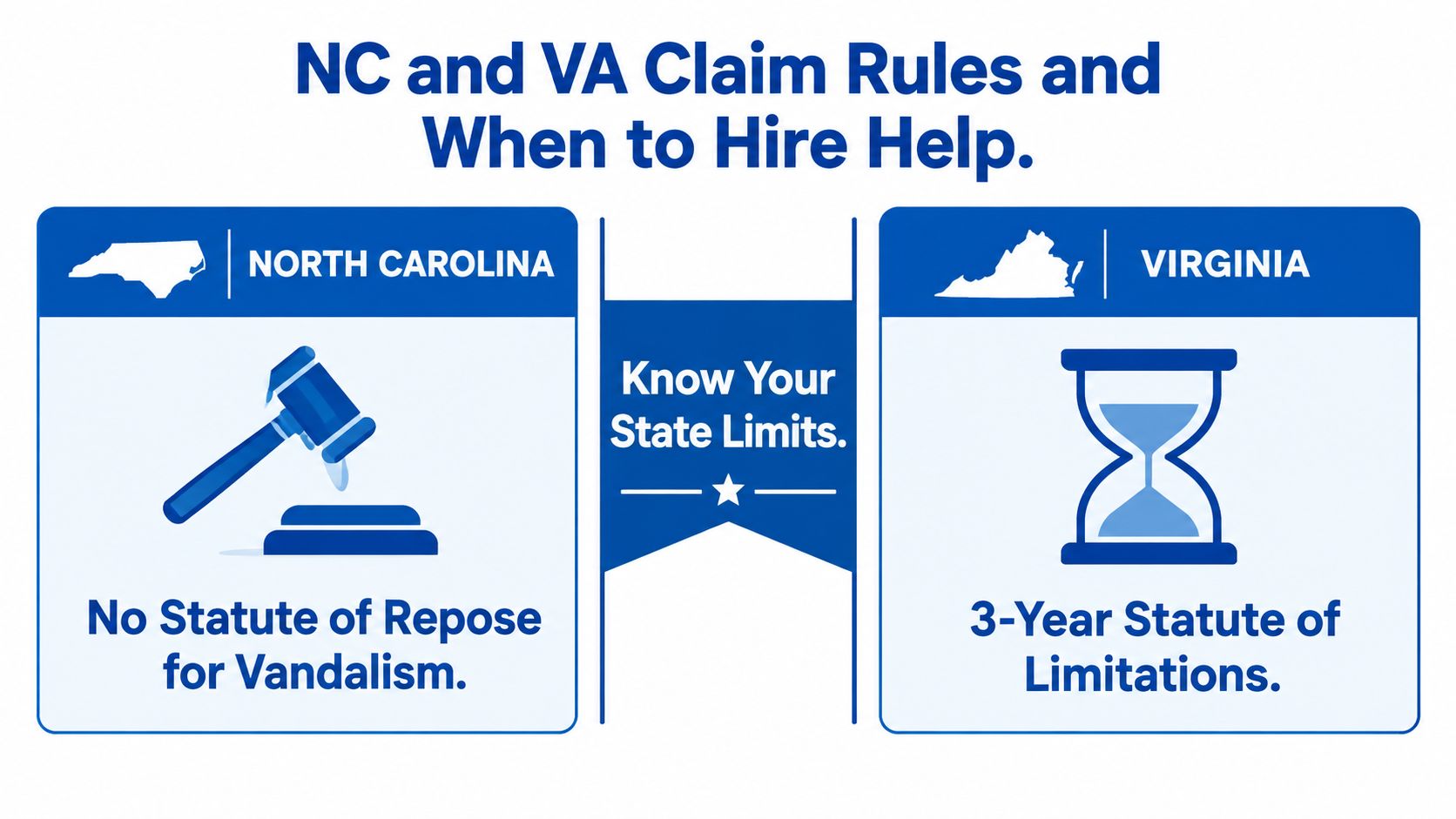
North Carolina property claims are commonly subject to a three-year statute of limitations under N.C.G.S. § 1-52, while Virginia property damage claims may be subject to a two-year limitation under Va. Code § 8.01-243. Confirm the rule that applies to your policy, claim type, and facts with qualified counsel. Don't assume carrier negotiations stop or extend a statutory deadline.
North Carolina's Department of Insurance and the Virginia State Corporation Commission Bureau of Insurance can provide regulatory information and complaint channels. A regulator may help identify communication or claims-handling concerns, but it generally doesn't replace a coverage analysis, appraisal, litigation advice, or a properly supported estimate.
Prompt handling rules and policy provisions also matter. Review N.C.G.S. § 58-63-15, the applicable state standard fire policy language, endorsements, notice requirements, proof-of-loss conditions, and appraisal provisions. The policy contract remains the central document.
Use a practical triage test
Consider professional help when any of these conditions apply:
- The carrier denied the claim: A written denial deserves a policy-based response, not a phone argument.
- The underpayment is substantial: If the carrier's scope is materially below the repair estimate, compare line by line before accepting payment.
- Vacancy is disputed: Gather occupancy proof immediately because this issue can affect the entire vandalism peril.
- The repair scope is complex: Multiple buildings, business contents, structural damage, or extensive security work justify an independent scope review.
North Carolina regulates public adjusters and imposes a regulated maximum fee schedule. Virginia also regulates the profession. Verify the adjuster's license, contract terms, fee, services, and cancellation rights before signing. A public adjuster can prepare and negotiate the insurance claim, but an attorney is the right professional for legal advice, litigation, or interpretation of rights outside the adjuster's role.
Use this claim dispute guide to organize the issue before a consultation. Bring the declarations page, full policy, denial letter, estimate, photographs, police report, video, receipts, occupancy records, repair invoices, correspondence, and a timeline of every inspection and conversation.
A strong consultation should answer four questions: What peril does the policy cover? What exclusion is the carrier asserting? What evidence defeats that exclusion? What repair scope remains unpaid? If those answers aren't clear, don't sign a release or accept a settlement as final merely because the carrier calls it payment.
For The Public Adjusters, Inc. reviews vandalism coverage, documents the physical loss, prepares residential or commercial scopes, and negotiates with the insurance company when a claim is denied, delayed, or underpaid. Visit For The Public Adjusters, Inc. for a no-cost claim review and help deciding whether your vacancy dispute, scope reduction, or vandalism denial needs professional representation.