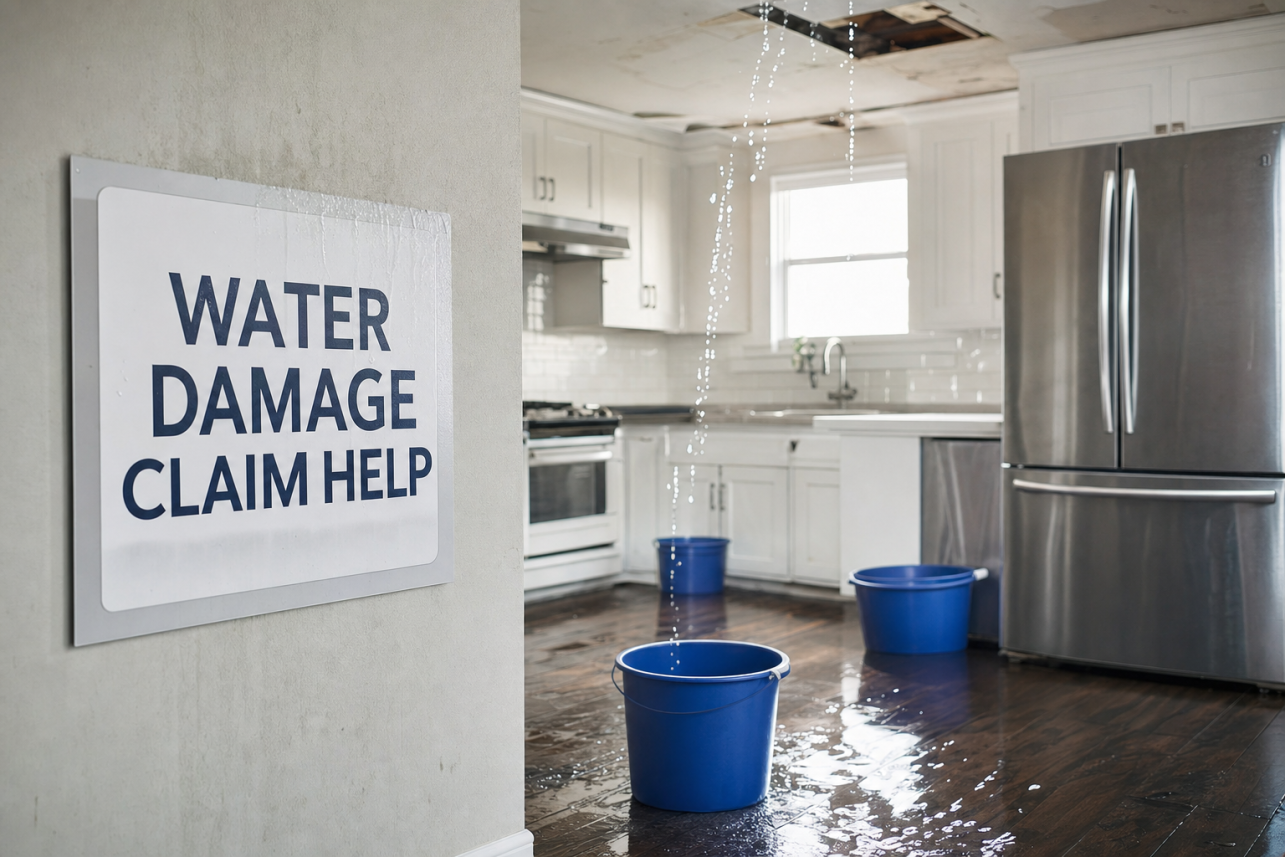
Water Damage Claim Help Burlington NC means having a licensed public adjuster on your side who works for you — not the insurance company — when water wrecks your home or business. For The Public Adjusters, Inc. documents the full scope of your loss, prepares the proof your policy requires, and negotiates directly with your insurer. Whether the water came from a burst pipe, a roof leak after a summer thunderstorm, or the remnants of a tropical system, we handle the claim so you can focus on getting your property back.
What This Service Is
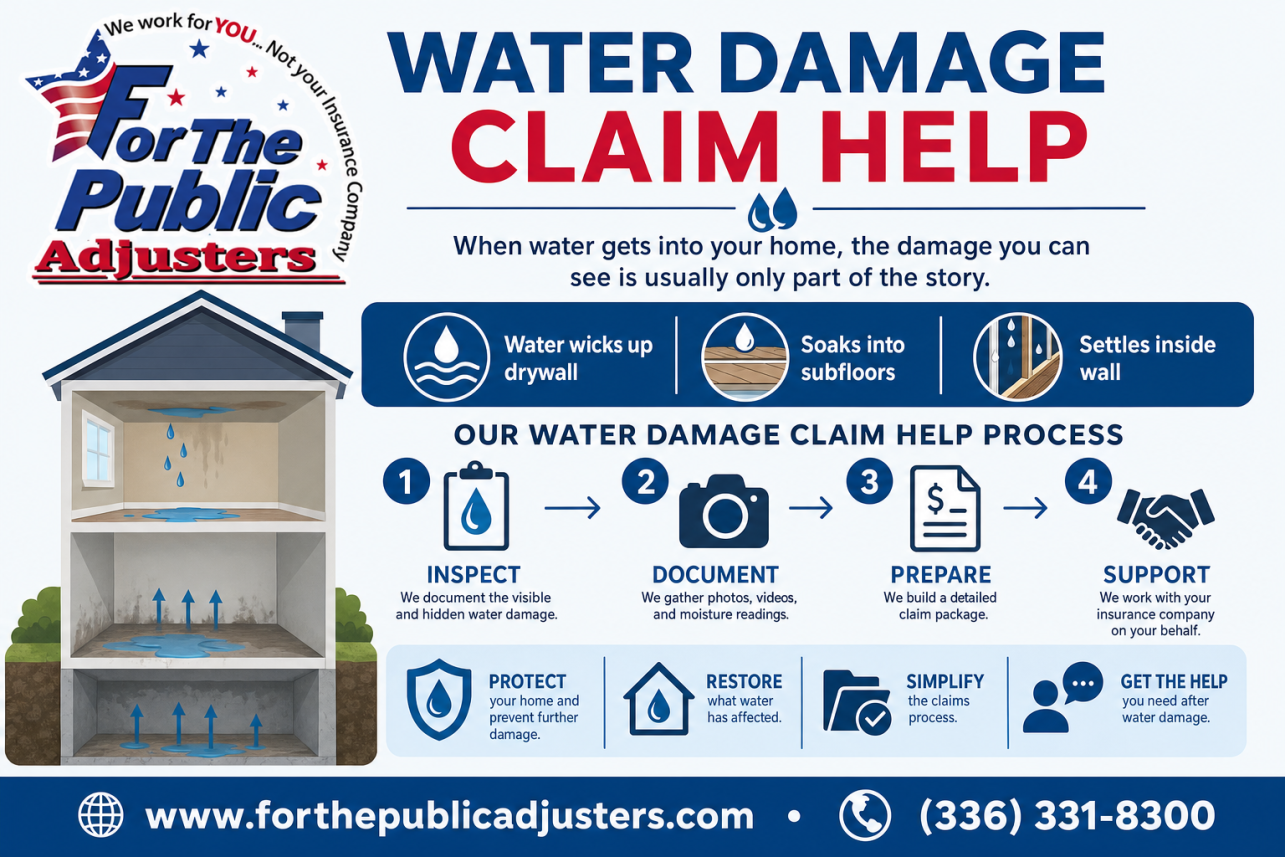
When water gets into your home, the damage you can see is usually only part of the story. Water wicks up drywall, soaks into subfloors, and settles inside wall cavities where it quietly feeds mold in Burlington’s humid summer air. The adjuster your insurance company sends works for the insurer — their estimate often stops at what’s visible.
A public adjuster works exclusively for you, the policyholder. We inspect the property, measure moisture where the eye can’t see, inventory damaged contents, and build a complete, documented repair estimate. Then we present that proof of loss to your insurer and negotiate the settlement on your behalf.
We also read the policy the way the insurance company does. That means checking your coverage limits, your deductible, whether you’re owed replacement cost or only a depreciated actual cash value payment, and whether your emergency cleanup costs — water extraction, drying equipment, tarping — are recoverable. The North Carolina Department of Insurance regulates public adjusters, and its NCDOI Public Adjusters Guide explains exactly what licensed adjusters like us can do for policyholders in this state. We are licensed and bonded, and we handle residential and commercial water losses alike.
Common Problems
When You Actually Need Water Damage Claim Help Burlington NC Homeowners Can Trust
Call before you accept a check, not after. The most common calls we get: the insurer denied the claim outright, blamed the loss on a maintenance issue or a policy exclusion, or made an offer that wouldn’t cover half the real repair cost.
We also step in when a contractor’s repair estimate is thousands above what the insurance company approved, and the homeowner is stuck in the middle paying out of pocket. If any of that sounds like your situation, an independent review of the claim costs you nothing to explore.
Hidden Damage And The Low First Offer
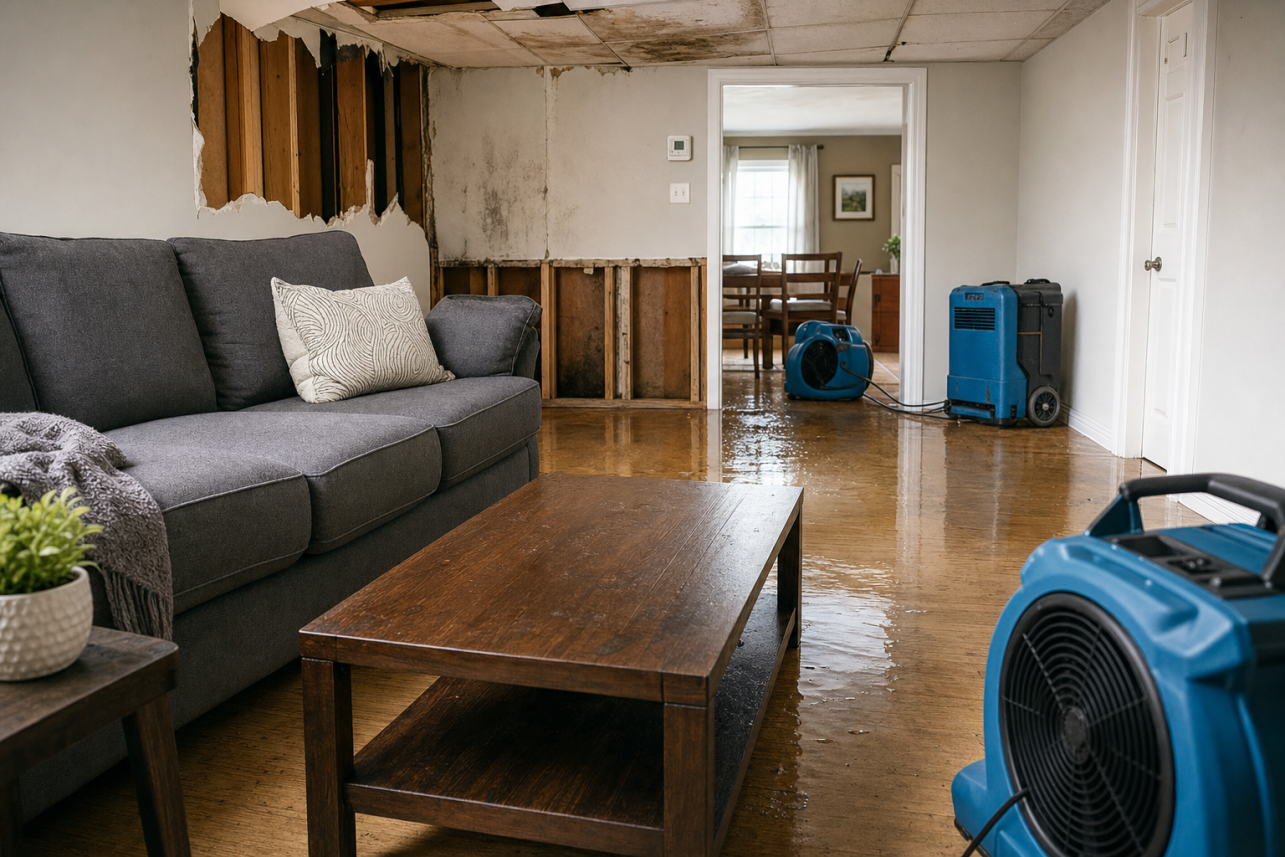
Insurance company estimates frequently miss what’s behind the walls. Wet insulation, swollen subflooring, and moisture trapped under vinyl or hardwood don’t show up in a quick walkthrough — but they show up months later as buckled floors and mold.
In Burlington’s older housing stock, plaster walls and aging plumbing make hidden damage even more likely. A low settlement based on surface damage means you absorb the difference. Documenting the full loss before you settle is the only reliable defense, and policyholders have won when they pushed back — in Guessford v. Pennsylvania National Mutual Casualty Insurance Co., a North Carolina homeowner whose storm-damaged home was underpaid was allowed by the federal court to pursue his unfair-claims-practices case against the insurer, and the matter ultimately resolved in his favor.
Flood Water Vs. Water Damage — Why The Source Decides Everything
Here’s the trap that catches many Alamance County property owners: a standard homeowners policy covers sudden water damage from inside the home — a burst supply line, a failed water heater — but not rising water from outside. Flooding requires a separate flood policy, usually through the National Flood Insurance Program (NFIP).
Insurers sometimes deny claims by labeling the loss ‘flood’ when it was actually a covered roof leak or wind-driven rain from a tropical storm. We investigate the true cause of the water and fight misclassified denials. If you do have a flood policy, we handle NFIP flood claims too, and those have their own strict deadlines and proof-of-loss rules.
Our Process
Free Claim Review And Policy Analysis
We start by reading your policy line by line and inspecting the damage in person. We identify your coverage limits, deductible, exclusions, and whether the insurer’s position on your claim actually holds up.
If the claim is worth pursuing, we tell you. If it isn’t, we tell you that too. We never guarantee a specific outcome — no honest adjuster can — but you’ll know exactly where you stand.
Full Documentation And Proof Of Loss
We measure moisture inside walls and floors, photograph everything, inventory damaged contents room by room, and build a detailed repair estimate using the same estimating standards insurers use.
That sworn proof of loss becomes the backbone of your claim. When the paperwork is airtight, there’s far less room for the insurance company to underpay or delay.
Negotiation And Settlement
We present the documented claim to your insurer, attend the company adjuster’s inspection alongside them, and negotiate every disputed line item — from depreciation deductions to emergency mitigation costs like water extraction and drying.
You stay informed at every step, and nothing gets settled without your approval. Our fee comes from the recovery, so our interests are aligned with yours from day one.
| What Happens | Filing on Your Own | With For The Public Adjusters |
|---|---|---|
| Damage documentation | Photos on your phone; hidden moisture usually missed | Thermal imaging, moisture mapping, and line-item estimates that capture concealed damage |
| Estimate preparation | You rely on the carrier’s adjuster to write the scope | Independent estimate written in the same pricing software carriers use |
| Policy interpretation | Exclusions like ‘seepage’ often accepted at face value | Coverage provisions, matching rules, and ALE benefits enforced in your favor |
| Negotiation | One low offer, take it or fight alone | Documented rebuttals and supplements until the settlement reflects the real loss |
| Typical result | Underpaid claims and out-of-pocket repairs | Settlements frequently multiples of the initial offer, at no upfront cost |
Commonly Overlooked In The Public Adjusting Industry
- Moisture trapped inside wall cavities and under flooring — Carrier adjusters rarely use thermal cameras or moisture meters, so damage you can’t see from the surface never makes it into the estimate.
- The policy’s matching provision for continuous flooring — Carriers offer to patch one room of hardwood or tile even when it flows through three, because most policyholders don’t know matching language can require full replacement.
- Additional living expenses (ALE) during repairs — Homeowners pay for hotels and meals out of pocket without realizing the policy owes those costs while the house is uninhabitable.
- Cabinet and vanity removal to dry behind them — Drying companies dry around cabinets to save time, leaving saturated drywall and mold conditions that surface months after the claim closes.
- Preserving the failed component as evidence — Plumbers routinely discard the burst pipe or corroded fitting during repair, throwing away the proof that separates a covered sudden loss from an excluded slow leak.
- Category 2 and 3 water classification — Water from dishwashers, washing machines, and drains is contaminated and requires removal of porous materials, but carriers price the loss as clean water to cut mitigation costs.
- Supplement rights after the first check — People assume the initial payment is final, when in reality damage discovered during demolition can and should be added to the claim.
- HVAC ductwork and insulation contamination — Water that reaches crawl spaces and duct chases soaks insulation and duct lining, and no one looks there unless someone crawls under the house with a meter.
Case Studies
Case Study #1
Situation: A homeowner off South Church Street in Burlington came home from a weekend trip to find their upstairs bathroom supply line had burst, sending water through the ceiling into the kitchen and living room below.
Problem: The insurance carrier’s field adjuster inspected for twenty minutes and issued an estimate of $9,400 — enough to replace some drywall and repaint, but nothing for the hardwood floors, cabinetry, or the moisture trapped inside wall cavities.
Investigation: Our team brought in thermal imaging and moisture meters within 48 hours. We mapped moisture migration through the subfloor, behind the kitchen cabinets, and into the HVAC chase, then documented Category 2 water contamination that required professional mitigation, not just drying fans.
Findings: Moisture readings behind the kitchen cabinetry were three times acceptable levels, the oak flooring was cupping across two rooms, and the ceiling insulation was saturated. The carrier’s estimate had missed roughly 60% of the actual damage.
Solution: We prepared a line-item estimate using the same pricing software carriers use, submitted the moisture mapping documentation, and invoked the policy’s matching provision for the continuous hardwood flooring that ran through three rooms.
Outcome: The claim settled at $52,300 — more than five times the original offer — covering full flooring replacement, cabinet removal and reinstallation, professional mitigation, and additional living expenses while the family stayed elsewhere.
Lesson: A burst pipe rarely damages only what you can see. Hidden moisture in wall cavities and subfloors is where carriers underpay most, and it’s exactly where documentation within the first few days matters.
Case Study #2
Situation: A small business owner near Glen Raven had a water heater fail in a back storage room over a holiday weekend, soaking inventory, commercial carpet, and the lower two feet of drywall throughout the retail space.
Problem: The carrier initially denied a large portion of the claim, arguing the damage was ‘long-term seepage’ excluded under the policy, and offered $6,800 against losses the owner estimated at over $40,000.
Investigation: We pulled the water heater’s service records, photographed the corroded tank fitting, and had the failure point evaluated. We also inventoried the damaged stock item by item with photos, invoices, and wholesale cost documentation.
Findings: The tank fitting failure was a sudden and accidental discharge — a covered peril — not gradual seepage. The mold beginning on the drywall was a direct result of the covered loss, which triggered the policy’s limited fungi coverage rather than an exclusion.
Solution: We submitted a formal rebuttal to the seepage denial with the evidence package, presented a complete business personal property inventory, and documented lost income for the days the store couldn’t open under the business interruption provision.
Outcome: The carrier reversed its position and settled for $47,900, including inventory, build-back, mitigation, and eleven days of business interruption income the owner didn’t know she could claim.
Lesson: Denial letters citing ‘seepage’ or ‘wear and tear’ are often the carrier’s opening position, not the final word. Proving how and when the water release happened frequently turns a denial into a full payment.
| Type of Water Loss | First Priority | Is It Usually Covered? | When to Call a Public Adjuster |
|---|---|---|---|
| Burst or frozen pipe | Shut off the main water valve, photograph everything before cleanup | Yes — sudden discharge is a covered peril on most policies | Before the carrier’s adjuster inspects, so hidden moisture gets documented |
| Water heater failure | Cut power/gas to the unit, keep the failed tank and fittings as evidence | Yes, if sudden — carriers often try to reclassify it as seepage | Immediately if the carrier mentions ‘gradual leak’ or ‘wear and tear’ |
| Appliance or supply line leak | Stop the source, pull back flooring edges to check the subfloor | Yes for resulting damage; the appliance itself usually isn’t | If flooring, cabinets, or walls are affected beyond one room |
| Roof leak from storm damage | Tarp the roof, document the storm date and interior staining | Yes if wind or hail opened the roof; not if the roof simply wore out | Right away — proving the storm caused the opening is the whole claim |
| Sewer or drain backup | Avoid contact — this is contaminated water requiring professional mitigation | Only if you carry a backup endorsement; check your declarations page | Before accepting any denial; endorsement limits are often misapplied |
| Flooding from outside (surface water) | Document water lines and get to safety | No — requires a separate flood policy, not homeowners insurance | If there’s any dispute over whether water came from inside or outside |
| Slow leak discovered late | Stop the source and document the hidden failure point | Sometimes — hinges on when the release began and what you could have seen | Essential — these claims are denied by default and won on evidence |


Reviews
Our washing machine hose let go while we were at work and flooded half the first floor. State Farm’s adjuster offered us less than $12,000 and said the floors could be ‘refinished.’ For The Public Adjusters found soaked subfloor and moisture inside two walls the carrier never checked. Final settlement was over $40,000 and every dollar went into putting our house back together correctly.
Marcus T., Burlington
After a pipe froze and split in our crawl space last winter, the insurance company kept asking for more documents and dragging things out for weeks. These folks took over all communication, sent their own estimate with photos and moisture readings, and had it resolved in about six weeks. The stress relief alone was worth it, and the payout more than tripled.
Denise W., Alamance County
Water heater flooded my rental property near Elon and the carrier tried to call it long-term seepage and deny most of it. I almost accepted it. My realtor recommended calling a public adjuster first. They proved it was a sudden failure, got the denial overturned, and even recovered lost rent I didn’t know was covered. Only wish I’d called them on day one instead of week three.
Jamal R., Burlington
Frequently Asked Questions
What Does Water Damage Claim Help Burlington NC Actually Include When I Hire For The Public Adjusters, Inc.?
When you bring us in on a water loss, we take over the entire claim process from documentation through settlement. That starts with a detailed inspection of your Burlington home or business, including moisture mapping behind walls, under flooring, and in crawl spaces, where hidden saturation is common in Alamance County’s older housing stock.
From there, we photograph and inventory every damaged item, write a line-item estimate using the same software insurance carriers use, and review your policy to identify every coverage that applies. Many policyholders miss things like code-upgrade coverage, additional living expenses, or mold remediation sublimits simply because no one pointed them out.
We then handle all communication with the insurance company. We attend the adjuster’s inspection, challenge lowball scope decisions, and negotiate until the settlement reflects the real cost of drying, tear-out, and rebuild at current local contractor pricing.
Our adjusters work on contingency, so our fee comes from the settlement we recover, not from your pocket up front. If your claim was already underpaid or denied, we can also reopen it, as long as it falls within North Carolina’s claim deadlines. Most homeowners tell us the biggest relief is not having to argue with the carrier themselves while also managing water mitigation crews, plumbers, and a disrupted household.
My Insurance Company Already Sent An Adjuster To My Burlington Home. Why Would I Need A Public Adjuster Too?
The adjuster your carrier sends works for the insurance company, and their job is to settle the claim within the company’s guidelines. A public adjuster works exclusively for you, the policyholder, and that difference matters enormously on water losses.
Water damage is the most commonly underpaid type of claim we see in Alamance County. Carrier adjusters often scope only visible damage, missing saturated insulation, wet subflooring, damage inside wall cavities, and moisture that will cause mold if it isn’t addressed. They may also apply depreciation aggressively or classify a covered sudden pipe burst as excluded long-term seepage.
We’ve handled claims throughout Burlington, from homes near Elon and downtown to newer builds off University Drive, and the pattern is consistent: independent documentation almost always reveals damage the first inspection missed. We use moisture meters, thermal imaging, and detailed estimates to build a claim file the carrier can’t easily dismiss.
There’s no conflict in having both adjusters involved. North Carolina licenses public adjusters specifically so policyholders can have professional representation. In many cases, our involvement significantly increases the settlement, often several times what the initial offer would have paid. Even if your claim seems straightforward, a free review costs you nothing and can confirm whether the carrier’s numbers actually cover a full repair at real Burlington contractor rates.
How Long Does A Water Damage Claim Take To Settle In Alamance County, And Does Hiring You Slow It Down?
Most residential water claims we handle in the Burlington area settle within 30 to 90 days, depending on the severity of the loss and how the carrier responds. North Carolina requires insurers to acknowledge claims promptly and to pay undisputed amounts without unreasonable delay, and we hold them to those obligations.
Hiring a public adjuster typically does not slow things down. In fact, it often speeds up the parts that matter. Claims stall when documentation is incomplete, when the carrier requests information piecemeal, or when the homeowner and insurer go back and forth over scope. We front-load the claim with a complete estimate, full photo documentation, and moisture readings, which removes most of the reasons carriers use to delay.
Where our involvement can add time is when the initial offer is far too low and we push back. A fast settlement isn’t a good settlement if it leaves you thousands short on the rebuild. We’d rather take an extra few weeks and recover enough to actually restore your home than accept a quick check that runs out mid-repair.
If you’re displaced, we also pursue additional living expense coverage right away so temporary housing costs are handled while negotiations continue. Throughout the process, you’ll know exactly where your claim stands, because we communicate at every stage rather than leaving you waiting on the carrier’s timeline.
My Water Damage Claim Was Denied Or Underpaid. Can I Still Get Water Damage Claim Help Burlington NC After The Fact?
Yes. Getting Water Damage Claim Help Burlington NC after a denial or low payment is one of the most common reasons policyholders call For The Public Adjusters, Inc. A denial letter is the carrier’s position, not the final word, and underpaid claims can be reopened and supplemented.
The first step is a free review of your policy, the denial or settlement letter, and the carrier’s estimate. Water claims are frequently denied on grounds like “long-term seepage,” “wear and tear,” or “lack of maintenance,” and those determinations are often wrong or unsupported. We inspect the actual damage, document the true cause of loss, and build the evidence needed to challenge the decision.
For underpayments, we prepare a supplemental claim showing what the original estimate missed: hidden moisture damage, code-required upgrades, proper drying protocols, matching materials for flooring and cabinetry, and realistic labor rates for the Burlington market. Carriers frequently pay to patch a section of flooring when your policy actually entitles you to continuous, matching replacement.
Timing matters. North Carolina policies contain deadlines for supplementing claims and filing suit, so don’t sit on a denial letter. Bring us your paperwork as soon as possible, even if the loss happened months ago. If we find grounds to reopen the claim, we handle the entire dispute on contingency, and you owe nothing unless we recover additional money for you.
How Much Does Water Damage Claim Help Burlington NC Cost, And What If My Claim Doesn’t Pay Out?
For The Public Adjusters, Inc. works on a contingency fee, which means our compensation is a percentage of the settlement we recover for you. There are no upfront charges, no hourly billing, and no invoices arriving while your Burlington home is still torn apart from a burst pipe or slab leak.
If we don’t recover money for you, you don’t owe us a fee. That structure keeps our interests aligned with yours: we only get paid when we increase what the insurance company pays.
Homeowners often ask whether the fee eats up the benefit of hiring us. In our experience across Alamance County, the answer is almost always no. Carriers routinely miss hidden moisture in wall cavities, underestimate drywall and flooring replacement, and apply depreciation aggressively. When we document those items properly, the increase in the settlement typically far exceeds our fee.
Before you sign anything, we review your policy and your loss at no cost. If we believe your carrier’s offer is already fair, or that the damage falls under an exclusion we can’t overcome, we’ll tell you plainly. We would rather turn down a case than take a fee for work that won’t move the number.
Every fee term is spelled out in writing before we start, as required for licensed public adjusters in North Carolina. You’ll know exactly what the percentage is and how it’s calculated, with no surprises when the settlement check arrives.
What Kinds Of Water Losses Do You Handle For Burlington And Alamance County Homeowners?
We handle the full range of sudden and accidental water losses common to homes in Burlington, Graham, Mebane, and the surrounding area. That includes burst supply lines, water heater failures, washing machine and dishwasher hose ruptures, frozen pipe breaks during winter cold snaps, roof leaks after storms, HVAC condensation overflows, toilet and drain backups, and slab leaks under older homes.
Many houses in this area were built between the 1950s and 1990s, and aging polybutylene or galvanized plumbing is a frequent culprit. We know how carriers scrutinize these losses, and we know how to document that the damage was sudden and accidental rather than long-term wear, which is a distinction that can make or break coverage.
We also handle the secondary damage water leaves behind: warped hardwoods, saturated subfloors, ruined insulation, compromised cabinetry, and mold growth that appears days after the initial event. Insurance estimates often stop at what’s visible. We use moisture readings and thorough inspection to capture what’s inside walls, under floors, and above ceilings.
One important note: standard homeowners policies exclude flooding from rising surface water, which requires separate flood coverage. During our free initial review, we’ll read your specific policy language and tell you honestly whether your loss falls under a covered peril. If it does, we build the claim to reflect the true scope of repair, not the carrier’s abbreviated version.
What Should I Do In The First 24 Hours After Finding Water Damage In My Burlington Home?
First, stop the water if you safely can. Shut off the supply valve at the fixture or the main shutoff, which in many Burlington homes is near the water meter at the street or where the line enters the crawlspace. If water has reached outlets or your panel, cut the electricity to affected rooms before walking through standing water.
Second, document everything before you touch it. Take wide photos of each room, then close-ups of damaged flooring, baseboards, furniture, and belongings. Video works well too. This evidence becomes the backbone of your claim, and it’s far harder to prove damage after cleanup begins.
Third, take reasonable steps to prevent further damage, because your policy requires it. Move furniture off wet carpet, mop up standing water, and run fans. Save receipts for anything you buy or rent, including tarps, dehumidifiers, or emergency plumbing repairs, since those costs are typically reimbursable.
What you should not do is authorize major demolition or sign a broad work authorization with a restoration company under pressure. Some contracts assign your insurance benefits away or lock you into pricing before the scope of loss is even known.
If you call us early, we can guide you through the reporting process, be present when the carrier’s adjuster inspects, and make sure the claim starts on the right footing. It’s much easier to build a strong claim from day one than to repair a weak one later.
Is Water Damage Claim Help Burlington NC Only For Big Losses, Or Is A Smaller Claim Worth Pursuing Too?
Water Damage Claim Help Burlington NC isn’t reserved for catastrophic losses, and smaller claims are often the ones carriers underpay most. A kitchen supply line leak that looks like a $4,000 repair can easily become a $20,000 claim once you account for cabinet removal, subfloor replacement, matching flooring throughout continuous rooms, and proper drying.
Here’s why size is deceptive: water travels. What appears to be a small stain on a ceiling in your Burlington home often means saturated insulation, wet framing, and moisture inside wall cavities that a quick visual inspection misses. Carrier estimates frequently price only the visible surface, leaving you to discover the real scope after the check is cashed.
We use moisture meters and detailed room-by-room scoping to establish the actual damage, then price repairs at real Alamance County contractor rates rather than the carrier’s software defaults. On modest claims, that difference regularly doubles or triples the settlement.
That said, we’re honest about when a claim isn’t worth filing. If the true repair cost sits close to your deductible, filing could hurt more than help, and we’ll tell you that in the free review. Our adjusters look at your deductible, your policy limits, and the realistic scope before recommending anything.
The short answer: don’t assume your loss is too small to matter. Let us look at it first. The review costs nothing, and the visible damage is rarely the whole story where water is involved.
How Do I Know If My Burlington Water Loss Is Covered As ‘water Damage’ Or Excluded As ‘flood Damage’?
This distinction trips up more Alamance County homeowners than almost anything else. In insurance language, ‘flood’ means surface water rising from outside your home — a creek overflowing, storm runoff pooling against your foundation, or groundwater seeping in. Standard homeowners policies exclude flood; that requires a separate FEMA or private flood policy.
Most of what we see in Burlington homes is not flood at all. A burst supply line, a failed water heater, a washing machine hose that let go, an HVAC condensate overflow, or rain entering through storm-damaged roofing — those are typically covered water damage under a standard policy, even when the resulting mess looks identical to flooding.
The problem is that insurers sometimes label a covered loss as ‘flood’ or ‘groundwater’ to deny it, especially in crawlspace and basement claims. We’ve reviewed Burlington claims where a broken pipe under the slab was written off as groundwater intrusion until the evidence proved otherwise.
When we take on a claim, we trace the actual source of the water, document the path it traveled, and match the facts to your specific policy language rather than accepting the carrier’s characterization. If your denial letter uses words like ‘surface water,’ ‘seepage,’ or ‘flood,’ don’t assume that’s the final answer. Bring us the letter and your policy — that review costs you nothing, and the source of the water often tells a very different story than the denial does.
What Documentation Should I Gather Before Starting Water Damage Claim Help Burlington NC Services?
The good news: you don’t need a perfect file before calling us. Part of Water Damage Claim Help Burlington NC is building that documentation for you. But anything you preserve early makes your claim stronger, so here’s what matters most.
First, photos and video — lots of them, with timestamps. Capture standing water, wet drywall, buckled flooring, soaked contents, and especially the source itself, like the split pipe or failed fitting. Shoot before anything is removed or dried, then keep shooting as mitigation progresses.
Second, keep the evidence. If a plumber replaces a burst line, ask them to save the failed section of pipe and write a brief description of what they found. Carriers in this area frequently question causation, and physical evidence shuts that argument down.
Third, save every receipt: emergency plumbing, water extraction, fans and dehumidifiers, tarps, even the hotel bill if your Burlington home was unlivable. These fall under different coverage parts of your policy, and unreceipted expenses are easy for an insurer to refuse.
Finally, locate your full policy — the declarations page plus the actual policy form, not just the billing statement. If you can’t find it, we’ll request a certified copy from your carrier.
Don’t throw away damaged materials or contents until they’ve been documented and, ideally, inspected. Discarded evidence is one of the most common reasons Alamance County claims get underpaid. When in doubt, photograph it, bag it, and set it aside in the garage until we’ve seen it.
Will Filing A Water Damage Claim Raise My Insurance Rates Or Get My Burlington Policy Dropped?
It’s a fair worry, and we hear it constantly from homeowners across Burlington, Graham, and Mebane. Here’s the honest picture.
In North Carolina, homeowners rates are influenced by many factors — statewide loss trends, your home’s age and construction, and your claims history among them. A single water claim rarely triggers non-renewal by itself, especially when the cause was sudden and accidental, like a burst pipe, rather than neglected maintenance. Carriers are far more concerned with repeat losses and unrepaired damage.
What genuinely hurts you long-term is an unrepaired or partially repaired loss. If you accept a low settlement, can’t afford proper repairs, and moisture lingers in walls or the crawlspace, you’re set up for mold, rot, and a second claim the carrier may then deny as pre-existing. That pattern is much more likely to cost you coverage than one properly documented, fully repaired claim.
Also worth knowing: the loss goes on your CLUE report the moment you report it to your insurer, whether or not you hire us. Bringing in a public adjuster doesn’t add anything to that record — it simply changes who’s negotiating on your side.
Our advice for Alamance County homeowners is practical. For a loss near your deductible, we’ll tell you honestly if it’s not worth filing. For a real loss — soaked subfloors, saturated insulation, damaged kitchens — the money you’d leave behind by not filing or by settling low almost always outweighs any premium effect. We’ll walk through that math with you before you commit to anything.
What Happens If Mold Or Hidden Damage Shows Up After My Claim Has Already Started Or Settled?
This is one of the biggest reasons Burlington homeowners call our adjusters weeks after a loss. Water travels, and Piedmont humidity makes hidden moisture especially dangerous here. Water that seemed contained to a bathroom often wicks into wall cavities, under vinyl plank flooring, and down into crawlspace insulation — places a quick carrier inspection never checks.
If your claim is still open, supplemental damage can and should be added. We use moisture meters and thermal imaging to map where water actually went, then submit a supplemental demand with photos, readings, and a revised repair scope. Insurers pay supplements routinely; the key is documenting the connection to the original loss before the trail goes cold.
If your claim has already settled, you may still have options. Most settlements don’t legally close the door on damage that was hidden and reasonably undiscoverable at the time — mold blooming inside a wall cavity two months later is a classic example. North Carolina policies also carry deadlines for reopening or supplementing claims, so speed matters. Waiting six months makes it far harder to prove the mold came from the covered loss rather than something new.
One caution on mold specifically: many policies cap mold remediation, sometimes at $5,000 or $10,000. How the damage is categorized — mold remediation versus water damage repair — can swing the payout dramatically, and that categorization is negotiable. If you’re smelling mustiness, seeing discoloration, or your floors feel spongy after a ‘completed’ claim, have us take a look before you sign anything else or start tearing things out.
The Insurance Company Made Me An Offer That Seems Low. How Does Water Damage Claim Help Burlington NC Change What I Actually Get Paid?
First offers on water losses are almost always built from the carrier’s own inspection, and those inspections frequently miss what water actually does inside a house. Moisture wicks up drywall, travels along subfloors, and soaks insulation behind walls where a quick visual walkthrough never looks.
When For The Public Adjusters, Inc. takes on a claim, we start by re-scoping the loss ourselves. That means moisture readings, photo documentation of affected cavities, and a line-item estimate written in the same software carriers use, so we can compare our numbers against theirs item by item.
Common gaps we find in Burlington offers include missing drywall replacement (carriers often pay to dry when replacement is warranted), no allowance for matching flooring across connected rooms, underpriced cabinet and vanity replacement, and omitted code-upgrade costs that older Alamance County homes routinely trigger.
Once we identify the shortfall, we present the documented difference to the carrier and negotiate on your behalf. You are never obligated to accept a first offer, and in North Carolina, accepting a partial payment generally does not close your claim. If you have already cashed a check and later realized the settlement fell short, that is exactly the situation Water Damage Claim Help Burlington NC exists to fix. We review the file, document what was missed, and pursue a supplemental payment for the full scope of your covered damage.
Do You Handle Water Damage Claims For Rental Properties, Condos, And Businesses In Burlington, Or Only Single-Family Homes?
We handle all of them. Water losses hit landlords, condo owners, and business owners across Alamance County just as often as homeowners, and each situation comes with its own policy complications that we deal with regularly.
For rental property owners, the big issues are usually loss of rents coverage and tenant displacement. If a burst pipe makes a unit uninhabitable, your policy may owe you the rental income you lose during repairs. We document the rental value and repair timeline so that coverage actually gets paid, not overlooked.
Condo claims add another layer, because you have to sort out where the HOA master policy ends and your unit-owner policy begins. In many Burlington condo and townhome communities, the association covers the structure to the drywall while you cover everything inward. We read both policies, coordinate with the association’s claim when needed, and make sure your damage does not fall through the gap between the two.
For commercial properties, business interruption is often worth more than the physical damage itself. A restaurant, salon, or retail shop on South Church Street that closes for three weeks of drying and repairs loses real revenue, and proving that loss requires financial documentation most owners have never had to assemble. Our adjusters build that claim alongside the property claim.
Whatever the property type, the fee structure is the same contingency arrangement, and the goal is the same: a settlement that reflects the full scope of what the water actually cost you.
My Insurance Company Wants To Send Its Own Restoration Contractor. Do I Have To Use Them?
No. In North Carolina, you have the right to choose your own contractor. Carriers often steer policyholders toward a preferred vendor network, and while some of those companies do fine work, they answer to the insurer that feeds them business, not to you.
That matters on water claims specifically because scope decisions get made fast. A network contractor working to the carrier’s estimate may dry and patch where full tear-out and replacement is actually warranted, or reinstall flooring over a subfloor that should have been replaced. You live with those decisions long after the claim closes.
Our approach as your Burlington public adjuster is to establish the correct scope of repairs first, independent of any contractor’s relationship with the insurance company. Once the covered scope and settlement are properly documented and negotiated, you can hire whichever licensed contractor you trust, whether that is a local Alamance County builder you have worked with before or a restoration firm we can point you toward.
One caution: be careful with contractors who show up unsolicited after a loss and ask you to sign paperwork on the spot. Some assignment agreements hand over control of your claim proceeds. Have someone who represents your interests read anything before you sign it.
Emergency mitigation is the one exception where speed matters most. Getting water extracted and drying equipment running within the first day or two is worth doing immediately with a reputable local company, and your policy generally covers those reasonable emergency costs.
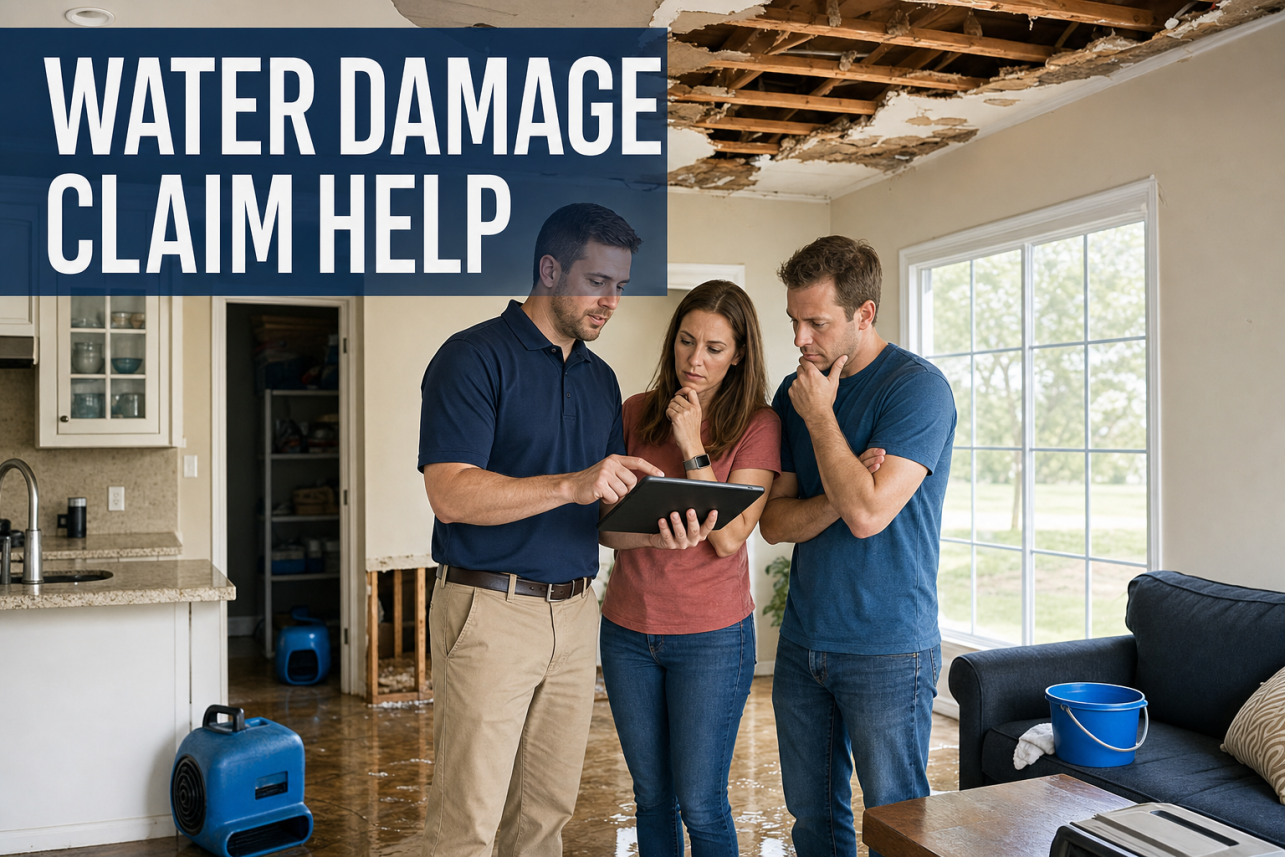
How Do I Get Started, And What Happens In The First Few Days After I Contact You?
Getting started is simple, and the first conversation costs nothing. Call For The Public Adjusters, Inc., describe what happened, and we will tell you honestly whether your situation is one where our involvement will add value. Not every claim needs a public adjuster, and we will say so when that is the case.
If it makes sense to move forward, the first step is a free review of your loss and your policy. We come to your property, whether that is near downtown Burlington, out toward Graham or Elon, or anywhere else in Alamance County, and inspect the damage ourselves. We read your actual policy language, because coverage for water losses turns on specific wording about sudden discharge, seepage, and resulting damage.
Within the first few days, we document everything: moisture mapping, photographs, an inventory of damaged contents, and a detailed repair estimate. We then notify your insurance carrier that we represent you. From that point on, the carrier’s adjuster deals with us, and the calls, inspections, and paperwork stop landing on your desk.
If the loss is fresh, we also help coordinate emergency drying so the damage does not spread while the claim develops. If the loss is older and you are unhappy with how the carrier handled it, we start by pulling apart their estimate to see what was missed.
Either way, you will know within that first week what your claim should realistically be worth, which is often the most valuable piece of water damage claim help in Burlington NC that we provide.
Local Relevance
Burlington sits squarely in North Carolina’s summer storm corridor. Severe thunderstorms roll through the Piedmont regularly from June into September, and the remnants of hurricanes and tropical storms can dump inches of rain on Alamance County in a single afternoon. That water finds every weak shingle, clogged gutter, and low-graded crawl space.
Much of Burlington’s housing dates to the mill-town era and the decades after — homes with original galvanized or aging copper plumbing, older water heaters, and crawl-space foundations that trap humidity. Those are exactly the conditions that produce burst pipes, slow hidden leaks, and mold that spreads fast in our muggy summers.
We also help local business owners, because a water loss in a commercial building on a retail corridor doesn’t just damage the structure — it interrupts income. Commercial water claims involve inventory, equipment, and business-interruption questions that deserve the same careful documentation as a home claim. And when a summer storm drops a tree through your roof and lets the rain in, we handle that combined tree and water loss as one properly documented claim.
Many Burlington-area homes built in the mill era and mid-century decades sit over vented crawl spaces, and in the Piedmont’s humid summers a small plumbing leak down there can run for months unnoticed — so by the time water damage shows upstairs, the documented scope of loss is often far larger than the insurer’s first inspection reflects.
Get A Straight Answer About Your Water Loss
If your claim was denied, underpaid, or is dragging on while your Burlington home sits damaged, let a licensed and bonded public adjuster review it — at no cost and no obligation. For The Public Adjusters, Inc. serves homeowners and business owners throughout Alamance County, and we don’t get paid unless you recover.
Request Your Free Claim Review
Call us: (336) 331-8300
Helpful Resources
- NCDOI Public Adjusters Guide
- National Flood Insurance Program (NFIP)
- North Carolina Department of Insurance — State regulator overseeing insurers and licensed public adjusters in NC
Serving Burlington · Alamance
Last updated: July 18, 2026