When you pay your insurance premiums every year, you're buying a promise. That promise is that if disaster strikes, the insurance company will make you whole again. Replacement Cost Coverage (RCV) is the core of that promise—it's designed to cover the full cost to repair or replace what you lost with brand new materials of similar kind and quality, without subtracting a single penny for age or wear.
It's the difference between getting enough money to buy a new laptop versus getting a check for the value of your five-year-old, coffee-stained machine. The problem is, insurance giants like State Farm and Allstate have built their empires on breaking that promise.
Your Policy's Most Important Battleground
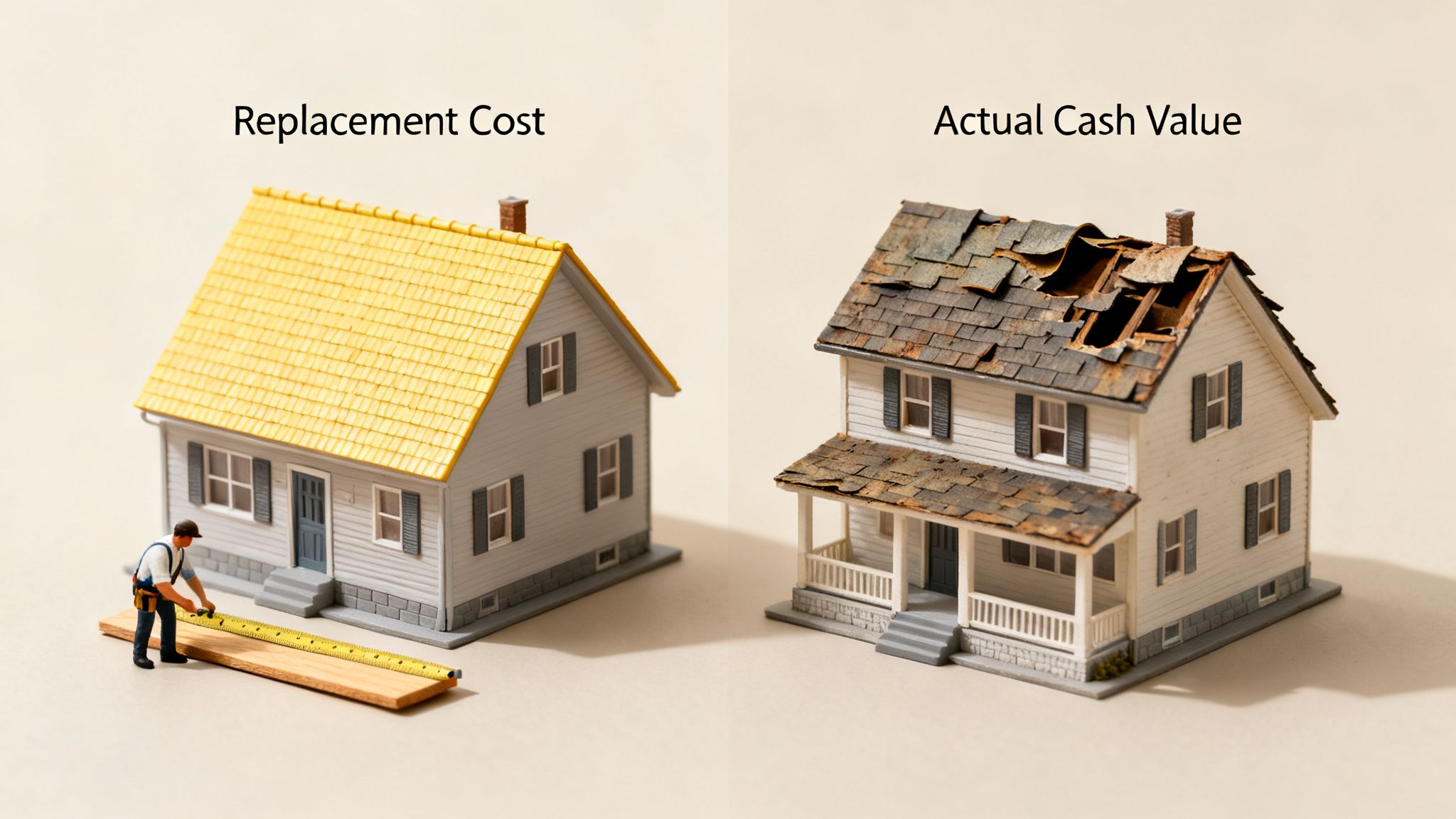
After a fire guts your kitchen or a hurricane rips the roof off your business, the entire fight with your insurance company almost always boils down to two terms: Replacement Cost Value (RCV) and Actual Cash Value (ACV).
Getting this right is everything. It’s the first and most important step in fighting back against the lowball settlement offers that carriers like State Farm and Allstate have built their entire business models around.
Your RCV policy is your ticket to a full recovery. ACV, on the other hand, is the insurance company’s favorite weapon to drastically underpay your claim.
The Lowball Offer Tactic Explained
So, what exactly is Actual Cash Value? It’s the replacement cost of your damaged property minus a deduction for depreciation. Depreciation is just a fancy word for the value lost due to age, wear and tear, and general obsolescence.
Insurance companies are obsessed with ACV because it gives them a bulletproof excuse to pay you far less than what you actually need to rebuild your life. They know you are vulnerable and use this tactic to increase their profits at your expense.
Let’s break it down simply:
- Replacement Cost Coverage (RCV): Pays to replace your 15-year-old roof with a brand new one at today’s prices.
- Actual Cash Value (ACV): Gives you a check for a fraction of that cost, arguing that your roof was old and had "lived most of its life."
This tactic is designed to leave you, the policyholder, holding the bag. You're left to cover the massive financial gap out of your own pocket. You paid faithfully for full protection, but when you finally need it, the insurer tries to pay you based on used-goods pricing.
To show you what this looks like with real numbers, let's look at that 15-year-old roof example.
Replacement Cost (RCV) vs Actual Cash Value (ACV) Payout for a Damaged Roof
| Metric | Replacement Cost Coverage (What You're Owed) | Actual Cash Value (The Insurer's First Check) |
|---|---|---|
| Cost to Install a New Roof | $20,000 | $20,000 |
| Roof's Lifespan | 20 years | 20 years |
| Roof's Age | 15 years | 15 years |
| Depreciation Deduction | $0 (Not applied to final payout) | -$15,000 (75% of the roof's life is used) |
| Policy Deductible | -$1,000 | -$1,000 |
| Your Final Payout | $19,000 | $4,000 |
See the difference? One puts a new roof over your head. The other leaves you $15,000 short and scrambling to find a contractor who'll work for pennies on the dollar.
The Real-World Financial Impact
The gap between RCV and ACV isn't just a few bucks—it's often tens or even hundreds of thousands of dollars. Here in North Carolina and Virginia, where storms routinely batter properties, having true replacement cost coverage is absolutely essential.
Data consistently shows that RCV policies are the only way to cover full repair costs (minus your deductible, of course). ACV policies, by factoring in age and wear, routinely underpay claims by 20% to 50%.
This is why you have to understand the fine print. You need to know why ACV vs RCV really matter in a claim dispute. Getting this wrong is a devastating financial mistake, but knowing your rights is the first step toward demanding the full, fair settlement you're owed.
How Insurers Manipulate Your Dwelling Claim
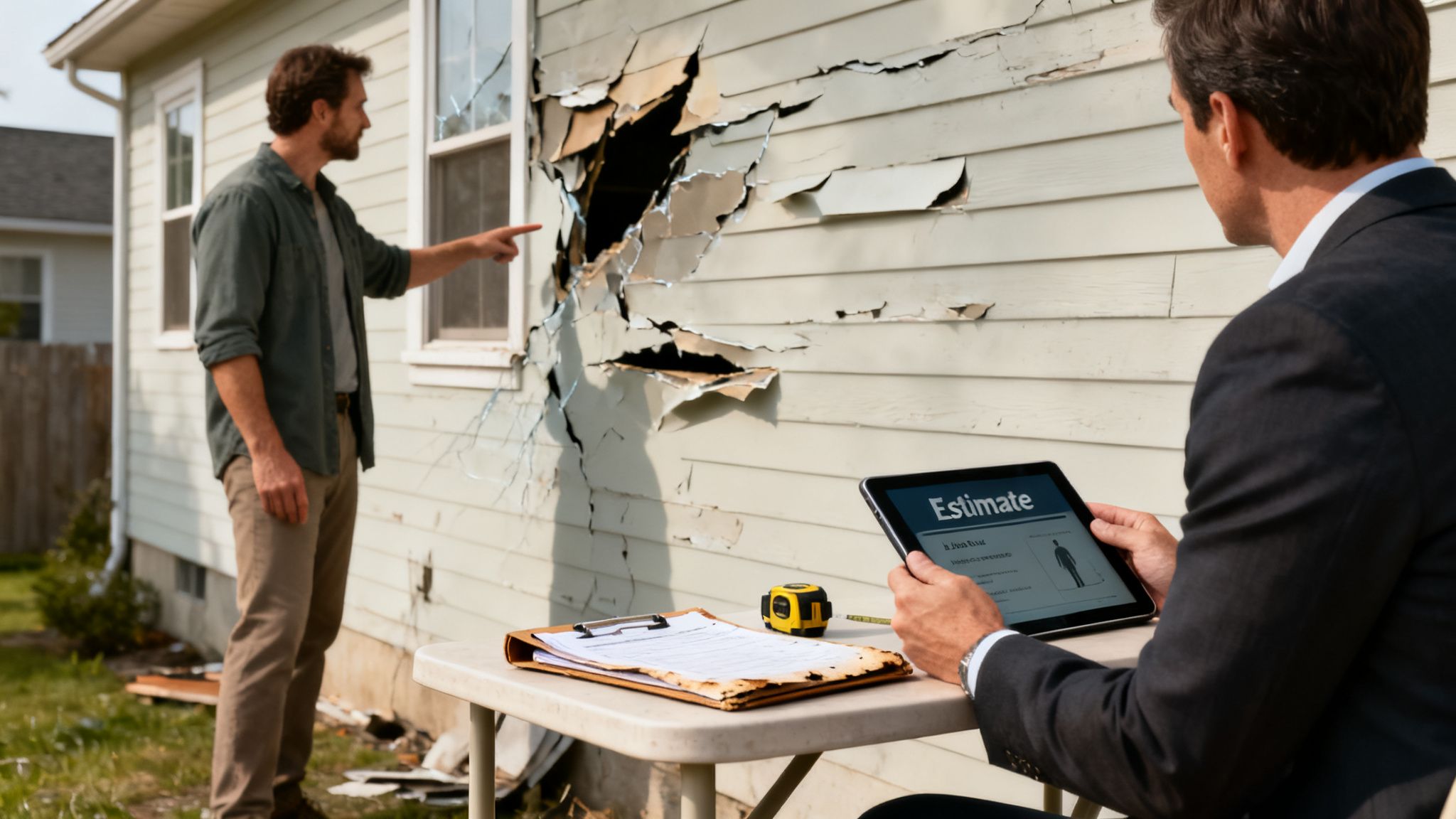
Here's the hard truth: having a Replacement Cost Coverage (RCV) policy doesn't automatically mean you'll get a fair payout. Not even close. Insurance companies have a well-worn playbook of tactics designed to systematically underpay your dwelling claim, and they’re betting you won't have the energy or knowledge to fight back.
These companies didn't become multi-billion-dollar giants by paying claims in full. They profit by minimizing every single payout, and your home’s structural claim is the biggest target on their list. The adjuster they send to your home works for them. Their job isn't to help you; it's to protect the company's bottom line.
Common Underpayment Tactics
That adjuster from your insurance company often shows up with a laptop running software designed to do one thing: produce the lowest possible repair estimate. They have a dozen ways to cook the books.
- Outdated Pricing: Their software often pulls from old, national-average pricing databases. This completely ignores the reality of your local market in North Carolina or Virginia, especially after a storm when labor and material costs skyrocket.
- Ignoring Code Upgrades: They’ll conveniently “forget” to include expensive but legally required updates to meet current building codes. That leaves you holding the bag for thousands in mandatory upgrades.
- Minimizing Scope: The adjuster will argue that a section of your roof can be "patched" when it needs a full replacement, or they'll claim smoke-damaged framing is perfectly fine when it’s structurally compromised.
These aren't honest mistakes. They are calculated moves in a game they play every day. That first offer you get from the insurance company is just that—an offer. It is almost never what it will actually cost to fix your home.
A Public Adjuster Success Story
Let’s look at a scenario we see all the time. A hurricane tears through a coastal North Carolina town, wrecking a home’s roof, siding, and underlying structure. The insurance company's adjuster spends 45 minutes on-site and spits out an RCV estimate of $80,000.
The homeowner knows this feels wrong and hires a public adjuster. Our team spends hours combing through the damage, climbing in the attic, and peeling back layers. Here’s what the company adjuster "missed":
- $25,000 in hidden structural damage to the roof trusses.
- $12,000 for mandatory electrical upgrades to meet the current code.
- $8,000 to source matching for the home's now-discontinued siding.
Our detailed, line-by-line estimate forced the insurer to pay an additional $45,000 they tried to sweep under the rug. That initial lowball offer wasn't a mistake; it was a strategy. This story is not unique; it is the standard operating procedure for many insurance carriers.
Imagine that hurricane hitting your Virginia home, causing $250,000 in structural damage alone. With proper replacement cost coverage, your insurer is on the hook for the full $250,000 to rebuild with today's materials and labor—no deductions for your 15-year-old roof. Under an Actual Cash Value (ACV) policy, they'd happily slash that payout by 40% for depreciation, leaving you with just $150,000 and a massive financial hole.
You can get more background on insurance definitions at irmi.com, but the key takeaway is this: you must be ready to fight for every dollar you're owed.
Winning the Fight for Your Personal Property
When disaster hits your home, the damage to the structure is just the first blow. The real gut punch often comes when you have to fight for your personal belongings—every piece of furniture, every electronic, every article of clothing. This is where your replacement cost coverage for contents is supposed to be your safety net, but big insurers like Allstate and State Farm often treat it like a suggestion they can ignore.
Your policy is a contract. It says they owe you the money to buy a new television, not the yard-sale price for your seven-year-old model. But they will fight you tooth and nail on this. They’ll send out their adjuster who insists your smoke-saturated couch can just be "cleaned," or they'll price out a cheap, flimsy replacement that’s nowhere near the quality of what you actually lost.
Worst of all, they'll bury you in mountains of paperwork. They demand an impossible level of detail for every single item you owned, from socks to spoons, hoping you’ll get so exhausted and frustrated that you just give up. This is a deliberate tactic of delay and denial.
They Will Offer You Pennies on the Dollar
Imagine losing everything in a house fire. You're shattered, displaced, and just trying to figure out how to start over. Then the insurance company you’ve faithfully paid for years slides a settlement offer across the table that values your life’s possessions at pennies on the dollar.
This isn't a bad dream; it’s a deliberate strategy.
We recently helped a family in this exact nightmare. Their insurer’s first offer was a slap in the face, treating their cherished belongings like they were worthless junk. The family was completely demoralized.
That’s when our public adjusters stepped in. We began the painstaking work of creating a detailed, itemized inventory of every single thing they lost. We didn’t just write down "couch"; we documented the specific make, model, and quality. We didn't list "clothes"; we proved the real value of their entire wardrobe, piece by piece.
We brought in certified experts to prove which items were truly non-salvageable from smoke and heat damage, shutting down the insurance company's ridiculous "it can be cleaned" argument. By meticulously documenting every item and proving its true replacement value, we forced the insurer to honor the policy they wrote. The final settlement wasn't just higher—it was the correct amount that allowed the family to replace what they lost with new, comparable items. Just like the policy promised.
This is where professional advocacy makes all the difference. Public adjusters step in with IICRC-certified expertise to document every last item, fighting so you get today's $2,500 to replace the couch, not the depreciated $1,000 you paid for it years ago. You can learn more about how replacement cost is defined by industry experts and why this fight is so critical. Without an expert on your side, you’re left arguing with an adjuster whose only goal is to close your claim for the absolute minimum.
Navigating the Two-Check System and Recoverable Depreciation
Let's get one thing straight: the way insurance companies pay out Replacement Cost Value (RCV) claims is intentionally confusing. It’s a system they’ve perfected to hold onto your money for as long as possible. You won't get a single check for the full amount to fix your property. Instead, they force you into a frustrating two-check system designed to make you give up.
The first check you get is for the Actual Cash Value (ACV)—that’s the lowball number we talked about, the one where they've already subtracted a bunch of money for depreciation. The second, much larger payment is for the rest of what you're owed, a chunk of money called recoverable depreciation. But here's the kicker: they refuse to release that final payment until you prove you've already finished all the repairs and paid for everything yourself.
How Insurers Exploit the Process
This system is a strategic trap, plain and simple. Your insurer is betting that you don't have tens of thousands of dollars just sitting in the bank to front the cost of rebuilding your home or business. By holding back your full settlement, they put you under incredible financial pressure.
They will drag their feet on that final payment, asking for endless paperwork, picking apart your contractor's invoices, and arguing over every single receipt. The goal is to make you so financially strapped and emotionally exhausted that you just throw your hands up and abandon the fight for that final check. When you do, they legally get to keep the money that was rightfully yours all along.
The infographic below shows exactly how this plays out. They start low, but the power shifts back to you when you have the right documentation.
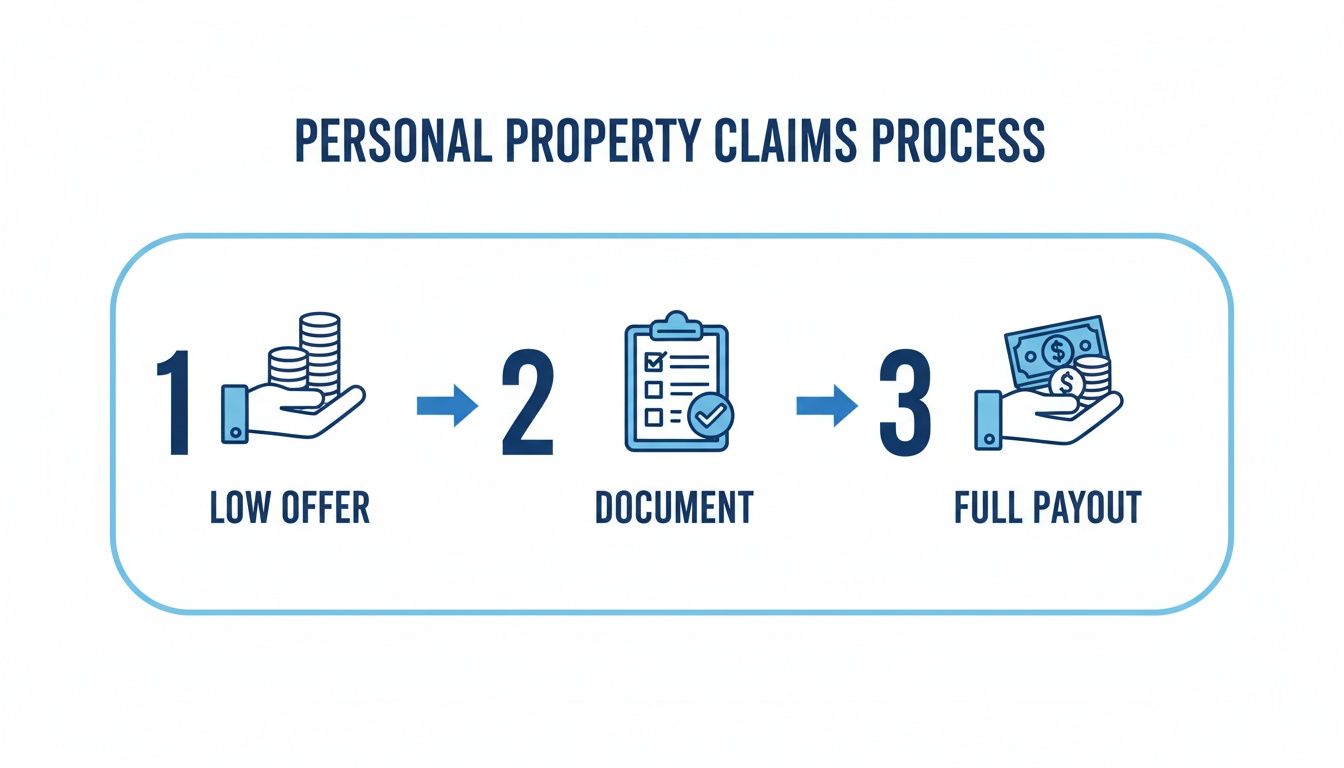
As you can see, their first move is almost always a low offer. Your job is to build an ironclad case with documentation to force them to pay what they actually owe.
Fighting Back with Documentation
To beat them at their own game, you have to become a record-keeping machine. Every single dollar you spend on your repair needs to be documented with military precision.
- Save Every Receipt: Keep a dedicated file for all invoices, material receipts, and proof of payments for both labor and supplies.
- Take Photos: Document the entire repair process. You need before, during, and after photos to prove the work was actually completed to the proper standard.
- Submit Everything at Once: When you’re ready to request your recoverable depreciation, send them a complete, organized package with all your documentation. This makes it much harder for the adjuster to claim they're "missing" something.
When you're putting together the full replacement cost for your home, knowing the real-world cost of materials and labor is your best weapon. Looking at a detailed hardwood flooring installation cost guide, for example, gives you the data to push back against their low numbers. The more you understand how depreciation on insurance claims works, the better equipped you'll be to demand every dollar you're owed. Don't let their process cheat you out of your full settlement.
A Real Homeowner's Claim Dispute Story
It's one thing to read about insurance theories in a blog post, but it's another thing entirely to live the nightmare of fighting a billion-dollar insurance company that’s holding your future hostage. They drag their feet, deny the obvious, and wear you down until you're too exhausted to fight back. This isn't a scare tactic; it's the reality for countless homeowners who get stonewalled by the very company that cashed their premium checks for years.
But don't just take my word for it. Here’s a real story from a policyholder who was getting nowhere before they finally called for help.
This client's review tells a story we see every single day. The insurance company "did not want to pay" what was clearly owed for a legitimate loss. Their experience is a perfect example of the playbook: delay, deny, and defend. The goal is to make the process so painful that you'll either give up or accept a ridiculously low offer just to make it stop.
The Power of Professional Advocacy
Stories like this are exactly why public adjusters exist. After a major fire or storm, you’re emotionally drained and overwhelmed. Meanwhile, your insurance carrier unleashes a team of their own adjusters, engineers, and lawyers whose only job is to protect the company's bottom line. It’s an ambush from the start.
Hiring a public adjuster is how you level the playing field. Instead of going it alone against a corporate giant, you have a licensed expert in your corner who knows their tactics inside and out. We document every single detail of your loss, build an ironclad claim, and go to war with the insurer to get the full settlement you're entitled to under your policy.
This isn’t about squeezing a few extra dollars out of them. It's about getting the actual money you need to put your life back together. In fact, claims data shows that properties with RCV coverage recovered 35% more on average than those with ACV after a hurricane. Having an expert fighting for your full replacement cost coverage payout means you can actually rebuild without liquidating your retirement savings. You can learn more about the impact of different valuation methods from insurance industry analyses.
When to Hire a Public Adjuster to Maximize Your Claim
Let’s be honest. The line between a frustrating insurance claim and an outright financial disaster is crossed the moment you try to fight the insurance company by yourself.
If your property damage is significant—and we’re generally talking anything over $20,000—it’s time to get a professional in your corner. Another huge red flag? When the insurance company’s adjuster does a quick 30-minute walkthrough and calls it an "inspection." That’s your sign that a lowball offer is already in the works.
Remember, your insurer has a whole team of adjusters, experts, and lawyers working around the clock. Their job is to protect the company's bottom line by minimizing what they pay you. You absolutely deserve that same level of expertise fighting for you.
Leveling the Playing Field
A licensed public adjuster works exclusively for you, the policyholder. We don't show up to save the insurance company a dime. Our one and only mission is to document your loss, negotiate aggressively, and secure every single dollar you're entitled to under your replacement cost policy. You can get more details on the role of a public claims adjuster on our blog.
Here are some crystal-clear signs that you need an advocate on your side, right now:
- The settlement offer is insultingly low. It doesn’t even come close to what’s needed for proper repairs.
- Your claim is being dragged out. They keep burying you in endless requests for more and more information.
- The insurer is flat-out denying parts of your claim. They’re doing it without a clear, valid reason backed by your actual policy language.
The gap between what your insurer offers and what you truly need can be devastating. For example, a 20-year-old roof needing a $10,000 replacement can easily result in a $0 payout after the insurer applies heavy depreciation and a high deductible on an ACV basis. That leaves you holding the entire bag.
Don't let their tactics cheat you out of the settlement you've been paying premiums for. If you're heading into a dispute, get a second opinion. We offer a completely free, no-pressure claim review to help you understand your rights and see what your options really are.
Common Questions About Replacement Cost Payouts
When you're fighting for a fair settlement, the insurance company has a playbook full of excuses. Here are the answers to the questions we hear most from homeowners and business owners trying to get paid what they're owed.
Can the Insurance Company Just Pay Me Less and Walk Away?
No. If your policy says you have Replacement Cost Coverage, that's a contract. They are legally required to pay what it actually costs to rebuild your property or replace what you lost.
But here’s how they try to wiggle out of it: they pay the lower Actual Cash Value (ACV) upfront and call the rest "recoverable depreciation." Then they hold that remaining money hostage, demanding mountains of paperwork and creating endless delays. They’re betting that the financial pressure will force you to give up before they have to pay that final check. It's a dirty tactic, and it's why having a public adjuster to enforce the terms of your own policy is so important.
What if My Contractor’s Estimate Is Way Higher Than My Insurer’s?
Welcome to one of the oldest games in the book. The insurance carrier will show you an estimate from their special software, like Xactimate, that's packed with outdated, national-average pricing. It’s a fantasy number that completely ignores the reality on the ground here in North Carolina and Virginia.
Their estimate doesn't account for post-hurricane price hikes, local labor shortages, or the true cost of quality materials needed to do the job right. It's designed to be low. We fight back by building our own independent, line-by-line estimate based on current, local costs. We use that detailed proof to force them to stop playing with their software numbers and pay for what your repairs actually cost in the real world.
Do I Have to Use the Contractor My Insurance Company Recommends?
Absolutely not, and you shouldn't. You have the absolute right to choose your own contractor—someone you trust to do the job correctly.
Think about it: an insurer's "preferred" contractor has a huge incentive to keep the insurance company happy, which usually means cutting corners to keep costs down. Their loyalty isn't to you; it's to the company that sends them a steady stream of business.
Always get estimates from your own vetted, local contractors. But before you sign anything, let a public adjuster review their bid. We’ll make sure the scope of work is complete and that it includes every single thing needed to restore your property properly. This one step can save you from a nightmare of shoddy work and future problems down the road.
Tired of getting the runaround from your insurance company? The team at For The Public Adjusters, Inc. offers a free, no-obligation claim review to help you understand your rights and start fighting back. Get the expert help you deserve by visiting us at https://forthepublicadjusters.com today.