- Smoke Odor Damage Claims: The Quick Answer NC and VA Homeowners Need
Smoke odor damage claims are routinely denied or underpaid by insurers in North Carolina and Virginia because adjusters classify lingering odor — without visible charring or soot — as a cosmetic issue rather than structural or functional damage. That classification is often wrong, and policyholders have real tools to push back and recover meaningful compensation.
Key takeaways
- Insurers in NC and VA routinely label smoke odor claims as ‘cosmetic’ losses when there is no visible char or soot, but odor alone can signal deep structural contamination requiring full remediation.
- A public adjuster can document smoke odor damage using air quality sampling, gas chromatography reports, and HVAC system testing to provide objective chemical evidence that defeats the cosmetic classification.
- The absence of visible damage does not equal the absence of covered loss — smoke compounds like polycyclic aromatic hydrocarbons (PAHs) and volatile organic compounds (VOCs) penetrate drywall, insulation, and wood framing invisibly.
- Policyholders who accept a cosmetic-only settlement for smoke odor damage often face uncovered remediation costs months later when odor resurfaces after painting over the problem.
- Requesting a formal scope of loss in writing and engaging an industrial hygienist early are the two most effective steps a homeowner can take before an insurer closes a smoke odor claim.
Why This Matters to You Right Now
If your home or building was exposed to smoke — whether from a kitchen fire, a neighbor’s house fire, or a wildfire event — and you can still smell it weeks later, your insurer may have already sent you a low-ball estimate or a flat denial. The reasoning you’ll hear sounds almost reasonable: “There’s no visible damage, so this is cosmetic.” Don’t accept that at face value.
Smoke odor is not merely unpleasant. Smoke particles and volatile organic compounds (VOCs) embed themselves in drywall, insulation, HVAC systems, wood framing, flooring, cabinetry, and soft goods. The smell is evidence of chemical contamination — contamination that standard cleaning rarely eliminates and that can affect indoor air quality, habitability, and resale value long after the fire event itself.
The Bottom Line for NC and VA Policyholders
- “Cosmetic” is an adjuster’s opinion, not a policy definition. Most standard homeowners policies in NC and VA cover direct physical loss. Embedded smoke particles causing odor and air quality degradation can qualify as physical loss under many policy forms.
- Denial is not the final word. You have the right to dispute the insurer’s scope of loss, request an itemized explanation, and invoke appraisal or other dispute resolution processes spelled out in your policy.
- Documentation is everything. Industrial hygienist reports, air quality testing, and professional remediation estimates shift the conversation from a subjective argument about smell to an objective record of contamination.
- Professional help changes outcomes. A licensed public adjuster or an attorney experienced in home insurance claims can re-open and re-scope a claim the insurer tried to close cheaply.
What This Article Will Walk You Through
The sections that follow explain exactly how and why insurers use the cosmetic label, what smoke actually does to a structure at a chemical level, how to build a documented claim without visible char, and what NC and VA policyholders have been able to recover when they pushed back. If your smoke odor claim was denied or underpaid, keep reading — the path forward is clearer than the insurer wants you to believe.
Why Do NC and VA Insurers Call Smoke Odor Damage Claims ‘Cosmetic’?
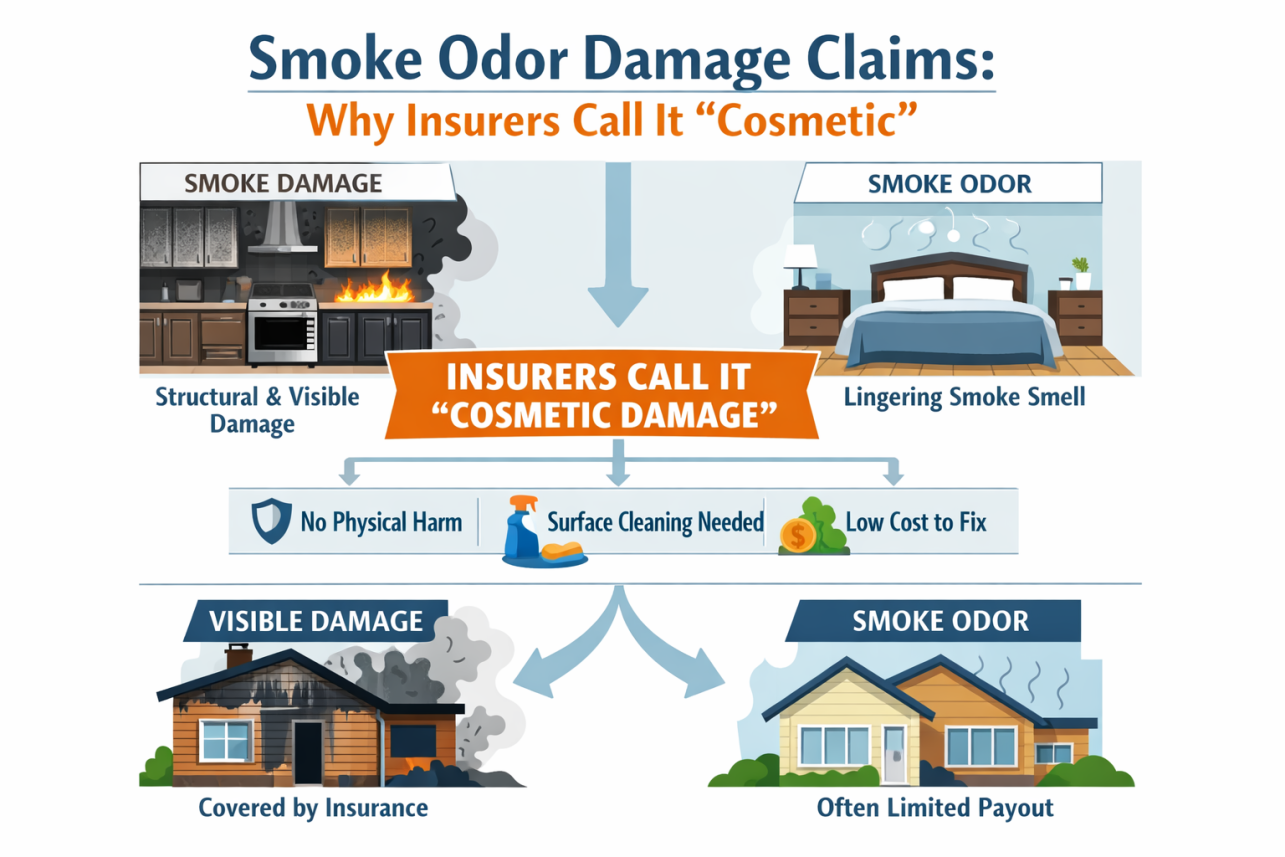
NC and VA insurers label smoke odor damage ‘cosmetic’ because their adjusters are trained to look for visible, measurable destruction — charred framing, melted wiring, collapsed ceilings. When a fire produces heavy smoke without widespread char, adjusters often argue that nothing structural was harmed and that odor alone is a surface-level, cosmetic issue that does not trigger full coverage. That classification is both legally questionable and scientifically inaccurate.
The Adjuster Playbook: No Char, No Coverage
Insurance adjusters operate on a simple internal logic: loss must be visible and quantifiable to justify a large payout. When smoke permeates a home but fire damage stays confined to one room or area, the adjuster’s field report may read something like “no structural damage observed” or “odor only — cosmetic in nature.” This framing allows the carrier to offer a fraction of what full remediation actually costs, or to deny the claim outright.
Common tactics you may see in a denial or underpayment letter include:
- Vague policy language used selectively: Many standard homeowners policies in NC and VA cover “direct physical loss.” Insurers argue smoke odor does not constitute physical loss because no material was destroyed — ignoring that smoke chemicals bond to and alter physical materials at a molecular level.
- Limiting language around “cosmetic” exclusions: Some policies contain cosmetic damage exclusions originally designed for minor hail dents on metal roofing. Adjusters sometimes stretch this language to cover smoke odor, even when the policy clearly did not intend that application.
- Relying on visual inspection alone: Adjusters may walk through a property, note no visible soot on walls, and close the inspection without air quality testing, surface sampling, or industrial hygienist input — none of which are visible to the naked eye.
- Undervaluing remediation scope: Even when odor is acknowledged, insurers frequently approve only basic cleaning rather than the ozone treatment, thermal fogging, duct replacement, or content restoration that certified restorers recommend.
Why the ‘Cosmetic’ Label Is Scientifically Flawed
Smoke is not simply a smell. It is a complex mixture of particulates, volatile organic compounds (VOCs), carbon monoxide byproducts, and acidic gases that physically embed themselves into porous building materials — drywall, insulation, wood framing, HVAC ductwork, and soft contents. Industrial hygienists and certified fire restoration professionals document this routinely. The odor is a symptom of chemical contamination, not a standalone aesthetic problem. Calling it cosmetic is roughly equivalent to calling mold growth cosmetic because you cannot see the spores.
For NC homeowners navigating this fight, working with a licensed public adjuster who understands fire loss documentation can be the difference between a cosmetic-only offer and a settlement that reflects true remediation costs. The process of securing a fair insurance settlement for fire damage almost always requires more documentation than a standard adjuster inspection produces — and that documentation burden falls on you, the policyholder, unless you have an advocate in your corner.
Why the Legal Argument Is Also Weak for Insurers
Courts in multiple states — and increasingly in the Southeast — have found that persistent, pervasive smoke odor can satisfy the “direct physical loss” standard in a homeowners policy because the property’s function and habitability are genuinely impaired. When a home cannot be occupied or sold without expensive remediation, the argument that no physical loss occurred becomes difficult to defend. NC and VA policyholders who push back with proper documentation often find the “cosmetic” classification quietly disappears from the conversation.
What Does Smoke Odor Actually Do to a Home or Building in Smoke Odor Damage Claims?
Smoke odor is not just a smell — it is evidence of chemical contamination. When smoke moves through a structure, it deposits volatile organic compounds (VOCs), acidic particulates, and soot into porous building materials like drywall, insulation, wood framing, and HVAC ductwork. These substances bond at a molecular level with the materials they contact, meaning the odor persists because the contamination is embedded, not merely surface-level.
How Smoke Actually Travels Through a Structure
Smoke follows air pressure gradients, which means it does not stay in the room where a fire or smoke event occurred. It migrates through:
- Electrical outlets and switch plates, which act as pathways into wall cavities
- HVAC systems, which can distribute smoke particles throughout an entire building within minutes
- Attic and crawl space insulation, which absorbs and traps smoke compounds deeply within fibrous material
- Subfloor assemblies and wall cavities, where particulates settle out of reach of standard cleaning methods
By the time smoke odor is noticeable to occupants, contamination has typically already spread well beyond the visible source area.
The Chemistry Behind the Odor
Smoke is a complex mixture of gases and fine particles. The compounds most responsible for persistent odor include:
- Volatile organic compounds (VOCs) such as formaldehyde, benzene, and acrolein, which off-gas from contaminated materials over time — sometimes for months or years
- Acidic particulates that can etch glass, corrode metal surfaces, and degrade drywall paper facing when left untreated
- Polycyclic aromatic hydrocarbons (PAHs), some of which are recognized as hazardous to human health
- Tar and resin compounds that bond tenaciously to porous surfaces and resist standard cleaning products
Why This Matters for Your Insurance Claim
When an insurer labels smoke odor damage as “cosmetic,” the implication is that it can be resolved with surface cleaning or paint. The chemistry tells a different story. Painting over smoke-contaminated drywall seals in VOCs temporarily, but off-gassing often continues underneath and eventually bleeds through. True remediation frequently requires removal and replacement of affected drywall, insulation, and ductwork — not just deodorizing sprays.
Industrial hygienists and certified restorers use air sampling, surface wipe tests, and materials testing to document that contamination exists within the structure itself. This kind of technical evidence is exactly what distinguishes a well-documented smoke odor damage claim from one that gets dismissed as a minor inconvenience.
How Do Smoke Odor Damage Claims Get Documented Without Visible Char?
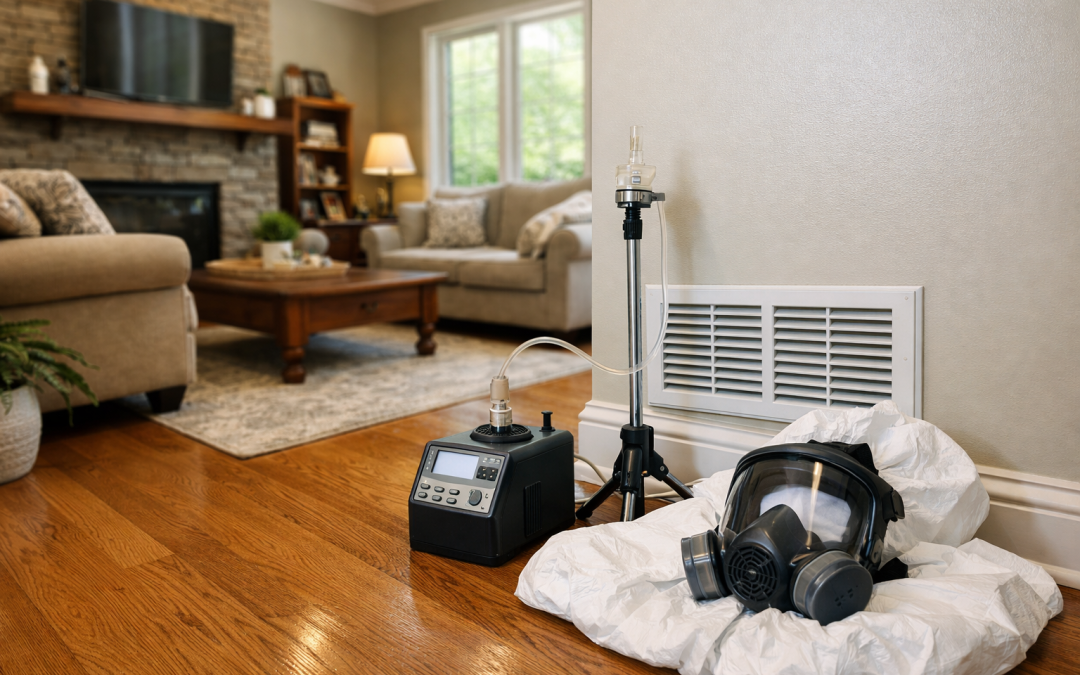
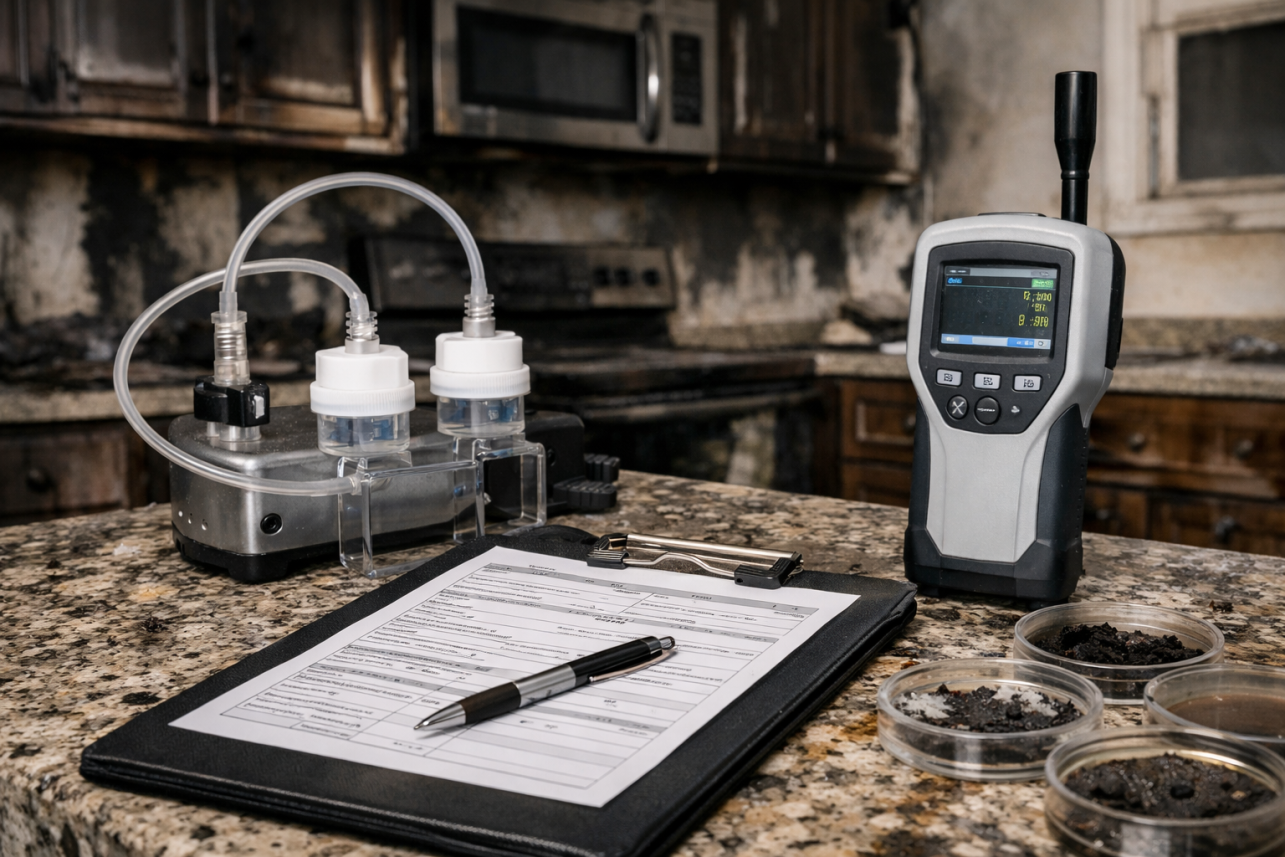
Smoke odor damage claims without visible char are documented through a combination of air quality testing, VOC sampling, particle counting, and independent industrial hygienist reports. Together, these methods produce a science-backed evidence package that shifts the conversation from a subjective “I smell something” dispute to objective, measurable contamination data an insurer cannot easily wave away.
Why Standard Photos Are Not Enough
A smartphone photo of a clean-looking living room gives an adjuster every reason to call the damage cosmetic. Smoke particles and volatile organic compounds (VOCs) are invisible to the camera. If your documentation stops at photographs, you are essentially letting the insurer set the terms of the argument. A thorough evidence package goes well beyond images.
The Core Testing Methods
VOC Air Sampling
- A certified industrial hygienist or environmental testing firm collects air samples inside the affected structure.
- Samples are analyzed in an accredited laboratory for compounds commonly associated with combustion byproducts — things like benzene, formaldehyde, and acrolein.
- Elevated readings above baseline outdoor levels establish that contamination is present and measurable, not imagined.
Particle Counting
- Handheld or stationary particle counters measure the concentration of fine particulate matter (PM2.5 and smaller) suspended in indoor air.
- These tiny particles embed in porous materials — drywall, insulation, upholstery, HVAC ductwork — and are responsible for persistent odor long after a fire is extinguished.
- Comparative readings taken in multiple rooms and at exterior reference points demonstrate the scope of penetration throughout the structure.
Surface and Material Sampling
- Swab or tape-lift samples from walls, ceilings, and HVAC components can be tested for soot and combustion residue that is invisible to the naked eye.
- This is especially persuasive when samples from inside wall cavities or ductwork show contamination the adjuster never inspected.
The Industrial Hygienist Report
A written report from a licensed industrial hygienist (IH) ties all of the test data together. The IH interprets the findings, explains the health implications of the contamination levels found, and — critically — recommends a specific remediation scope. This scope becomes the foundation for your repair estimate. Insurers have a much harder time dismissing a remediation recommendation that comes from an independent credentialed professional rather than the homeowner alone.
Photographic and Narrative Protocols
- Photos should document every room, HVAC register, attic access point, and crawl space entry — showing the full potential pathway of smoke migration.
- A written narrative log with timestamps records odor observations, areas of strongest concentration, and any symptoms reported by occupants.
- Before-and-after photos of any contents affected — clothing, furniture, documents — add supporting context.
When these elements are assembled into a single, organized claim package, smoke odor damage claims become far more difficult to dismiss as purely cosmetic. The evidence speaks in a language adjusters and, if necessary, courts understand: data.
Have Policyholders Won Smoke Odor Damage Claims in Court?
Yes — policyholders have successfully won smoke odor damage claims in court, and judges have repeatedly rejected insurers’ attempts to classify persistent odor as merely cosmetic. Courts in multiple jurisdictions have ruled that when smoke penetrates structural materials and renders a home uninhabitable or significantly less usable, that constitutes real, compensable property damage — not a surface-level blemish.
The Trutanich Case: A Landmark for Odor Claims
One of the most-cited decisions in this area is Farmers Insurance Exchange v. Trutanich, an Oregon Court of Appeals case in which the court found that a neighbor’s cannabis smoke that had permeated the insured’s home constituted physical loss or damage under the policy. The insurer argued the odor was not a tangible, structural harm. The court disagreed — reasoning that the persistent infiltration of odor-causing compounds into walls, flooring, and HVAC systems was a form of physical alteration to the property. This reasoning has been influential well beyond Oregon and is regularly cited by policyholders’ attorneys in states like North Carolina and Virginia when fighting cosmetic-only denials.
Why This Precedent Matters for NC and VA Homeowners
While Trutanich is an out-of-state decision and not binding in NC or VA courts, it reflects a broader judicial trend: when smoke odor is pervasive enough to affect habitability, marketability, or the actual physical composition of building materials, courts are willing to call it what it is — damage. Here is what these rulings have generally established:
- Odor penetration is physical alteration. Courts have recognized that smoke compounds chemically bond with porous materials, meaning the structure itself has been changed — not just its appearance.
- Habitability matters. When occupants cannot reasonably live in or use a space due to odor, courts have found that the property has suffered a functional loss, not a cosmetic one.
- Insurer labels don’t control outcomes. Calling damage “cosmetic” in a denial letter does not make it so. Judges look at evidence, not adjuster terminology.
- Expert testimony is decisive. Industrial hygienists, certified restorers, and air quality specialists have helped policyholders prove in court that full remediation — not a coat of paint — is the appropriate standard of repair.
What These Wins Have in Common
Successful smoke odor damage claims in litigation almost always share a few characteristics: the policyholder had thorough documentation, they hired credentialed experts who could explain the science of odor penetration, and they worked with an attorney or public adjuster experienced in first-party property insurance disputes. Going to court is a last resort, but knowing that courts have sided with homeowners in these situations gives you real leverage — even before a lawsuit is ever filed.

What Should You Do If Your NC or VA Smoke Odor Damage Claims Were Denied or Underpaid?
If your smoke odor damage claim was denied or underpaid, do not accept the insurer’s first answer as final. You have the right to challenge a “cosmetic” classification by gathering independent documentation, invoking your policy’s appraisal process, and filing a complaint with your state’s Department of Insurance. Acting quickly and bringing in professional help early gives you the strongest position.
Step 1: Request a Written Denial and Review Your Policy
Ask your insurer to put the denial or underpayment in writing and cite the specific policy language they are relying on. Then read your policy’s definitions of “direct physical loss,” “cosmetic damage” exclusions, and any smoke or odor language carefully. Many policies do not contain a blanket cosmetic exclusion, and insurers sometimes apply one that isn’t there.
Step 2: Build Independent Documentation
- Hire an industrial hygienist or certified restorer to conduct air quality testing and produce a written report confirming odor-causing compounds are present in the structure.
- Get a remediation estimate from a licensed contractor that itemizes what must be done to actually eliminate the odor — not just mask it.
- Keep a written log of every conversation with your insurer, including dates, names, and what was said.
Step 3: Invoke the Appraisal Clause
Most homeowner policies include an appraisal clause that lets you and the insurer each hire an independent appraiser when you disagree on the amount of loss. If negotiations stall, formally invoking this clause in writing puts the dispute before a neutral umpire and often produces a better outcome without litigation.
Step 4: Bring in a Licensed Public Adjuster
A public adjuster works for you — not the insurance company — and is licensed by the state to document losses, interpret policy language, and negotiate on your behalf. They are especially valuable in odor-only claims where the loss is invisible to an untrained eye. In North Carolina and Virginia, public adjusters must be licensed by their respective Departments of Insurance. You can verify a license and learn about your rights as a policyholder through the North Carolina Department of Insurance and the Virginia Bureau of Insurance.
Step 5: Watch Your Deadlines
- Suit limitation clauses in most NC and VA policies require you to file suit within one to two years of the date of loss — check your specific policy.
- Proof of loss deadlines are often 60 days from the insurer’s request; missing them can complicate your claim.
- State complaint deadlines vary, but filing sooner keeps your options open.
The earlier you bring a public adjuster or attorney into a smoke odor dispute, the more documentation can be preserved and the less leverage the insurer has to minimize your loss. Waiting until a denial becomes final limits your options significantly.
Smoke Odor Damage Claims: Cosmetic Classification vs. Full Remediation Coverage
| Factor | Cosmetic Classification (Insurer Position) | Full Remediation Coverage (Public Adjuster Position) |
|---|---|---|
| Damage Standard | Requires visible char, soot, or staining | Recognizes chemical contamination and olfactory evidence as covered loss |
| Testing Used | Visual inspection only | Air sampling, VOC/PAH lab analysis, HVAC swab testing |
| Typical Payout | Surface cleaning or repainting only | Full remediation: encapsulation, material removal, duct cleaning, and rebuild |
| Long-Term Risk | Odor returns; homeowner bears future cost | Root-cause contamination addressed; recurrence unlikely |
| NC/VA Policy Language | Interpreted narrowly — ‘physical damage’ required | Interpreted broadly — ‘direct physical loss’ includes chemical alteration of materials |
Illustrative Case: The Kitchen Fire That Wasn’t — A Composite Scenario
Illustrative example
Consider a homeowner in the Research Triangle area of NC whose neighbor’s attached garage fire sent smoke through shared wall cavities into their home — leaving no visible soot but a persistent, acrid odor throughout every room. The insurer’s adjuster conducted a visual inspection, found no char or staining, and issued a cosmetic-only settlement covering little more than a fresh coat of paint. The homeowner, unconvinced, engaged a public adjuster who arranged industrial hygienist air sampling and HVAC swab testing; lab results confirmed elevated PAH and VOC concentrations in wall cavities and ductwork far exceeding acceptable thresholds. Armed with the chemical evidence and a written scope of loss citing the policy’s ‘direct physical loss’ language, the public adjuster successfully argued for full remediation coverage including duct replacement, encapsulation of affected framing, and reconstruction — a dramatically larger settlement than the original cosmetic offer. This type of outcome illustrates why objective scientific documentation, not a visual inspection alone, should define the scope of any smoke odor damage claim.
Frequently asked questions
Why do insurers classify smoke odor damage claims as cosmetic losses even when the smell is severe?
Insurers often argue that if there is no visible char, blackening, or soot deposits, the structure itself is undamaged and the odor is merely a surface-level nuisance. Many policies contain language distinguishing ‘cosmetic’ impairment — affecting appearance or smell — from structural or functional damage. Without visible evidence, adjusters assigned by the carrier can more easily justify a limited payout or outright denial. This classification conveniently reduces their exposure while leaving the homeowner with a property that may be genuinely uninhabitable.
What kinds of evidence can a public adjuster use to prove smoke odor is a covered loss rather than a cosmetic issue?
A public adjuster can document the claim using air quality sampling, surface wipe tests, and third-party industrial hygienist reports that detect volatile organic compounds (VOCs) and other chemical byproducts of combustion embedded in drywall, insulation, HVAC systems, and porous materials. Odor can also be mapped room by room and tied to specific smoke-affected pathways. This scientific evidence reframes the loss from a subjective sensory complaint into a measurable chemical contamination, which is much harder for an insurer to dismiss as purely cosmetic.
Does North Carolina or Virginia state law offer any protection against insurers calling smoke damage cosmetic?
Both states require insurers to investigate claims thoroughly and in good faith, and their departments of insurance have the authority to review unfair claims-handling practices. While neither state has a statute that explicitly defines smoke odor as structural damage, policy language and case precedent generally support the position that damage rendering a property uninhabitable or requiring professional remediation goes beyond cosmetic impairment. A public adjuster familiar with NC and VA regulatory standards can cite applicable policy language and, if necessary, refer the matter to the state Department of Insurance or recommend legal counsel if bad-faith handling is suspected.
When should I hire a public adjuster for a smoke odor claim instead of relying on the insurance company’s adjuster?
You should consider hiring a public adjuster as early as possible — ideally before you accept any settlement offer — if the carrier’s adjuster has labeled the damage cosmetic, offered only air freshening or surface cleaning rather than full remediation, or denied that the odor constitutes a covered loss. The insurer’s adjuster works for the insurer, not for you. A licensed public adjuster works solely on your behalf, knows how to build a documented claim file with third-party testing, and can negotiate for the full scope of remediation your policy may actually cover.
Related local pages
Don’t let your insurer label your smoke damage ‘cosmetic.’ Contact our NC and VA public adjusters today for a free claim review and let us fight for the full remediation coverage you deserve. Get in touch.
Last updated: June 28, 2026