
You come home after a storm and see lifted shingles, brown ceiling stains, or water pooled beside a wall. The damage looks obvious, yet the insurer's letter calls it “wear and tear,” “pre-existing,” or “maintenance.” Then the check arrives, and it covers little more than cleanup.
That moment is frustrating because the dispute often isn't about whether something happened. It's about how the carrier classifies what happened. The practical question is not merely, “Is this broken?” It's whether the event caused covered physical injury, created a covered loss of use, and can be tied to the policy's covered cause of loss.
Table of Contents
- When the Adjuster Says It Wasn't Real Damage
- The Working Definition of Property Damage in Claims
- Damage That Is Covered and Damage That Gets Denied
- Cosmetic vs Structural, Wear vs Sudden, Flood vs Storm
- How to Document and Prove Your Property Damage
- Policy Language and State Rules That Decide Your Payout
- When to Bring in a Public Adjuster for a Denied or Low-Ball Claim
When the Adjuster Says It Wasn't Real Damage
A homeowner returns from a windstorm and finds shingles lifted along the roof edge, water stains spreading across the ceiling, and a soft spot near the gutter. The carrier's adjuster photographs the roof, looks briefly inside, and later sends a letter describing the condition as “pre-existing wear and tear.” The payment covers a small portion of the visible damage, while the roof work and interior repairs remain the homeowner's problem.
That result usually comes from recharacterization. The adjuster doesn't necessarily deny that the shingles are lifted or that the ceiling is wet. Instead, the claim file describes the condition as “long-term neglect,” “deferred maintenance,” or “cosmetic only.” Those phrases move the discussion away from the storm and toward an exclusion or limitation.
The classification fight
A sudden wind event can expose an older weakness, and that creates a genuine coverage question. But the carrier still has to connect its position to the policy language and the physical evidence. A roof's age alone doesn't prove that wind played no role, just as a stain alone doesn't prove that the moisture developed gradually.
Practical rule: Don't argue only that the damage looks serious. Show what changed, when it changed, what caused the change, and what building components were affected.
The same issue appears in business claims. A store may have broken glass and water intrusion after a storm, while a restaurant may have smoke residue and damaged equipment after a fire. The carrier can still question cause, scope, depreciation, maintenance, or policy exclusions even when the loss is plainly visible.
Why the definition matters
A legal definition commonly used in property disputes treats property damage as injury to real or personal property. Cornell's property damage definition also reflects a value-based approach. If the property can be repaired economically, damages generally involve the reasonable repair cost, subject to the property's value before and after the incident. Loss of use can also matter when substitute property is reasonably needed during repairs.
Once you understand that framework, the denial letter becomes easier to analyze. The next questions are whether there was physical injury, whether the property became unusable, whether the cause was covered, and whether the carrier has supported its exclusion position.
The Working Definition of Property Damage in Claims
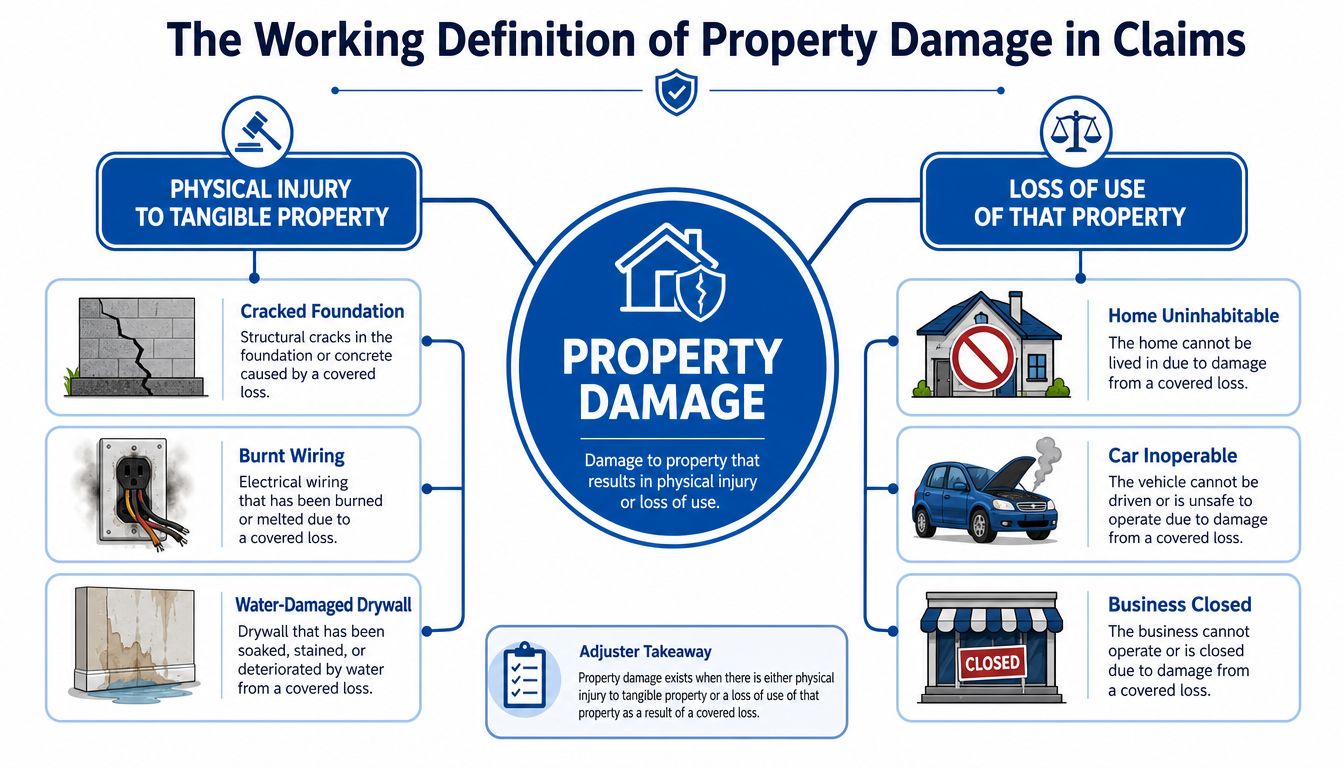
For a homeowner or business owner, property damage has two working pillars. The first is physical injury to tangible property. The second is loss of use of that property. Both can affect a first-party claim under your own policy, although the exact response depends on the policy form, exclusions, limits, endorsements, and facts of the loss.
What the file should identify
An adjuster's claim file should identify the damaged asset, the physical change, the suspected cause, and the requested repair or replacement. A cracked foundation, burnt wiring, or water-damaged drywall gives the carrier something tangible to inspect. A home that cannot safely be occupied or a business that cannot operate may also raise a loss-of-use issue.
The homeowners coverage overview is useful when separating dwelling damage, personal property, additional living expenses, and policy conditions. These coverages don't automatically apply to every event. The policy still controls.
Policy structure changes the conversation
A named-perils policy generally responds only when the loss fits one of the listed causes. An open-perils form starts more broadly, but exclusions and conditions still control the result. The relevant analysis often begins with the policy's Covered Causes of Loss language and then moves through exclusions, limitations, deductibles, and duties after loss.
A first-party property claim involves damage to your own home, contents, or business assets. A third-party claim usually concerns damage allegedly caused to someone else's property. Homeowner disputes about roofs, water intrusion, fire, smoke, contents, and additional living expenses usually occur in the first-party setting.
A useful shorthand is this: identify the sudden or accidental event, identify the physical change, identify the affected property, and then test every exclusion against the evidence.
The legal meaning is broader than visible breakage, but it isn't unlimited. Purely financial disappointment, an abstract reduction in value, or a maintenance problem without a covered event may not satisfy the policy's requirements. That distinction is the yardstick for evaluating the examples that follow.
Damage That Is Covered and Damage That Gets Denied
Carriers tend to respond more favorably when the evidence connects a specific event to a specific physical change. Wind-torn shingles, hail damage that exposes roofing material, a sudden pipe burst, fire and smoke residue, a fallen tree impact, theft, and vandalism can all present recognizable claim paths. The policy still controls, but the cause-and-effect story is easier to establish.
Gray areas create the larger disputes. A roof may have gradual sagging, a wall may show long-term moisture staining, or a foundation may display settling. Mold that follows an unresolved leak can raise questions about timing, maintenance, and exclusions. Faulty workmanship and code-upgrade costs may also be limited or excluded unless the policy provides a relevant endorsement.
Where the carrier usually pushes back
Consider three common situations. A restaurant suffers a grease fire, and the carrier accepts direct fire damage but questions smoke cleaning, odor removal, damaged equipment, and business-income effects. A landlord discovers a busted riser, and the insurer asks whether the pipe failed suddenly or leaked for an extended period. A retail shop has smashed glass after vandalism, but the carrier requests proof for merchandise allegedly stolen during the same incident.
The counter-move is not a louder argument. It's a better record. Obtain a written cause assessment, preserve damaged materials when safe, separate emergency mitigation from permanent repairs, and tie every requested line item to a room, component, item, or measurable service. A practical storm damage roof insurance guide can also help homeowners understand why roof condition, storm timing, and inspection evidence matter.
| Damage Type | Likely Carrier Position | Typical Trigger Language |
|---|---|---|
| Wind-torn shingles | May accept direct storm damage if the inspection supports it | “Wear and tear,” “age,” “maintenance” |
| Sudden pipe burst | Often evaluated through the failed component and resulting water damage | “Ongoing leak,” “repeated seepage” |
| Fire and smoke residue | Direct damage may be addressed, while cleaning and contents require documentation | “Pre-existing condition,” “odor only” |
| Fallen-tree impact | The carrier may examine the point of impact and removal scope | “No structural damage,” “neglect” |
| Gradual roof sag | Commonly challenged as deterioration or maintenance | “Long-term,” “deferred maintenance” |
| Mold after an unresolved leak | Coverage may be limited based on timing and cause | “Ongoing,” “preventable,” “neglect” |
| Code-upgrade work | May be restricted unless ordinance-or-law coverage applies | “Betterment,” “upgrade” |
Coverage doesn't rise or fall solely on how dramatic the damage looks. A badly damaged item can still fall outside the policy, while hidden damage can be covered when the evidence shows a qualifying physical alteration caused by a covered event.
Cosmetic vs Structural, Wear vs Sudden, Flood vs Storm
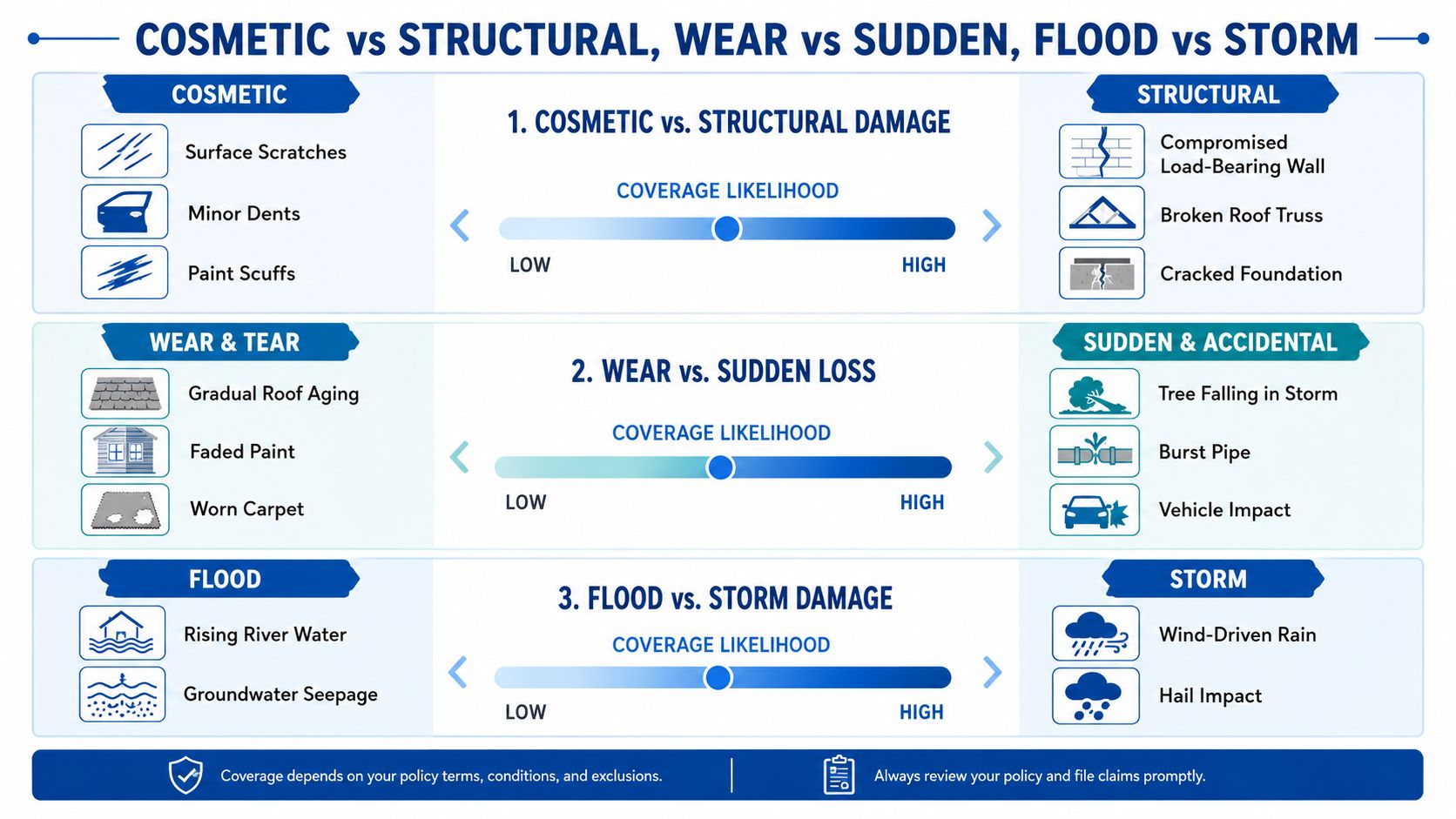
Carriers commonly draw three judgment lines. They ask whether the damage is cosmetic or structural, gradual or sudden, and flood-related or storm-related. Those labels can determine whether the claim receives a repair scope, a limited payment, or a denial.
Cosmetic versus structural
Cosmetic damage may include surface scratches, minor dents, or paint scuffs that don't affect function, weatherproofing, safety, or serviceability. Structural damage reaches components such as framing, load-bearing walls, roof decking, trusses, and foundations. A carrier may still dispute repair scope, matching, or depreciation, but structural impairment generally gives the claim a stronger physical-damage foundation.
A dented metal roof with intact performance can be treated differently from a roof surface punctured by hail. A cracked wall finish can be cosmetic, while movement in the wall assembly or compromised framing raises a different question. The inspection should identify the component and explain how its condition affects usefulness or value.
Wear and tear versus a sudden event
Wear and tear describes a gradual process the insurer may attribute to maintenance or age. A burst pipe, wind-lifted shingle, or falling tree presents a defined event. The property's age doesn't automatically settle the issue. The important evidence includes weather records, plumbing findings, photographs, prior repairs, and the sequence in which the damage appeared.
Flood versus storm
The flood distinction causes frequent confusion. Standard homeowners policies often exclude flood, surface water, waves, tidal water, sewer or drain backup, and groundwater seepage, even when the resulting damage is severe, as explained in Congressional Research Service policy materials. Wind and rain-driven storm damage may fall under a homeowners policy, while rising water or ground saturation may require NFIP coverage or a flood endorsement. Some exclusion language can treat ensuing fire or explosion differently, so the precise wording matters.
For local repair context after a storm, property owners may also consult Atlanta storm damage specialists, particularly when an inspection must distinguish roof covering damage from underlying structural damage. Don't let a carrier's label replace a cause analysis. Classify the physical condition, the event, and the route water took before accepting the coverage conclusion.
How to Document and Prove Your Property Damage
The strongest claim file answers basic questions before the carrier asks them. What changed? When did it change? Which areas and items were affected? What work is necessary to restore the property, and why?

Build evidence before the scene disappears
Start with timestamped, geo-tagged photographs and video when conditions are safe. Take wide images showing the room or exterior elevation, mid-range images showing the affected component in context, and close-ups showing cracks, stains, exposed materials, residue, broken fixtures, or damaged contents.
Then measure. Record the diameter of ceiling stains, the depth of floor cupping, moisture readings in drywall, and room dimensions relevant to repair estimates. A photograph can show that a wall is wet. A written moisture reading and room location can help establish the extent of the condition.
A contractor or restoration company should provide a written statement on letterhead that addresses cause and scope. “Repair drywall” is weak. “Water entered at the failed roof penetration and affected the ceiling assembly and adjacent wall,” if supported by the inspection, gives the adjuster a more useful explanation. For hidden plumbing problems, a specialist addressing water leak detection can help document where the water originated.
Create a file the carrier can audit
Use a room-by-room inventory for contents. Include descriptions, model numbers, purchase dates when known, photographs, receipts, manuals, and replacement information. Keep receipts for emergency services, temporary repairs, storage, lodging, and other reasonable expenses tied to the covered loss.
Carriers often challenge verbal contractor opinions, photographs without identifying information, and inventories that list values without support. Fix those weaknesses by requesting written findings, preserving original files and metadata, labeling each photograph by location, and matching each inventory entry to a photograph or record.
A daily communication log should include the date, the person contacted, the subject discussed, documents sent, promised follow-up, and the response received. The proof-of-loss guidance can help organize the sworn documentation the policy may require.
Evidence that survives review: original photographs, measurements, written cause opinions, itemized estimates, receipts, and a dated communication record.
Policy Language and State Rules That Decide Your Payout
The policy, not the adjuster's summary, determines the starting point. For homeowners, property damage coverage commonly appears in Section I, including the perils insured against, dwelling coverage, personal property coverage, and related limits. An HO-3 form and an HO-2 form can treat covered causes differently, so the form and endorsements must be read together.
Exclusions and conditions may address wear and tear, ordinance or law, defective workmanship, water, neglect, duties after loss, appraisal, and loss settlement. The carrier may rely on a concurrent-causation clause when it argues that a covered wind event and an excluded water event combined to produce the damage.
Read the carrier's theory, not just the conclusion
A denial letter should identify the policy provision supporting the decision. If it says “wear and tear,” ask which condition is allegedly gradual, what inspection evidence supports that conclusion, and how the carrier separated pre-existing conditions from new storm damage. If it says flood, examine the water path, weather information, site elevation, drainage, and timing.
Meteorological data, tide records, photographs, plumber findings, roofing reports, and the sequence of damage can challenge an unsupported classification. The goal isn't to overwhelm the carrier with documents. It's to show why the proposed cause does or doesn't fit the physical evidence.
| Policy or Rule | How It Helps the Carrier | How to Push Back |
|---|---|---|
| Covered Causes of Loss | Limits payment to listed or qualifying causes | Match the event to the exact policy wording and evidence |
| Wear-and-tear exclusion | Recasts damage as gradual deterioration | Separate older condition from the sudden new damage |
| Ordinance-or-law language | Restricts code-upgrade costs | Check for ordinance-or-law coverage and document required work |
| Concurrent-causation clause | Connects covered and excluded causes | Establish the sequence, source, and physical pathway of damage |
| Duties after loss | Creates grounds for reducing or denying payment | Preserve records, mitigate safely, and meet stated deadlines |
| North Carolina statutory protections | Gives the dispute a state-law framework | Review applicable good-faith, prompt-payment, and mediation options under N.C. Gen. Stat. § 58-63 |
| NFIP Standard Flood Insurance Policy | Lets the WYO carrier apply federal flood-policy terms | Compare the denial letter with the SFIP wording and document the flood mechanism |
North Carolina homeowners and business owners should treat statutory references as a serious part of the dispute, not as a substitute for policy analysis. NFIP claims require special care because the adjuster may work for a Write Your Own company, while the Standard Flood Insurance Policy supplies the governing terms. A flood denial should be tested against the policy language, the physical definition of the loss, and the evidence showing how water entered the property.
When to Bring in a Public Adjuster for a Denied or Low-Ball Claim
A public adjuster becomes useful when the carrier's scope no longer resembles the property's actual condition. Warning signs include a payment covering only a fraction of a contractor's estimate, missing debris-removal or code-related line items, repeated requests for the same documents, a revised scope that removes rooms or components, or an adjuster who stops returning calls after the inspection.
A denial that calls sudden damage “wear and tear” deserves a careful response, especially when photographs, weather records, repair history, and contractor findings point elsewhere. The same applies when the carrier accepts the cause but undervalues the scope.
The value is in the re-scope
A practical example illustrates the gap. A hail claim was initially scoped at $4,800, while a public adjuster later developed a $38,000 scope by documenting matching roof slopes and connecting interior leaks to the covered event. Those amounts come from the example itself, not a general promise about results. Every claim still depends on policy language, evidence, damage extent, and the carrier's position.
The work of a public adjuster typically includes inspecting the property, documenting damage, preparing a scope and estimate, interpreting coverage, organizing supporting materials, and negotiating with the insurer. What a public adjuster does provides additional context for policyholders weighing that option.
For The Public Adjusters, Inc. is a state-licensed public insurance adjusting firm serving homeowners and businesses in North Carolina. The company assesses, documents, estimates, and negotiates residential and commercial property claims involving fire, smoke, water, wind, hail, hurricanes, tornadoes, theft, vandalism, and flood-related disputes, with no-cost claim reviews available.
When negotiation has stalled and the difference between the carrier's offer and the documented repair cost keeps widening, getting claim help can be more practical than continuing the same conversation alone.
If your insurer has denied, delayed, or underpaid a property damage claim, For The Public Adjusters, Inc. can review the damage, policy language, estimates, and denial position to help build a documented dispute. Have your water damage claim questions answered at NO COST. Call 919-400-6440 to speak with a licensed Public Insurance Adjuster or Contact Us here with questions. WE Work For YOU… NOT Your Insurance Company!