Call a lawyer first when your insurer denies coverage, misses deadlines, or alleges fraud, and call a public adjuster first when the dispute is about the dollar amount. Act before the applicable clock expires: an NFIP denial carries a 60-day FEMA appeal window, and North Carolina's standard fire-policy appraisal framework requires each side to select an appraiser within 20 days after a written demand.
Your contractor says the insurer's estimate won't cover the repairs. The adjuster says the payment is correct. Meanwhile, you're living around damaged rooms, paying bills, and waiting for someone to explain what happens next.
You don't need another vague promise to review the file. You need to identify the dispute, protect the deadline, and put the right professional in charge.
Table of Contents
- Choose the Right First Call
- Deadlines in NC, VA and NFIP That Start at Different Trigger Points
- Bad-Faith Conduct and the Court Cases Insurers Lost
- What Lawyers and Public Adjusters Charge
- NFIP Flood Denials and the FEMA Appeal Path
- Claim File Checklist Before Any Attorney Call
- Next Actions After a Denial or Low-Ball Offer
- Vet Local Counsel Before You Sign Anything
Choose the Right First Call
Decide the sequence before you pick a professional. The dispute type tells you who leads. The policy, state, and NFIP clocks tell you when the handoff has to happen. If coverage is challenged, counsel leads early. If the fight is over price or scope, a licensed public adjuster builds the number first, with counsel close enough to step in before a legal window closes.
When you search for a lawyer for home insurance claim help, ask two plain questions: what exactly is the insurer disputing, and which deadline is already running? A carrier that says “excluded” is making a contract argument. A carrier that says “covered, but not that much” is making a pricing argument. Treat them differently.
Claim trigger and the right first call
| Trigger | Call First | Why It Matters |
|---|---|---|
| Insurer denies coverage by citing an exclusion | Lawyer | Coverage turns on policy wording and applicable law, not measurement alone |
| Offer undervalues scope or repair pricing | Public adjuster | The dispute needs a supported estimate; appraisal may address valuation |
| Payment stalls past policy or statutory deadlines | Lawyer | Counsel should assess the missed obligation and available remedies |
| Examination under oath or recorded statement demanded | Lawyer | Get advice about your obligations and preparation before responding |
| Insurer alleges fraud or misrepresentation | Lawyer | Don't handle serious allegations without legal advice |
| NFIP flood denial | Public adjuster for measurement; lawyer promptly for coverage or litigation issues | Protect the FEMA appeal deadline without postponing legal review |
A public adjuster inspects, photographs, prices line items, and negotiates the amount of loss. A lawyer reads exclusions, sends legal demands, prepares suit, and advises on appraisal rights. The adjuster builds the repair record. The lawyer enforces the contract around that record.
Sequence the work instead of choosing sides
Say the carrier's estimate leaves out wet insulation behind a wall. The first job is proof: moisture readings, photos, scope notes, and a line-item price. If the carrier then invokes an exclusion to refuse that proved work, counsel takes the lead while the adjuster keeps the file tight.
A documented estimate gives counsel something concrete to evaluate. Ask your professionals to agree on who requests reports, who communicates with the insurer, and who monitors deadlines. Avoid duplicated inspections and conflicting demands.
Practical rule: A public adjuster should strengthen the claim file, not become a reason to postpone a necessary attorney call.
Complaint data is context, not a prediction. Claim-handling disputes are common enough that you should challenge an unsupported position with organized evidence. Your result still depends on your policy, your proof, and your deadlines.
Deadlines in NC, VA and NFIP That Start at Different Trigger Points
Hiring help doesn't restart a deadline. Some obligations run from the loss date. Others run from a payment, a written demand, or the denial letter itself. The trigger decides when the adjuster-to-lawyer handoff has to happen, so identify it before you assume the clock started the day you got the bad news.
North Carolina and Virginia handle replacement-cost timing differently, and the window may run from the loss or from an actual-cash-value payment rather than from a denial. Read the replacement-cost provision in your own policy and have counsel confirm the period that applies. The NAIC homeowners-claim guidance explains how filing requirements vary, but your policy language controls the actual deadline.
Claim deadlines by state and program
| Rule | North Carolina | Virginia | NFIP Flood (Federal) |
|---|---|---|---|
| Replacement-cost proof | Read your policy's replacement-cost provision; the deadline may run from the loss date, not the denial | Read your policy's replacement-cost provision; the window may run from an actual-cash-value payment or judgment, not the denial | Prepare the sworn Proof of Loss described below; a replacement receipt alone doesn't satisfy it |
| Appraisal demand | Each party selects a competent, disinterested appraiser within 20 days of written demand under the state's standard fire-policy framework | Review the policy's appraisal clause | Don't assume a homeowners appraisal clause applies |
| Payment timing | Have counsel identify the payment deadline set by your policy and state law | Have counsel identify the applicable payment requirements | Adjuster reporting benchmarks aren't payment guarantees |
| Deadline to sue | Counsel must compare the policy's suit clause with applicable law | Counsel must evaluate the policy clause and applicable law | Get prompt federal-program legal advice after denial |
| Deadline to appeal a denial | Review any stated reconsideration process without assuming it extends other deadlines | Review any stated reconsideration process without assuming it extends other deadlines | Use FEMA's appeal process and its denial-letter trigger |
| Unfair claim practices | Counsel should assess available state-law remedies | Counsel should assess applicable statutory remedies | Federal program rules require a separate legal analysis |
For NFIP claims, the insured must prepare, sign, and swear to a Proof of Loss within 60 days after the flood loss date, unless FEMA extends or waives that requirement. The insured may later amend it to request additional covered amounts, as explained in FEMA's claims manual.
Put the trigger beside the deadline
Create a calendar entry for each obligation. Include the triggering document, the trigger date, the required action, and who will complete it. If a trigger date is near, that is the moment the file moves from adjuster to lawyer, not the day you get around to calling. Ask counsel to confirm both contractual suit limitations and statutory limitation periods rather than relying on a general internet summary.
A request for more time isn't the same as a granted extension. Keep the written extension with the obligation it changes, and don't assume negotiations, appraisal discussions, or a regulator complaint preserve your right to sue.
Bad-Faith Conduct and the Court Cases Insurers Lost
When a disputed claim reaches a courtroom, the judge asks a narrow question: did the carrier violate a specific legal duty while handling your file? The answer turns on which state's law governs the property, and North Carolina and Virginia give policyholders very different tools.
North Carolina names the prohibited conduct. N.C. Gen. Stat. § 58-63-15(11) lists unfair claim settlement practices: failing to act promptly on claim communications, refusing to pay without a reasonable investigation, and not attempting a fair settlement once liability is reasonably clear. A proven violation can support an unfair and deceptive trade practices claim, which permits treble damages, and a court can add attorney fees for willful conduct. That exposure is why some North Carolina denials get reconsidered once counsel enters the file.

Virginia is tougher ground. Its unfair claim practices law is enforced by the state insurance regulator; policyholders generally cannot sue under it directly, and Virginia courts have not recognized a standalone bad-faith tort against your own carrier. A practical route there is a breach-of-contract action, with statutes that can shift attorney fees when the insured wins judgment on the policy. Ask counsel which theory your policy supports before anyone says "bad faith."
The conduct that loses in court
Insurer losses share an anatomy: ignored evidence the carrier already held, a denial written before the investigation finished, a valuation or exclusion position changed with no new facts, weeks of silence after everything requested was supplied. A low offer alone proves nothing. A documented pattern of mishandling is what turns a dispute into a bad-faith case.
What to build before the handoff
A public adjuster builds the damage record. The lawyer's case is the conduct record, and it starts accumulating the day the carrier's handling first misses the mark. Keep four things:
- Every dated submission: what you sent, when, and proof the insurer received it.
- Every response gap: how many days passed before the carrier answered each request.
- Every stated reason: the exclusion or basis cited, in writing rather than by phone.
- Every changed position: valuations or coverage stances that shifted without new evidence.
Skip referrals built on someone else's lawsuit. When a firm cites a verdict, ask what the ruling decided, which law applied, and whether the facts resemble yours. A settlement, a procedural ruling, and a final finding of unlawful conduct are three different outcomes.
For the North Carolina side, review this discussion of bad-faith insurance claims in NC. Then have counsel read your file. Any lawyer who promises penalties or fee recovery first is guessing.
What Lawyers and Public Adjusters Charge
The main arrangements are hourly attorney billing, attorney contingency fees, retainers, and percentage-based public-adjuster fees. Experts may charge separately. Compare the written agreements, not just the headline rate.
Don't assume the professional with the smaller percentage produces the better result. The right question is whether you're paying for the work your dispute needs.
Fee structures for claim representation
| Option | Typical Structure | What You Pay | Watch For |
|---|---|---|---|
| Attorney hourly | Time billed for consultations, letters, and file review | The agreed hourly rate, potentially funded by a deposit | Charges for insurer calls, research, and routine updates |
| Attorney contingency | An agreed percentage of recovery | The percentage defined in the contract | Whether expenses come out before or after the fee calculation |
| Retainer | Deposit against hourly work | The amount stated in the agreement | How unused funds are handled and when replenishment is required |
| Public adjuster | Percentage-based compensation under a written agreement | The agreed fee applied to the contract's defined payment base | Treatment of advance, undisputed, and previously issued payments |
| Expert or engineer | Separate inspection, testing, or report charges | The agreed third-party cost | Who authorizes the work and who owes the bill |
An hourly consultation can help resolve a focused legal question without committing immediately to litigation. A contingency agreement may suit a disputed recovery, but it still needs a clear definition of what counts as recovery and what expenses remain your responsibility.
Read the payment base carefully
Ask whether the fee applies only to additional money recovered or to other claim payments as well. Identify previously issued funds, undisputed amounts, and additional living-expense payments before signing. Don't leave their treatment to an assumption.
For public-adjuster agreements, use this explanation of how public-adjuster fees are structured to prepare your questions. Ask about applicable fee restrictions, cancellation rights, and any separate appraisal or expert charges.
Ask for the expected net recovery calculation in writing, including fees and expenses, before you authorize the work.
Also establish who controls settlement decisions and how the professional will communicate with you. If an attorney takes over insurer communications, ask which routine documents you should still submit and which requests should go directly to counsel.
Before signing, ask: “Exactly which payments will your fee apply to, which expenses are extra, and what will I owe if this produces no additional payment?” An agreement you can't explain back in plain English needs clarification.
NFIP Flood Denials and the FEMA Appeal Path
An NFIP flood dispute runs through a separate process from an ordinary homeowners claim dispute. An NFIP insurer or Write Your Own company handles the adjustment; FEMA decides the appeal. Objections sent to the wrong desk can leave the actual appeal unfinished while the clock runs.
A public adjuster can help develop the damage evidence. A lawyer should address disputed coverage, legal deadlines, and potential litigation. The date on the denial letter, not the pace of informal conversations, controls when that handoff happens.

Escalate while the appeal clock runs
Treat internal escalation and the FEMA appeal as parallel tracks. The appeal window does not pause while you talk to supervisors.
- Ask the adjuster to explain the determination in writing. Identify the disputed rooms, materials, quantities, or coverage provisions.
- Request the adjuster's supervisor. Give that person the unresolved questions and the supporting documents.
- Escalate to the insurer's claims management. On some files the adjuster is also the claim representative, so ask for the next level up rather than repeating the same request to the same person.
None of those steps extends the appeal deadline. File the FEMA appeal within 60 days of the date on the denial letter, even if the insurer is still talking, as FEMA explains in its policyholder appeal resources. If a revised determination arrives before the deadline, you can weigh it. If it arrives after, your appeal is already filed.
The appeal addresses disputed claim issues. It cannot add coverage or exceed policy limits. Include photographs, itemized contractor estimates, and drying logs where they support the disagreement. The same FEMA appeal guidance also calls for room-by-room repair or replacement estimates, the adjuster's final report, flood policy information, and an elevation certificate where relevant. Organize the file around the insurer's stated reasons for denial, not the order in which you collected the documents.
Record inactivity without confusing it with a payment deadline
FEMA expects the assigned adjuster to contact you promptly after notice of loss, though severe flooding and local conditions can stretch that window. Its flood claim filing resources describe the reports adjusters must produce as a claim progresses, so you can measure silence against FEMA's stated expectations instead of a fixed promise.
Keep a dated log of whom you contacted, what you requested, and what remained unanswered. A documented pattern of no response is evidence; it is not proof the insurer owes payment. For help organizing the adjustment dispute, see this guidance on FEMA flood insurance claim assistance.
The Proof of Loss obligation stays separate from the appeal. An adjuster's disagreement does not relieve you of your own documentation duties.
Claim File Checklist Before Any Attorney Call
A lawyer can only act on what you can prove. Build the file before the handoff, because once the suit limitation clock gets short, an incomplete folder burns time you no longer have. Start gathering the records below now, but don't postpone an urgent legal consultation because the folder isn't complete. The deadline decides when you call, not your filing system.
Claim file checklist
| Document | Why It Matters | When to Gather |
|---|---|---|
| Policy and declarations page | Establishes coverage, limits, endorsements, and conditions | Before your first call |
| Dated photos and video | Connects visible damage to the claimed event | Before cleanup, where safe |
| Room-by-room inventory | Supports damaged contents and replacement demands | Promptly, while details remain clear |
| Receipts for mitigation and repairs | Documents amounts spent and work performed | As invoices arrive |
| Preserved damaged materials | Supports cause and scope analysis | Preserve safely until inspection and any agreed release |
| Correspondence log | Records silence, responses, and promised actions | Update daily |
| Proof of loss copy | Documents the demand submitted and its timing | Keep the signed version and delivery evidence |
| Living-expense ledger | Separates claimed displacement costs from ordinary expenses | Update regularly |
| Written explanation of each partial payment | Identifies paid and disputed components | Request with each payment |
| Independent estimate | Identifies omitted work and disputed pricing | Before evaluating a settlement |
Whether your dispute is a denial, a stalled claim, or a settlement that won't cover the work, your file should let a reviewer identify which problem you're facing and what the insurer had in hand before it took that position.
Read the release before treating a payment as final
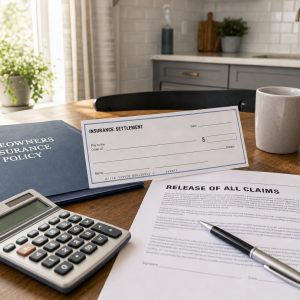
An initial payment doesn't necessarily close the claim. A signed release may have a different effect. Before agreeing that a payment resolves everything, identify outstanding structural damage, contents, depreciation, code-related costs, and claimed living expenses.
Delay also has a dollar value for the carrier. Analysis from the Consumer Federation of America found that homeowners insurers earn interest and investment income for every day a claim stays unpaid. For you, delay means the original estimate goes stale and temporary housing costs keep climbing. Keep updated estimates and a running expense ledger so your demand reflects current numbers, not the figures you submitted months ago.
Preserve evidence without leaving the property unsafe. Photograph urgent work, keep invoices, and document why damaged materials had to be removed.
Use one folder, one dated correspondence log, and a retained copy of everything sent to the insurer. Label revised estimates clearly so counsel can distinguish the original demand from later supplements. If a public adjuster is still working the claim, share the same folder. The handoff to a lawyer should happen because the deadline requires it, and a complete file is what makes that handoff fast.
Next Actions After a Denial or Low-Ball Offer
Start with the carrier's written explanation. You can't answer an exclusion, an omitted repair, and a depreciation deduction with the same argument. Make the insurer identify which issue it's raising.
Move from objection to a supported demand
Request the policy basis. Ask the carrier to identify the policy language and facts supporting each denial, reduction, or omitted repair. Request the reports and estimate it relied on.
Send a reconsideration letter addressing those reasons directly. Attach your independent estimate and dated evidence, identify the corrections sought, and request a written response by a specified date.
Ask a supervisor or claims manager to review the file. Record the reviewer's name, the documents supplied, and the outcome. After a telephone conversation, send a short written recap.
If the dispute concerns amount, evaluate appraisal under the policy before demanding it. In North Carolina, follow the appraiser-selection requirement already identified, and have counsel preserve unresolved coverage arguments separately.
Calendar the controlling deadlines. Assign responsibility for replacement documentation, proof of loss, and legal review of the suit clause. Don't assume someone else has entered them.
File a complaint with the North Carolina Department of Insurance or Virginia Bureau of Insurance, as appropriate. A regulator complaint is free and can create a documented insurer response, but it isn't legal representation or a substitute for a court remedy.
Hand the matter to counsel when the insurer denies coverage, alleges fraud, demands an examination under oath, or stalls past an applicable deadline. A nearing suit deadline requires immediate attention, and a proposed final release deserves legal review before signature.
NFIP disputes require the FEMA channel described above, not a homeowners-policy escalation strategy.
Keep negotiation advice within its proper scope
Negotiation resources aren't interchangeable across claim types. AskLegally's resource on seeking fair compensation after a crash concerns a different setting; it shouldn't determine your property coverage, appraisal rights, or deadlines.
For your home, the strongest demand ties each disputed repair to documented damage and the relevant policy provision. Replace “this offer is ridiculous” with a list showing what the insurer omitted, the evidence supporting that work, and the correction you're requesting.
Vet Local Counsel Before You Sign Anything
Choose a lawyer who handles first-party property insurance disputes in the state where your property sits. General litigation experience isn't the same as experience with homeowners coverage, appraisal, and claim-handling disputes.
Check the lawyer's standing through the North Carolina State Bar or Virginia State Bar. Separately verify a public adjuster's license with the appropriate insurance regulator. Ask whether the lawyer represents policyholders, insurers, or both, and how potential conflicts are checked.
Ask questions that expose fit and cost
- Have you won coverage or bad-faith cases against a homeowners carrier in North Carolina or Virginia? Ask what those outcomes establish and how the disputes compare with yours.
- Who handles my file day to day? Identify your contact and who makes strategic decisions.
- Which deadlines will you identify and calendar immediately? Ask for confirmation that someone has reviewed the actual policy.
- How is your fee calculated, and does it apply to payments already issued?
- Will you work with a licensed public adjuster or engineer? Clarify who hires specialists and authorizes expenses.
- What would a litigation budget look like through the major stages? Ask what changes if the insurer disputes expert findings or coverage.
- How do I end the representation, and what would I owe? Read the termination provisions before signing.
Ask for a proposed work plan, not a guaranteed recovery. A useful answer identifies the immediate legal question, missing evidence, likely dispute route, and decisions that require your approval.
Client reviews can help you assess communication, but they don't establish that your loss is covered. Read for specific descriptions of responsiveness and file handling rather than treating praise as proof of legal results.
Finally, bring the proposed fee agreement and your deadline calendar to the consultation. Leave knowing who is responsible for the next action, when it must happen, and what it will cost.
For The Public Adjusters, Inc. is an independent, state-licensed public adjusting firm serving North Carolina and Virginia, offering no-cost claim reviews and help inspecting, documenting, estimating, and negotiating property losses. Visit For The Public Adjusters, Inc. with your denial letter, insurer estimate, and policy so the team can assess the damage-documentation dispute and discuss coordination with counsel when legal action is needed. Have your water damage claim questions answered at NO COST. Call 919-400-6440 to speak with a licensed Public Insurance Adjuster or Contact Us here with questions. WE Work For YOU… NOT Your Insurance Company!